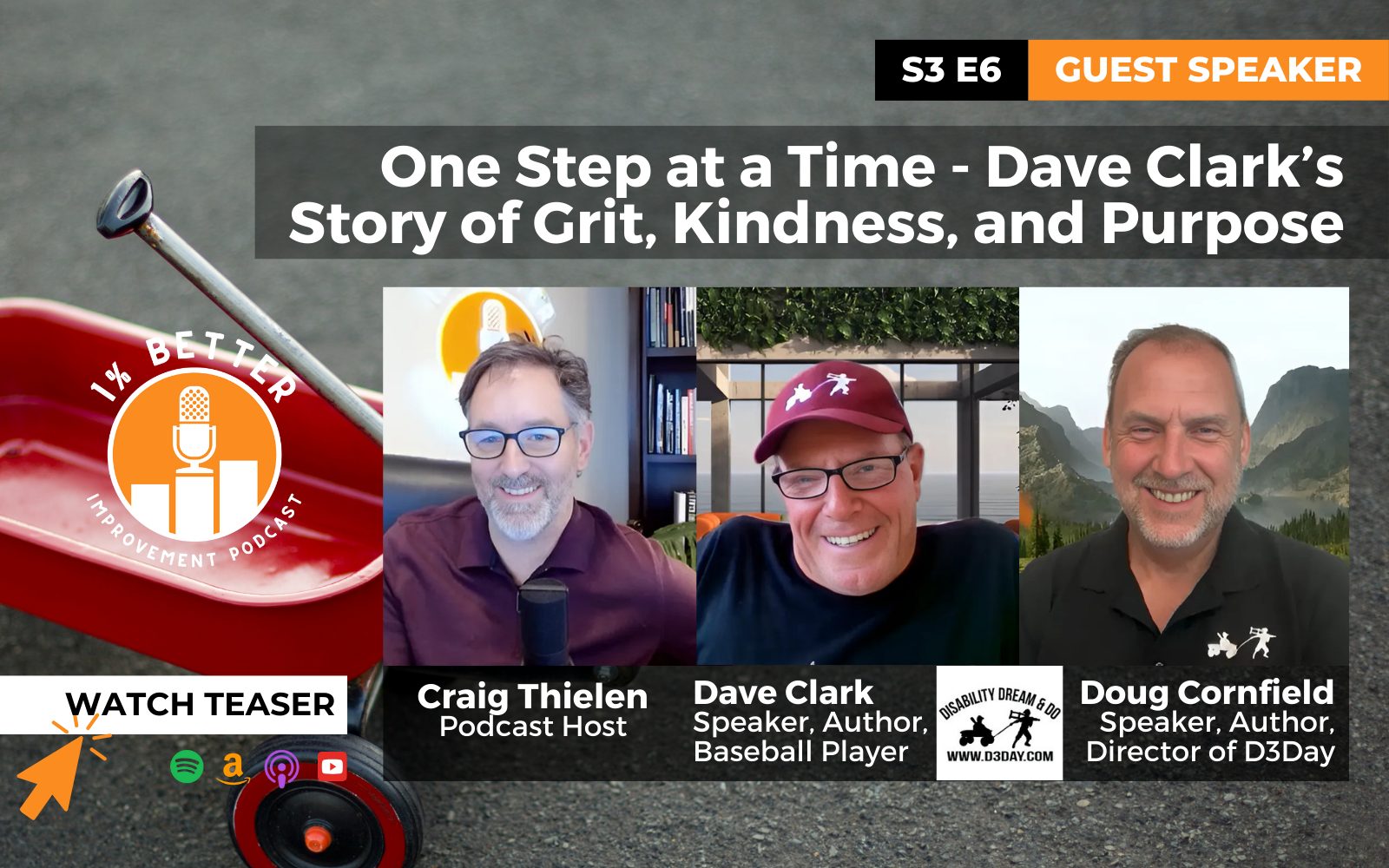
Find us on your favorite podcast platform including: Spotify | YouTube | Apple | Amazon
1% Better Podcast Dave Clark & Doug Cornfield – Quick Links
Get a copy of A Pound of Kindness children’s book
Check out Doug’s other book, Pulling Each Other Along
Learn more about D3Day (Disability, Dream & Do)
Watch Dave Clark and Ernie Pound reunite
Connect with Dave Clark on LinkedIn
Connect with Doug Cornfield on LinkedIn
Connect with Craig Thielen on LinkedIn
Check out host Craig Thielen’s full bio page
Key Takeaways
- Mindset is everything – Dave’s story demonstrates that ability is shaped more by mindset than by physical limitations
- Early encouragement matters – Small acts of belief, like a gym teacher insisting Dave try the rope climb, changed his trajectory
- Kindness echoes – A simple gesture by classmate Ernie Pound pulling Dave in a wagon became the inspiration for a children’s book and foundation
- 1% Better is a way of life – Every small improvement—one rope knot, one pitch, one more step—adds up to extraordinary achievements
- Pay it forward – Through the D3 Foundation, Dave and Doug now help kids with disabilities explore their full potential on and off the field



























1% Better Podcast Dave Clark & Doug Cornfield – Transcript
[00:00:05.06] – Craig
Hello, I’m Craig Thielen, and this is the 1% Better Podcast. Today, I’m speaking with Doug Cornfield and Dave Clark. Welcome to 1% Better, Dave and Doug.
[00:00:16.02] – Doug & Dave
Thanks for having us, Craig. Thanks for having us, Craig.
[00:00:17.14] – Craig
Yeah, I’m looking forward to this conversation for a couple of reasons. One of them is, first of all, Dave, your story is an incredible story. I’m really excited to hear about it and how you guys met and what you guys have done together and just how you guys have leveraged what we talk about a lot with the 1% Better mindset, I think you guys have a great example of that. Then lastly, your focus in life has been around baseball, and you’ve been able to leverage and immerse yourself in baseball. I’m a baseball guy. I’ve grown up playing baseball and played at multiple different levels. I, in fact, just retired. When I turned 50, I finally put my cleats away and and retired from the sport. But I absolutely love the sport, and there’s so many life lessons and great memories I have from it. So I’m looking to tie all that together with you guys today.
[00:01:11.09] – Doug
Sounds good.
[00:01:12.07] – Craig
So, Doug, why don’t we start with you? We’re going to talk a lot about Dave, but just your background and how you met Dave.
[00:01:20.01] – Doug
So I have a bunch of kids, and my fifth child was born with no arms. I have a bit of an athletic background myself. We played all the sports growing up, those kind of things, and my dad was a world-class athlete, but also in the sports industry. And so when I’m reading an article about Dave Clark back in 2000, I was transitioning my family at the time from the Atlanta area to upstate New York to Corning, New York, where Dave is from. And I was to partner with my brothers at Merrill Lynch. I’m sitting here reading an article while I was studying about this man. I took a break, obviously… I’m reading the newspaper I’m reading about this man who played professional baseball on crutches, and I’m like, What is this? Who is this? Why don’t I know about this? And probably the oddest part about reading this article in Atlanta is that he was from Corny, New York, and that’s where I was transitioning my family at the time. So having a child born with no arms who was not even walking at the time, being in the sports industry, finding out about this story, I got to my office, and so Dave is from Corning… so I’m talking to my brother Kurt, and I’m saying, Hey, who’s this Dave Clark guy? Do you know this Dave Clark guy who played professional baseball on crutches? And of course, he gives me the, Yeah, I know Dave. I’m like, Well, why don’t I know Dave? Kind of thing. As it would be, Dave had just finished a 10-year career of coaching in the Swedish Major Leagues, winning three championships his last three years.
Swedish Major Leagues. That’s a story in itself.
Well, there’s so many stories. You’re never going to have enough time on this podcast, let me tell you. Anyway, to try to make this story short, I wound up. Dave had retired and had a home in Corning, but now he was living in it more full-time at that point and not coaching in Sweden. But he got a part-time job pitching coach at our local pro team at the time in Elmire, New York. But Dave was full-time coach with the San Diego Padres, I believe, at the time. I go to a game with my family and had Gideon in arms after the game and went around to the dugout, basically asked Dave if he would meet me after the game. And of course, he did. He’s probably sorry for that, but he did it anyway. Yeah, he’s agreeing there. And so Gideon in my ams… So we had a conversation, exchanged phone numbers, and a few weeks later, we met for breakfast. And I guess you could say, if you fast forward, the rest is history. But one of the things that I remember from that breakfast meeting is that when I got done with asking Dave questions in our conversation, his response was he had never heard questions asked like I was asking them.
I was asking him from a perspective of a father having a child with some serious limitations, wondering how Dave and his parents, how his parents treated him, how he was treated in school, possibly, all those things, very differently than what was your pitch. I got to that later, but I didn’t get to that in the first conversation. Anyway, we had some other phone calls. The light bolts started flying off. Even though I was a young advisor at Merrill Lynch at the time, I was wondering, why isn’t this a movie? Why isn’t this story more known? It kept getting more and more unbelievable, and it’s still more unbelievable. Even this week, I tell people every time I’m with Dave, I get new stories, and I got a new story about pickle. Pickle juice, is it? I got a new story about pickle juice that I’ve never heard before, just this weekend, when we were putting out a camp with the Minnesota Twins organization. So anyway, that’s a long-winded, short-winded story. It could go a lot longer.
[00:05:10.08] – Craig
Well, we’ll circle back to that, but I think that’s important. And then since you guys connected, as you said, the rest is history, but we want to cover some of that history with some of the things that you guys have done together with the foundation and the D3Day organization and what you guys do. But let’s get into Dave, your story. So maybe start from a childhood and your life story and how you evolved into this guy that’s done some pretty amazing things.
[00:05:44.03] – Dave
Well, Craig, I had polio at 10 months old, and I always say the good part about that is that I hadn’t learned how to walk yet. So I didn’t have an adjustment to make. I didn’t have to go from being walker to a guy using crutches and braces. That was my norm. When I came down with polio, my parents put me in what was then called a reconstruction Home, and I was there for a year. The first meeting they had with doctors over there, they told my parents very bluntly that there was a good chance I wasn’t going to make it. For people who don’t… Polio is, I guess it’s reoccurring a little bit nowadays, but for a long time since the Jonas Salk vaccine, polio was a forgotten disease that nobody worried about anymore. Put it in a perspective, it was the COVID of the 1950s and ’40s.
A lot worse.
Anyway, two weeks go by after that original diagnosis, and my parents went for another meeting, and they tell the doctor. The doctor tells them that looks like he’s going to make it, but he’s never going to have use of his muscles. He’s going to be a vegetable. That’s the exact word they used. He’s going to be a vegetable. A year later, I came out walking with crutches and two full-length heel to hip leg braces, weighing 5 pounds each on each leg. I had 10 pounds of weight on my legs. Doug says, he asked what my parents did. It’s very simple what my parents did. It’s a very simple lesson. What they did was nothing. They didn’t stop me from doing anything. They treated me just like my two brothers. That’s the lesson I try to get across today to people with kids with limitations is that very very frequently, when someone has a limitation, we reel that leash in very tightly. Can’t do this, can’t do that. You can’t do this. As a child, That’s your foundation years. When you keep hearing can’t, it clouds your think tank. All of a sudden, you’re having doubts.
What can I do? My parents are telling me I can’t do anything. It was a very simple equation. My parents never said, You can’t do this. You can’t do that. The only time my mom hesitated, I tell this story all the time, was when I went to her and said, Hey, I want to play ice hockey. She hesitated and she said, and I could see the wheels turning in her head, and she finally said, I’m going to make you deal. You can play ice hockey, but the day you come home with any missing teeth is the end of it. Wow, I got all my teeth… So I did play ice hockey as a goalkeeper. Wow, unreal. My brothers were the same way. When I needed the crap kicked out of me. They kicked the crap out of me.
And when I needed to kick- They treated you just like anyone else because I’ve got five brothers. Yeah, I know exactly what that’s like.
Exactly. You hit the now and I head. They treated me like anyone else. I never felt different until I got to grade school. Then it all changed.
[00:09:53.07] – Craig
Dave, I think that’s critically important that your parents just had this mindset said, you’re not different, you’re not limited, you’re just like anyone else. So let’s just move on with it. Didn’t your doctor make a statement at one point that early on where something about you’re not limited, but You still have this is…
Yeah.
So what was that and when was that?
[00:10:21.07] – Dave
That was back at the Ethica Reconstruction Home.
[00:10:25.12] – Craig
Okay. And by the way, that’s a pretty… So they took you out of your home for an entire year, and you lived outside of your home in a reconstruction home. That’s a dramatic event in itself.
[00:10:37.12] – Dave
But I don’t remember any of that. But my mom related a few things with that. One, She said it broke her heart when she was allowed to visit twice a week. It was about a 40-mile drive. My parents were allowed to visit twice a week. My dad worked at Ingersoll Rand, so he couldn’t make the weekday visit. He made the Sunday visit. But my mom said that when she would come and visit me, it broke her heart because I’m a little over a year old, and she’s a stranger to me because I’m not living with her. She said when she would arrive, I would run to my nurse, and it broke her heart because she was the mother, and yet I viewed the nurse as my mother. And the other thing that you’re alluding to, during one of those sessions with the doctor, both my mom and dad were in the session, and the doctor said something was giving them the diagnosis. My mom looked at the doctor and said something to the effect of, But doctor, if he could only walk. The doctor looked at and said, No, Mrs. Clark, you want to get to where if he can only use his brain and think for himself.
Man, he was that doctor. I disagree with a lot of doctors, but that doctor was dead on because later on, some 15, 17 years later, there were many guys more talented than I was. I was not the most talented player on the field. Sure. But when you get to that level, the brain, the mind, the thinking is what gets you to the next level. There were a lot of guys I looked at that had million dollar bodies and 10 cent brains. And some people still say, I got a 10 cent brain.
Well, you got a sense of humor.
I kept quiet.
[00:13:00.02] – Craig
Well, that’s just an interesting story in itself because your parents clearly had a mindset of, Hey, let’s just work through this and not focus on the negative, focus on the positive. But then the doctor even reinforced that even further, and you heard that, and that stuck in your brain. I do have a brain, and that’s just as good as anyone’s brain. So then let’s go into grade school because you said, Hey, I grew up normal. I know anything different. And then what happened in grade school?
[00:13:34.10] – Dave
I say this a lot, but it’s almost like Hank Aaron, when he signed to play professional baseball with the Indianapolis Clowns, and he had never racial discriminated what it was like. I didn’t know what it was like either to be looked upon and be discriminated against because I have some limitations. When I got to grade school, a few things. First time I ever felt different. First time I was ever called names. First time I was ever picked on because of the way I looked, the way I ambulated, all new to me. Kind of a shock. Then I wasn’t allowed to participate in phys-ed classes. My gym teachers took a look at the cover of the book and said, He can’t do anything. So you’re going to go sit on the sideline after we tell the kids what we’re doing that day. You’re going to watch because we don’t want you involved. Things of that nature were taking place that were totally foreign to me. One of the things that happened was in first grade, the teacher announced a walking field trip to the local fire hall about five blocks away. All the kids are estatic. They’re getting the day off of school. We’re going to be outside. I’m not. It’s the worst day of my life because I got to walk five blocks now and I’m going to slow the class down, and I’m realizing the bullies are going to have a field day with me. She announces it a couple of weeks ahead of time. Every day it gets closer, my anxiety levels are going up. I can still feel something today when I tell the story. The day comes when the event is going to happen, and I try to play sick. I get up that morning, I remember going, Mom, I don’t feel good. Mom, treat me like anybody else. You’re not sick. Get your braces on. You’re going to school. I didn’t want to tell her I didn’t want to go because of the field trip, so I went to school. Teacher says, All right, let’s get going. Line up. I did the only thing a little six-year-old brain could think of to do, and that was I waited for the line to form, and I went to the very end thinking that if they all walked, I knew the gap was going to get a little bigger between me and the guy in front of me.
But maybe if they didn’t look back, I could catch up and just before we were about to leave, a classmate of mine named Ernie Pound, never forgot his name, came up with a little radio flyer wagon, and he said, Dave, I brought this for you to ride into the field trip. Jump in.
That’s amazing.
It changed the whole day. I went through the entire tour, and it changed. That little thing Ernie did changed the day from being drudgery to a fun day. I never forgot that. If you don’t mind, I’m going to divulge to Doug here because he puts the exclamation point on that story.
[00:17:22.14] – Doug
Basically, obviously, I shared earlier that I have a son that was born with no arms, and I was pushing Dave to become a friend and a client of mine by this time, and I was pushing him to write a book about his life story. And he had made a couple of attempts with some other writers. It just never got done. And finally, he hunkered down with a sports writer, a local sports writer in our area, and they got this book done, divulging Dave’s stories from his journals. Dave’s a journaler, so they had all these stories to go with and very detailed because of the journals. To finally got this book done… In chapter 2, there’s a chapter called My Saviors, a little less savior, not a God savior, but the people that had a big impact. The author, who actually just passed away, Roger Newman, did a great job of just weaving these stories in. His father, a phys-ed teacher, which is a story we often tell, but he told a story about Ernie Pound. Here I’m rereading that story in my office when I was organizing five book signings in our local area for Dave, just as a friend.
At this point, we’ve been friends, and I helped him in coercion. I’ve got this book in my hand… I’d already read the manuscripts, all those things, but I was rereading that chapter, and of course, I was like, Oh, my gosh, I got to find this guy. I wound up finding him living 45 minutes away, an Erst Pound in the phonebook. I give this awkward phone call.
You actually found him in the phonebook.
That’s how long ago this was.
That’s amazing in itself. That’s not easy.
Yeah, no, I found an Ernst Pound living in Odessa, New York, which is out by Watkins Glen for the NASCAR people. And had that awkward phone call, and I basically asked him, I’m looking for an Ernie Pound that went to ng in Corning first grade. I didn’t know if I was talking to a grandfather, a father, a son, any of those things. We’ve gotten no Ernie over the years, but he basically said, I don’t want to answer any questions… Then I told him, I said, I’m looking for you. I’m looking for this Ernie Pound because he had brought a radio flyer wagon to school to help out a classmate.
Yeah.
And he goes, Well, I remember the wagon. Now, what happened is Ernie’s family had left the area after first grade, and Dave and he had literally never seen each other again. And so when he remembered the wagon, I convinced him to come to a book signing at one of our local coffee shops in the area. And he… it was a snowy night… he winds up coming to this book signing, gets in line with everybody else, finally gets up to Dave… Dave’s sitting there saying, who should I sign this to? And Ernie basically just says, sign this one to Ernie Pound. And of course, Dave doesn’t tell this part of the story because when we do speaking events and things like that, because he gets so dang emotional to this day. And so we show a video of that. I have a video. So if you’re listening in and you’re getting all emotional just listening to the story here, which is very often. I reunited Ernie and Dave. That’s amazing. After 45 years, and Dave cries like a baby now every time he tells a story.
Well, that’s incredible.
That’s the exclamation point. I do now have a children’s book that’s aptly named A Pound of Kindness. It tells this story of Dave and Ernie going to the fire hall together.
[00:21:07.11] – Craig
Well, we’ll get all those in the links on this podcast. But I’m curious, when you’re reuniting with Ernie, what did he remember about it? Was it as simple as, Hey, I’m just doing a favor for a friend? Or what did he remember about why he did it?
Go ahead, Doug.
[00:21:28.05] – Doug
It’s funny because That’s because you always say- There’s a couple of exclamation points we don’t always tell about this story. Ernie didn’t know Dave, didn’t know he went on to play professional baseball, any of those things. He just remembered the wagon. Here he’s done a kind act. We’ve run into people that know Ernie at our speaking events. They’ll come up to us, Oh, my cousin’s Ernie. That’s happened even down in Florida. The interesting thing, everybody that we meet that knows Ernie, they always say, I’m simply not surprised.
It’s just who he is.
It’s just a matter of they are not surprised because of all the kindness that he has shown throughout the years to everybody. And so that’s one of the things. And then I got out of Ernie, which is completely crazy, and I’m going to lead you down a rabbit hole a little bit here, but Ernie was a professional pitcher as well.
Oh, wow. That’s a coincidence.
And isn’t that a coincidence?
Yeah, there’s a lot of coincidences here that are just- Well, I led you down a rabbit hole that’s deceiving, but actually, Ernie was a professional horseshoe thrower.
Okay.
A horseshoe pitcher. And he played as a Horseshoe pitcher, he threw horseshoes at the highest level, world level. He’s one of those guys I asked him because I’ve seen these tournaments before, and I asked him, Are you one of those guys who can throw 20 ringers in a row? And he goes, I think he something like, Well, my record was like 24. Oh, my God.
I’ve played Horseshoes. I know how hard that is.
[00:23:08.04] – Doug
Right. So he’s in the New York Hall of Fame for a Horseshoe throwing, and he’s actually won prize money and he’s a pro pitcher. I brought these two pro pitchers together, I guess, in this incredible story.
[00:23:21.05] – Craig
Well, that’s a very memorable story, and he’s had an impact for sure. Dave, at what point You went through grade school is was tough. I mean, grade school is tough for a lot of people. Kids are ruthless. Kids say things. It doesn’t matter what the issue is, overweight, or you’re poor or anything. They’ll go after you, right? But you had a pretty tough awakening, and this is why is this happening? And then you had to deal with that. But at what point did you feel like you overcame that? And then at what point did baseball enter your life? I mean, that’s two different questions, but I don’t know how closely related they are.
[00:24:06.05] – Dave
It depends on what you want me to say here because-
I’d go to third grade, Dave.
You don’t want to go to second grade?
No, I’ll just skip to third grade.
You guys have all the recording tracks.
[00:24:20.05] – Craig
You’ve been through this story a few times.
[00:24:22.06] – Dave
Well, there are a couple of things that go through my mind when you ask that question. But to skip to the third grade, as I told you, the phys-ed teachers wouldn’t allow me to participate. I couldn’t understand that because in the neighborhood, I was participating in all the neighborhood games. I knew that I could do some of the things that the gym class was doing. But as a kid, back then, a little bit different today, probably, but back then, you did what you were told. I did what I was told. Well, third grade, we had a new gym teacher. First year for him named Mr. Snetschler.
[00:25:07.14] – Craig
Sounds like a teacher’s name.
[00:25:10.11] – Dave
He was a tough dude, a military man, Okay. Crew cut, no nonsense crap. The first day in his class, we gathered around him, and I can remember him telling us what we were going to do and slapped his hands. He said, Let’s go. I immediately took steps to the sideline, but there was no chair. I thought, Well, new teacher forgot to put the chair.
Right. Rookie.
Rooky. But before too long, I took two, maybe three steps. I heard just, Where do you think you’re going? Now I’m shaking. Little eight-year-old, I’m shaking. I turn around, I look, and he’s going like this. I’m thinking, Oh, man, what I do now? I walk back over to him and he looks me dead in the eye. Never forgot this. He says, Dave, he said, I’m going to tell you something here. He said, There may be some things in this class that you’re not able to do, but you’re never going to find out what those things aretry them. You are going to try everything in this class. Love it. Well, the activity that day was climbing the rope to the ceiling.
[00:26:33.01] – Craig
Oh, yeah, I remember that. That’s a tough deal.
[00:26:34.14] – Dave
You got it. I’m automatically, first off, thinking, why is it got to be today that we’re doing a rope to the ceiling? Because there’s no way that I’m getting up there. And so my turn comes and he said I had to do it. I dropped my crutches, I’m hanging on a rope, and I put fist over fist. And remember, I got 10 pounds of weight on my legs.
Oh, you got the braces on.
I got the braces on.
[00:27:05.14] – Craig
And you’re at a multiple disadvantage because I remember doing it. I used my legs and my feet, and you’re probably using mostly upper body, right?
No, I’m using all upper body.
And then if you fall, which a lot of kids do, you don’t have a backup plan.
[00:27:25.01] – Dave
So I’m doing this, and I’m elevating. Surprisingly, even to me, I’m elevating. What I didn’t understand, Craig, was walking with those crutches, I had a massive upper body strength. Oh, yeah. So I’m pulling myself up, and I’m going up, and I get about three quarters of the way up and higher than any kid in the class has gotten. I’m gassed. I’m sitting there thinking, Okay, Hey, well, this is good enough. This is good enough. Then the other side of me kicked in and said, No, it isn’t. You’re three quarters the way up, GO! I made it to the top. I was the only kid to get to the top, but now I had the problem you’re alluding to. You got to go down. I could not form that little S with my feet to slow me. I came flying down the rope. But when I got to the bottom, I say this all the time, it was the best burn I’ve ever felt because the kid’s jaws dropped. The picking, the jumping Dave stopped. All the picking. I always say that you shouldn’t have to do that to stop being bullied. But the bullying-
[00:28:52.14] – Craig
But you gained respect from some of the other kids because not only did you keep up or you did part of what they could do, you actually did something they didn’t do or couldn’t do.
That’s right. That’s correct.
And so was that the moment where you realized, not only can I do some things, I can do some things better than other people.
[00:29:17.00] – Dave
Yeah, it was an awakening. And the next thing we did in class was baseball.
Okay.
And I found out my strengths and my weaknesses. I had great hand-eye coordination, couldn’t run fast. Right there at eight years old, I can still remember analyzing every sport that I wanted to play with my strengths. Where do I fit? Where’s my best chance for succeeding in this sport? In baseball, I wasn’t going to be an outfielder, wasn’t going to be a middle infielder.
Not a catcher.
Not a catcher. A pitcher, first base. Ice hockey, couldn’t skate. Goalie. Football, quarterback, had a good arm. Had to go from the shotgun because wasn’t going to be able to fade back. All those things were formulating that. Basketball, play basketball. But can you imagine playing basketball at 4’2 or whatever it was when I was that. So I developed a hook shot so I wouldn’t get it stuffed back in my face. Those are things that I was thinking about at eight years old that later served me very well because as I went through the ranks in baseball, by the time I was 14 or so, the dream started, I want I want to play professional baseball. I didn’t tell anybody.
[00:31:01.06] – Craig
When you were early teenager that started forming in your head?
[00:31:07.13] – Dave
Yeah, about 14, and I didn’t want to tell anybody at that point. But then I also realized Your fastball is not going to get you looked at. It’s not fast enough. You got to develop. So I started developing a knuckleball. It took me a year and a half, maybe two years to develop the grip, the arm angle, the release point that worked for me because I knew I had to have something else if I wanted to even attempt to reach my dream. The eight-year-old thinking started formulating again at that point at 14, what can you do to reach your dream? What can you do differently so you can stick out and have some success and a shot at reaching your dream?
[00:32:02.03] – Craig
So between 8 and 14, you must have had some success playing baseball that gave you enough confidence going, I think I can do this.
[00:32:10.11] – Dave
Oh, yeah. When I first started Little League, Little League wouldn’t let me play. They told my parents, he can’t play. He’s going to get injured. My parents literally went to bat for me to Williamsport. Corning, New York, where I grew up, was about an hour a half drive from… Now it’s about an hour drive to Williamsport, Pennsylvania, the world headquarters for Little League. My parents literally drove down there and said, Why are you preventing our son from playing Little League. They fought for me. I got to play Little League. When I played Little League and was allowed to play, I found out I could hold my own against all those guys, even the best ones.
Interesting.
I started going up the ranks right up through. And by the time I was in high school, I didn’t play high school ball, but I played in a very competitive league outside of the high school realm. And I ended up having the third best ERA in that league. And so the dream started formulating. I didn’t know if I could make it or not, but I wanted the shot. I wanted the shot.
[00:33:28.14] – Craig
It’s so interesting, and we call this the 1% Better Podcast, but it’s all about mindset. Everything you’re talking about is mindset all the way from when you were early with your parents, the mindset that they gave you, and then the doctor, and then Ernie, and then the phy-ed coach. Just a really simple story. I coached a lot of youth baseball teams. You were talking about, Hey, when we used to play around in the neighborhood, well, that’s how I grew up. We played everything in neighborhood. There wasn’t really organized sports until you got later. Well, now everything is organized. It was uber competitive. And so I was coaching these traveling baseball teams. So they’re supposed to be the best players. And so these are like nine and 10-year-olds, but they’re on traveling baseball teams. So after you do it a couple of years, you get to know the routine. So I did it. And the first thing I asked the team, I go, Okay, line them up. And I said, Okay, who’s a pitcher? And about three or four kids would raise their hands. Now, these are nine-year-olds, right? But already three or four kids out of 10 or 12 knew I’m a pitcher, and the rest knew they’re not a pitcher.
However they came up with that, don’t know. And I said, wrong answer. Everyone raise your hand. And so all 12 raise their hand. You’re the pitcher. All of you are the pitcher. All of you are going to pitch. You’re going to get innings, and we’re going to find out. And it’s going to be great. And if you can’t, it doesn’t matter. But you’re all going to give it a try. And half the kids were sweating, going, I’ve never pitched before. I’m not a pitcher. This guy’s a pitcher because he says he’s a pitcher. He’s bigger, he’s stronger, all that stuff, right? As it turns out, the three or four kids that raised their hand that thought they were the pitcher weren’t our best pitchers. And three or four kids that were afraid to even try because they didn’t have the confidence or whatever, they ended up being our best pitchers. And it’s about mindset, you just you got to try it. You got to have an opportunity. But I forced them like it’s no longer an option. It’s just you all going to try it. And it’s the same thing that you just described.
It’s interesting how that works. All right, so You got your confidence. Baseball was your sport. You figured out how to throw a knuckleball. So I’m curious about your baseball career. And Doug, please feel free to help here. But just huge long baseball career. Dave really wanted to go as far as he could and say, I want people to tell me that I’m not good enough, but I’m going to put in every ounce of effort to get there. Maybe just describe since post high school, how he went on to participate in a lot of different roles and organizations in baseball and what that career was like.
[00:36:21.14] – Doug
Yeah. So as Dave said, he started to dream just like any other child our age back in the day. We all dreamed about playing professional baseball. For me, it was every sport. It was probably part of my hindrance. I wanted to play professional baseball. I wanted to be a basketball player. I wanted to be a runner. And then you finally figure out what you’re going to get the highest in. Well, Dave started developing that knuckleball, and he was starting to get people out. But of course, he was getting people out in Corning, New York. It’s a small town trial. But he wanted to find out for sure whether he could make it or not. Dave literally penned a handwritten letter to every Major League team at the time, every one of them. He still hand writes letters. If you get one of these handwritten letters, you keep it as a keepsake because that’s a lost art today. He handwrote every letter. If you could imagine the GMs getting this letter from a young man saying, Hey, I’m on crutches and braces, but I want to try out. Well, the miracle of it all, that 1% thing that Dave talked about, the 1% man, is that he got three replies, and he got one tryout out of the deal.
The lead scout for the Pittsburgh Pirates organization, his name is Art Gaines. He also owned a team in Missouri, which was in the Pirates organization at the time. So Dave had to go out to Missouri and get all the way out to Missouri for this young tryout. I believe he was 17 or 18 at the time… 18… yeah 18. And he’s getting this try out, and he’s got to go through all the drills. He’s got a bat. His first at bat was bunting. He turns to bunt, and what does he do? He bunts the ball right in his face. So he’s thinking it’s over. They’re not even going to even give him a shot. But as it would be, he made the roster. I’m quickening the story. And so he wound up playing for two years on this team in Missouri. And to fast forward, it parlayed to a 10-year career of playing in the Philly’s Minor Leagues, playing independent leagues. He wound up playing for the famous Indianapolis Clowns because they had integrated white players into that team. And in 1975, he’s playing at Comisky Park. He’s playing all these places. He’s got stories where the hecklers were on him.
These are amazing stories that are always better when he tells them. But can you imagine being in a packed-out crowd and you come in as a relief pitcher, and there’s a heckler yelling at you saying, Knock the crippled bastard out so the whole stadium can hear it. In a way, he was like a Minor League Jackie Robinson, but for the people in the disability community. He had to deal with that pressure. He didn’t always deal with it the best because in that particular case, he wound up trying to hide his glove, and he gave the old free bird to the guy in the audience. This created probably not the greatest response. People are throwing food and drinks onto the field, booing him. That’s the stuff a person back in the ’70s had to deal with. His coach didn’t take it too kindly either. When he came out to the mound to confront Dave, it was, What do you think you’re doing? You can’t do this. Dave’s thinking, What do you mean? That guy just called me a crippled bastard. He said, It doesn’t matter. If you can’t handle it, you can’t be here. His just basically kept asking him, Do you want to pitch?
And Dave said, Yes, sir. Yes, skip. Do you want to pitch? Yes, skip. Yes, skip. And so that created that, obviously, Dave was different. And he had to deal with stuff that folks just didn’t have to deal with. And It wasn’t applauded. If he would go out on the mound today, and let’s say, a college game or anything.
Oh, it’d be way different.
People would be applauding him, thinking he’s the greatest guy in the world. And then as soon as he struck somebody out, they’d be like, Oh, my gosh, this guy’s for real. And that’s what started happening everywhere he went. In 1975, Dave was actually the fireman of the year for the Indianapolis Clowns. They had him in a relief role that year, and he had 20 saves, four wins, and no losses. He actually caught the attention of the owner of the Chicago White Sox, Bill Veeck, who saw him play at Comisky Park. And of course, we could go on and on and on with these stories, but he literally had the Chicago White Sox watching him. That’s how powerful his knuckleball was time. That’s awesome. He didn’t get that call. That’s a whole another long story. Dave didn’t have the same year in 1976, let’s just say, due to some outside issues and whatever. And Bill Veck called him back and said, Hey, we’re going to keep watching you, but we can’t pull you up this year. And so he actually wound up having another good year, played in the Philly’s organization. And to wrap up his pitching career, Dave got a four-year contract to play in the Swedish Elite League, which is their major League level. And he made his first All-Star team that year with the Swedish Elite team. Blew out his elbow, never got to play in that game, and tried to come back. Again, all these stories. And when he finally tried to pitch again, he blew out his elbow again. And there’s, again, a whole long story with that one. But he wound up buying the Indianapolis Clowns. Oh, wow. So you can’t put a guy like Dave down. When he can’t pitch, he’s going to figure out something else. And so he bought the team and wound up… And this was high-level baseball… So it was the lowest level of pro, but still very high-level baseball.
Oh, incredibly high-level.
To the bigs. And he wound up playing first base for his own team for another five years, having to hit, having to do everything.
[00:42:20.14] – Craig
I think I saw a video where you dove for a grounder, and it’s like a lot of first… Able legged, able, everything, first basers don’t dive anymore. You were diving into the dirt.
[00:42:36.09] – Doug
Well, if it meant winning or losing, Dave would put his face in front of a ball. And again, Craig, I thought I was competitive, and I competed at a pretty high level at the University of Georgia track and all those things. I thought I was competitive, but the bottom line is if I would have been as competitive as him, I would have been way better.
Yeah.
His mode of competition, now, sometimes it converts into anger. Let’s just say a little extreme anger to be nice. But he had that fire in him. It was amazing. It was part of the gifting set that he had that got him to the highest level. And then when you can’t play anymore, what do you do?
[00:43:17.10] – Craig
You manage and you scout, and he did all that. Yeah, it goes back to the doctor that said, Don’t focus on what you don’t have, focus on what you had. Dave had that competitive spirit and that feistiness and that never say, never attitude. And that’s incredibly valuable in any walk of life. So okay, I do want to get to that amazing career that you had. But then let’s just talk a little bit about what you guys have been able to do together since meeting. I think there’s been books, there’s a movie, there’s a D3 organization. So just talk about that because I think that’s in itself amazing because not only is it about Dave, but now it’s about how you can impact thousands of other kids and people.
[00:44:04.00] – Doug
Yes, and we have. And we’re coming off actually a weekend of working with the Minnesota Twins organization in Hammond Stadium in Fort Myers, Florida. So it’s fresh on our mind what we do and why we do it. When we don’t have enough money, we do it anyway. It’s just one of those things. But we had somewhere about 70 children and young adults on the field with the young pro team just this past weekend. What we do is we set up a pro-style baseball practice where we set up stations all around the stadium. We set up five stations. It’s all soft equipment. Balls are flying everywhere. We have recaps that are just being posted on our Facebook page from this weekend and all those things. We get to put this camp on and inspire children and young adults to explore their potential like Dave did. Then to add it to it, we added another Dave because I can’t have just one Dave that works with us, I have two Daves. And Dave Stevens is our other Dave, and he was born with no legs. Okay. And he is a three-sport athlete who played baseball, football, and wrest in high school and college, two times State champion wrestler, played for the Saint Paul Saints. So he had a short contract to play for the Saint Paul Saints in Minnesota. And he’s a seven-time Emmy Award winner with ESPN.
Wow.
So when I’m bringing these two Daves out to these camps, these families get to see that just because there’s challenges doesn’t mean there’s… I mean, everybody has limits, but we want to find out what those limits are. We want them to explore those potentials, whether they’re intellectually challenged or whether they’re physically challenged. There’s one young man that just comes to mind. He’s actually in a recap and he’s in a wheelchair, and I think this is his third camp. I think he was pretty hesitant to come to the first camp.
Sure.
He’s in a wheelchair, but now he’s playing wheelchair basketball. I think he’s even trying to get into the dart world of throwing darts because he wants to figure out where he can be competitive. It doesn’t have to be in baseball, it doesn’t have to be in basketball or track or whatever it is. We want to find out where do they fit in and where do they explore their potential, whether it’s in music and arts and business and life, whatever that is. And because I get to present these two Daves and give these kids an actual opportunity to actually hit a ball, run around the bases, crawl around the bases, roll around the bases, whatever the scenarios are, they get this day of excitement with these pro teams. And that’s what disability dream and do or D3 Day is what it’s all about. We give out T-shirts, we give out hats. The second part of the camp is they also come to the game. We give out an award called the Pulling Each Other Along Award based on the children’s book that I have, A Pound of Kindness, and Dave’s story of being pulled in the wagon.
And so it’s a whole event. And obviously, we’re just wanting to do more and more of these. We have six more scheduled for this year. Oh, wow. Finances willing, thing. But we do have six more events scheduled for this year. Well, that’s amazing.
[00:47:22.07] – Craig
So, yeah, just amazing what you guys have done and even done together to impact others. So I need to wrap things up on Dave’s having some technical difficulties. So I might ask you, Doug, just to answer for him. But I got two questions. The first one is we’ve talked about the 1% Better mindset a little bit on this podcast. And then, of course, you said, Hey, he’s a one percenter. His odds, I think, weren’t in his favor, and he exceeded all the odds. But just describe for you, what is this whole one 1% better mindset? What have you learned about just Dave and the other Dave just working with a lot of people? What is that mindset all about?
[00:48:03.14] – Doug
Yeah, it’s about… Even when I do the camps, and I’ll refresh, just this weekend, I would do a camp. It’s like, How can we make it better? It’s just that there’s little tweaks. I don’t want to change a lot because what we have is a secret sauce that really works. But little things. This year I added, we have a logoed ball that’s the softy balls that we use. We always allow the kids and the participants to get a ball and get it signed by the players and they get this, whatever. But so yesterday at the game, we were actually giving out those balls to the game. We wanted to throw them in the stands, and at some of the stadiums, I think we’ll be able to have the kids and the participants throw the balls in the stands. But this net at this arena is too big. There was no way to do that the way they’ve made those nets in today’s game. But we’re always looking for that little thing to ratchet us up. How do we make the food experience a little bit better? How do we make the t-shirt sharper? How do we make the hat a little bit better?
And Dave’s rope climb story is really about that. It’s just putting one fist over the next to see how high you can take it. And eventually, you get three quarters of the way and you might be gassed. But then that’s when you want to go one more percent higher. And that’s the way that we look at it as well.
[00:49:20.06] – Craig
Yeah, that’s awesome. Yeah, I mean, Dave’s whole life story is about 1% Better. Every step he took just showed him a couple more steps that he could take, and he just going one knot at a time, right? The last question is just taking a step back from the work that you do, the camps and this story, but just life lessons. What would you want to pass on to what you’ve learned in your life and what you’ve learned from Dave and the other Dave? What would Dave say? Just life lessons that he’d want to pass on to others.
[00:49:53.06] – Doug
Yeah, it’s exploring your potential. Especially as a parent with a child with limitations, I want my son and all my kids, obviously, to explore their potential. But especially with the population that we work with at our camps, we want them to explore their potential, and we want the caregivers and the parents to not doubt their hopes. So when they have a dream, don’t throw water on their fire. Let them explore their potential. Let them see how high they can take that. And again, we could go on to major stories because one of the things that Dave’s parents were just incredible examples of is they didn’t hold him back. Even though they doubted, they never showed their doubt. There’s so many messages that go on with our camps and what we want to do. We want the parents, when you have a child with limitations starting to dream, let them.
Yeah, give them opportunities.
Don’t put your doubt onto them. Even in the book that I co-wrote with Todd Sivan, our Pulling Each Other Along book, we have Chris Nikic, who I know you know.
Yeah, Chris has been on the show.
It’s 1% better. It’s things like that. With Nick and the program that he’s putting together, it’s just okay. It’s just like a process of running. My oldest son is a high-level coach at Northern Arizona University. These guys, to get 1% better, it’s process. Sometimes you plateau, and then sometimes you even get hurt, and then you got to start those steps up again. Running is probably and exercise is one of those things where it’s to get 1% better. You do a little bit, you stop your rest, you do a little bit more, you stop your rest, you eat right, you do a little bit more, and all of a sudden you’re way ahead of the game.
[00:51:53.13] – Craig
Yeah, I think the beauty of that message is it applies to every single human on this planet. We all have limitations. Many of them are mental, some are physical, some are other things that have happened to us. And everyone has potential limitations. But how do you reframe it into how far can you go with something and try to remove obstacles for people rather than putting obstacles in front of people… It’s a timeless lesson. So Dave, I don’t know if we got a connection back, but any final words wisdom from you?
[00:52:32.06] – Dave
Alluding to what Doug was saying is after I retired due to post-Polio in 1988, I was watching the NFL on Sunday afternoon, my dad at my parents house. My mom sidled up alongside the chair I was sitting in at the time and just stood there, didn’t say anything. I saw her out of the corner of my eye, I finally looked up and she looked down, handed me an envelope said, Read this… First thing I noticed was the postmark was 1971. The address on the envelope was to our neighbor from where we lived at the time.
[00:53:13.02] – Doug
It’s a great story.
[00:53:15.05] – Craig
Oh, my God. It sounds like it. Yeah. Well, I think we can… Sorry, Dave. It’s just not coming through very good. I think we got plenty of good content, unfortunately, not all of it. It’s all good content. We could go for two hours. But thank you, guys.
check out other podcast episodes