Find 1% Better Improvement Podcast Here





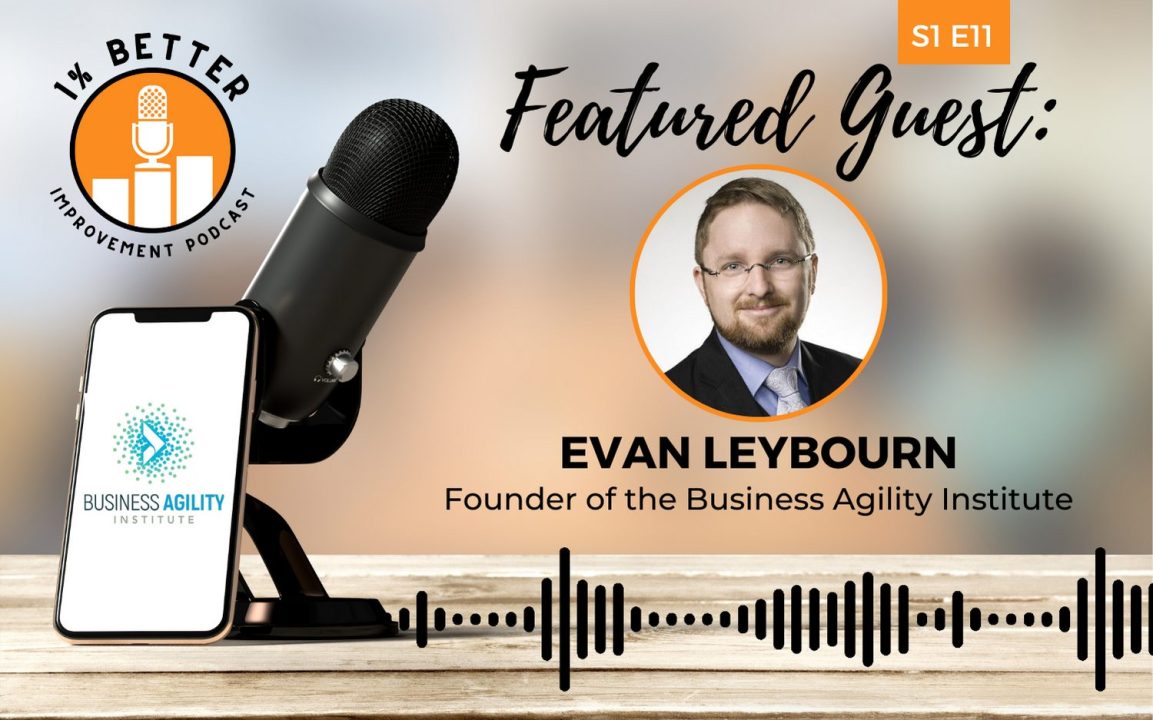
1% Better: Evan Leybourn, Founder of the Business Agility Institute – Quick Links
Learn more about the Business Agility Institute
Read Evan’s article titled Taking my own Medicine
Check out Eric Ries book The Lean Startup
Connect with Evan on LinkedIn
Connect with Craig Thielen on LinkedIn
Key Takeaways
- The Evolution of Business Agility: Evan Leybourn, the founder of the Business Agility Institute, has played a pivotal role in shaping and advancing the field of business agility. Over the course of eight years, the Institute has grown to nearly 7,000 members across 85 countries, emphasizing the increasing importance and global interest in business agility. This highlights the significant shift in how organizations operate, moving towards more agile and responsive strategies beyond the IT department.
- The Power of Conversations and Taking Risks: Evan’s journey to founding the Business Agility Institute began with a simple conversation and the courage to take a significant risk. This story underlines the impact that meaningful dialogues can have, leading to transformative actions. Evan’s willingness to act on a good idea, despite the uncertainties, underscores the importance of initiative and risk-taking in achieving remarkable progress.
- Challenges in Promoting Global Business Agility: Expanding the concept of business agility on a global scale presented numerous challenges, including managing different time zones, understanding cultural nuances, and tailoring approaches to various international contexts. Evan’s experiences in promoting business agility worldwide showcase the complexities of adapting and applying principles across diverse cultural and operational landscapes.
- The Lean Startup Influence: Evan discussed the significant impact of Eric Ries’s book, “The Lean Startup,” on his approach to starting and running businesses. The book’s principles of iterative development, customer focus, and value-driven delivery provided a language and framework that facilitated more effective communication with stakeholders. This demonstrates the broad applicability of Lean Startup principles beyond the tech industry, influencing business strategy and agility.
- Mental Health and Leadership: A compelling part of the conversation was Evan’s candid discussion about his personal challenges with mental health and the decision to take a step back for self-care. This moment highlights the often overlooked aspect of leadership – the importance of acknowledging personal limits and the necessity of self-care. Evan’s story serves as a reminder of the resilience required in leadership and the critical role of support networks in navigating personal and professional challenges.
















1% Better Episode 11 Transcript
[00:00:00.320] – Craig
Hello, I’m Craig Thielen, and this is the 1% Better Podcast. Today I’m speaking with Evan Leybourn, Founder of the Business Agility Institute – a global research and advocacy organization for business agility. Evan is our first guest from down under calling in from Melbourne, Australia, and I think I got that pronounced right. I’ve known Evan for the past eight years, and we’ve both been active in the space that we call business agility. I think, Evan, eight years ago, I don’t think many people were calling it business agility, so we have that in common. And in that short time, eight years, he has managed to grow his organization to nearly 7000 members in over 85 countries with over 500 publications, becoming, in my opinion, the preeminent independent source in this field of business agility. And wow, has this field exploded also in those eight years… so welcome to 1% Better, Evan.
[00:00:55.190] – Evan
Thank you, Craig. Good morning… well, morning for me. It’s Friday morning, Thursday afternoon for you, the joys of time zones.
[00:01:03.370] – Craig
And Evan, you are one day ahead, and that’s the idea, right? You’re always staying one day ahead of the rest of us. So first of all, I just want to congratulate you. I’ve been following and we’ve stayed in touch over the years and just the success, I think it was very much needed back in the day when people were trying to understand where this agility space was going. And every day it becomes more and more important as every seemingly organization and every part of organizations are trying to leverage this thought process and mindset. So why don’t we start with where this thing started for you… What caused you to start the Business Agility Institute? And what is the organization all about?
[00:01:40.890] – Evan
Oh, goodness. The institute started in 2017, and it started almost on a dare. Back in 2016, I was in India at an Agile conference, Agile India. Now I’ve been talking business agility for the better part of, was 15 years since 2008… I think is when I started talking about this stuff. I was lamenting to a good friend, an agile coach from Canada, who was also there about how there were so amazing people at all of these agile conferences, but none of them could change organizations. I’d be sitting up there on stage, talking about business agility and the need to change how finance works, how governance works, how leaders and structure was important. And everyone in the room is nodding it, Yes, we agree. We absolutely need this. How can you be agile if you can’t move funds around? It’s where the funds are needed. And this coach, Ellen Grove, she said to me, Well, why don’t you create a business agility conference then? I was like, You know what? That’s a very good idea. I was about to swear, but I…
[00:02:49.240] – Craig
That’s okay. Everything goes on 1% better.
[00:02:52.850] – Evan
It’s a very good idea, and I put it on. This was in New York. Ahmed Sidky from ICAgile was my co-host at the time, and this predates the institute. It was Evan is a private citizen putting on this conference in New York. Noting I lived in Singapore at the time, and that’s a 12-hour time zone difference. I literally could not be further away if I tried. But try I did, and it was successful. But long story short, it basically gave us the confidence that it was the right time to… We sold out. That conference, everybody came. We had people from Jamaica, from Portugal, from Canada, and, of course, from all over America. We had such this diverse audience of people who are feeling that same sense of frustration that I was. And it gave us the confidence that maybe we should do something for that community. Maybe we should build something, not just a conference, and support this growing, emerging community. And hence the [Business Agility] Institute was born back in 2017, so it’s fun.
[00:04:04.020] – Craig
Well, it’s a great story. And it’s just astounding how one conversation or one comment can start a revolution, sometimes they say. But this whole notion of a butterfly effect, what if she didn’t say that to you? You would have been went back and kept doing your day job. Now maybe you would have started it six months later or something. Who knows? But it just shows you the power of conversations, and you can have an impact on people by the things that you say. You really can.
[00:04:34.080] – Evan
And I think it’s both the power of the conversation, but also a willingness to take some of those risks. This is the 1% Better Podcast, not the Business Agility podcast. To get 1% better, you need to be open to those conversations, but you need to be open to doing something from them. And I think it takes two to tango. That’s the old saying, isn’t it?
[00:04:59.200] – Craig
Yeah. Well, as you said, you have to be open to… You could have said, Oh, that’s a great idea, and just chucked it off to the side, but to listen, because sometimes you get little gifts, sometimes you get clues. We get them every day, and sometimes we don’t listen to those things, and they could even be coming from within ourselves. So it’s one thing. It’s great that we’re seven, eight years into it, and it’s great to look back. But starting an organization like that with global aspirations, you didn’t start it as, Hey, I’m going to start it in this city. I’m going to start it in Melbourne and Singapore or wherever. You set out to do this globally. It’s a very daunting task.
And so looking back, what were some of the biggest challenges you faced? You get this whole globe, you got this whole huge community of Agile. I wouldn’t say there was a community of business agility, but there is a huge and strong community of Agile, which is very focused around software and technology. What were those big challenges and how did you overcome them?
[00:05:57.230] – Evan
That question, I could take the next three minutes just answering that one question. Let me give you three answers. The first challenge is around the very topic itself. So a lot of people, even today, think business agility is agile outside IT. Or worse, they think, Oh, we have a product owner from the business, therefore we have business agility. There’s nothing wrong with starting there. There’s nothing wrong with starting with agile outside IT or agile business. But business agility happens when the behaviors, the capabilities, of the ways of working of the organization enable them to achieve their purpose no matter what the future brings. Business agility is a systemic, whole-of-organization capability. It’s the way that people act. Agile is our heritage, but it’s not what business agility is. And that, I think, was and still is sometimes a huge challenge.
Another big challenge is, as you pointed out, we chose to do this globally. And part of the reason we chose to do this globally was we had a global audience at the first conference. And business agility was not something that was starting in a city. Now, maybe if I lived in New York or somewhere in America, maybe it would have been a US-centric. But being from Australia, I naturally… For us to do anything, it involves the rest of the world because we’re so small. Doing it global is instinctive, but it’s also hard because you’re now dealing with 24 hours in a day of time zones and working hours. You’re dealing with cultural nuance. We had an event in Africa just before the pandemic in 2020, and I was there, I was in Nigeria, and we were talking about what is the nuance of business agility in Africa? What is different about it compared to the US? It was eye-opening for me because I’ve worked in Asia, I’ve worked in India. We have members in the US and all over the world. But the idea of I’d never worked in Africa, and again, it was yet another context.
The third challenge is more personal, and that was, and I think maybe this talks somewhat to that 1% etter as well, and that’s managing my own energy and time. I didn’t do that well for quite a while. We talk about work-life balance, but when you’re a startup founder, especially of a global organization, you don’t really have work-life balance. It’s very difficult. I don’t want to hype that hustle culture, but there is this sense of if you don’t do it, it doesn’t get done. One of the things that I struggled with was getting the right balance between running the business, the actual operations of the business, growing the business because obviously we need revenue, building the product so that we could actually create value for our members, and then delivering the products. Because we’re a research organization and we do research studies for our members, we actually have to do that work. Every day was this tension between, do I do… What percentage of my time is on growing, on delivering, on building, on running? And this constant tension, trying to figure out where I need to focus. If I under-focused on one area, which I always do, there’s not enough time to focus completely on all of them. I’d under focus on one, but then two weeks later, that would have an impact and I’d need to shift my focus. I’d either do a spike on growing the business and then I’d have to have a spike on delivery. But when I do that delivery spike to actually deliver on what was sold, I’m not then selling for the next one, so you get this very uneven cycle. And as a small organization, that was one of the things that I personally struggled with. And I think any of your listeners who are running a business will be familiar with that very dynamic.
[00:10:19.420] – Craig
Yeah, I think what you described is very familiar to entrepreneurs that understand the startup world. However, I think you had a little bit of an accelerant in that not all, but many startups start with, let’s start in San Francisco. Let’s start in the US, and then we’ll go year two, year three, we’ll go to Asia, we’ll go here, we’ll go here. You start day one, maybe not with large numbers. But even if you have one in each continent, the clock never stops, right? So I think that’s definitely stretched you. And then I’m curious how much you applied your own thinking, this business of thinking back in that same era, a very popular book, as I’m sure you’re very familiar, Lean Startup, Eric Ries, I believe it is.
[00:11:04.450] – Evan
Eric Ries, yeah.
[00:11:05.400] – Craig
And great book, and it really talks exactly about this. How do you actually do this? I’m curious how natural that was and how helpful that was starting a business using those same iterative and customer-focused and highest value first, all of these customer-centered, all of these principles that we adhere to, how did that work?
[00:11:27.120] – Evan
So two things to that. So in a general sense, I owe a huge debt of gratitude to Eric Ries for Lean Startup back in, was it 2012? 2011? I think the book was published. Like I mentioned, I’ve been talking about business agility since 2008, but I was getting nowhere. I knew it was necessary. I knew that organizations needed this. And the ones I spoke to and the companies in Asia and Australia that I was working with, they all knew it as well. But it was an uphill battle. When Lean Startup got published, suddenly the business around the world had a language that they could use, pivots and MVP. These were words that weren’t technology. They weren’t… Well, they were jargon, but it was a new jargon, and it was a business-oriented jargon. It was…
[00:12:20.070] – Craig
A startup jargon as well.
[00:12:21.510] – Evan
But it was a startup jargon, but it was adopted by every bank, every large organization suddenly was using the word pivot, an MVP. And maybe they didn’t quite understand what it meant, but I had a language. And so this is before the [Business Agility] Institute, this is like Evan, as a consultant, as an individual. But I had a language when I was going into talking with the CFO. I could use language now that there was a shared mental model. The Lean Startup is something that I have to admit it’s not perfect. There are no silver bullets, but it created a language that has changed business forever. Now, in terms of starting the business myself, it was absolutely vital to use all of those techniques and ideas. You have to be customer-centric. Now, we’re not perfect. When we look at the domains of business agility and those capabilities that organizations show, we are self-assessed, but we would say that we are very good at some of those capabilities. We are very good at our operations. We are very good at the leadership. But we are weak in things like prioritize, prioritize, prioritize one of the domains because we do tend to try and do too much. We’re enthusiastic and optimistic. And so we’re not perfect.
[00:13:46.040] – Craig
Yeah, well, nobody is. That’s the idea of 1% Better. Even the Spotify, everyone wants to copy them or Apple or Amazon or whoever.
[00:13:55.210] – Evan
Don’t get me started on Spotify.
[00:13:56.840] – Craig
Right. Well, I mean, they were a client of ours. And so I always use them as example because so many people wanted to quote-unquote, copy them, even though they said, don’t copy us. And we said the best thing about them is they weren’t using all the agile jargon, but they were always challenging to say, how do we get better? And there was always things to get better. So everybody does. And I think that’s the whole idea. Once you think you’ve arrived, once you think you’re… And this is my challenge to any maturity model of any sort, it’s going, Wait a minute. If you get to a five, does that mean you’re done? Of course not. That defeats the whole ideology of agility and continuous improvement. So what would you consider personally or professionally, the biggest accomplishments that you look back and say, I’m really proud of that over the past seven or eight years.
[00:14:41.920] – Evan
You mentioned, when I was telling the story of how we started and that conversation, the biggest accomplishments for the last seven years have been the conversations we’ve had with others, where they’ve walked away with that inspiration. And we’ve published big things. We’ve done research papers that have taken 30 or 40 volunteers and thousands of hours to put together this massive research paper. And those are good, and we are proud of them because they are impactful and they are meaningful. But the real change that I found happens is when I have a conversation with one of our members and they go, Of course, I hadn’t thought of that. Or, You know what? We should give that a try. And they do. And the change happens not because of some big, massive transformation, but because of the inspiration from one person and the conversations that we have, being able to be in the right place at the right time for that person. And again, as a membership body, as a research organization, we have conversations with companies all over the world all the time. And so just being able to inspire individuals has been the most rewarding part of everything that we do.
Every time that I get stressed about how much work it is and are we making a difference… I think about some of these conversations and not the big ones, but just those little ones. We’re talking with the bank and they’re talking like, We need your help to 5X our transformation team. Our budgets have been cut and we’re losing people, but our scope, the transformation is just getting bigger. So we had to do five times more with what we’ve got. And having those conversations to go, All right, here’s what you can do. Or being able to have a conversation with a business leader who was curious. We did an executive forum, oh, goodness, like 2019. And the executive of bank came along who was curious. And so it was them, the transformation leaders, and a few other executives from different organizations. It was just a small private event. And at the end of it, this bank executive walked away and became the biggest advocate, the biggest supporter of the transformation in that bank. And this was like the head of consumer banking… not a Technology executive, not a Transformation executive. They were in the business. And they became such a supporter that this transformation just accelerated. All because of those little conversations that you get to have. That has been the most rewarding part of the last six, seven years.
[00:17:35.290] – Craig
It keeps you going, right? It’s like golf. You remember the good shots and it keeps you going to the next one. It’s interesting because if I parallel in the consulting world, management consulting, we help organizations in different ways than you do. And I’m very engaged, very let’s be part of it, show it, teach it, coach it, et cetera. And I would say the two most satisfying parts of what we do is the two moments, and I think you touched on them. One is the moment that the light bulb goes on like, Oh, I get it. You can see it. You can literally see it. I’m like, I get what this… This isn’t about this group or this department or methodology or even ceremonies. We can talk about how to describe it… It’s a whole mindset, and it’s a whole operating model, and it’s a whole system. That moment. And then the other moment is when they go through the hard work, and they get the successes, and they get the outcomes, and they get the pride, and they get the credit. Those two moments, there’s nothing like it, right?
[00:18:33.540] – Evan
I agree. Now, we’re a research organization. We don’t do consulting, so we don’t get that second one very often because we can study companies. We can show them the path ahead. And we have for our members, we do this thing called mentorship, where it’s like phone a friend. If you’re a member, you don’t pay us, but we can, well, you pay us to be a member, but don’t pay us for the mentorship. But you can give us a call and ask these questions. So we get a lot of the first, but not much of the second, which is sometimes a shame because it’s just the nature of that independence that we’ve got. But that first one for us is incredibly rewarding.
[00:19:12.240] – Craig
Yeah. We keep going with that. So one of the things that you guys do publish and perhaps even one of the things you’re most well-known for is your annual survey. I love that survey because for me and for us being in the field, it gives a chance to take a step back and reflect and say, What’s going on? What’s happening? What have we learned? And it’s very independent because there’s so many people that contribute. So in fact, I just filled it out a couple of weeks ago. So I wanted to talk about that a little bit. How many years have you been doing that? And over that course of how many times you’ve published that report, what has changed the most in summary? And any surprises for you? If you were to go back at the start and go, Wow, that surprised me.
[00:19:53.930] – Evan
So for your listeners benefit, this podcast recording has been postponed a couple of times. Now, I’m actually glad it has been postponed until today because literally yesterday we finished the analysis of this year’s report. And something like 11:00 PM at night, I was talking with the designers last night about taking what we’ve written and turning it into the final report, which we published before the end of the month. I don’t know when the podcast will be published.
[00:20:21.190] – Craig
The podcast is scheduled to be three weeks from now, so it’ll be after…
[00:20:27.480] – Evan
In that case, it should be live or coming live within a day or two. Like they’re talking that close.
[00:20:32.710] – Craig
Perfect timing.
[00:20:33.620] – Evan
So this has been going on since 2018. And in that time, we have seen a continued advancement of business agility year on year. Now there are variations, different regions got stronger or weaker, different focus areas. Obviously, during the pandemic, even though agility went up, what they were focusing on and what they became good at was different to prior years until this year. This year, there has been, for the first time since we’ve done this in 2018, a substantive drop in both investment and progress in business agility. This is global, but you can see it very clearly in some regions and some areas. For example, one of the capabilities that we talk about is for an agile organization, you need the ability to act as one. You need unity. Collaboration across divisions and silos in order to achieve a common goal. That’s down 8%, which is an enormous drop.
[00:21:38.390] – Craig
Did you say 80%?
[00:21:40.590] – Evan
No, no, eight.
[00:21:41.560] – Craig
8%. Okay, that’s still a sizable drop.
[00:21:44.350] – Evan
For a year-on-year analysis, most things change 1 or 2%… 1% better… Most things change a small number.
[00:21:53.520] – Craig
What’s your sample size? How many people respond generally?
[00:21:57.160] – Evan
Each year, usually about 300 to 400 organizations. So it’s statistically significant around the world. But things have dropped dramatically. Now, what seems to be the cause? Now, this what I’m about to say is subjective. Quantitatively, I can say that things are down all across the board. The collaboration, intra-organizational collaboration inside an organization is down across the board. Different regions, different areas, there are those weaknesses. The customer centricity still remains relatively high. That’s always been the number one. But what, this is my subjective opinion based on the conversations and everything else, the economic uncertainty and the economic downturn that’s happening. Very much in the US, but certainly impacting the rest of the world as well. It has led to large scale layoffs. It has led to transformations.
Organizations are kicking out the consulting firms. They’re keeping the transformation, but they’re shedding the support staff that are making it run. So they’re just happening it is being done internally. Organizations are those transformations, which were let’s transform the whole organization are now focusing inwards and going, Okay, technology is funding the transformation, so we’re just going to focus on technology. And so we’re seeing this reduction of organizations transforming multiple functions towards something like 82, 83%, don’t have the stats in front of me, are transforming just one function.
Whereas last year, that was something only like 50% or 55% was transforming one function. And so you’ve got this, actually, no, I think it was less. I think it was actually like 30 or 40% was transforming one function. So you’ve got this contraction of organizational change, which is a shame because in an uncertain economic environment that’s literally when you need agility. But these organizations, again, now this is just a personal opinion, a lot of them are just acting out of fear. They’re building walls and protecting themselves because they don’t want to be made redundant. They’re trying to protect what they’ve got.
[00:24:12.890] – Craig
So you would say that’s your biggest surprise. I mean, this thing has been building, building, building. And then all of a sudden out of nowhere. I mean, we’ve had recessions before and we had COVID and we had other things, but it always surpassed it or always went now, it went backwards. That’s the big surprise.
[00:24:29.340] – Evan
Things went up in COVID. Collaboration went up. Absolutely. Investment and transformation went up. Even though companies were laying off staff, there was… I think the companies that laid off staff, it was bad, but everyone knew why. It was very clear it wasn’t a company at fault. It was just the world really sucked. Now I think it’s the opposite. Organizations are contracting and they’re making decisions out of fear. The people inside those organizations and the customers of those organizations are looking at them and going, What the F are you doing? Your profits are record high, unemployment rates are record low, and still all of this tension, all of this stress. So there does seem to be a lot more… There’s less forgiveness in the market for the shenanigans that companies are pulling. And certainly with the employees, especially those transformations, because it’s transformation staff who respond to the survey. So I think transformation staff are a lot less forgiving of those shenanigans and crap that get pulled.
[00:25:40.320] – Craig
That’s really interesting, and it is surprising to me as well. Anecdotally, every year we look at and say, Well, what’s the theme of this year? What are we going to talk about? We can’t talk about the same thing year after year because the world changes. And for us, the two biggest things, well, there’s really three that we’ve seen as trends. In fact, we’re about to publish ourselves the 6 macro trends of enterprise agility, and so we’ll talk offline more about that. But one trend that we see that has been clear cut ever since last fall is that everything is about business value. And if you cannot show business value. And so what we’ve done to adjust for that, because so many people are three years in, five years in, some are 10 or 15 years into this transformation, and the business at some point starts asking, Well, show us the returns. Show us where the investment has paid off. So we’ve really been focused and we did our own little conference, we called it Where’s the Beef. It’s an old advertisement from Wendy’s a long time ago. And there’s got to be value. There’s very clearly measurable value. So we say, Let’s start with that. Let’s not worry about that later. Let’s start with it. So that’s one big trend that may have some impact here.
The other one I’ve seen is there has been a lot of stress that we’ve seen in our clients where maybe it’s because this idea of business agility is becoming almost too mainstream that people are taking it for granted. And when we used to say a coach can coach two or three or four teams, now they’re being asked to coach eight or ten or 15 teams. It’s like, really? Or a Release Train Engineer or whatever the role is and the scope and complexity, it’s almost unbearable. And so maybe again, that’s part of it. The third one, which came out of seemingly nowhere, is this whole idea of data and generative AI and how is that impacting the world, and it impacts everything and everyone in some ways. I think that’s going to be the next trend that we see impact some of this work. But I don’t know if that aligns or if that complements what you were feeling.
[00:27:42.100] – Evan
It does. So we did a research study called Connecting Coach to Business Need. This was a study on agile, less-so-business agility, and we were looking at the structure of transformation teams. And what was really interesting is just seeing some of the numbers about coaches per team or coaches per business unit. And what we saw was that there was this trend and there were teams where it was one coach per 300 teams. Now at that point, you’re nothing more than a glorified trainer because you definitely can’t do anything more than that. All the way down to, I think, one coach per team or one coach per two teams. If we’re talking about embedded team coaches like Scrum Masters, team facilitators, delivery coaches, then we’re talking one coach per 2.2 teams was the average. If we’re talking about an agile coach, your standard agile coach, an agile coach is not standard.
[00:28:41.930] – Craig
No, there is not.
[00:28:42.510] – Evan
You know what I mean? The industry average there was 3.1 coaches per business unit. We did it by business unit rather than by team at that level just because there’s a lot of variation in terms of numbers of teams per business units and all that thing. And coaches were generally assigned to a business unit. So they would work with the teams and the products that were most relevant. But those numbers were down. The number one challenge reported by every organization that we interviewed was they did not have enough coaches. They did not have enough support to make the improvements that they were being asked of. And so they were always compromising on the quality of the transformation because they didn’t have enough capacity to do everything that they needed. Now that’s a different conversation to have, but that’s the global space that we’re in.
[00:29:33.900] – Craig
Yeah, interesting. Well, let’s shift gears a little bit. One of the things that we believe here at 1% Better is that there’s not, you mentioned the term work-life balance, which says, hey, there’s these two things and you want to balance them. And we’ve talked about this on many of our shows that maybe is an idea or term that really has failed from the beginning, this intersection of personal development and professional development. And we’re one person, we’re one human, and so they’re interconnected. So that leads me to you. And I want to talk to you about a big life decision that you made. You’re the founder. You put your blood, sweat, and tears in your life and countless hours into this thing, and it grew and it became successful. And then at a certain point, you made a big decision. It was not too long ago. So walk us through that decision and how that went.
[00:30:26.630] – Evan
So long story short, I burnt out. And I burnt out bad. I was overseas and a small thing happened. I had a couple of meetings canceled. That happens every day to all of us. But I didn’t realize how empty I was in resilience. And so these meetings were in other countries and I was doing this European tour. And within an hour, unrelated, three different meetings in three different cities got canceled. And I found myself, Okay, well, what do I do? And I couldn’t make a decision. I just froze. All executive function ceased. And that is really scary. Long story short, I got through that episode and good colleagues and family and friends and so forth who helped me through. But it made me realize that I’m proud of where I’ve led the organization, but I needed time for myself. Now, simultaneously, like I mentioned, this is a tough economic environment. And as an organization, we’re feeling the challenge just like everybody else. And it means that there are new decisions and different decisions that need to be made. Now, for any of you listeners who are leaders, especially business leaders, you know that leadership is a skill, management is a skill. But within that, there are nuances and subskills. And for me to become the leader that the Business Agility Institute needs today, not the leader it needed five years ago when we started, but today in the current economic environment, I realized that I didn’t have the mental resilience to become that leader. I didn’t have the mental resilience to become that leader in the time needed. It would take me too long. And so I stepped down a CEO, promoted my colleague Laura. And there’s a great quote by Marshall Goldsmith, ‘What got you here won’t get you there,’ or words to that effect. And that’s where we are at the moment. So I’m proud of where we were, where I’ve brought us. I’m proud of the decisions that I’ve made, but a new set of decisions are needed going forward, and I wasn’t the person to make those decisions at the time. Laura, so far, has definitely been making some pretty bold and very good decisions. I’m excited and proud to be working with her on this. I think for anyone listening, I would point out two very key things that I learned. One is that no matter how much you feel like you’ve got it, no matter how much you feel like, Yeah, I can do this. I’ve been doing it for years. Think of it like there’s a bank account of resilience. Every time you make a decision, every time you get that stress, it draws from that bank account. For me, I wasn’t checking the balance, and I reached a point where I overdrew. And up until that point, everything was fine. I was stressed, but I’ve been stressed a lot. That there wasn’t a big deal.
[00:33:25.990] – Craig
Yeah, and some of that was motivating. You had adrenaline and you were just riding that high, right?
[00:33:31.080] – Evan
But at a certain point, it’s like, Oh, hang on. I don’t have anything left. So just be mindful of that. And the second thing that I would point out or be mindful of is, especially if you’re a founder, especially if you’re in a role that you created, you need to let go of the ego that says that I’m the boss. If you don’t, if you’re unable to step aside and let someone else who is going to make better decisions than you, who is going to be better for the organization at this point in time, then if you try and hang on to it for too long, you will kill the organization. And I’m hoping that I let go soon enough.
[00:34:12.300] – Craig
Yeah. Well, thank you, first of all, for sharing that. And I know for those that want to… You have posted an online version of it, and it was just really heartwarming to read. I’m sure it was incredibly difficult process for you. And so thank you for sharing that. My guests, we talk a lot about growth here, 1% Better, and there’s this idea that nothing can grow when it’s in the comfort zone, when it’s in not being stressed. And so sometimes this is through tragedy, sometimes it’s through necessity. But my guess is that you’ve grown immensely personally. But the word that you said came to mind as well, like ego, the hardest part as being a founder and a CEO is that title and that ego of what you build and pride, frankly. So I commend you for not only what you did, but how you did it, and you’re very public about it. So it’s great to see because I think everybody in their own ways finds those moments in lives, and some don’t confront them and reflect and make those tough decisions, and some do.
[00:35:13.380] – Evan
I would just add very quickly to finish up that one of the reasons I was very public about it, so we’re a membership organization. So when we made the decision to step back and promote Laura, we spoke to all of our members first, all of our co-promoters, because we didn’t want them to find out from LinkedIn. We wanted to talk to them.
[00:35:30.100] – Craig
You didn’t want them to flee.
[00:35:31.800] – Evan
Yeah, exactly. Now what happened was, as we were talking, we were explaining why this was happening. And what emerged is like, this is not an exaggeration, this is not hyperbole. But one out of four, two out of four would say, Oh, I’m going through the same thing. I’m feeling the same stress. I had a conversation this morning with someone who said, By the way, thank you for sharing that because I’m in a much better place now because I was able to see those trends in myself. You talk about those moments of connection, those conversations, that was one of them. The reason why I was very public about this, we seem to have come out of a global pandemic into a pandemic of burnout. And if I can share what was leading up to this, and so people can avoid reaching the point I reached, then that’s something that I will happily do.
[00:36:30.140] – Craig
Well, it’s another way that you’ve left a very positive legacy. Let me ask you this. What is the most practical advice that you could give a leader, any leader, whether they’re the CEO or just someone in an organization? And this is I feel like many, many, many people feel this way that feel like things are overwhelming. The world is moving so fast. I mean, now we’re in a generative AI world. If we thought it was moving fast before, and then just whole buckle up. So what would be the most practical advice? You sit down with somebody and they say, We can’t keep up. The world’s moving too fast. I’m overwhelmed. What would you tell them?
[00:37:11.440] – Evan
So change happens from within, but it takes a tribe. It takes a herd. It takes those around you. You are not alone. So find and use those networks of peers, of collaborators, of conspirators, people who are going through the same journey, people who have been through it. Build your herd. Build that network to support you through the change. Whether it’s personal, like my burnout, or whether it’s organizational, you need allies in that journey. I’ve started to say politics is the currency of human systems. We might talk about reducing the cost of change, but unless you’re going to reduce the political cost of change, unless you’re going to build influence and networks of people who are supportive and allied to what you’re trying to do, the change you’re trying to bring to an organization or to yourself, it’s not going to happen because that political cost is too high. And so you’ve got to build those networks.
[00:38:20.750] – Craig
Yeah, good stuff. Okay, well, we are at the end of the show here. It’s been great. We could go a lot longer. But last question on 1 % better is always this question: looking back at your career and you get a long career ahead of you, you’re sitting down with yourself at 18 years old or your grandkids. What piece of advice or several pieces of advice would you want to give outside of all this agility stuff that we’re talking about, just as being a human and what you’ve learned on this planet?
[00:38:51.460] – Evan
To be successful, you need three things: confidence, skill, and empathy. Confidence and skill without empathy is arrogance. Confidence and empathy without skill is fraud. And empathy and skill without confidence isn’t trusted. You might be trustworthy, but people won’t trust you. You need all three in balance to be successful. And that’s something that I learned later in my career, unfortunately. But it’s something that I wish I had known earlier.
[00:39:31.770] – Craig
Yeah, great stuff. I love that. I’m going to remember that one. Well, thanks so much, Evan. I really enjoyed the conversation and appreciate your time.
[00:39:39.740] – Evan
Thank you so much, Craig.
[00:39:41.360] – Craig
Take care.