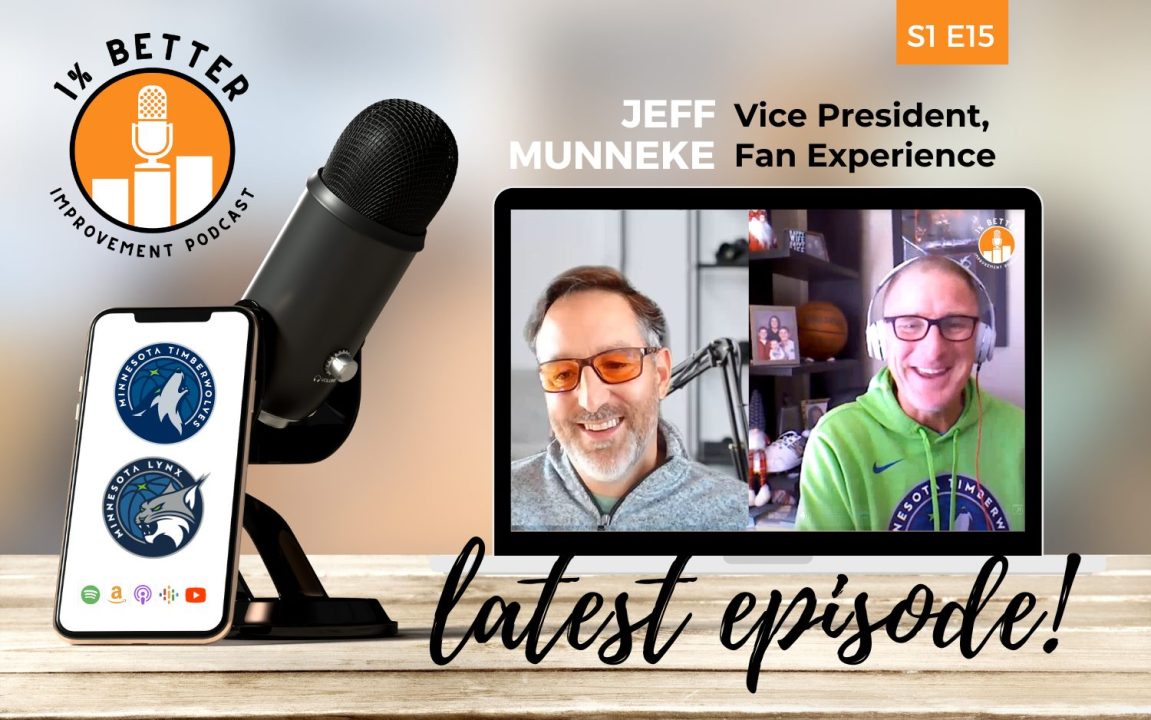
Find 1% Better Improvement Podcast Here





1% Better Jeff Munneke – Quick Links
Get tickets to the Minnesota Timberwolves or Lynx
Connect with Jeff Munneke on LinkedIn
Connect with Craig Thielen on LinkedIn
Key Takeaways
- Importance of Fan Experience: Jeff Munneke highlights the significance of fan experience in the competitive sports industry. Despite not being able to control the game’s outcome, the emphasis on creating an exceptional experience for fans every night is paramount. This focus on fan interaction and engagement is a driving force for Munneke and is crucial for sustaining and growing the fan base amidst a crowded entertainment marketplace.
- Career Journey and Growth: Munneke’s story from starting his career with no sales experience to becoming a VP showcases the power of learning on the job, mentorship, and the importance of relationship building. His journey exemplifies how passion, hard work, and the willingness to learn and adapt can lead to significant career advancement.
- Adapting to Changes and Innovation: The transition to digital ticketing as a bold move requiring adaptation from both the organization and its fans illustrates the challenges and opportunities presented by technological advancements. Munneke’s approach to embracing change and leveraging new technologies to enhance fan experience underscores the need for innovation in maintaining competitiveness and meeting evolving consumer expectations.
- Collaboration and Sharing Best Practices: The openness to sharing information and best practices with counterparts across the league and in other sports indicates a collaborative approach to improving the industry as a whole. This mutual exchange of ideas to enhance fan engagement and experience is a testament to the collective effort to elevate the sports entertainment landscape.
- Work-Life Balance Challenges: Munneke touches on the personal sacrifices and challenges faced by professionals in the sports industry, especially in balancing demanding work schedules with family life. The acknowledgment of the need for a supportive family and the impact of the industry on personal life highlight the broader considerations and trade-offs faced by individuals pursuing careers in high-demand fields like sports entertainment.
















1% Better Jeff Munneke – Transcript
[00:00:07.290] – Craig
Hello, I’m Craig Thielen, and this is the 1% Better podcast. Today I’m speaking with Jeff Munneke, otherwise known as Minnesota Mun, who is the Vice President of Fan Experience for the Minnesota Timberwolves and Minnesota Lynx. Jeff, welcome to 1% Better.
[00:00:24.900] – Jeff
Hey, Greg, how are you? Good to be on with you. This is great.
[00:00:28.160] – Craig
Yes. Well, first of all, hey, I got to congratulate you for a big win in your home opener. And for the record, you’re still undefeated at home. And as VP of Fan Experience, all you can control is your home court advantage, right? So congrats on that.
[00:00:44.690] – Jeff
Yeah, we’ll take it. Is a good win. A raucous crowd, really into the game. It’s so fun to see your fans back in the building again. We always kind of liken it to, at the end of the season, whatever that is, and hopefully it’s longer than you hope every year, but it’s kind of like you go away for college and you go home for the summer, and then you come back as a sophomore or a junior the next year, get to see everybody again. And so it was great to welcome everybody back to Target Center, and we had the place thumping. It was a really fun night.
[00:01:13.800] – Craig
That’s great. And like you said, it’s like every season is a new season. You have all sorts of anticipation, you’ve got some new players in the mix, and it’s just got to be just a really exciting build up and a time of year for you to get the season off.
[00:01:26.080] – Jeff
It is for us. You had mentioned that I can’t necessarily control what happens on the court. I can’t make shots. I can’t make coaching decisions or defensive stops, but I can control how we treat our fans, and that’s what drives the engine for me every single night is that we have this wonderful opportunity to invite 15, 16, 17,000 people into our house on those home games. And in a really crowded marketplace like we have here in the great Minneapolis/St. Paul, with so many things to do, the least we can do is put on a show for them. That’s the way we look at it. And so for me, I’m super passionate about it. I love it. I love those interactions with the fans and the relationships you get to have and get to build. And so it was really fun to see all our fans again to start the season.
[00:02:10.240] – Craig
Yeah, that’s exciting. Well, we’re going to come back to the whole fan experience and what that’s like, but I want to just give the folks in the audience, a sense of who you are, because I think your story is an amazing story and I think it’s inspirational. And in some ways, it’s a classic mailroom to c-suite story, but I think it’s even better than that. So just walk us through how did you get into this business of basketball?
[00:02:39.350] – Jeff
Yeah, so I go way back. Like a lot of kids, when you’re going through your middle school and junior high and high school years, you have all these photos and posters of all your favorite players on the wall. I was no different. I had Dr. J, Larry Bird, Magic Johnson, you know, all these guys on my wall. So I grew up as a huge basketball fan. I did play other sports. I ran cross country. I played baseball as well. But basketball is always my passion, and I had the opportunity to go on and extend my playing career after graduating from Lake City in 1982 and go out and play for a Division 2 school out in South Dakota called Heron University. And so we ended up having a really good team out there. Our claim to fame is my junior year, we got beat by Southeast Oklahoma State, which had a gentleman by the name of Dennis Rodman on the team. So after holding Dennis to 38 points and 26 rebounds, I figured perhaps my thoughts of a pro career and being one of those posters on a wall probably are going to wane pretty quickly. So I better come up with a plan B here pretty quickly.
So I got really lucky. And what I talk about all the time is relationships. And the importance of relationships is no different for me. Gentlemen, that helped recruit me to play basketball for the coach I played for ended up getting named General Manager of the Minnesota Strikers here, which is the old indoor soccer team that played at Met Center way back in the day, where Mall of America sits today. So that was my entry into an interview process that ultimately I got hired as a sales rep for the Strikers. I didn’t have a clue what I was doing. I was 21 years old. I’d never sold anything in my life. We had no training. It was pretty much, hey, there’s an office. Go sell some soccer tickets. And I sat in my office staring at my phone for two days in a near panic, realizing that my phone hasn’t rang one time. I haven’t sold anything. So I got some really good advice from my boss at the time, who was just a couple of years older than I was, and I said, boy, I’m really struggling here. I’m not selling anything. And he gave me some great advice that I still hold to this day.
He says, well, the phone’s not going to just ring for you. You got to go make it ring. And I thought about it that night. I’m just like, oh, wait, I must have to go talk to people. That must be the key to this thing. So I came back in and I told him, I said, I’m just going to go out and work soccer fields every day. You don’t even see me. I’m going to go out and introduce myself to soccer kids, soccer coaches, soccer parents, administrators. And what I was doing was I was very inquisitive by nature. I was not afraid to go talk to people. I was not afraid to stick up my hand. And I was asking a lot of open-ended questions, not really understanding the power of what an open-ended question does. If you ask good questions and they’re open-ended, people, unless they’re just a complete jerk, they don’t want to talk. They’re going to give you some great dialog back, and the dialog will help you develop that rapport relationship and maybe the trust with someone where if I’m a good notetaker and I kind of remember what the conversation is about, gives you the opportunity to say, well, hey, based on what you told me or based on what we were talking about, boy, we could be a good partner and do some things together for soccer tickets, and here’s how we can utilize them.
So that’s how I kind of cut my teeth on the sports industry doing that, but literally just going out and working soccer fields and talking to a lot of people. So I was very fortunate in that I went from, wet behind the ears, no clue what I’m doing to selling season tickets and group tickets for one year for the soccer team. At the same time, the NBA wasn’t the Timberwolves yet. The NBA was being announced as it looks like they’re going to come back to Minneapolis and Minnesota.
So, of course, I was thrilled to death being a basketball guy in my hometown state. Of course, I started the application process and was lucky enough to get in through, from what I’m told is 3,000 resumes. They’re hiring nine sales reps. And I got lucky again because coming from soccer, the second employee hired by the Timberwolves was a gentleman by the name of Tim Leiweke, who is Vice President of Sales and Marketing. He came from soccer.
He came from the Kansas City Comets, and he was our first Vice President of Sales and Marketing. So probably my resume gave it a little bit of shine. I guess you could say. Maybe it’s just like, well, if he can sell soccer tickets, perhaps he can sell basketball tickets. He’s a basketball guy, right.
[00:06:49.890] – Craig
I was thinking, like, Soccer 35, 40 years ago in Minnesota was really very few people even knew about. I certainly didn’t have much of a following back then, so that was not an easy sell in Minnesota. Out of all the sports that you could sell, that’s got to be the hardest one.
[00:07:06.570] – Jeff
Craig, you’re 100% right. I didn’t grow up around soccer. I’m from Lake City, Minnesota. We had the traditional sports, baseball, football, basketball, track and field, et cetera. We certainly didn’t have soccer. They do now today, which is awesome. But back then, it was really pretty much the metro schools, like in Apple Valley, and maybe some of the private schools had soccer, so trying to find people that wanted to even talk about it was certainly interesting, but it was a good learning curve for me. I just learned so much doing that and doing it more or less on my own to try to just figure it out. That probably led me into some good questions and some good background for the Timberwolves staff to look at me as one of those potential nine reps. So went through the interview process, was very fortunate to get into that role. I sold season tickets and group tickets for two years, was promoted to Group Sales Manager, did that for a year, and then I ran the ticket sales area for, I think it was about 15 years. And then I started a new area called Fan Relations, which turned into what’s now called our Membership area.
And then I think it’s eight years ago now, we started this whole new venture called Fan Experience, and that’s where I lie today as the Vice President. And then for about 30 of those years, I oversaw the youth basketball area, too, which was very near and dear to my heart. So it’s been a good ride.
[00:08:24.570] – Craig
Yeah, to say the least. So what exactly is a VP of Fan Experience? I mean, explain what the scope of that is for… and by the way, it’s both the Timberwolves and the Lynx. What is the scope of that?
[00:08:38.220] – Jeff
Yeah, that’s a great one. I get asked that a lot. Like, what do you do every day? There’s so many tentacles to this, where ultimately, it’s kind of the forward facing arm of everything that the fans do and see. And so it’s anything from thinking through, okay, what’s the best way to park? Are we communicating the best way to park? What’s the best way to get into the building? Are we communicating and answering to suggestions on how perhaps this could be better. What happens for our food narrative? Do our fans and season ticket members like the food we’re serving or are there some suggestions? I’ll spit that out there, but it’s everything that you see that’s forward facing to the fan. And so we’re the main liaison between our building partners and trying to put on this great experience every night. Again, I mentioned it once before, we are in a wonderful city or cities, state, where we have everything here you have soccer, you have baseball, you have football, you have great theater, you have great arts. You have everything to choose from. And again, so in a really crowded marketplace, you really have to rely on the experience.
Especially, you can’t say that you can just rely on wins and losses. If you did, this place would chew you up because we’ve had those 18 years where we didn’t make the postseason. Now a couple of years in a row we have, which has been great. And that certainly, we always say when the team wins, hot dogs taste better, beer gets colder, right? There’s something to that. But in the meantime, we got to make sure that we’re delivering the goods. And for me, that’s the passion with the people, and that’s the passion of how they’re treated when they come to our doors.
[00:10:09.610] – Craig
Well, that’s helpful because as a fan, you often think, well, you focus on the game, right? And as you said, it’s amazing how wide it’s everything from what they’re hearing about the team to when they’re the parking and even timeouts and what music is playing and what the intro video, and it’s that whole experience. And at the end of the day, you can’t control how the team plays. I mean, that’s the coaching side of the business and the operations. But again, any given year, you’re going to have as many wins as losses. Good years, you’re going to have a few more bad years, a few less wins, but you’re going to have losses. And so you don’t want to tie a loss to a bad experience. A loss can be a great experience, could be comes down to last second or could be you got together with friends. So it’s interesting because you broaden that whole experience, and at the end of the day, that’s what it is. It’s entertainment, and people are going to pay for that.
So I’m curious, how do you see the Timberwolves, the NBA and the Lynx and the WNBA, and how different do you look at the fan experience and very different sort of business models, very different fan models is the fan experience the same for you, or how do you think about that?
[00:11:22.400] – Jeff
Yeah, that’s an awesome question. And I’d say at first our thought process would be the same. It’d be similar, like from a food narrative. What are we doing with food? It should be the same both ways. Parking should be the same both ways. The experience, however, for our fans is dramatically different, which was a surprise to us when we started the WNBA. Now, I’ll give you a great example for the WNBA and our Lynx fans. And obviously, we’ve won four championships, and so it’s about the game. So very, very little interaction when, other than halftimes or before the game, if the game is going, the concourse is a great spot to be. If you want to just run laps, because there’s nobody in the concourse. Everybody is focused on the game. Where on a Timberwolves game or NBA, there’s a lot more interaction. There’s a lot more social piece to it. It’s not to say that the Lynx aren’t social. Our fans are very social, but it’s social about the game. So when you walk into our building, people do not want to miss the tip. They do not want to miss how the third quarter starts, and they certainly are going to be there at the end.
We’re on the Timberwolf standpoint. A lot of people are getting a bite to eat downtown, maybe lingering about, saying hello to some friends, maybe going in one of the premium spaces, kind of hanging out in one of the atriums, talking to people like myself, and all of a sudden, it’s kind of like, oh, I should probably go check it out. It looks like we’re halfway through the first quarter. That’s where it’s different. But the thought process of what we’re trying to do from an experience standpoint, again, with parking, communication, food narrative, those things are the same.
[00:12:52.420] – Craig
Yeah, very interesting. You have to pay attention to that. If you tried to use the exact same experience, I mean, the approach can be similar, but the product and how you approached it, then you wouldn’t be connecting with the fans as well. So just listening to the fans and what they’re telling you, I think, is probably the key there, and you clearly can distinguish the two.
Well, let me ask you this. So clearly, you have a passion. You’ve been a basketball junkie ever since being a kid, and you have a passion for it, and you just really wanted to get into the organization, and as you said, fortune got you in, but that only gets you so far, right? Like to go up and take on the multitude of roles. And now to lead the entire fan experience for two professional sports organizations takes a lot of business acumen. It takes a lot of leadership skills, team building skills, and at the end of the day, being an executive or a leader, it’s about results, right? So whatever your goals, I mean, I’m sure you have metrics and you have goals that put upon you or that you accept.
So how did you progress as just a professional, as a person from, as you said, when you were still wet behind the ears selling soccer season tickets to going up through the ranks? Let’s face it, I think sports franchises are very much dog eat dog, very much competitive, not just on the court, but you get new owners, you get new GMs, you get all sorts of new people periodically. And sometimes there’s regime change and there’s different philosophies. So how did you progress as a professional throughout all of that change?
[00:14:24.320] – Jeff
Yeah, it’s a great question. And I remember when I started off, I was thinking, oh my goodness, I am here. This is my dream job. I hope I can stay for a year, really not screwed up. And all of a sudden you’re there for five years and you’re like, oh my goodness, is this happening? And then by that point you’ve been promoted maybe once or twice, perhaps, and you’re thinking, well, maybe I can be here a bit. And so, number one, in this industry, you have to produce. So from a sales standpoint, you have to put up numbers. It’s fairly black and white. You can be the greatest person of all time, but if you’re not producing, that’s an issue. Or perhaps it’s just maybe some technique. It’s maybe some things you’ve been trained to do. Perhaps your effort is there, there’s just a couple of tweaks in the process that we can or your managers can help with. So there might be a little bit of that. So I was very fortunate that early on I had some great trainers, I had some great leaders that showed me the way. I got very lucky in that I just felt like I’m not going to get out worked, even though we had a tremendous staff, we were all working hard.
But I got lucky in that the people that I followed and really learned from really had some incredible insight and technique to the sales process and gave me some additional knowledge and some different ways to do things that helped me excel from a number standpoint, when it does become black and white numbers and suddenly perhaps you’re in the middle of the pack. Well, suddenly maybe you’ve done enough and you’ve learned enough and been educated enough, where suddenly you’re at the top of the pack. So there’s no question that helps. Secondly, I think you have to be a great person. I think you have to be a really good team player. You have to fit the fabric of the culture. I think you need both to succeed and be able to go up through the ranks, or you take this experience and go to another team or another business. People want to be around people that they like. I think, fortunately, I’ve always been blessed to be around unbelievable people, much smarter than me, lots of talent, and I’ve just been able to kind of come along with them and just learn a lot and be, like I said before, very inquisitive.
Okay, that was an interesting thing that you just said. Perhaps I could put that into my repertoire a little bit. Or, hey, here’s a problem I was having. How did you handle this? Or again, I had Tim Leiweke, I had Bob Stein. I have Al Nuness. I have all these people that became big executives in and around the NBA and professional sports. That’s who I learned from in and amongst nine or eight other sales reps that were really talented and really good. I was just blessed to be along for the ride a little bit, is what I say.
[00:16:55.460] – Craig
Well, a lot of humility there, but one of the things that I always get from you is not only your passion for basketball, which is clear, but you also have a passion for the fans and talk about the voice of the fan. You talk about staying curious, and it’s easy to say those things. I mean, obviously, that’s your job, right? But it goes beyond that, even when I look at your tweets, and it’s always about the fan, and it’s always about a fan experience, or maybe it’s a worker providing that experience. And so it seems like that’s a little bit of your secret sauce. But talk about, was that just innate in you, that you just always had that, or is it something that you learned? And then my question is, how do you balance that? Because that seems obvious, right? I mean, your job is to make a great fan experience, but then there is the business of basketball. It says you got to sell tickets and you got to have revenue growth, and we got to be profitable. And, oh, by the way, cut your budget by 10% because they’re having some tough times, and so there’s always balance. Or maybe how do you stay true to your fans when you have a business to run?
[00:18:01.470] – Jeff
Yeah. More good questions. I think our feeling has always been, you have to personalize the relationships with each fan. You have to figure out and ask the right questions. Why are you a fan of the Timberwolves? Why do you consume this product? One person might say, oh, I have three kids at home, and I just want to treat them. I like basketball myself, but my kids are really getting into it. They play house league or traveling. And so two of my daughters really like the mascot [Crunch]. My son likes basketball or vice versa. And the next person might say, hey, I’m all about client entertainment. I own tickets because this drives my economy for me. This drives business for me. So I’m all about treating my top clients to games. Sometimes I’ll go with them. Sometimes I’ll just give them the tickets. The next person might be, I’m such a basketball junkie. I just love this. I can’t have enough. So you have to ask those questions. And then we always say, personalize the relationship for that person. So whatever those hot buttons are, let’s do that.
So if a person has tickets because of their kids, let’s find opportunities and events where the mascots are there. Or maybe there’s a dance team clinic, or maybe there’s something cool. There’s a kids coloring contest, the guy with the clients or the season ticket member with the clients, let’s make sure that when his top three clients are coming down to a game, we’re doing something for those clients and making him the hero. So let’s do that. So we log all that into CRM, and a lot of it’s just up here in my noggin, just my brain, because my goal has always been to know every single season ticket member by name. There’s a lot of them, and I got a lot of them down. I don’t have all of them, but that’s always been my aspiration, to know everybody personally. And then secondly to that, when we’re going through this, I always try to think through, like, okay, if I was a fan, and I’m a fan of a lot of things, what’s interesting to me, and so I always think about, like, nostalgia is really good, old school type things, is really fun. People like to take those trip down memory lane.
People like to see behind the scenes things that you can’t just see on social media or you have to be invited to. So I’m always trying to bring people into those things and say, hey, check it out. If you’re a season ticket member, this is what happens. Or if you come down to a game, you could experience having our usher Rick in Section 129 greet you as you walk into the stands. And then suddenly you not only are getting staff attached to it and you’re showing how important they are, but fans are recognizing that and say, you’re right. Rick is awesome. He’s great. Well, suddenly you have a string of 25 people commenting on what a great experience it is going in Section 129 and dealing with Rick, and that’s fun. So everybody wins the game that way.
[00:20:43.340] – Craig
So we’re in the business of management consulting, helping organizations run better, and technology, and how to leverage technology. So I’m really curious. In the world that we’re in, we’re now in a digital world, an AI powered world, and we’ve got moneyball. We all know about how data is leveraged for sports, for, again, the play on the court. But I’m curious, how do you leverage data for your job?
[00:21:06.580] – Jeff
Another great question, and I am not an expert by any stretch, on technology. I know how important it is, and I know how it’s made us way smarter as sales and marketing teams because we’re using business intelligence, we’re using analytics to help show us demographics and trends and being able to get to where it’s more efficient for a fan. And so I remember when we went to digital tickets, it would have been six years ago, I think it was. Oh, my goodness. I mean, the backlash that we got was crazy.
[00:21:37.970] – Craig
How many years ago was that?
[00:21:39.360] – Jeff
I think it was six years ago.
[00:21:40.860] – Craig
Okay.
[00:21:41.340] – Jeff
And it’s five or six years ago. And I remember talking to the Cleveland Cavaliers, who were the first team to do it, and we followed their model, and they said, we went into it and know we gave people the option of either digital tickets or hard printed tickets. Well, everybody took hard ticket prints. And so they said, if you’re going to do this, go all in, rip the Band aid off and go. So that’s what we did. And it was a huge change for our seasoned ticket members and our fans that were used to putting those ticket stubs in a wallet or giving them to the newspaper kid or giving them to a client. And so it was quite an education process to go through that and big change where a lot of people are like, what do you mean they’re on email? What do you mean they’re on your phone? Well, now, six years later, can you imagine without it? It’s so easy now. And it also allows us to track data that we utilize to make us better and more efficient for the fan as well. Certainly there’s selfish reasons to do it, too, because we want to capture that data. We want to capture opportunities for a franchise as well, but it also gives us great intel to make the whole experience better for the fan.
[00:22:57.330] – Craig
Yeah, for sure. There’s never enough data, right? Because at any given time, you have 15, 18,000 people. If your goal is to make it a personal experience, you need to know things about them and data. So interesting. I’m sure it’s evolving and growing, and AI, I’m sure, is going to play a role of it in it, if it hasn’t already, sometime soon. That’s what we’re across, every company and every organization.
So you said something I’m really curious about. We think in our heads, like, okay, in the NBA, it’s ultra competitive. Everyone’s trying to win, and so the actual game itself is very competitive. Right, but I’m curious. You said, hey, I called up my friend, Cleveland Cavaliers. So from an operational standpoint or from a fan experience, is it collegial? Do you share ideas? Is it open or is it like, no, this is our secret sauce. Stay away.
[00:23:45.450] – Jeff
Great question. So the NBA is really good about sharing information and best practices. So we have a series of monthly sessions. So people that are my counterparts, we get together once a month and talk via Zoom or Teams. Right now, we’re always trading notes back and forth. There’s league meetings that you attend that you hold up in a hotel for three days and basically share different ideas and best practices there. Locally, that’s what’s really been fun for me, is that we’re also doing this locally. So once a month for a number of years now, we get together with the Vikings, the Twins, United, the Gophers, the Wild, everybody in town, and we share ideas. And it’s really funny because in some markets, people will say, wait, you’re talking to the teams in town. Really? Why would you do that? I’m like, why wouldn’t we? There’s a couple of things. Number one, why can’t we share information and see if we can make it all collectively better for a fan frequently in all our sports? Secondly, we have a lot of consumers and clients that perhaps are Timberwolves season ticket members, that there’s an event at US Bank, there’s an event at Target Field that they want to go to.
Well, it’s easy for me to make a call because I have relationships built with my partners over there behind us or across town. And thirdly, it’s just the right thing to do. It kind of goes into the whole experience piece. Why would I not want to know the people that work at the other organizations and become friends? And certainly there’s some competition, I guess you could say, because if people are making decisions on one sport versus another, get that. However, we feel that if all the sports teams are clicking in town, it just makes the market that much better. And I really enjoy sharing the information and say, hey, Twins, and hey, Vikings, and hey, Gophers, and hey, well, this is what we’re doing. What do you think? And then you’re going to get some information back and say, oh, that’s an interesting twist. Well, here’s what we’re doing about it, or here’s how we handle that situation. It’s been great.
[00:25:36.240] – Craig
That’s really interesting. I think there’s a lot, there’s some lessons in other industries. I mean, again, in one of the most competitive industries, you can’t really think of too many industries that everybody has the exact same goal at the end of the year, extremely competitive and lots of turnover, lots of coaching changes and leadership changes because of that. But at the same time, you are sharing ideas on how to get more fans and how to… That’s just a great, it’s great to hear both across the league and in town. But I think a lot of other industries sometimes could learn from that because, again, there’s lots of customers and we can all learn from each other rather than not sharing. So good stuff.
I’m curious, Jeff, you’ve been in this league a long time, which is incredible in itself, I think, because of, again, how many times there’s been ownership change and leadership change, but what from you has really stood out? Like, what’s changed in the business of basketball? What’s changed in the game of basketball? And is there any sort of correlation? Because obviously the game has changed significantly, but what really change stands out in your mind with the business as well?
[00:26:46.180] – Jeff
Yeah, I think with social media, there’s some really good positives to social media. It’s another engagement tool for our fans. And like we had talked about before, I really utilize that a lot to find different ways to connect to our fan base, whether they’re season ticket members or just a general fan. So that part is good. Social media also creates a lot of opinions that can be a little toxic from time to time. That part is a challenge. Sometimes dip into your phone after a loss and you might say, oh, boy, I think I’m going to go to bed. There are some things being said where you’re like, oh, boy, okay, again, I think most of us don’t take it defensive. People want us to win. They’re fans. They have opinions about trying different things. So we get that. That also connects you much more often. So perhaps maybe previously you could have got back to someone the next day or a couple of days later. For the most part. You need to respond pretty quickly now. Or the ask of our fans is that, hey, I sent you a note, I’d like an answer back, like now or within the hour.
So that creates more time where you probably don’t shut down properly. At least I don’t. I’m trying to get better at it. I’m probably not real great at it. So that part is a challenge. But I think overall it’s just such a great connector for us to create. Whether it’s photos or video clips or information that we can share and make the experience better for our fans. They like those things. I think the challenges personally are just time. We have so many events and so many games that for me it’s 41 regular season Timberwolves games. It’s 17 Lynx games. It’s another probably 30, 40 events that you’re putting on. That’s 100 nights that you’re away from home. That is a challenge, or it can be a challenge. We’re allowed some flexibility back where I never missed any of my kids basketball games or golf events or very rarely missed them. So that was great. And I was able to coach them through some of their sports as well, which I would have been devastated to miss some of those things for them because I just so enjoyed those youth sports with the kids. But at the same point, you have to have a very patient spouse to work through those many nights that you’re going to be gone.
[00:28:59.650] – Craig
Yeah, I was just saying that’s another team, right? It’s your family team, it’s your spouse. It takes teamwork.
[00:29:04.870] – Jeff
For sure. But I just think it’s such a curious industry. And I went and spoke at St. Thomas here a couple of weeks back and the class is probably 45 students and I think I’ve had almost half the class follow up and want to know more. And that kind of makes my day because first off, it’s okay, whatever I said seemed interesting to those kids. They want to learn more. Secondly, never stop the interview and talent. I always think that even though they might be a sophomore or a junior, we’re going to have positions at some point. So keep talking to kids, keep talking to people that want to get into your industry, you might develop this unbelievable pipeline. And thirdly, I just look at it as I would have killed to have someone come in from a professional sports team to talk to my classes back when I was in school, I never had that opportunity. And so it’s just a great give back for me.
[00:29:56.270] – Craig
Excellent. Well, Jeff, the 35 minutes always flies by here. So we’re to our final question, which on our podcast is what 1% better advice would you give someone who is early in your career, and perhaps maybe you did this with the St. Thomas kids last week, that you would give and say, hey, this is things that you’ve learned that you would have loved to know when you were that age and just how you think about life and how you think about looking at a career, whether it’s in sports or any other career. What advice would you give?
[00:30:28.140] – Jeff
Yeah, in fact, this question did come up at St. Thomas, and I’m going to answer it the same way. I wish I would have pushed myself more in high school and college to do public speaking. If you think about all the times, like now, it seems like I’m doing that every single day, and it becomes pretty familiar. I’ve gotten better at it. I’m by no means a great orator, but I’ve gotten better at it because I’ve practiced it and done it more. But early on, I was probably like a lot of high school kids and college kids, like, oh, my goodness, speech class. Really, it’s the last thing I want to do. You do just enough to get by with maybe that C plus or that B minus, just enough to skate by. And I didn’t take it serious enough realizing that that probably was the life skill I needed the most to work on with what I do today. And it’s something I didn’t prepare and practice for nearly enough going through the ranks, so I had to kind of learn the hard way because when I was working for the Strikers and early on with the Timberwolves, one day I could be presenting to a board in a boardroom full of 16 executives, including the company president.
The next day I could be just talking to a general fan. But you’re always presenting, and I wasn’t refined enough early. So I quickly realized that after going through a couple pretty clunky presentations, like, I got to get better at this. So I actually went to our PR team and said, look, I know we get all kinds of crazy requests for Kiwanis clubs and Lions clubs and breakfast speakers. All that thing, all those things said put me in line with those. If you get requests, I’ll do them because I got to get better at this. Number one, we need it for our franchise. Somebody’s got to go do these. I’ll volunteer to go do these because I got to get better, too. And I think that really helped me. And if I could go back and do one thing, that’d be it.
[00:32:12.720] – Craig
Great advice. Well, thanks again. Appreciate the time. And let’s see if we can extend our undefeated season at home. What do you say?
[00:32:21.780] – Jeff
Let’s do it. We got four big games coming up. We got Denver, Utah, Boston, New Orleans coming up here. So the road, there’s no free lunch. That’s for so, but I like it.
[00:32:32.340] – Craig
Thanks again, Mun. Appreciate the time and all the great insights.
[00:32:36.460] – Jeff
See Craig, thanks for having me on.