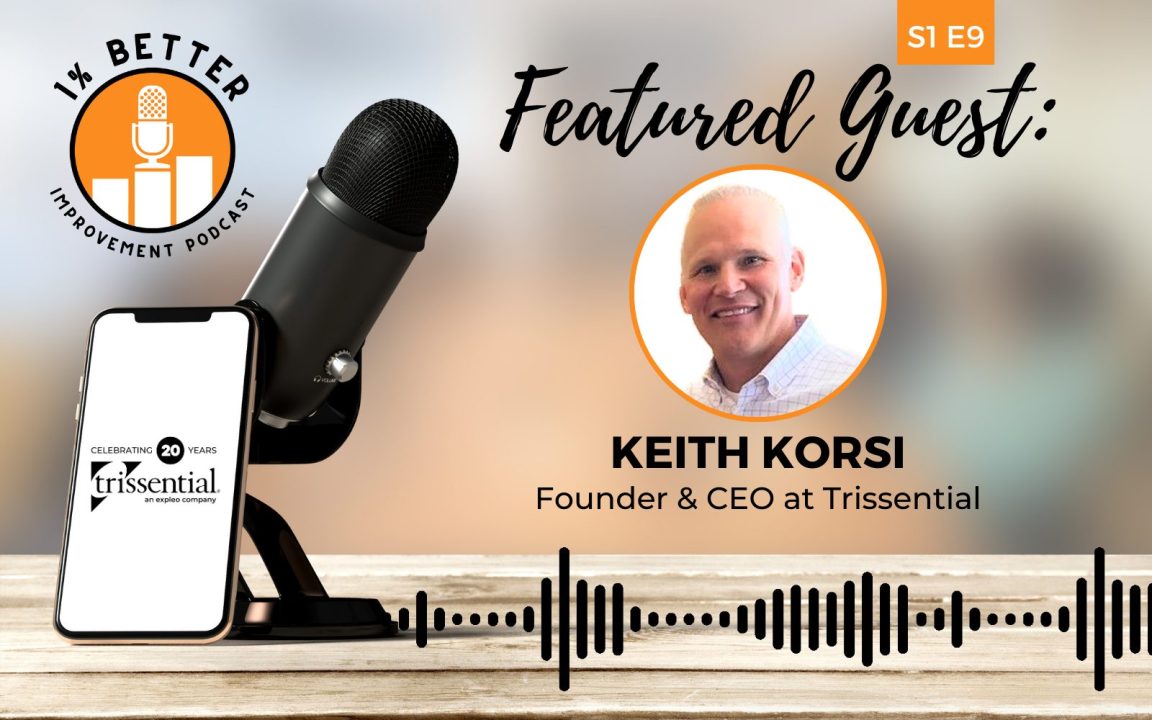
Find 1% Better Improvement Podcast Here





1% Better: Keith Korsi, CEO and Founder of Trissential
Quick Links
Learn more about Trissential and the Essential Business Model (EBM)
Check out the personality tool Managing Performance in Organizations (MPO)
Connect with Keith Korsi on LinkedIn
Connect with Craig Thielen on LinkedIn
Key Takeaways
- The Foundation of Trissential: Keith Korsi shared the journey of starting Trissential, highlighting the need for a third alternative in the IT consulting industry that bridges the gap between large system integrators and local staffing firms. This idea was born out of the observation that many IT projects significantly exceeded their budgets, with a substantial portion of rework costs attributed to requirements issues.
- The Power of Improvement and the Essential Business Model (EBM): The conversation emphasized the importance of continuous improvement in business operations. Trissential’s tagline, “The Shape of Business Improvement,” reflects its mission to help organizations progress. The Essential Business Model (EBM), built on three pillars—Strategy, Management, and Execution—guides their approach to delivering tangible improvements to their clients.
- Organizational Culture and Values: A significant focus was placed on creating a unique life experience for employees and clients, rooted in a culture of improvement and a commitment to leaving organizations better than they were found. This culture is based on the belief that the success of an organization is deeply intertwined with the satisfaction and growth of its people.
- Challenges and Perseverance: Keith Korsi discussed the early challenges of establishing Trissential, including overcoming obscurity in the market and building trust with clients. He emphasized the importance of unwavering faith and the internal fortitude to persevere through difficulties, illustrating this with the concept of the Stockdale Paradox—balancing faith with confronting brutal facts.
- The Importance of People and Diversity: At the heart of Trissential’s success is a profound understanding that everything comes down to people. Keith Korsi highlighted the significance of caring for people, embracing diverse perspectives, and fostering dynamic tension within teams to arrive at the best solutions. He also shared personal insights from coaching youth sports, underscoring the value of setting goals, fostering belief systems, and the impactful parallels between coaching and leading in a business context.














1% Better Episode 9 Transcript
[00:00:00.200] – Craig
Hello, I’m Craig Thielen, and this is the 1% Better Podcast. Today is our ninth episode of the 1% Better Podcast, and the number nine has been a big number over the ages. It’s the last single-digit number in our counting system, and it represents the end of a cycle. Ancient mathematical philosophers called it the finishing post, and ancient Greeks called it the horizon. So at Trissential, we also believe in numbers, in particular in the number three and the power of three, which is where Trissential got its name, and we will talk more about that. Back to nine. Nine divided by three is three. So it’s very appropriate with that that we’re having Keith Korsi on this episode, and Keith is the Founder and CEO of Trissential. So, Keith, a lot of math there, but welcome to 1% Better.
[00:00:48.980] – Keith
Thanks, Craig. Obviously, a huge fan of what we’re doing here, and I’ve loved every episode and you’ve had some great people on. So happy to be a part of it.
[00:00:56.730] – Craig
Well, let’s get started, Keith, with the whole backstory with Trissential, being the Founder. And by the way, this is our 20th year and the impetus behind this podcast. This is the 20 years that we’ve had as a company and all the great organizations and people we’ve run into and share those stories. So take us all the way back on the story of how Trissential was started.
[00:01:17.200] – Keith
Yeah, it’s a great story, I think. Coming out of college, technical, I was a COBOL, CICS, IMS, DB2 guy and worked with a lot of people like me, thousands of programmers working at a big company, and got a lot of technology learnings along the way, and grew up becoming more of a business analyst and then more of a project manager, and got to see just how we solved technical problems at our company. And we always did it the same way. We hired a big accounting firm, and we got the strategy set. Then when we implemented, we’d implement with local staffing firms, and we struggled, and a lot of other companies were struggling. We saw a lot of issues with the way we were doing that. Then as my career progressed, I ended up working at other companies and getting to see more of the same. At that time, two of the statistics that Trissential was really founded on was 53% of IT projects went 100% over budget or more, and 82% of project rework cost was directly related to requirements. So if you combine those stats, over half the time you double your spend, and over 80% of the time, you didn’t even get what you wanted.
And so I always wondered, while we were out there in the field, why doesn’t something exist that’s really a third alternative? A third alternative from the staffing firms on one end and the big SIs (system integrators) on the other end, why doesn’t a company exist in the middle that can take a company from strategy through execution… And that problem or the solution to the problem I saw, I just didn’t see existing. And I shop that idea with a couple of really smart people that I had worked with and said, if a company existed like this, what would you think? And they emphatically said, we’d join. And you start thinking about that experience of, okay, if we could bring that value prop to a company and fix those problems and really help that organization advance, what a great career that would be. And so that was really the vision behind Trissential as being that third alternative and then really creating a life experience. When you talk about one 1% Better, creating a life experience that was different for the employees that worked at Trissential and people who had the same belief system and wanted the same life experience of going in and helping an organization get better and really teaching them to fish in the value prop of we’re going to leave you better than where we found you, a Do Manage Mentor situation, and then when we’re done, we’re all going to high five and hug and say mission accomplished. And so that was why Trissential came to be, to fill that third alternative and hopefully do it with a life experience that the best people in the industry hadn’t been a part of in the past.
[00:03:46.210] – Craig
Thanks for sharing. That’s a great story and I think there’s still a lot of pieces of that that still are alive and well today. So I got to ask for those that don’t know, the tagline of the company, Trissential, which by the way stands for the three essentials: Strategy, Management, Execution. The tagline was Trissential, The Shape of Business Improvement. And so why improvement? Why did you choose that as an anchor? And then how did you get the name Trissential? Even though I gave a clue to it, I think there’s a story there as well.
[00:04:16.660] – Keith
The Shape of Business Improvement, we really wanted to help organizations advance. And I’ve always been a fan of poetry, but there’s this great quote from Henry David Thoreau when he says, ‘to affect the quality of the day, that’s the highest of arts.’ And I’ve always loved that quote. And I thought, with our company, yes, we have to be a profitable organization. We’re going to solve problems, and we’re going to have a great value prop for the people that work with us and the people that work for us. But what’s the highest art in that is really leaving an organization better off than they were when we found them, teaching people to fish. So the idea of The Shape of Business Improvement, that’s a play on obviously the Essential Business Model (EBM) and Trissential, the message of Strategy Management Execution. We thought when we leave, we should leave that organization and those people in a better spot. We’ve taught them what they need to know and they can go off and do this on their own. We thought The Shape of Business Improvement, tying that all together that we want the organization to improve and it ties into our business model (EBM). We thought that was pretty catchy and very realistic with what we wanted to accomplish for an organization.
[00:05:21.820] – Craig
Well, the old saying is you can learn something new every day. I certainly learned something new with every podcast, and I just learned something new. We’ve been working together for roughly 15 years, and I never knew you were a fan of poetry.
Keith
Yeah, don’t tell too many people. I’m not sure that’s a great one.
Craig
It might get out.
Keith
I think great things have been said, and I like to remember them and try to live by them.
[00:05:42.750] – Craig
The consulting business, you went into a business that’s not an easy business to be in. It’s got a lot of big players and a lot of smart people, well established, and you jumped into it. And you started a company from scratch, right? It was really three people. You added a fourth one early on, but you really did start from scratch. And so what was the hardest part… Looking back 20 years, the hardest part about starting a consulting business, and then how did you overcome those challenges?
[00:06:09.220] – Keith
Yeah, the hardest part by far was also I think, the most exciting part was we knew we were going to take a completely new message to complete strangers. Those of us who jumped in early on the Trissential game, we were in non-competes and obviously wanted to honor those. And so when you really thought about the excitement of let’s start this company, we believe in our mission statement, to have a positive impact on the life of anyone who interacts with Trissential. We believed in that. We believed in our value prop. We believed in the people that we had talked to that wanted to come work with us. So we really believed and had a lot of excitement around that. But the hardest thing is when you take a new message to complete strangers with a name that no one has ever heard of, and you say, this is a value prop, trust us. And we’ve told our wives, give us a year… If we don’t make it, we’ll punch out and go get real jobs again. But we get one year of no pay, and let’s just see if people don’t buy this, then we’re worried there’s not a value prop to be had.
And so our wives agreed to it. And thankfully, in month nine, we signed our first client. In our 10th month, we signed our second client, and our third one came shortly after that. And so we got in under the deadline. We didn’t have to shut ‘er down. And that was exciting. I remember when I was reading Good to Great for the first time, and there’s a great component in there about a Stockdale Paradox – It’s this concept of you have to have unwavering faith that you’re going to succeed while you confront the brutal facts of your reality. I remember reading that the first time, and I’ve read that book several times, and I just remember thinking, we didn’t know what the Stockdale Paradox was, but we had it. We had unwavering faith that our message would be good. We would be able to create an environment and a life experience for clients and employees that they had never experienced before in this industry. Yet while we confronted the brutal facts of no one knows who we are, no one has heard of this company called Trissential. People buy from who they know and trust. How are we going to do that with complete strangers?
We always believed we’d be successful, and we thought if this works, we will have done a very hard thing with this new organization, but it will prove out people believe in value, and we could win them over with a message that says, here’s where we’re going to take you on this journey, and here’s how it’s going to start, and here’s how it’s going to end, and it’s going to be great for everybody. That was our belief. So we lived that Stockdale Paradox without even knowing what it was.
[00:08:34.280] – Craig
Yeah. I mean, if you had to say what’s the greatest trait or consistent trait of entrepreneurs, it’s that what you just said, it’s that unwavering faith because there’s challenges literally every day… You question yourself, but you have to have that belief system that it’s going to work out. I think that applies even well beyond starting a company, even though the stakes are greater, right? To some degree, if you take your life savings or you take your 401(k), you’re putting things at risk. You could apply that, I suppose, to anybody in their job, their role, in their personal life, having that faith that, hey, it’s going to work out. I’m going to get through this, right?
[00:09:09.650] – Keith
Yeah, just an internal fortitude. And it’s a competitive nature with yourself and just the belief that you will get through it, and you will. I’m a pretty faithful guy in my personal life, and so I lean on that a lot. We had really unwavering faith that this would work. And again, it was about the life experience more than anything. If we get this right and we do this right, we will affect the quality of the day of many, many lives and what a cool life experience that would be.
[00:09:36.780] – Craig
Yeah, absolutely. So what about on the flip side? There’s been a lot of evolutions. I don’t think we’ll be able to cover all of it of just how Trissential has evolved over the years, the 20 years. But when you look back again, what are your proudest moments looking back?
[00:09:51.940] – Keith
Oh, boy. It’s funny. I was telling somebody the other day when we were talking about when someone retires, and I always use the Super Bowl analogies, right? Everybody wants to go out like Montana, win four Super Bowls, and some people go out like Elway, win the big one, and then call ‘er quits after that. And then there’s folks who do it the Akeman way. You get your one, and then you go deep into the playoffs, but you never get back there. And I’ve thought about that often about the Super Bowls that Trissential has won. And obviously just making it is probably one of the proudest moments I’ve ever had is when you hit that two, three-year mark, and everybody knows the stats of what percent of companies fail before year five, and you’re rolling in years two and three, just making it and getting people to believe in the dream and then follow, and just knowing we were going to make it was one. Obviously, when we sold the company, having an organization find us from Germany and say, we want you to be our launch point into the US, and we want to take your intellectual property to 30 countries around the world.
That was a huge Super Bowl win. And then we started recently, Craig, as you know, we started celebrating regular retirements. And that’s a fascinating thing. We started this company when I was 34, and all of a sudden, I’ve turned around twice and I’m 54. And Craig, you and I have seen that some of our foundational people that came into this organization and spent 15, 18 years with us have called it a career. And each one of those is bittersweet. It’s exciting. And I take a lot of pride in the fact that people in this industry that are at the top of their game that could go work anywhere, spent their last 10, 15 years with this company. That’s amazing to me and very humbling. And I’m very, very grateful for that. And then just look at the Super Bowls that we were brought in. We had two companies brought in by the parent company and merged into us in 2018, 2019. And we brought those organizations in. And I was proud of how we did that. We had the mission the first year of win their hearts and minds, if you remember that. And it was all about getting those people into the Trissential life experience and showing them the culture and make them want to be a part of this team.
We did that for a year before we even thought about systems integration and technology. Who cares? We’re in the people game. And so that was another Super Bowl. And there’s been so many proud moments over the years that doesn’t say everything’s been a proud moment. We’ve gone through our trials and tribulations. But I think you got to look for even the small wins as we get going here in mid 2023. It feels like we’re getting going because the first half of the year has been tough. It’s exciting to think about how we’re going to finish this year and what we’re going to do next year. So there’s lots of moments when you think back over the years of what we’ve all accomplished. It’s very humbling. And that doesn’t even talk about the things with the clients, how many client engagements we’ve done, and how many happy clients we’ve had over the years. And that’s just the most rewarding part of everything is, again, the people side of our game. It’s all people, right? Our people go out and work with other people. And when you get the people game right, it’s very fulfilling, and that’s our game.
[00:12:49.090] – Craig
We’ll have to do the math on that sometime… How many clients we’ve worked with, I’m guessing it’s going to be somewhere around 500… And how many engagements, maybe around 2,000 plus. And every one of those is a story and a learning for me, anyways. I know you’ve been listening to some of these podcasts and it’s been a lot of fun for me to be able to reconnect with some people that we met along the way. And some of these people met in India and Germany and Ireland and all over the world as we’ve now become part of this global organization. They just hear those stories and it’s an endless road when you think about all the people that we worked with over the years. I really look forward to every one of these to retell some of these stories and the learnings that we’ve had and that they’ve had. So that’s got to be fun for you as well.
[00:13:33.580] – Keith
Yeah, it’s amazing. When you think about when we were approached about partnering and then that turned into our sale to SQS at the time and them wanting to take this message that we had developed over 10, 15 years to 30 countries, and you were part of that, Craig, and I was part of that getting to go really educate the world on how we do the management consulting game, the Trissential way, and all of those relationships. Right when you thought your life was great and we had done some awesome work, all of a sudden you’re dealing with 30 other countries and great people from around the world that want to do things a different way in a better way and again, have a better life experience. And so, yeah, I think about all those people around the world and the experiences we’ve had. It’s very surreal.
[00:14:16.250] – Craig
Here’s a challenge for you after you’re done with this is try to think back… you don’t have to answer it here, but think back of the first, second or third customer we had and let’s see if we can get them on the podcast. That would be a real fun conversation to go back 20 years.
[00:14:30.150] – Keith
I would love that. I remember our first three clients very vividly, so I could easily do that. And that’s the beautiful part about it. We’re still friends and still acquaintances with those people. And some have retired and others are still in the game swinging for the fences. And I would love to do that.
[00:14:46.850] – Craig
So we talked about the improvement theme as the company, and I always love to go back in time. And I think we’re at a transition in the world, a shift in technology, a shift in how we think about countries, how we think about global versus local. Lots of different things are starting to shift in the world. And here we are, 20 years ago, you were talking about improvement. Did you ever envision that focus would be bigger, faster? We’re in the world of AI and generative AI and the speed of change and speed of improvement is really exponential. And it also is including some things that have been around for a long time, like mindfulness, for example, spirituality, consciousness, these kinds of things were not even talked about in a business context 20 years ago. Right now, these are things that a lot of people are talking about publicly. So could you imagine this world that we live in 20 years ago and improvement is more relevant than it’s ever been?
[00:15:45.090] – Keith
No, I would have never thought the improvement message from 20 years ago would be a timeless message, which is what it’s turned out to be. We always know we’re trying to improve and get better, but where we’re at today with the speed of technology is amazing. You and I have talked about that with AI now on the scene. And again, organizations are going to need to keep up with it. I would have not thought we had created a timeless message, but very excited about how it still relates, and it’s going to relate now forever. It looks like it is timeless because there’s always something to improve on. And you’re right, the whole human side of companies now. And I remember listening to one of the podcasts with Tom Goodell, and he talked about a couple of things that I really loved. He said, leadership is now about self-regulation and being deeply self-aware. When you think about those concepts, that is what we need. That’s what the world needs. That’s what the organizations need. They need deeply self-aware people. Craig at our company, we’re very into the personality profiling game and making sure that we understand how people are wired and how they want to be communicated with.
I think we brought a lot of value around improvement to our clients, and even internally, just with that language, we can all speak because we know how you’re wired, and we know how I’m wired, and we know how we want to communicate, but we know how we want to be communicated with. So I just think we will be on a never ending improvement game. And I think as technology gets bigger and harder, what we do is needed even more. And people being very self-aware and very heavy into the EQ side of the house as much as we are into the IQ side of the house, it’s just imperative because people get things done. Yes, these machines are smarter and getting faster and better every day, but people drive that, and that will not change. So I’m excited about how the message lives on and it just continues to morph with time. And as technology speeds up, it stays right at the forefront in my opinion.
[00:17:38.460] – Craig
How many things stand the test of time in 20 years? I mean, how many companies have completely come and gone? Redbox completely was on the scene and maybe still around, but it’s a fragment. And there’s so many things that just come and go. But improvement, I think, as close to timeless as you can get. So shift gears here from big company level stuff, which is fun to go back through the memory box a bit. But let’s talk a little bit more personally. There’s been a lot of trials and tribulations and clients. And when you’re working with people, we have a lot of variables every single day. What have you learned personally, Keith, over the past 20 years from just again, running, growing, selling, integrating, working with people at many, many levels, clients. What have you learned on a personal level?
[00:18:22.740] – Keith
Oh, man, Craig, there’s so much there. But I think when you boil it all up, I would say my overarching, biggest learning is it’s just all about people all the time. There’s all the sayings, right? People don’t care what you know till they know that you care, and people don’t buy what you do, they buy why you do it. All the catchy phrases. But at the end of the day, being an expert or trying to be as educated as you can on the people game and what makes people tick, I think, is the biggest learning. You cannot treat everybody the same. People are not the same. If you know the tool we use, Craig, and it divides people up into four quadrants. And if you think about that, only 25% of the population is the same quadrant as you. 25% is similar to you, and another 25% is similar to you in another way, and the fourth 25% is pretty much your opposite. And again, none of those are right or wrong, right? That’s just how God made us and somebody raised us, and we’re out there in the world interacting.
And I think the thing I’ve learned the most is you have to be able to work with all kinds of people. The diversity in a group is the best thing we have because it’s the diverse thinking of, hey, if somebody comes from another quadrant from you, they have similar thoughts, but probably pretty different in some areas, and some are total opposites. And when you get a group of diverse people at the table and you can communicate your way through that, whatever is the issue or the initiative you’re talking about, you come out with a really good answer, in my opinion, because you’ve seen everything from left field, right field, and from home plate. And I think organizations and teams that figure that out and welcome the dynamic tension, we talk about that all the time here internally. I love dynamic tension because it means we care and it means we’re uncovering all the gotchas or as many as we can find, and then you can make really, really good decisions. I’ve learned a lot over the years on a lot of topics, but I think at the end of the day, that’s the most important is people get this done, teams come together, groups come together, cultures come together. There are subcultures within the cultures. And if you can be a student of that game and navigate through that, you have a much better chance of success.
[00:20:27.940] – Craig
I think there’s a growing understanding out there that diverse teams perform better. You’re referencing a tool that we use (MPO). There’s lots of different tools that different organizations use, but personality, traits and behaviors. We’ll share the link to this one in our show notes, but it is helpful and diversity does create broader thinking and challenging each other. And so it’s something we do internally, but we also do it for some of our clients and help them so you don’t have 80% of people in one quadrant, which is a pattern, right? If you want to hire people, people like yourself, they tend to all be in the same quadrant.
So let’s keep going on the personal front. In this podcast, it’s been really interesting to talk about professional improvement, which we’re quite used to doing in the Western world versus personal improvement. And so both you and I have been involved with our kids and youth sports coaching. I know you’re really passionate about that. I’m curious, what have you learned from your business learnings and brought that to working with kids and vice versa. Have you learned something from that? Do you see similarities? Very different contexts, but still people, right?
[00:21:34.120] – Keith
No, you’re exactly right. And just little people. You know that, and I appreciate the question. I was a youth baseball coach for my son from age four up until we turned him over to the high school team. And I was a help coach hockey team of my sons, and I helped out on some basketball teams with my daughter. And I would say, again, the personality game, granted their kids and their brains aren’t fully formed, but kids respond just like adults, right? They respond differently to different situations, and you got to find the magic with each kid. And one thing I would say I learned from the kids is how much they can handle. And my best story on this is when we moved to Minnesota, and my son was nine and I didn’t coach that year. I didn’t know anybody. I just came and settled in. And at 10 years old, they asked me to coach the first traveling team. So we were going to create a traveling team of players. And I coached in-house. We had an in-house league. And then this special group of kids that made the tryout would play on the traveling team.
I remember the first parent-coach meeting of that traveling team. Here I’ve been in Minnesota now for six months. And in front of the parents and the coaches, I said, So what’s the championship here? How do we know when our traveling team is the very best baseball team in the state? It was very quiet and some grumblings, and I was dead serious. I wanted to know. And one of the parents said, Well, you’d win Gopher State. I’m like, All right, guys, we have our marching orders. Our mission is to go win Gopher State as a baseball team. I know anything about sizes of teams, none of that. We’re just going to take this 10-year-old baseball team to Gopher State. That was our mission. I’m happy to say, as 11-year-olds, we won Gopher State. It was just a mission we put out in front of ourselves with a ‘why not us’ mentality. Why not this group of kids from Orono? There’s only 14 of them and only 20 tried out. Yeah, why not us?
We always talked about how do we outwork our competition. How do we, when they’re taking 50 ground balls, we’re going to take 100. They’re going to take 20 pop ups, we’re taking 40. Why not set the pitching machine at high school, fastball for your 11-year-olds if they can handle it? These kids just had this belief system that we’re just going to have to go win this Gopher State tournament. And that year, I think we were 30-3 in the championship game. We almost 10 run’d them. It was just a machine of a team that just had this belief. And I learned from that like, wow, setting goals, everybody hears about that. But it wasn’t really setting a goal and putting a post-it on your mirror. It was a team belief system that we could do this. And why wouldn’t it happen to us if we’re willing to outwork everybody? And that was the motto, we’re going to run a little faster. Actually, the parents thought I was crazy. I actually wrote this creed that these 10-year-olds had to sign, and it talked about how I will outwork and I will sacrifice for my team because I’m a member of this team and my buddies are counting on me. They all sign this creed, and it became a rite of passage for us to continue on this venture.
I learned a lot from that. We weren’t the most talented group, but I will say, and this is when you think about our core values at Trissential, one is humble confidence. We talked about before every game, we’re walking in here humbly confident – confident, not cocky. We’re going to win this game.
[00:24:47.890] – Craig
Man, you brought the core values of Trissential to the 11-year-old baseball team?
[00:24:51.720] – Keith
I did. Why not double up? We’re going to be confident, not cocky, and we’re going to beat this team gracefully, and all things will work out the right way. Again, it’s almost that Stockdale Paradox, and everything will go the right way if we do the right things. And those right things are play hard and be thoughtful and no whoop’s, another thing we’ve talked about at Trissential. There was a lot of ties, but I think coaching kids and watching them respond and seeing what they can handle and then working obviously in our professional world with adults, it has a lot of synergies, and kids can handle a lot.
[00:25:24.900] – Craig
Well, good things must come to an end, and we’re at the final question of 1% Better. So what is your best one % better advice that you’d give yourself when you were 11 years old if you could go back in time or someday when you have a grandchild you want to share everything you’ve learned? What would you say?
[00:25:42.590] – Keith
I guess I’ll give you a three-prong Trissential answer. How’s that? Since everything is three, I’d say stay close to God. Number one, faith is huge. I would tell my 16-year-old self to out-plan, out-work, and out-care the competition. The world needs thoughtful, hardworking people. And I would also say be a student of the personality game. You have to understand people. They come from all different paths. They have all different backgrounds, and it’s how they were hard-wired and somebody raised them and learn their language or speak to them how they want to be spoken to. And if you get those three things right, this is a great life experience.
[00:26:21.210] – Craig
Awesome. Well, thanks so much, Keith. It’s been a lot of fun going back through memory lane. And it’s also been great working with you, working for you and all the great life experiences I’ve had along the way. I think we have fulfilled the mission in part anyway. We’ve impacted a lot of people, like I said, in the thousands. And it’s been a learning experience for many, many people and a very positive one. So thanks for starting it all off.
[00:26:44.280] – Keith
Thanks, Craig. Yeah, we got more lives to impact.
[00:26:46.840] – Craig
All right, take care.
[00:26:48.130] – Keith
You too. Bye-bye.