Find us on your favorite podcast platform including: Spotify | YouTube | Apple | Amazon
1% Better Podcast 2024 Year in Review – Quick Links
Learn more about DigiKey
Check out Good Energy by Calley and Casey Means
Connect with Shane Zutz on LinkedIn
Connect with Craig Thielen on LinkedIn
Key Takeaways
- Optimism is a Leadership Superpower: True leadership isn’t blind positivity but a confidence in navigating uncertainty and bringing people into the conversation. Great leaders balance optimism with realism to inspire and guide teams through challenges.
- Human-Centered Leadership Wins: Across industries and roles, leaders who prioritize relationships, emotional intelligence, and adaptability tend to create more engaged, resilient, and high-performing teams.
- AI is a Catalyst, Not a Threat: The rise of AI in 2024-25 underscores the importance of human-centered AI – using technology to enhance, not replace, human connection, decision-making, and creativity in leadership.
- The Power of Language in Driving Change: David Marquet’s insights on leadership transformation highlight that changing language is key to shifting behavior. Using new terminology signals change and helps organizations break out of outdated mindsets.
- 1% Better Every Day is a Mindset, Not a Limit: Continuous improvement isn’t about incremental gains alone – it’s about building a culture where every day presents an opportunity for growth, whether at an individual, team, or organizational level.















1% Better Podcast 2024 Year in Review – Transcript
[00:00:35.14] – Craig
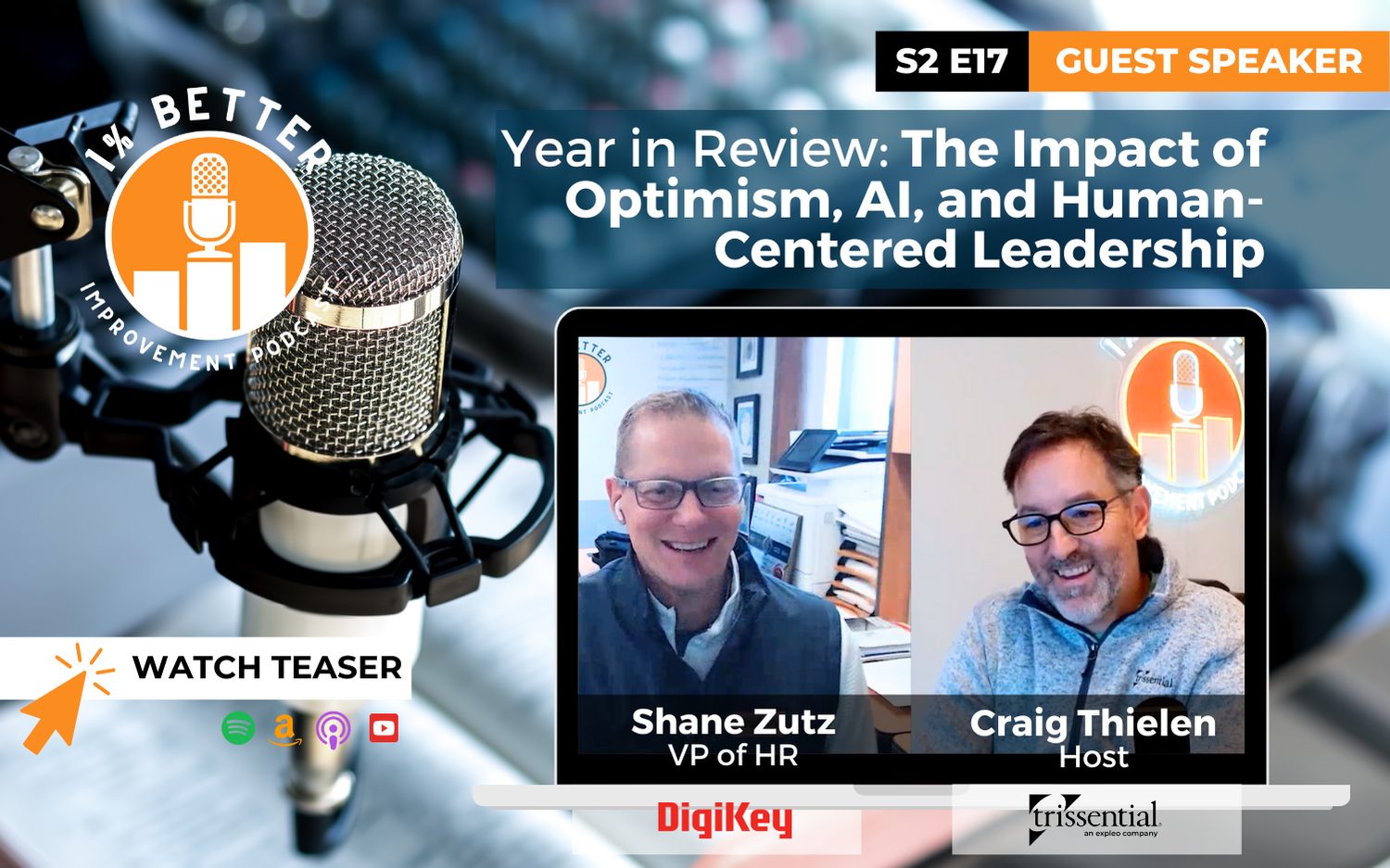
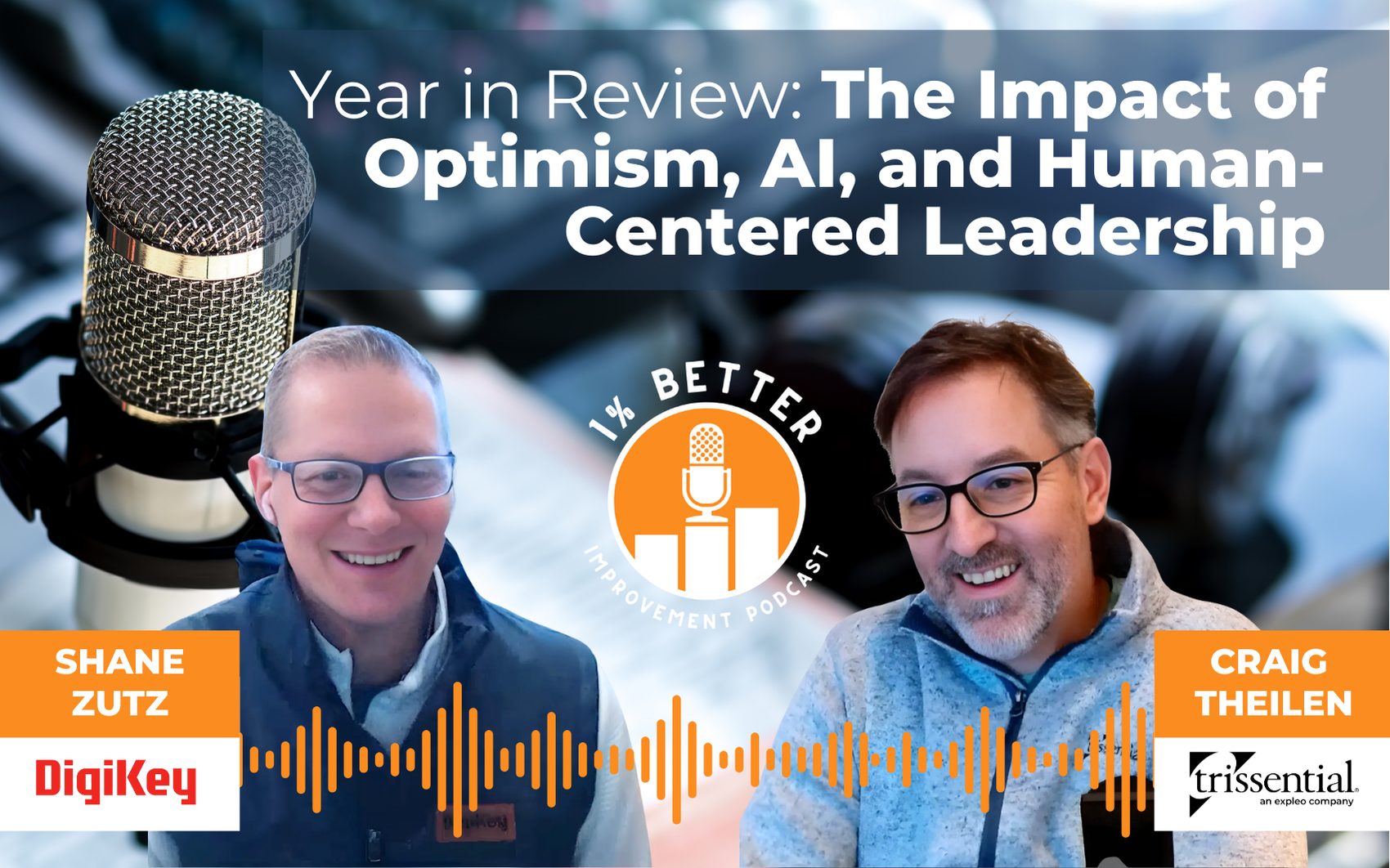
Hello, I’m Craig Thielen, and this is the 1% Better Podcast. Today, I’m speaking with Shane Zutz, and Shane is the Vice President of Human Resources at DigiKey. Shane has a unique distinction of being the very first guest on the 1% Better Podcast back in 2023, for which I’ll forever be grateful. I always call him the bravest podcast guest out there. So welcome back to 1% Better, Shane.
[00:01:11.08] – Shane
Yeah. Glad to be back, Craig. And the first, it only got better after that. I could say that because I listen in often, so for sure it got better.
[00:01:24.04] – Craig
I don’t know about that, but we do live and learn a little bit. And I’ll come back to that because there’s an interesting story there. But I’m super excited to be talking to you again. You’re also the first guests to make a second appearance. So if we keep this up, we might have to fit you for a jacket like they do on Saturday Night Live. And we talked, Shane… This is also going to be fun because this is the final episode in season two, and you are going to play the fun role of turning the microphone around a little bit and interviewing me. And so that’s going to be fun. And you have big shoes to fill because Kelcey Carlson did season one, and she is a true professional.
[00:02:05.04] – Shane
Yeah, I actually looked at that, Craig, and then I was going to bow out of this thing. She is a true professional, does an amazing job in her role. It’s all good. We may not measure up to that, but we’ll try to have some fun and pull out some good nuggets for that. It’s all good. Well, I’m going to turn it over to you. So, yeah, Craig, I’m super excited that when we look at this show and doing it a little bit different, I was nervous on the front end. And then as I started to take some notes and look back at your guests of season 2 and even season 1, it starts to really put and show this body of work, Craig, that you’ve put together in the podcast. And I think it’s always at the beginning of a podcast, there’s always these flowers of bouquets that get tossed back and forth. But if you really, really look at the depth and the width of the guests of their leadership abilities and experiences, it’s really, really significant. So I listen in very often to your podcast. I don’t listen to every single one, but I listen to many of them.
And so I thought I would kick off this morning by just having you listen to the potential impact of what you brought into the listeners of the 1% Better Podcast. So I won’t dip into season one, but I’m going to highlight this for season two. And I don’t have the last four or five episodes. I didn’t think we were able to connect on those. So this will take me just 30 seconds But here’s the different topics that you were able to tease out with leaders. And just listen to this, Craig. I think it’s very powerful.
Recognition of excellence in that idea around customer focus; personal growth; embracing change and enjoying the journey; leveraging the power of digital technologies while cultivating team performance; the role of technology, but also the role that humans play, and just driving that really tight connection; innovative problem solving in your role as a leader and developing those strong team dynamics; adaptability in your career; how to take care of yourself as a leader… I think many times the messages are push, push, push, more, more, more. So I thought that that was really an important podcast in 2024; and managing career transitions, I love that, Craig.
I think a lot of times leaders have different experiences. But as you hit different parts of your career journey, those transitions take on different importance and maybe there’s different things needed from you as a leader during those. So that was really strong. The role culture plays in success; Why authenticity and vulnerability are superpowers for leaders; Navigating chaos with intention and skill; aligning your purpose at work with your personal values for your true health as a leader and for your team; continuous learning and leadership through empowerment; How to empower your team, shifting from commanding to enabling; and finally, driving transformation through people, not just process, and recognizing our role as mentors in that process. So that’s almost a mic drop, Craig, when you think about 2024 and the people that you were exposing all of the listeners and followers to in your podcast.
So number one, I just want to say I’m a big fan of the work that you’re doing. It’s not easy to start a podcast. There’s that uncertainty… Is anyone going to listen? And things like that. And I will encourage you. I don’t know how many followers you have. I haven’t looked, but I know this for a fact that there’s many, many passive people who listen in to these things. So you can’t always go by the amount of clicks or the a lot of favorites and things like that. Anyway, I’m a big fan, Craig. I’m relishing the opportunity to be able to visit with you today, and kudos to 2024. So I’m going to let you jump in there when you listen to all of us.
[00:05:56.11] – Craig
That was fun. Yeah, that was fun to hear some of the different highlights It just brought back a lot of different memories. Some of them I connected right to… Sometimes when you get a smell or you see a picture, it brings you back to that moment. Some of that brought me right back to the conversation, and I know exactly who it was that we were talking about some of those topics. And it’s Shane, how I feel after I’m done with every episode is I feel this like, wow, I just learned so much, and we dug into such great topics. And I’m always so grateful for the opportunity to talk with some just amazing people, but also very hopeful that other people listen because there’s so much to be learned from every one of these conversations. So that was fun just to hear that. So thanks for pulling that together.
[00:06:44.14] – Shane
Yeah. On the other part, too, Craig, that I think is that as I reflected, you really have this, and I won’t call it a perfect balance because you’re not trying to strike that, but there’s people who work for large private enterprises. You have… or public enterprises, private too, as well. And then also entrepreneurs, and then those people that are helping support leaders across in all those different sectors and how their businesses are run. So I think that that’s another important… But let me ask you the first question. So with that great depth of knowledge and experience you brought, how do you go about choosing your guests? And I’m not asking you this so that someone listening can say, okay, I’ll do those things so I can get on the podcast. But as you set pace in 2023, you were very clear what you wanted to have happen in this podcast. You wanted people to understand that incremental growth can be extremely powerful when embraced. So how do you go to choose your guests so they lean into that mission and purpose of your podcast?
[00:07:48.04] – Craig
Yeah, it’s a great question, and it’s evolved, Shane. I mean, it started with, first of all, just a celebration of Trissential and 20 years of business and just us being grateful for all the people we’ve met in companies and work that we’ve been able to work with other people. We wanted to share some of the stories and just share some of that with other people to give back, and that’s part of our mission. And so a lot of season one, at least the first half, it was just basically friends, colleagues, mentors, people that I really grew to know and trust. I felt like they understood this idea of 1% Better, they really were about improvement and getting better. So it was pretty easy. But then when you got past that first wave, and after I had eight or ten of these conversations, I started I go, the diversity and every conversation I had, there were surprises, and there were things that I had learned that I didn’t know before. We got into a depth of conversation I wasn’t really expecting. And so then I started going, well, maybe I can have this conversation and the diversity of people that even in the first ten was quite good. And I thought, this isn’t just a C-Level conversation. This isn’t just something that we put leaders on pedestals. This is really a mindset that can cut across. So it started to broaden out, started pulling in people of different backgrounds and different roles. And every time that happened, again, the connective tissue, Shane, is I really wanted to talk about people that were passionate about improvement, passionate about not just saying, here’s my accolades and here’s all the great stuff I’ve done, but actually the reality of the hard work it takes and maybe some of the challenges and some of the learnings. And sometimes people that achieve really great things, not sometimes, always… They have really, in some ways, almost the greater the accomplishment, the greater the challenges and obstacles they’ve had to overcome. And so it’s a lot of networking and a lot of just finding people that are passionate to share their story in an authentic way that we can all learn from. And then started to rethink at the end of season one and season two.
And I think it’s continuing to expand Shane, which is it doesn’t really matter the role, the size. Like you said, we’ve got some We got some people who are individual contributors. We got some people that have started businesses. We got some senior level executives. We’ve even got people that are not even part of the business ecosystem. In season three, I think you’re going to see even a more diverse group of people. But the connective tissue is people that authentically want to share their journey, share the trials and tribulations, things that we can all learn from. That’s what I always look for. What story is there to be told that we can all learn from and that can give us a little bit of inspiration in all of our own lives. That’s half the fun for me is finding that. I don’t always… I don’t target certain roles or that thing. I just find what I think is a really interesting story that’s compelling that I think people can learn from.
Again, diversity is the key for me because we all come from different places and different backgrounds. We all have different challenges, we’re at different places in our life. So what might resonate with me might not resonate for others and vice versa. So I’m trying to get it as broad as possible. But again, all It’s all about improvement and how we overcome challenges and get better every day.
[00:12:05.09] – Shane
Yeah. It’s really well said. And the thing that I am so excited about us getting to connect this way today is I’ve told you this offline before when we’ve connected via teams and phone calls and in person. You have so much knowledge to share with others, too. So I’m really excited about how we can pull some of that out today. But I agree with you on, and again, out of the 15 to 18 episodes, maybe there were in season two, I probably listened to nine of them, I would say, that I was familiar with. And I would definitely agree with you that there is this authenticity that, hey, I don’t have this figured out. I’m working like crazy to still figure it out. It sometimes drives me crazy to figure it out. But I do agree with you, but there’s that passion. And then the way you have this ability to pull those stories out, that’s what people remember, Craig. And you just have such a gift there. So again, thank you for that. When you reflect on some trends, you started in January for 2024, obviously, with the first podcast of the year.
What trends did you potentially see? And I get that you have a wide diversity of guests, but did you start to see some things that that emerged in 2024 through your guests, that in lieu of the role that they were in, the companies that they were a part of, and the circumstances, that there were any trends that ran across that group that you were able to see?
[00:13:35.06] – Craig
Well, I think I’d have to answer that in two ways because it’s hard to separate my daily job from these interviews. I’ll probably answer that two ways. One way, just ‘24 trends. I just think ‘24 was the year that AI was born in the world for mainstream. I mean, it’s been around for a long time, but it became a real thing that everyone had to recognize and say, What do I do with this? So I think that was really interesting. A lot of people essentially just tried to educate themselves. What is it? Play with it a little bit and then understand how can this impact me personally, professionally, my team, my company. So I think that was an interesting trend I saw. Again, I get the opportunity to work with over the course of the year, maybe 50 to 100 organizations every year. And so that was a clear trend.
I think the word of ‘24 was tentative in total. I think there’s a lot of stuff going on. If you look back, we had a couple of pretty significant war conflicts, global conflicts. We have a lot of political divisiveness. We had an election. We had some pretty massive natural disasters. And the economic economics that was going on in the world were up and down, depending on industry, but overall lukewarm. So a lot of tentative, a lot of apprehension, maybe anxiousness, maybe anxiety. That’s what ‘24 felt like. Whether people verbalized it or not.
The interesting part, Shane, is when I then shift over to the actual interviews, the people that I spoke with, those people, which, again, they are inspirational people, all of them in their own ways, and they just have, I would say, optimism. And I think that’s what people need in tough times and good times and challenges. They need someone who doesn’t have all the answers, because I think you’ve picked up on that, that it’s not that these are the smartest people and they have the biggest degrees, they have the most experience. They just have some other, I guess, behaviors and abilities and traits that basically say, hey, whatever it is, whatever the challenge is, let’s work through it, let’s figure it out, and let’s get better because of it. And they have that optimism. I mean, I left every one of the episodes with an energy and an optimism and a bounce in my step. I just learned something. I got inspired. And it wasn’t because of the big accomplishments. It was because of how they got there. It was because it wasn’t easy. And it came back to some pretty basic things things, how you interact with people, how you treat people, how you look at relationships, how you learn. But sometimes it’s the recognition that you don’t have all the answers, and you just have to fight through it. So I think that’s a two-sided coin for you on that question. But I always got some energy out of those in the optimism out of the conversations.
[00:16:56.05] – Shane
Yeah, I love that you drew out optimism. I think sometimes their leaders can get feedback almost negatively when they’re optimistic, right? Now, if they’re blindly optimistic, I think people see through that. The people that you had on your podcast, they’re not blind. They have tremendous experience. And one of the words that I had written down was I saw this this real strain of DNA through everybody around human-centered leadership. Yeah, I would say that. And that doesn’t mean it’s kumbaya all the time. That doesn’t mean they don’t make tough decisions.
[00:17:31.10] – Craig
By far.
[00:17:32.03] – Shane
But I think sometimes, Craig, I don’t know what your thoughts are on this. I like to draw it up. Sometimes I feel like if you’re optimistic, then people think, well, you can’t make tough decisions or you don’t. I don’t tend to sign up to that, and I don’t tend to agree with it. But do you have anything to draw out there a little bit further on that optimism piece and human-centered leadership?
[00:17:51.03] – Craig
Yeah, I think there’s a difference between optimism and a confidence and we can figure this out together. And let’s work on this together with, I would say maybe cheerleading or I don’t want to talk about the tough stuff. I think there’s a big difference there. The epitome of leadership, Shane, there’s lots, and I know you do so much work in leadership, and you follow a lot of people. You have a lot of books, you read a lot, and I do as well. And I think that the epitome of leadership is a gentleman that was on my show. His name is Will Steger. Okay. And so he did something- We can have his screen right now, yep – He did something that was not only incredibly difficult, probably more difficult than going to the moon and back in terms of what they did. But when you think about leadership, literally their life was on the line. They were in a place that’s the least hospitable place on the planet. No one’s ever done before. We’re in Minnesota, as you and I spoke here, and it’s minus 20 below. They were at minus 130 below for weeks.
And His team that he was leading literally didn’t know if they were going to live or not. They had to make… We talk about business, and we talk about projects, and we talk about things, and we think these are tough conversations, even personnel, and are they the right fit? Did we make the right hire? Things that are difficult and challenging and big budgets and missing goals and objectives and things, it’s nothing in comparison to life or death.
And so I often think about that and go, if you want to talk about leadership, what they did and how they did and the decisions that they made and how they made them is really the epitome of leadership. And there’s so much to be learned that he wasn’t a command and control leader. By far, he was the opposite. And he had to have an optimism because if you listen to that story, and there’s a great movie as well, documentary of what they did crossing the Antarctic, more of the group wanted to turn back. I think there were seven or eight of them, and I think at least four of them were like, We can’t make this. We’re running out of food. We lost a dog. We’re out of communication. We tried. Let’s go back. We want to live. And he didn’t say, No, we’re going ahead. Don’t worry. I got it. He, through confidence and through being analytical but being calm, he talked through it. They talked through the challenges. They talked through the next steps. They talked through the probabilities. They talked through it as a team. And as a team, they then made the decision. But he did in a very different than we do a lot of times in the corporate world. It was a form of optimism, but grounded in reality. And it was a very difficult decision because, again, he’s responsible for their lives and the dog’s lives. And it’s a pretty big stake. So I think there’s a lot of lessons in how they went through that and how he went through that as a leader. And obviously, it turned out really well. But I think people want to be part of the conversation. I think they want to be heard. I think we all have fear, uncertainties, and doubts, and the fact that a leader can relate to that and talk through that, take input, and try to make the best decision as a team.
I think that’s what people value, right? If it was just Will saying, No, sorry, you guys can go back. I’m going ahead. I don’t think it would have worked out very well. Or if he would have tried… If he wouldn’t have listened to them or if he wouldn’t have been very thoughtful in making that decision. I think we can all learn from that to some degree.
[00:22:10.11] – Shane
Yeah, and to your point, his leading with optimism was highly strategic as well. You have the physical, the mental. You had to make essentially business decisions out there on which way to go, how to manage your resources, the wind, the direction, the whole along with their life. So to your point, that That’s really a good point. I love what you said, though, that sometimes optimism is just this humble confidence, and then you want to draw people in to be part of the conversation. So that’s a great takeaway, Craig. So let’s lean a little bit further into 2024…
[00:22:46.06] – Craig
Shane, one thing I just want to add back to Will, I just think it’s so profound. I asked Will specifically, how did you do it? Because you were in a tent for basically 20 hours a day in darkness, in this cold, weighing out your options. It had to be incredibly depressing, incredibly, you were afraid for your life. You’re afraid for the life of your team. That’s a very stressful situation. How did you deal with it personally, knowing that you are the leader and you have to ultimately make some decisions? And his answer surprised me, but it’s so profound. And he goes, Craig, I did fight over the position we were in and what to do for many, many days. And what I ended up doing was I had to give in. I had to release myself to the circumstances and let it go and basically recognize, don’t fight it. I can do it. I’m smarter. I can figure out a way. That’s the blind optimism. But he goes, I had to give in to it being Mother Nature, this world, this scenario, this environment. I had to give in to it. And once I did, I got clarity.
It’s very fascinating. Instead of him fighting the circumstances or saying, I’m going to overcome it, he gave in to it, which gave him peace. Then he got clarity on really more the analytics of, Now let me play out in a very pure, independent, unbiased way. Let me play out the scenarios versus an ego-led, I’m going to do it. I’m going to find a way. Then we have cognitive bias. Then we have all sorts of things that maybe skew our judgment or skew the situation. If you read a lot of these stories about people have died on Mount Everest or other places, it’s because the judgment of humans were skewed and their egos got in the way and other things got in their way. So I thought that was fascinating that his answer was, I had to give in to it, then I got clarity.
[00:25:03.07] – Shane
Yeah, that’s really, really well said. You think about it’s like control what you can control. And it’s just like some of the stories, you’re right, on Everest, if there’s a blizzard, you can’t control that. So now we recognize that, put it aside and work within that. And I think that’s where a lot of leaders get frustrated, right, Craig? Or they think, okay, the grass is greener on the other side of the fence and those types of things. And I can say that was some personal perspective on my own. When I switched careers from education to business – Absolutely – There was this period of time where I really struggled emotionally around that because I was like a fish out of water, and I had a network and we were doing some great things, and peer group across the state, all the things that make you feel connected as leader to essentially nothing. And I kept looking backwards, or I kept trying to control things that maybe I couldn’t. And when I just paused and took a breath and opened my eyes, I’m like, oh, wow, there’s all kinds of room at DigiKey to have a great impact.
And when I did that, I actually felt better. I mean, that’s a little bit vulnerable for me, but it’s like I just personally felt better. Well, when I felt better, I led better, too. I mean, that’s an obvious one that came out in some of your topics this year.
Okay, so outside of that, what was something that unexpected from one of the guests that… I mean, I always joke with people like, what did you go and call a friend about last night? Or what did you tell your spouse about based on a meeting or a promotion or a big win in a project? But in this case, within the context of your podcast, where’s one of them when the day ended? You just had to tell somebody, I can’t believe this story, or this hit me this way, or it made me think about, I don’t know, my childhood. It made me think about my first job. Or what’s a moment that maybe impacted you? And this can be more personal. We don’t always have to talk about leadership, but…… because part of who you are, Craig, and how you show up is why the podcast is special, right? But who hit a nerve or a good nerve with you in some of the times you spent?
[00:27:11.11] – Craig
Well, it’s an amazing question. And part of me wants to say, Shane, every single one of them in a different way. And this is what I think every conversation, I think the podcast format, I don’t think I’m maybe the best podcast podcaster in the world. But I think that the format itself, and it’s proven, it’s the biggest format in the world right now for having conversations. It’s incredible the impact it’s having on the world. But I think the format allows people to get into a depth of conversation. I would say with complete honesty is that every single one of the episodes, I got something that was a personal connection, a personal aha, personal wow moment. But I’ll give you a couple of examples because it’s fun to talk about them. I would say that the David Marquet was a memorable one because he’s, first of all, very well known leadership guru. He’s written a book, Turn the Ship Around. He’s working on a second book, incredibly popular New York Times bestseller. And he’s really popular in the circles of organizations that are trying to find better ways to lead and get work done. So this enterprise agility idea and this team of teams, and how do we get work done? And we do a lot of work in that space. He’s very legendary. And so the thing that was fun is… And his pedigree is something that’s a bit intimidating, right? He’s a commander of a nuclear class submarine. It’s one of the most powerful, dangerous environments on Earth. And he commanded this ship. And not only did he do that, he reinvented how to do it in a leadership way that’s very applicable across any organization of any size. And so I was talking to him, and he’s going through his techniques of intent-based leadership and servant leadership. And I just asked him, I try to cut through the dialog and try to get to the essence of how did you get here? How did you get the aha I asked him, at the end of the day, what was it? What’s the magic? Because you were taught how to do command and control leadership. That’s how the military teaches you. That’s how the guidebooks and the policies are all written. So first of all, we realized that necessity is a mother of invention. So all of his teachings, he would have failed miserably. And he had to turn around the lowest performing nuclear submarine, and he was thrown in. He couldn’t be the command and control guy because he only had about three months of experience on this particular ship, and they’re different. He was trained on a different one. And so he really didn’t even understand the mechanics of this thing. And so he goes, this isn’t going to work. So you had to come up with a new way. And I go, so what was it? What was the key to you shifting them? Because everyone has been taught the same way. Everyone had the previous commander. They’ve all been taught, I take orders, orders for my boss, and they take orders, and it’s a very much command and control situation. So how did you actually change it so that people would change behavior? And he goes, language. I had to change the language. If I was using the old military language, they weren’t going to ever think differently. So I had to ask them different questions, and I had to use a different language that they go, okay, this feels different, and I had to repeat it. And I thought that was really, really interesting. The other one that stands out, and by the way, I’ve reused that so many times with other clients going, if you’re trying to change something, are you using the old language that you were using before the change?
And if you are, that gives people signals that it’s really the same. It’s just – Excellent point, Craig – So the other one that was really interesting, completely different, the way that it hit me was Richard McDonald, and he’s just a brilliant leadership coach, and he’s from South Africa. And when I was asking him about where did he get his philosophy, where did he get his learnings about leadership, how does he think about leadership? He immediately went to the ocean, which is fascinating because South Africa is really an ocean country, and they have an amazing surfing and amazing scuba diving. And it’s an ocean culture, essentially. And at least along the coastlines. And I had been to South Africa twice, and he started talking about leadership like nature and how it just reminded him and everything he knew about the ocean and about nature, like, for example, you can’t control it. You cannot control the ocean. You cannot control the weather. You cannot control. In fact, expect the unexpected. And he witnessed some pretty massive storms at a young age, and he goes, he recognized this is not something… It’s not something to be afraid of, but it’s not something to think you understand or that you can master, you can control. You need to be respectful. And so that’s the way he thinks about leadership.
Don’t think you can control your context. Don’t think you can control the whole environment and the outcomes. But try to understand it, try to be a part of it. So be a part of the ocean, be part of the system. Don’t harm it. Don’t try to control it. And he just had a lot of connotations to nature and the ocean. And that really hit home for me. I’m like, it all makes perfect sense. We’re all part of one globe. We’re all part of one team, one organization. How do we coexist? Just because someone’s got a different title doesn’t mean they’re more important. The shark’s not more important than the squid is not more important. It’s all part of an ecosystem. If there’s not balance there, then bad things happen. We know that. And I think we’re learning it actually in the globe that everything we do has an impact. How do we coexist with nature? He really tied that together, and it really made sense to me. Having been to South Africa as my first place, I did a scuba dive. And so that was fun because it brought me back to my experience there, but it also helped me understand leadership in a different way than even someone like David Marquet or Will Steger. They all have very different terminology and thought processes, but actually they’re all similar in a lot of ways as well.
[00:34:08.09] – Shane
Well, I think what was interesting, what you just said in my words, not yours, is that, and it shines in your podcast, right? It’s respecting the diversity of thought and how people can lead. And so what you just said is that when you think about the ocean and all the things we talked about control what you can control and release myself to the circumstances. And the other way to say it is respecting the moment. And these can be really positive things. I was talking to my son, he’s a Senior, and three or four other pictures yesterday, and we have a really nice chance in the spring to get to the state tournament for baseball is one thing. And I actually talked yesterday about respecting the moment. So when you think you don’t want to do the extra work, you don’t get this moment back. And you know that, Craig, that you don’t always… So again, it’s just this idea of slowing down and looking at things with a wide open lens. And I need help with that all the time. I don’t tend to just be a bulldozer through things, but that’s why these leadership podcasts and the diversity of people you bring in, they’re personally really important for me. And I think you just highlighted the many ways they show up for you, of course, in your own leadership.
So let me switch gears. So that was 2024. And I want to get a little more personal to Craig, because like I told you, I think you had a lot to add. So et me give you an easy one to start with here. What was the best book you read in 2024 and why?
[00:35:38.06] – Craig
Great question. I try to always be reading books. I’m at any given time reading maybe three or four books. I would say the one that stands out is the last one that I read in 2024. It might surprise you, and it’s something I got so much out of. I actually bought it for all my siblings. I’m from a big family, so I have nine brothers and sisters. And so I purchased one for all of them and for my kids and a couple of other friends, and it’s called Good Energy. And it’s by Calley and Casey Means. And this book is phenomenal. It talks about health and longevity in a way that’s more broad. I mean, it talks a a lot about food, and it talks about what we put into ourselves and how that’s the source of most disease and most issues that we have health-wise. But it also talks about a lot of other things like sleep and stress and being part in nature and very well-rounded. Essentially, the title is We are producers of energy, humans are, and we can be producing good energy, which we’ve talked a little bit about. You can feel like I feel good energy when I talk with people on my podcast, you just feel it.
So there’s an interpersonal connection that you can make that creates energy, your mindset creates energy. But what you put into your body, whether it be good nutrients or whether you put toxins, that’s going to also produce good or bad energy. And if you think about sickness, So my goodness is bad energy. And so it’s an amazing book. I learned so much from it from so many different aspects. And so I think it’s really foundational. Anyone that wants to be happier, healthier, live longer, this book is phenomenal.
[00:37:49.06] – Shane
Terrific. I haven’t actually even heard of that one, Craig, which is not a big deal, but I’ll have to check that one out or share that with some of the people I share things with. So let me take you back. Let’s talk before you were a leader, whether it was high school, early college, early career, I’m not sure. You’re going to have to decide who was your first mentor? What was their name? Recognize them and what did what impact did they have on you that you didn’t know it at the time, but probably still influences you bit as a leader, or at least propelled you into this idea of leadership.
[00:38:30.00] – Craig
Yeah, I think we all have to start with our parents because I think from the day you’re born or perhaps even before you’re born, they influence you. You absorb and you adopt their traits. And I had two wonderful parents. I learned a lot from both of them. So that I think I have to start with. I could go into a lot of depth there, but just hard working, how to treat people. You don’t get entitled or granted anything in life. You got to go out there and make it happen and earn it and be good to people. Just a lot of really good values that I still will always have and always will look back at them for.
But beyond the parental influence, when you’re in grade school and middle school and high school, you don’t really think of leadership. It’s like the last thing from your mind. But I think there are moments that you go back and go, that was a moment where I made a decision or didn’t make a decision. And probably the big first mentor, someone that I could look up to and help really challenge me and define me was my high school football coach, and I know you probably can appreciate this. You’re an athlete, a baseball player, and played sports. But a guy by the name of Rick Manke, and anyone who played football for him, and I think he’s in the Minnesota Hall of Fame from a coach standpoint, he won state championships at Glendon Felton, Detroit Lakes. We won a state championship, two of them. He influenced their life, and he was military style but he commanded respect because you knew that his intent was to make you a better person. It wasn’t just because he wanted to win football games. It was because he wanted to make us all better people. And he set the bar so high on what excellence looks like, how you have to act, how you have to dress, how you have to represent yourself, your family, your community. He set that bar so high. We didn’t want to let him down. And he also, on a personal level, he gave me confidence that I could be a leader. I ended up being the quarterback, and you have to exhibit some leadership skills to do that. And I didn’t know if I that in me. I think a lot of people want to be the quarterback, but there’s a lot of responsibility.
You’re responsible for the other guys in the right spots, knowing the play, knowing when to call this, knowing when to call a timeout for the team’s success. And he really instilled that I could do it and guided me and mentored me a little bit. But mostly, interestingly, even though I said he was a very military-style, disciplined guy, he didn’t tell me how to be a leader. He actually gave me opportunities to discover it and fail and learn. But it was clear that he expected me to be the leader of this team, and he didn’t say, you did this wrong, or you did this right, or you need to do this. In a true coaching, and we don’t always think of coaches. We think coaches of Xs and O’s, and they tell you what to do and what’s wrong. He was a true coach in the sense of he let me figure it out and let me figure out what was inside and how I could lead this team. And that was tough because I wanted the answer. I went into his office one time and said, hey, what do I need to do to get to the next level? And he more or less said, you need to figure that out yourself. And so that was pretty profound. And we had a lot of success as a team, but mostly, I think I and we as a team, we learned a lot about ourselves.
[00:42:27.12] – Shane
Yeah. I ran across something last week, and it just popped into my head again as you were talking about Coach Manke, and what a great example. Thank you for sharing that, number one, with your parents, and then also with a coach that had an impact. But there’s this… I read it or I heard it on something. Actually, it was John Maxwell’s podcast, Recap for 2024 – Sure – And he talked about this idea is that you don’t manage people, you lead people, and you manage processes. You manage budgets, but you lead people. And that’s really what you said. I love the opportunities to fail. To your point, your first podcast of the year with Rick King from the Airport Commission in this idea around excellence. I love the Minneapolis airport. There’s probably some bias there, but you can go to 100 other airports.
[00:43:25.15] – Craig
Number one. Yeah.
[00:43:26.13] – Shane
Yeah, it’s unbelievable. It’s unbelievable. And so I think sometimes people take… When people have these high expectations, I think that’s what leaders need to do is really set that knowing we may not reach it, but if we come down, but if we set that bar back further, we’re going to probably come up short there, Craig. And I think there’s opportunity for leaders in there. So I love that, really, how you said that. That really made a lot of sense to me. So now let’s start moving to 2025 here as we get closer to the end. Where do you see that leaders are going to have the biggest opportunity in 2025 or challenges. You can look at it through either lens and they’re both positive. But where do you see that? Where do you see 2025 bringing us from a leadership perspective? And listen, again, I want people to understand, when you inform these questions, it’s with a wide background from a tremendous amount of experience with many different businesses, plus your exposure in the podcast. So I’m really interested in this question, probably personally more than anything. But where do you see some opportunity or challenges that are going to rise for leaders?
[00:44:36.13] – Craig
Yeah. Again, I love it because it’s so fun to look back and look at trends and then look forward. And I think ‘25 is already shaping up to be a really amazing and unique year. And I’m super grateful we’re alive in these times. I sense a lot of optimism, frankly, from a lot of people and businesses and industries. Today is the presidential inauguration. We have a whole new, and again, regardless of what side of the aisle people support or what they believe, there is a change, and there’s a pretty strong change that’s happening. I feel that economically, I feel that there’s hope in the world that we can move beyond some of the conflicts that we’re experiencing, the wars, how we can move beyond that, how we can work together more in countries and across the world with our environment. I sense a lot of optimism, frankly, in terms of, practically speaking, how I think that’s going to show up in companies. Again, I always have to put myself in the moment. And so right now, the number one topic in every organization is, what are we going to do with AI? I think that that’s what’s interesting about that, Shane, is it almost is good in a way, because I know there’s a lot of fear and certainty of doubt. Is AI the demise of humanity? Is it going to take over? What’s our role in this world? Because once you understand it, it’s incredibly powerful. Yes, it can do things well beyond our comprehension and our abilities. But what I also look at it and say, this is going to allow us to bring the focus to where it needs to be… in that, and a lot of leaders, I talk with a lot of people, and some are CEOs, and some are CIOs, and some people have lived their whole life in technology. And I think everyone really recognizes, I can’t fully understand AI. I can’t fully understand… I can’t be the expert in it. So what can I do? Well, I can make sure I have great team that is educated on it. I can make sure that I create an environment of curiosity, an environment of learning, an environment of safety. Maybe we need to make sure this is a safe and ethical use and really bring back to core principles. What’s the culture? This is what we’re good at with humans. We’re good at connecting. We’re good at, hopefully, decision making, having empathy. These are things that we’re not going to give the keys to AI, or I sure hope we don’t for a long, long time.
AI, and you said this earlier, you said human-centered. I think that’s the moment I’ve started to even use that when we’re talking to clients of this idea of human-centered AI. We’re still the center. We still control things. We allow it to do certain things. But how we do it and how we let it complement us and enhance our processes and enhance our scalability, we can control that. But if we don’t do it together, I think then you could lose control of it, or you could be afraid of it, or you could say, Let’s control it. Maybe your competition is going to unleash it. I think this notion of human-centered comes back to culture. How do we connect with our customers? How do we connect with each other? How do we bring people’s talents and passions out? How do we create great environments for people? How does AI enhance all that? I think that’s a interesting thing, but all the conversations that you and I have had on the podcast around leadership and how we do things, I think, is even more important in an AI world, not less important.
[00:48:42.07] – Shane
Yeah, great point. I think it’s so easy to get caught up because it’s the most powerful technology the world has ever seen collectively, right? And so then you get caught up in that. But to your point, to lead through AI, not through it, along with it or through it, I guess, either way, however you want to say it, is going to take that just tremendous fundamental leadership around all the things that we’ve already talked about today and pulling from your guests throughout 2024. So that’s a really good point. Just a couple more quick ones here, Craig. Your company is so supportive of the podcast, so I’m interested in what conversations internally have the podcast driven for Trissential.
[00:49:26.09] – Craig
Yeah, it’s been interesting. Again, first we started to give back to our clients and people about just things that people we’ve met and the experiences that we’ve had. It’s really started to evolve and snowball. We’ve always been an improvement company from day one. Trissential stands for the three essentials: strategy, management, and execution, and how those three things come together to help organizations have success and improve. We call it the shape of business improvement. And so we’ve always been an improvement company, but 1% Better, it puts a little bit of a fine point to it saying, how do we get better every day? And we need to because we have to stay ahead of our clients to help pull them ahead. And so we’ve started to do internal learning development with the 1% Better mindset. How can every one of us get better every day? We’ve started to do some of our own process improvement. Essentially, eventually eat our own dog food, right? Yeah. That’s been fun. It’s been fun to see. It’s a little bit of a branding thing where we can all rally around, Hey, how do we get better? Because then we can make our clients better. That’s been a fun thing. We’re going to continue to, I think, invest in that and try to proliferate and even maybe try to bring it into some of our engagements – Sure –
It also caused an interesting weird dialog around, well, is 1% Better? Is that all? Is it limited to that? Maybe a company wants to get 100% better. It’s like, I don’t think 1% Better, the mindset is limiting at all. In fact, I think it’s unlimited mindset. Essentially, it’s just saying every single interaction, every day, if you get better, wow, think about that after 30 days. Think about that after a year. I think it’s something like you’re three times better or 350% better if you do this over a course of year. Just think what that could do to a department or a company if that really was the case and you’re getting smarter and better every day. I think it’s pretty powerful.
[00:51:45.06] – Shane
Yeah, wonderfully said. I’m not making a comment. That was super well said. And kudos to the company as well for supporting because I did want to draw out the meeting at Trissential because we’ve talked about that before. So you went where I wanted to take you. All right, two quick ones. One is you could have any guest in the world on your podcast, 2025, I can snap my fingers and make it happen. Who’s here and why?
[00:52:12.00] – Craig
Well, that’s a tough question because, man, there’s so many people past or present or this or that. But the first one that came to mind, so I’ll go with it, is Joe Rogan. I mean, the guy, what he’s done with podcasting is mind boggling, and how he started. And talk about simple, humble roots. It’s like him and a buddy, this is like, we didn’t even have technology, really. And they were just shooting the bull about a couple of things. And it was just to grow into where he’s got… he just signed $100 million, $200 million contract or whatever. He’s probably worth a billion dollars and the tens of millions of listeners and the people that he has on his show. So I would love to talk to him and interview him about his journey and just the people that he interacts with. And I’m fascinating. It doesn’t matter if he’s talking to some of the smartest people on Earth, like Elon Musk or scientists on certain topics or some topics that are out there, like UFOs and that stuff, or whether he’s talking about just comedians or whether he’s talking to people in politics, like he said, Benjamin Netanyahu. And he can hang with them. He can talk intelligently. It’s pretty amazing. So that would be a fun one to get on just, again, to reverse the table, so to speak, and put him on the spot.
[00:53:41.02] – Shane
Pull the learning for your end selfishly. That’s a good one. Okay, last question. And as we wrap up season two and again, Craig, I just want to thank you so much for the opportunity. What are the goals we have for 1% Better Improvement Podcast? In 2025 Season 3?
[00:54:03.03] – Craig
Yeah. So again, two sides of the coin. One is just want to really eat our own dog food on it and just make it better every episode and just continue to get really interesting, inspiring people and try to learn myself and try to get better at pulling out the superpowers and pull out the inspiration from each one of them. The other side of the coin is I just really think there’s so much value from these conversations and learnings. So to get it to more people, how can more people hear this and listen to it? Because, again, I learn every single time, and I’m confident that other people will as well. So we’re going to try to get it out to more and more people however we can.
[00:54:51.06] – Shane
Well, great. Wow, be proud. You’re, I think, 31 or 32 episodes in, two seasons down, gearing up for season three. And in 2025, I know all that I’m looking forward to continue learning with the guests that you pull in. And again, if I could give you any encouragement, your style resonates well, Craig, in being able to connect with people. And that’s why you’re getting these really unique stories that, again, you have talented leaders all day long that are showing up to the podcast. But there’s these stories and these nuggets that come out. I think that a lot of podcast, I think podcasters miss. They I treat it as a checkbox. Here’s all the things I got to get through. How did you do that? And it gets a little mechanical…You avoid that. And I think keep getting that wide diversity is just so important because I know that I pick up things and we’re a fairly large company, right? So people think, well, you must have to listen to people work for large companies. It’s like one of the best things you can do as a leader is to learn things outside of your industry and from leaders who don’t have the same background, like you said, with the gentleman, the coach in the ocean. What can you learn from that? So that was such a good parallel. But keep up the great work. And thank you so much for the opportunity today, Craig. I truly, truly value it and appreciate it.
[00:56:13.06] – Craig
Well, thank you, Shane. It’s always a pleasure to talk with you. I do have, by the way, I have one final question for you. And before I ask that question, I’m super excited about this next season. And I think you’re going to see even more diversity of people on the show, just a little bit of a teaser we have as an example, because we tend to have a lot of business leaders on. We have a kid who was the superstar of the March Madness NCAA tournament last year, and he spearheaded the upset of Kentucky, hit 10 three-pointers. So he’s going to be on the show, Jack Gohlke. Super excited about that. And he’s a one-percenter.
[00:56:57.06] – Shane
We talked about him. I remember that.
[00:56:58.11] – Craig
He’s exciting. And then I got another just really fascinating story that will, I think, blow a lot of people’s minds, a kid by the name of Chris Nikic. And he’s got mental disabilities. And the things that he’s done, anyone that’s got full access to all of our abilities wouldn’t dream of doing running ultra marathons and Ironman and being two-time ESPY winner and spokesperson of Special Olympics and speaking in front of massive organizations, just what he’s done is so inspiring. And it just goes to show you this is nothing to do about title or role or anything. It’s just about a mindset. And so that I’m really excited about. And he also anchors his work and what he does to 1% better mindset. So that’s going to be fun.
But last question for you, and I just realized, Shane, I think you may be the only guest. As I got into this thing, I started figuring out what do I want to do with a rhythm to it. And so I asked every guest, I thought every guest, the last question, which I never asked you because I didn’t have that figured out yet. So I’m going to ask you the question that you never got to answer the first time. So Are you ready for this?
[00:58:16.04] – Shane
Let’s go. I can do it.
[00:58:17.14] – Craig
So the question that every guest has answered is, step back from all of the stuff that we talked about and just look at your entire life, your career, what you’ve learned as a human, and then say, what would you give back to either yourself when you were maybe in high school and you wanted to share it with yourself or maybe your grandkids someday and you want to pass on some wisdom and learnings that you’ve had in life? What would those things be?
[00:58:47.08] – Shane
It’s something I actually do think about, and I can say it very quickly because there’s three things. I tell my sons, three of them, and they’re getting into their careers and in college and things like that. But there’s lots of things that when that day comes when you’re not around and you list all your accomplishments and you’re on this board and you did that and whatever. But what I want people to know about me is that I cared about people and that I worked really hard and I really respected people. Sometimes caring for people and respect, they’re not exactly the same thing, right? And respect means, I may disagree 100% with your view, but I’m going to take the time to try to learn it and understand. So I just feel like there’s so much success that can be had, especially as the world pushes away from caring about others, respecting others, and working hard. And hopefully now we’re going to see dynamics potentially change 2025 and beyond for a multitude of reasons. But I truly believe in this idea, Craig, of caring about people, respecting others, or working hard. I mean, that’s something I would love to… Somebody would say, you know what? I heard that from Shane, and that made some sense me. That would make me feel really good, to be honest.
[01:00:03.07] – Craig
Well, that’s a great way to end the conversation today. Those are three outstanding, profound, and deep pieces of advice that anyone can learn from. So thanks again, Shane, for being a two-timer on 1% Better.
[01:00:17.15] – Speaker 2
Yeah, my honor, for sure. You take care of Craig. Thank you.
[01:00:21.10] – Craig
All right. Thank you.
check out other podcast episodes