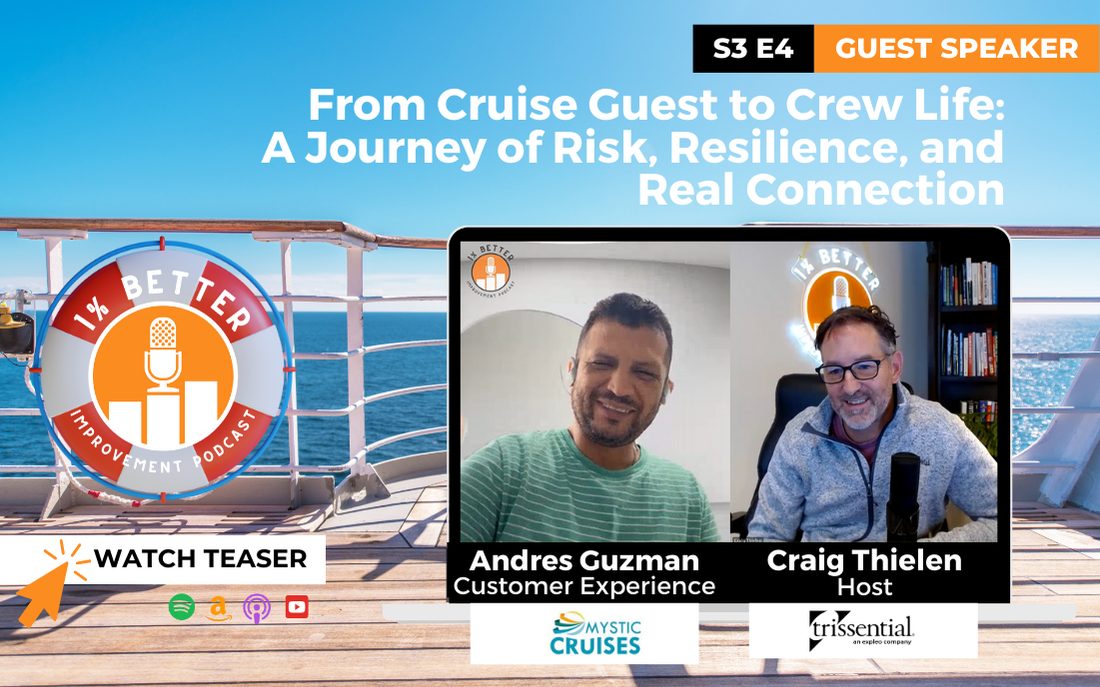
Find us on your favorite podcast platform including: Spotify | YouTube | Apple | Amazon
1% Better Podcast Andres Guzman – Quick Links
Learn more about Mystic Cruises
Connect with Andres Guzman on LinkedIn
Connect with Craig Thielen on LinkedIn
Check out host Craig Thielen’s full bio page
Key Takeaways
- Life Transitions Create Opportunity – Andres took a leap of faith by leaving his corporate job and ultimately found his dream career at sea
- Authentic Service Builds Trust – Genuine human connection—not just technical service—defines a guest’s experience
- Cultural Understanding Matters – Working with over 25 nationalities taught Andres how to lead with empathy, not assumption
- Adversity Can Shape Maturity – Financial struggles, long commutes, and career resets all helped shape his growth and focus
- Small Moments Leave Lasting Impact – Whether helping a guest or mentoring a teammate, consistency and care make the difference





















1% Better Podcast Andres Guzman – Transcript
[0[00:00:05.14] – Craig
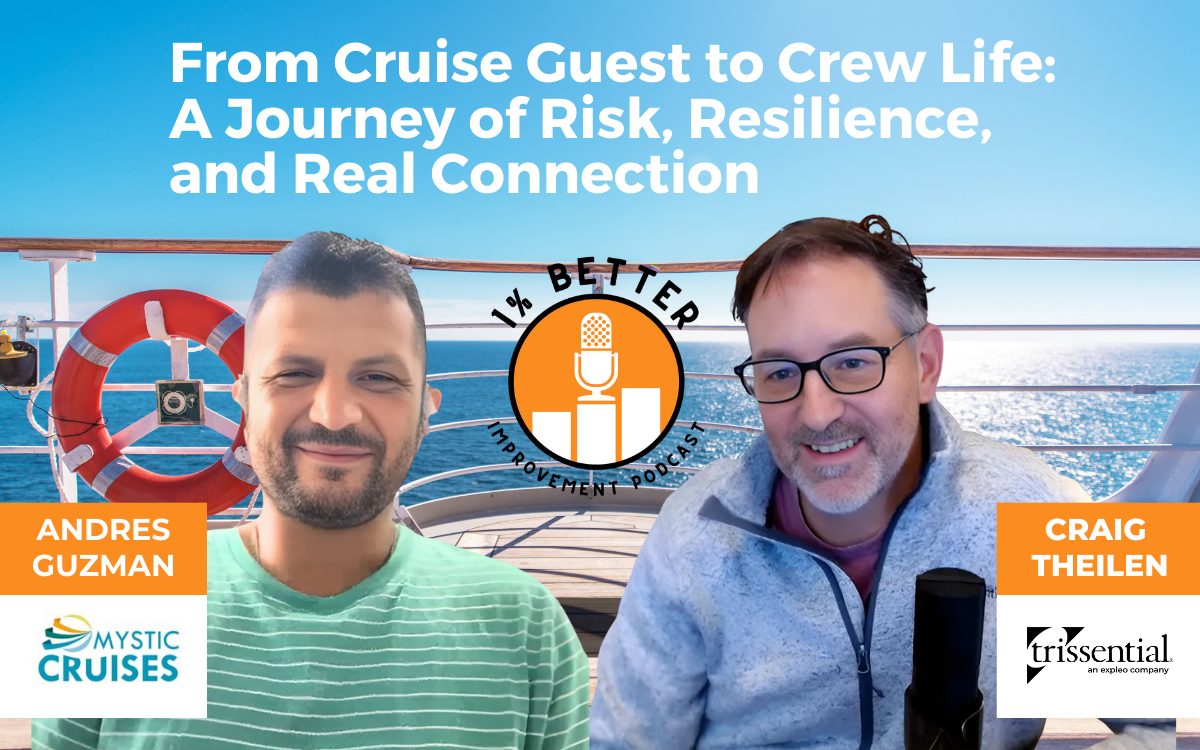
Hello, I’m Craig Thielen, and this is the 1% Better Podcast. Today, I’m speaking with Andres Guzman, and he is calling in from some unknown location in the middle of Colombia, South America. Welcome to 1% Better, Andreas.
[00:00:23.03] – Andres
Thank you, Mr. Craig. Thank you so much for the invitation. Happy to be here talking with a really good friend of mine.
[00:00:30.12] – Craig
Yeah, well, let’s talk about how we met. So we met on a cruise ship, Atlas, a luxury cruise line, and we were bouncing up the Coast from Buenos Aires, Argentina, up to Rio de Janeiro, Brazil. And you worked, and you still do work for Mystic Cruises. And we met on the ship. And I think what caught my eye or why we became friends is, A, you were just really good at what you did… You were very positive and cheerful and helpful, which is obviously your job. But you seem to have a different perspective. First of all, I think you had a lot of interest… We had good conversations, and you seemed very worldly when we asked you questions about going on shore. You always seem to have good advice, and we just built a connection. You obviously are traveling around the world. Travel is one of my passions, and so we’ve stayed in contact. But as we’ve gotten to know each other, I’ve learned that you’ve got this really amazing life story. I thought you’d be a great fit for 1% Better. But do you remember the cruise? Do you remember when we met?
[00:01:44.05] – Andres
Yeah, of course. Like you said, we were in the south part of South America. You were with Matt and Brenda. I guess the first connection, I normally made the first connection talking about the sports and where you’re from and Minnesota and the Vikings… talked a little bit about that. Then, of course, working in the front desk in the customer service part of the ship or the vessel where I work, while it was easy to interact with you, Matt and Brenda, and keep talking through the cruise. I guess after that, we changed numbers. And here we…
[00:02:31.05] – Craig
Right, and it’s been fun ever since. So let’s go back and talk about your early life. You speak very good English, and you went to university in the United States. So tell us about how you got to the US, your early career in the US, and just a little bit of who you are.
[00:02:53.04] – Andres
Well, I grew up with really good education given by my parents, my family. So here in a private school in Colombia, then when things were not okay here in Colombia, I moved to the States. I was able to go to school in the United States.
[00:03:09.00] – Craig
I’m just curious, was that a difficult thing to apply to and go to university in the United States?
[00:03:17.14] – Andres
What happened is that I already have an uncle that graduated from Texas A&M. So he did the whole process of getting the I-20 and the whole process of getting all the paperwork. And mostly the job is done by the university while you do that. Then it was to start English as a second language and I started my process to start college. Then after that, it was not an easy process, but it was easy living with family members. I moved to Texas, and I have to say that I have never met anybody in Texas that have treated me wrong.
[00:04:01.14] – Craig
Oh, nice. Great to hear. They really love their football, too, don’t they? Texas A&M.
[00:04:06.08] – Andres
I mean, it’s Mr. Craig. I will tell you, it’s just how you approach to the environment, not how you let the environment approach to I mean, if you became part of the… I was really into the history classes. I remember history. 1301, I think it was, and government, 2303, when I was in college and things like this. But I was always around American people involving the sports part. I was really involved in… I had my Latino friends, but I had my American friends.
[00:04:46.05] – Craig
Yeah, you integrated with the locals or with people that were coming probably from all over to go there.
[00:04:52.08] – Andres
And with everybody. I have never had a problem, never had an issue with anybody. And it was a really good time growing in the States. And I love it.
[00:05:02.06] – Craig
Okay, so you graduated from there. Then what was your early career like?
[00:05:07.07] – Andres
I worked for a little bit with USA Gymnastics.
[00:05:11.07] – Craig
Right. Okay, so who did you work with? Who was the coach?
[00:05:15.14] – Andres
I ended up working with Bella Caroli, Michio Michio Kutchi, back in those times when they did the…
[00:05:27.08] – Craig
I could not believe when you told me that you were with Bella Caroli… So he was obviously if not the most famous gymnastics coach ever. I think he started in USSR, Russia. And then he came over- He was the one that built the US.
Right. He came to the US to build our program up to compete with Russia. And I think he had Mary Lou Reton. And it was in the heyday of gymnastics, was really in that ’80s, 1980s and ’90s. And so what was it like working with Bella?
[00:06:01.03] – Andres
He was a really nice guy. Also, it was a lot of coaches, like in gymnastics, Miso Miso Gushi, for example. He was the men’s gymnastic, but he was building the pre-school program, so I was not really involved in gymnastics I mean, it was not my thing, to be honest with you. And then I met the owner of LA Fitness and ended up working for LA Fitness. That was something that catch my attention working with customer service in sales in Houston. I opened the first gym back in 2001, I think, when it was the Bally’s and Gold’s gym.
[00:06:37.13] – Craig
Okay.
[00:06:38.08] – Andres
And I’m working with LA Fitness as well in the States.
[00:06:42.14] – Craig
And so, okay, so you worked for LA fitness, opening up a bunch of gyms, then what?
[00:06:49.01] – Andres
I did banking also with Wells Fargo.
Okay.
[00:06:52.14] – Andres
I started working in different things involving sales. That was something that make really good commissions. I remember it was also Wells Fargo was something funny because I quit Wells Fargo and four years later or five or six years later, the Netflix series or documentary came out about how they were robbing or increasing their money or something like that. Yeah, they were selling accounts. It was in the time that I was selling, and I was a really good salesperson, but I was doing what I was like-
[00:07:29.04] – Craig
Doing it by the book, what you were taught… Yeah.
[00:07:30.06] – Andres
So it was also pretty good. And then after that, things started changing in the States. I started getting closer again to my family that was already in Colombia. I started traveling a lot to Colombia. I met who is right now my wife. So I ended up in Colombia again, and here I am.
[00:07:47.13] – Craig
Okay, so you were in the States, and then you started going back. You met your now wife. Is that why you decided to move back, is to be with family, to be with your new misses or new girlfriend?
[00:08:02.02] – Andres
Mrs. Guzman. It was a really nice connection with her. We’ve been together for 14 years now. We have a 12-year-old, and I decided to move to Colombia because of her. She’s close to her family. We want to be here in Colombia. Living here in Colombia is nice with good salary.
[00:08:22.04] – Craig
But that was a big decision. I mean, a lot of people that come from South America, Central America, they get to the States. Was that a hard decision to decide to move back?
[00:08:33.10] – Andres
It was hard, but it was something that at some point needed to be. I’m Colombian. I was born here. All my friends are here. My family is here. Everybody is here. Traveling back and forth from Colombia to the States is expensive. Living in two places is expensive. Working in the States and having a family in Colombia paying for two houses and not being able to be together because I’m not able to save a lot of money. It doesn’t make sense either. And like I say, I mean, Colombia is a nice place to live. I mean, it’s really, really nice country to live.
[00:09:14.05] – Craig
So and you at the time, this is during COVID. And so you had a job that allowed you to move back and retain the job originally. Is that right?
[00:09:21.14] – Andres
Well, here in Colombia, you make really good income when you do something related with English. Having job opportunities here is hard if you don’t have the degree of the degree of the degree or connections, and there is a lot of corruption here. If you don’t pay attention, you also can make a living out of it. Working with English is something that pays really well, either being a teacher, teaching English for an academy that teach adults, not only kids or in a school, but also because of the English in Colombia, that it’s clear, and the people that learn English that is from Latin America, some countries like Colombia, English is sounds attractive when it comes to customer service or with sales.
Sure.
[00:10:21.08] – Andres
I end up working in the call center industry here in Colombia for companies that are outside Colombia, so in United States or even in Spain, doing customer service in English or everything related to telephone companies, internet, air conditioners…
[00:10:43.10] – Craig
So because of your education in the States… you’ve lived there… you have very good English… you were able to get a job relatively easy for, I guess, a global company. Then I think you lost your job, right, through COVID.
[00:10:58.02] – Andres
I mean, I moved to my hometown, and then the company wanted me to move back. COVID, I decided to retire, to quit the job that I had, thinking that I was going to be able to get a job remotely that I have. It was not easy. I have to move to the capital. I was wasting five hours of public transportation every day. That was crazy.
[00:11:21.13] – Craig
Just to get to your driving to Bogotá back.
[00:11:23.12] – Andres
To my work in Bogotá, leaving 5: 30 in the morning, coming back at 9: 30, 10: 00 pm.
[00:11:30.06] – Craig
That’s tough.
[00:11:31.14] – Andres
Five hours daily. In my hometown, where I live is five minutes. You go from one side to the other in town. So I decided to quit. When I say that you have your angels or life is perfect and everything in the right moment at the right time will come to you if you do things the right way and things like that. I was looking on Instagram for job opportunities or whatever, just wasting time. I looked for a job. They were looking for people to work in cruise lines. I had a friend that had started before and have told me that he was working for a cruise line but never pay attention. And because I have some experience as a waiter, I decided to apply…
How long were you out of a job when you said, I’m not going to travel to Bogotá anymore? How long did it take you before you found this cruise line?
[00:12:39.09] – Andres
Probably like two months.
[00:12:41.02] – Craig
Okay, so you were looking for two months. Okay. And then you found this ad, then what happened?
[00:12:47.10] – Andres
It was crazy because it was October sixth. I remember the day. And I sent the applications with my resume and whatever I had, but it was for another company. Not for Atlas Ocean Voyages, which is where I work right now. It was for another company. And when I did the first interview, they told me, Oh, you have a really good English. Your resume looks really nice, and there is a new company starting, but I don’t know if they will take someone with no experience at sea. But if they say yes, they will need you before October 20, I think he said. I was like, Okay. He said, If it doesn’t work with them, we continue with this one that will take a little bit longer. I told him, Listen, I don’t have any training, nothing to work at sea, the ones that you’re telling me that I need. He said, You can do all this online. I hang up the video call and I told my wife, Okay, this is a scam.
[00:13:55.03] – Craig
It didn’t feel right. It felt too easy or something, right?
[00:14:00.01] – Andres
This guy is going to start asking for money. He told me that he has to call me right away. So he was going to send the information and upon respond, he was going to tell me the next step. The next day, he called me at 5 in the morning, Columbia time. I don’t know where he was because he was at an agency. He said, Andres, the company, say, Yes. I’m going to send you an email with all the information. In the bottom of the email, I remember that it says that this company will never ask you for money. Everything will be… But still, I’m Colombian.
[00:14:44.04] – Craig
Yeah, I hear you. You’re always looking for what the scam is.
[00:14:48.07] – Andres
I sent the passport and all the paper where I did everything. I had to embark on October the 19th in Palma de Mallorca. I even thought that they were going to rob me at the airport.
[00:15:04.00] – Craig
So you had to fly to Majorca, Spain. Now, was that on your nickel or did they pay for the flight?
[00:15:10.05] – Andres
No, everything was paid by the company.
[00:15:12.10] – Craig
So that seems pretty good. But you’re still like, Yeah, what are they going to do with me when I get there?
[00:15:17.09] – Andres
Then I guess… I have seen ships before in my life, but I get to this huge ship in that moment. Now that I see other ships, I know it’s not that big because our vessel is 180 passengers.
[00:15:31.12] – Craig
It’s actually a very small ship. It’s tiny.
[00:15:34.02] – Andres
It’s a private luxury yacht. That’s how we approach the vessel that I I worked for, a luxury yacht. It was beautiful. I got there as an assistant waiter, but we had no guests for one month. That month gave me enough time to learn a lot of the process, how it worked. I was able to get with really good people, and they gave me good advice on how life in ships was, which is not easy and it’s not hard. I mean, it’s-
[00:16:17.10] – Craig
Were you one of… I’m just curious, Andres, were you one of… It seems like there’s a lot of young people that go to work on ships, especially in entry-level jobs. Were you one of the older ones, or is it a mix as far as ages?
[00:16:33.03] – Andres
Probably the people that is, let’s say my age, I’m 44, will be people that has been working in the industry for a while already. The people that is starting in the industry is the young people. To be honest, I was lucky to get in this great company. I’m probably in the right place in the right moment in this moment working-wise. This company has treated me amazing.
[00:17:05.14] – Craig
Yeah, you just love it, right? And how many years have you been there now?
[00:17:10.02] – Andres
Three. And I went from assistant waiter. Now I’m going to be the tour coordinator. I was receptionist, front desk.
[00:17:19.11] – Craig
So you’ve been promoted three or four times?
[00:17:22.12] – Andres
Short manager. I’ve been given the opportunity to do different things because I have shown, let’s say, where I’m good at and where I’m not. So they’re able to work where I fit the most. And I guess I like talking with people and the customer service part. But it’s a company that look at you and if they see that you have potential, they will not hesitate to…
[00:17:52.04] – Craig
Well, that’s smart. They were lucky to get you because you’re not just a kid that is learning on the job. You had a lot of skills, not only education, but a sense of… You had a lot of jobs in corporate America. You know how to get a lot of customer service jobs. You know how to deal with people. Probably one of the things that stood out for me was how just well you dealt with people, not just us, but everyone. I’m curious. I think it is a very demanding job because especially, this is like you said, it’s a luxury yacht. It’s a premium. People expect just every everything to be perfect, the food, the service, the weather, the everything. No matter how bad of a day you’re having, no matter how hard it is, you might have worked 14 hours or 16 hours, you still have to put on a smile and make sure everyone’s having a great experience. Describe what that’s like just learning how to deal with a wide variety of people from different countries, different ages, different attitudes. How do you approach that?
[00:18:58.11] – Andres
Well, that’s one of the parts that you need to learn in this job. There is a lot of them. That’s one of them. Let’s talk about the crew that we have in the ship. It’s obviously well-trained to provide a really good service. We do train on this, and it’s something that the company put a lot of effort on how the things needs to be. Now, it is on you on being responsible on how you do things and how you end up approaching these things. The guests will see this. I will say that you make your life easy when you’re on duty, which is seven days a week or the time of your contract, which is about six months, normally six, seven months. Doing your job every day and putting on effort on your goal, in my case, is my family, providing for my family, making a good future for my family, well, would put me in a different situation that if you’re probably younger and want to make money to go and have a night, three-month vacation after you finish your work.
[00:20:24.07] – Craig
You were serious. You were doing this for your career, for your family. You weren’t just doing it for a life experience. You were very serious about it, right? But do they train you? I know they train you on all the protocols of how to serve food and how to really make sure that it’s a great experience, functionally for people. But the part that I think is the magic part is the interactions that you have with people. People can feel if you’re authentic. I can tell even… It was an amazing experience, okay? Top-notch ship, very classy, very high-end. But what I remember is just the people that I interacted with. And some people were heads down and just doing their job. If you asked them for something, they would do it. And some people were like you, which was you were very interpersonal. You would ask about where we’re from, you would ask about our day, and it felt authentic. It wasn’t just like you were going through the motions and then you had 10 other things to do. So did you bring that based on you had that from all your other customer experience roles, or did they try to train you on how to make it a great experience for everyone? And again, some people are crabby people. Some people don’t treat you well. Some people expect perfection. You deal with a lot of personalities. It’s not easy, right?
[00:21:49.13] – Andres
What happened, Mr. Craig, is that they trained you, but they expect you to be already ready for the job. In my experience, and it is authentic because I like talking with people. But at the end, the reason of talking with the guests, asking questions with the guests, and asking where they’re from is to be able to remember the name, for example, related to something. It’s being able to create a bundle with the guests. It creates this feeling of I’ve been served, I’m getting what I’m paying for and this person is here to support me. He’s not doing a job. He seems to enjoy what he’s doing. In your mind, that creates a different perception when the bad things happen. We try to do our job perfect and in the best standards possible, but not everything goes on the book every day.
Of course.
Bad things can happen. The chip may move more than expected. Maybe this food was delayed a little bit or your room was not clean on time. Small things that can happen. But when you have already created this bundle with the guests, he will approach to you as, Look, Andre, this is happening, and it will be easier for you to handle the situation. This I learned from all my experience on sales, on how you have to deal with the guests to be able to touch people called by because of a feeling, of emotions, and these things. If you have this ability, I will call it, or this skill to psychologically or do this bundle thing, it will work better for everybody. In your job, you will not be treated as, You don’t want to help me. Because if I’m telling you that it’s not possible to do something or because of security, this is not possible, then you will understand that I’m doing my best. Or if I tell you that I’m going to escalate it to my supervisor, you know that I’m not willing to take the decision, but I’m doing my best, which is transferring to the person that can do it.
You will understand different if we create this bundle. It is stitched by the company, but you need to also put your 90% focus on the detail. That is something that one of the managers say from the company, and the difference is in the detail. The black point in the white wall. Focus on that black point because that is what the guests will remember. If you always finish with something positive, that’s what the guests will remember.
[00:24:43.06] – Craig
I think That’s a good… I mean, a good lesson, actually, for anyone in any role is that if you can build a personal connection, it makes everything go better. So for example, you weren’t just a waiter. You weren’t just a front desk person. You were Andres. You were a person that I knew. You knew where I’m from. I knew where you’re from. Once you build that connection, now you’re a real person. You’re not just a worker, right? So I think that can… you obviously learn that in many different companies. But it’s also got to be authentic, I would say. It can’t just be going through the motions. I felt there were people said, Hey, where are you from? Okay, and then they move on. You could tell they were just asking everyone the same questions. But building that personal connection, it’s got to be hard because you see hundreds and hundreds of people. But I think at the end of the day, it’s like any profession, you have to enjoy what you do. If you don’t enjoy what you do, it’s hard to fake it. It’s hard to be authentic. You have to actually go, I actually like serving people. I want to make their day. I want this to be a great experience, right?
[00:25:54.07] – Andres
I don’t know, but it’s the way you see things sometimes, Mr. Craig, That’s the way that I see it. For me, sometimes the harder or the most rude guests at the end, at the beginning, end up being the most wonderful guests at the end. Sometimes the ones that are really joyful at the beginning and at the end, the ones that you’re like, Oh, my God, we have these nice crews with this guy that may be complaining for everything. Or like I normally tell my people at work. You can see that you’re working and that it’s really hard and you’re tired, or you can see that there is people looking for jobs and tired to look for a job and you have one that is providing for whatever your goal is. This makes your job being easy in what we do, and it makes it better for the guests. But it’s understanding also, like you were talking about nationalities. It’s understanding this thing that everybody’s different, that you may talk in a different way. This is something that in the cruise industry, we have a rule that is we forget what happened yesterday.
We put everything on the table. If we have our discussion, if we have our disagreement, we sit down, maybe supervisor will be present. We talk about it, and we apologize if we have to, and we move on. Tomorrow, it’s another day, and we have to start all over again. This is hard for everybody, but it can be easy for everybody if everybody helps. Interesting. Because dealing with different nationalities is difficult. It is, yeah. I mean, even in your environment, in your same department. I do things this way. I like to do these things way. My culture say that this should be like this. But if you start understanding that there is different, everybody is a work. Everybody has their own problems and their own happiness in their minds. So everybody will react different, and you start seeing that the reaction is not personally. This is something that comes from maybe a lot of years behind. We’re just being a part of a situation in that moment with that guest or with that colleague. And if you see it like this, you know that nothing will take you away from your focus. And I think that has been my thing with my job.
I have been with a lot of issues, being tired. I wanted to quit sometimes, a disagreement with colleagues. But my focus was always or has been always provide for my family, being able to have a nice retirement later on if I save good money or do good investments. And that put me to grow and show that I was able to deal with these different cultures and different reactions and not being an aggressive person or whatever.
[00:29:04.06] – Craig
It’s definitely a skill set, and I’m sure you learn every day because you interact with different people. It reminded me when you were talking about so many correlations to what you do with what we do. We’re in management consulting, so we work with a lot of different big companies and lots of different people and personalities, and we are global as well. But there’s this book called The Culture Map. And what it is, it’s really fascinating. It maps out the different cultural aspects. I think there’s six different dimensions. And it says this is how Americans expect, have different dimensions. One of the dimensions, I think is masculinity. One of them is timeliness. One of them is how you give feedback and accept feedback. It’s very different than even how the English do it or how the Germans do it or how Asians do these things. The biggest thing is just understanding. It’s fascinating, by the way, to see how different cultures treat the similar situations very, very differently. But then it also just opens up your mind like, Hey, maybe this wasn’t really as big of an issue. I’m perceiving it as an issue, but maybe it was just a miscommunication or a misunderstanding of expectations.
And once you understand that, then I think you have more empathy for each other and you just try to seek to understand what were you expecting. I’m sure you deal with that every day. So a lot of similarities there.
[00:30:33.11] – Andres
Based on what you’re saying, I just want to say that sometimes, even though it’s hard to deal with the situations, it’s just something that everybody has to do in life. You just try to resolve as best as you can and move on, and everybody will be happy. But sometimes, and I’ll be honest, it is harder to deal with people from our same culture, for example, when it comes to Latinos, there is not that many Colombians that go to… But sometimes it’s harder to deal with them.
[00:31:11.08] – Craig
That’s interesting. We have an old saying, Andres, it’s, you can’t be a prophet in your own land. So sometimes being in a different place and space is a bit easier.
[00:31:25.14] – Andres
But we’re talking about it and it’s different expectations based on your culture and the way that you were raised.
[00:31:32.02] – Craig
Yeah. By the way, you said something again that there’s a lot of correlations. We have a saying over the years, we work with a lot of customers, and occasionally, there’ll be issues and challenges. And what we’ve learned is we used to go, Oh, boy, why did we have this issue or challenge? It might be the project didn’t meet expectations, the team or the resource didn’t meet expectations. We say, We need to do better. We need to do better. What we learned, in addition to that, we need to always try to do better, 1% better, is that those are opportunities. Every time there’s an issue and a challenge, it’s an opportunity actually for us to get closer and tighter and more trusting of each other. Because if you can work through a problem together, then you get to build a relationship and then you build trust. Let’s just say I ordered something from you and it didn’t come for 30 minutes, and I expected it to come in five minutes, and you go, Mr. Craig, My fault. I forgot, or we have a problem in the back. I will fix it. I will take care of it.
Now I trust you. Now I know you and I trust you rather than you brushing it off and us harboring bad feelings. So not that we were always looking for issues or problems, but we always said, Hey, this is an opportunity for us to build a better relationship, which is counterintuitive. It’s what you were saying earlier.
[00:32:57.14] – Andres
It’s 1% Better, It’s 1% Better. You can do 1% Better. You cannot do 100% better because not everything that happens around you depends on you only. When you were talking, I was related everything to once you hear, you hear sometimes things that you relate. It’s like a car. You need good tires, you need good transmission, you need good wheels, good water, oil. Everything needs to work okay, and every single piece needs to do its part for the car to work and operate the right way. You can only do 1%, and that 1% is what you can do to make First, being honest with you. I think you cannot be honest with other people or you cannot be trustful if you’re not honest with you and the people that you’re around with.
[00:33:56.12] – Craig
Yeah, that’s a very good point. You got to be honest with yourself, You got to be honest with your coworkers.
[00:34:03.08] – Andres
Don’t hide anything. Don’t hide a personality. You’re not. Because at the end, you’re going to show it and you’re going to end up being the… That’s something that will pop up if you pretend to be-
[00:34:17.14] – Craig
Good advice there. That’s very good advice. So I want to go back to this change that you made. So you left your job and you were taking a chance then because you didn’t have another job. You said, Hey, I can’t do this five-hour commute every day. I need to get better life balance. And then it took you a while, and you didn’t know what your next job was going to be. And there’s not a lot of jobs in your local community, obviously. You didn’t want to commute to Bogotá. Then you found this job. Again, when it first came, you just like, I don’t know about this. I’ve never been in this whole cruise business. I don’t know if it’s a scam. I don’t know what it’s going to be. You started very entry-level, and it’s turned out to be, three years later now, just such a blessing for you… You’ve gotten many promotions. You seem to really love what you’re doing, and it’s the best job that you could have ever imagined. Is that a good synopsis? And then what does that teach you about just going into the unknown, it was pretty scary for you. But then you had to do that to find this opportunity.
If you would have just stuck with your current role, you would have never found this opportunity. So maybe just talk a little bit. Looking back on it, what was that experience like?
[00:35:35.02] – Andres
For a lot of people, it may sound crazy Mr. Craig, but I’m a big believer that life will take you to where you need to be in the right time, in the right moment, and everything is experienced. My grandfather used to say that the smart people make mistakes every day. The stupid people make the same mistakes twice.
That’s good. Smart grandfather.
My grandfather was really, I think, one of the angels. But probably been given this opportunity before in my life, and I was really wild at some point. I was not patient a lot of time with things that I needed to be patient. Being in sales, it’s something that is really demanding because if you did great yesterday, today, I don’t care. It’s another day and you have to do better. It’s never enough. At some point, when life… I was given this job before, probably it will be not something that I will do the way that I’m doing it right now with the focus that I am right now, with the goal that I have right now. It will take me probably somewhere different. Right now for me, and that’s what I say, that this industry can be a really difficult experience for some people, but I have here, and in my case, great experience for some other people because I know what I’m doing. I’m working. I’m not a tourist person. I’m not there to travel like the guests. I’m working. I pay a lot of attention to this. My goal is always the same. Having this job in this moment, for me, it’s not like it’s difficult or not.
It’s just like it is the right time for me to be able to provide for my family. Either I take advantage and I am that 1% that take advantage of the good opportunities or I don’t do it. I don’t pay for food, I don’t pay for traveling expenses, I don’t pay for anything. When I’m on duty, everything can be put in What we do it in a compartment for education for my daughter and things like that.
[00:38:05.04] – Craig
Yeah. Like you said, it was the right time and right place for you. And it’s fun to see you be in that right time, right place. But you allowed it and you were open to it and you trusted that it was going to come to you. So let’s talk a little bit. So you’ve been doing this for three years. You’ve been moving up the chain a little bit or a lot, I should say. But you’ve also had an opportunity to see a lot of countries. So how many countries have you seen in three years?
[00:38:37.00] – Andres
Well, including the ones that I have been before this industry. Sure. It’s been, I think the last count was 58, if I’m not mistaken, something around there. Obviously, being with this company, something great about this company is the size of the ship, allow the ship to go to these ports where big ships cannot go. So being able to be in Antarctica, for example, it’s something that is a place. Greenland, Ireland, Scotland, every place… the Caribbean was a great season for me. It was nice to get out of work, go out, have the nice beach right in front of you. Come back, take a shower, and get back to work after two, three hours on the beach it was really nice.
[00:39:32.04] – Craig
So over 50 countries. So tell me, that’s a lot. What have you learned from seeing so many different countries and so many different people from different countries? What have you learned about that?
[00:39:49.04] – Andres
Every culture is… I mean, we are really different people. You get to see how different people live. It doesn’t matter if it’s the people in Monaco or the people in Morrocco or people in… I have seen here in Colombia, I have traveled a lot in Colombia, not only in the industry of the crew ships, but I think we have, if I’m not mistaken, I think is the first most populated island in the world that is close to Cartagena, and that is a really poor island. You get to see that it doesn’t matter where you are, everybody is moving to the same purpose, like trying to fight for their family, try to provide for their families, try to do the best they can. I put here everybody. If you’re in the wrong side, that is up to you. But I’m pretty sure you’re doing it because you try to provide. It’s not the right way. But everybody moves forward to provide for someone. It’s just hard to see sometimes the difference between the ways of life of people. But at the end, we are 1%, so we need to do or think in our work. But also nice to see how… For me, it’s amazing to see how many years in advantage, for example, the UK has against Latin America, these buildings and all these things are also really nice to see in the other side, the castles and being able to see all these different ways. Hopefully, we learn a lot of culture from other countries in Colombia, being able to be more friendly when we’re driving and not as crazy as we drive and things like this.
[00:41:54.14] – Craig
Yeah, I would say the same thing, Andres, that the more countries and the more of the world that we see, we see incredible differences, right? And the differences are in traditions, obviously language. There’s all sorts of dialects. It’s not just English and Spanish. There’s many versions of Spanish. There’s even many versions of English and how people dress, how they live. But then the more you travel and you really understand, you don’t just say, Oh, they’re different. We’re different. But you dig and you get to understand the more you see that we’re all the same. We are all very much the same, and we all have traditions, and we all have families, and we want to do our best and live life and have great meals and have great times, but work hard. It’s just people are very, very similar. That’s what’s fun is learning the differences, learning… That makes people and cultures and countries unique. They came from different places. Obviously, The history had a lot to do with that. And then how are we all the same? And then building those relationships across that because we can all learn from each other. Every time I travel, which is often, I learn so much. I learn so much from every trip, every person, every country. And that’s what’s so fun because you come back to your world and you go, I can see the world differently now.
[00:43:25.08] – Andres
I can relate something really short to you, Mr. Craig. I was thinking while you were talking about where I live. I live in a ship. When I’m working, I live in a ship. We live there. If we are in the Mediterranean, that is the most we go out, we are every day in a different port, but we still have to commit to our working hours every day, and we have to be in the vessel. But let’s say right now we are about 25 different nationalities in the vessel, including probably every single continent. Filipinos, people from Europe, Ukraine, Portugal, United States, Escortions, Colombia, Latino America, Honduras, 25 Chinese people that we need to communicate also with Chinese people, people from all over the world. Everybody, I know we want to show the best we… I mean, that we’re all doing great. Nobody wants to show that they’re not doing okay, that we have a mortgage, that we may have issues in our marriage, that our kid is not doing okay in a school. Everybody wants to hide those things. Everybody wants to show in the real world here where I am in vacation, every single family, I see it in the school of my daughter, everybody wants to show the best they can.
Their Instagram version.
There you go. But in the crew ship, you can see the real life. Because when you are eating in the crew mess where we eat for dinners, you can see someone talking with his wife or her husband or their kids and cry. Or you can see someone having to leave the vessel, which is probably something that I think every day about because they receive a call that someone died close to their family, like his father, his brother, his wife is sick. So you start living with other cultures and you start seeing that it doesn’t matter where you’re from. Everybody has the same way of living, which is pretend that you’re okay because you need to show up to work, showing up that everything is okay around you. You need to be okay with your guests. But at the same time, you need to live with the real life that is that something is not okay. And that’s when you need to create the balance. And you need to be able to express it. Like in my case, I do it a lot with my wife. When things are not okay, I I’ve expressed myself and I’m able to believe.
And that put me in the situation to be able to handle the guests the way that I do normally, which is okay and not exploding. But at the end, you get to see different cultures living in the same place. And you get to see that everybody is in the same boat.
[00:46:34.12] – Craig
Exactly. The same problems, the same issue. So do you find, since you’re more mature in life and more mature in your career than many of those people that you work with, Do you find yourself coaching, counseling, advisoring, mentoring, some of those people that you work with?
[00:46:53.12] – Craig
I guess everybody does, Mr. Craig. We all do. Everybody is a coach. It’s up on you on how you receive the coaching that everybody is giving you because something bad from someone can be a coach for you that is not something that you wanted to be. And something good is something that you want to be. I’m not really into the coaching. This is a step one, two, three, four. It’s something that works because this depends a lot on the person.
It might just be a pat on the back going, It’s okay. I’ve been through it. I understand. You’ll be okay.
Or, this is the way that you should go. This is what I would do. I know that you’re thinking that quitting right now is the right thing to do. Probably there is, yeah, other companies and other opportunities, but you have this one right now. It will be better for you to finish your contract, okay, leaving the doors open. If things don’t go well there, you come back here. So you can give an advice, but at the end, it’s the person, the one that will be giving what they need to give to be able to get to that point. But coaching only, it’s a guidance. It’s like when your parents teach you something, they’re telling you this is not okay, but you’re the one that go and toss the fire or not.
[00:48:26.14] – Craig
Yeah. When the student is ready, the coach appears. Well, hey, this has been a lot of fun to talk with you. The last question on the podcast is always the same one, which is take a step back from where you are right now and look at your whole life… You’ve learned a lot about life in the last 44 years. What do you wish that you knew now that you could have known when you were 18 years old? What would you tell yourself or what would you tell your grandkids about just life lessons? What would you pass on?
[00:49:04.10] – Andres
I don’t know, but my way of thinking about that one, Mr. Craig, is because I have a daughter, and the way that I see this question, they have asked me, If you have known something before. I have a daughter, and everything that had happened before in my life that I changed will not put me on my daughter. This one that I have. The one with the curly hair, the one that is crazy.
I’ve seen pictures of you guys.
She’s starting the teenage year and he’s driving us crazy right now at home. But we love her. But everything I change from my past will not put me on having her. It will take me to another road, meeting another person that will be my wife.
Not necessarily changing what you would have done, but what have you learned in life that you’d pass on to anybody else?
I will learn early financial management. For me, it was easy to make money as easy as spending the money that I was making when I was in this sales industry that makes a lot of money. You end up in the wrong side of the road on your goals. At the end, financially, you’re not stable or you end up with no friends or not money there in the accounts. I think if you’re able to learn financial management in an early age, you will be able to do easier when you grow up and have a coach to worry less than how we end up worrying when we are ready.
[00:50:48.03] – Craig
Yeah, it’s definitely a topic that’s not really taught that well. I know in American schools, we don’t teach it well enough. So it’s something most people have to learn But Mr..
[00:51:00.10] – Andres
Craig, I will disagree with you in this one, but where I learn how a credit card works and how things work, where in America, in Colombia, it’s even worse.
Okay.
I mean, the education financially here, don’t get involved in any politician or anything, but it seems that they don’t want to educate people and do better financially. But in the States, it’s, yeah, it should be better. But if you’re interested, you can start taking these financial classes. Oh, sure.
[00:51:32.10] – Craig
It’s all available. Yeah, it’s just not mandatory. Yeah. Well, very good. Well, hey, what I appreciate about the conversation is I just feel like there’s so much that you’ve lived that we can all learn from. No matter where we come from, no matter what role we play, what country, we can all get better. We can all play our role better. And just being really great at it, the attitude that you have, learning. You, for me, do epitomize the 1% Better mindset. You always want to get better. You’re curious in how you treat your job and how you’re focused on the bigger goal. So I appreciate you sharing that because it makes us all get better by learning from what your life experience is.
[00:52:18.11] – Andres
Yeah. Thank you, Mr. Craig, for the invitation. For me, this is the first time interacting in a podcast. So it was a great experience, I guess, being able to do it with a friend and being able to talk as greatly as I was. And for sure, with your guidance, it was pretty nice to do this as well.
[00:52:41.14] – Craig
Well, excellent. That was our first time having someone from Colombia on the podcast. So we always like to get perspectives from around the world. So thanks, Andres, for being on the 1% Better.
[00:52:53.03] – Speaker 1
Thank you, Mr. Craig..
check out other podcast episodes