Find us on your favorite podcast platform including: Spotify | YouTube | Apple | Amazon
1% Better Fast 15 Podcast – Engagement Quick Links
Learn more about the REACH Program
Check out Chad’s first 1% Better episode with partner Chad Greenway
Watch REACH video, Everyone has a Story
Connect with Chad Harlander on LinkedIn
Connect with Craig Thielen on LinkedIn
Key Takeaways
- Relationships are essential – Engagement begins with authentic human connection, not processes or titles
- First impressions matter – You have 26 seconds to make a positive impact; be present and genuine
- Culture drives scale – A safe, supportive environment fosters trust and accountability at every level
- Walk the talk – Core values only matter if leaders model them consistently
- Check in often – Simple gestures like asking “How are you?” can transform engagement and morale


























1% Better Fast 15 Podcast – Engagement Transcript
Craig Thielen (00:07)
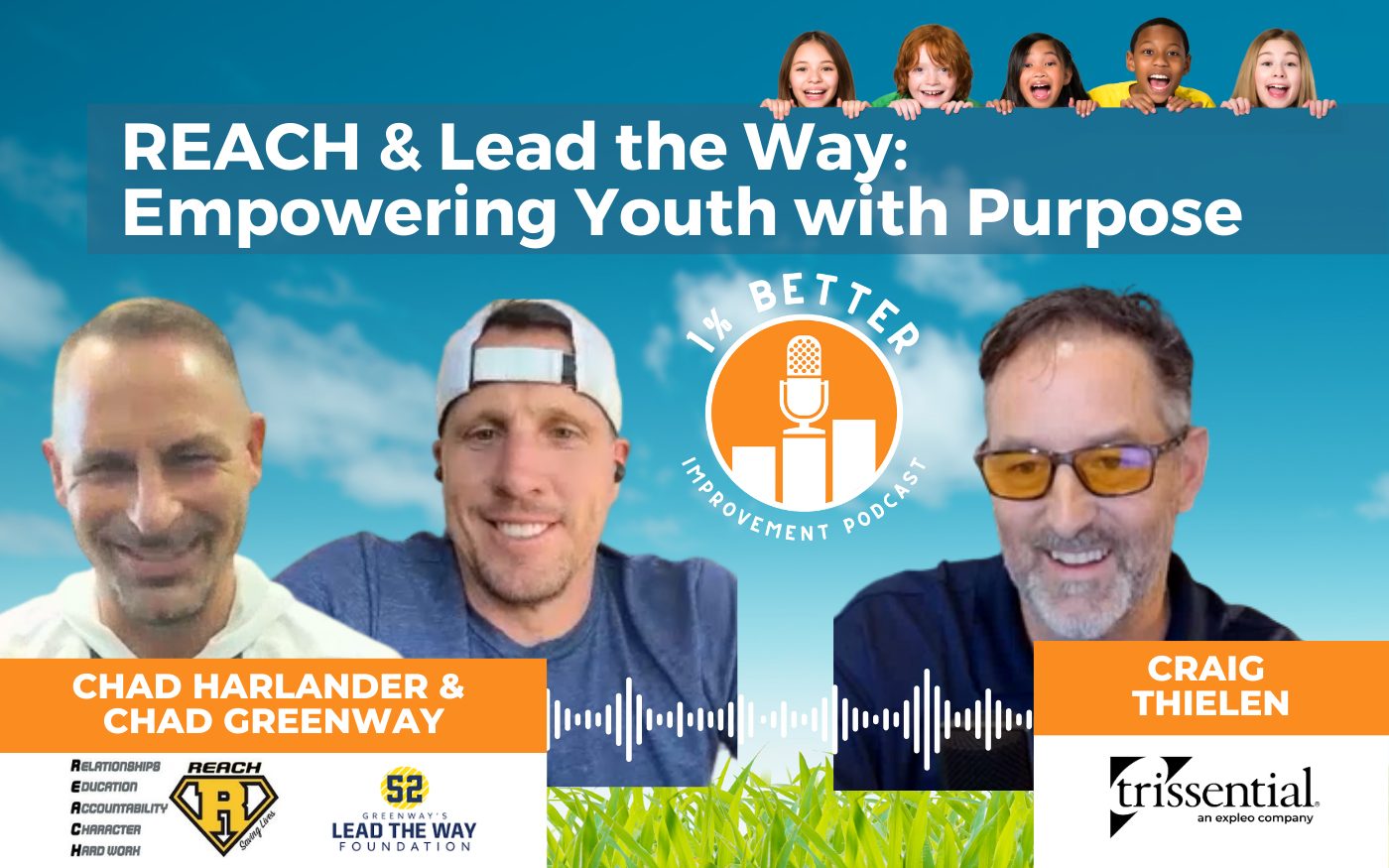
Hello, I’m Craig Thielen. This is 1 % Better Fast 15. With me today, I’ve got a friendly, familiar face, Chad Harlander, who has been on 1% Better in our long form. Welcome back, Chad.
Chad Harlander (00:20)
Top of the morning, Craig. Thanks for having me back.
Craig Thielen (00:22)
Yes, I’m excited to have you back. When I thought about this Fast 15, I don’t know why it popped in my head, but the topic of engagement did. And it must have been I was working with a client or working with a situation. And you’re my number one draft pick when it comes to engagement. I appreciate that- So first of all, we’re going to go really fast here, but just for those that haven’t seen the previous episode, which I highly recommend people do if you want to go deeper on Chad and his background as well as his partner, Chad Greenway, please watch that 1% Better, but just remind the folks what you do.
Chad Harlander (00:59)
Yeah, I’m the director of the REACH Program in the Hutchinson School District. That’s a program we started 19 years ago. We wanted to create a program that support kids emotionally, socially, and or academically. And yeah, we’re going on year 19. That program has taken off. We’re in 46 schools across Minnesota, South Dakota, and down in Texas.
Craig Thielen (01:20)
That’s awesome. So thank you for that. And that’s the topic is engagement. So how do we get people engaged into a program, into a movement, into an objective, a collective group of people, of course, individuals. And I thought, what better example, so our audience and I, we live in the corporate world, right? And so we call it Org Change Management and we have a process for it and we’re trying to shift people from whatever the current state to the future state is. But I thought what a great example. I mean, if you had the toughest audience to try to change or try to control, it’d be kids, right? And you work with kids of all ages and some of them have some real tough challenges. And so I thought, let’s use that as an example. So just generally speaking, so you alluded to this, but I want to hone in on a little bit more – you’ve had phenomenal success. I mean, your job, your day job is to do this for Hutchinson schools and to get kids in a better place and on a good path, feeling good about life. And so why don’t we start there and then we can talk about kind of how you scaled it. But just when you guys started 19 years ago, how did you try to get, and were able to get kids bought in into this program? What were you trying to accomplish and how did you get them engaged and get them participating?
Chad Harlander (02:42)
Yeah I think we throw this out there and you hear it all the time. I don’t care if it’s in the business world, the education world, it’s always about relationships. But we genuinely, it is about relationships. And I knew when we started this that it was about making a connection and being present and being very, very genuine. And with this population of kids that, you know, there’s trust issues. They’re coming from trauma, they’re coming from challenges and stuff. And for them, and you know this, our youth… they’re very quick judge of character. And I learned very quick, I learned this from a mentor a long time ago, Coach Ken Heupel. He says, you got 26 seconds to make an impression on somebody, good or bad… 26 seconds. And so I’m always mindful of that whether whoever I’m meeting, whether it’s our kids getting off the bus in the morning, whether it was that first year reach, is that every person that I meet, I want to be present in that conversation, I want to be genuine. And I think what helped back when we started 19 years ago was that I just wanted to honor where they were at in their journey and their story and be present in that relationship that we were starting to build. To do that, you have to be vulnerable and you have to be very genuine because as you know, they pick up on that heartbeat if you’re just another voice and you’re only here from seven to three and you forget about me at the end of the day.
Craig Thielen (03:58)
Absolutely. Yeah, I think that that’s one of the most powerful things. Again, I’m trying to use the success you had and the techniques and the learnings that you had in your world and say, well, how could we apply that in the corporate world? I think what you just said alone is very powerful. think in the corporate world, a lot of times you go, well, we can’t get into personal relationships. We can’t really get into stuff that’s not about work. So we just talk about work, work, work.
And there’s more behind that. And I think you do a wonderful job of, getting behind the skin, so to speak, with the kids and getting to, know, hey, how are things going at home or how, I don’t know how you do it because there is a line there of they have to be willing to share. You can’t get too personal too fast. And you said being vulnerable is one way, but just maybe talk more about that. Cause I think we’re very afraid and it’s sort of off the table in a corporate world to get really personal. Again, not with your really close coworker who you’ve worked with for 10 years, but someone, maybe you’re working on a team and you’re trying to accomplish something, but how do you do that?
Chad Harlander (05:11)
I think more than ever in today’s world, it’s the most important thing we can do now. I don’t care what world we’re working in, whether business or education, is having that relationship. you know, for me personally, I have a goal like every day when I come to school, I have the best opportunity in the morning. I get to meet 600 kids right away when the buses pull up at 730. An hour ago, all our buses pulled up and 600 kids. And I make it a priority to try to reach as many of those kids every day, whether it’s a fist bump, good to see day, how you doing?
Because we don’t know where they’re coming from. It’s 7:30 in the morning, we don’t know what happened the night before, and I want to be that first person, that first impression, to say… I see ya, I hope it’s gonna be a good day, I’m here if you need anything. And again, I think that carries over whether you’re in a school building or whether you’re in an office. I just think that’s so important. We have lost that value of just how you’re doing today. I care about you, just checking in. Give me the good, the bad, the ugly.
Craig Thielen (06:07)
Yeah I mean, I love that Chad. And one thing I’ve seen you in, not just talking, but I’ve seen you in action and it’s very clear that you do care. there’s a saying, people don’t really care what you have to say until they know that you care. And so that I think that’s really clear. And, another thing that you do really well is that you make it personal. You don’t just say, Hey buddy, high five. You’re like, Hey John, how are you? And that’s a, I mean, that’s a skill set to be able to remember. But I think you have to care first to want to remember their name, to want to get to know them, to want to do that. But it’s a wonderful technique. And is that something that was just natural to you or do you have to work on that? Because I mean, know, hundreds, thousands of kids now, some of them are now out of college and in their career and you still can talk to them from 10 years ago. So how do you do that?
Chad Harlander (06:38)
Yeah you know, I go back to the role models I had in my life. And I was one of those kids that had some challenges. I shared that with earlier in our earlier podcast is that, I had some people that were present in my life. They didn’t have to be. They were there to teach math, science, but they took that extra time, whether it was before class or after class, whether they was just a calm voice when there was a storm going on, and I really have tried to honor that that was modeled for me. And then I just tried to replicate that as much as I can on a daily basis. So I wish I could tell you I came up with something. I just want to know that everything that was given to me on those tough times during those years of adolescence, that I’m able to do that with our kids today.
Craig Thielen (07:42)
Yeah, I think it comes back to that. I mean, it’s not any sort of magic technique. There is some techniques with memorization. There’s a guy by the name of Jim Quick, who’s like a brain guru and he gives all sorts of techniques on that. But I think the first thing is you have to care. And the second thing you have to focus on it. And you’re all in, it’s very clear. You’re very present. You’re all in on whatever you’re doing. And I think, like you said, kids pick up on things in a millisecond, but they also give you feedback.
In a lot of cases, not all cases, but a lot of cases where adults, tend to just kind of observe things, but not always give feedback on, was that authentic? Do I believe you? Is that real? But one thing I want to ask you about, because a lot of times the work in corporations is not so much the one person at a time. think that’s incredibly effective. But sometimes the goal is to get groups of people, could be a team of 10 or 15 or 20, it could be a department of hundreds or it could be a whole area of thousands of employees and we’re trying to get them to shift to whatever it is we’re trying to get them to shift to. So you’ve had this opportunity, you’ve taken what you have done personally at Hutchinson schools and then you’ve helped other schools, you said I think up to 46 different schools. So that’s a different equation because it’s not hardly having this one-on-one relationship, but how do you translate that? How did you teach? How did you get other organizations to replicate what you’re doing?
Chad Harlander (09:12)
Yeah, I wish I had some big fancy answer and I think I’ve shared this in the past and this is just the way I’m wired. I really believe you got to create a culture and I think you saw it when you came out to our camp to Chad’s camp. I think if you walked into our building into our reach room, you would see there’s a culture and the culture is that it’s about family. I’m just gonna… it’s family. It’s team. This is who we are. We’re mixed up differently. We all have a different story, but we’re here to support each other at the end of the day and and we have to kind of love each other at our worst and be there at times when it’s difficult and sometimes those different moments takes when we have to hear some feedback that maybe we don’t want to hear – it’s called accountability, but I think it goes back to what I started with is that culture if you create that culture where it’s safe, in here when you come on our football field, our camp it’s safe, we’re all in this together to get better or you walk into our classroom it’s safe in here, we’re all here to grow as people. I think that’s where you bring in the numbers and they start saying hey this person got a story, this person’s got a story, they’re trying to get better, so am I, they’re at different levels, but they’re there to care for each other. And you have to create that. And it’s got to be, like you said earlier, it’s got to be very genuine.
Craig Thielen (10:21)
Yeah, and I mean, that’s a big word in the corporate world too, right? culture – what’s behind you, you’ve got your core values and a lot of corporations have these beautiful plaques and these beautiful wall hangings. So I guess another question for you, Chad, is, I’ve personally witnessed where the core values are beautifully on the website and they’re on the walls, but yet maybe not everyone’s following it. And maybe those that aren’t following it are leaders.
Chad Harlander (10:25)
Yep.
Craig Thielen (10:49)
And so have you had some of that where maybe it’s some of your administration or some that just weren’t part of the program? That’s the Chad’s Rah Rah program. I’m not part of that. And how do you sort of get the right people on board? Is it just having one-on-one conversations or how have you dealt with that?
Chad Harlander (11:06)
Yeah, and I’ve said this before too, is all schools and sort of businesses, they have the core values like you said. And our number one value is all relationships are essential, right? And so you got to walk that talk. If that is your core value, you better walk that talk. And I think that you strong people that do that, that have that same mindset, and that model that and I’ve been very blessed. I know the people I work with and the kids too. You have to bring in the right core people. I get asked a lot of times about what’s it take. There’s a school bell ready to go. I get asked a lot of times, what’s it take to run a REACH program? You know, what do you got to have? And for me personally, and I don’t mean to offend anybody on this, how many initials you have?
Craig Thielen (11:39)
There’s a school bell. It’s time to go. Right.
Chad Harlander (11:54)
does not impress me. I don’t know if it impresses kids, but what you can do for a person, the heart you give, that impresses me. And we try to surround ourselves, whether it’s in our building, our district, or in this room, with those people that walk the talk.
Craig Thielen (12:09)
Yeah, 100%. So what have you learned over 19 years? What are some of the challenges and some of the learnings, again, specifically to getting that engagement, getting people to buy in, ⁓ getting people to really believe in it, and in themselves to some degree.
Chad Harlander (12:27)
I started this 19 years ago ⁓ and I can remember the first time I went into this meeting to present the idea of REACH and it got declined. I’ll be honest with you. I was rah rah. I am, you I got my pom poms out and I’m just preaching from the highest levels and ⁓ it got declined. And so you take that passion dream, you go somewhere else and they give you an opportunity and those doors open and then that first opportunity that you knocked on the door that they declined you and said, hey, you know, maybe it’s working. And I think I’ve learned that you still stand in the tallest building, you still try to be the loudest voice, you need help doing that, if you continue to have that passion to help our youth… and that’s where I’m still at today. I still have that fire, I still have that passion. The thing that I’m working on, that I’ve been trying to work on for 19 years, I don’t know if I’ll ever get there, is if I can, and I struggle with this, is to separate some of the challenges that our kids are coming to school with. I am, end of the day, I’m a father of three daughters and a young man we adopted. And it’s hard to walk out of this building sometimes at three o’clock knowing that some of our kids are hurting.
Craig Thielen (13:32)
Yeah. Yeah. And I think Chad, ⁓ that’s where empathy and humility and vulnerability comes into play. It’s not easy. Even like in the corporate world, and I think one of the reasons I think society says in the corporate world, we don’t talk about home life. But when we do, it’s messy, right? Life is messy. Relationships are messy. Everyone’s… we, regardless of what we think of people that whatever their title is, like you said, whatever their initials are, we think, they’ve got the great life. They got the nice car, the big job, whatever. But guess what? Their life is, has just as many challenges as any of us. And the closer you care, the closer that you get to them, the closer that you build those relationships, the more you’re going to possibly be part of it. And you have to be prepared for that, right?
Chad Harlander (13:59)
Yeah. Absolutely agree. agree. I wish we would all take time… again, I don’t care where you’re at. Just take the time to check in with each other. Whether it’s in the business world, education world, just take time. 15 minutes, how we doing? How was the weekend? Give me a good, give me a bad, give me ugly. How can we support each other?
Craig Thielen (14:24)
Yeah. I love it. There’s so many, all of these lessons really and thinking really can apply to the corporate world. So I hope that this gives people some ideas, everyone that’s kind of back in their office trying to drive a program, a project, a team, and just gets a few clues. Any final thoughts here, Chad, as we wrap up Fast 15?
Chad Harlander (14:49)
Yeah. Well, I appreciate it. only thing I’d say is be present. You know, be genuine. Bring the juice every day. They’re counting on us. Our youth count on us. Our coworkers are counting on us. And when you’re having a bad day, be open about it. We’re all vulnerable. We all have a story. Yeah, thank you, sir. Yep, have a good day.
Craig Thielen (15:08)
Awesome. Thanks, Chad. Appreciate it. Appreciate you. Take care.
Check out other podcast episodes