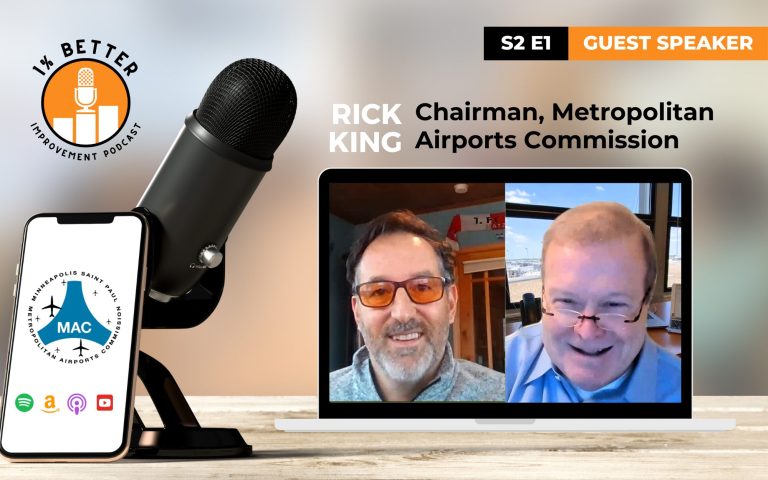
Find 1% Better Improvement Podcast Here





1% Better Rick King – Quick Links
Wall Street Journal’s Best and Worst Airports of 2023
Learn more about the Metropolitan Airports Commission
Connect with Rick King on LinkedIn
Connect with Craig Thielen on LinkedIn
Key Takeaways
- Recognition of Excellence: The podcast highlights the Metropolitan Airports Commission (MAC)’s success, with MSP Airport being ranked the second-best in the country by the Wall Street Journal in 2023. This achievement is attributed to strong leadership from MAC’s staff and its CEO, Brian Ryks, emphasizing the importance of customer focus and excellent operational management in achieving high rankings and recognitions.
- Operational Model of MAC: Rick King explains the unique operational model of the MAC, which functions like a private entity despite being a public corporation. This model involves generating revenue through various airport services and leveraging this income to maintain and improve airport facilities. This approach allows MAC to operate efficiently and keep costs for airlines and passengers competitive, illustrating an effective public-private operational structure in the aviation sector.
- Board Membership and Diversity: The conversation touches on the evolution of board membership requirements and the increasing efforts to diversify boards with members from minority groups and women. This reflects a broader trend towards inclusivity and the recognition of different perspectives and backgrounds as vital for effective governance and decision-making.
- Impact of AI and Technology: Rick King and Craig Thielen discuss the transformative impact of AI and technology on various sectors, including aviation. King stresses the inevitability of technological advancement and the need for companies to embrace change, innovate, and prepare their workforce for the future. This includes understanding and leveraging generative AI responsibly while anticipating job transformations.
- Continuous Improvement and Customer Focus: The podcast emphasizes the importance of continuous improvement, customer focus, and leveraging technology to enhance user experiences. This approach is not only critical in the aviation industry, as demonstrated by the MAC, but also in government and other sectors striving to meet the evolving needs and expectations of their customers and citizens.















1% Better Rick King – Transcript
[00:00:08.170] – Craig
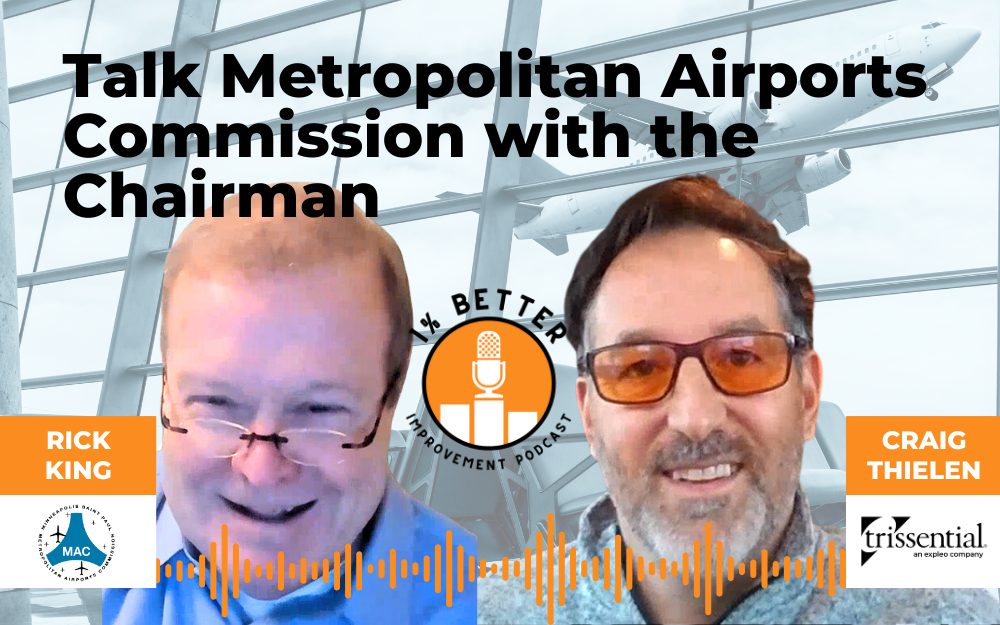
Hello, I’m Craig Thielen, and this is the 1% Better Podcast. Today I’m speaking with Rick King, Chairman of the Metropolitan Airports Commission and a member of several other boards and committees. Welcome to 1% Better, Rick.
[00:00:21.420] – Rick
Hey, Craig. It’s great to be here with you.
[00:00:23.010] – Craig
Yeah, I’m looking forward to talking to you. We’ve got some lineage early in my career that goes back to some of the things that you’re involved with as well as some recent things. So, first of all, I want to congratulate you and the MAC, as it’s called. The Metropolitan Airports Commission on Wall Street Journal just came out with their annual ranking of airports, and MSP came out number two in the country, which is very impressive, so congrats.
[00:00:46.100] – Rick
Thank you. We’re really proud of that. And the credit goes to a fantastic staff that we have there with Metropolitan Airports Commission and a great leader, Brian Ryks, who, incidentally, was just named the top CEO for the airport community in North Americas by one of the trade groups in the airport business. So that’s a great thing. It’s no accident, you have a great leader and you have a great airport staff, and then they’re really focused on the customer. They’re really focused on who’s flying. So that makes a big difference.
[00:01:15.720] – Craig
Yeah, and we were just talking here… I’m a frequent flyer, and I certainly, as a customer of the product that MAC puts out, had gone through a lot of airports and can attest that it’s a first-class operation, and we’re very fortunate for the service that we have and the facilities and the whole experience, so I can attest as a customer. So let me jump into a little bit the MAC, for those that aren’t familiar with it, which I think largely a lot of people aren’t, of course, we all know about the airport and airports that we have. But tell us a little bit about what is the Metropolitan Airports Commission and what they’re doing, what their role is and how it’s changing. Given the world is changing, how is that industry and MAC changing as well?
[00:01:59.980] – Rick
Yeah, I think it’s kind of interesting. The MAC, the Metropolitan Airports Commission was created by the Minnesota legislature in 1943 to bring together the airport building in the Twin Cities area. Before that time, there was some vying in Minneapolis to have a big airport and in St. Paul to have a big airport. And this brought it all together, and it created a unique structure which is actually called a public corporation. So those two things don’t usually go together. In this case, they do. It established 15 commissioners, two named by the mayor and the rest by the governor, that would be the board of directors for this public corporation. And then the business is run like a private entity. So you would pay fees. You would pay fees as a flyer through your airline tickets, through the food that you buy there, whatever you buy, the parking. We take a piece of the revenue off of all of those things and then take that revenue and operate the airport, keep it up to date, do all that kind of thing… and we actually do our own bonding. Rather than being a state entity where you have to go to the legislature for bonding, the MAC can actually do its own bonding.
So they created this little thing that’s part government, part private, and it runs something that everybody’s happy with, because if you use it, you’re paying some of the fees for it, and if you don’t, you’re not. There’s not a tax dollar collected from the state of Minnesota. Well, there’s just a couple from MN Dot Aeronautics, but it’s very small. And, of course, the FAA collects ticket fees from people’s tickets, and it comes back through the government. But you fly, you buy.
[00:03:36.370] – Craig
How unique is that to Minnesota, that structure that you talked about? And how do other states do it? I mean, is it kind of different, or is that kind of the model?
[00:03:45.560] – rick
It’s not really… Let’s just talk U.S. It’s probably the model, in maybe 40% of the airports, there are a large chunk of airports that are a department of a city. Chicago is a good example that they have a department of aviation. It runs the two airports in Chicago. Then you’ve got people that have either county/city operating the airport, and that’s one like Detroit, the county, Wayne County runs that airport. So then those things are closer to the political structure that they’re involved in. Almost no airports that I’m aware of that are commercial airports are totally private in the United States. That’s a model that you see in Europe and in Canada quite a bit, where a private entity owns the airport and operates the airport. So there’s a lot of different models. We think we’ve got a best practice model because we have the best things from the government that we have. We get bulk purchasing, we get those kind of discounts and so forth. Plus, we can do our own bonding, and we don’t rely on tax dollars.
[00:04:43.800] – Craig
Okay. Well, it’s very interesting. Is there any dynamics that are shifting in the industry, or is it very similar, kind of steady as it goes? Obviously, there’s improvements. But is there anything shifting?
[00:04:55.850] – Rick
Well, I think there’s a lot more public private partnerships inside the airports now, where you might have terminal that’s named after a company, you see that in Denver, and there’s some funds exchanged for that. So airports are becoming more like a business that way, to try to make sure that they can keep their rates low. The whole game to attract an airline is that you operate reliably in all kinds of weather. And some people don’t have to plow snow. Right, we do. And then that you have a decent.. your cost structure for the airlines is good. They get the services they need, but they’re not paying exorbitant rates. And we have something called cost per enplaned passenger. And our goal at MAC is to always be in the lower or lower half of the cost per enplaned passenger number. There’s some in the big cities are very big numbers, cost per enplaned passenger. And then there are some smaller than the MAC, but they happen to be warm places that don’t plow snow.
So when an airline looks at you, they go, your rates are good. You operate efficiently. We can operate our fleet in and out. Our passengers are more likely to have their flights complete. That’s what we want. That’s why we’re rated well by the airlines. And then you just have to have passenger amenities and focused on the customer, like the airlines do, to have people want to fly out of your airport.
[00:06:19.430] – Craig
Yeah. So, again, just better customer experience, more retail, more amenities. Okay. Makes sense. I mean, that’s where a lot of other industries are as well.
[00:06:29.980] – Rick
Craig, just one quick note. One of the biggest amenities that we’ve gotten awards for, which is you might find strange, is the renovated men’s room and women’s room, the bathrooms. Widening those out, making more room… listening to what people have to say. And you can tell in the airport where we’ve done the renovations and where we haven’t, they have art mosaics on the outside featuring local artists, so it gets rave reviews. The other thing you got to have is you got to have damn good Wi-Fi. Of course, people get really anxious if they can’t connect.
[00:07:01.960] – Craig
Of course we have to have our tickets on our phones, and we don’t want to be in line and trying to connect. Well, good. Let’s jump a little bit broader. You share the board at MAC, but also, you’ve been on many other boards. You are on several other boards, and you’ve been on many boards, both public and private. And so talk a little bit about the role of a board. It’s very different than being in an executive operational leadership role. So a little bit of what the role of the board is. And I’m also curious. It seems as though board roles have been challenged or are evolving very quickly in the past couple of years. I think pressured by things like cybersecurity, things like now AI, and these are top for boards. And so just talk a little bit about your experience being on boards.
[00:07:46.720] – Rick
I think you may bring up some really good points. Craig. One of the first things you have to learn, because most board members come from the executive suite at some point or other, is that you’re not an executive at that business. You’re on the board and getting yourself out of the action orientation, like an executive would be, you have to kind of train yourself on that. And that’s why it’s helpful for a lot of people, as they’re considering board service, to be a board member in a larger nonprofit while you’re still working. Get kind of your cadence down on that. I do think that boards over the last few years have been changed the way people have been recruited. There’s been great strides, and there continue to be good strides in diversifying boards, whether it be minority groups or women. You do see a lot more groups like that in there. But the expertise required has morphed over time. You know, when I was working, one of the people that worked for me was the CISO, the Chief Information Security Officer, and the experiences I had in supervising that are immensely valuable to a board.
So we see people looking to diversify their board, but also saying, I need somebody who understands how to do a technology transformation, I need somebody who understands how to be cyber aware. And now what’s evolving is more about AI, people looking for people that understand and can help guide AI. It’s not the executive in charge of any of those things, but it’s about the supervisory aspect. Are we doing the right things? Who should we listen to? What are we not thinking about? It’s all those questions that help the business reduce risk, because that’s the board goal, is return money to shareholders. The value proposition has got to be there, but you want to reduce the risk in doing so as well. So risk oversight becomes a major piece.
[00:09:38.780] – Craig
Yeah, I mean, is the biggest value you see the board’s responsibility to be that outside set of eyes, independent, not in the day to day, not caught up in the day to day running of the business and the demands, but asking those tough questions, bringing outside perspectives. Is that what you see as kind of the primary value?
[00:09:58.590] – Rick
Absolutely. I think there’s some things that you have to do, you have to prove certain things, no matter what board you’re in. There’s rules and regulations, whether they’re SEC or the bylaws of an organization that you join, that the board has to prove. The board also generally hires the CEO, which is a very critical thing. And outside of the CEO, the board might have an opinion on other players, but that’s the CEO’s job. That’s where, again, you’ve got to know your role.
But knowing your role is different than giving your opinion. In board meetings. The CEO, the good CEO, is going to encourage you to make sure that if there’s something on your mind, if there’s something you see, if there’s a way to make it better, contribute, that’s your role as a board member. I do that in all areas. Even though I might be highly valued for maybe cyber or technology experience, I am not a one dimension board member, nor does a company want a one dimensional board member. You have your expertise from where you came from.
But for example, I’m on the board of Huntington Bank. I was on the board of TCF Bank. Huntington bought TCF. So in my last corporate job, one of my client sets was financial services. So I had some knowledge about that. But I’m not a banking expert, but I do not fail to contribute my ideas about banking growth and banking risk and things like that. I’m not just there for cyber. So that’s important. You bring your whole to that board.
[00:11:23.370] – Craig
Do you feel maybe this is very individual or sort of specific to the situation or the actual board, but do you feel like it’s healthy to have some tension between a board and obviously there’s multiple members of a board. Sometimes there’s factions on strategy or risk profiles or investment. So some stress between the board within the board and then the board to the executive team? Or do you feel like, no the ideals, when we’re highly collaborative, trusting, and we’re sort of acting as one, or do you feel like there should be some natural tension there?
[00:11:56.390] – Rick
I think there is some tension, but I think the ideal is that tension is released in the conversation, in a respectful conversation, and then the board would come to what it feels is an outcome. If it’s the board’s decision, if it’s the executive decision, then they’ve gotten a pretty broad base of things to think about, to listen to, and they can make the decision.
I think the worst cases are when the board sort of have warring factions and really play it all out. It’s kind of played outside the board meeting and people come in with agendas. That’s very difficult, a very difficult board to be on, a much more fun board to be on. I happen to be on those kind of boards. And if I’m the board leader, I’m going to cultivate that. People can say, they need to say what’s on their mind. We need to talk about it, we need to understand it. We need to respect different opinions and different directions and different experience sets. And I think when you do that, just like when you’re picking people for jobs, there’s many forms of diversity. One of the forms is diversity of background, thoughts, experiences… and the more you bring it in, the better decision you’re going to make.
[00:13:01.840] – Craig
Yeah, makes sense. I don’t know how close you followed this one, but as we’re speaking here just a few days ago, and this is going to be, I think, a case study, a very famous board transition, OpenAI. Their board decided to release the CEO of OpenAI, Sam Altman. And of course, there’s dynamics involved. Microsoft is a significant shareholder in OpenAI to the tune of something around $11 billion. And two days later, Sam Altman declared he’s now going to join Microsoft. So they have this very collaborative, heavy investment. I don’t think Microsoft appears to be controlling the board. And they released him from OpenAI and then Microsoft hired him and then the president now left. So that’s a very unusual for many reasons, scenario. But I don’t know if you have any thoughts or insights on that one.
[00:13:51.610] – Rick
Well, I don’t know how much insight I have. I definitely have some thoughts, Craig, and I followed it just like you have. My first thought is, before this actually happened, OpenAI was recruiting new board members. I think they had lost four board members leading up to this dismissal of the CEO and the president quitting.
[00:14:12.160] – Craig
And so people, by the way, some people may not know that Elon Musk was a former board member and part founder in OpenAI, and he left a few years ago I think.
[00:14:22.450] – Rick
Year, so my question would be, you’re thinking… if somebody came to you and said, well, OpenAI is looking for three or four more board members, there’s probably not a person in the world that wouldn’t go, wow, that would be a great board to be on. Why did they have openings for so long? And then you look at the board members that are there. They are not really experienced board members, I have to say. And two of them were Sam and the president himself. So those two are not independent board members. It’s not run like a real company. It’s run like a nonprofit, to tell you the truth. And I’m not saying that’s bad, but it has some dynamics with it. Don’t then attract maybe the better board members, I think, but that would be my case. These board members are going to be looking very bad in the studies, I think, and Microsoft’s going to end up looking pretty good for scooping those folks up and hiring them. I’m not sure we’ve seen the last drop of ink on that story.
[00:15:14.280] – Craig
Yeah, I was just thinking, I think there’s a lot more to be told yet. And who knows, maybe at some point Microsoft takes over the whole works. I mean, they’re obviously a significant investor, so I think it’s going to evolve. It’s only been a few days, but it’s very interesting.
[00:15:29.210] – Rick
That ownership structure is interesting too, because the president and CEO didn’t have really an ownership stake because they don’t really have stock the way an organization might normally have because of the status. So there’s some different dynamics here that maybe aren’t similar to your typical Silicon Valley startup with all that kind of success.
[00:15:50.530] – Craig
Yeah. Interesting. Well, since we’re talking about AI, I mean, generative AI is really the topic in every organization, every industry, and I’m sure in a lot of board meetings. So love to get your take on how you view something that is not like anything we’ve ever seen before. I mean, we can try to compare it to in the early 90s, we had the thing called the World Wide Web and we didn’t really know what it was. And of course turned into something where we have real time communications globally with billions of people. But it’s like anything, nothing that we’ve seen, and it’s evolving incredibly fast in terms of sophistication and there’s a lot of fear. It’s at so many levels, it’s even a geopolitical issue between governance, and it gets onto a personal level to a person going, I’m worried about losing my job and am I going to be replaced by an AI? So I’m just curious, again, from a board position or just your position, I know you’ve got a lot of background in technology. Just how do you think about generative AI when you’re with companies or at large?
[00:16:55.800] – Rick
Yeah, I think it’s a really good question and I think I’m no expert at it, so I would never say I am. I think that the one thing we know is what’s happening and it’s going to go and accelerate. So you can’t try to plug the dike. And I think this is where our political folks are maybe missing it a little bit in the Internet world, back when it started, and maybe even social media when it started. When they do a retrospective in their heads, they think they miss fixing that before it went on to be something that they didn’t think it should be. So they’re bound and determined to put something in place to try to control this, which I don’t think they can do. But it’ll be fun to watch, much like it was fun to watch them try to recover when the other two developments happen. One of those things that would make good reading is the Biden Executive Order. That’s good reading for people. That makes some sense and was put together by logical folks.
But I think for companies, the idea is to look at where can this benefit us? And there are so many places it could benefit companies, and then there’s, where are the risk elements that we have to deal with? I think these are going to all evolve, and I think putting down some kind of guidelines for use in your company might be the best thing to do, even if they evolve over time as you learn more. But what are you going to do? How do you focus on the customer? How are you going to use this and those kinds of things to give your employees and your customers the guidelines about what you’re thinking.
As to jobs related to this and job loss, I view this as maybe a little bit worse than most technology, where people think my job is going to be replaced because of technology. It’s my encouragement to people who are doing a job if they think this job can be replaced by computer in the past or by AI as we go forward in the future, you have to take it upon yourself to retool yourself because the world is not staying still so that you can be employed at a job that you have now for 40 years. That’s just not the way it’s going to be. It has nothing particular to do with AI. It has nothing particularly to do with an iPhone. But those two things and others, Internet and social media, have modified and created new jobs. But the jobs go upstream a lot. The jobs go upstream and people have to educate themselves to be able to take on the higher level tasks. The worry today, of course, is that AI is going to start taking the higher level tasks away. So then you’re kind of freaking out a new level of person. But I still say if you want to future proof yourself for jobs, you’ve got to go up, you’ve got to go up the stack. You’ve got to understand how this stuff works. Maybe you participate in how to harness it, maybe you participate in how to create it, but you’ve got to go up the stack. And if you see where you’re standing today, going to be taken over by that, I would say start working on the training.
[00:19:49.530] – Craig
Yeah, I agree with you. I thought it was interesting. Sam Altman did a podcast with Joe Rogan. In it, Joe Rogan was asking about predicting the future of AI. And Sam kind of paused and said, hey, I don’t know, because if you had asked me five years ago or ten years ago where we’d be now, I would have got it all wrong. He would have predicted all the kind of the simple task and the menial and manual and physical kind of things. We’d have robots, we’d be doing all this stuff, and then we would slowly start making it more sophisticated and do the much more advanced things, which are things like creative and things like innovation. And he goes, spend the complete opposite. We’re still doing everything manually, we’re still driving trucks around. We’re still doing lots of manual labor. But the creative stuff is what it’s really flourishing in right now, marketing and content creation. And so I thought that was interesting coming from someone who’s been invested in it much as anyone.
But to your point, I think the first step, we do a lot of work in this space with our clients. The first step we do is education and literacy. And just first you need to understand how it operates. If it’s just in a black box, then you’re going to be in a bad place because you don’t understand it. You make up lots of everything that’s said about it is true, and it’s also not true. And so you have to understand, well, how does it work? Like when people say, well, ChatGPT gives false results? Well, it may, but you may have guided it to it. It may think that’s what you want, and there’s a lot of reasons it’s not there to give correct answers.
[00:21:11.130] – Rick
It depends on what it’s been trained on. Right.
[00:21:13.100] – Craig
Exactly.
[00:21:15.830] – Rick
That’s the most important question.
[00:21:17.210] – Craig
Exactly.
[00:21:17.770] – Rick
That is, what did you get trained on?
[00:21:21.610] – Craig
The most influential training is like how you’ve interacted with it, and so that prompt engineering. So just that education is incredibly helpful. So we could talk about that for a long time, but it’s definitely a fast moving topic, and I’m sure it’s a topic that you’re dealing with on a daily basis.
Let’s talk a little bit about, speaking of technology, you’re on the technology advisory committee for the State of Minnesota, and of course, we’re doing a lot of work there, including some AI work that they’re experimenting with. But I’m just know public sector versus private sector. Of course, there’s sort of know old thought process that the public sector is kind of a little bit slower, laggard behind the times, doesn’t invest as much, et cetera. Of course, I had Tarek Tomes, CIO on the podcast, and he challenged me back going, no, that’s not how it works. We’re doing all sorts of great stuff and innovation. So I thought I’d love to hear from your perspective what you see going on at the State and compare that and contrast that with maybe private sector.
[00:22:20.570] – Rick
I think the State of Minnesota has been doing a lot of progressive things in technology. I think commissioner Tomes has been really exceptional in kind of guiding people to think about things differently. And I think this technology advisory council and its predecessor, Blue Ribbon council on it, have been very helpful to the commissioner and the staff and the other agencies in terms of giving them some things to think about. And there’s some reason for stagnation. Some of that has to do with the way they fund stuff in a company. We know that when we, let’s say we create a new app, we use a new app from a third-party vendor, we need to maintain that. We need pay money for enhancement, support, and eventually we’re going to replace it. Those has a lifecycle and we need to fund each aspect of that lifecycle. Well, in the State up until recently, a lot of these programs, they get built rather than thinking of them as a product over a lifecycle, they think about it as a project.
[00:23:26.260] – Craig
Right.
[00:23:26.680] – Rick
So, okay, it’s going to take us two years to implement this. Go get the money. Implement it. Okay. We got to enhance it now after two years, don’t have any money. Got to go back for money. We’ve got to think of a long-term funding strategy and think about these things in terms of products. They have teams that guide them over time. You don’t just do one year and then that team is disassembled and a new one comes in. That’s very disruptive. You wouldn’t find that in a company. So a lot of the agencies have changed the way they do that, and that’s been under the commissioner’s guidance. And I think some of the agencies have found ways to use newer technology. They go to third parties instead of building something, look for off the shelf stuff that already does the job in another state and implement it. That’s what they did when they replaced the old drivers in vehicle licensing system MNLARS with what’s known today as MNDRIVE. MNDRIVE, as it’s under the fast corporation, was created and was running in eleven states when Minnesota was having a failure to build its own.
[00:24:35.900] – Craig
Right, infamously. Yeah.
[00:24:38.020] – Rick
And I think when the governor took over first election that he was elected, he just said, let’s figure out if we got to change this up, we change it up. And I think going to something that’s running in other states, not customizing for your own because you know better is just lessons that a lot of the companies have learned. And that’s what the private sector people on this council bring in. They bring in these kind of experiences. Plus the idea that even in government you can focus on the customer. You do have customer, don’t be fooled. And where does the customer want to do their interaction with the government for which transactions. And that brings you to a lot of self service, different language requirements, all those things that we see some of the agencies dealing with really nicely. So I’m proud that they’re also thinking a lot more about the customer rather, and that’s much more like a company than when we started.
[00:25:33.790] – Craig
Yeah, it’s actually refreshing. As you may know, we’re pretty involved with that shift to product mindset and also to a customer user experience mindset. And it’s refreshing because at the end of the day that’s what government is there for. If you look at the founding Declaration of Independence, you look at what even state governance for, it’s for the constituents and you want a great customer experience. And so bringing that sort of private sector mindset that’s usually revenue and profit driven, but to have that same mindset, to know taxpayer, I one time had a great conversation with, Commissioner Tomes, when he was at the city of St. Paul and I’m like, why are you asking about all these other cities? what are they doing? He was always asking me about what we’re seeing. And he goes, because people have a choice. They can move away from St. Paul, they can move out of Minnesota, they can move to Texas and Florida with lower tax rates. So why wouldn’t we want to make this? And so it makes sense, right? And it’s really as again a customer of the State of Minnesota to know that there’s the right focus on our behalf.
[00:26:40.530] – Rick
One of the things I try to simplify things and this is a very complex thing to do. But from my perspective, a citizen should be able to do a transaction with government anywhere, anytime that they want. So it’s as simple, if I want to go downtown and see somebody face to face, maybe there’s hours, but then I know those hours and what I need to do. But if I can do it online from my home or wherever that might be, that’s what you got to do. And more and more people will elect the simple way to do it. That is, more and more people are going to be digital natives.
[00:27:16.110] – Craig
Absolutely. I mean, again, if you were in a business, running a business, you wouldn’t even think twice to say that. And so why don’t we have that mindset? And I think it is shifting there, and it’s exciting to see it.
[00:27:28.100] – Rick
MNSure’s been really strong with that, Craig, and I know I’ve spoken to governor about it directly numerous times, and he’s all supportive about this. And in fact, that idea of customer service, customer focus, is part of that ‘One Minnesota’ plan that he talks about all the time. It’s fantastic to see.
[00:27:46.700] – Craig
Yeah, excellent. Well, let’s take a step back from those specifics and just this whole podcast, we created it with the idea of 1% better and at a personal level, a professional level, at an organizational level, every organization you’ve worked with is always trying to get better. Everyone’s trying to step up and meet those customer demands, and what technology is is evolving. So how do you think about, just generally speaking, when you’re working with these different organizations, this notion of continuous improvement, this notion of how we get better every day, how we learn, how we use that sort of methods and mindset to drive competitive advantage. Curious on how you think about that.
[00:28:30.850] – Rick
Yeah, a really important aspect. I think it boils back to getting the right people. And part of the hiring criteria needs to really be that people are bringing in this, how they operate, how they work, because it’s easy to analyze that they have the expertise that you’re looking for.
[00:28:50.650] – Craig
Sure.
[00:28:51.040] – Rick
But it’s how they deploy the expertise. Are they creative? What kind of challenges have they overcome? Are they collaborative? Did they work with teams? And do they come across in different ways? That diversity aspect we talked about a little earlier from backgrounds and approaches and so forth? So I think the most important thing is when you’re hiring, and I think people could get themselves in trouble now because hiring is difficult. So therefore, when you see people that you see people applying and you don’t have as many as you used to, you may jump at what you want to get. But I contend that hiring is that most important decision because they’ve got to come in and enhance your culture, enhance your work, and take the time that is required to hire the best people fit in so many different ways and they make the difference overall. Once they’re on the team, you want them to rise up the performance of the team. I think you also have to bring in people that have new skill sets that particularly as you see emerging skills, not everybody can go back and learn about AI and become an AI expert. It helps to have somebody that maybe knows a little bit more than your organization does about that or about anything, whatever the topic might be. If you’re going to do digital marketing and you never did it before, maybe you need a consultant to start out. Maybe you hire somebody ultimately, those kind of things.
[00:30:18.740] – Craig
Yeah. So it becomes blocking and tackling. Get good people and they’ll figure out how to make the improvement happen. Right. So look for it.
[00:30:26.100] – Rick
Yeah, I think so. Here’s a metric I think about a lot, and I won’t be specific, but if you have an employee that is not doing the job and you’re trying to counsel them and then have to exit them for some reason, my guess is that is probably a three to six month process. Could be longer because everybody wants to give everybody the right chance. Maybe they had something going on. We tend to do hiring a lot faster than that. Isn’t that interesting that those two aren’t really equal? Or maybe that the hiring part actually takes a little bit more time in terms of not just gap time for the applicant, but things that you want to find out. They interview with teams. Maybe you give them certain kinds of tests and things like that that help you uncover what you’re really looking at. So I go back to that. Spend as much time or more interesting than you would on the exit side.
[00:31:25.900] – Craig
It’s an interesting observation. It kind of reminds me of the adage. It’s interesting that in professional sports, which are very competitive, the people spend 99% of their time practicing, honing their skill, working out, training. 1% is actually the performance that we see on the tv. And in business it’s the opposite. We do 99% playing and we do less than 1% of training and learning, experimenting. Kind of interesting. Do we really have that right?
[00:31:53.940] – Rick
It’s a good analogy, too. The muscle memory didn’t get created during the practice, did it?
[00:31:59.670] – Craig
Right. So we’re at the end of our time here, and so we finish 1% Better with the same question for everybody, which is looking back on your illustrious career and everything that you’ve been involved with, for you, it’s been a lot of different things in different industries and different organizations. You’re speaking to yourself when you were 18 or maybe your grandkids. Coming up, what advice would you want to pass on with what you’ve learned about people and life in general that you would want to pass on?
[00:32:30.820] – Rick
Well, I’d certainly say that nothing good happens without good people that sort of tails into what we were just talking about. But I would also say this that I actually like, and I’m not sure the balance is quite right yet, but I like that people are talking about combining a really aggressive business life with personal life. I think that’s a light bulb bonus. I think that in my career early on, there were a lot of family things missed. There were herculean efforts to get back for certain events, and it seemed like a torture and most important meeting you’re ever going to have. You got to be there, blah, blah, blah. You’re making these decisions early in my career, all of those companies do not exist anymore. My two children are in their 40s. Look what has the persistence when you look back and I just say, create the right balance for yourself and think not every one of those things is critically important. I’m not saying you don’t have to make sacrifices, but I’m saying balance is important.
[00:33:32.150] – Craig
Yeah. Well, then that’s something you reflect on. Right. So I think people have said on their deathbed, and people probably aren’t going to think about those meetings that they’ve missed. They’re going to think about their kids and family and friends. So it’s pretty sage advice for all of us to keep seeking that balance. And hopefully the organizations that you’re working with and the people you’re working with support that. Right?
[00:33:54.330] – Rick
Well, that’s the key. Ask yourself this question when you interview, because you’re interviewing the company you want to go to work for, too, if you’re the employee, do they have the same philosophy about some of these things that I do? Is it compatible? Because if it’s compatible, whether it’s, you work 24 hours a day, seven days a week, that’s what they expect. That’s what you want to do. I’m not saying I do or there’s a balance. If you meet and match, it’ll be a lot better for both parties.
[00:34:22.310] – Craig
Well, thanks, Rick, for all the time. It’s been fascinating kind of touring the whole circle of topics that we hit and really enjoyed it, so thank you.
[00:34:31.840] – Rick
You’re welcome Craig. It’s good to be on with you and keep up the good work. You guys, your company, your organization does a lot of good things to help State of Minnesota and other businesses to really stay on top of important topics. So appreciate that work.
[00:34:45.210] – Craig
Thanks Rick.