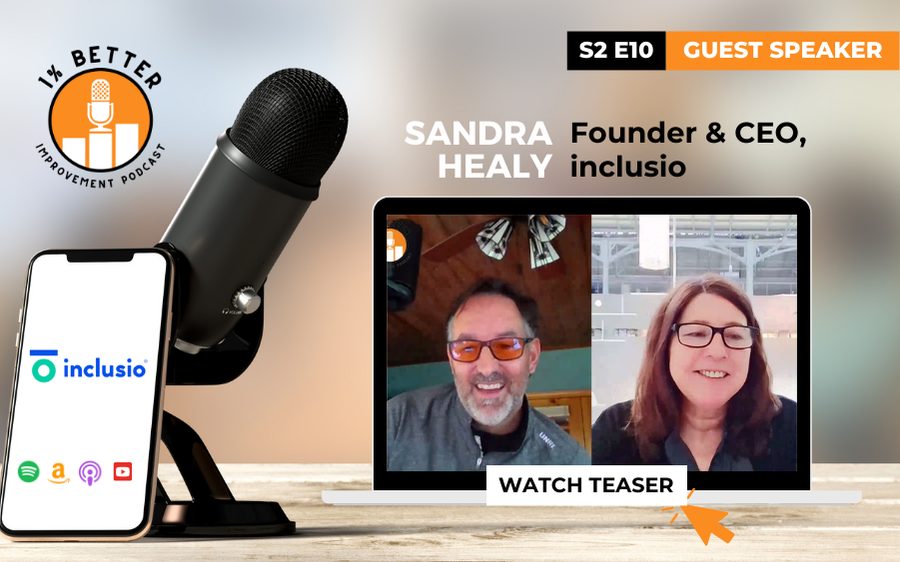
Find 1% Better Improvement Podcast Here





1% Better Sandra Healy – Quick Links
Learn more about inclusio
inclusio’s DEI Maturity Assessment
Check out inclusio’s whitepapers:
Unlocking the Power of Organizational Culture : How Data Can Build Successful Companies
Unveiling the Importance of DEI and demonstrating ROI to C-Suite Leaders
Follow Sandra Healy on LinkedIn
Connect with Craig Thielen on LinkedIn
Key Takeaways
- Early Influences and Career Evolution: Sandra Healy shares her journey from starting as a technical engineer in the telecom industry to becoming a leader in diversity and inclusion. Her transition was driven by a commitment to fairness, influenced by her personal experiences and the noticeable disparities in the workplace, which motivated her to engage with diversity and inclusion long before it became a mainstream topic.
- Founding of inclusio: Sandra founded inclusio to address the lack of data in demonstrating the impact of diversity, equity, and inclusion initiatives in corporate settings. inclusio helps organizations measure and manage their cultural and diversity efforts through data, providing metrics that were previously difficult to track.
- Challenges in Data Collection and Trust: One of the significant hurdles Sandra discusses is the challenge of collecting sensitive data from employees who may be reluctant to share personal information. She emphasizes the importance of building trust and ensuring data confidentiality to successfully gather and utilize this data for organizational improvement.
- Impact of Culture and Belonging in the Workplace: Sandra highlights the critical role of culture in organizations and introduces the concept of ‘belonging’ as a more impactful metric than traditional engagement. Belonging, as she defines, is about being valued for one’s individuality and contributing to organizational success, which leads to increased productivity and retention.
- Emerging Trends and Data Insights: Sandra points out emerging trends and surprising data insights, such as the high percentage of employees self-identifying as neurodivergent, which was unexpected by many organizations. This data helps companies understand better and address the specific needs of diverse employee groups, highlighting the importance of inclusivity in talent management.













1% Better Sandra Healy – Transcript
[00:00:05.55] – Craig
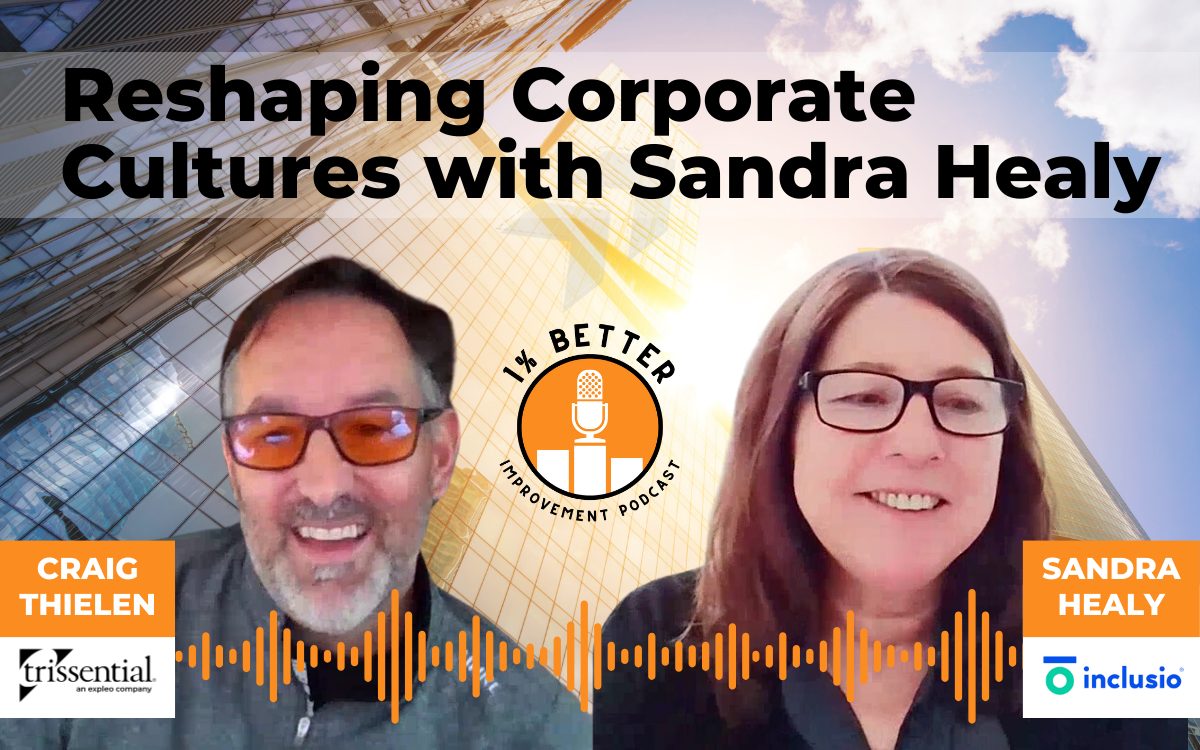
Hello, I’m Craig Thielen, and this is the 1% Better Podcast. Today, I’m speaking with Sandra Healy, Founder and CEO of inclusio, and she is calling in from Dublin, Ireland. And unfortunately, Sandra, you’re not the first guest from Dublin. Our good mutual friend, Fin (Goulding), beat you to that great honor.
[00:00:26.25] – Sandra
Very good. I’m impressed.
[00:00:29.32] – Craig
Yes. So he’s a fun guy, and he connected us. So welcome to the show, the 1% Better Podcast.
[00:00:36.20] – Sandra
Thanks, Craig. I’m delighted to be here.
[00:00:38.26] – Craig
All right. Sandra, you’ve been a leading expert in corporate diversity inclusion for a long time, I think somewhere around 20 years. Examples of some of your work, and it’s a long list of your contributions in the space, but you’ve been involved with establishing the European Union Diversity Charter for Ireland, your a member of the Expert Advisory Group for Ireland’s Citizen Assembly and Gender Equality, and you’re a member of the Leadership Advisory Council for Ireland’s Police Force, just to name a few things. So maybe start out with just giving us a little background… How did you get involved with this space? Long before, by the way, it’s mainstream, and it’s very much talked about, very popular topic or very important topic in today’s age, but it wasn’t that way 10 years ago, 15, 20 years ago. Maybe just start with a little bit of background.
[00:01:33.37] – Sandra
Yeah, it’s an interesting one. If I think I might start at the beginning just around my own background and bring it up to today, how I ended up in getting involved in diversity and inclusion. I spent 20 years in the global telecoms industry, and I started out as a technical engineer, and then over the years, eventually moved into senior roles in sales and customer delivery and customer experience. And in parallel to that, though, I studied psychology and organizational psychology. And while I was in the tech industry, there’s one thing that really drives me, and I have one rule, and when I get asked that rule, it’s something that I live by myself, and that’s don’t step over it. So when a problem comes to me or if I see something that needs to be addressed, unfortunately, I compel myself to be part of driving that change. And interestingly, that’s where diversity and inclusion, that’s what brought me to diversity and inclusion. And when I was in tech, what I realized is that, and it wasn’t necessarily my own experience, but what I saw was a lot of unfairness. I saw different people having different experiences and some of them confided in me around their experience, for example, around neurodivergent individuals, for example, not feeling comfortable about asking for what they need. I saw working parents really struggling to try and get the work-life balance right, both men and women, in fairness, trying to figure out in a really high demanding commercial sales roles and things like that. And I decided then that I wanted to be part of that change. And driven by that sense of fairness, at the time, there was no diversity, equity and inclusion. I actually went and did some research. And how I researched, I went and I interviewed 10 senior leaders in tech and asked them, what did inclusive leadership mean for them? And I used that whitepaper that I developed to get my Chief People Officer on board and convinced her to let me set up the first diversity and inclusion committee in Ireland, I think at the time, I can say that. Yeah, so that’s what brought me to us. Accidental, I would say.
[00:03:48.53] – Craig
Yeah, well, accidentally, but also I think it goes back to the principle that you shared that you at very early on, you said the principle was, if you see something, don’t step over it. It reminds me of this when you go through Heathrow Airport, it’s all over the place. See it, say it, sort it. It gets printed on your brain, see it, say it, sort it. It’s similar to that, but that’s a core value that you had. You made a decision like, Hey, I’m seeing something. I’m sensing something. I can either just go, Well, that’s not my role. That’s not my job. Someone else will worry about that, or maybe I should be the one to help drive this. Again, there wasn’t even a… I don’t think the term even existed, as you said. So where did that come from? Did you just get ingrained from mom and dad, or you made that decision early on? Have you ever reflected on that?
[00:04:43.12] – Sandra
When I grew up in a house with three boys. So I certainly think that that’s helped me in my technical engineering role, and particularly for those 20 years in telecoms, because particularly in the early days, I would have spent a lot of time in teams where sometimes I was the only woman. So I think that early grounding of finding how to compete with three boys in the house, I think I certainly think that that helped me. So a lot of the unfairness I saw wasn’t necessarily my own experience. Where does it come from? I think it was a question actually I was asked recently when I was being interviewed around where did it come from? So my mother and father split up when I was four. And I can tell you, in 1980s Ireland, was not the place to be a single parent, and it certainly wasn’t the place for us either, unfortunately, going into Catholic schools and all that thing. I think in some cases we were viewed very differently because we came from a single parent household. So maybe it came from that. I don’t know. I know our values are very much coded into us from our early experiences and our communities and our families. But I do think that that judgement that was imparted on us as a family very early on, I’m sure that that had some influence on my sense of fairness. Yes.
[00:06:09.02] – Craig
Yeah, absolutely. Okay, well, tell us a little bit more about inclusio. Why did you start it and what does inclusio do?
[00:06:17.47] – Sandra
Yeah. So again, it’s grounded in everything we’ve just been talking about, which is not stepping over the problem. So what I realized as I moved into senior roles at the last company I worked in, for example, was Vodafone. And I was in with the senior leadership team presenting KPIs and metrics and data around things like customer delivery, customer experience, sales metrics. And what I realized is I actually had no metrics to be able to demonstrate the very meaningful work and the impactful work we were doing around culture and diversity, equity and inclusion. And at the same time, when I was studying organizational psychology, I was learning around the science, around how you measure and quantify culture, which is inherently difficult to measure because it is it lives in the collective behaviors of every individual in the organization. So it’s always shifting. So I decided that I wanted to be part of that solution.
And so I when I finished my masters, it was myself and 10 slides at the time, I spun the idea into Dublin City University, which is that’s where I had studied my master’s. I went into the university as Head of Equality, Diversity, and Inclusion. I went in and worked for the university for just under five years to develop and deliver the strategy for the university. I also established the DCU Center of Excellence for Diversity and Inclusion, which I describe as taking the academic research off the shelf and getting that into business and getting that into being actioned and helping organizations with some of the challenges they were facing around talent management and culture things like that. And that’s where I describe inclusio came from, because inclusio brings the data element to that.
So I spun the idea into the university in 2016. We secured Enterprise Ireland Commercialization Funding Look, that’s funding, which I think it’s unique to Ireland. Absolutely brilliant. If you have an idea and you’re in an academic institution, you can get state funding to help you incubate an R&D, that idea. So I brought on two co-founders, and between the three of us then, over four years, we research, designed, built, and spun out inclusio in 2020.
[00:08:37.28] – Craig
Okay. Well, I guess the first challenge you had is getting data, right? Because that’s the whole point of inclusio is how do we get data so we can measure progress, we can measure where we’re at and what some of the maybe some of the actions that you’re deploying, are they working, and do you need to shift some of that? So I guess one of the obstacles that seems pretty obvious to me is this getting over the chasm of employees sharing this kind of information. I mean, it’s more than just demographics, right? It’s actually, how are they feeling? What’s happening? What are those behaviors? Some of it gets into some, I guess, touchy feely or feelings or what have you. So how do you get over that? Just getting employees comfortable sharing data and some of their feelings that they’re going through so you could start to collect data and start to do something with it.
[00:09:33.01] – Sandra
Yeah. And before we started to build, I describe it as before we built one line of code, we did a deep dive research with 35 global companies because we wanted to figure out what’s the problem we’re trying to solve. Are other companies having the same challenge I was having? And what we found is when we spoke to the employers, they said to us, we want to be reflective of the customers and the communities we serve, but we don’t know who we have in the organization. So it’s very difficult for us to reengineer or adapt our hiring efforts when we don’t know who we have in the organization. The second thing they said to us is we think we’re doing really good work in diversity and inclusion. We’re rolling out these global programs and fingers crossed, we hope what we’re doing sticks, but we have no way to measure return on investment and to get that leadership buy in and show that what we’re doing is actually having an impact. And then when we spoke to the employees in the same companies, they said to us, we do not like disclosing personal things about ourselves and having that attached to our HR systems and records.
We see a lot of companies now and a lot of HR systems, for example, have you just switched on your self ID. And wouldn’t it be absolutely wonderful if employees trusted that? But that’s what we found in our research that they don’t. And in fact, they said to us, we have access to these annual engagement platforms and surveys and all of this kind of thing, but we generally don’t trust the confidentiality of them. So we want to be heard. We want to be part of the change. We want our managers to get better. We don’t want them to get into trouble, but we don’t trust the systems that are here.
So we took all of that on board and took on that challenge around, okay, how are we going to address that? And I remember the first thing I said to my team is, I want us to build a beautiful piece of software. That was the number one remit. You know, there’s a lot of fatigue out there around surveys. There’s a lot of engagement platforms, all very same, same, same. I wanted us to build something that was completely different and looks and feels like software you use in your everyday life.
One of the other components of it was taken into consideration that the world is distributed now. People working from anywhere, and we needed to be able to figure out how are we going to meet people where they’re at. And we also had to figure out that people are time poor. There’s a lot of stuff coming at them every day. So we used behavioral science. So this concept of short interactions over time, we know are more likely to encourage behavior change. So we deployed and embedded behavioral science into every single aspect. So we created a beautiful piece of software, one that people trust It’s easy and simple to engage with and it’s short interactions. And when you put all of that together, you can use it on any device. It’s very personal and it’s yours essentially. And it’s about trust. I think that’s the key word here, Craig. And that’s one thing that we’ve proven. We’re gone into our fourth year now. We get exceptionally high levels of participation and completion in every sector that we’ve worked in. And that’s a testament to what we’ve built. But it’s also around how we communicate around building that trust.
[00:12:48.23] – Craig
Right. So getting… I mean, clearly, it is all about trust, right? And so how did you earn that trust? Is it that communication up front that says, listen, this is a third party. We de-identify data. Nothing’s going to be… And you go through and really have to educate them. Because the natural reaction is, well, if I say something negative, there might be some retribution from my manager or someone’s going to see something. And it doesn’t even have to be to a person. It could be… but this department’s really unhappy with this, o we’re going to go put a lot of attention on this department. And so I would assume there’s a lot of fear about that. So how do you get through that trust? And what kind of techniques you use or communication helps with that?
[00:13:32.51] – Sandra
Yeah, it is about communication. It’s about taking the time to make sure that we communicate and not rush in and switch it on. It is around making sure that we bring the people on the journey. We’re a social impact business. That’s something that’s really important for me. We are a business. To have impact, we need to be a business. But for us, we represent the voices of people in work. And every person in Inclusio takes that very seriously. And that’s the starting point. We built this platform for people to be heard in work. We listened to them through our research. And when they said to us, we don’t trust the confidentiality. We said, okay, let’s build a platform that you can trust the confidentiality that maintains that anonymity and gives you the opportunity to give the deep pinpointed feedback that your organization needs to take action to make your life better and to make things better for you and your team. So that was really important. We take that very seriously and we take the time to deliver that message. It’s not just that. It is a combination of the experience of going through Inclusio because the whole organization is going through it at the same time building that baseline.
And actually what we found now is we have customer documented case studies of customers saying that it has transformed their culture because there’s a learning component in the platform. So people are learning what it’s like for people who are different from themselves. And that’s a very different component. Like there’s lots of platforms out there, that listening platforms that capture data and all of that. Ours is very much based on science. It’s listening. So it’s given people back something at the same time as they’re giving us something. And what it does essentially is builds, aggregates and builds a very comprehensive, scientific, benchmarked view of what’s going on and every level in the organization.
[00:15:32.03] – Craig
Right. And benchmark, meaning you can internally, you can break it down and say, how are we doing in different segments of our organization? However you want to break that down, I assume by location or function or age or other certain markers. But also you could compare against other companies in your industry or other companies in the maybe geographic region of the world or et cetera. Okay. Let’s talk a little bit about the data. Okay, so you get over the hump of people are willing to share, and you figured that out. What are the core metrics that… I mean, I’m sure you can tailor it to some degree to each organization, but there’s got to be this core set of metrics that you say, let’s go and gather this information so we can baseline and we can say, What actions do we want to do to address maybe some of the lower laggards? So what are those core metrics and what are those metrics telling you now with all the data that you’ve seen?
[00:16:34.38] – Sandra
I think we can say that we capture one of the deepest demographic profiles that exists in the world. We collect a lot of protected characteristic data. That’s part of our expertise. And particularly myself and the team, we would have worked at a European level and at a national level as well as setting language and things around how you capture that type of data in a very inclusive way. We also developed a science model around culture. So we captured, when we spun out of the university, we had 240 data points in our model of culture, and we’ve now standardized that, and we have the 64 points of inclusive culture. Within our model, we capture information on trust, psychological safety, job supports, well-being, and then the ultimate belonging. We just published a paper recently on how belonging is the new engagement, which is quite interesting because engagement has always been the metric, the number one metric that we use.
[00:17:37.14] – Craig
Define that for us because that is a new term or it’s a different term that I’m used to hearing. I am used to hearing about we want people engaged and really involved. But what is your definition of belonging?
[00:17:50.54] – Sandra
Yes. So belonging is an environment and where you feel that you’re valued for who you are. So it’s not a case of you have to leave a piece of you out. You can go into work, you can be yourself, and you’re valued for who you are. That’s the first thing. The second thing is that you get the opportunity to contribute to the success of the organization. That’s a really, really important point. That’s where it links in with psychological safety. Interestingly now, Amy Edmondson, you’re probably familiar with her work around psychological safety. She’s starting to link now how belonging is a really, really important component of the activation of psychological safety and how you start to shift that towards more innovative work behavior and things like that. So engagement is an output of belonging. So if we think about belonging, if you’re in work, whether you’re physically in work or virtually in work, if you feel that you can be yourself, that you’re valued for that, and that you’re contributing to the success of the organization and you’re valued for that and you feel part of the whole… That’s essentially what belonging is. And the output of that is more productivity, you stay longer on higher levels of engagement. So it’s an interesting one.
[00:19:15.37] – Craig
Yeah, it is an interesting one. It feels to me like there’s a balance there that you want to belong to be part of a company and feel like, Hey, I’m part of where this organization is going. I’m part of this department, this team. And so there’s that aspect. But then there’s like, Hey, but I’m an individual, and I really like music, or I really like sports, or I’m really into introspection, or whatever defines yourself. And I want to bring all of me to work. And so there’s this… It’s not a contradiction, but it’s like two forces of we’ve got individuals, and you want to bring all of what gets them excited and what their superpower, some people call them or their talents. But then we all want to be part of a corporate culture says, here’s who we’re about and we’re one team. So it’s bringing those two things together, isn’t it?
[00:20:12.04] – Sandra
Yeah. And I’m listening to you smiling because you’ve just described culture and corporate culture. Because if you think about culture and where does it come from, I mentioned it earlier. So the culture and our values and our beliefs, that gets coded into us when we come into the world and if we’re lucky enough, we’re born into a family and a community and our education system and all that, that codes into us our values and our beliefs, which starts to drive our behaviors and drives how we interact with others. And that’s our culture, essentially. And when we go into an organization, it’s the leader’s responsibility in the organization to think about, Okay, how do we set the tone? What’s the tone? How how do we become the beacons of this is how we do things around here? And that’s the work of the leader that’s never done. Because that shifts. That’s contextual to where do you operate? What’s your business? Who are your customers? How do you interact with them? Who do you have in the organization? What generational mix do you have? Do you have neurodivergent individuals? Do you have members of the LGBT+? So this is where Inclusio comes in… it’s very, very difficult for you to understand how do you create an individual culture would have a single culture where everybody is rolling in the same direction. If you don’t know who you have in the organization, it’s very difficult for you to intersect that with the culture.
[00:21:48.24] – Craig
Yeah. No, it’s a fascinating topic. It’s one of my favorite topics. In our business, in management consulting, we do a lot of transformation work. You quickly learn when you’re doing real transformation that really all roads lead to two things. You can talk about what kind of transformation, you can talk about all these great outcomes, but it really needs two things. One is strategy. So where are we going? What’s our vision? Where do we want to be? Who do we want to be? And then culture, which is how do you want to get there? What are those behaviors that are acceptable? What are those behaviors? Because there’s lots of ways of getting to a goal. So where do we want to go? And then how do we want to get there? And I quickly glum on to that in any organization. And of course, it’s fascinating when you’ve worked with hundreds of organizations, it’s fascinating to see how quickly you can pick up on culture, just the words they use, how they interact, how there’s rank in the room, how they deal with stress, how they deal with issues. So it’s really fascinating. One thing I got to ask you, though, is speaking of culture, I don’t know if you’re familiar with this book, The Culture Map?
[00:22:56.36] – Sandra
I am, yeah. Very good.
[00:22:58.04] – Craig
Okay, so Aaron Meyer. And so I use that because one of the things I love about it, and it’s fairly easy to read and understand, is it really dissects for you a global culture, not just corporate culture, but global culture. And so how do Japanese show up as opposed to Americans, as opposed to Germans, as opposed to Ireland. People show up very different because we all grew up in a country culture, right? Yeah. So my question to you is, how does that factor in? Because is that you could be measuring those same core metrics that you just talked about, and it’s very different in Japan as it would be in Ireland or Germany or America, even different parts of America. How do you filter and factor that in?
[00:23:54.20] – Sandra
Yeah, I think if I think about what we measure, we measure the conditions, the conditions, the corporate culture that exists in the organization. I think what you’re describing there is around the nuances of understanding the cultural nuances and how do you adapt and take responsibility for your communication as you interact with different people who are different from yourself. I think for us and how we measure culture, it’s around setting the tone of the organization. So getting into that… the DNA, if you like, around this is the policies and practices. Are we doing the right things? This is how we’re working and this is how we do things in this organization.
You’ll have a culture within a team, as you’ve just described there, Craig, you’re going to have a culture within different parts of the business and different locations. So you need to have that grounding on that basis of the fundamentals of the culture and their behaviors and then the nuances, as you were describing, of how we interact with each other. So a perfect example, right? So quite often we can hear organizations say, one of our values is respect. I’ll use a simple one. That’s all good and well, having a value of respect. But what does that actually mean? When you start to translate that into an actual behavior, you need to start thinking about them. What does that mean for the people in the organization and they interact with each other. When they interact with each other in different parts of the world, it’s the responsibility of your own responsibility and of the organization to help you understand what does that respect look like and those principles around that happen.
It’s a challenging one. And I think I’ve worked with organizations over the years as they’ve grown multicultural workforces here in Europe. And it’s always a big challenge. 150 nationalities all working on the one floor. How do you create that consistent culture and that consistent experience? And one of the things that’s really important, which goes back to something you mentioned earlier, Craig, is around that individuality. That’s important because you’re not asking people to say, leave yourself outside the door and everything that comes with you. It’s not about that. It’s around the fundamentals of how we interact as humans in here. It’s not something that should be compromising on who you are as an individual, if that makes sense.
[00:26:24.09] – Craig
Yeah no, it’s fascinating. There’s so many layers.
[00:26:26.45] – Sandra
There’s so many layers.
[00:26:27.41] – Craig
So many layers to culture, and it’s all contextual. Again, it depends… Are we talking at the team level, the department, the corporate level, even the community you live in or the country? The same exact behavior could be treated as, boy, this is really bothering me. It hurts me. I’m offended by it. In another country culture, part of region of the world, it can be perfectly acceptable. And everyone’s like, this is how things work here. In the Japanese culture, you don’t directly give bad criticism or you don’t directly address it. Things are much more subtle. Whereas in the East Coast of the US, it’s like, you just say it like, Hey, I didn’t like what you said. Or, That was a crappy job that you just did. And that’s like, cool. Thanks for telling me. But if you said that in Japan, it’d be like, whoa, we have a massive problem. There’s so many layers through it.
[00:27:27.14] – Sandra
It’s actually one of our first customers, Craig, were a global aviation company that had operations in Japan. So exactly as you describe, it was a good experiment for us, rolling out Inclusio globally for a company that had gone through an acquisition. So they had very different people, some functions doing the same roles in different parts of the world. And we actually worked with them, took the Inclusio data, so that baseline data, and worked with them over the following year to help get that create a consistent experience and a consistent culture for people right across the organization. Because when you think, when I describe culture and the work that needs to be done, really what we’re trying to do is create a consistent experience for the human, no matter what part, no matter what team they work in, no matter what part of the world you work in, no matter what level you’re at, that you experience the culture in a very consistent way. And that’s the culture that we measure. Now, obviously, there’s going to be nuances in how people interact and get to know each other. And in fairness, that’s part of the learning that we have built into the platform, is learning around things like unconscious bias and stereotypes and creating respectful curiosity around people who are different from yourself.
[00:28:47.30] – Craig
Yeah, great point. Speaking of unconscious bias, a topic that comes up in almost every one of our podcasts here is AI. We live in an AI world now, that we’re not going to be going backwards. So my question for you is, how are you viewing AI and generative AI? It’s all around us. We’re using it more and more every day. It’s integrated. Is that helpful in helping some of these challenges and goals around DEI, or is it actually, in some ways, making it worse because AI can be very biased for many reasons. And depending on how you use it, it could actually possibly have you go backwards or cause unintended consequences. How do you view that?
[00:29:34.44] – Sandra
I think there’s a lot of discussions now, and I can see there’s a lot of guidelines being published now around in Europe and in different parts of the world around How do we deal with that? And the quality of the data and the quality of the decision making is based on what’s the decision making trained on? What’s the data set? And if there’s bias in the data set, unfortunately, that’s what we’re starting to see then is that the output is bias. So I think if I was to look at the Australian government’s principles, ethical AI principles, that’s what we built our platform on. And some of the key principles, the very first one is do no harm. That’s the first one. Another one is around making sure that it is testable and transparent. And I think there’s a lack of that. Personally, this is my view. Ai is relatively new for the world and bias is going to be inherent in it. We need to find ways that we try and balance that. The way to do that is testable and transparent around the data sources. I will say one other thing on it is being taken responsibility and accountability when you find that it’s not and correcting it. Because unfortunately, what we’re finding now is the speed to get it out there is that when we find that it is biased to what we should be doing is saying, Okay, how do we correct that? Let’s take action and course-correct. And unfortunately, that’s not happening.
[00:31:12.36] – Craig
The classic example of this is the Google Gemini that came out, and it was so far on a diversity scale that you literally couldn’t actually even get realistic depictions of people out. Even if you tried to say, what did the United States Congress look like in 1776? And it was all African-American and Hispanic. It’s like, wait a minute, that wasn’t real. I mean, it might have been something we wanted, but it’s not real. So on that topic, this might be… Well, this is certainly a very controversial topic in the US, potentially globally. But this is my question that leads me to is, can you go too far on DEI? Like the Google Gemini, they pulled it after three days and said, whoa, we’re getting a backlash. We need to go back and recalibrate. But there’s controversy about allowing men or transgender women into women’s sports and all sorts of things. So can you actually go too far? And again, from your corporate involvement experience, do you have to find that right balance or just how are you seeing that?
[00:32:20.28] – Sandra
Yeah, I think diversity, equity, and inclusion, it’s turned into an acronym of DEI. If we break that down, then what does that mean? When I describe diversity, that’s a technical term for everyone is individually different. There’s no two humans, whether we grew up in the same house, same, same, same. There’s no two of us are exactly the same. If that’s our understanding of diversity, that we’re all individually different. That’s the starting point. Equity then is around understanding that over the years, some systemic barriers have been created that excludes certain parts of certain groups of people. So if we commit to equity, whether it’s in the workplace or in the world, equity is about understanding where those barriers are and trying to redress and address and create equitable access. And I think that that’s important, right? And that’s driven again by fairness. And if we think about inclusion, if we look at the research around inclusion and exclusion, I remember reading a study when I was in the university. And there was scientists that published, and neuroscientists, published some research that said, exclusion to the human is the same as getting a physical kick. That’s how it lights up the part of the brain. Being excluded. And we see that. We see that in our kids. We see that what happens in schools, right?
[00:33:51.40] – Craig
If you’re the last kid picked on a team, you’re picking out of the 10 kids, you pick five and five. The last one picked, that is just as bad, maybe worse than getting kicked, right?
[00:34:00.40] – Sanda
Yeah. So if you break down DEI into we’re individually different, sometimes the system is stacked against us and we want to redress that because we know better now. I say that in inverted commas. And an inclusion, we’re here for a short time. Nobody wants to be excluded, particularly when it comes to our group of people. And this is again, we’re belonging. Who wants to be? Nobody wants to be excluded. That’s part of the human condition. We’re we’re tribal people. We want to be part. So when you put all those things together, I think what’s happened is, I suppose it’s the way of the world in 2024, isn’t it? Social media and I suppose it being used in the way that it was not intended to use. But I think as humans and individuals, you can only do what you can do personally yourself. And I think for me, certainly it’s about taking personal responsibility about your impact and the impact that you have on the people around you. If you’re brave enough and you can do it, don’t step over it. Do something about it and be part of that change.
[00:35:10.15] – Craig
Yeah, either way, whether it’s going too far or not enough, it’s still dealing with it. It has become weaponized in certain cases or politicalized for sure. There’s no question about that.
[00:35:22.30] – Sandra
I definitely think politicalized. What can we do? We have to just go with the flow, I think.
[00:35:30.03] – Craig
Well, hopefully we get to vote at some point, right? If we’re a democratic society and we get to influence and have a say in that, too. Maybe just switch gears here, get out of the politics side. We could have a whole show on that part, probably. But I guess I’m really curious. You’ve got a lot of data now. You’ve had, I don’t know how many years of pretty good size data. I guess my question is, are we getting better in corporate America at not just awareness, but actually the numbers and the metrics are headed in the right direction? Do you see any mega trends or what do you see in there?
[00:36:08.02] – Sandra
Yeah, it’s an interesting one. One thing that I think surprised all of our customers and surprised us was the number of people self-identifying around neurodivergence. That was quite interesting. We haven’t had an organization with any less than I think 12% is probably the lowest. Some, would you believe, up to 19% of people self-identifying around neurodivergence.
[00:36:32.00] – Craig
Define that for us.
[00:36:32.38] – Sandra
Yeah, so that could be things like autism, dyslexia, dyspraxia. Those type of things that quite often can coexist, just to say. Sometimes they can create challenges for us then in work. Around how instructions are given or how we interpret things. Even sometimes I think we’re all aware, sometimes physical environments for some people over stimulation can be a challenge and things like that. What we’re finding is through our research is that we have higher levels of people self-identifying but us, not self-identifying and asking for what they need from their employer. So that’s a challenge.
It’s great that we now know that it’s something that needs to be addressed, but now we need to figure out how are we going to do that. Actually, we’re working with Professor Lauren Spung in Stanford University and Dr Chris McDochland in Ulster University. We’ve been working for the last two and a half years tracking our data, and we have some publications coming out now later this year around how, when all things are the same, what’s different for neurodivergent individuals in work and around how they’re connected to the organization.
So that’s an emerging trend, Craig, that I think has been unanticipated by employers. But thankfully, now we’re able to use our data now to help organizations know how they need to address that. I think another thing that’s come up for us, we were talking earlier about benchmarking. So we’ve brought the insurance sector together here in this part of the world, and they’ve given us permission to combine their data. And we’ve published the first of its kind sector benchmarking, the report is on our website. And very interesting what we find, what’s come out of that is, one, is that there’s work to be done around employment of people with disabilities. So we have the national stats, we have the European stats. And when we start to look in now at the sector, we start to see that we don’t have that representation. So what I like about what we do is you get it’s informed, it’s informed action. So you see where you’re doing well, you see where you have a gap, and then you can create an intervention, whether we’re part of that intervention or not, create an intervention then to take action and address that underrepresentation or that challenge that has been uncovered.
[00:39:00.40] – Craig
So short of… I mean, that data is just incredibly valuable for organizations, but short of having access to that, let’s say a company or there’s some people listening out there that don’t have access to that data, is there any just real basic practical advice you can give to people and say, Hey, how do you make your team, your department, your company better in this space? Any guidance or advice you’d give on that?
[00:39:28.13] – Sandra
Yeah, I think work with inclusio. I have to say that I’m biased, obviously. Why do I say work with Inclusio? Because we set out to address a challenge, and that was to give people a voice in work. What we know is that people don’t necessarily trust the different platforms and the different ways of… They’re asked to give feedback at the moment, and we have found a way that people trust. I think it would be very, very difficult, if not impossible, for you to be able to create an inclusive culture and say, or proclaim that you are representative of society if the people have not given you the data. I don’t see how that would work. And there’s a lot of badges out there and accolades and different things that you can be part of that make you look good. But if it’s not based on the voice of your people, how can you say?
[00:40:24.13] – Craig
You got to have the data.
[00:40:25.16] – Sandra
How can you say?
[00:40:26.27] – Craig
You got to have the data. Yeah, and I can even see that just in my our own organization. We’re part of a big, large global. The topic came up in, let’s say, a global leadership kickoff meeting about diversity and inclusion. The topic was specifically around women. What are we doing? Because in the tech business, as you know, you stated earlier, very low percentage traditionally, and ours was in that realm. So what are you doing to promote opportunities for women, whether it be at large or leadership positions, et cetera. It was like, didn’t know what to say. Leadership didn’t know what to say because they didn’t have a strategy, a policy. They didn’t have data. It was like, Oh, yeah, we’re going to look at it and we’re going to do our best and we support you, and et cetera. Well, now, fast forward. That was five years ago, let’s say. Now, fast forward, now, we have a governance committee. We actually track metrics that by different parts of the organization, different leadership, and we can report on it, and we have goals. So even that’s a basic first step. Don’t just give it lip service, but okay, what is it? What are we going to… What are our goals? Get some data, even if it’s a basic demographics, and let’s set some targets and let’s take some actions. Let’s have some governance. So that’s step one. And I can see a difference in just how we act, how we report, and how we make decisions. So that’s a practical example in our world.
[00:41:59.07] – Sandra
And I think it’s great to hear that because you have to start. If you don’t measure it, it doesn’t get done. I think the next evolution for your organization then is going to be intersecting that with the cultural experience, because in some ways, when we focus on diversity, not that women are diverse because we’re 51% of the population, but when you focus on that underrepresented group, whoever they happen to be, when you bring them into the organization, the cultural conditions need to shift to make sure that they’re welcome, that we get the best out of them, and making sure that managers are equipped to create that consistent experience across the organization. We have had some of our global customers stop hiring in certain parts of their business when they got their cultural insights because they said it’s a revolving door. Now we see what’s going on. Now that we understand the cultural experience in that particular location, we need to address that problem before we hire. So they’re actually saving money by halting, addressing the problem, and then back hiring to bring the underrepresented groups in.
[00:43:06.04] – Craig
Yeah, very good. Well, Sandra, time has flown by. So we’re at the end of our time here, but we always finish with one question, the same question, which is putting everything that we just talked about aside, just reflecting on your entire life and your career. What life advice would you give, whether it be to yourself when you were younger that you wish you knew or to your grandkids or some young people that you’d want them to know as they’re beginning their life, what 1% Better life lessons would you share?
[00:43:44.37] – Sandra
I think I live my one 1% life lesson. I recognize that I learn from every mistake I make. So I use that to be better, faster moving forward. I think certainly moving into entrepreneurship in my 50s. I don’t think I ever thought that that was in my horizon, but I felt compelled to follow something that I believe I needed to bring to the world, and that’s inclusio. So I think follow your dream, I suppose, and never give up. I don’t think you can ever, ever give up. And I see people around me. I’m in the startup world now. I spent many years in corporate. I’m in the startup world now, And I see the brave founders that some are successful, some scale, some fail. It’s a brave move. But if you have entrepreneurship in you and you have an idea, go for it. That’s what I would say. And it doesn’t matter. There’s no such thing as the right time or the wrong time or too late. None of that. If it’s in you and you want to do it, I go for it. It’s very exciting. It’s rewarding. It’s tough. But I love it.. And the advice I would have given myself, I think, is make sure you do that, Sandra.
[00:45:07.18] – Craig
Right. And if you see something, don’t step over it.
[00:45:11.40] – Sandra
Don’t step over it, yeah.
[00:45:12.30] – Craig
Love that. Very good. Well, thank you so much. It’s been a lot of fun talking with you. We all learned a lot, so thank you.
[00:45:18.49] – Sandra
Yeah. Thank you.
check out other podcast episodes