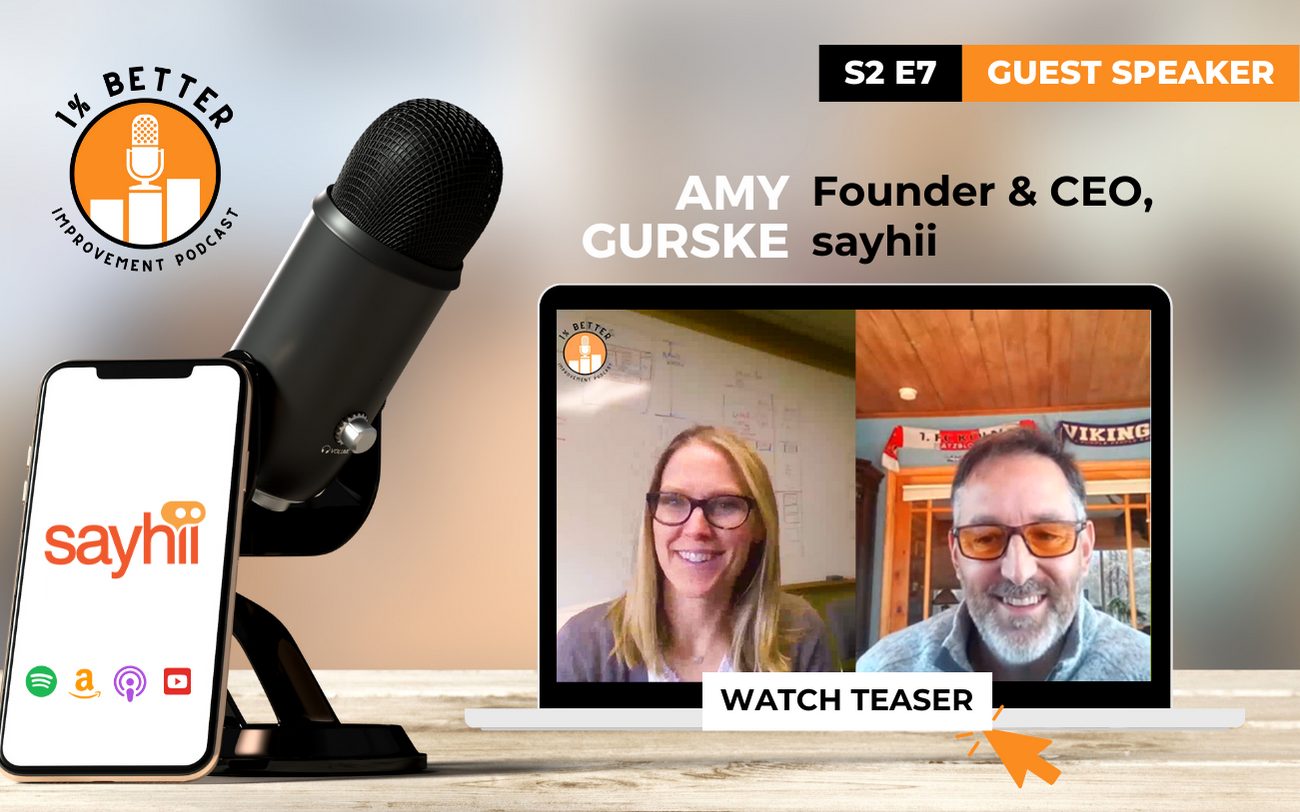
Find 1% Better Improvement Podcast Here





1% Better Amy Gurske – Quick Links
Learn more about sayhii
Follow Amy Gurske on LinkedIn
Connect with Craig Thielen on LinkedIn
Key Takeaways
- Career Path and Adaptability: Amy’s journey through her career highlights the importance of adaptability and seizing opportunities, even unexpected ones like walking into the wrong information session. Her ability to create roles and opportunities for herself, particularly at Grainger and later Amazon, underscores her proactive approach to career development.
- Women in Engineering: Amy discussed the challenges and experiences of being a minority as a female in the engineering field, particularly at a time when there were fewer women in such roles. This part of her story emphasizes the gender dynamics in STEM fields and the slow evolution towards more inclusive environments.
- Employee Advocacy and the Birth of sayhii: The idea for sayhii stemmed from Amy’s personal experiences of feeling unheard within large organizations like Amazon. Sayhii was created to act as a “Chief Listening Officer,” using daily feedback to foster better communication and ensure that every employee feels heard and valued.
- Innovative Approach to Workplace Communication: Sayhii’s methodology is innovative, focusing on daily, real-time feedback from employees to assess their well-being and workplace challenges. This approach aims to foster a more responsive and empathetic corporate culture.
- Data-Driven Employee Engagement: Amy emphasized the importance of real-time, data-driven insights into employee sentiment to manage and improve engagement effectively. Sayhii’s approach allows for personalized feedback and action plans, helping companies address individual and team-specific issues promptly.













1% Better Amy Gurske – Transcript
[00:00:05.840] – Craig
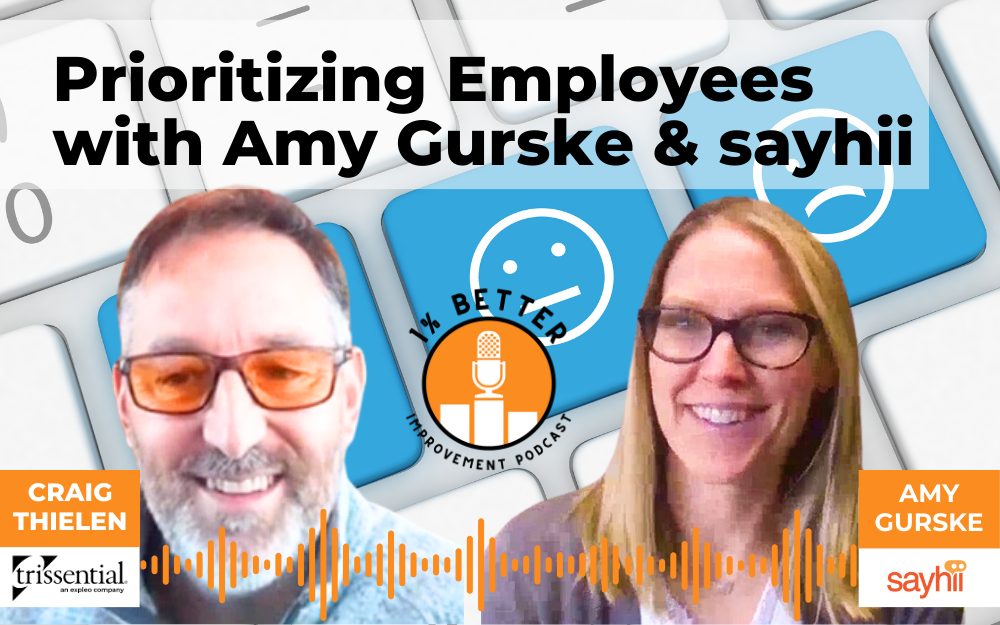
Today, I’m speaking with Amy Gurske, who is the Founder and CEO of sayhii. Amy, welcome to 1% Better.
[00:00:15.080] – Amy
Thanks, Craig. So glad to be here.
[00:00:18.030] – Craig
Well, this is going to be fun… You and I have had many conversations over the past couple of years, and I’m really excited to bring that to our audience and what you’re doing in the world I think it applies and we can all learn from it. Before we jump into that, why don’t you give us a little bit of background on who Amy is and where you grew up and early career work that you did?
[00:00:43.910] – Amy
Yeah, absolutely. Well, it started on a beautiful spring day in Rochester, New York. Just kidding. We won’t go that far back. But I was born and raised in Rochester, New York, and ended up going to college for engineering. When I went for my interview, they said, Can you talk to a wall all day? I said, Well, probably. And they’re like, No, not have fun with it. But what we mean as an engineer, you’re probably not going to be associating with a ton of people. You’re going to be doing a lot of engineering, numbers, calculations, stuff like that.
[00:01:15.310] – Craig
I’m guessing, by the way, that back when you went to school, not that long ago, but there weren’t a ton of females in engineering. Was that true?
[00:01:23.870] – Amy
Yeah, and t’s odd… the college I ended up choosing, which was Clarkson, and I’ll explain the reason in a little bit, but the ratio was nine to one, nine males to one female. The majority of the females that went to Clarkson were in our Physician’s Assistant program or physical therapy. They weren’t actually in engineering. We were a very small minority within the campus, which was already a small campus. But to your point of even early days, and I can’t believe I’m saying it because I remember being the early 20-year-old in the workforce thinking like, Oh, these people are old, and now I’m the old one. But yeah, 20 years ago, it was…
[00:02:03.260] – Craig
Speak for yourself about age… you’re still the only one.
[00:02:04.070] – Amy
Listen, we’re not that far off, sir. But yeah, now we talk about it. It’s like, Yeah, this was 25 years ago, right? There weren’t a ton of options. And so the reason I picked Clarkson was because they had an interdisciplinary program, which essentially you came out with an undergrad in engineering in what’s an equivalent of an MBA. The program was meant to be able to bridge the gap between sales teams and engineers. Right off the bat I didn’t choose a degree that was very well known in the world. Then I ended up walking into the wrong info session, which is what started my 17-year career with Grainger. Even then, I walked in the wrong info session. They were looking for seniors. I was a freshman. After they came out, I was too embarrassed to leave, and I knew I wasn’t going to get a job because they didn’t have internships. They said, Do you want to create one? I worked for Grainger through college doing account management in the middle of nowhere. Internet was just coming out. So grainger.com was the first e-commerce website. We were like, we’re so cool. People were like, How to use the internet? We’re like…
Craig
Leading edge.
[00:03:07.860] – Amy
Yeah. I remember bringing the CD-ROMs as the catalog. So fast forward, 17 years at Grainger. The internship I took wasn’t there until I created it. I switched over to a rotational program when I graduated. They pulled me off of that within six months and put me in a role that also didn’t exist. So this concept of moving into these gray areas, solving a problem, coming up with a solution and delivering has been consistent throughout my career, and where most of the either promotions or lateral or whatever moves within Grainger in those 17 years came from, was me bringing to the organization, Here’s a problem. I’m hearing this over and over and over again from people, right? How are we going to solve this? And they’re like, We’ll go figure it out. Then I fell through the cracks.
At the end of 17 years, there was a position that opened up reporting to the C-suite. I was a lead consultant for the team, been on there 10 years doing global supply chain consulting for Fortune 100s. My boss said, Yeah, this position is exactly what you’re looking for. You’ve been here 10 years, it’s an absolute fit. I can’t let you take it. I’m like, I’m sorry, what? He’s like, You’re a top performer. He’s like, Give me another 4-5 years. Again, I’ve been doing the role 10 years. I went to one of my clients at the time, which was Amazon. They had made an acquisition…
Craig
This little company that sold books, right?
Amy
Yeah, out of the back of a Honda Accord or something like that. Yeah. So a couple of years after they started selling books, they decided to make an acquisition and get into the B2B space. And so they needed help figuring out how we’re actually going to sell to businesses using the Amazon platform. And Amazon business was born out of a startup called Small Parts. So I moved over. I left Grainger after 17 years. And as soon as I went over to Amazon, I got a call from the CEO and he said, Why did you leave? And I told him the situation, wanted this job, was told I couldn’t do it. My boss at the time, so well respected. He’s like, Yeah, you had no options. I get why you left. And this all builds to where I am today at Amazon.
Same thing. I was burning out, asked for a work from home day. They said, No, we’re in office. And I had to have a workaround. Okay, I’m going to give everybody else work from home on Friday so I can get my stuff done. I shouldn’t have to create a workaround because I can’t work from home and get my stuff done. And so we had 20 billion in sales, and I ended up departing Amazon business. And I honestly didn’t know what I was going to be doing next, and that’s when I met you. And that’s where the whole journey started.
[00:05:36.490] – Craig
I just want to fill in a couple of blanks. When you left Amazon, you had a big job. You had how many people reporting to you?
[00:05:43.050] – Amy
At Granger?
[00:05:44.180] – Craig
No, at Amazon.
[00:05:45.040] – Amy
At Amazon. 650.
[00:05:47.330] – Craig
Yeah. So you had tons of people and layers and levels, and you left because why? Because the culture, the stress, the workload, what was it?
[00:05:59.710] – Amy
Yeah, the final crack was I’m sitting there, and it’s all self-awareness, right? My company cannot change my stress level. My company cannot fix my work-life balance. That’s a Amy thing. And so I spent a lot of time. I actually went on a 10-day silent seated meditation retreat, which you and I have talked about plenty. Really, and I didn’t even leave the organization until six months later, but it came to me that I was burning out, that what was coming in and what was being put on me was more than I could handle at that point. And I knew that I needed to ask for help. And so I asked for help. I said, I need to work from home day to be able to get this stuff done. And they said, no. So just like Grainger, Hey, I want this position. I’ve worked really hard. It’s a perfect fit. Then I go over to Amazon and it’s like, Why am I not being heard? I don’t understand. I’m not being heard. I’m listening to people and trying to advocate for them, but I’m not being heard. And so I ended up leaving organizations because I wasn’t heard.
I didn’t have a seat at the table, which really was the birthing of sayhii, and the purpose behind sayhii is to ensure that every single person has a voice at the table. A lot of the problems we try to solve for, we have to experience ourselves. I was one who fell through the cracks. My mission moving forward has been to ensure that every voice is heard.
[00:07:17.930] – Craig
Well, yes. Let’s jump into that. As you said, after you left Amazon, we got introduced and we were looking for a role and a great engagement that we were doing. And you would have been a great, amazing add to our team at the time, but it didn’t work out for a couple of different reasons. But all things happen for reasons, right? And so then shortly after that, you did create a company. And again, you were talking to me about this idea you have… I’m going to create this software… I’m going to make this experience better for people. And I was like, Oh, that’s a cool idea. And you actually did it. You took this idea and you started this company called sayhii. Let’s start there.
So what is sayhii? I mean, first of all, I think we already got a few clues as to why you started, but maybe just in the end, it’s one thing to have an idea and have some life experiences. But what was your ultimate reason for, I need to do this. I need to create this company. You could have taken the job. You could have taken on with us, I know you have lots of options and a big network, but the need to, I need to build this thing. So a little bit about the why there, and then describe exactly what does sayhii do.
[00:08:35.910] – Amy
Well, it’s so funny because our path in the inception of sayhii, it was actually that client we were working with that literally asked me, What is your most innovative idea? I told them the inklings behind sayhii, and that client said, You need to build it and bring it here. I was like, Okay.
[00:08:55.150] – Craig
And they still need it, by the way.
[00:08:57.150] – Amy
Correct. They actually did a pilot with us. So we will be going back to that organization because they had the same struggles. And then I realized it was in that conversation listening to this person who’s very high up in this organization say, We need this solution. It doesn’t exist. We need this. Go build it. So that really gave me enough confidence to say, Okay, let me at least start to do some additional market research.
So the inception of sayhii, May 2021, the concept behind sayhii is super simple. When I told you what I struggled with at Grainger. I didn’t feel heard. I was overlooked. At Amazon, I didn’t feel heard. I was asking for what I needed. I wasn’t getting it. I wasn’t feeling heard. So we needed a better way to listen to people. And every single conversation starts with saying hi. That’s what we do. We say hi once a day to every single employee to optimize their own personal health and wellness in the organization, but also provide real-time data to the organization so they can actually see what teams are struggling, what they’re struggling with. If they’re making changes within the organization, they can see how people are responding. They can go and help the people that are responding poor to the change. They can actually directly impact those individuals.
Just like we have solid inventory numbers because we need to make sure that we know what we have so we can sell it or we can get rid of it if it’s gone bad. We to-date, there is no platform or program that gives you real-time data on how your humans are doing at any given point in time. We saw the impact through the great resignation. A trillion dollars was lost, but there’s no hard, this is the problem, this is the problem. We’re talking about human behavior.
And one of the big things happening right now, and I know we’re seeing a ton of memes about it, and we all joke about it. But the Gen Z coming in, we’re all making fun of them for a little bit, or boomers are different than this, then different than millennials, then different than this. We’re talking generations more than we ever have. And the generation coming in wants to be heard. They’re demanding to be heard. The statistic, I think it’s like 68% of Gen Z will leave their job in the first year because they don’t feel heard. So I built sayhii to essentially come into an organization as their Chief Listening Officer. We listen and we bring you to action. That’s our goal.
[00:11:18.000] – Craig
It’s interesting that you drew the analogy to, we have all this data. I mean, you grew up in supply chain. I grew up in manufacturing companies implementing ERP systems. We have a lot of data about inventory, our machines, our production. We know everything about that, but we know nothing about our, quote, unquote, most important asset. We know very little about it. At best, we even know anecdotal, and sometimes we don’t even know that stuff. So one of my questions, this fascinates me, by the way, is what was your going in hypothesis about, okay, if we’re going to actually engage with people in a very consistent and, yes, digital way that we haven’t really been accustomed to doing, what data did you think or what hypotheses did you have around what you were going to hear from people? And again, how you break them by age groups… you could break them a lot of different ways. I’m even curious what demographic data you have. And then what have you learned? Because you’ve done a number of pilots, you have customers, you have quite a bit of data now. What’s changed now that you see real data from real people?
[00:12:31.350] – Amy
Yeah. So all great questions, so much in there. What we’re seeing is exactly what we thought we would see, which is people are enjoying a, say hi when we ask this one question a day, which is what we do, right? We say hi, we ask one question takes individuals 1-5 seconds to answer. It’s teed up to them. So we don’t want to interrupt their day. We don’t want it to take too much time. It has to be so super simple.
[00:12:55.860] – Craig
So just to get a visual, everyone logs on to their computer every day, and literally a box pops up and has one very simple question. Give me an example of what a question would be. If I logged on today, what would a question be?
[00:13:08.370] – Amy
Yes, I trust my team to manage my workload when I’m on vacation. Okay. So everything likert one to five, and we give you the option to skip, but there’s no X out of the box. So you either have to answer it or skip it, which is why we have a 99.9% adoption rate. People would rather answer than skip. So in our original hypothesis was…
[00:13:31.500] – Craig
So you don’t get people just on that point. You don’t get people just, I don’t want anyone to know anything about me. I don’t like this whole Big Brother thing. They just close the box. You don’t get that. You get people either skip or they answer the question 99.9% of the time.
[00:13:47.620] – Amy
Yeah, 99.9%. That’s amazing. And we have less than 0.05% skipping.
[00:13:51.940] – Craig
That’s amazing. Because I would have thought that a lot of people would say, This is creepy. This is weird. Why are you asking me these questions? Who’s going to see it, but you’re seeing a super high adoption rate.
[00:14:02.960] – Amy
Yeah, and it’s because of the way we position it. My career at Amazon was all around customer success and professional services. When I built out solution architecture, so when I built out sayhii, we knew it had to be super simple implementation, which it is. It can be turned on in 24 hours, which is scary. We actually need to slow down the technology implementation to allow ourselves enough time to communicate to end users to let them know what the purpose of the program is, how their data is safely and securely kept. All those answers that come back to sayhii, they’re first anonymized, then they’re themed and they’re aggregated by theme, so all the questions go into a theme. They’re anonymized, They’re aggregated and they’re themed. Then you have to have a team of five or more. We keep data so safe that we have to make sure that we can communicate that to the individual. One of the other key features of sayhii is we don’t know what question we’re going to ask until you answer your question the day before. Every other survey or engagement tool has a static list of questions, which is typically what the organization wants to know about how they’re doing.
So essentially these surveys, you’re rating the organization on what they’re doing well. sayhii is flipping that on its head. We’re saying the things you’re struggling with are the things that the organization can’t help you with. You’re missing a sense of belonging, you don’t trust your manager, a poor communication, lack of autonomy. None of those things you’re going to see at the organizational level. So we use our line of questions to actually diagnose the specific need of every single individual. To do that, we have to be very smart about our line of questioning. On the front end, we don’t know what question we’re going to ask you until you answer your question the day before. So Craig might be low on trust. I might be low on communication. We’re all answering at any organization…
[00:15:49.310] – Craig
So it’s not the same question for everyone in the organization. It’s a different question for every person.
[00:15:54.790] – Amy
It follows the journey of every single individual, which, again, is a game changer. Instead of that static list that the company wants to know that is a biased list of questions put together by the organization. We’re saying, We don’t really care about what the organization wants to know. We care about this individual in getting them to perform at their highest ability. We’re going to focus on their needs to get them connected and solve those needs in the workplace so they can feel that sense of longing. They can increase their trust. If trust is so low, a part of the monthly activation we send every individual is a conversation. We may send you to someone across the organization another department to go have a conversation with. There’s a networking component that’s a part of sayhii as well that helps us build that sense of connection relevance. There’s a lot of components that actually go into sayhii to solve the whole complex human system versus just measuring engagement.
[00:16:45.830] – Craig
Interesting. How do you then… Let’s say you have, let’s just pick a number, 10,000 employees, and you have 10,000 people doing this and see you have a ton of data. How do you then aggregate the data and of course, the company is buying the software and they’re paying money for it. They expect to get a return on their investment. They expect to be able to learn and be able to take action and whatever metrics they have, whether it be employee satisfaction or whether it be turnover, whether it be… you name it. They want to move the bar. So how do you take that data and then replay it back to leaders and managers so that they can then act upon it or be aware? How do you use that data?
[00:17:31.300] – Amy
Yeah. So everyone’s answering their one question a day, and everyone’s getting this different question there on their own journeys. Once a month, we send every single individual who answers 80% of their questions a monthly activation. That’s going to run you through your organizational vitals. So your stress, work-life balance, capacity. We’re going to tee you up to have a conversation, tell you who you’re having it with, give you a skill to work on. We also democratize the data to show you how you fit in the mix of the whole, and we give you a team development page.
Managers can use that team development page on a monthly call. We give them a team activation, which is a question that is non-transactional, something that will actually bring your team closer together. Those typical iceberg questions or icebreaker questions. But we also use personality data and we say, Hey, if you’re trying to build trust, depending on where people fall, do these things. So we’re not just giving personality types. We’re actually bringing the content directly to managers to share with their team that says, Did you guys know that people build trust in different ways? And the way that Craig builds trust is from Amy.
Amy doesn’t want to be judged or dismissed. And Craig’s very analytical. He wants to know the data. He wants to know what’s behind that. That’s going to give him that trust or confidence. So two very different ways of building trust. So we want to help them understand that. And then, again, for the organization, they get this real-time data. So at any point in time, they can go in and see which teams are struggling and what they’re struggling with.
We had a current client that launched a new platform, and they wanted to know how the change was They used sayhii real-time data to figure out which teams were struggling with the change. When directly to them, scheduled time as leadership met with them, next day, we started to see the scores go up. It’s just allowing people to be more directive with their action, we don’t replace human interaction. We’re actually trying to create more of it. That original thesis of better conversations, better results is what we’re seeing. Our pilot clients, we’re seeing the vitals right size. There’s always going to be stress. You’re always going to have people with a wonky work-life balance and capacity can shift.
But we can use this real-time data to actually get ahead of these issues instead of behind them. So the example I use is Kodak. I’m from Rochester, New York, originally. It’s where I’m sitting right now. After moving all over the country and back again, Kodak was the organization here. And what happened? They lost their culture. If you don’t have data to tell you that things are sliding, how do you know until it’s too late? So we just knew we had to get better because, again, it’s not that we’re sacrificing dollars here. We’re sacrificing people. I just don’t want to mess around with that. So we need to listen better.
[00:20:13.670] – Craig
Yeah. No, I think it’s amazing to have that data available. But one thing that I’m curious about is because data can be used in a lot of different ways. So data can be weaponized. So if you have a toxic culture, if you have a, Hey, we just need more work done and work harder and get more stuff done. And we’re going to use this data to find out who’s not happy, and we’re going to go and make sure they’re happy. That could be a real negative thing. And I could see some people going, Well, I’m just going to fill this out happy path because I don’t want someone coming to contact me from corporate or someone from work change management or whatever we’re going to call them to sit down and coach me or sit down and network me or have an intervention or something. So is that something that you just have to educate leaders? Like, Hey, how to use this data in a very productive way, in a very constructive way, versus we’re going to use it against people, and then it’s useless at that point.
[00:21:14.090] – Amy
Well, that’s why we tee up those monthly activations, we actually don’t want them to have to figure out the data, so we figure it out for them. So all those connections we’re making every month are on purpose. You’re talking to these people for a reason. We’re pulling people together with intention. So we’re actually using the data to drive action already. Technically, the organization doesn’t have to do anything with the data. We want them to be able to look at it. We want them to be able to utilize the data, but the program actually runs self-sufficient on its own.
We do most of that data work and bring you direct to action. Now, to not weaponize the data, again, we had to make sure that there is no way possible that they could. First off, that’s Sehai’s responsibility. There is no way that you can reverse engineer what question anybody was ever answered. There is no reflection ever in the organization, Craig got these questions. Not even that he scored this, just that Craig got these questions. That doesn’t even exist. The organization doesn’t even know that Craig…
Craig
Or a team or an area because you could work through teams and groups, too, right?
[00:22:15.280] – Amy
Right. Say, for instance, there’s a lot of different use cases, and I won’t get too far in the weeds, but we measure different things. If someone is struggling with trust, we want to figure out, do they not trust the organization and leadership? Do they not trust their team? Do they not trust their manager? We have different levels of questions we also ask which help with the diagnostic. We actually can tell you this person has a problem, but it’s of their own doing, essentially. We don’t give that to the organization. We just give them skills in their monthly activation to actually address their own needs.
Whether they choose to use them, up to them. But what I will tell you is the power of awareness, which I know you personally know. But the minute you’re aware of something, it’s like if you ever heard someone say something and you’re like, I’ve never heard someone say that. Then all hear for the next two weeks is that saying, and you’re like, I’ve never heard this, and now I’ve heard it so much in two weeks. If someone sees that their stress level is super high and they’re like, Well, there’s nothing I can do about it, they’re going to be thinking about their stress level and trying to right-size it for the next couple of weeks without them even knowing they’re doing it.
Really, just making people aware already drives change. That’s why I said they don’t even need to look at the data, but we want them to specifically see. Again, we theme everything, we anonymize, we analyze all the data, and we aggregate to a level of five. You’ll never know what question and answer anyone gave, but you’ll know the team is struggling with trust specific to gossip. You’ll know this team is struggling with communication specific to frequency. That gives you something trainable. That gives you something to talk about in that team page.
[00:23:48.750] – Craig
Interesting. What would you say if you had to extrapolate all of the data that you’re getting back? I’m sure it’s super interesting. You could just look at the data endless mostly about seeing trends, but what would you say are themes across companies and industries that is somewhat consistent in the data? Anything that comes to mind?
[00:24:12.270] – Amy
First off, I’m obsessed with data. I knew we had to have so many different ways to look at it. One way that we scrape a ton of different demographic information, we’re looking at geographic trends, we’re looking at generational trends, which is what I want to come back to, because that’s really what we’re seeing. We’re seeing it reflected in turnover. Like, 68% of Gen Z is going to be gone. How do we get them to stay? What I’m doing, and what sayhii is doing, is looking at the data and saying, Well, what matters to these people? Really, it’s being seen, it’s being heard. What we’re doing with some of our clients is we’re specifically saying, In your onboarding, we want you to introduce sayhii as your Chief Listening Officer. That is a complete confidential source that will listen to every single employee and make sure that your own contribution to being heard are brought to action. We want to make sure that you’re heard. It is important that we understand you. You see things very differently than we do, and we want to understand that.
That actually telling Gen Z that, We hear you. We know you want to be heard. We are putting mechanisms in place to hear you. They’re loving it. That alone is shifting the number. Organizations have to get on this listening bandwagon. It’s not just listening to customers and customer feedback. Your customers are your employees. Like you said, you came from manufacturing, I came from supply chain. It doesn’t matter how tight your inventory is. It doesn’t matter how much revenue you have coming in. If all of your people leave, you’re not making revenue and you’re not keeping that inventory up to date. We’re getting to the point, and it’s the crux right now, where people are saying, This generational rub is killing us. Our turnover is skyrocketing and it’s not going down after the great resignation. What do we do? The answer is, listen.
[00:25:55.000] – Craig
Can you measure if people are happy or not? And what percentage across the clients of your work with the data that you have, are people happy versus unhappy at work?
[00:26:05.700] – Amy
We don’t measure happiness because that can be a bit elusive. We’ll measure positivity. We’ll measure optimism. We also know which personality types are more apt to be positive. When we create groups in sayhii, so one thing we also do, so these monthly activations go to every single individual. We act like a one-to-one coach for every person. For the organization, we do a six-month activation, which is a deeper dive into every single theme, and we consolidate groups, and we have leaders, and we tell them what they’re talking about, and those conversations all bubble up. It’s honestly a beautiful orchestra when done properly, of just people talking, bubbling ideas, funneling up to leadership of the company, all by people having conversations, sayhii just uses the data to put the right teams together to extract the right information.
We’re seeing from the organizational side, they’re just loving the fact that people are connecting, and that’s what Gen Z needs. They want to be seen, they want to be heard. If we are not going above and beyond to connect them, we’re going to lose them. And it’s also helping the older generations, even… I’m a cusper. I’m mainly Gen X, but I technically could be considered a cusper. I tend more towards Gen X. I will work all day. The grinding mentality. I’ve actually had to reframe that for myself. Grinding is not working 23 out of 24 hours a day. It’s doing the things you don’t want to do that you know you have to do. That’s my new definition of the grind. Yeah. We’re all just rate-sizing. So, yeah.
[00:27:31.520] – Craig
But you… I mean, part of the goal here is moving the bar. So if you had 70% of your people that weren’t very positive, and you can shift that to 50%, 30%, 20%, whatever. There’s some metrics that you can use in an organization. Say, are we improving the morale or are we improving happiness or positivity? I mean, you can measure that stuff, Are you seeing it go up? How quickly can it go up?
[00:28:03.880] – Amy
The big metrics that we’re capturing for organizations are engagement, ENPS, which is not derived from one question. We’re looking at their overall wellness grades. We’re looking at their cultural score. Those are going to be the four big hitters. The vitals, we break that down, so we want to look at stress, capacity, work-life balance. Are those right-sizing? Because they’re never going to be a zero or 100. They’re always going to be something we got to keep them healthy. But we’ll see organizational wellness increase. We’ll see organizational engagement increase. That is what we’re seeing through our studies. One thing I want to be able to measure, like I said, is a productivity index. It’s currently in beta, so I don’t want to talk too much about it. But if you think about what performance is, it’s AMO, A-M-O… Ability, Motivation, Opportunity. sayhii is measuring all of those. So essentially, we should be able to create or develop a performance index. That, I could care more about because my CTO, David, you’ve yet to meet him, I don’t think. He’s hysterical, but he will tell you he is my naysayer. He is the negative to my positive. You know me, I’m eternally optimistic. I love change and challenge. Actually, I hate change, but I go through it anyway. David’s my naysayer. I don’t want David to be… I want David to say my naysayer. It’s actually his personality type. He’s super analytical. He wants to find the holes in the gaps. Guess what? He’s the yin to my yang. Perfect. So we’re not saying that everybody needs to be positive and optimistic and upbeat, because that’s not who people are. We want them to be productive. We want them to be positive, and we want them to be well. If you are well, you have more opportunity to be positive.
[00:29:45.470] – Craig
So let me ask you this. Let’s just say for people listening, until they all have access to sayhii, until it’s the Google or the Microsoft Office, which maybe someday it will be, What would you say… you’re seeing data, you’re seeing what makes people not engaged, not productive. You’re seeing all those organizational impediments. What would you just say to any manager, what can they do today to help move the bar on that short of, again, getting all the data.
[00:30:17.320] – Amy
I’m going to break it out into gens. Gen Z, give them opportunities to lead, whether it’s a team meeting, leading stretches in a warehouse before people actually start moving boxes, leading an activity, taking a project on… Gen Z wants a responsibility, and they want a chance to execute, but they want you to support them through it. So give them opportunities. Don’t make them massive. Give them opportunities to lead. You’re going to lead this month’s team meeting. Great. Give Gen Z an opportunity to lead. What do millennials want? They want that balance. Millennials want… They’re getting into the point in their life where they’re starting families. They want you to understand when they say, I am struggling right now because millennials are known. We will tell you what is going on with us. I am struggling right now. I need to work from home. Things are falling apart. They want to be heard, which everybody does, but they want you to acknowledge what they’re saying. So give Gen Zs the opportunity to lead. Give millennials the opportunity to be heard. Make sure that you feed back what you heard from them. Gen X, they want recognition and acknowledgement.
You have been so consistent. You have been steady. Keep going. You’re leaders in this organization. They’re the ones who want the recognition. Believe it or not, Gen Z doesn’t need a ton of recognition right now. They want opportunity. Then if we have any boomers out there, we thank them. They are the backbone. They are the ones who know how to get it done, and they know how we got to today. We ask them to help our younger leaders, but we ask them to approach it with curiosity. We don’t go to them. We don’t ask boomers to go and say, technology is wrong, and we shouldn’t do anything, and everybody needs to be in the office, and we got to go back to paper reports…
[00:31:53.470] – Craig
Back in the day, we used to come in the office five days a week.
[00:31:57.120] – Amy
Right. And so when boomers say, Listen, all this stuff is shifting. We know what we know. We’re here as a resource for you. But all you whipper-snappers are out there creating and doing and changing, we don’t want that. We’re going to be your steer. We’re going to stay sturdy. We’re going to stay strong. And that’s who boomers are. So, we just want to acknowledge them and thank them for their service.
[00:32:17.660] – Craig
Very good. Well, that’s some very helpful stuff I think anyone can look at and apply. Well, we’re already through the quick 35 minutes here. So I’m going to ask you a question. With everything you’ve learned, looking back in your career and your life, starting with an interview, an internship interview that was messed up and you turned it into something really amazing. With everything else… starting a company and working for big companies and some of the biggest in the world, what would you want to share with someone fresh out of college or maybe yourself that you wish you knew when you were coming out of high school? What life lessons would you share?
[00:32:59.960] – Amy
I would share that the moment you feel like you’re going to give up, you have four more times to feel that before you actually do. One thing that we’re struggling with these days, and a lot of it has to do with COVID, is resilience. So that moment that you feel like you’re going to fail, you always hear, just keep going. What I’m going to tell you is you’re going to fail four more times. So just knowing you’re going to fail is enough to know it’s okay to fail. Fail fast, fail often. And that’s my advice. Don’t be afraid of failure. Dive into it. Acknowledge it, and move on. We’ve all made mistakes. We’ve all messed up. We’ve all learned from them, so fail fast, fail often.
[00:33:36.270] – Craig
Awesome. Great advice. We’ve heard it, but it’s like living it as a whole other thing. I don’t think it can be stated enough about how important failure is. In fact, I just saw a video. Now, they pop up on your phone. I forget the guy’s name now. He’s a leadership guru, and he basically said, You gain zero from success. Like, literally said zero.
Amy
Adam Grant.
Craig
The only time you fail or the only time you learn, the only time you grow, the only time you get better is by failing. Small, big, medium, large. And that was a put a stamp on it. So great advice. It was great talking with you. And I can’t wait to see where sayhii goes in the future.
[00:34:23.260] – Amy
Me, too. Thanks for having me, Craig.
check out other podcast episodes