Find 1% Better Improvement Podcast Here





1% Better Pam DeGrote – Quick Links
Trissential’s Approach
Trissential’s Mission and Core Values
Connect with Pam DeGrote on LinkedIn
Connect with Craig Thielen on LinkedIn
Key Takeaways
- Retirement Reflections: Pam discusses the reality versus expectations of retirement, emphasizing the freedom it offers, though she admits adjusting to a less structured lifestyle continues to be challenging. Even in retirement, Pam continues to apply her project management skills to personal projects, illustrating how professional skills can be transferable and beneficial in all phases of life.
- Career Transition and Growth: Pam DeGrote shares her unique journey from being one of the earliest clients of Trissential to joining and eventually retiring from the company. Her experience highlights the value of evolving roles within a single organization
- Project Management Insights: Throughout her career, Pam focused on project management, providing insights into her approach to handling projects, including the importance of adaptability and structured planning to ensure project success
- Adapting to Changes: Pam emphasizes the significance of agility and adaptability in project management, recounting experiences where being flexible and responsive to changing project dynamics led to better outcomes and solutions
- Cultural Impact on Success: Pam reflects on the importance of company culture and client relationships in consulting, stressing that a collaborative and ego-free approach has been key to her and Trissential’s success















1% Better Pam DeGrote – Transcript
[00:00:05.940] – Craig
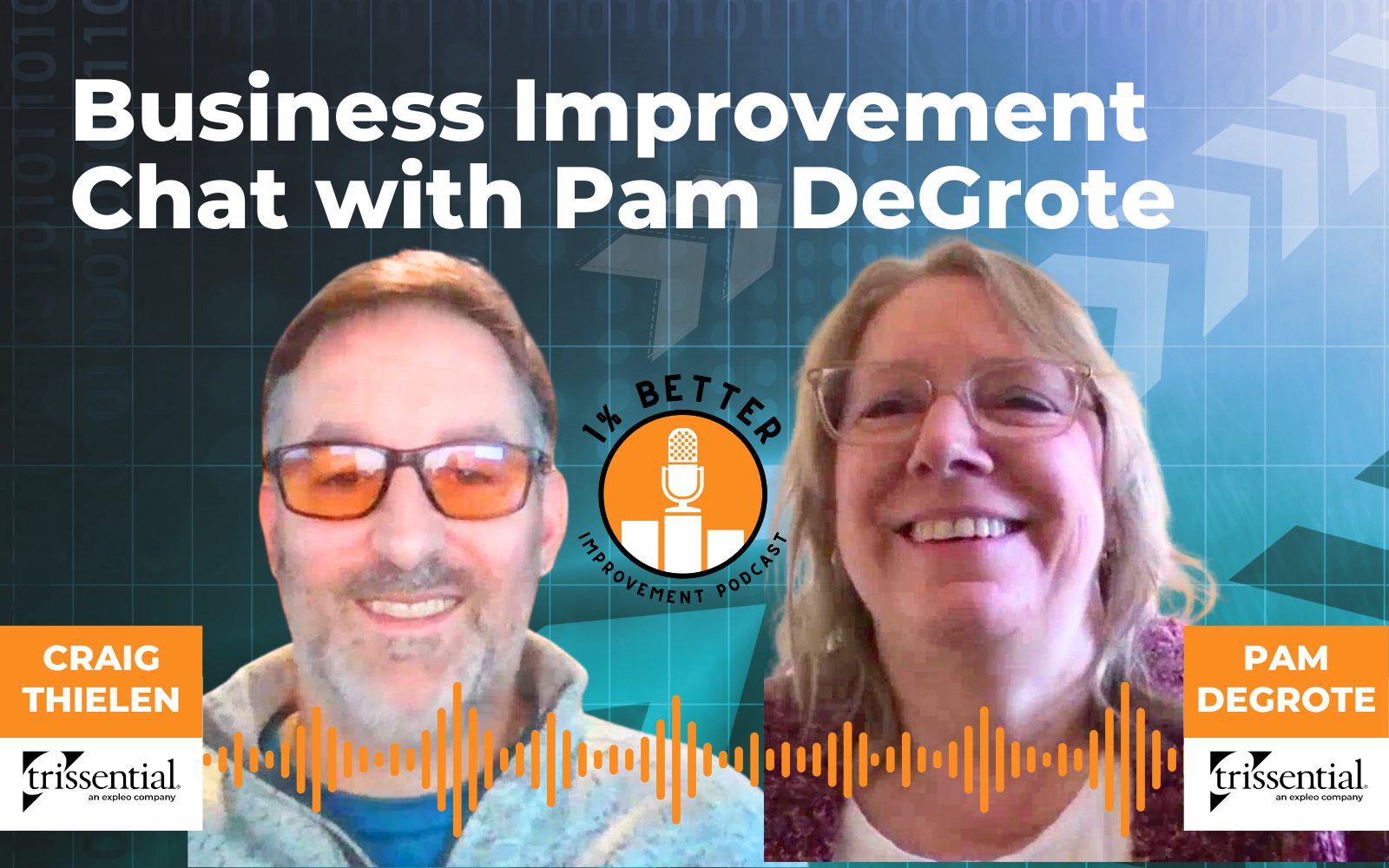
Hello, I’m Craig Thielen, and this is the 1% Better Podcast. Today, I am speaking with Pam DeGrote. Pam has a very unique distinction with us and perspective that she was one of our very first clients at Trissential. She then, at some point, decided to join our team and be an employee, which she did for nearly 14 years. And now she can really smile large and in charge because she’s retired, which is always the goal for everybody. So Pam, nice to see you again. Welcome to 1% Better. Thank you.
[00:00:41.470] – Pam
Thank you – Nice to see you, too.
[00:00:42.460] – Craig
All right. Well, let’s dig in here. First of all, congratulations on retirement. That’s awesome. Are you in one year in or how far have you been into it?
[00:00:51.500] – Pam
Yeah, I guess it was July of last year, so it’s almost a year and a half.
[00:00:54.940] – Craig
Okay, so time flies. We’ll hear more about that. Well, let’s just real quick How has it gone? It’s a year. I think a lot of people, we have this dream, someday we’re going to retire. Some of us, we have a long ways to go yet. But it’s something you think about on and off for a long, long time, and you have this dream and vision. You’re now a year, year and a half into it. How has it been? You got some friends there. Has it met your expectations? Or just give us the retirement update.
[00:01:25.260] – Pam
Well, I would say things never quite turn out the way you expect, right? Right. Here’s years and years for a certain retirement, ours got tipped on its side. But nonetheless, it’s been very enjoyable. Probably the one thing I enjoy the most is I don’t have to do anything I don’t want to do. I have no schedule. I can get up in the morning and I can do whatever I feel like doing that day for the most part. But the funny thing is, is you work for how many years? I worked for 30 years. Again, you are in a routine and everything’s planned. Especially since my background, I guess I’m a planner. So it’s been really hard to break that habit. I mean, I still go to bed every night asking my husband, Okay, what’s on the plan for tomorrow? A year and a half later, and I still have to know what we’re doing tomorrow before I can go to sleep. So I don’t know when that will stop. Maybe never. But it’s been very enjoyable. We just take each day as we want to. We have an RV, and we went traveling for about four months this year, but we also have a home base so it’s nice.
[00:02:34.110] – Craig
Well, it sounds nice. One of the things I was curious about, you’re wired a certain way, right? You’re wired to plan. I just got to imagine that your portfolio, you still have a portfolio, you still prioritize it, you still want to knock things off, you want to be successful with those things. Instead of corporate projects and initiatives, it’s personal. It might be vacation or getting a new appliance or remodeling or whatever the thing is that you’re doing, but it’s still the same. You’re still wired the same way, right?
[00:03:07.350] – Pam
That’s right. I impose those things on others as well. My mother, my sister, my daughter, they’ve got something they need my help with. Okay, well, how are we going to tackle this? What are we going to do? We’re going to do this first, then that, then that, then that to be most efficient. I’m imposing all of these things on their lives as well. But I hope I’m making their lives better by doing so.
[00:03:31.100] – Craig
I’m sure you are, just like you did with all of our clients, helping them help themselves in most cases. Well, let’s turn the clock back here. It was about 20 years ago when two guys, by the name of Keith Korsi and Mike Vinje knocked on your door, probably symbolically, if not physically, from this company called Trissential, that you maybe never heard of, likely. And somehow you became one of our first clients. Tell us that story.
[00:04:02.610] – Pam
Sure. Yes. I actually still remember it vividly in my very first meeting with Keith. I had known Mike sort of, just through professional organizations and so forth. He brought Keith to introduce Keith to me, and they wanted to talk to me about how they could help. How can we help you? I was a director of a PMO at the time. I would say at that point in time, they were probably operating out of the trunk of their car. They both just showed in the same car, we met for coffee, and I liked their story. I was fairly new at my position. I went back to leadership and the CIO and a couple of others, and told them what I wanted to do. I really wanted to bring in Mike, specifically, to have him assess the PMO because I was fairly new to it, not to PMOs, but to that particular organization. I thought an outside view, besides my outside view, of assessing where it’s at, what the growth opportunity was, when our plan should be forward, would be very beneficial. And Trissential was not known by anybody. So they’re like, Who do you want to hire? Why do you want these two guys out of the trunk of their car to do this for you?
[00:05:17.910] – Craig
How many clients do they have?
[00:05:21.980] – Pam
Yeah. So it was a hard sell. And I cracked my brain a little bit and I went back to Mike and Keith and I said, You know what? I want to try I’m going to sell it this way, but you have to be okay with it. I wanted to sell it as they would assess my PMO for free, and then they could prove their value and their knowledge and their wisdom, and then any work that fell out of it. It was just an agreement between me and them, handshake, but I would throw that work their way. But once they showed their value, I was fairly confident that that wouldn’t be a problem to sell it at that point. So they agreed, and then I went back to that same group of leaders and told them what I wanted to do, and they said, All right, well, I guess there’s not-
Craig
Can’t argue with free, right?
Pam
Yeah. If they do a good job, then we’ll give them more work. If they don’t find anything wrong with the PMO, which was highly unlikely, They won’t do any work. That’s what we did. Mike came in for what was probably one of the first assessments that were done at Trissential at that time.
He did it himself. It was short, and it was three weeks. And he did our normal assessment process, interviews, and looked over our documentation, talked with me about my goals, and came out with a really nice assessment document that I could walk through with leadership about Here’s where we’re at. Here’s our areas for improvement. Here’s how we should proceed with that plan. And then at that point, it was just history. At that point, Trissential became my number one go-to for any type of PM or BA or that type of work.
[00:07:02.320] – Craig
That’s amazing. That’s a good story all the way around. I’d love to go back and look at those deliverables that Mike produced from 20 years ago. That’d be fun. I’ll see if we can track that down. So looking back, now it’s 20 years later and seeing what their pitch was and how Trissential has grown and evolved. And of course, now we’re part of a global organization called Expleo that we have nearly 20,000 employees. We’re in 35 countries. We still, by the way, we still do a lot of work in that portfolio management and project, ways of working. It’s evolved some, but still do a ton of work in that space, but we’ve evolved into so many other areas. I guess I’m curious, looking back, how close was it to the vision? Obviously, you can’t predict the future, but just what their vision was at the time, and then what’s your biggest surprises along the way in terms of what Trissential has turned out to be?
[00:08:06.050] – pam
I think that it just exploded, actually, from their original… Well, I don’t want to say from their original vision. They might have had more to their vision than they shared with me. But at the time, the story I loved, and the story I think is still embedded in the culture of the organization is, though we’re here to help, right? We’re here to help you get better. We’re here to do whatever you need us to do to get better. Then just that, some of the old mantras, check the ego, go at the door, and the humble confidence. It just goes all the practicality of it. It’s not a consulting firm, and it was never intended to be a consulting firm that’s going to come in and be superior to those around us, to everybody at the client site. We’re here to roll up our sleeves and help you figure out what’s going to work best for you, not because it’s the thing to do out there as the new shiny object, right?
[00:09:06.320] – Craig
Yeah. That’s interesting.
[00:09:07.570] – Pam
Those things are still, those things are still part of the brand new butter of everybody that gets hired and everybody that works there.
[00:09:16.910] – Craig
Yeah, it is very interesting. Absolutely. It’s still part of the fabric of our culture that we’re just here to help. Humble Confidence is one of our core values. The mission of the company hasn’t changed either, which is we want to improve the lives of everyone that we come in contact with, whether it’s a coffee, a conversation, referring someone, or doing large amounts of work, or bringing teams or solutions, whatever the case may be. So it’s interesting to hear that and good to hear it, regardless of all the different capabilities we have. That culture still has carried through. So then about six years later, you decided you wanted to join this little rig band of people that had started to gain some momentum. So tell us, why did you want to join Trissential back then? Some of our listeners, many of them perhaps, have never been on both sides of the equation, being on the corporate side and, of course, working with consultants or people to help them, and then being a consultant. And so I’m curious, what was that like for you being on both sides? And what did you see as some of the key differences, or didn’t you really see it that way?
[00:10:41.780] – Pam
I will say I didn’t consciously decide I wanted to be a consultant.
[00:10:44.910] – Craig
Most people don’t. It’s not like a career aspiration or it’s not a degree that we take, right?
[00:10:51.350] – Pam
Right. I guess I kind of freaked out one day when I was part of a layoff, and I picked up the phone and I called them, and I called actually Jim Mohs, and Mike and Keith and was just like, Oh, my gosh. I’ve been working since I was 14 years old. I’ve never been without a job. I don’t know what to do with myself. They were like, Well, we can help you. I sat down and talked with them, and they was like… We got this gig over here. It’s a nine-month gig. Maybe you just need a break from the corporate grind. I said, You know what? That sounds nice. They said, Okay, well, you got to land the interview, so here you go. I went to the interview, and I thought I bombed it bigger than I could do in my life with the client. I drove away and Jim called me and he said, So what do you think? I said, There’s no way they’re going to want me. That was the worst interview of my life. He starts laughing. He’s like, I’m like, What? He’s like, They just called and said, When How can you start? I’m like, What? That was the worst thing I was in an interview.
But anyway, that nine months contract, it turned into 14 years. I think what I discovered was about myself was I had job hopped about every 5-7 years prior to that, and I didn’t need to do that anymore because what I liked about new opportunities was I was really into PMO leadership for quite a while. I really liked getting in there, building the PMO… establishing it… I wasn’t such a fan of running it once it was operational. With Trissential, I could go in and help other PMO leaders do that, and then I could go to the next one. I could help them improve if they were already established, as opposed to building it out and fed that need I had for the building side of it rather than the operating. But then on top of that, I got the variety because I had a business analysis background, I had a project management background, I had a development background. So I got to start wearing lots of different hats, and I had the leadership background.
So between all those four hats, it made me a little bit of a Jack of all trades, so to speak, at that time, because we were really in that BAPM, PMO portfolio, leadership place, right? And so I could jump around, I could meet with the C-Levels, I could roll up my sleeves and help the BAs with establishing some process or figure out if their requirements were solid enough, that type of thing. And then there was a lot of project rescue work, which I found extremely exciting to do. Go in and project sales and go in and help them figure out why and figure out-
Craig
Plenty of those, right?
Pam
That was just exciting work. So that nine-month project. At that client, actually, it became three years moving around, doing that work for them, and then next client and next client. It just became natural for me, and I enjoyed it. Now, one thing I will say is lots of clients said that I didn’t seem like a consultant. I think it’s because of the mantras and the values we had at Trissential. They would say, You’re interested in what’s best for us, you’re not just telling what to do. You’re interested in us talking to our leadership and selling ideas. You’re not interested in being the one in this limelight. I think that was also a key contributor to both my enjoyment as well as my longevity at Trissential because it was the way we wanted to operate.
We didn’t want to be the saviors going in. We wanted to help them.
[00:14:58.650] – Craig
Yeah, that was It’s different from the perception that a lot of consultants, especially the quote, unquote big guys, have. In fact, we even turned that into a bit of a slogan at some point along the way, saying, We’re not just consultants were Essentialists. And then we said, What’s an Essentialist? Well, it’s those that carry our core values. It’s those that believe and operate with those. And we’re an improvement company. So we’re good at strategy, management, and execution, not just one of them. And we want to take a step back, whatever problem or challenge you’re having, take a step back and look at the whole system. Because a lot of times you’d come in and they’d say, oh, all our projects fail or we have all these issues. And then someone’s pointing the finger at somebody. And then when we take a step back, we go, well, actually, it starts with your portfolio, and you keep adding, but you don’t remove or you don’t allow enough resourcing, or sometimes it might be that there’s just not good communication channels or everything turns red and there’s not enough communication on why or how we get there, how we can mitigate things.
So there’s lots of reasons when you look at the whole ecosystem, when you take a step back that can help solve not just the symptom, but the actual root cause. So well, you probably, out of all of those engagements over 14 years, there’s lots of them… And I know sometimes you’re even working with multiple clients. I’m just curious if there were any that stood out to you as particularly rewarding, particularly challenging, challenging you. And then you had a breakthrough moment, which a client, of course, then has a breakthrough moment. Is there any of those that stand out for you?
[00:16:57.720] – Pam
Well, there’s a few of those, but I think honestly, that first one that I went into was extremely interesting, and probably maybe as a sign of the times, 14 years ago, I don’t know. But it was an IT development project to write a new internal piece of custom software, and it wasn’t going well. And they needed somebody to come in, they thought, and basically supervise the business analyst side of the project team because they thought that they were the problem. And when I got in there, the project was just completely off the rails, and they weren’t being honest about that to themselves. I mean, it wasn’t they’re being dishonest. They just weren’t being honest with themselves even, and the PM and so forth. They had developers coding without any understanding of what was needed to be coded. They were trying to run it very traditionally, 14 years ago. They were trying to do requirements, but at a small level. They tried to break it down into some bites, but not to say they were going down an agile path or anything. They weren’t. But then they didn’t have time to wait for the BAs to do their work.
So here, they brought on a whole team of developers. They had two BAs, and they had 12 developers, and they said, just code. It was a recipe for disaster for them. It was way behind schedule and the PM decided it was a good idea to okay, well, let’s get rid of these developers and just outsource it and throw it to another country to develop.
[00:18:38.850] – Craig
It’ll be cheaper to fail.
[00:18:42.310] – Pam
Well, not really, though. When I broke down and saw the cost they were paying. But they decided to do that as I was walking in the door, they were starting to send stuff offshore. At first, I was just like, All right, I’m a first-time consultant, right? So, okay, I’m going to just doing what I’ve been told to do, and I’m going to get this BA team into shape, and we’re going to get in front of the development. We figured out a different way to attack that and to get going. We brought in a couple more BAs, and we broke up the work differently, and we started cranking out requirements. We were catching up, but it didn’t matter because the thing was so far gone, there was no fixing it. Though probably the most impressive thing I saw out of leadership to that point in my career was the leadership of this company deciding to pull the plug. That doesn’t happen very often, right? No. We don’t decide to stop spending bad money over bad money. And they did. And they said, No, we’re done. We’re not doing this. And they killed the outsourcing contract. They let go of a whole bunch of people, contractors. And then they That PM was internal from their PMO and had that person go back to other projects. Then they asked me what they should do. I don’t know why they asked me at the time. I was like, I’m flying…
[00:20:13.670] – Craig
Well, they trusted you.
[00:20:14.490] – Pam
Well, they really didn’t have… I don’t know. They had very little interaction with me, but for some reason, yeah, never. So they asked me what to do. I said, You know what? Give me. I need a few days, and we’ll figure out a plan. I need these people. So they didn’t let go of those people. Those people and I went into a room and figured out what would be a good plan forward. How would we fix this and how would we go about it? How much might it cost? Rough, rough, rough estimate, right? And we came out of there with a plan, and I went to that executive meeting, and we talked it through, and they decided to give it a try. Then at that point, I was running that particular effort. But we broke that system into, I think it was 14 or 16 different logical components or functions. Then we planned them in a way of most importance or first need. At one time in my career, I worked for a life insurance company, and there we used to build stuff. You built the software, the new product, in a way that what do you need day one of that life insurance?
You need to be able to sell it. You don’t need to be able to cash it in. People aren’t going to die on day one. So you build what you need to sell it. And then you have to hurry like heck before somebody dies to build the other half of it.
[00:21:46.300] – Craig
I don’t know if this has ever occurred to you, Pam, but what you’re describing sounds a lot like values and principles of agile. Essentially, what you said is, Hey, this whole thing is designed for failure, regardless of what we’re paying people onshore, offshore, the whole design of the initiative was set up for failure. So stop it, start over, put in the correct or better disciplines, a discipline process, so we know what we’re doing, how we’re doing it, break it into smaller pieces, probably iterated on that. What you just described as you could call an MVP (Minimum Viable Product), right? In agile language. Let’s not try to over-architect the mousetrap. Let’s start with something that’s basic, and let’s get the individual components right. So that’s interesting because you got to that just by using common sense, what you thought was a better, more disciplined approach. And, of course, that’s now just standard operating procedure. And one of the benefits of the agile mindset is, let’s not just go at six months or a year in and hope everything works and then have to cancel it or then have to figure out. This notion of every two weeks, what are we doing? Do we have the right priorities? Are we delivering stuff and assessing and checking and not necessarily canceling the team, but saying, Hey, maybe we don’t have our priorities right. Maybe we need to adjust our focus, workload. Maybe we don’t have the right skill sets. And you do that every two weeks rather than these big monolithic projects and programs that… It is very hard for people to pull the plug once they’ve invested because essentially, they’re implicating themselves, whoever those leaders are, whoever spent the money. They’re implicating themselves that they screwed up, and they just spent a lot of money and didn’t get anything for it.
So it was a huge problem. I remember so many times we’d come in and just say, This thing is… We could come in from the outside in because we weren’t part of that political fabric or implication. And so that’s sometimes the value I’m sure you were in that position many times is having another one of our sayings have the courage to report the truth, right?
[00:24:05.440] – Pam
Yeah, for sure. You’re correct. We weren’t even thinking that we were heading down an agile path or anything. We didn’t do stories and we didn’t do any of this stuff. But we did some of the fundamental concepts that are within agile without realizing that’s what we were doing. We did small teams as well. I partnered up a BA and a developer, and they worked side by side, which minimized the documentation in my mind so that we could really afford ourselves more time to get things up and running. Then we did show and tells. Other than demos, I called them show and tells…
[00:24:41.580] – Craig
Same thing, right?
[00:24:42.560] – Pam
We got together and we said, Here’s what it’s looking like. Is this exactly what we were talking about? We did get that feedback. The other thing, though, I did talk to them about was, and I do think that was a failure on their part on that first project, was the lack of executive involvement. I did, part of my plan did say, I need one… Actually, it was two different areas… So I need one from each of your areas to be very intimate with us on this. I need to meet with you on a regular basis. You need to really understand where things are at and how things are progressing and where we have issues. If we’ve got issues because of our performance, we need to tell you that. And if we’ve got issues because of the business area is not participating, we need to be able to tell you that, and we need to course-correct immediately.
[00:25:36.810] – Craig
That hasn’t changed in 20 years, right? That’s still critical to everything. Well, one of the things, and you got in the larger and larger program over time, one of the things that we always like to do is say, Hey, we come in. Again, regardless of what you’re asking us to do or whatever symptom or problem or opportunity, we always said, Hey, let’s look at people, process, and technology. Sometimes people wanted to jump to some technology, whatever it happened to be. And we’d always say, Time out, let’s back up. What process? What’s the best process? And then do we have the right team? And do we have the right people involved, et cetera? So from your perspective, What is the hardest part of that? Going in when people are saying, We need to change, whatever that change is, looking at people process, what’s the hardest part helping clients get through, quote, unquote, change?
[00:26:30.510] – Pam
Well, whenever whatever is wrong is caused by the people or the culture, quite honestly. So if they’ve got cultural problems, they don’t communicate laterally or vertically, or there’s some issue there, that’s always a problem, right? If they’re afraid, there’s an unbelievable amount of times that it seemed like the people on the project team, on the floor, were afraid to tell the truth. Everybody was so fearful they’re going to lose their job. I never worked anywhere where anybody probably lost their job that I know of. But everybody was always afraid to say it because they would I think pride probably gets in the way. I think the other big issue that I saw with some of our clients was turf. Turf caused so many problems, turf and pride. If we could get those to-
[00:27:31.860] – Craig
You saw that all over the place, and you probably saw that consistently. It’s just a matter of every client’s got their own culture, their own politics, their own egos, their own… But it’s always there, and it’s the thing that usually is getting in the way of great process and technology, right? So what was just your technique? How did you mitigate that? And I think you were quite good at it. Part of it was the clients got to trust you very quickly, and they said, Pam, so how do we fix this? Is it just having those crucial conversations with the parties involved, or what techniques did you use to help them break through that?
[00:28:05.200] – Pam
It depended on how far reaching the problem was, I guess. Sometimes it was just crucial one-on-one conversations, or two-on, me and two people that needed to work through something that I could see needed to work through something, and let’s just go in a room and talk about it and be level-headed about it. So a lot of conversation. It’s a lot of conversation. But I did have one client where it was turned into a whole series of workshops because there was so many issues, some old baggage, like old, old baggage that people just won’t let go of. And we had to help. It was almost training opportunities we decided to help them through letting go of that old baggage. So teamwork, a workshop on teamwork and a workshop on leadership, on what it means to be a good leader rather than a manager. Workshop on effective communication skills. It seemed rudimentary in some cases. But once you got into the workshop and people just found… it seems like people are just more willing. Oh, I’m in here training. Okay. Everybody’s here to train and to learn and to work together and be collaborative and do some exercises. Some of them are silly, and we can make fun of Pam because what you’re making us do something silly. It helps people just let go, I think, of some of that stuff and just move forward. My point is, I guess it was pretty diverse. Sometimes it was just a simple conversation. Sometimes it was so big. We ended up in a six-series workshop with a bunch of people. But I think in all cases, I really do believe we worked through it. Things were better when we left than when we got there, which is always something I try to do, leave something better, someplace better.
[00:30:06.670] – Craig
Right. And whatever the context or whatever the technique, it’s really just getting them out of their ruts or getting them out of their lock-ins. Like, first step in any multiple step process is, you have to know what the problem is. And a lot of times the people are the problem because people drive decisions, they drive process, they drive budgets, they drive resource allocations, they even drive selection of technology and what have you. And so getting them out of those lock-ins and ruts and just that they are part of the problem to solve the problem is the first step. So good.
[00:30:48.360] – Pam
There’s sometimes a little tough love there, too. And I think our current speak the truth helps us do that.
Yeah. And so making them look in the mirror. And I I can remember many times I told them, You know what? I can’t care more than you do about this. It will not help you. I mean, I can, but it will not help you improve if I care more than you do.
[00:31:10.710] – Craig
Yeah, exactly. Well, very good. Well, the time has flown by here. So we got our last question, which is taken to just a step back from all of this stuff and great history and conversation. What’s one piece of advice you wish you would have known when you were getting into your career, or maybe you want to pass on to the next generation, maybe your grandkids or whoever that’s entering their professional life, your best improvement, 1% improvement, just about life that you’d like to pass on?
[00:31:47.780] – Pam
Oh, my goodness.
Craig
It’s a big question. You’re up for the task.
[00:31:52.540] – Pam
I guess probably never underestimate the power of a conversation. I know I’m a fairly introverted person. I used to be extremely introverted when I started my career as a developer, which I thought meant I was going to be able to sit in my cube and just code and not talk to anybody. It doesn’t work that way. Communication is key. I know when we’re in college, we blow off some of those communication courses. I don’t think they should do that. And critical thinking. Communication and critical thinking.
[00:32:27.210] – Craig
Very good. Well, thank you for that and thanks for getting up early here in your retirement and getting back on a schedule for us today. It was great catching up.
[00:32:39.130] – Pam
Yes. Thank you very much. Have a good day.
[00:32:42.030] – Craig
Thank you.
check out other podcast episodes