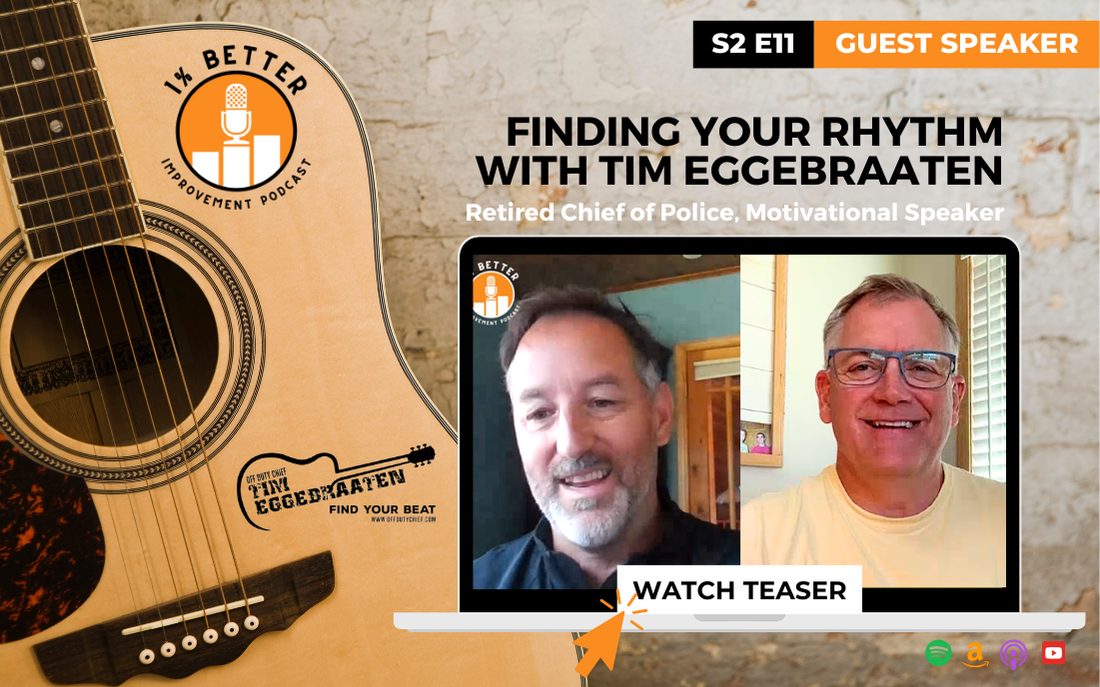
Find 1% Better Improvement Podcast Here





1% Better Tim Eggebraaten – Quick Links
Learn more about Tim at www.offdutychief.com
Download Tim’s original songs here
Watch Off Duty Chief Trailer showcasing Tim’s speaking events
Check out Tim’s book Find Your Beat
Follow Tim Eggebraaten on LinkedIn
Connect with Craig Thielen on LinkedIn
Key Takeaways
- Importance of Authenticity and Vulnerability: Tim emphasized the power of being transparent about one’s life story, including the highs and lows. Sharing personal experiences, even difficult ones, can inspire and help others, fostering a sense of connection and shared humanity.
- Finding and Living Your Calling: Tim discussed his lifelong aspiration to be a police officer and how he transitioned to his second calling as a motivational speaker. Recognizing and pursuing one’s true passions can lead to a fulfilling and impactful life.
- Impact of Small Interactions: The story of Norman highlighted how brief encounters can have profound impacts. Tim’s interaction with Norman was a pivotal moment that made him re-evaluate his approach to life and work, underscoring the importance of kindness and empathy.
- Role of Music in Life and Healing: Music has been a constant and powerful force in Tim’s life. He shared how music not only enhances joy but also serves as a therapeutic tool, connecting deeply with emotions and memories, as evidenced by his experience with a friend suffering from dementia.
- Mindfulness and Gratitude Practices: Tim advocated for mindfulness and gratitude as essential practices for maintaining balance and positivity. Taking time to reflect, meditate, and express gratitude can significantly improve mental well-being and help align one’s life with their core values and goals.



















1% Better Tim Eggebraaten – Transcript
[00:00:05.29] – Craig
Hello, I’m Craig Thielen, and this is the 1% Better Podcast. Today, I’m speaking with Tim Eggebraaten, otherwise known as the Off-Duty Chief. Tim is a motivational speaker, musician, and author of the book Find Your Beat, where he shares his entire life story, including 25 years of law enforcement and all of the inspiring challenges, life lessons, and things he used to work through it all. And really, as he says, get into the rhythm of life. So we’ll dig into all of that, and welcome to 1% Better Tim.
[00:00:38.19] – Tim
It’s awesome to be here, Craig. Thank you.
[00:00:40.26] – Craig
All right. Well, Tim, our connection is Detroit Lakes. You spend a lot of time there, even though you weren’t born there. I think you were born a little bit north of there… And north of me, which I was born in Callaway, Minnesota. But you were in Detroit Lakes for many, many years, and I think that’s still your home base today. And of I grew up in that area, went to high school there. And thankfully, we never met each other back in those days because you were the police chief. And so I’m very thankful for that. But it’s a beautiful part of the world. And we used to call it Sleepy Little Resort town. But I’m sure you have a lot of stories that say otherwise than sleepy, right?
[00:01:17.06] – Tim
Yeah, for sure. It was going to be a one year stop for my wife and I, and we’d never even been to Detroit Lakes. We both went to college at Morehead State. And after that, it was like, well, just looking for jobs all over the state. I’d taken a map and circled towns that were 30,000 people or more and just started applying everywhere to be a police officer. I was working in the jail in Moorhead, and I knew I wanted to be a cop. Detroit Lakes was hiring, and I thought, Well, we’ll give it a shot. Then got here, interviewed, tested and interviewed and stuff, and got the job offer. Then it was, Well, we’ll give them a year, and then go to Moorhead or a bigger town. And about two weeks after I got hired in Detroit Lakes, Mankato offered me a job, and then Grand Forks. Two weeks into the gig here, fell in love with Detroit Lakes. And 32 years later, here we are.
[00:02:17.10] – Craig
The way it goes. Well, and we do have a bit of an international audience. And so for those not familiar with the area, Minnesota, of course, in the middle of the US, and the Twin Cities, where I’m based out of Minneapolis, Saint Paul, Detroit Lakes is about three hours north and a couple of hours from Canada. So we’d call that Northern Minnesota is the location.
So Tim, the book that you wrote, which is just a wonderful book, and it’s really the story of your life. And it has all the highs and the lows. And I was reading it, I mean, you were very transparent about a lot of parts of your life that a lot of people don’t put out there in the public. And I thought, wow, first of all, I give you a lot of credit for sharing that. And second of all, I thought, man, everyone should do this. Everyone should come clean and say, this is who I am and what I’ve done. And again, the highs and the lows, because there’s so many learnings from it for not only your kids and your own family, but for future generations.
That’s mostly what this whole show is about, this podcast, is about how we get better in life, personal, professional. It’s usually not one aha moment, although I think you had a small aha moment that helped you rethink your Norman moment that helped you rethink life a little bit. It’s usually what you do every day and how you find, look for those improvements, which I think in some ways is what you call the rhythm of life and how you get into that mode. So anyways, I love the book and would highly recommend it. But maybe just walk us through a little bit… You started a little bit about just your life story and what led you up to even some decisions that you made, some challenges, and then what you’re doing now.
[00:03:56.07] – Tim
Yeah, absolutely. Well, thank you for the compliments on the book. Yeah, and that was tough. It was really tough to lay it out there. It was tough on me. It was tough on my wife and family to be that open. But yeah, growing up in Northern Minnesota, I was the youngest of four. I had three older sisters, and so I was the favorite son and the baby of the family and great childhood growing up. Amazing parents, very positive. My mom’s motto was, I am, I can, I will, and she lived it. So just grew up believing that I literally could be anything I want to be. And I remember even before-
Craig
Tim, just on that saying, which obviously is the big poster board right behind you, and it’s a theme in your book. You might have had it in the book, but where did your mother get that?
[00:04:46.13] – Tim
I don’t know if it was just something… I don’t know if it was something that was taught to her, or she didn’t have much growing up. It was just her and her brother and my grandma. And her dad died. My mom’s dad died when she was very young. They had a very modest beginning. And so I think it was just that she had that superpower of positive… almost annoying, overload sometimes. But super positive. And I am, I can, I will, was just one of her things that she responded to challenges with that phrase, and it stuck. Stuck with me.
[00:05:31.10] – Craig
Absolutely.
[00:05:32.13] – Tim
Yeah. But yeah, so growing up was awesome and great childhood. But I knew before kindergarten that I was going to be a police officer. It was a calling for me, and I didn’t stray from that very much throughout my high school, and I wanted to be a cop. And I knew nothing about it. I knew I had some relatives that were in law enforcement, but I didn’t know what it was like to be a cop. I just knew that I wanted to be one. And so I went to college, and then it wasn’t until my internship with the Fargo, North Dakota Police Department that I really got thrown into this is what police officers do and the nitty-gritty of it. And worked in corrections for three years and then started here in Detroit Lakes in 1992. And my wife and I have been married. We’ll celebrate 35 years in just a couple of weeks. She was my high…Congrats – Yeah, thank you. She was my high school sweetheart. And so we know each other well, and she’s been with me through the really awesome times and the crazy times. Like everybody, we all have challenges in life.
When I was 12, I started drinking alcohol, which I don’t think is uncommon, but what stuck with me on that was that I was really insecure, and I didn’t recognize any of this. When you’re in it, I wasn’t comfortable being around other people. But then the alcohol leveled the playing field, and that was I could hang out with anybody. And then that progressed, that drinking. But it stuck with me through my career. And so I’d go to police officer conventions or conferences, and I’d feel like I can’t hanging out with LAPD because they’re real cops and who am I? And it’s just that mindset. And that came through in the book when I was writing the book. It’s like, well, who am I to write a book? And just that internal battle that I think we all to face once in a while. That’s why I love your motto about that 1%… Just keep grinding and getting better and recognizing and acknowledging that we have our deficiencies. So how can we continue to push on that and improve?
[00:07:44.28] – Craig
So fast forward, you progressed in your career up the ranks. You became the Chief of Police in Detroit Lakes, which is, I guess, your dream job ever since kindergarten. And then you had a moment, a couple of moments, you had the Norman moment, and then you also had a moment where you couldn’t do it anymore, and you had to make a decision on if you wanted to continue in this job. So maybe just walk us through those.
[00:08:11.26] – Tim
Yeah. So I’ve always told people, if you don’t like your path, change your path. And that’s really easy to say, especially if you’re telling somebody, it’s like, Well, just change your path. Well, that’s great. But there’s that security of a job and the paycheck, and the insurance and all of that. But when I was 48 years old, I was chief of police, and I knew that the job was killing me. I mean, it was literally, I was drinking excessively, I was overweight. I was in a miserable place in my mind, and it was dark. And one of my best friends and partners of 19 years died by suicide 10 months after I became Police Chief. And so there’s all this stuff going on in 20 plus years of trauma, on the job stuff that I was just stuffing down inside me, and I didn’t deal with it positively. And so at 48, I knew that I needed to get out of law enforcement.
And at age 50 in the state of Minnesota, we can begin drawing our pension, but we take a penalty. But I didn’t care about that because I’m not really good with numbers, and I didn’t want to be a cop to make money. Most of what I do is just what fills me and how can I help people. I never even looked at what financial penalty I would take. I just knew that if I stuck around to 55, that I probably wouldn’t live. And I had a great team. I mean, they were true heroes, men and women that always went above and beyond and great people. But I could feel it just… And I didn’t want to be that toxic person that we all know, that person that’s no fun to be around. They’re always miserable. And I wasn’t, but I could feel myself going down that path. Everybody’s an idiot. These are all morons. I could feel it. I was like, Okay, Mister, slow down and let’s get this figured out.
I didn’t know what I was going to do when I retired. I knew that I’ve been doing a one-man band entertainment thing forever. I knew I was going to be doing music. But about six months before I retired, the Chief of Police from Burnsville, Minnesota, down by Minneapolis, he’d ask me if I would share my leadership with his leadership team. I did, and it was powerful, and we laughed and cried and sang and laughed again.
Then I found my second calling. I knew in kindergarten, I was going to be a cop. Right before I retired, I found my second calling of being a professional speaker, and I knew nothing about it. But I knew that people were resonating with my message. And this feeling of when somebody is listening and in their mind, they’re thinking, hey, I’m not alone in this. I’m not the only one that feels crappy sometimes and just dark. I’m not the only one that turns to alcohol or something not healthy. And so when I’m doing that, when I’m sharing techniques on how to be positive, how I’m positive, there was nothing better. I just got this burning fire inside of me to share this message. And so then when I retired at age 50, I hired a coach. I’m like, Well, how do I figure this out? How do I do it? I just started speaking around the country, and it’s blown up. And I’m finding that people, no matter what walk of life they’re in, they’re starving for something positive and unique, and upbeat, and I can provide that, and I throw music into it. And then the book just came along with it. It’s been a wild ride.
[00:11:50.13] – Craig
Tell us about the Norman moment.
[00:11:52.03] – Tim
Yeah. So early on in my career, I had developed that ‘us versus them’ mindset because I thought everybody was going to run away from me, lie to me or fight me. I worked a night shift for six and a half years, and my weekends were Mondays and Tuesdays, and I loved it. I mean, it was exciting. It was everything being a cop was supposed to be and more. But I really started to get jaded. Where it was my night shift partners. We were the us against pretty much everybody. And that happens. We’re all susceptible to that, where if it’s in our families, maybe it’s us versus our parents or our kids. Or maybe it’s… Obviously, We got a big political season brewing right now. And so there’s going to be a lot of that us versus them. And that guy’s an idiot. And I was really getting stuck into that. And I got a call one night on the radio to go to the Holiday Inn and check out this guy and move him along. And this guy was a homeless guy, basically. And he was coming from Minneapolis on the bus, going to Detroit, Michigan, and he saw a sign that said Detroit Lakes. And I thought, Oh, it must be close enough. And so he got off and he had this idea that he was going to revolutionize how vehicles are made in Detroit, Michigan.
[00:13:07.20] – Craig
Okay.
[00:13:08.16] – Tim
Yeah. So it’s just a simple, kind guy that was confused and maybe some mental health issues going on. But just a simple guy. It ended up, I got him a hotel room and it wasn’t… My interaction with him was maybe 20, 25 minutes. And he had these brown eyes that there was just… I can’t even describe them, but there was just something about his eyes that knocked me down. Right before I was leaving the hotel where I dropped him off at, he said, Wait a minute. And he looked at me with those brown eyes. He was looking at me, and it felt like he was looking into my soul. And I was just locked into his gaze. And all he said was, I want to remember the people who have helped me. And I didn’t know what to say. I had nothing to say. I just broke my gaze with him. I went to my police car, and I started to cry. And so the Tim Eggebraaten, at that stage of life, did not cry. I’m not against it. I’m not a saint of happiness.
There I was, and I remember thinking to myself, who have I become? Because that was not the Tim Eggebraaten that Kenny and Pat Eggebraaten raised to be caring and thoughtful and conscientious and to help people. But somewhere along that early path, I had lost my focus. And Norman, just by being himself, this kind and gentle man, had made me recognize that my rhythm of life was offbeat and I was becoming crusty and I needed to do something about it. Then throughout my career, then I ended up finding Norman. He had died, but somebody at a conference that I was speaking at said, I think I can help you find him. I wasn’t really looking, but he was a Korean War vet, and he’s buried at the Fort Snelling National Cemetery in Minneapolis. I found his headstone, and that was a process in itself and just a beautiful thing. So this man who had a profound impact on me just by being himself made me recognize that each one of us has an opportunity to be a Norman or a Norma for other people. And then these Normans and these Normans are everywhere. And if we’re so busy all the time and our minds are cluttered that we might bump into these people at the grocery store or something. But when we stop and recognize and just see that person, there’s just something about some people. I don’t know. I’m a faith. I have Christian faith, and so I believe that God put Norman into my life. Not everybody has that belief, but I do believe that people are put into our lives for a reason, and that man rocked my world.
[00:15:48.23] – Craig
So when was that? You retired at 48?
[00:15:52.03] – Tim
I retired at 50, but I do at 48.
[00:15:54.27] – Craig
Where was Norman? What age were you when you met him?
[00:15:59.01] – Tim
Probably 26 or 27.
[00:16:00.26] – Craig
Very early in your career. Okay. And so what do you think it was? Because you might have had dozens of interactions with similar interactions with people saying, Hey, I just want to thank you, and you helped them along or whatever, and you just brush it up. No worries. That’s my job. What do you think it was? Was it just that it was the right thing at the right time? Was it him or was it you were just at a breaking point? What caused emotion in you to come out, do you think?
[00:16:32.08] – Tim
I think it’s all of the above. I think it’s the timing, where I was at, because I think these people are around us, and I think events happen every day. But then I always look at it like it’s a big jigsaw puzzle, our life. And then there’s pieces getting put in, and they might be a small piece, and we might not recognize a bigger picture just because of that small piece. But then with my drinking, I was getting all these puzzle pieces put in the mistakes that I’d make and the good things that I did and whatever. I mean, they’re all puzzle pieces. So I think Norman was a piece that was put in to my puzzle at a time where there were enough pieces around there. And I started to be really clear to me that, dude, if you stay down this path that you’re on, that’s crusty, us against them, it’s going nowhere fast because that’s not who I am. And this idea that we can just sit back and wait for somebody to make us happy or make us… That person made me mad. Baloney. Nobody can make us anything. So it was just a wake up moment, and it was one of many. And then in the process of writing the book where you just sit down in a room and you start throwing ideas on paper or in a computer. Then it really started to string out and those puzzle pieces started getting put in for me that I recognized moments that I thought were, like you said, I brush them off at the time, but they ended up being a substantial piece of that puzzle somewhere, like where I’m at today. I’m thankful for the mistakes. I got arrested with the DWI a year after I retired, or six months after I retired. I’m thankful for that. I’m thankful for everything that’s happened because here I am talking to Craig Thielen on a podcast. And just the ideas that, I don’t know, nothing It happens by accident.
[00:18:31.05] – Tim
Yeah, for sure. And how one thing leads to another. And we’ve talked about this on previous podcasts. Sometimes people call it the butterfly effect. But the power of one conversation is the power of one interaction and how that’s impacted you. I mean, just look at all the things that you’ve done. And it’s not all because of that one interaction. So I’m curious. Just go back to that. Because I believe what you said is 100% true. I think things are constantly happening around us. And sometimes we just have this tunnel view and we’re busy with life, we’re busy with our job, kids, what have you. And we miss all the things that are happening around us. And it’s just being able to be aware and observe and pay attention. And those things can change your life. So when that happened, obviously it impacted you immediately. But did you just go, okay, I got to get back and do my job, get back in my routine? Or did it immediately change your behaviors and thinking, or was it something that built over the course of months and years afterwards?
[00:19:33.10] – Tim
Both. Right away, I woke up the next morning and he had lost his jacket in the men’s room at Walmart where they dropped him off. And so then after my interaction with him, I got home, probably 3:00 in the morning, went to bed, and I woke up, 8:00 or 9:00 in the morning, and he was right on my mind, and I thought, You know what? I have several coats, jackets. I could just grab one and bring it to him. I was already thinking, What a schmuck I was for thinking about myself. Oh, poor me, poor me. And that’s the mode I was in. So I grabbed a jacket. Of course, he was gone already. But then I started sharing that story, and there were details like his eyes, and he is wearing brown dress shoes. And I will never forget his brown dress shoes or his brown eyes. So, yeah, it impacted me right away. And then, of course, everything that stays for a while. And then we make some improvements or whatever in your attitude, and then things happen, and then you go down again. But he’s always there. He will always be a memory for me.
And then so a grounding force that can help me reset sometimes when I think about Norman and I think about all these people, if I’m holding the door open or if somebody holds the door open for me or just something somebody says. It’s not the big things. They pull you out of a burning car and do CPR on you. I mean, those are great. But it’s like those little things that people do for us. But then when we can turn that around and stop focusing on ourselves, it’s like when we can turn that around and write somebody a letter saying, hey, man, I appreciate you, you inspire me. And when you do stuff like that, then it just fuels us. So it’s just one drop of water. Norman was one, like literally a 20-minute interaction in my 57 and a half years of life right now, but it’s a huge impact.
[00:21:38.06] – Craig
But it also makes you think that how you interact with other people can be incredibly impactful. Just taking someone like, he didn’t have to. He could have just said, Hey, thanks, man, and he could have walked away, and you would have never made attention. But that little extra like, Hey, he was serious. And it was like, like you said, he looked into you. We can all do that with every interaction. We can be very sincere and we can make it something that’s memorable, and that may impact somebody. It’s how we act, too.
There’s a movie, I don’t know if you’ve ever heard of it, a book and a movie called Peaceful Warrior. Have you ever heard of it? It’s with Nick Nolte. It really highlights this whole idea of being aware of things that are around you and how you control your emotions, you control how you react. But we can program ourselves to say, Oh, the world’s bad luck, the world’s against me, and just how to be open and be more aware. It’s a great movie. It’s an even better book called The Peaceful Warrior. It talks a lot about that. Let’s switch gears a little bit.
Music is a huge part of your life. Ever since being a kid in your family and then throughout your career, you’ve always had it as something that you’ve done, you’ve played it socially and then professionally, and now it continues to be. And you’ve woven together a number of things. You’ve woven together your life experience as a cop. You had some tragedies with a partner suicide. You had some personal challenges after you retired. Intermixed music now into your whole message, right? Into your book and into your message. So just talk a little bit about that. It’s almost like it takes the combination of things and it enhances it. And how does music do that?
[00:23:26.11] – Tim
I think we’re all wired. It’s in our DNA with rhythm and music and whatever the genre of music is. I think there’s something about it way back in thousands of years ago when people would communicate with drums or with rhythm, and we were taught our ABCs, and we sing them. And so we remember that. And we remember if we’re doing something, if there’s a big part of our life where it’s the first dance we’ve ever had or the first kiss, or something that’s memorable. And if there’s a song playing, and it just gets hardwired in us. So I think music is such an integral part of who we are. And I was whistling before I could speak. I literally always have a song going on in my head, and it’s not like an annoying thing. It’s just like I just always have a tune, and usually it’s tied into something that’s going on, and I don’t hardly pay attention to it, but it’s so powerful.
And in the book, I talk about a friend of mine named Billy that had dementia, and he was a cop for a long time. I’ve known him forever, and I knew he was failing, and I was going to go see him at a nursing facility in Fargo, North Dakota. And my friends said, Tim, he’s not going to recognize you. And I’m like, Well, I’m still going to go see him. So I went and saw him. I had a music gig in Fargo. And so I brought my guitar with me. He hadn’t shaved for a while, and he looked awful. And he didn’t recognize me, and he couldn’t communicate. He was trying to say words, but they weren’t coming out, and his eyes were glossy. I took my guitar case and I set it up on the table. Craig, his eyes cleared up. He looked at me and he said, You’ve been doing this a long time, haven’t you, Tim? I thought, Holy smokes. Is anybody seeing this? And then as quickly as he did that, they glossed over again, and then he was talking incoherently again.
But then, so I took my guitar out and I started playing Margaritaville, I think it was, and he was mouthing the words to Margaritaville. And I thought, Holy smokes. This dude who… I don’t know what’s going on in the brain. I don’t even claimed to know. But there was something about the music that was tied to memories, so powerful that it brought him out of this trance momentarily. But it was like, Oh, my gosh. And so I play music. I’m a volunteer for hospice. So for people near at the end of their life, I get the blessing to sit down with them and play some tunes. And I was singing How Great Thou Art the moment my mom passed away, or I was right next to her. Just a beautiful moment. And I just think that music, if we can tap into that, and also the frustrated, angry music, too. We need that sometimes, too, because when we’re frustrated- Get it out, right? Yeah, it’s great to crank it and get it out. It’s great to crank it and get it out, it’s not all going to be Kumbaya every day. But there’s just something. So when I’m doing my keynote presentation, I start out with a song, usually an original song. And then as we’re going along and sharing stories, and we’re riding this roller coaster and laughing and learning, and then we go deep and grab the guitar and I’ll crank out another song just to tie that message in. And then we end with a big fun song at the end of it. So that’s what makes it memorable, that experience.
It’s an honor to take people’s time. Like your podcast listeners, I mean, I’m so respective of their time right now that they’re sitting there, maybe they’re at work, maybe they’re working the night shift and they have their ear buds in and they’re listening 1% Better and they’re thinking, How can I improve? And so I just totally respect their time and your time.
[00:27:20.15] – Craig
Well, I love, though, how you bring in. I think part of the magic of your message is you figured out how to bring… First of all, what I read out of it is… Tim, you went all the way back to your childhood and go, This isn’t the Tim Eggerbraaten that my parents raised, or this isn’t who I am. And when you felt that multiple times, you said, I got to get back to who I really am. So that’s part of that rhythm. And then part of… part of that is part of who you are as a musician. Like you said, you think it, you live it, you’re constantly surrounded by music and playing music, and it brings joy to you and it brings joy to others. You’ve been able to take everything in your life, get closer to who you are and your talents and your life experience, everything you’ve learned, and now you’re giving it to everyone else. So I think that’s, to me, what it means to find your rhythm, because what’s better than that? So music is a big part of that. I don’t know if it’s possible, but would you be willing to play us a song right now?
[00:28:18.01] – Tim
Yeah. I wonder if we… Let me grab my guitar.
[00:28:22.14] – Craig
All right. This will be a first on 1% Better. Live music. All right.
[00:28:28.05] – Tim
So this is my father-in-law’s guitar, my wife’s dad, and we figured he bought this in about 1958, and he passed away several years ago. And so none of my wife’s family was in the guitar playing at all. And so they said I could get the extended loan on it. And so I got the extended loan. Can you hear it? Does it come through okay?
[00:28:55.08] – Craig
Yeah.
[00:28:55.23] – Tim
So this is a song that I wrote called I Am, I Can, I Willhttps://www.offdutychief.com/music.
[00:29:02.12] – Craig
All right.
[00:29:04.25] – Tim
When I was young, my mama said, Sometimes I could, sometimes I bet, it’s a long time. Can’t control what’s going on. You can always choose how you’re going to roll along. So when they bring it down, all the troubles arise. Cloudy days then sunny skies, sing this song to get you over that hill. Sing I am, I can, I will. Oh, I am, I can, I will. Good night, everybody. Drive safe.
[00:29:51.25] – Craig
That is so awesome. Thanks for sharing that with us. So cool. I love it. Well, what would you say, Tim. I mean, your message is so great. And I think so many people… I mean, we all need the stuff that you’re talking about at various times, all times of our life. What would you say to people that… First of all, what is it? I mean, I describe my version of what the rhythm of life. So maybe you, how do people know when they’re not in the rhythm of life? And what would you give them for advice on how to get into it?
[00:30:23.08] – Tim
Yeah. And the rhythm, that’s the thing. The rhythm is going to be different for everybody. But we know when something’s off and it’s rhythm and harmony go together. And like that guitar I just played has six strings. And if one of those strings is not tuned properly, the whole thing goes wonky. And so if there’s an aspect of our life, if we’re spending too much time at work, obviously the home life might suffer. And if we’re spending all our time at home and then use up our PTO, and then the work life is going to suffer. And so it’s this intricate rhythm and this beautiful symphony of life.
So it’s going to be different for everybody, but we all know when something feels like it’s off. And so for me, the biggest key is to sit quietly. I do a lot of mindfulness and meditation. And when I do that, I was just doing a speaking event last night, and when I was playing music, I would look down and I was so focused. I could see my guitar strings just vibrating and everything slowed down. And it’s a beautiful experience. I’m doing my thing, but I’m so present.
And so I think that’s a big part of it is finding 10 minutes in the morning, maybe, or whenever you can carve out 10 minutes of your day. And I know we all get busy, but if you can get 10 minutes of either a guided meditation or just sit with your thoughts and no electronics and whatever. And then I think things start to slow down a little bit and you can identify things that are making you anxious. Okay, well, if it’s making me anxious, is there anything I can do about it? And most of the time it’s going to be no. I mean, it’s raining again today or whatever. The stock market is doing whatever. And so most of the stuff is out of our control, but 100% of the time, we control our attitudes, how we show up, what’s coming out of our mouth, what’s coming out of our keyboard. We control that. And if we’re not being mindful of that and what we’re saying, what we’re doing, how we’re showing up, if we’re a jerk to be around and you say stupid things and mean things, maybe you don’t recognize it… maybe you’re not hearing yourself.
And so when we slow down for 10 minutes a day, it really helps to understand that. And then writing a letter of gratitude to somebody if they’ve inspired you to write a short note. And what that does is it forces us to stop focusing on ourselves. Oh, poor me. Look at me. And then you focus on somebody else and you tell them in a letter that they inspire you. And then you send that letter or just jotting down three to five parts of your day that you’re thankful for before you go to bed. And that gratitude. And it gets your mind focused on what is good and what’s positive in your life instead of constantly beating yourself up over what’s going wrong and it’s stuff you can’t even control anyway.
[00:33:29.08] – Craig
Yeah, It’s all great advice. Well, Tim, it’s been a blast talking with you. We always finish the show with a question, the same question, which is, and we’ve talked about much of this, but maybe just summarize, what is your best 1% Better life advice? You’re sitting down with your grandkids, you’re on your deathbed, or you just want to pass on your best life lesson. What would those things be for you?
[00:33:58.02] – Tim
Well, I think right away, I think of what my mom passed down to me and what I’m hoping to pass to my kids and grandkids is that you are, you can, you will. And when you tell yourself that, I am, I can, I will, and you believe it, that’s the thing. And it takes some habit. It feels like you’re bragging at first. We say, well, you know what I am? I can, I will. But when you look at it and you really believe that, You know what? Yeah, today was a crappy day, and I got fired or I hate my job or whatever it is. But then if you turn that around and you say, you know what? I am going to do better. I can do better. I will do better. And so I love that 1% mindset because you’re not going to make sweeping changes overnight. It’s not going to happen. But if you continue to lay the groundwork and you’re focusing on one piece of your rhythm or that harmony in your life, just a 1% at a time, boy, by a month’s end or a year’s end, that’s some substantial growth. So I just think the one thing that I would say to my… If I’m on my deathbed, I would look to my people and I would say, You know what? You are. You can. You will.
[00:35:17.27] – Craig
Yeah. Awesome. And that’s so true and so you. So thank you for sharing your life and sharing with our audience and the world all of the great things that you’ve learned along the way. I really appreciate it. It’s been a blast.
[00:35:34.13] – Tim
Thank you, Craig. I appreciate what you’re doing and spreading out this message of just constantly improving.
[00:35:41.10] – Craig
Thanks, Tim.
[00:35:42.17] – Tim
Thank you, sir.
check out other podcast episodes