Find us on your favorite podcast platform including: Spotify | YouTube | Apple | Amazon
1% Better Podcast Jack Gohlke – Quick Links
Check out Gohlke’s 16 three-point shots from ’24 NCAA Tourney
Learn more about the Wisconsin Herd
Follow Jack Gohlke on Instagram
Check out the book Flow by Mihaly Csikszentmihalyi
Connect with Craig Thielen on LinkedIn
Key Takeaways
- Confidence is built, not born – Confidence isn’t just innate; it’s a skill developed through consistent hard work and preparation
- Love the process, not just the spotlight – The world sees March Madness highlights, but true success comes from daily grind and unseen effort
- Opportunities come from preparation – Jack wasn’t a highly touted recruit, but he outworked expectations and found the right system to thrive
- Seize the big moments – His mindset shift from “we have nothing to lose” to “we have everything to gain” helped Oakland take down a powerhouse
- Experience & team chemistry matter – Unlike Kentucky’s lineup of NBA-bound freshmen, Oakland’s team was built on trust, leadership, and experience, giving them an edge in crunch time






















1% Better Podcast Jack Gohlke – Transcript
[00:00:05.04] – Craig
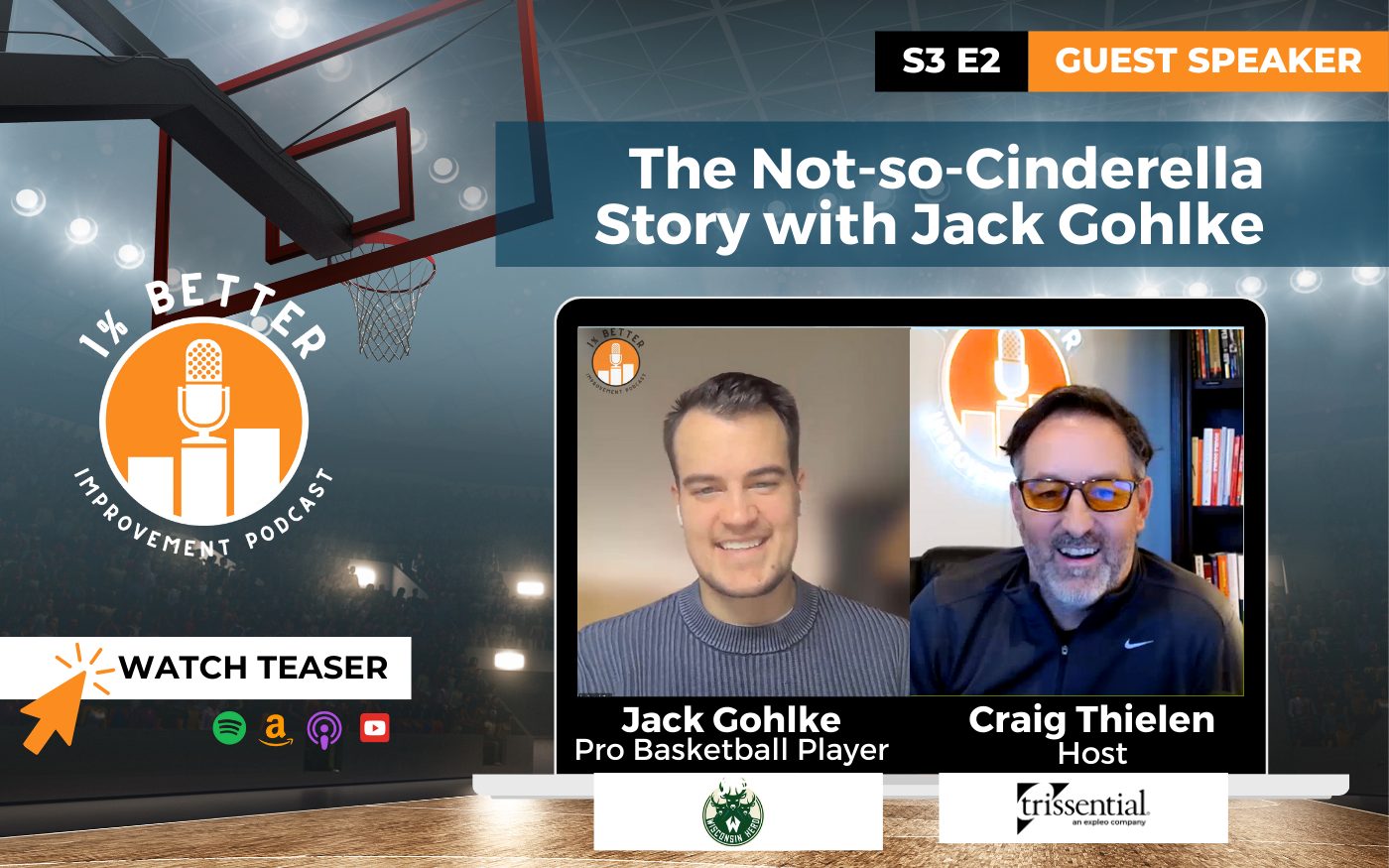
Hello, I’m Craig Thielen, and this is the 1% Better Podcast. Today I’m speaking with Jack Gohlke, a professional basketball player who recently signed, as of just a week or so ago, with the Wisconsin Herd in the NBA G League. Did they get all that right, Jack?
[00:00:21.10] – Jack
Yes, sir.
[00:00:22.09] – Craig
All right. Well, welcome to 1% Better, Jack.
[00:00:25.12] – Jack
Yeah. Thank you so much for having me. I’m excited to talk today, and I just I love the concept of this podcast, so excited to get into it.
[00:00:33.01] – Craig
Yeah, awesome. Well, the first question I have for you is, are you used to being called a professional basketball player yet?
[00:00:37.11] – Jack
No, that definitely still sounds a little weird to me, and it’s something that I always wanted to be ever since a kid and always grew up just hoping I could get paid to do what I love. So I feel very fortunate that that’s the case.
[00:00:52.07] – Craig
That’s pretty cool. That’s great. Well, we’ll dig into that more. So I got introduced to you through your father, Dave, who I have the opportunity to work with. Dave is part of Trissential, part of our organization. And so it just following your career, and then you came on the scene in a very prominent and national way in this little tournament we call March Madness, and that was quite an experience. So a little bit about you is that you came from… Well, the Oakland Golden Grizzlies, I think just from national scene, is a little bit under the radar compared to the big programs, the Kentucky’s, the Michigan’s of the world. And you upset the number three seed in that tournament that was a coming out party. And I think a lot of people now know who Oakland Golden Grizzlies are now. And Kentucky, of course, is just a perennial powerhouse, usually a one, two, or three seed. They’ve won a lot of different national championships, so a very prominent program. So to upset one of those organizations is no small feat and pretty rare.
And in that game, you hit no less than 10 three-pointers and scored 32 points. So you got two other, I think, free throws to add to it. Just an amazing game. The press likes to call it a Cinderella story, although I know you’re well noted as not liking that term. So we can talk about that. And that was only nine months ago, Jack. It probably seems like a lifetime ago. So how does it feel?
[00:02:31.02] – Jack
Yeah, it’s funny because it feels one of those things that goes both ways. It does feel like it was a long time ago. It feels like so much has happened since then because there has been a lot going on and a ton of opportunities that I could I’ve never imagined before, and I’ve been so fortunate to have experienced. But at the same time, it’s one of those things that I don’t think I’m ever going to forget the feeling of it and how exciting it was, how much fun it was, how great of an experience it was to share with my teammates and coaches who we’d worked so hard with the whole season. So it’s always going to be a moment that no matter how far away it gets, I’ll still remember it pretty well, I think.
[00:03:08.14] – Craig
Well, you should. I mean, it’s truly a one in a million story. It’s such a great story, and we’re going to dig into it for sure. But before we do, I want to talk a little bit about how you got there. The whole story itself epitomizes the whole mindset that we try to talk about on this podcast, 1% Better. I’m really excited because it’s proven that it applies to so many parts of life. I think sports and what you lived through is a great example. Maybe just walk us through a little bit of your career Jack, high school to college and then Oakland, and how you even got to be in this game or even getting to the tournament was a huge thing. But I think you had a lot of obstacles and the ‘how you got there’ is just as important as what happened when you did get there. So maybe walk us through that.
[00:04:04.09] – Jack
Absolutely. I always like to start with… A lot of people ask me, in regards to that and also basketball, when did you realized that you had the skill to get to that level. And I like to say that I knew early when I was a little kid and you run your first set play with your first basketball team. If you make the shot, the whole team gets ice cream. I was the kid that made the shot. So I like to say that’s where it started. Okay. But more so- That’s a good story. It was when I got to high school. That’s when I started to focus on basketball. I always loved basketball, and I had always been super passionate about it. I felt every day that I would go, whether it was practice or a game or drills, whatever it was. I really enjoyed it. And every kid has their thing that they love, whether it’s basketball, football, or playing the piano, whatever it is. And for me, it was just basketball. I get to high school, and I played a lot of travel basketball. I was very lucky that my parents supported me and took me to all these tournaments and stuff like that so I could play against the best kids my age.
And I was always good, but I was never one of those kids that was getting talked about in middle school or in high school, this guy is going to be at Kentucky or whatever it is. So I just knew I had to keep working, keep getting better. In high school, we had a good team, and I had some good teammates, but I wasn’t really a highly touted recruit. I got one full ride scholarship offer, and as soon as I got it, I was excited to take it and to start getting ready for that next phase of my career because I knew I had always wanted to play in college, and I knew I wanted to get a scholarship and not have to worry about the financial considerations of that type of thing. So I think it was actually my junior year of high school then that I committed to Hillsdale College, which is where I started.
And so I had about a year and a half left in high school to get ready for that. And I worked at the time as what I thought as hard as I could. I tried to do some workouts before school. I would work out after school and, like I said, go to these travel basketball tournaments, play against the best talent, the same type of thing I had always done. And I felt ready once I got to college, I was like, Okay, it’s my time. I had a good high school career, but now I’m going to take it to the next level. And it was a rude awakening. I got to college and a very good D2 program. But like we said, it wasn’t one of the powerhouses that you hear about on a national level, especially being a D2 school. And I got there and immediately I had a red shirt. I couldn’t play my first year. And that was a shock. And I think it’s something that a lot of people go through, definitely in sports, but in other aspects as well, where you think, Oh, I got this new opportunity. I’m super excited to jump into it and make an impact right away. And sometimes there’s a big learning curve, and you got to figure some things out.
So in that first year, I learned a lot from my older teammates, from my coaches. I had to put a lot of time in, and I had to learn also how to… I knew how to work hard as a high school athlete, but I wouldn’t say I knew how to work hard as a college athlete. I had to learn even more about what a real work ethic is and put time in, whether it was in the weight room to improve my athleticism or on the court to improve my skills. My shot in particular is what I focused on. That took me time, and it a lot of struggles. And my first three years, like I said, I read shirt in my first year, but my two years after that, I still didn’t really play that much until later in my career at Hillsdale and started to break through, got moved into the starting lineup. My junior season, about halfway through, and then we went on a big run that year and made the Elite 8, which was a lot of fun. I still say that’s my favorite accomplishment of my college career and just all the work that went into that It was something that I think a lot of people can probably relate to of your first real accomplishment or your first real win of your career or of your life, whatever it is.
[00:08:11.13] – Craig
And you’ve been building up to it for three or four years, right? You’d been looking forward in high school, and then you’d gotten in a position to see some success. Even at the end of that, I could see where that was a big deal.
[00:08:24.11] – Jack
Yeah, exactly. It’s something that I just had never had that seminal moment yet, and when it all came together and we won our region, which is like in D2, that’s like making the final four is in D1. So that was a huge deal for us. And for me, that was a moment where I could reflect on it and say, all this hard work I had put in is worth it to this point, and I feel very satisfied. This was so much fun. But at the same time, then it just leaves you wanting more. And anyone who’s a competitor in any field knows that feeling of you just reached what you were hoping for, but then it just opens all those new doors of, okay, now maybe I can go do this or go do that next thing. So then I refocused myself again and worked even harder. And I was lucky enough after the next year to have an opportunity to transfer for a graduate season based on the extra eligibility from the whole COVID thing that went on with the college sports.
And through some luck of my coach from Hillsdale, new Coach Kampe, who I played under at Oakland and that connection. It just made a lot of sense with how I played and the type of players that Coach Kampe was trying to recruit. And yeah, it worked out. So I ended up there and pretty much treated that as a professional season in a day of the college experience is over. I’m not going to be… I was never a big crazy partier or anything like that, but more so of like, I’m not really… It’s not as much of a college setting, as we all know, with the social things going on and all that stuff. I wanted to really be professional about it and go about my business. And that was how Coach Kampe structured everything, too. So I had a lot of time to work out. I had a bunch of great people supporting me and spending time with me watching film or working on the court, all that type of stuff.
So I think that’s another thing that throughout my experience up until this point has been something that I’ve always learned and always try to I use myself is just how much other people can impact your success, and whether it’s them helping you and pushing you or just being there to be a helping hand. I know the example of basketball because that’s what I do, But it’s something as simple as having someone there to rebound for you every day, it just increases your efficiency that much more, which I’m sure you know, like with your business, there’s little things that can really change the efficiency, and then that changes the equation for you. So I think that’s something that helped me a lot once I got to Oakland and then just kept working on it from there. And just like you said,.
[00:11:09.07] – Craig
And you got into a program at that time. They were building a very solid program, I think, well before you got there. And then you were a piece of this team that came together to have just an amazing season. So I just want to go back a little bit because I think just even you getting to Oakland was a one in a million chance, or it was a huge long shot. I mean, like you said, so you get high school, you get a scholarship to Division 2. You go, This is great. I’ve made it. You’re happy. And then you get there and you’re like, You’re a nobody. You’re red shirt. You’re starting from ground zero. You don’t get a lot of playing time. A lot of people would just say, you know what? It’s a lot of work. The coach told me I’m going to be a great player, and I get there and I’m red shirting. I’m not even playing. All these other recruits come in year after year. It would be easy to get disenfranchised. What kept you going in those first two or three years, Jack, when you weren’t seeing play time, you weren’t seeing It’s success. It’s easy to give up.
[00:12:17.02] – Jack
Yeah, it’s really hard. And I mean, there’s been multiple times in my career, and at that time in particular, where I definitely wanted to stop and wanted to say, okay, maybe I failed, maybe it’s over at point. But I felt very fortunate that I was always in love with basketball. And even if it was as bad as I wanted to play every Saturday and every Thursday or whatever it is, I still love showing up to practice every day and getting to play during practice or getting to shoot after practice or getting to work on my ball handling, all that type of stuff. And that’s something that I feel super fortunate, that what I get to call my job now and what I’ve done my whole life is something that I just love to do every day. There hasn’t really ever been a day where I didn’t want to go and do it, and it didn’t really feel like I had to. And I know everyone can’t play basketball, and I know I’m not going to be able to play basketball for my whole life, but Just I think being able to have something that’s that much of… That you get excited to do every day, and that’s something that you feel like you’re making a positive contribution to is something that really helped me get through that time and helped me to lock back in and say, okay, it’s not exactly what I want it to be right now, but I can still enjoy the process of it while I get better to find that outcome in a couple of years, where I know if I do this and every single day I get a little better than I know even if maybe it doesn’t go exactly how I want it to, I can live with the results because I put in the time.
[00:13:53.01] – Craig
Yeah. I think the one thing you said about that you just loved basketball enough to love the process, just love shooting, love getting better at. I mean, there’s a lot of details to basketball. There’s a lot of technique. I think in anything like sports or music, maybe even art. There’s so many details, and people only see the games, and they only see that once a week or whenever, how often you play games, they don’t see all of the work, the hundreds and hundreds of hours and each shot, each dribble, each technique, and there’s so many levels of it as well. So to be able to love the grind, as they say, or just love the process is a huge thing because it is a lot of work, and getting 1% better sounds great, but that’s really what it takes. It really does take… I just have to be able to not turn the ball over or make this move, free myself up, get around screen. There’s so many little techniques, and it’s just repetition so that you don’t even have to think about it when you’re on the court. Loving the process, I think, is a key, but it also takes hard work and tenacity to stick with it as well.
Well, I’m curious. One of the things that you’ve become famous for is being a three-point specialist. And this has been coming through college basketball for probably the last decade or so, pro basketball, has really changed in the last 10 years to now this whole outside in-game and three-point specialist. But I think, Jack, you take three-point specialists to another level. So if my data stats are right here, 97% of the shots you took in your last season with Oakland, your only season with them, just to put that in perspective, you took 372 shots, 364 of them were three-pointers. I’ve never heard of anything even close to that. And you shared with me that I could see if this was just who you are, you grew up this way, you just practice your three-pointers, you don’t have much of the rest of the game. This could happen because there’s some players like that. But you said, Hey, this is a new thing. So how did you grow into being like this three-point specialist?
[00:16:33.00] – Jack
Yeah. I think a thing that’s just super important in life, whether it’s sports or any opportunity you come across, is just seeing where you can fit in and seeing how great of an opportunity something can be, even if it’s not exactly what you’ve always known or what you’ve always done. But yeah, like you said, for me, last year, it was 97% of my shots, and it felt like 100% of them were coming from the three-point line. Because that’s just… Coach Kampe always had a player like that. He loved having that threat on the floor. And there was actually a guy, I want to say six or eight years before me named Max Hooper, who I think he shot 253s that season, zero twos. So So it was the thing that Coach Kampe recruited, and he knew what he wanted. But yeah, before in my career, I would say I was always known as a good three-point shooter, but probably more of a 75, 25 or a 70, 30 type thing where I would shoot a lot of threes, but definitely get to the rim, shoot some layups, have a couple of backdoor cuts or pull up jumpers from the mid-range, that type of thing.
But when I was getting recruited by Coach Kampe, he was just super on me about my film from Hillsdale and watching how I shot the ball. And he likes to always talk about the analytics of the game. He loves the data, he loves the math, and he’s saying, well, here, this is how far… This is the distance So the college three-point line is 22 feet, nine inches at the top of the key. I think you can make this shot at a 41% clip or whatever number he told me. And he said, Instead of shooting that pull-up jumper that you might shoot when the defense sprints at you, I want you to take a dribble to the side and just shoot a three instead. So it’s something that I took on as a challenge. And I saw as this isn’t… In my game before, it had always been, okay, I’ll come off the screen. If the three pointer is there, I’m going to shoot it. If not, I’m to dribble it inside and either shoot it closer shot or kick it to my teammate. So here I saw a new challenge of, okay, now at this new school, with this new opportunity with Coach Kampe, if that’s not there, I need to really improve on my step back or my side dribble, whatever you want to call it, to create that space for another three-point shot rather than going and shooting a two.
And I think that really motivated me of, okay, I can be great at this. Coach believes that I can be great at this. He’s got faith in me. He wants me to have the responsibility of taking these shots from my team and trying to be a valuable asset here. So I want to make sure I don’t let him down and let my teammates down by being inefficient or not putting in the work to make sure that I’m capable of doing this type of thing. So that summer, I just worked really hard at it and try to focus on being able to make those shots from all different angles and all different launch points and stuff like that.
[00:19:29.04] – Craig
Let me ask you about that a little bit because I did watch your highlights. And again, I’ll just share some stats with those that didn’t hear your story. I would highly encourage anyone listening to go to YouTube and just type in Jack Gohlke, NCAA. The highlight reel… there’s been a lot of people that have put together these highlight reels… In fact, one of them, I think, on TikTok, had millions of views. So it definitely went viral last year in the tournament. Just amazing. And what I noticed was, I don’t I don’t think any two of… Okay, so first of all, you made 10 three-pointers. That’s the second most in NCAA division one history in a playoff game. The highest was 11. Two gentlemen, do you know who they are?
[00:20:16.12] – Jack
I did know their names, but I couldn’t tell you them right now.
[00:20:19.14] – Craig
Actually, it might not be one person. Loyal Marimont, Jeff Freier. Okay. So he made 11 out of 15, which is incredible. You made 10 of 20. So you took a lot, but 10, so that’s second most ever. But what I noticed, Jack, is I don’t remember two of them looking alike. You took some… I mean, obviously, some were coming off screens and you were off balance. One leg out. A couple of them were straight coming off of a screen. A couple of them a side, shuffling, you were mentioning. You created your own shot. You went to the side. Some of them were 22 feet. Some of them were 25. Some were 30. I don’t know the longest one, but I just noticed that your body was in different positions. It wasn’t just like you see some guys in there, just straight up, and they got to be set and they got to have everything balanced and they got to be wide open and they can knock them down like crazy. You were creating shots, you were off balance, you were getting fouled on some of them that were called, some weren’t called. And in the distances, that caught my eye, too… They were all over. So I’m just, how do you practice all of that? Is it just you can… You just adjust to your shot, or do you actually practice some of those different angles and some of those different lengths over and over and over?
[00:21:42.04] – Jack
Yeah, that’s a great question. It’s one of the things that I love about basketball, and I know it’s the same for everything in life, but just the more you learn about it, it’s almost like you learn 10% of it, and now you realize there’s 90% more to learn.
[00:21:57.07] – Craig
The more you know, the more you know you don’t know, right?
[00:22:01.04] – Jack
Yeah, that’s exactly how I should have said it. That’s a great way to put it. For me, it was just trying to… Every workout I do, it’s got to be full speed. It’s game speed. Like you were saying, you see a lot of times where guys can make shots just standing there catching and shooting. And in workouts, a lot of guys will make 90 out of 100 just standing there catching and shooting. And I’ve never been… I’ll make 75 standing there catching and shooting, but that’s just not what I practice. It’s just not what I think is valuable for me in a game to be able to stand there and just make 20 in a row or whatever it is. I always practice full speed, coming off those cuts like you were saying, whether it’s 22 feet or 25 feet away. My legs might be at different angles. My feet might be going crazy ways and stuff like that. But the only thing that really matters in shooting is that your shoulders are squared towards the rim. So if my legs are going crazy or getting fouled or getting hit, my focus is always just to keep my shoulders squared at the rim and just release the ball at the same point every time.
And as long as I do that, I know it’s going to go in. And sometimes the defender does a great job, and they make it so that you can’t quite adjust. And then at that point, it does turn into a ‘feel thing’ or something that you can’t really practice because you really can only practice so many shots. And that’s where I like to learn about basketball and learn about the mindset of things. I think one thing that I learned maybe one or two years ago that opened up some things for me in my career is the concept of flow in sports and that flow state of just living in the moment and trusting all the work you’ve done. So I always work super hard to wrap all those things at game speed, whether it’s shots in the corner, shots at the top of the key, shots in transition. So I’m confident that I’ve done everything as much as I can, but also before your games actually to happen, I think it’s important to get in that state of mind of just being free out there and being comfortable.
So while maybe the day before in practice, I work on a thousand shots at full speed, going all different directions. Once the warm off of the game comes, it might look a little weird, but I’m out there just doing free, free flowing, fading away or just having fun, almost like it’s the playground, because for me, it’s just the mentality preparation is very different on a game day than it is the day before or in the summer.
[00:24:35.12] – Craig
Yeah, for sure. So, Jack, you mentioned flow, and that’s a well-known term. There’s been books written about it, being in the flow state, where you are locked in, right? Some people say you’re in the zone, and the basket seems like it’s this big. Is that something that you read a lot about? Did you get any training… Did you get any… Now there’s sports coaches and mindset coaches. How did you develop that?
[00:25:08.06] – Jack
Yeah, it’s something that when I was a kid, when I was in high school, I had every athlete experience it every once in a while. And when you do get that feeling like, Oh, I really want to find that again. I really want to get that again. Just because, like you said, you’re locked in and it’s just almost a feeling of bliss while you’re doing your favorite thing, playing your sport. Actually, my dad just encouraged me to follow it and find, Oh, is there a book you can find that will have some good insights for you? Or is there a teacher or whatever it may be. For me, I think it was a book. I can’t remember who the author was, but it was called ‘Flow’ by a researcher. You might… Maybe you have it back there.
[00:25:49.02] – Craig
There’s a number of different ones, but this one’s by Mihaly Csikszentmihalyi. Is that the one?
[00:25:56.03] – Jack
That’s it.
[00:25:56.14] – Craig
Yeah, he’s the grandfather of the idea of flow, and he’s not a sports guy, so it’s all about actually business. But I think he’s the grandfather of the concept.
[00:26:07.06] – Jack
Yeah, I think… And that’s part of the reason why I love the book, too, is because it’s not telling you how to get in the flow state for basketball. It’s just talking about how it works and how the human mind works in any field. And I just took from that book a couple of strategies on how to try to lock into that state for myself. And that’s created a routine for me every game, before every game, I do the same thing. Like I said, messing around on the court, trying to free myself up, have a little fun, and then listening to some music and trying to focus and just get your mind locked into one thing and not have all those distractions there. Because for me, that’s what it is. It’s just the less distractions there are, the more you can be focused on that singular task and nothing really affects your mind, whether it’s the fans in the stadium or the refs or even the players on the other team, you’re reacting to them, but you’re not really letting them dictate what happens for you. So, yeah, I mean, at the end of the day, it’s just that’s the best feeling in the world. And just trying to chase that flow state and experience it one more time. It’s almost like a home.
[00:27:17.09] – Craig
Well, you had it. You definitely had it against Kentucky. So let’s talk a little bit. How did you guys even get to the tournament? How big of a deal was that? Just even getting there.
[00:27:27.02] – Jack
Yeah. At the beginning of our season, that That was our goal, was we want to make the NCAA tournament. We want to win our conference and make the NCAA tournament. And I think that’s what every midmajor’s goal is. And that’s what every kid, I think, who grows up playing basketball dreams of doing is make an NCAA tournament. I don’t even think I dreamed of beating Kentucky or anything like that. It was just, I want to be there. I want to play in the tournament.
[00:27:50.14] – Craig
Get to the dance.
[00:27:52.01] – Jack
Exactly. So that’s what we did. Our coach at the beginning of the season told us we had three goals. Our first goal was to get a top four seed in our conference so that we could get a buy in the first round of our conference tournament. So we worked all season. Once we checked that off the list, then our next goal was to win our conference regular season, which we checked that box, too. So we got the one seed. And then once we got to our conference tournament, we were played in the Horizon League, a great conference, but just very level conference. No one’s really that much better than anyone else. And we played a couple of really tough games in the conference tournament, but came out on top, had an amazing performance from one of my teammates in the Championship game. I think he had 38 points or something like that. So we just had a really good team, just a really balanced team, everyone. And I think the biggest reason for our success, obviously, talent helps in sports, but we were just all bought in. We all believed in each other, and we all had trust in each other.
And I think that was something that, especially now with everyone transferring, and I was a new guy on the team. Having that type of buy-in for a group of people that hadn’t been together for that long is something that I’ll cherish for a long time, just those relationships we had.
[00:29:07.10] – Craig
For anyone that’s participated in high-level sports, you know that you couldn’t have gotten a win like that. Basketball is a team sport. It doesn’t always seem like it when you’re playing AAU and some of these tournaments, but it is absolutely a team sport, and you couldn’t have even had a chance to beat Kentucky without the whole team playing as one and really performing at a high level and having a lot of trust in each other. You came in, so you’re a fifth-year senior. Was the rest of the team building and growing together? How new was this team? And how did you guys gel so much as a team, do you think? Just looking back on it.
[00:29:52.04] – Jack
Yeah, I think that’s when a Coach Kampe his strengths is his team building and almost being a general manager or an eye for people themselves and how they can fit together. We had three guys on that team who had been there for four years already and were going to be those graduate seniors. Those guys were the foundation for the team. Like I said, one of them was a guy who had an amazing game in our conference championship. He was the player of the year in the conference, so a great player, but an even better friend, an even better guy. And we had another guy who had been there for just as long, who was a great leader. And then one more guy to go with them, who was also a four year guy. And I think Coach Kampe looked at those three and he said, I have my great players here, but I also have my leaders. So how can I fill in around them and make sure everyone’s bought in and everyone has the same goal? Because like you said, in sports nowadays, sometimes it’s hard to align those goals for a team, as crazy as that sounds.
But we were lucky enough. I think something that really contributed to our success was we had a foreign trip in August. So we went to Italy, played a couple of games there, but really just bonded and got to know each other, had a bunch of fun. And I think that just created more of an understanding for us all, how we all work together as teammates and as friends, and just gave us that trust. And as the season went on, I think it’s also important that you don’t go 25 and 0 before the important part of your season because there’s going to be some really hard moments at the hardest times. And we had lost a couple of games at the beginning of the year that we should have probably won, and we just rededicated ourselves. And as the year went on, we just kept improving, and we didn’t really take any steps back once it turned to January in that important time in the conference. So I think in any team activity or sport or endeavor, it just comes down to being able to have the trust in each other because you hear it all the time, but it really is, the team is only as strong as the weakest link. And if one person or two people aren’t going in the same direction as everyone else, it’s just going to weigh you down. So we’re fortunate that we’re all pushing.
[00:31:58.02] – Craig
It’s amazing. So how do you prepare then? So again, great season. The program has been building. He’s got a nucleus. He adds you as just the last piece to the puzzle. I mean, most of the season, you came off the bench. You were the sixth guy off the bench, and you gave him a lift. You hit some shots, give some guys a breather. How do you prepare for them? You get to the dance, there’s all this emotion. It’s your Super Bowl to some degree. We got to the tournament, and then it’s like, Okay, we’re playing Kentucky. You couldn’t put a bigger program, I mean, eight national titles, perennial, top seed. They got the lineup full of future NBA players. No matter how much you tell yourself about I’m going to go out there and give the best effort and be fearless and get in the flow and all this stuff. Your brain just goes, Oh, my gosh. This is just another game for these guys. They’re probably looking down going, who’s Oakland? This is going to be an easy first round. They’re not sweating anything. They’ve been through the ringer a thousand times on games like this, but this is the biggest game.
So how do you prepare for that? Do you prepare for it any differently than any other game you had during the season? And let’s face it, this is one of the toughest things to do, I think, in sports is to play at a level maybe you’ve never played at before. I mean, whether you’re in the NBA or NFL, last night, the Vikings were playing The Lions. It’s a huge game. Both teams are 14 and 2. But frankly, the Lions haven’t, quote unquote, been there very often. And the Vikings, this team hasn’t really been there very often in terms of we’re going to be the number one seed in the NFL home field event. So it’s a big moment. Even our quarterback, I think he had a little bit of nerves. He was airmailing some passes he normally doesn’t. The nerves get you. Even Brett Favre, your favorite quarterback, probably being from Wisconsin, He was known early in his career to just have too much gas, too many nerves. So it get to the best of anybody. So how did you prepare for that game? And how did you avoid just, oh, my gosh, we’re playing Kentucky and the nerves get the better of you.
[00:34:16.14] – Jack
Yeah, it’s definitely tough, and it’s something that we got a little best here. How’s it going? But I think first, I want to credit Coach Kampe for that, because in that moment, you really just need a good leader who’s experienced and who knows what they’re dealing with. And he’d been to the tournament before. He hadn’t won one of those games, but he played against North Carolina one year. I think he played against Kansas another year. So he knew what he was doing. And as soon as we saw that selection show, we had our team meeting, and he pulls us in there, and he tells us, Yeah, it’s Kentucky. They’re the Blueblood. They’ve got all the NBA picks. They’re an amazing team. But this is an opportunity that you’re only going to ever get once in your life. And we could not have possibly asked for a better situation. We got Kentucky. It’s seven o’clock Eastern Time. It’s the primetime game on CBS. What more could you ask for?
So he did a great job of framing it in a way to where it’s not, oh, my gosh, we have to play Kentucky. It’s we get to play Kentucky. And we’re going to prepare and we’re going to we’re going to do everything we can to seize this opportunity and make the most of it. Because at the end of the day, it’s a chance where if we do capitalize on it, and luckily we did, then it’s something that we’re all going to remember for the rest of our lives, and we’re going to get to talk about how it happened. And I think the other thing also that went to it is we had so much support from the community around us, everyone who supported Oakland basketball in the suburbs of Detroit. We’re all rooting us on and everything. But I actually told my teammates, I said, everyone’s telling us to go out there and have fun and let’s just enjoy this. And you guys earned this. Go have fun. This is the tournament. This is what it’s all about. Make sure you have fun. And I told my teammates, I said, We get to play basketball. We love basketball. It’s going to be fun. But let’s not approach this and say, Let’s just go have fun. Let’s approach this and say, let’s go out there and let’s win.
Let’s go in there and have that mentality of not we have nothing to lose, but we have everything to gain, and we can make this into something special. And I think that’s just important. Like you said, it’s always going to happen where you’re going to have some doubt of, well, yeah, they got all the NBA players, they’ve got the five stars, and we’re the mid-major. But at the end of the day, it’s something that you work really hard towards. And I think you got to have as much confidence as you can because you earned it from your season just as much as they did. So you just got to show up and play.
[00:36:48.02] – Craig
Yeah, it really is something special. First of all, I think it helps when you do put in the time and the work. It helps when you’re completely committed to your team, to your sport, to each other. It helps when you’ve had some other big challenges that you’ve overcome, like other teams that you weren’t supposed to beat. Maybe you were behind by 10 or 15, or maybe some other… I’m sure you guys played some top 20 rank. There had to be something because it’s just such… I mean, let’s face it, they’re a three seed for a reason. They win like 95%, three seeds against… Those games go a certain way, and a lot of it is just pure experience, confidence, been there, done that. And so you guys as a team really had that. It just says a lot, but there had to be a lot of those little things along the way that gave you guys the ability to just go, We can play with these guys. Let’s go.
[00:37:52.03] – Jack
Yeah, absolutely. And that’s a great point you make because I left that out, but it’s something that another thing that Coach Kampe did a tremendous job of when building his team is he said, okay, college sports is turning into there’s a lot more experienced players and people who know what they’re doing. And it’s almost at some point, especially when you get to March Madness, everything games on TV, it’s almost like we’re pros. So he built his team of, okay, I’m going to have these graduate students and these guys who have been through it before. They’ve played in these big games, maybe not in the NCAA tournament, but they played in important games against great teams. So we had our whole starting lineup, I think was 22, 23, 24, whereas Kentucky, maybe they had one or two of those guys. They were all extremely talented 18 to 19 year olds, which obviously they’re tremendous basketball players, but that experience was really on our side. And I think it just turned the tide of, yeah, when the game got close, we were comfortable. We had been in plenty of tough basketball games, and those guys are used to running whoever they’re playing out of the gym and of resting by the end of the game.
[00:39:01.14] – Craig
No, that’s a good point. You had more experience than they did, actually, as a team, and just life experiences helps, too. Well, we could talk about that game again. I highly recommend just people go out there and YouTube it. The highlights, it’s just so fun to watch. It gives me goosebumps. I’m sure it gives you goosebumps. One of the things that’s so fun for me is seeing your parents in the crowd. I think even more in the second game, but certainly in the second half of the first game, and it was fun just to see them and the experience that they had as well. You could just tell they’re proud and just enjoying every second of it.
[00:39:41.06] – Jack
Yeah, I was very fortunate to have them there and to have my sister there as well and a bunch of friends and just experience that with all of them. And yeah, like you said, the TV cuts to them were hilarious. Just them going crazy in the stands.
[00:39:55.02] – Craig
I mean, very humble, modest people and smiling ear to ear. There’s some parents out there that they’ve been building this and their kids been a prodigy ever since they’re 8, 10 years old, and they’ve been managing their careers every step of the way. It’s a little bit different than parents that are literally just thankful to even be in that spot and enjoy every second. It was fun to see.
Well, let’s go beyond that game. Just a phenomenal game. Then you had this social media buzz throughout the tournament after that. In fact, one of my favorite things is watching you get interviewed right after the game, and you made a point. The interview was actually over, and you said, Hey, we’re not a Cinderella story. That just shows I was like, you guys were very confident. You were there to win games. You weren’t just there like, Hey, we made it. Wow, amazing game. But no, you guys were there to win games, and you felt like you could play with everyone. So that was fun. Let’s talk a little bit about post-college career. So you did a season with the Montenegro League. And so I want to hear what that experience is like. And now you’re in the NBAG League. So just walk us through what that post-college experience has been like.
[00:41:14.09] – Jack
Yeah, It’s definitely been crazy, but same as every summer, I was just trying to then build towards that next thing. And this summer, I was fortunate enough to play in the NBA Summer League, which I always had wanted to do. I played with the Thunder there and I didn’t get as much playing time as I had wanted to, but it was an amazing experience, something that I always… Another basketball box that I had always wanted to check and never knew if I would be able to. So that was a great experience. And then, like you said, I ended up starting my overseas career in Montenegro, which is a beautiful country. It’s such a cool place to be and something that I feel like I learned so much about myself from so many different aspects, basketball-wise, for sure, but also just being on your own in another country, a whole new culture, learning how to embrace the food, the people, all the different aspects of it. There were so many cool things to learn. I was fortunate enough to have teammates that showed me around in their home country of Montenegro and took me to the beautiful seaside or up into the mountains and stuff like that.
I just found myself every day saying, I’m thankful to be able to get this experience and get to say I’m getting paid to play basketball. As the season went on, things turned a little bit and I wasn’t playing as much and wasn’t getting as much opportunity on the court. And that’s when I started to reflect a little bit and say, Is this what I want to be doing still or do I need to move in another direction? And I think, like I said, it just took a lot of time to figure that out and say… Because I didn’t want to be done. I always wanted to keep playing basketball and keep pursuing my career. But I knew at that point that I needed a change and sometimes a change of scenery can be super important and super helpful. And I think that was what I realized as much as I had liked it at the beginning. And I struggled because I didn’t want to quit. I didn’t want to say, I’m giving up on this opportunity in Montenegro. But at the same time, you know how it is. Now it’s a business, now it’s a job. This isn’t college anymore. It’s something that I’m getting paid for. And now I have bills to pay. I’m not sitting there and getting a scholarship or whatever it is.
So I was like, okay, I think it’s time to move on and try this G League thing and come back to America, see if I can make an impact there. And luckily, it all worked out, and I signed on with the Wisconsin Herd, the Bucs affiliate. So I’m back in Wisconsin where I’m from. And my parents are able to come to games and stuff like that, which is great. But also now, I just feel like I’m back in a better spot, a better headspace of mentally approaching the game, how I to and doing everything the right way. Whereas just like we talked about with going against a team that’s considered way better than you, I think it’s your mentality in that situation. You have to be perfect with it in order to get the win. And when I was in Montenegro, I think as the season went on, my mentality, my mental approach to everything was fallen off a little bit, and I had to refocus. And I think coming back here helped me refocus a little bit. And now I think things are going move back in the right direction. I mean, that’s the same with anything, is you got to make sure that you’re always there mentally as much as you are physically, because as you know, it can be a struggle to succeed even when you’re doing the right things on the court or in the weight room, physically… if your mind’s not there, the pieces don’t necessarily fit together. So I’m just glad I’m back in a spot.
[00:44:56.11] – Craig
Well, good. I mean, it’s good that you pay attention and recognize when things don’t feel right or they’re off and just recognize, Hey, maybe there’s a need for a change or what have you. Well, Jack, I think that you really epitomize this whole 1% Better mindset of just making really small incremental improvements day after day after day, and you can really get amazing breakthrough results. I don’t think anyone could have predicted even a year before, six months before, two years before, three years before. You would be the guy to be hitting the big shots against Kentucky in the tournament. But all those little small steps, you could probably trace back every practice and every extra thing that you did and to prepare for that. And every one of those things was needed to be able to do what you did. So I’m curious, do you think just having that mindset, how do you think that’s going to help you? At some point, you won’t be playing basketball. Just help you in life, help you in your post-basketball career.
[00:45:59.11] – Jack
Yeah, I think as I’ve gotten older, at first, I never really thought I wanted to be a coach or have a career in basketball afterwards. But as I’ve gotten older, I’ve realized how valuable the 1% better everyday mentality is and how valuable the people that helped me realize that mentality and helped me also just perform it every day of workouts or practices or whatever it is, how valuable those people are and how valuable those relationships that I have with those people are. So I think after basketball, I want to be that person who helps out a young kid or a high school or a college kid who has the passion and has the drive to be successful but doesn’t necessarily know exactly how to fit it all together or just needs a mentor. So whether that’s me being a coach or just me being a skills trainer or whatever it is, I just want to do something that’s working with young people where I can make an impact with them and just do the same thing for me that other people have done or do the same thing for other people that I’ve had done for me and be that person to rely on, to learn from and all those types of things, just because that’s where I’ve had some of the most valuable relationships in my life. And I’ve realized that at the end of the day, it’s as fun as the basketball is, it’s the relationships that I really love from it, and I want to contribute to that.
[00:47:28.14] – Craig
Well, good. Yeah, you’ll do a great job. I mean, not a lot of people have had the experiences that you’ve had, and so to be able to share that with others and how you got there and what it took. I mean, everyone can watch the highlight videos and go, wow, he’s a really good shooter. Well, there’s a lot more to it than that. There’s a lot of work and just life experience of how did you get there and sharing that with others. I think whatever mechanism you do, it’s going to be highly valuable because you got a lot to share.
Well, Jack, we’re at the end of our time here. The last question I usually ask folks is, looking back at your long, long career, what would you share with yourself as a teenager or your grandkids? But I’m going to switch it up with you because you’re early. You I mean, really started your post-basketball career. But I would just maybe shift it and say, from what you’ve already learned in this journey you’ve had, high school basketball and AAU, and college and two versions of college, and how multiple pro basketball stents, what have you learned from that, and what would you share if you are talking to another aspiring athlete that has big dreams or even something that’s not basketball related? What would you share with someone like that?
[00:48:46.09] – Jack
Yeah, I think the single best piece of advice I’ve ever gotten for anything, sports or otherwise, is just that confidence is not an innate ability or it’s not something that some of us have and some of us don’t have. Confidence is a skill, and it’s something that you work at, and you indirectly work at it. But whatever your field is, but if for me it’s basketball, and that’s what I understand the best, I build confidence by working at my shooting, at my dribbling, at my passing. And in the game, it’s obviously important to be talented and to be able to make shots and to be able to dribble and to be able to pass. But at the end of the day, it’s really a mental thing. And there’s so many players that are more talented than other players, but it’s the confident ones that succeed, especially in the biggest moments. So just treat your confidence and treat your mental approach as a skill as well as the physical skills that come with whatever it is that you do.
[00:49:48.02] – Craig
Never really thought about that way, but absolutely. They always say winning begets winning, and that becomes a habit, right? Absolutely. But it’s the things that lead to winning. It’s not the actual winning itself. It’s all the work that goes into winning and all the practices that you put into the mindset. And it’s like anything else, right? It takes practice. Well, thank you for sharing that, and thanks for telling us about your story. And thanks for being on the podcast.
[00:50:16.11] – Jack
Yeah, absolutely. Thanks so much for having me on, Craig. It was a great time..
check out other podcast episodes