Find us on your favorite podcast platform including: Spotify | YouTube | Apple | Amazon
1% Better Podcast Ben Albert – Quick Links
Learn more about all of Ben’s podcasts at Real Business Connections
Follow Real Business Connections on Spotify
Subscribe to Real Business Connections on YouTube
Follow Ben Albert on LinkedIn
Connect with Craig Thielen on LinkedIn
Key Takeaways
- Microinfluence Over Mass Appeal: Success doesn’t mean going viral. It’s about having a meaningful impact on a small, well-defined audience—your mentors (plus), peers (equals), and mentees (minus)
- Creation-Driven Networking Works: Forget awkward small talk. Use creative collaboration—like podcasting or community content—to build authentic relationships and opportunities
- Podcasting Is a Long Game: Great podcasts take time. Consistency, clarity of purpose, and adding real value are more important than fancy production or celebrity guests
- Marketing Starts With Helping People: The best marketing strategy is to build something that truly helps people—then amplify that value through community, content, and conversation
- AI Is Changing the Marketing Game: With AI driving more “no-click” searches, your website must clearly answer key questions. A strong FAQ and authentic stories are more critical than ever
















1% Better Podcast Ben Albert – Transcript
[00:00:05.03] – Craig
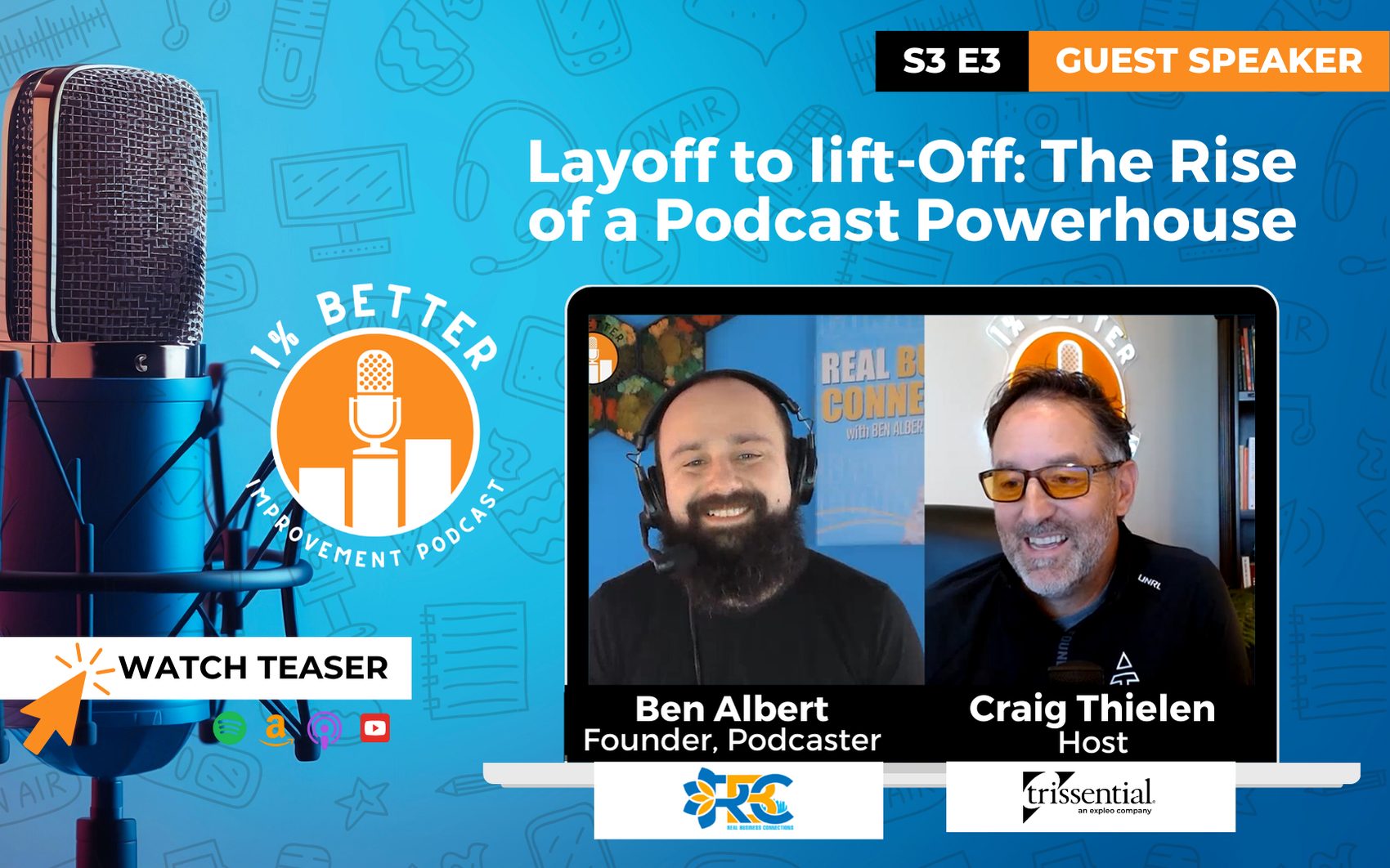
Hello, I’m Craig Thielen, and this is the 1% Better Podcast. Today, I’m speaking with Ben Albert, founder of Real Business Connections, and Balbert… I’m not sure which you go with, they both work I’m sure, Marketing Company, LLC. Ben is, among other things, an absolute podcast savant, which is where we met. And he hosts a network of five podcasts, and he’s done just an amazing job with them. He’s, I believe, in the top 1% of podcasts, which is pretty impressive. Ben’s podcast, when we did it together, he invited me on. We talked about AI, and that was back in January. Hey, Ben, welcome to 1% Better.
[00:00:48.00] – Ben
I’ve been looking forward to this. This is going to be fun, Craig, Thank you.
[00:00:50.03] – Craig
Yeah, well, thank you. When we did the podcast in January, it was on a very lively and emergent topic. It seems like so much has changed, and that was only two months ago with AI, and it just continues to evolve. But it was really fun. You did a great job facilitating a very diverse panel, but really great panel. I enjoyed it. I learned from it and got different perspectives. But I just want to know, just tell me, I know you look at numbers and whatnot. That wasn’t your lowest rated podcast, was it?
[00:01:22.02] – Ben
I don’t think so at all. Well, the beauty of panels… so Ben’s favorite kind of podcast is a one-to-one interview… The beauty of panel discussions is I like to believe I’m a connector, and I can take people from different industries, different levels of knowledge, different genders and roles, and bring them together for panel discussions. I get to play matchmaker, and I call it OPA, Other People’s Audiences. When you have three guests on, you actually get more views and listens than when you just get one because there’s four people promoting the same episode versus just a small amount. That’s one of marketing strategies behind it. But I’d have to check the numbers, but I’d say it was in the top 10%.
[00:02:07.10] – Craig
Nice. Okay, that’s good. You always got to fluff the feathers of your host, so thank you for that. Yes, sir. All right, let’s see a little bit more about you. I know you went through an experience during COVID. I mean, I think we all did to varying degrees, but I think you went through a professional, as you describe it, hit the rocks type thing. You had to What am I going to do? How do I reinvent myself? Just walk us through that experience and what it led to.
[00:02:36.02] – Ben
I’m an accidental entrepreneur. I didn’t have Jeff Bezos or Brené Brown or Oprah on my wall, wanted to be a basketball player when I was a kid, and was working my way up the corporate ladder. I worked for a marketing agency, sales executive… When COVID hit, I got to let go. Short version is I was brand new at this firm. I had just moved over from another company. The last one in, first one out. Sure. I was a music guy on the side. I had a music podcast. I was in the music industry promoting bands. But Music Ben, was broke, unemployed… non-essential because the music industry shut down.
[00:03:17.01] – Craig
Hard to make money at the music podcast.
[00:03:19.08] – Ben
Yes, sir. Why I say I’m an accidental entrepreneur is I started applying for jobs because I didn’t know what my next move would be, but I didn’t get a job right away because of the pandemic. I just happened to pivot from Music Ben with a music podcast and music marketing to Business Ben. And Business Ben is an entrepreneur. In a moment’s notice, I didn’t change, but my mindset did, my vision did. I started taking my skills… This is the biggest lesson I could teach someone is all our experiences and skills are preparing us for who we get to become. I took my music production background, I took my marketing background, I took my podcast background… I took my conversations I was having with musicians and just applied it to a new category, which was business. Before you know it, a year passes, I replaced my sales executive income, and Ben became an accidental entrepreneur. That’s what I’ve been doing ever since. But whether I was doing this in entrepreneurship or in a leadership role, an intrapreneur in a fantastic company, I just wish I had started… I had started forever ago, but I wish I had I had the clarity to see what this stage in my life would be because I’m pinching myself right now. It’s 2025. We’re talking about 2020. So a long time has passed, and I wouldn’t have it any other way.
[00:04:43.04] – Craig
Well, that’s a great story. In fact, I think there’s a stat, you may know the stat, that says something like 70% of all new businesses are a result of a layoff or a firing or something where, like you said, you call it accidental, I don’t know that there’s really anything that’s accidental in life, I think things happen, and we’re constantly preparing ourselves for what’s next, whether we know it or not. But some other external, not planned event happens, and then someone finally goes, you know… I think I want to do something, and this is the opportunity to do it. I think that’s a pretty common thing, but it’s great to see. Let’s just talk a little bit since that happened. You jumped, as you said, into the podcast world. You were already in it, but in a professional sense, when it was really just exploding. I think podcasting absolutely exploded in that 2020, 2021, 2022… Now, it’s the dominant mechanism in the world for getting conversations, getting information. It’s actually even taken over mainstream media in terms of numbers, not even close. The numbers that the big podcasters are getting, dwarf the networks, which is quite interesting in itself. Tell us a little bit about this network of podcasts. How many podcasts have you actually done? Tell us about that.
[00:06:12.08] – Ben
I’ve done hundreds. It’s in the thousands by now. I don’t keep track. When you say network of podcast, this is for creating any product, any piece of content. First off, you have to be mindful that we can’t be everything for everyone. If you don’t have the capacity or the team, don’t try to do everything, but I just happened to try to do everything. When you say five podcasts, I actually think there’s six, seven, or eight now. I don’t know what the bio says, but there’s different segments.
You are part of a panel discussion because people… Me, in this category, I don’t always know the right questions. But if I bring a panel together, the conversation it starts gets it to a higher level conversation than maybe if I was just interviewing someone at a beginner level, and you get to connect people. So we do panel discussions. I do 15 Minute Fridays, which is 15 minute shorter segments that someone can listen to on a commute to work. Then there’s Learn, Speak, Teach, and Rochester Business Connections… So Learn, Speak, Teach is long form, about an hour, and it’s for people that really want to dive deep and hear the story behind the story. Rochester Business Connections is where I started. We can talk about that if you’d like, but I started my podcast with Rochester, New York, business leaders. If you’re in my hometown, that’s the podcast for you. Ben’s Bites is me doing solo, Enough About Me…
Really, the point in these different segments is there’s long form, there’s panel, there’s short form, there’s solo, There’s local to my city, there’s Ask Me Any Things inside of my community. There’s all sorts of stuff because the goal is to create products, services, solutions, and content that can serve as a ‘choose your own’ adventure. Someone might follow me on Instagram and watch the Shorts. Someone might subscribe and listen to the long form stuff. Someone might just come and watch a panel on LinkedIn Live. But I try to diversify my content so I can grab people at their level. It does benefit me that I have a marketing firm and I do marketing for podcasters. When people see how I operate my business, it builds trust, I add value, it gains credibility, and then it’s easier to make a decision to connect with me, buy from me, refer to me, because of that.
I said this before, I wish I had started forever ago because if I’m in a sales role, if I’m a leadership role, if I’m in HR, if I’m in any category of leadership, this mentality will attract the proper talent, the proper customers, and build a personal brand that people like what you do, and that’s something that can never be replaced for you. If you look at the top CEOs, the top anybody, they have personal brands, they’re household names, and it’s because of the things we’ve talked about today. They’re shaking hands, kissing babies. They’re doing it all.
[00:09:16.14] – Craig
So podcasts, now there’s tens of thousands of them. It’s insane how many podcasts there are, and people only have so much time in a day. Yet I think a lot of organizations, ok, businesses are going, jeez, we better tap into this. This is where the eyes and ears of people are at now. So it sounds easy to create a podcast, and it is incredibly easy to create one, but it’s difficult, becoming increasingly difficult, to have a successful and meaning people actually listen, and then you get some engagement. Because at the end of the day, you don’t just do this… You want it to be a two-way street… You want to get some value back out of it. Most businesses would say that anyways.
I know we could talk an extended form podcast about how to be successful with it, but just what comes to mind? What are the top two or three things? If some company or some person says, I want to use this mechanism to get the word out and to get some benefit from it, what are the basics that you say that you’ve learned from? You’ve done so many, you’ve created different brands of podcasts that are the basics of getting in and being successful with podcasts. I’ll chime in with my experience. This is like our 40th now podcast, and we’re in our third year, and we’ve learned a lot, I can say, from it. So I’ll let you go first.
[00:10:45.02] – Ben
Have you had anyone on the podcast talk about microinfluence at all?
[00:10:49.07] – Craig
I don’t think so.
[00:10:50.11] – Ben
I’m nicheing down. Most business professionals understand the concept of nicheing down. Microinfluence is having a big influence with a small amount of people. I think the biggest problem in the podcasting space is everyone wants to be rich and famous. They want to be Joe Rogan, the girl from Call Her Daddy, like world famous, Oprah famous overnight. I think we’re defining success incorrectly. If I were to, and this is not my zone of genius, that’s why I pass it to people that it is their zone of genius, but if I were to run a pay-per-click ad campaign, I’d focus 100,000% on the numbers. I’d figure out how to change the copy, change the image. I’d run A/B test. I’d focus a million percent on the numbers because I’m paying per click per conversion. When people treat a podcast with that form of understanding of a ROI, they’re often missing the purpose of a podcast because you don’t have those numbers. It’s harder to track. It’s more PR, personal branding, relationship building, notoriety. It’s an engagement. It’s an audience building campaign, not a conversion campaign.
People go in wanting to have millions of listeners that convert into sales overnight. I think that is not a good metric for what success is going to look like. What I like to do, and we can go deeper, I know we could do a whole freaking seminar on this, is I like to simplify it to three categories, plus, minus, and equals. Plus is mentors, they’re thought leaders in your space. They’re people that you and your audience want to learn from. Minuses are mentees in the audience. They’re listeners. They’re people that are going to buy from you. They’re people that you’re going to mentor. Equals is peer to peer. Peer to peer, you share ideas, you learn from each other. You also become strategic partners, referral partners. You can build business without spending money on each other. If we understand who are plus our mentors, who are minus our mentees our audience, who are equals our peers are, we can build a podcast strategy around those three categories. Because, again, simply put, your mentors, having someone, Chris Doe’s He’s a great example. He’s way bigger brand than me. People in the digital marketing space, especially graphic designers, love Chris Doe. I had him on my podcast. That’s it. He’s not my best friend, but he provides social proof that I must know at least a little bit about what I’m doing that Chris Doe came on.
You get social proof, you get education from your mentors, you become a thought leader at starting these conversations. You’re equals, you collaborate together, they refer you business, and your minus, that’s your audience, that’s the people that are spending money with you. People… sometimes I struggle with this, they don’t know how to fill the blank in for those three categories. If you understand those three categories, you know what your micro niche, your micro influence is. So very quick, simple example. And I’ve went international, which actually caused me to tank for a little bit and do less sales. I started with a Rochester, New York, business podcast highlighting local leaders in my city. We can break down each category, but it was very easy for me to build thought leadership in my city, get in room with leaders that had money to spend, that had things to teach me, and that’s how I built my business. But it’s because I was focused on a small amount of people. I knew exactly who they were, and I didn’t look at numbers because it could just be me, Craig, my mom, and Craig’s grandma. But if I’m building a relationship with Craig and we can start a strategic partnership together, I don’t care if I have listeners.
[00:14:58.04] – Craig
Yeah.
[00:14:59.13] – Ben
That’s my overview of it all.
[00:15:01.12] – Craig
It goes back to what are you trying to promote and who are you trying to promote it to. It’s interesting when you broke it down into those three levels, I didn’t realize this, but we went through that in the order that you did. I started with mentors of mine, people I highly respected, and that was the first 10 or 15 folks, and then shifted to peers and clients and people that I’ve been working with. Then now we’ve opened it up to people, have a person who’s a professional basketball player, an Arctic Explorer, just people that are just… But we did have something that glued it all together, which is this notion of personal and professional improvement and this mindset of 1% Better. I would say the biggest, in addition to what you said, and you probably can echo this, but just because you create a podcast and you have a great idea, and even if you have great content, doesn’t mean that people are going to show up. It takes time.
And you just have to have whatever number of episodes, 30, 40, 50, 60, so that people actually go, This thing is real. I can depend on it. I can go there. And know, What am I going there for? And it just takes time to build that trust, just like you wouldn’t go on a first date and expect to propose to somebody, right? Which is like somebody that keeps watching you. You have to work your way into it. So that’s the thing that we learn, and just be patient with it. And the more we were… If you add value, you have good content, you add value, and it’s consistent value to a certain topic, a certain segment, in your case, Rochester business owners, then your likelihood of getting people to come back because they know what they’re getting and it fits them, versus, every week, this one didn’t apply, I’m not coming back because it didn’t apply to me. I don’t know if any of that lands with you, but that’s what we learned.
[00:17:03.12] – Ben
I got one thing to add because it’s such a dichotomy. Patience is valuable. Simultaneously, you have to be impatient. Because I could put up five episodes and say, God’s got me, let’s go viral. But the impatience comes when you promote it, you set a schedule to consistently put out content, put it out the same time each week. You’re impatient with trying to find big guests and ask anyone you think, and you’d be surprised, huge guests will say yes to you. You want to be patient with the input, what comes back to you, but you want to be impatient with the output, the actions you take to get better at anything you do. It’s a dichotomy. You have to be patient, but impatient simultaneously. Then the third part is sometimes you just have to outlast. Sometimes the person that wins is just the person that stuck to it longer than the person that quit early.
[00:18:07.05] – Craig
Yeah. No, those are great points. For us, we did the impatient part because we… Well, first of all, we didn’t understand the patience part. So we were just like, Hey, we’ve done five. These are great. Why do we only have 50 followers or something like that? So we constantly applied the 1% Better and said, Well, what can we do? How do we get the word out? How can we make it better? What did we learn from that? And so that’s a great way to look at it.
The one that comes to mind with the impatience is this often gets used as an example of how podcasting is not as easy as people think. So Michelle Obama created a podcast. Most people don’t know this. She did six episodes, and I don’t even know who was on it. Probably some very famous guests or whatnot. And that’s it. It was done because they didn’t get enough viewers or whatever the reason. And you’re not going to hit it out of the park. Even if you’re the President’s wife, it doesn’t just instantly mean 30,000 people are going to start following you. That’s the example I use. Well, hey, let’s shift…
[00:19:13.01] – Ben
You know what… Real quick, you know what stinks? If Michelle Obama put out a podcast and it didn’t use her name and she used some alias name and it wasn’t good, nobody would listen to it. People will listen to Michelle Obama, they’ll listen to Trump, anyone of power, just because of their name. For sure. But we need to not forget with 1% Better, you want to put out a good product because your name will only get you so far. I’m not saying her podcast was bad. It could have been incredible. But your name can only get you so far. You need to put out good stuff, truly. That’s what I believe in more than anything else.
[00:19:49.10] – Craig
Well, and the last thing, and I want to shift away from podcast. But when we started doing ours, I became a student of, How does this all work? How do you get this out to more people? So I went and the godfather of podcasting, as we all know, is Joe Rogan. I went back and listened to his first two or three podcasts, and I was so astounded. They were absolutely horrible. They were terrible. They felt like college guys just shooting the you know what. But he just kept on. Now, he was inventing it back in the day, there was no such thing as podcast. He was just testing out this new technical ability to do this stuff. They just kept at it because they enjoyed doing it. It was fun. Then something happened. I think he has a certain brilliance to himself that kept people… a certain humor, a certain depth, a certain ask good questions, all that stuff. But that was actually helpful for me to go, Hey, I don’t have to have everything perfect. It doesn’t have to be this beautifully marketed, productive the lights are right. You can just show up and just give some good content, and it should work itself out.
I do want to shift, though, because I think this whole term of being a podcaster is such a funny term because I don’t know that anyone is really a podcaster for a living. Even Joe Rogan, even though he makes, I don’t know, hundreds of millions of dollars doing it, I don’t really consider him a podcaster. You, for example, I consider you, you’re a networker, you are a marketer, you are a small business person. You are… there’s a lot of… you use podcasting for sure, and I think you’ve gained some really good skills there. But just being a podcaster enough is not enough, I don’t think. So let’s shift into that. Networking, I know, is something that you use podcasting to do a lot of. So give us a little bit of networking. How has it changed? What would be your 1% Better approach for people in networking in 2025. Then as you’re thinking about that, I got to show you a book that I grabbed out of my book shelf, and it’s humorous. I don’t know if you’ve ever seen this book. Do I even have it handy? Well, anyways, it’s the Harvey McKay book on networking.
[00:22:17.10] – Ben
Okay.
[00:22:17.14] – Craig
Have you heard of Harvey McKay?
[00:22:20.06] – Ben
It sounds like an old name.
[00:22:22.06] – Craig
It’s a very old name. I got this book when I was in either high school or college. Somebody gave it to me. I don’t know. But he’s, I think, a businessman, I think from the Twin Cities. And he was the guru of networking. And this is back in the ’80s, right? So this is probably predates you, but I grabbed it off my shelf. It’s like one of the first, and now I’ve got lots of books and stuff. It’s one of the first ones I got. And so I want to hear what networking is to you, how you think about in 2025. And then at some point, I’m going to go back and say, What did Harvey McKay say about it?
[00:23:00.01] – Ben
I even remember, had him in high school, we had a guest, and he came in to speak to our class, and he talked about business and networking… Harvey McKay, Network Builder… This is literally where I was going. There’s a handshake right on that cover. Yes.
We had someone come in and teach us how to give a proper handshake, how to make eye contact, smile… They gave us these one… None of that information is bad. It’s incredible. It’s important. But that was the focus. It’s if you’re going to be in business, focus on your handshake.
[00:23:39.12] – Craig
Interesting.
[00:23:39.14] – Ben
Which is not a negative thing, but a lot of us aren’t even handshaking each other. True. You and I are on a Teams. We’re on a podcast. We’re on a Zoom call together. We could do the…
[00:23:52.12] – Craig
We can high five.
[00:24:03.02] – Ben
Yeah, but networking has changed in many ways, and nothing’s ever going to replace IRL or in real life, person-person experiences. Nothing’s going to change there. But I’ve coined a term that I call creation-driven networking. Creation-driven networking. And whether you’re the life of the party or soft-spoking introvert. I think it’s for everyone, but it’s especially for soft-spoking, more introverted creative types, because some people have the capacity, and still, I encourage them to do it, to walk into a busy bar, a networking event… They’re smiling, they’re high-fiving, people are gravitating to them. They can hand out business cards without looking sleazy. They are the life of the party. But a lot of us aren’t that life of the party, and we can try to teach that, but a lot of us are more soft more spoken, creative, more strategic. I call creation-driven networking, and it’s really simple. It’s finding ways to create stuff that you find interesting with other people, and that can be the purpose around your networking. In a virtual world, it’s never been easier. Podcasting, we won’t hammer this too much because we’ve talked about it quite a bit. Great example of creation-driven networking. We get to create a podcast together and get to know each other while we do it. If I’m trying to network with industry leaders and cold calling isn’t working or they’re not showing up to networking events, maybe I have a podcast.
Maybe I put on a live event where I invite these people and provide them awards, and I co-host the event with someone else, with a mover and shaker in my industry. Maybe I do a virtual event. Maybe I start a blog or an article or a series highlighting roofers in New Mexico, highlighting COOs for companies with 100 to 500 employees, COOs for mid-size business blog, and I start featuring these people. There’s lots of ways, if we get creative… I don’t know the person, so I had to step on my tongue there. I was on a podcast and the host provided this example. I didn’t see it happen, but it’s a great example. The gentleman was a financial advisor. He’d go to his kid’s games and he would take Little League games, and he would take pictures of his kid hitting the ball, throwing the ball, playing baseball. They were fantastic pictures. He was a photographer on the side. People started saying, I know this is a passion project of yours, but can you take a couple of pictures of my kids? Now he’s out there and he’s taking pictures of the whole game, and he’s not even a full-time photographer. He’s a full-time financial advisor. But he found a way to create something and network. I have these photographs. I’m going to give them to you. He built trust, and now people trust him with their money because of that. So networking doesn’t have to be just a good handshake, life of the party, business card. It can be creation-driven, especially if you’re quiet. Think about ways that you can connect in a nontraditional way, and with Zoom, the Internet, it’s never been easier to do that.
[00:27:19.07] – Craig
Yeah, there’s a lot there. The two takeaways I got from that, Ben, in some ways, it’s never been easier. In some ways, it’s never been harder because people tend to hide behind… I’m working from home. I don’t meet people anymore. I can’t walk down the hallway. They don’t answer their phone. They don’t answer email. But in some ways, there’s so many different channels. But what I took away from you is, you don’t always have to be the mastermind and orchestrate everything. You can create a podcast. You can create these mechanisms for sure, and that can pay a lot of dividends. But the baseball parents’ story, that was not planned. He just sees an opportunity. He’s doing something that he loved. My networking, I would say I’m not an intentional networker. Well, I shouldn’t say that. There are a part where I very much am. I go on to LinkedIn, and every month I go through a certain segment of my… Just to stay connected, because when you have thousands of connections, it’s easy to not talk to someone for a few years. So that part is intentional. But the part that’s not is similar to is just… I’m in airports a lot, coffee shops a lot, different places a lot. I would just say, be curious. So don’t be afraid to have a conversation with someone and ask them where they’re from, what they do, some of their experiences.
I have made some of my best connections by that. You would call it accidental or incidental or like that. But one time, I started a little group on LinkedIn and asked for I was going to speak, and someone responded, and he’s from Australia, and we’re best friends. That was 10 years ago because we just stayed in contact and we had a lot in common. Another person I met on a ship, and he’s going to be on the podcast. I just started talking to him. He worked on the ship, and I was just curious about what his background was. If you just, I think, show genuine interest in people and curiosity, it’s pretty easy to network. Whether you’re introverted or extroverted, people want to talk about themselves, and they actually are very open if you show some curiosity and interest.
I just think that’s a great example that you showed. It doesn’t have to be orchestrated. It can just be in what you’re out there doing shopping, taking a walk in the neighborhood, grocery store. Wherever you’re at, there’s people, then there’s people that know… If you have the perspective, everyone you meet, you can learn something from them and build a connection, that is enough. That’s a pretty good start, right?
[00:30:01.12] – Ben
It’s cheesy, but you can orchestrate that. Oh, I’m sure. You can put in your calendar. You can put in a non-negotiable, I’m going to talk to five strangers today. It’s not, Hey, I’m trying to talk to this girl because she’s cute and I want to get a date. It’s, I’m going to talk to the first person I see at the grocery store that looks towards me. Might seem weird, might seem odd, but it’s like, I’m going to go to the baseball game. I’m not going to just stare at my son. I’m going to talk the person and ask them, Hey, is your kid here?
[00:30:33.02] – Craig
Yeah, I think the biggest thing that’s going on in the world, and I notice this when I travel, is how many people, Ben, in the world are doing whatever they’re doing, and they’re like this. If you have your face in your phone, and people are doing it in the grocery store, they’re doing it in their car, they’re doing it when they go for a walk, they’re doing it at the baseball game, they’re doing it at the airport… everywhere. If people have their face on their phone, it’s very hard to actually… It’s not impossible. You still go up and say, Hey, I noticed this, or I got a question for you. But if you just take that phone down and just look around, I think it’s amazing. The people go, Wow, I’ve just noticed this, and maybe I should go see if I can help that person or ask this person a question. That’s a thing in the world of just being so immersed in the digital world that you forget there’s a real world with real people around you.
Okay, so now Podcasts, networking. Now, let’s talk about marketing. I mean, this is what you do for a living as well. You’re a professional marketing, you have a marketing company. What are you seeing out there? Marketing, in some ways is a lot like consulting, which is my business. We work with many, many different companies of different size, shapes, forms. We get to sit back and see trends that are happening. Talk about what you’re seeing from a marketing… How does podcasting play into that? How does networking working play into that? And just what trends are you seeing in marketing? Because every company is trying to market themselves better, and things are shifting, whether it’s the demographics with the age groups and consumer behaviors are different, or whether it’s a technology or now AI as a factor. What would you say are the trends that you’re seeing?
[00:32:21.14] – Ben
Can I dumb it down to the simplest form imaginable? Sure. Podcasting, marketing, consulting. A lot of these are tools, and a lot of us come up with why statements and purpose statements. I think 99% of us have the same purpose, and it’s just to help people. It is to help people, and we find different ways to do it, but the goal is to help people. There’s no better marketing than a product, service, or solution that genuinely helps. Phase one, which we forget about, but it’s the most important part, is to create a product a solution, a service that genuinely helps people because then they become ambassadors and your greatest advocate. Because the best marketers don’t spend all their time talking about themselves… They share stories, success stories about past clients… They get referrals, they get testimonials, they share those testimonials… They build a community around what they’re doing, advocates for them. So at the simplest form, find a way to help people better. And then marketing is easy because you’re just injecting steroids into a good thing. If I run an ad, you click, you convert, and my product’s amazing, You’re going to be an advocate.
[00:33:48.01] – Craig
Start with the foundation. Don’t market something that’s half baked, but have a good product. Start with why. What is your why? Why should people care? Then let’s just say those things are in place. People that have a great product, they have a great purpose, how do they market using all these latest tools, technologies, methodologies? What are some of the go-to advice you’d give people?
[00:34:17.11] – Ben
This is, again, generalized because I like to take an MRI before I give a diagnosis. For sure. It depends on the specific business, but general. The big thing is get out of your own way because you wouldn’t have this question if you’re already out of your own way because you have a good thing. All you need to do is find channels to get that good thing to more people to help more people. It depends on what you do. I have a podcast. I have a podcast production agency. I also have a community called Grow Getters Only. My big goal is get the knowledge from the people who have it to the people who need it. How can I have as many small bits of information, bits of conversation, just to get people into my world. For me, that’s posting lots of content. It’s having lots of conversation. It’s inviting people to free events. If someone wants to join the community, it’s often a good idea to come to a free event first so they can see, wow, these free events are so valuable, I can only imagine the stuff behind the paywall is valuable as well.
So it’s adding an immense amount of value in whatever you do. Again, marketing is such a big topic that if you want to give me a specific case example, we can go microscopic, but you want to have a website. Your brand colors don’t matter that much, but you want a website with brand colors and consistency. You need to understand what your purpose is, how you solve people’s problems, what you value, and then your marketing materials. If you’re in the beauty industry, you’re going to be on Instagram. If you’re more a consultant, you’ll be on LinkedIn.
[00:35:55.08] – Craig
Yeah, or TikTok.
[00:35:56.07] – Ben
Or TikTok. Your marketing materials will vary based on where your audience is, but the core principles still stay the same. What’s your purpose? What’s your values? How do you help? How can you connect with people that have similar values and you can solve a problem for them?
[00:36:15.00] – Craig
Yeah, I’m curious if you’ve seen this one. We’ve noticed this over the past, I don’t know, three or four months. Back when websites started becoming a thing, it was about the mid ’90s, the Internet, the World Wide Web, all that was just coming online, and everyone had to have a brochure, essentially. We’re a real company, we have a URL. Then it’s evolved to all this sophistication. But then I think it feels like the last 5-10 years, it’s gotten stagnant. Websites, nobody really cares about websites anymore. It’s just a checkbox. It doesn’t matter if it’s the world’s best website or a basic one. It’s not going to make that big of a difference. I’m talking very generalized, obviously. But now with AI, what we found is if we don’t have our best information on the website, people are out there evaluating us using AI and what does AI have at its axis? It doesn’t have all of our stories. It has what we publish. If it’s not on our website or if it’s not on some post somewhere that we’ve put out into the world, it doesn’t know it about us. Now it makes our website that much more valuable.
If we want to try to hire someone or if a client is evaluating us, they are using AI now, and our website is absolutely something that AI is using. And so now we’re going, Boy, we better polish that baby up and make sure it has our best stories and our most relevant and accurate capabilities, because otherwise it’s garbage in, garbage out type of thing. Are you seeing the same thing?
[00:37:52.11] – Ben
I’m not an expert on this yet, but it’s brilliant, and I’ve been nerding out about it. Quick question, does your website it have an FAQ section?
[00:38:02.09] – Craig
I don’t think so.
[00:38:03.12] – Ben
Add one. Because this is a whole another conversation. Over 50% of searches nowadays are no click. If someone hasn’t heard that term before, no click means they do a Google search or they use ChatGPT for the search. They don’t actually click on anything. They get the AI analysis at the top. So they’re not actually clicking on anything at all. So you just said it. The best thing you do on your website is to answer questions in a concise, succinct way. I love that. A podcast guest of mine, Roger Wakefield. Anyone can do it. It just makes his algorithm better. You type in the word plumber, plumbing, plumbing education, plumbing marketing, anywhere into YouTube, Roger Wakefield Plumbing Education comes up first. He told me, and he was right, he’s like, If YouTube doesn’t know exactly what you do, If you can’t explain what you do in one word, plumbing, the algorithm can’t explain it either. They don’t know exactly what you do, you’re missing out. So FAQ section answering all the questions you get asked all the time. So when someone searches, no click, their question’s answered. And that’s small little data points. Your name, your address, your phone number, directions, common concerns.
[00:39:29.05] – Craig
Even what you do, what problems do you solve? Who are your customers? Really basic things that you would never normally put on a website. AI has to… either you just tell it and it takes it as fact, or it has to figure it out on its own, which, as we know, isn’t the best thing. I think that’s brilliant, honestly, because the old standard was SEO, right? Exactly. The old standard was, how is Google going to access the information. Now there’s something that even trumps Google, which is that AI that sits on top of it, whether it be Gemini or ChatGPT. So now we’ve got to change how we feed that. That’s brilliant.
[00:40:12.09] – Ben
I had bloodwork drawn a month ago. It wasn’t the results I wanted. There’s a couple of small concerns. I use ChatGPT. Now, granted, it does not replace my doctor, not advice to replace the doctor. For sure. But I use ChatGPT as a genius and a best friend simultaneously. I had to organize all the results. I had to give me diet tips. I had to encourage me that things will be fine. This is the things you should be tracking, get 1% better at your eating each day. I had this full conversation with the GPT about my blood work, which is very expensive to do with a therapist or a doctor. Again, it doesn’t replace that. But I did all of that, and I didn’t click on a single website. Yeah, there you go. It’s grabbing the information. What I just described will become commonplace.
[00:41:03.13] – Craig
Oh, it is.
[00:41:05.14] – Ben
Yeah. You want to be the one they’re talking about is the short version. Because they’ll say the Mayo Clinic suggests, Craig Thielen suggests, Ben Albert suggests… That would be brilliant if ChatGPT is using me as a quote.
[00:41:19.11] – Craig
Yeah, I think… My hope is, and it’s just a hope at this point, we know how biased the Googles of the world were in their searches. At the end of the day, it came down to who is paying money, that type of thing. My hope is with AI, it gets a little bit more democratized where podcasting and what they call it citizen journalism or whatever, where any of us can publish stuff and AI can access that, but it doesn’t just go to the Mayo Clinics and the Cleveland Clinics because that’s a very big Organization, again, it’s going to come down to money and size and all that stuff. But you’d hope that AI can access, but we have to put it out there. It’s on us to publish and get information out there so that there is alternatives, and it’s not just what the big mega companies want us to believe.
[00:42:18.09] – Ben
Yeah, that’s a podcast and a half.
[00:42:23.03] – Craig
It is. Well, hey, I know this time’s flown by. It’s been super helpful. I’m going to ask you two questions, not at the same time because that’s a terrible podcast host thing because then you can’t, you forget the second one by the time you’re down at the first one. So the first one is just bringing together, if somebody’s out there and going, jeez, I just feel like maybe I’m not in the right role, the right team, the right company. I need a change. What practical things can they do to get their name, their brand, through networking, through what practical things can people do, even if they want to stay in their job, but just want to expand their universe or maybe understand what’s possible out there, what’s some practical things that you would suggest people can do?
[00:43:08.05] – Ben
Yeah, in any role, in any business, at any phase, if you go down to the simple exercise of plus, minus, and equals, who’s your mentors? Who’s your mentees? Who are your peers? When’s the last time you sat down and bought your mentor lunch to learn from them? When’s the last time you mentored someone? Who are peers, other businesses, other opportunities, other departments you might want to be a part of? If you get clarity of… It’s better to have literal people, but even just the kinds of people in each of those categories. Build a strategy around mentoring someone, getting mentored and talking to peers. Then I think the clarity will come on its own. I could look at a situation and give a suggestion, but we’re all unique beings. I think the answer will come on its own. If you sit down with a mentor, if you start mentoring, you start to see, maybe I’m not in the right role, or maybe I’m not in the right department, or maybe I was built for leadership and I need to step up. I think it all starts with that.
[00:44:17.00] – Craig
Yeah, great. I appreciate that. Last question on the podcast for all the guests… You’ve learned a lot just through your life experiences the last five years, but if you had to take a step back from all the subject matter that we’re talking about and just say life lessons, 1% life lessons… If you were 18 years old and you knew what you knew now, what would you tell yourself? Or if someday you have grandkids and you want to pass on what you’ve learned from life, what would be those couple, two, three, 1% Better life lessons?
[00:44:49.10] – Ben
It’s funny you mentioned 18 years old because I was a rebel, and I got arrested a couple of times. Nothing major, just stupid, petty stuff. And guess what happened when I got in trouble? They took my fingerprint. Why do they take your fingerprint when you get in trouble? Because each fingerprint is unique. We all have a unique DNA code. We’re all unique beings. I like to joke that there is no one key to success. It’s a combination lock. Each individual, just like a padlock at the gym or your pin on your phone, every individual is going to have a unique combination. The goal isn’t just to listen to one podcast, one mentor, one idea, and try to copy it. The goal is to find your combination. We talked about, and I could go on a long rant, but the skill stacking of podcasting, marketing, all this stuff prepared me 1% each day for what I call it accidental entrepreneurship, you pointed out it wasn’t an accident, I was in preparation for that. The more we develop skills, the more we develop our unique combination, our business’s combination, our leadership combination. If we show up as our best in, we’re all going to be slightly different, that’s how you get 1% better. You just find a new digit in your code. Every day you find a new digit in your code.
[00:46:12.07] – Craig
Yeah I love that. It’s finding your authentic self and being 1% more of you every day, right?
[00:46:17.05] – Ben
It’s practical as hell because I can follow someone else’s authentic self, and I’ll be nothing but their number two forever.
[00:46:25.11] – Craig
Yeah, you’ll never be as good as anybody else because you’re not them. But you will be the best at who you are if you can find that, like you said, that combination of who you really are. So great stuff. We could probably all think and meditate and noodle on that one for a long time. So Ben, it’s been a blast. And thanks for being on the podcast once again.
[00:46:50.03] – Ben
Yeah. Anytime, man. This is fun. Thanks, Craig..
check out other podcast episodes