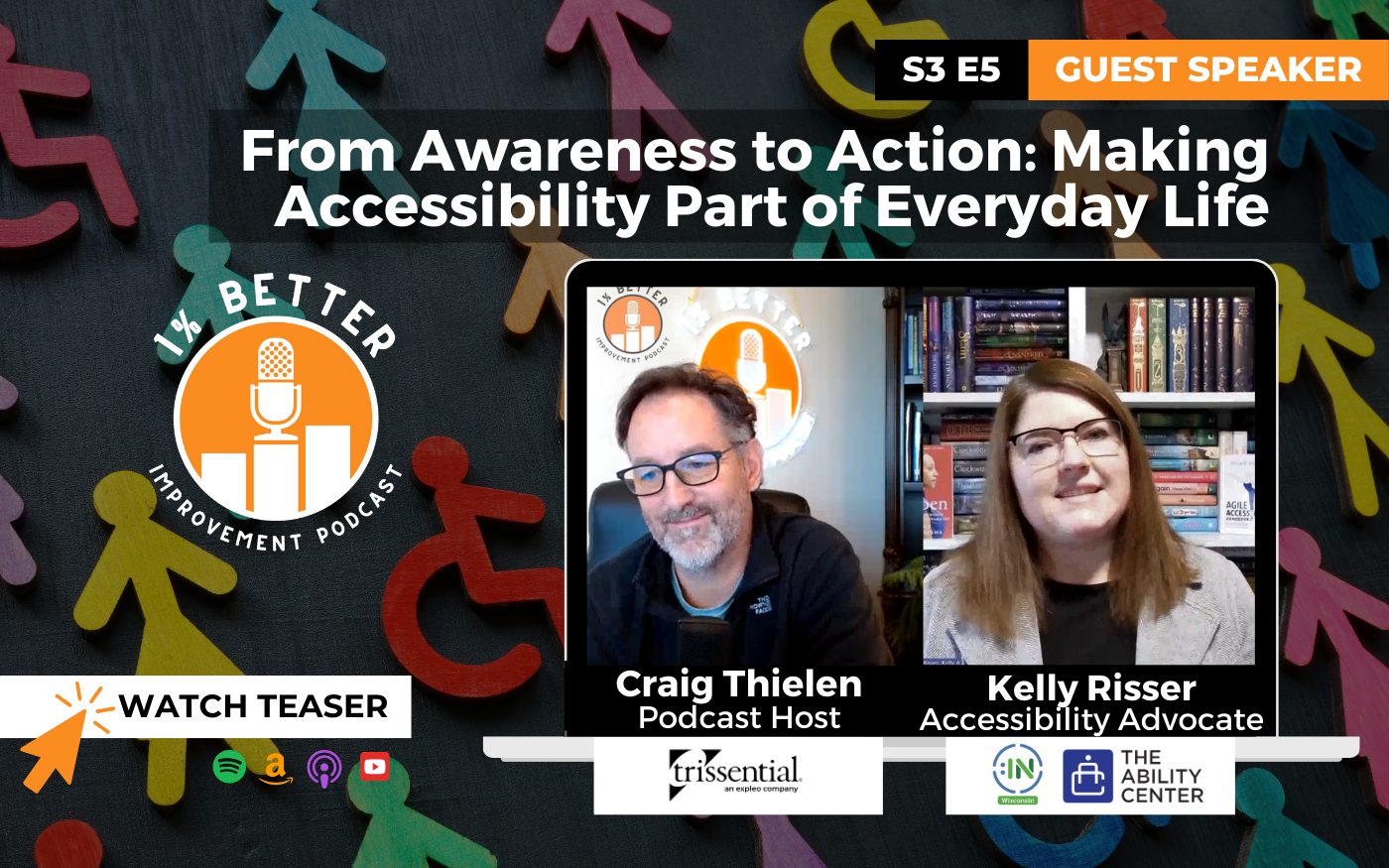
Find us on your favorite podcast platform including: Spotify | YouTube | Apple | Amazon
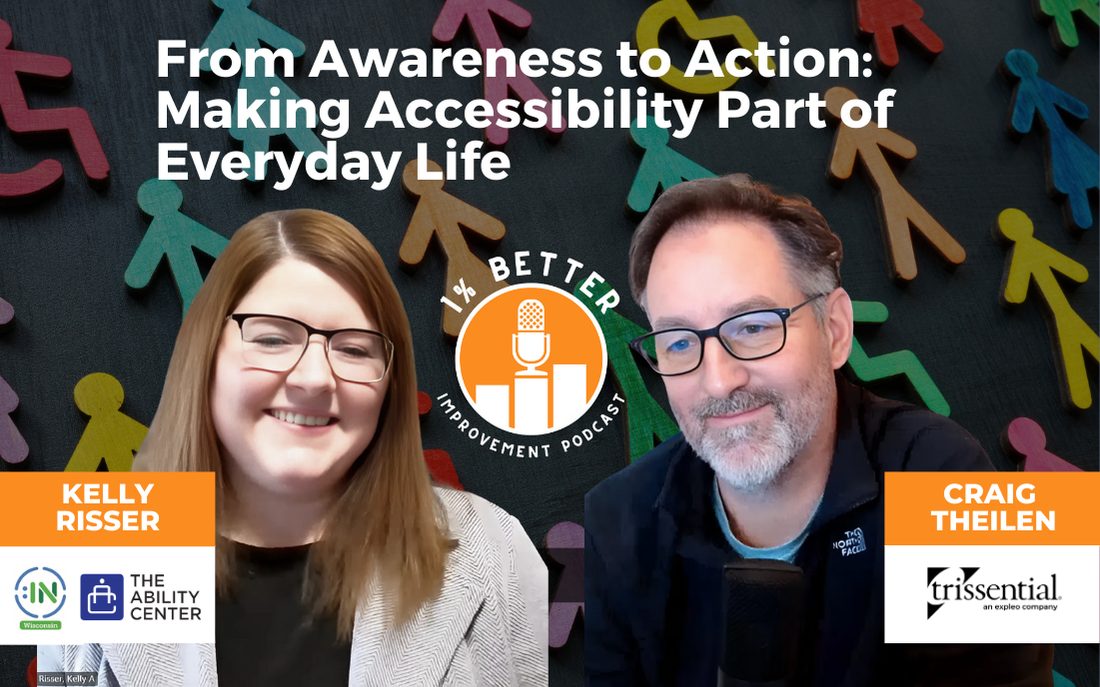
1% Better Podcast Kelly Risser – Quick Links
Learn more about Disability:IN Wisconsin
Check out The Ability Center
Celebrate Global Accessibility Awareness Day
Connect with Kelly Risser on LinkedIn
Connect with Craig Thielen on LinkedIn
Check out host Craig Thielen’s full bio page
Key Takeaways
- Disability is everywhere: 1 in 4 Americans has a disability, many of which are invisible – and everyone is just “temporarily able-bodied”
- Accessibility benefits everyone: Concepts like the curb-cut effect prove that inclusive design helps all users, not just those with disabilities
- Simple changes matter: Improving color contrast, using accessible language, and understanding assistive technologies can make digital spaces more welcoming
- Education leads to empathy: Learning from those with lived experiences can reshape our perspective and reduce stigma
- Inclusion is good business: Companies investing in accessibility not only do the right thing but also open doors to broader markets and better customer loyalty














1% Better Podcast Kelly Risser – Transcript
[00:00:05.06] – Craig
Hello, I’m Craig Thielen, and this is the 1% Better Podcast. Today, we’re speaking with Kelly Risser, and she is a Director at a large financial institution working in the space of disability. She’s also a board member at a couple of organizations, Disability:IN Wisconsin and The Ability Center. I want to welcome you, Kelly, to the 1% Better Podcast.
[00:00:27.07] – Kelly
Thanks, Craig. I’m happy to be here.
[00:00:29.06] – Craig
Yeah. Why don’t we just start a little bit about your background, your journey in this topic of disability… I know you started in education with a degree in communication, and then you had some personal experiences that led you down this path. Why don’t you walk us through that?
[00:00:45.02] – Kelly
Yeah, absolutely. I think disability is really one of those things that’s all around us. One in four people have a disability in the United States, but we don’t really stop and think about it until it impacts us personally. Actually, personally, there was some instances of disability in my life before it really, truly hit home for me. So my grandmother, she actually had macular degeneration, which is where your retina starts to deteriorate. And so she lost all of her vision except for her peripheral in her early ’60s, so pretty early. And she was a woman who loved to bake, loved to sew, loved to be independent and drive everywhere. I remember as kids, she took us all over the place, and that really changed her life dramatically when she lost that. At the time, I was a teenager… I understood from the perspective that it could be devastating to lose your vision when it’s one of those senses we rely on so much. But I didn’t really stop and think about it a lot. Then we fast forward, and I had my first child. I had my daughter. Well, I had her 10 weeks early, and there was also a brain bleed at her birth, some complications, a double knot in the umbilical It was a very stressful time.
I’m sure, yeah.
Yeah, but for me, I was thrust into this world and had heard everything from she could have seizures, she could have cerebral palsy, she will most likely have permanent disabilities. Typically, when you have a Grade 3 or grade 4 brain bleed, there is permanent damage that occurs. She did. She came home from the hospital. She had failed the hearing test, so she had a hearing aid right away as an infant, shortly followed with a second hearing aid, had some pretty significant vision loss. Then in early grade school, she was diagnosed with autism. My son, who’s three years younger, shortly followed on that autism diagnosis too. Really, I was thrust into this community and really became a strong advocate for my kids for making sure that they had the accommodations they needed in school and really learning as much as I could to support them at home. Not only was I a new mother, but I was a mother of kids who needed some additional support from me.
[00:03:07.01] – Craig
Yeah, so thrust into it you were. I’m sure you just read everything you could, talked to people, professionals, and just work through these challenges day by day for your children. At what point did the personal life intersect with professional and say, Hey, I’m going to go beyond some people, a lot of us separate our personal and professional life. What happens at home, we keep away from work, and vice versa, we tend to do that. At what point did you go, Hey, maybe I should start looking at opportunities at work that can connect these?
[00:03:44.03] – Kelly
Yeah. This would be back in 2017. I was just looking around on our intranet and looking at our different employee resource groups because at a previous employer I had been at, I’d been part of an employee group there that was just a general group to bring people together and socialize and really help people feel engaged in the company and get to know people in other departments. So as I was looking, I came across a posting that we were looking for people interested in starting a board for a disability group. And of course, that caught my attention, right? Because I was like, oh my gosh, I’ve been advocating for my kids their whole lives. I would love to be able to help employees. But not only that, as a parent of kids with disabilities, it would have meant so much to me if my employer had had a group like that when my kids were little, where I could have found other parents that were working with me, and we could just share stories, share resources… So I stepped forward and said, I want to be part of this group. And I was part of the initial board, and I came on as the communications officer at the time because that fit really well with the work and my professional experience.
[00:04:54.12] – Craig
Again, a lot of people, this is helpful for a lot of people. And I think, as you said, we have so many disabilities out there in the world. We all know, many of us have disabilities, and we all know people that have disabilities of different types. But some people may not know there’s actually roles in organizations, whether it be how you got involved with a group support, and now there’s evolved into official roles. But maybe what can you share about what roles exist and what do they do?
[00:05:25.04] – Kelly
Yeah, absolutely. There’s really a lot of roles that can support, not only disability inclusion, but also accessibility, because when it comes to the disability community, a lot of it is about different functional needs that people have. So the inclusion comes in making sure that the programs we create and the materials we create, especially those digital materials, support all different functional needs. So there’s roles in design groups like user experience design and designing of programs and materials. Even within marketing and communications roles, there’s opportunity to be an advocate for accessibility. When you think about a post going out on social media, well, have we put a description on that image so that somebody that can’t see that image who’s using a screen reader will know what the image is and We’ll be able to get, especially if there’s text in that image, we’ll be able to get that same information. There’s also roles, of course, on the technology side. Developers, they really want to make sure when they’re building that code, that they’re running it through accessibility testing tools, that they understand the basics of accessibility. Then there’s roles in compliance areas, too, because, of course, you have to understand the laws and the regulations. You don’t want to lead with that. You want to lead with doing the right thing for people and making sure all people can access your products. But laws are important, especially if you’re getting challenged on a law or you just need to know the ins and outs of the law to make sure you are following it appropriately.
[00:06:54.14] – Craig
Yeah, it’s interesting. A lot of people, and myself included, 10 years ago I didn’t realize there even were laws about accessibility. We got involved with it when we really got into… We sold our company to the world’s largest independent software testing company. One of the spaces, it’s a subspace, is around computer software validation, computer software assurance, which gets into, are you compliant with various laws, including accessibility? And so we built testing procedures and protocols calls for companies saying, Hey, are you aware that there’s some laws and some compliance and that you need to meet these as you publish software and you create websites and whatnot. And so it’s a lot of companies weren’t aware that there were laws in place. We’ve done a lot of work from a software testing standpoint to make sure that organizations are compliant. But again, until you know, you don’t know. It’s fascinating. Then you go, Well, jeez, why wouldn’t we do this? It’s not just the compliance, but this is the right thing to do for our customers. There’s people that are hearing impaired, visual impaired, and other forms. It’s like, how do we help serve them as well? That’s obviously, when you say technical aspects, is that the space you’re referring to?
[00:08:19.12] – Kelly
Absolutely, yeah. There’s the Web Content Accessibility Guidelines, which really speak to a lot of that. Success Criteria, as it’s called. You’ve got perceivable, operable, understanding, robust. The acronym is POUR. That’s really all about making sure that no matter how somebody comes at that, no matter what assistive technologies they use, or even if they’re a distracted user, that we’re designing, if you follow those Web Content Accessibility Guidelines, you end up with a better product for everyone involved because it considers all those functional aspects of a distracted user, of somebody who maybe broke their arm and now they can no longer operate their mouse because that’s their right-hand and that’s what they’re using for their mouse. So make sure that keyboard can get to the same parts of the website as the mouse does. There’s so many things to think about, but when you get into this space and you start to understand it, it really isn’t that complicated. It’s just about thinking about different functional needs.
[00:09:20.14] – Craig
Yeah, I think what you said is also, again, something that a lot of people wouldn’t recognize. Maybe it’s just a lot of this is education. It’s not just being compliant, and it’s not just even serving people that need some other levels of support or other considerations to include them, but it also is good for the bottom line. It helps all of your customers. It helps broaden your customer base. It’s an ROI thing as well, isn’t it?
[00:09:50.00] – Kelly
It is, absolutely. There’s a phrase in the disability community called the curb cut effect. A lot of people aren’t familiar with that term. But if you think about it, When you think about crosswalks or you think about entrances to buildings, and back when the Americans with Disabilities Act was passed, we started to see changes. We started to see those slopes in the crosswalk so that somebody that’s in a wheelchair, it was intended, someone in a wheelchair or someone using a cane or a walker could safely cross the street and not have to step down or go up a curve. But if you think about it, somebody that’s pushing a stroller, someone that is making a delivery and has a dolly, they can use those same benefits, it benefits everyone. It doesn’t just benefit the disability community. That curb-cut effect really applies in the digital space, too. When you’re thinking about different functional needs, you’re developing a product that’s very robust and that will really just work for everyone.
[00:10:46.07] – Craig
I mean, that’s such a great point. Such a great analogy, too, because we all benefit from that for sure. You’ve been in this space quite a long time now. It was probably just very emergent new space. It probably felt like when you first got involved, how far have we come the last 5 or 10 years in this space?
[00:11:09.00] – Kelly
We’ve come so far, and we continue to grow. You think about how much digital is changing all aspects of our life, and it really amplifies in this space because what it’s doing is it’s removing those barriers, and it’s creating more opportunities for people with disabilities. If you think about your phone your phone, or your, I’m not going to say her name because she’s in my room and I don’t want her to speak. But all those things that we use today and we take for granted, voice activation, there’s so much assistive technology built into our phones. And because they’re designed to work for all functional needs, they really open up the playing field. And I think the more we think about that and design our products to be accessible, it just works better for everyone. AI is another game changer. It’s coming in and really starting to do things that are improving even assistive technology to start to anticipate what someone needs instead of that person needing to say it or program it or do what they have to do. So I really think this is an exciting time to see how much is coming. But it’s also a cautious time because I think if we don’t think about different functional needs, what may happen is that people get left out. So I love hearing the conversations. I hear them a lot about how do we make sure we’re thinking about all users, all people as we’re designing products.
[00:12:34.01] – Craig
Yeah, it’s a great point. Again, educate us all. We’ve referenced hearing impaired, vision impaired. There could be people that are physically impaired that they’re not able to type or use a mouse. But what are the other, I don’t know, categories or groups of people that you think maybe aren’t as widely understood or known?
[00:12:58.11] – Kelly
Yeah. I think the interesting thing within the disability community is you have people that are born with a disability, and you have people that acquire a disability. So Damian Buchman, who’s the founder of the Ability Center, he has a saying he likes to say called temporarily able-bodied or tab. If you think about it, we all fall into that category. The disability community is one community that we all have the opportunity to join and probably will at some point in our lives because we lose our vision, we start to lose our hearing, we can lose some mobility as age, and then there’s the cognitive piece. I think if we really even think about the baby boomer generation, largest generation right now, as that generation is aging and technology is growing so fast, but then we have an aging population that technology was not natural to them. They were introduced to it later in life. So that can create, I think, some challenges or some opportunities there, too. So cognitive is a big one. When you’re designing things, Think about your readability levels. Think about the words you’re using. If you’re using acronyms, spell them out the first time that you’re putting them.
Try to stay away from industry jargon when you’re creating things. That’s big. And if you have a site, think about things like consistency and where placement is on that site so that people know and they know what to expect when they come. They feel safe coming to your website or your application. I think there’s a lot of, especially for people where they didn’t grow up with technology, there’s a lot of trust that they have to learn to develop for, especially if you’re talking about your finances or something that’s personal to them. So thinking about that when you’re developing your applications is really important. It may not be disability, but it really is about, again, thinking about the whole person and what they’re bringing when they’re using your application.
[00:14:57.03] – Craig
Yeah, I love this reframing and rethinking about it, it’s not there’s people that are disabled as much as we’re all in a temporary state of ablement and disablement. There’s a bunch of degrees to that. I could argue that every one of us has some disability. I’m not super good at calculus, or I’m not… Some people are saying, I’m just not very coordinated. I don’t have a voice, or whatever you are measuring, we all have different degrees of it, but I really… It’s reframed it for me going, We’re all going to have a disability. When we’re young children, we all have some… We’re just growing and learning. Then, of course, on the later ends of life, my mother’s 93 and she has dementia. She has a lot of disabilities, cognitive issues and challenges. We’re learning. We’re trying to figure out, Well, how does she get around? How does she watch TV? How does she do things that she likes? And it’s constantly changing. So I love that. It’s like we’re all in this together. Let’s think about all of us, not just, quote unquote, people that were born with something that we have a label for, right?
Right. Exactly.
Yeah, that’s a great point. So a lot of leaders listening to this, and they might be going, Jeez, never really put much thought to this, but what are we doing in our company, in my role, in my department… Where’s a good place for people to get started in terms of educating themselves and how to get started? Saying, How do we support our employees, support our customers, and really make sure that we’re aware of this opportunity.
[00:16:50.09] – Kelly
Yeah, absolutely. Well, I think Disability:IN is a great organization, so I’m going to start off with that one as a resource because it’s really global organization and it’s business leaders coming together to talk about disability advocacy, about accessibility, about those employee resource groups, and really sharing best practices. How do you hire more people with disabilities. A big part of it is looking at your own company, too, and saying, What’s the diverseness of our employee base? Do we have employees with disabilities? Can we talk to them and see, how are we doing? Get that reality check. Are we providing an accessible environment for them to work, or are we putting up barriers left and right that they spend a good portion of their energy and time needing to overcome? I think your employee base is a great place to get information, and that’s part of what Disability In brings forward, too. But then I would also say, look at some of the leaders in this space. If you look at Apple, you look at Microsoft, you look at Google as three of the big ones because they’re really driving that inclusive technology, and they have a lot of information on their website about the accessible features in their products, and you can look at that and think, Okay, how can I take something similar and apply that to the products and services that my company has?
And even I know Microsoft, specifically, they have an inclusive design guides and training right on their site that anyone can access. So it’s a great place to go and teach yourself. And then I guess the last thing I’ll say is always best to learn from the people who have the actual lived experience. So we’re in a world today where information is at our fingertips. So YouTube, Instagram, LinkedIn, find those influencers who have disabilities and share their own lived experience. If you don’t know someone personally, you can learn from those individuals, and they will talk very frankly about their lives and what works for them and what doesn’t.
[00:18:54.11] – Craig
Yeah, that’s a lot of great thoughts there. What was the Disability In? Can you share the website name?
Yep, it’s disabilityin.org.
Okay, great. We’ll reference that in the notes. I think May 15th is Global Accessibility Awareness Day. What is that?
[00:19:17.04] – Kelly
Yeah, that’s a great… So that was started years ago to really get people thinking and talking about digital accessibility and sharing best practices and really just trying to build more awareness at a time when it was just starting out and a lot of developers weren’t thinking about it. I think nowadays you’ll find most people at least know the term Web Content Accessibility Guidelines if they’re in the technology line of work. But back then, it was rare for people to know. They started this day in May every year, and people come together and they either do within their company or they share externally just different webinars that you can attend. Typically, it’s free webinars you can attend and just learn about the Web Content Accessibility Guidelines, new innovation happening in this space. I’m sure AI will be a big topic this year and how AI is changing the landscape for your accessibility, or even thinking about those cautionary tales within AI and making sure that you’re using AI in an accessible way. I think it’s just a great day. It’s a great opportunity for companies to do something within their company to make sure your employees are aware of accessibility, too.
Yeah. So again, I’m sure there’s a website for that to learn more about that.
Yes, I believe it’s gaad.day (it’s accessibility.day)
[00:20:44.04] – Craig
Okay. All right. Well, we’ll have to get that out there as well. So on a more personal note, I always wonder how we learn to interact. I feel like sometimes with things that we don’t really understand, sometimes we get really cautious. We might see someone in public or maybe even a family or a friend or something, and maybe they have hearing impaired or they have some disability and we tend to maybe just go, I don’t really know what to say. I don’t want to say the wrong thing. Maybe people feel isolated, or they feel ignored, or they feel the oddball. How do we get over that just social stigma? Because I feel like just talking about it helps people to go, Oh, well, I thought maybe that would be rude. I didn’t know how to talk to someone or approach someone. What are your thoughts there?
[00:21:38.14] – Kelly
Yeah, I think that’s a great question, and I think you’re right. I think sometimes we get lost in our own head, and that prevents us from maybe extending a hand and reaching out and talking to somebody. I think if you just think about what we’ve already talked about, the fact that disability is just part of the human experience. Then anyone with a disability, they’re just another human being. They just have a different experience than you do. So I think some of the classic things to keep in mind is a disability, whether it’s visible or invisible, there’s a medical component to it, typically. And just as you wouldn’t go up to someone and be like, Hey, so how was your physical last week? You don’t need to go up and ask the person about the ins and outs of their disability, right? I think one of the best things to keep in mind is it’s always good to say, Is there anything I can do to help you? Just as you would anyone else, especially if you see someone struggling. One thing I know that’s really important is don’t just step forward and do something without first asking that question of, May I help you?
Because the answer may be no, and that’s okay. But if you step ahead and do something, you could inadvertently make it worse for that person. If they’re trying to open the door and you come in and just swing that door open, you could throw them off balance. I think it’s really important to just keep those human courtesies in mind. Language is a big thing in the disability community. The best piece of advice I can give you on language is take your lead from the person you’re talking to. There’s really two camps, and it is very personal what somebody prefers. There’s person-first language where they say, I am somebody who wears hearing aids, or I am someone who has a hearing disability. Then there’s identity-first language. I’m a deaf person. It’s really dependent on that individual, how much they’ve internalized their disability and to share that, how much that’s a part of who they identify as. You won’t know that until they tell you. I would say if you’re not sure and they haven’t given you that cue, always defer to person-first language because we’re all people first.
[00:23:47.13] – Craig
Well, that’s super good and helpful. Like I said, it’s just good to talk about this, so we all get more comfortable with it. I’m curious, this is the one 100% Better Podcast, and so we talk a lot about how we can do incremental, consistent things in life to get really breakthrough results. I’m curious for you, what would you say is a 1% better way for all of us in the context of this? How do you apply that to this space, this whole idea of 1% better?
[00:24:28.10] – Kelly
Yeah, I think for me, personally, it’s realized that functional differences exist in the world, that not everyone has the same experience as you, not everyone’s going to do things the same way as you. Some of the basic things we can all think about in our jobs to just make things a little easier for others around us is make sure you’re watching colors is a big one. Color contrast is huge because especially if you think about 70% of disabilities are invisible. Within that invisible category, is people who are colorblind. Interesting. If you only use color as a differentiator, you might be inadvertently not giving someone all the information. I will also tell you as I age and I see things in yellow or light green or real light color writing that those designers with their young 2020 vision are putting out into the world, it may look really pretty, but it may not be functional, especially for people that are aging, your aging users. So think about things like that. Color contrast is really easy to check. There’s a website called WebAIM, and you just plug in the color values, and it’ll tell you whether the colors pass or fail, and you can keep playing with the colors until you get the one that works.
Yeah, absolutely.
[00:25:53.14] – Craig
There’s a wonderful book that a friend of mine wrote. It’s called Seeing Red Cars. And the whole point of the book is, you may not even realize how many cars are red, blue, white, whatever. But as soon as you buy a red car, let’s say you buy a little your dream car, Corvette, or whatever, Mustang, they’re a lot of times red. And all of a sudden you notice, oh, my gosh, there’s a lot of red cars. And if you buy a red Mustang, oh, my gosh, I’m seeing all these red. It’s just because that’s where your attention is and that’s where your focus is. And until you have some knowledge, and then you have, even more importantly, understanding of something, all of a sudden, you might recognize something you never recognized before. So if you go on a trip to Rome, you may all of a sudden realize, Oh, my gosh, everything around me is from Rome or a lot of the news, or you never pay attention anymore. It’s a similar thing. Once you know, then you can start recognizing certain things.
Well, one of the things that I’ve learned Just over the course of the last few years doing this podcast is there’s been some incredible stories about people that have leveraged this mindset of 1% Better to do some incredible things. One kid hit 10 three-pointers in the NCAA tournament to beat Kentucky. No one would have guessed he would have been in that position to do it. There’s a lot of great stories like that in the corporate world, in the sports world, et cetera. But equally, there’s those stories in this disability world. There’s a kid, I call him. His name is Chris Nikic, and he has down syndrome. And he’s used this idea of 1% better, and now he’s run, I don’t know, 30, 40 marathons. He’s run triathlons, he’s run ultra marathons, Ironman, and he’s won two ESPYs. And it’s like, wow. So a disability is not limiting. Sometimes we think, Oh, you’re limited in what you can do. Actually, yeah, there might be some physical cognitive limitations, but we all have some form of that. It doesn’t mean you’re limited in what you can accomplish. I think, again, to me, that was like, Wow, so this idea of we can all get one 1% better and do amazing things is not limited at all to what your limitations are, if that makes any sense.
Absolutely does, and I 100% agree.
I’m sure you have a few stories of just people you’ve encountered and interactions that you’ve had of just like, wow, what amazing things can be accomplished when even us able-bodied, so to speak, people haven’t accomplished. It’s all relative, right?
[00:28:47.08] – Kelly
Absolutely is. I would say you hear that a lot. People with disabilities will often say, We don’t want to be your inspiration. I get it, right? People just want to live their lives. But at the same time, I’ll say, I’m not out there running marathons and triathlons. I’m not out there breaking down barriers or encountering barriers every day, just trying to live my life. I think truly, the more we can think about that and just try to make things easier for people, try to remove those barriers, I really think for me, that’s my 1% mission, is to continue to do that work and keep removing those barriers for people.
[00:29:27.03] – Craig
Yeah, give them opportunities, even if it’s confidence, support to know that, Hey, there are no limitations, so we don’t need to put limitations on you. You don’t need to put them on yourself type of thing. Absolutely. Well, that brings us to the last question in this podcast, which is just take some steps back from this topic. You’ve learned a lot just going through what you’ve been through this involvement and just being on this planet for as long as you have and the life experiences. What would you share that wish you knew when you were 18 or you’d want to pass on to generations about just life lessons? Again, it doesn’t have to be specifically about this topic, but just about how to be a better person and things that you’ve learned along the way. What would you share?
[00:30:14.06] – Kelly
Yeah, I think for me, I can really resonate to your message about the red car. I think it’s really… I wish if I could go back in time, I was more aware of how different everybody’s life experiences were from my own and how much I can learn from just talking to other people and hearing their stories. I think I am very fortunate to work for a very large company that has a lot of these employee groups that cover all different groups of people. Just to hear people’s stories, to attend panel discussions where our employees are talking about their lived experience, I’ve learned so much, and it’s really, I feel, made me a much more empathetic and well-rounded person that if I could go back, I would have just told younger Kelly, Hey, keep your eyes and ears open because there’s a lot you can learn from others. I’ve gotten there, but I could have gotten there maybe a little sooner.
[00:31:08.06] – Craig
Right. Yeah, the power of stories and just giving each other time to understand each other and hear those stories is life-changing. I mean, literally, right? It is. It can happen anywhere. It can happen at work and joining certain groups. It can happen meeting someone at the airport. It can happen meeting someone at the grocery store or anywhere in life of just taking a little bit more time and understanding people and go, Wow, I would have never have known if I wouldn’t have talked to you and I’ve learned something. That’s a very powerful thing, isn’t it?
Absolutely.
Well, thank you for sharing that, and thank you for sharing everything. I think we can all learn from everything that you’ve shared, and thanks for being on the podcast.
[00:31:53.14] – Kelly
Absolutely. It was great. I loved every minute of it..
check out other podcast episodes