Find us on your favorite podcast platform including: Spotify | YouTube | Apple | Amazon
1% Better Podcast Chad Harlander & Chad Greenway – Quick Links
Learn more about the REACH Program
Watch REACH video, Everyone has a Story
Learn more about Lead the Way Foundation
Donate to the Lead the Way Foundation
Connect with Chad Greenway on LinkedIn
Connect with Chad Harlander on LinkedIn
Connect with Craig Thielen on LinkedIn
Check out host Craig Thielen’s full bio page
Key Takeaways
- Everyone Has a Story – See the Child First: Harlander’s early experiences shaped his mission: to ensure every student is seen, heard, and supported, regardless of their background or labels
- Authenticity Wins: Whether in the NFL or the classroom, kids can spot a fraud. Real impact comes from being genuine, passionate, and consistently present
- 8 for the Day – Building Daily Habits: The REACH lifestyle encourages kids to unplug, sleep well, and rise with purpose – key habits for building resilience in the digital age
- Lead the Way Foundation Is More Than Charity—It’s a Lifeline:
Chad Greenway’s nonprofit, the Lead the Way Foundation, began as a way to support families impacted by childhood illness and has grown into a multi-program organization providing technology, emotional support, and now access to secondary education for REACH students - The Power of Structure and Play: While modern youth sports are highly structured, there’s still a need for unstructured play, free decision-making, and failure as a teacher
- Do What You Say You’ll Do: Greenway’s life mantra, passed down from his father, emphasizes integrity, consistency, and honoring your word – values that anchor long-term success























1% Better Podcast Chad Harlander & Chad Greenway – Transcript
[00:00:05.02] – Craig
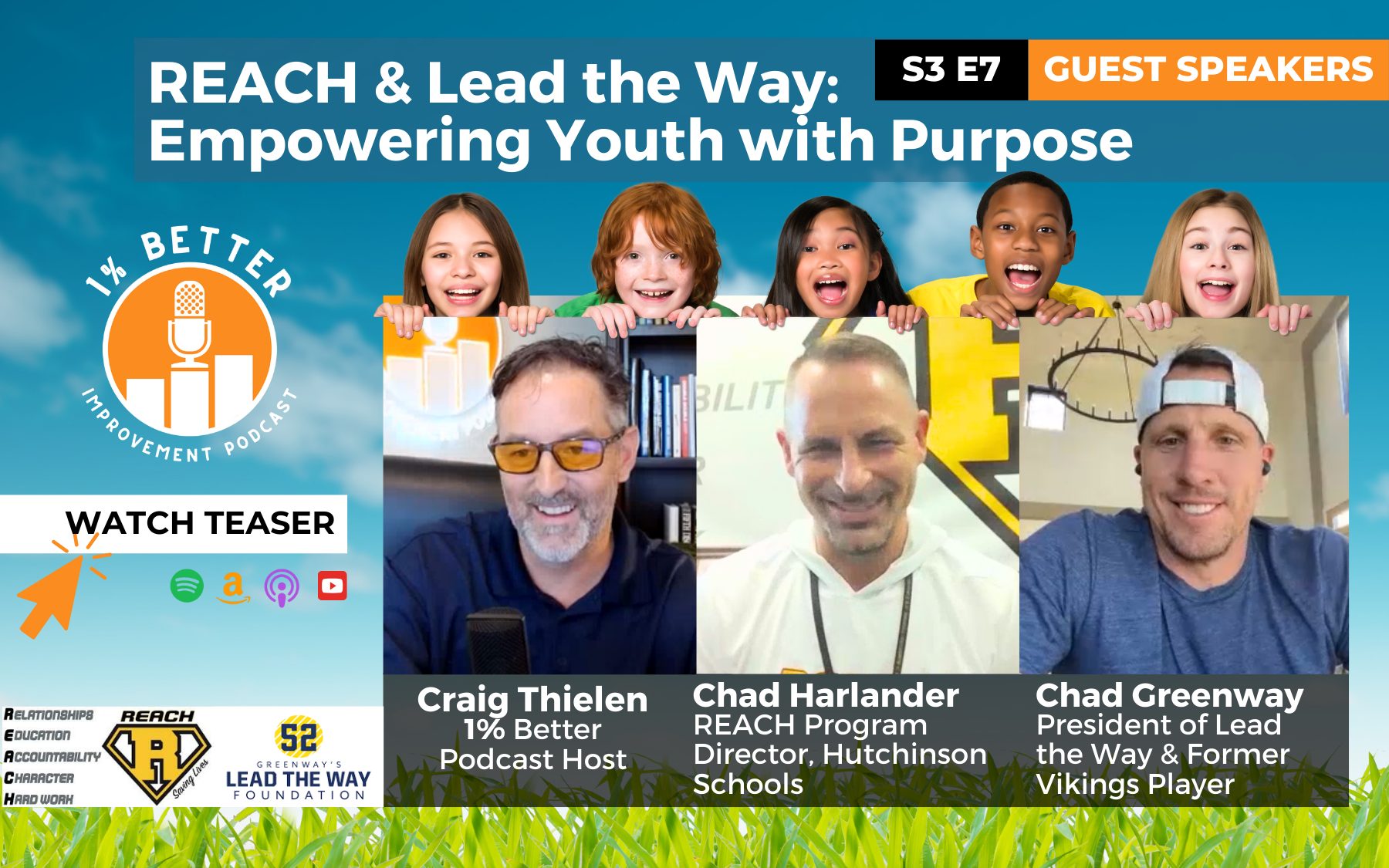
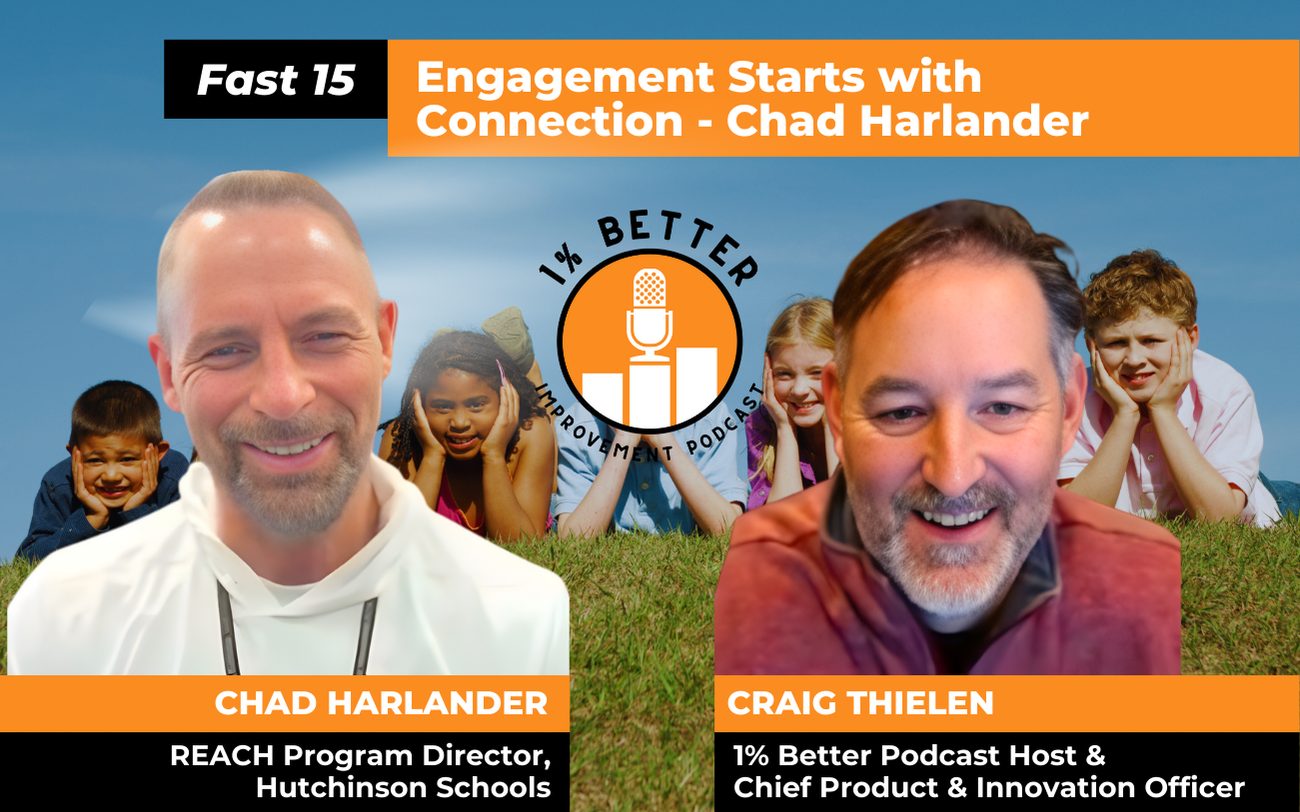
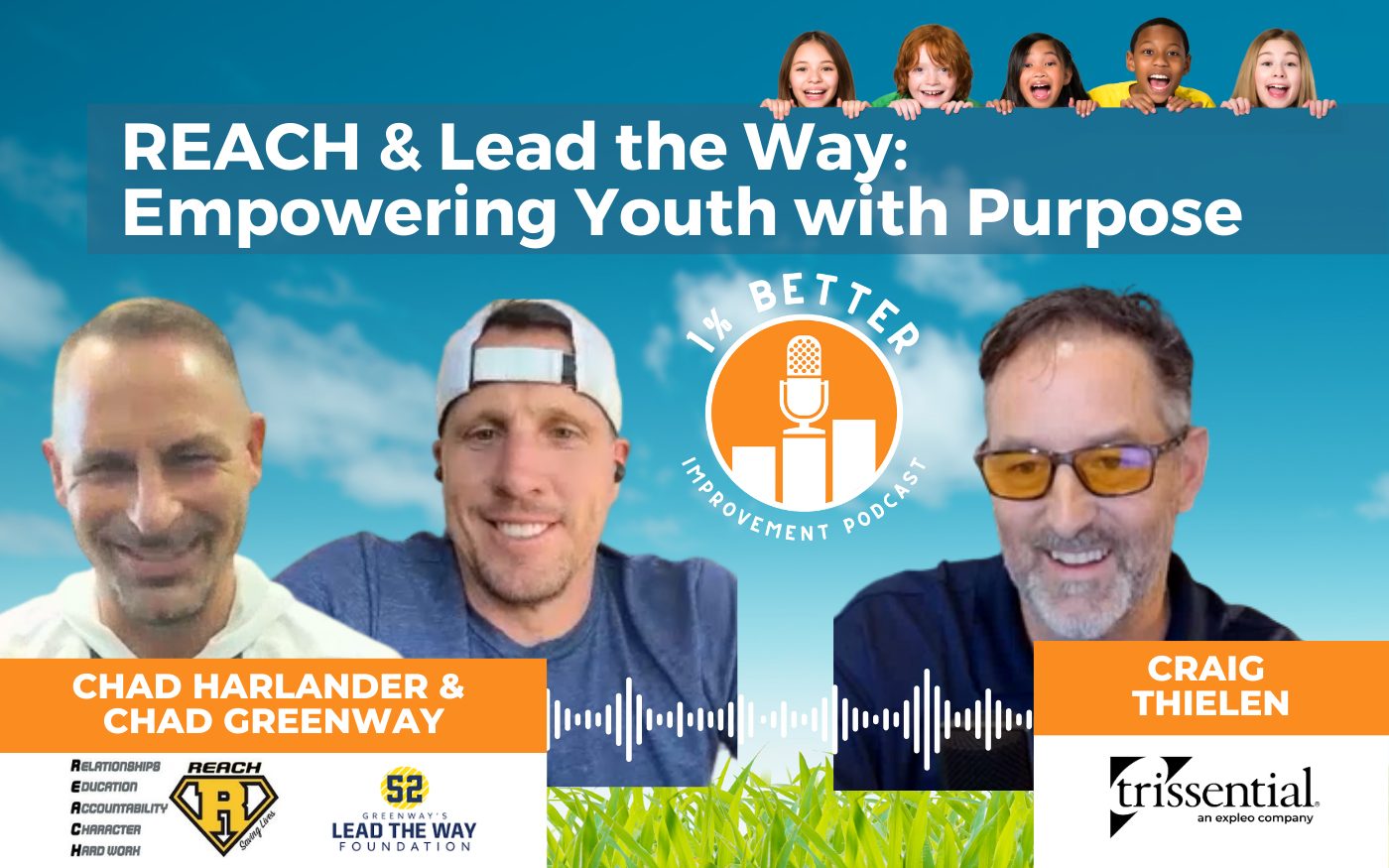
Hello, I’m Craig Thielen, and this is the 1% Better podcast. Today, I’m speaking with Chad Harlander and Chad Greenway. Chad Harlander is the REACH Program Director for Hutchinson Schools out of Minnesota, and Chad Greenway played professional football for the Minnesota Vikings for 11 years. And among other things that he’s doing, he is the President of the Lead the Way Foundation. So welcome to 1% Better Chad and Chad.
[00:00:31.07] – Harley
Thanks for having us.
[00:00:33.03] – Chad
Yeah, double Chad. Thanks for having us, man.
[00:00:35.12] – Craig
Right. It’s the first time that we’ve done a three-way call, and then we have to add, we have two Chads… I’m going to have to figure out how to refer to each of you guys, but we’ll make it work.
[00:00:45.12] – Harley
Harley and Chad.
[00:00:47.09] – Craig
That’s easy. All right. Well, let’s start with you, Harley. Tell us about your background, how you got working in, just your life story a little bit, and then why you decided to focus your life on working with kids and starting this REACH Program, which is very nicely marketed all around you.
[00:01:07.01] – Harley
Yeah, we all have a story. And real quick story… I grew up in a home. We had a great family, but we had a family like a lot of family, had their challenges and stuff. Some of those challenges that wasn’t talked about back in the day was mental health. My dad was undiagnosed bipolar, and needless to say, with bipolar, there’s highs and lows. And with the lows, the house became chaotic and challenging at times. I didn’t know that that wasn’t normal. I thought that was the norm. For me, I think the light started to flicker a little bit when I would go to friends’ homes and find out that they’re sitting together, eating together, just saying, I love you. They’re spending time together and having these conversations. That just wasn’t on a daily basis in our house growing up. I knew that was something I wanted. I knew that when time had come to leave Hutchinson and to hit that next stage in my life, that I wanted to have a family, and I wanted to have the typical normal family. That was a challenge because I didn’t have that skillset… I wasn’t given those skills to deal with a lot of things.
School, for me, I’ll be honest, when I went to school, it was a safe environment for me. Academics, just to be very transparent was a challenge for me. But I had a group full of people like we all do that were of difference makers that spent a little extra time with me who loved me at my worst. And I think that provided me to where I am today. And I had the opportunity to head out to Aberdeen, South Dakota, get my education and play some college football. And I knew going out there, I really didn’t have a career path. I knew I wanted to help people. Went into social work and sociology, and just had a great opportunity to come back to Minnesota and start working with Greater Minnesota Family Services as an in-home family counselor. And I worked with rural counties, and I would get referrals from social workers, probation officers, and have the opportunity to go in these homes and work with their children and their family and to create a home and environment. Then the old opportunity came to be in the school system. I worked in a small school district that had an at-risk program, and you’ll probably hear this later.
I’m not a label guy, but in the world of education, there’s a population of children that struggle in school and sometimes are identified as at-risk. I did three years at this school in Dassel Cokato, Great School district. The thing that we wanted to do when we got there was implement tracking of how we were doing. There was no data, and so I wanted to see how they were doing before they came in the program, how they were doing, why they were with us, and how they did after. And so three years of that, Hutchinson called, and I graduated from Hutchinson, and they said, Hey, Chad, we’d like you to start a program. I remember saying this very clearly to the administration who was willing to think outside the educational box. And I said, It needs to be for all kids. The program that I was at Dassel was just for kids that qualified for special Ed services. And I knew from doing family counseling, we had kids walking around hallways that didn’t qualify for services, but we’re dealing with other challenges in mental health. And so 17 years ago, we started REACH, and here we are, now year 18, going on year 18, and been blessed, and we’re in 46 schools across Minnesota and the US.
[00:04:30.07] – Craig
Well, that’s awesome. Thanks for sharing all that. I think it’s just so important to what you’ve done with it and what it’s become, and we’ll dig into REACH a lot more. But let’s jump to Chad Greenway. Chad, we’ve got quite a diverse audience in the US and outside the US. So just really briefly about you, you had a very successful career in the NFL. And part of your story is growing up in a small town, 350 people, which was that nine man or 10 man or 11 man football? What was that?
[00:05:04.02] – Chad
Yeah, Mount Vernon, South Dakota, nine man football.
[00:05:07.01] – Craig
Nine man football, which is incredible because it’s a very unique brand of football for those that are into it. So to be able to come from that and then get to a Big Ten school, Iowa. And not only you get there, but All-American, first round pick in the NFL with the local regional team, the Minnesota Vikings. And again, not only did you play for a long time, 11 years is an eternity in the NFL, but became team captain, two-time Pro bowler, Walter Payton Man of the Year. So just lots of leadership and great accolades along the way. So one note is the only thing on that entire list that I can even come close to competing with is I grew up in a town of 130. There you go. Other than that, I have nothing to compare against. But you’re active post football with a lot a lot of different businesses and startups, and you could just ride off in the sunset, but you decided to spend a lot of your time and invest in developing this nonprofit called Lead the Way. I just would love to hear about what that is and why you decided to do that.
[00:06:14.04] – Chad
Yeah, thanks. Thanks for having me, first of all. I think like anything, my story is rooted in the foundation, which is my family back in Mount Vernon. Grew up in a small town, as mentioned. And that town really embodies, and I try to embody what it means to me. And also my mentality is really, since I’ve left, is always to make those folks proud. When they say, Hey, this is one of ours from Mount Vernon, from South Dakota. When people read a news article and people read a story, I really want people to look upon what I’ve done with accomplishment and being proud to say he’s one of us. And it starts with trying to make my parents proud of the person I am, my grandparents, when I was younger, before I lost them. And then when I got this platform in the NFL, I realized that there was so much more to it than just playing football. That was the dream and the goal. But if I had just retired a football player and didn’t make an impact, then that was pretty short-sighted of me and pretty selfish of me.
So when the foundation idea came about, it was initially started to impact the children in Sioux Falls area with Sanford hospitals and their children’s hospital they were building at the time.
And that’s where the foundation started, was to generate some dollars through a foundation using my platform to be able to give back and be a part of the Sanford Children’s Hospital. And then it just it blossomed from there into this idea of helping families and sick children with childhood disease. And then we branched off a number of different programs. And fast forward, the impact we’ve been able to make during my playing career was really special. I mean, let’s be honest, it’s pretty easy. You’re playing the NFL. Everybody wants to be around you. They want to be a part of what you’re doing. They want to be able to tell their friends, this event or that event. But where I felt like the impact was… My impact was authentic and the relationships were real was when I retired, and all of a sudden, I was no longer in that spotlight. I was no longer the guy playing. Nobody ran away from me. In more ways, they embraced me more because it was just a normal person from a small town and just tried to be my authentic self. I think I’m very proud of that our foundation has actually gotten bigger, stronger, more robust, more programs, financially more solvent or more secure in the last eight years, and I’ve been retired.
So very proud of that. Yeah, so we met… Sorry. So how I met Harley, got introduced to the REACH program. Really, Harley first was in Mitchell, South Dakota, at a football camp that I hosted back there, which is near my hometown. And we met through a common friend that Harley played with at Northern State. And Harley had this idea, and I got a glimpse of the energy and passion that Harley had for kids and for doing things the right way.
[00:08:50.14] – Craig
It’s pretty easy to pick up on his passion in about what, 10 seconds?
[00:08:55.08] – Chad
Yeah. If you see this guy interacting with children and kids and holding kids accountable and identifying a standard, really just impressive and something you can’t fake. I think authenticity is something that’s measured when people say, Oh, I’m a good judge of character. My first impression really matters. It’s because you’re really unable to hide your authentic self when you’re in those environments. And if you’re faking it or if you’re a fraud, people know it’s too obvious.
[00:09:24.04] – Craig
Kids are pretty good fraud detectors, aren’t they? You can’t really fake it with kids very well.
No doubt.
[00:09:30.07] – Chad
Very perceptive. And so I got that feeling that this was the guy I wanted to hook my wagon to. And so we started a camp in Hutchinson 17 years ago, and we were able to make a massive impact on a bunch of different kids in a bunch of different communities. And I’ve been very proud to be a part of the REACH program in a small way, just to add to what Harley’s been able to accomplish. And to use my notoriety or Fame, or celebrity, whatever you want to call it, to be able to get kids to come in, for us to be able to impact them in a positive way. And it’s labeled as a football camp, but it’s really a life camp is how I look at it. You’re going through these drills, and yes, they’re football drills, and we’re teaching kids, but it’s more about life lessons, about character building, about helping somebody else up, about meeting somebody new that you don’t know. I think those are the things that really will matter at the end of the day. And the interesting part about it now that I do have teenagers, is that you see how they’re affected differently than maybe a young person when they’re now smart enough to understand that a parent isn’t home, that a parent isn’t doing what maybe they’re supposed to be doing.
They go into somebody else’s home, like Harley said, and realize that, wait a second, my house isn’t like this. Why? Is it because of me? Is it something I’m doing? And they have these thoughts, and there’s all the online pressure and social media pressure. And then there’s all these things that they’re dealing with. And they’re so smart and perceptive, as we talked about, that how do we help them navigate that part of their life? Because that same person who’s struggling at 15 could become the President at 45. We just need to get them in the right-hand to get them the right opportunity. Just a quick story before we move forward. I was at track meet yesterday in Orono with my daughters, and Hutchinson was there. There’s two REACH kids that came up to me and just wanted to take a picture and say hi and thanked me and the smile on their face, and you could just tell they were happy, healthy kids. And that just means the world to me. So it’s fun to be able to talk about it.
[00:11:26.02] Craig
I appreciate it.
Before we jump into the… Well, I just I want to make sure the Lead the Way Foundation, is it primarily focused on these camps, football camps, but life lessons, or is that the main focus of it?
[00:11:40.08] – Chad
Yeah, the REACH program is a part of what we do. So we’re really based around helping families that have impacted by childhood disease. That’s where we got our start, and that’s our bread and butter. So we have two different fundraisers that we do to raise funds for Chad’s Locker, which is a locker that’s in 12 different hospitals across the Midwest, and their technology locker is filled with laptops, PlayStation portables, these Nintendo DS’s, all these things you need to use or that you may want to use. And basically kids can go check them out like a library system at the hospital. And we build up these life size NFL lockers, and it’s all filled with all these technologies and iPads and all sorts of stuff. And then we have a couple of programs for the moms of sick kids. Tender Heart Luncheon is one of our primary programs that we run. So we really focus around kids and families that are being affected in that way. The REACH program is a bolt on to what we do because it’s really important to me and family. And quite honestly, the next 10 years, our focus is shifting, not shifting away from what we’ve been doing, but adding on to the REACH program and creating opportunities for secondary education is my goal for these REACH kids.
That’s really my goal in the next 10 years is to get these REACH kids through high school and now connected to secondary education opportunities to take what we’ve done at REACH and then embolden these kids to go out and take that next step and go get a one year certificate, go get a HVAC certificate, go get something that can go create a career. A career, a career at a job. So that’s my next 10 years of focus when it comes to the REACH program, and we’re working hard to get there right now.
[00:13:07.05] – Craig
Awesome. Well, let’s dig into that then, Harley, as we said. Just maybe break down, you’ve got the big banner behind you. I know it’s not just a saying or a nice slogan, but it’s a very systematic approach that you’ve developed to working with kids and getting them to see their potential. Can you just walk us through what the REACH program does?
[00:13:29.04] – Harley
Yeah, those are our values. I think I shared with this earlier is that when we had the opportunity to come back to Hutchinson and develop this program, the first question is, What are you going to call it? I remember sitting with my wife and I said, Hey, do you have any ideas what we can call this? I remember sitting there saying, Well, how about reach? You’re trying to reach these kids. Just to be transparent, I thought that was corny. But then I started thinking about, What are we about? What do we about and what do we want to teach? You want to teach about healthy relationships, who you surround yourself with, the opportunities that come through education, accountability, doing what’s right when nobody’s looking, character, what person you’re going to be, and then the end of the day, to teach and to model hard work. And so those are the values that we teach each and every day. And let me say we model each and every day, whether it’s through the day to REACH football camp or we’re in the classroom on the daily.
[00:14:20.05] – Craig
Yeah. And so you’ve incorporated. So Chad, then you guys meant you incorporated that right into your camp. So you’re teaching, again, not only, Hey, this is a great time to be with an NFL player and learn about football, but we’re going to go through these life lessons. So, Harley, you also have this thing called 8 for the Day. So what is that?
[00:14:40.13] – Harley
It’s a lifestyle. We developed it last year, and it’s really simple. And I don’t need to tell you guys, our kids are growing up behind screens. And so it’s a self-care lifestyle that we developed, and it’s 8 for the Day, which means at eight o’clock, we’re shutting off the devices. We’re putting that phone or that device on the kitchen table. We’re getting eight hours of sleep. And then when we wake up, eyes open within eight seconds, your feet are on the floor, and then you work to be the 8%. The number that’s out there is 92% of people eventually, and when they set a goal, give up on it. So we’re teaching our kids to strive to be that 8%.
[00:15:13.09] – Speaker 1
Yeah, I love it. I mean, it’s great about that is some of these things, it’s easy to talk about life lessons and values and characters and stuff, but it’s really like, how do you actually implement it? And these are just some great practices in the world that we live in to create good habits that lead to really good outcomes, which is really the whole idea of this podcast, 1% Better is how do you every day, do I get better as a person? And incremental improvement, but dedicated hard work, discipline. And then that leads to the great outcomes. So it’s very similar. There’s a lot of similarities. I want to come back to something you mentioned, Chad, and both of you are deeply involved with, which is kids. When we grew up, we faced a number of challenges. Kids always do and always have, bullying and all sorts of things. And then there’s a new set of challenges, the technology, the social media. But just maybe describe that from both your perspectives. What are you seeing as the similar challenges and what is different with kids today and how is this helping them?
[00:16:22.02] – Harley
I can jump in here quick. Just being in the educational system as our kids, we’ve moved into the education’s behind the screen. Back in our day, it was sit and get, and you would have lectures done to you, and sometimes there would be hands-on projects. And now today, it’s behind the screens. Well, unfortunately, and that has its positives, do not get me wrong. However, in the outside world, too. Once they leave here, well, then they’re behind those screens again. So our kids have, and there’s been a lot of studies on this, too, is we have this anxious generation. Our kids’ minds are like this 30-second reel. Every 30 seconds, they need something new, something fresh. And so we have kids that are looking and trying to find that sense of belonging, and sometimes they’re finding it, unfortunately, in the wrong places behind the screen.
[00:17:09.05] – Chad
Yeah, from my perspective, I’m just going to take an approach with my own children and what I see. And I think that short window, what I He is a shorter intention stand to get things accomplished that don’t come easy, and they give up on things and move to the next thing and move to the next thing and move to the next thing. And some of us that have brains that work that way, for me, I’m a list guy. When I make a list for the day, I I have to make a list every day and say, These are the things I’m going to focus on and get through them and get them done to completion. My wife would say, I don’t do that as often as I should.
[00:17:38.08] – Craig
I’m sure she’s got a bigger list than you have, right?
[00:17:42.01] – Chad
Yeah, exactly. But I see my kids that are successful in their own ways through sports and academics, struggle with the same types of things. They want to sit there and just scroll, and they want to spend time just being zoned out. I’m like, Okay, there’s a better way to serve our time. And that’s just one of those things that you have to understand this is going to part of their life. Now it’s about management, and how do we use them for the benefit rather than… I’ve taken the approach of like, we’re just going to rip it away and do nothing. Well, it’s not realistic either in this day. It’s just not. So you have to… And now with Madden, our oldest being 17, going to College in a year, you’re like, okay, we have to limp her to prepare for all of a sudden mommy and daddy aren’t there. How are you going to go to college and become the best version of yourself when you are dealing with all these distractions and things? It’s a reality. It’s all it is. We have to just deal with it and find a manager the best way.
So yeah, putting some rules in place, putting the phone down, the eight-hours thing is awesome. It’s a great way to look at it.
[00:18:37.01] – Craig
Yeah, it’s a really great technique. Another thing that I noticed, Chad, I know Greenway, you’re involved with youth sports, and Am I ever? Yeah, I did a lot of coaching when my kids were growing up and coached a lot of teams and got really involved with that whole scene. And it’s a crazy scene a little bit with the parents and expectations. But one of the things I noticed, and I think we have this small town connection, is we didn’t have any structure. If you wanted to go play something, you would just go get some buddies and go get… We would make our own balls and do Wiffleball and do all sorts of things. We just created. There was no structure until we literally got to high school, and then the school had some structure into some of these programs. Well, now, from the time that you are six years old or five years old, there is really over-structured and competition and A team and B team and traveling team and all of these different things. There’s some goodness to that, but on the other hand, it’s like the kids are just are told what to do, what time to wake up, what time to go to practice.
You got to go to this camp. You got to play a sport year-round. All of this stuff is just programmed in. And I see that going, they actually aren’t driving the bus. The parents are, and these programs are. And how do we get that out of them? Because at some point, it’s really all about them and their choices, their interests, their desires. So do you guys see that? And how do you deal with that?
[00:20:17.02] – Chad
Yeah, I’m in the absolute thick of that world, whether it’s travel, soccer, and basketball, to AU basketball, to high school sports… I’m right in all that. I think there’s one positive that we forget to talk about when it comes to youth sports these days. If you want to talk about what makes the military really good or what makes certain sectors of our life really good, it’s structure. Sometimes structure and time and when to be there and your team is expecting you to be there, there’s an expectation. So that’s one of the things that doesn’t get talked about enough of, yes, things are more structured than they used to be. Yes, things have changed. That’s not all bad. I think one thing that’s funny is you go, I’ve run the West Side Youth Basketball Association on the girls’ side since I retired. So 2017, eight years. So I’ve dealt with parents and travel teams and complaints. And I’m very proud of the work we’ve done and all the kids we put to different colleges or levels. And it’s crazy the amount of talent coming through. And I’ve dealt with those crazy parents. I’ve dealt with unrealistic expectations.
But at the same time, I’ve seen the positive that come from sports and team and structure and camaraderie and failure. Absolutely. And the greater good of what we are doing with sports are there when taught in the right way. And you’re never going to put your arms around all 100% of people and say, Here’s how it should be done. There’s going to be the crazies. They were the crazies in the ’70s and ’80s. They were there. Different. I think it’s not all bad, but at the same time, what I was going to say was, if you ever want to see something funny, go take a group of… The group I’m coaching now, a group of fourth-graders, really talented kids. I’ll say, Okay, we’re going to play four on four, five on five, whatever we have for numbers for that basketball practice. I’m going to say, You’re going to run your own scrimmage, half-court, call your own fouls. And we’re not going to say a word. They don’t know what to do. They don’t know how to call.
That social experiment is hilarious. I have a practice with my fourth grader’s team. I’m going to do it tonight. I allow them to have about 15 minutes of free play where they have to decide. Now, I manage a competitive level and the expectation to say, Okay, this isn’t going how we’re supposed to go. But I don’t overcoach it. I let them play. Call your own fouls, make it take it. Whatever you want to do, create the rules, shoot for teams. All the stuff we did, what does it feel like to not get picked for a team or be last to pick for a team? We all know because we dealt with that. Well, Harley knows being picked for last for a team. I’ve never been picked last. But the point is, those are social experiments that just happened organically when we were very young. I love that. And kids don’t have that now. So I do it where we’re not picking, but we’re shooting for. You didn’t make the free throw, you don’t get put on the team. It’s like pickup. You do those things, you put kids in that situation. It’s just funny to see them react.
But yet we create some structure on our practices, too, where there’s a way we do things to set a standard. When I think about Harley, I think about the REACH program, I think about my own life, I think the most important thing is your standard. Your standard is what you walk by and allow to happen.
That’s your standard.
When you think about things that way, that is a microcosm of your life. If you walk by the stuff sitting on the floor of your bedroom and you don’t pick it up, and you don’t pick it up, and you don’t pick it up, well, that’s your standard. If you are the person that always leaves your gas tank on E, then you end up on a lake and stuff and get gas. That’s your standard. Those little things add up to what really matters. I talk about standards a lot with my own children about if these are the goals and this is the path to get there, what standard are you going to have for yourself? And it’s that simple. And your work will determine your outcome. I think that’s how I coach. That’s how I approach sports. But I’ve also done it long enough now to know that how much fun has to be baked into every practice, and kids love to compete. So we have a lot of fun competing and keeping things fun, where we’re smiling. But the first lesson I always teach kids, and I’ll shut up after this one, is, How do you spell fun? W-I-N.
[00:24:28.02] – Craig
That tends to make things more enjoyable, that’s for sure. But I love that. Chad, there’s this balance between the discipline and the structure and then the building in some of that creativity and some of that just free time and letting them have fun. And fun is not something you can do it because we say to do it, but it’s got to be authentic like we talked about before. And at the end of the day, sports is really about having fun and maybe learning some life lessons along the way and building some friendships for 99.9% of kids. I got a funny story I love how you incorporate that in your practice. So I coached a traveling baseball team, and on day one, and after you coach every season, you learn something new every time. And by the way, there’s this great program you might know about it, Chad, called Positive Coaches Alliance. Yep. Have you heard of that? Yeah. So that’s a really great program that really instills a lot of great practices that you can get kids a positive experience regardless of their talent, regardless of anything. But also it doesn’t hold the best talent back. It actually promotes the high performers and everyone.
There’s some really great techniques in that. And so I had a traveling baseball team, I had 12 kids. And these are the A-teamers, right? These are the best of the best kids at that age level, and they’re like 11 years old. And so day one at practice, I said, Okay, raise your hand if you’re a pitcher. And three kids raise their hand out of twelve. Now, don’t ask me why. They probably pitched the year before or their parents said you’re a pitcher. Now, the other nine raise their hands and I go, The pitchers on our team, every single one of you is going to pitch. Whether you want to or not, you’re going to do it because you know what? Why not? Let’s just do it. It’ll be fun. Well, at the end of the season, our best pitchers turned out to be one of the nine. And it wasn’t the kids that self selected themselves as pitchers. So it’s the same thing. Give them a chance. They don’t even know what their limitations are, who they are. And it’s fun to see that happen. So All right. I’m going to-
[00:26:30.11] – Chad
One last thing on that is kids, for you how to play is if you go teach kids or tell baseball kids what a ghost runner is now, kids have no idea what a ghost runner is. We all have ghost runners because we didn’t have enough kids to play with. So it’s like, okay, ghost runner on second. Kids don’t know how to play those games anymore. It’s so funny. The things we did back in the day were so normal. And we’re the problem, parents. Teach your kids how to go do it. That’s the funny part.
[00:26:58.01] – Craig
Yeah. Well, even the term coach… A lot of people believe, and I did for many years, that a coach is the expert, the Xs and O’s, do this, don’t do this. And that’s actually not the definition of a coach. The real definition of a coach is to guide people into finding out what their own potential is, removing their own obstacles. You could probably talk, Chad, about the best coaches you had in your career weren’t the ones that were just like, that’s wrong… line up better… Use this technique… It was the ones that helped you discover your potential, but they helped you do it. They didn’t do it for you. That’s really the definition of a coach. And we’ve inverted that in our world going, no, the coach has to tell me what to do and not to do, right?
[00:27:42.07] – Chad
Exactly right. 100%. The greatest motivator I’ve ever been around is Mike Tomlin, the head coach of the Steelers. He had this unbelievable way of using language to challenge you, but pat you on the back at the same time. It was the most astounding thing. His ability to do that forever changed my mentality about not being offensive or abrasive to criticism, but actually embracing it because that’s how I got better. But yet he made me feel good at the same time. And I’ve taken that with my youth sports journey is like, I want the best for these kids, and how can I encourage them through positivity, but yet hold them to a standard and also having fun. It’s a really fine balance.
[00:28:26.08] – Craig
So what you just touched on is beautiful because it’s really about this whole idea of 1% better, right? So where anything’s possible, if you can remove your mental limitations, focus on what can I do, what can I control to get better? All feedback is good feedback. There’s no failures, there’s learnings. And Chad, I know for a fact that this applied directly to your ascent into professional sports because you could never have gotten where you went to with Iowa and the Vikings if you didn’t really focus on trying to get better every single day. And as talented as you were, I bet you played with dozens and hundreds of people that had equal or more athletic ability than you. And in the end, your athletic ability is a small part of what led to your success. And it was your mental attitude in this mindset. So maybe just talk a little bit more about where did you get that early? I mean, Mike Tomlin had certainly a big influence in you. And then how do you see that post football that you can apply that same mindset I mean, I’m sure you built that in, and that’s part of REACH coming in and helping kids understand that mindset.
[00:29:36.11] – Chad
Yeah, it’s real simple. I think people like to take credit for that, but I think I was just coded that way by my parents. And I think it’s a gift I was given. So yes, I had people around me to harvest that and to hold me to that. Really good people and coaches and high school coaches that gave me the perspective of thinking bigger. And the small town, South Dakota, you can go accomplish these things from here. You don’t have to be from the big city or from the big school. So I had the people around me. But everybody has to take credit. But I think I was lucky to be born and genetically coded with those types of things, the mentality to go drive harder and to go figure out where I need to get better at and be motivated to do that. But there’s three things, really, that are separators in every facet of life. And I will believe this until the day I die. Your enthusiasm towards something, your attitude towards something, and the energy at which you bring these things. Essentially, the reason I was drawn to Harley was of those things, the energy, the passion, the attitude towards whatever he’s doing. And that’s the difference maker. At the professional level in the NFL, there are, of course, there’s the 1% of the 1% that are just freaks. Those people exist organically in nature somehow. Adrian Peterson just existed. And you’re like, what is that?
[00:31:01.06] – Craig
But some of those, to prove your point, even that had incredible talent, phenomenal physical talent, still failed because of the mental limitations and decisions that they made and work ethic and attitude and all those. I’m sure you’ve seen a lot of first-round picks come and go, right?
[00:31:20.08] – Chad
Sometimes your physical ability ends up being your limitation because you’re so talented, things come easy. And all of a sudden, you come up against a guy like me, for example, who’s or Adam, for example, who’s probably not as fast, probably not as strong, maybe not as talented. But goll darn, is he going to… He is unwilling to quit, unwilling to give up, and he’s willing to embrace the stuff he’s not good at and say, I am not good enough. I have to get better, and I’m going to go work until I do. That’s the person that will win because there’s a minimum level of physical ability you have to have to be in the NFL or play one football. There’s certainly limitations and minimums, but your ceiling is not limited to that. So how do you go find your ceiling within your athletic minimum? You have to have, and then you go, then the sky’s the limit. And I think for me, the people I was blessed to be around. At Iowa, I went to the program that embraced kids that just wanted to have their head down and work, and they didn’t care that you were the most talented.
They just wanted kids that were going to come in and grind. And I got drafted to the Vikings where it was about with Mike Tomlin as my defensive coordinator, with this idea of, we’re going to draft you and bring in. We love how you play. It’s not like, Oh, you’re so fast. You’re going to be good. No, we like your mentality around getting better and playing. And then I took it from there to extend it to an 11-year career by just finding my weaknesses and making them strengths.
Yeah.
[00:32:43.10] – Craig
Awesome. Chad, I know you have a limitation on time, so I’m going to ask you one more question, and then I’m going to let you go. And then, Harley, I got a couple more for you, if that’s okay. The one question, Chad, that I ask everyone on the show, and I think you already gave us a lot with the three things that you’re going to go to your grave with, which are all amazing things. But the one question is, so if you take a step back from football, you take a step back from the foundation that you’re doing, you just go, Hey, you’re a human that’s on this planet. You’ve learned a lot. I’m sure you got so many great stories, not only in your college and NFL career, but just working with kids and just inspirational stories. What would you want to pass on? What life lessons would you want to pass on to the next generation or your grandkids or wish that you knew when you were 18 that are the best life lessons? Anything there?
[00:33:40.00] – Chad
I think the most important part, there’s a lot there. If I was going to boil it down to one thing, It doesn’t have to be one. Well, I think the one most important thing is to do what you say you’re going to do. For me, it’s that simple. It’s integrity. It’s this idea. I think about my dad, who I lost in 2014. And I think about what he embodied. This idea… He grew up in a farming community. What’s the one thing in the farming community that is the most valuable? It’s land. And any time a piece of land would come for sale, my dad would never grow our family farmer business on the back of somebody else. So if somebody else wanted that piece of land, if that family wanted that piece of land, if the neighbor wanted that piece of land, he’s not going to go in there and outbid somebody to grow his own nest because of what he wanted to do things the right way. And his moral value was much more important than his financial value. You could see that at his funeral. You could see the reaction of the community, just a simple farm guy from Mount Vernon who lived just a life so well-lived because he simply did what he said he was going to do.
If I shake your hand, look you in the eye and say, I’m going to do this, then I do it. Even if that makes me really uncomfortable, even if that puts me in a really big bind, you do it. And I think that’s, to me, that’s the most important thing. I think it’s an important lesson for kids to learn this day, too, with everything so transactional and so fast and it’s happening so quickly, is be somebody that can be counted on and be there for people. And that’s why is the REACH program so important? Because a lot of these kids don’t have somebody like that. They don’t have somebody they can look to and say, I trust you. I believe you. You’re going to be there for me. That matters. And those people come into kids’ lives in all different ways. Sometimes it’s a teacher and educator. Sometimes it’s somebody that REACH programs. Sometimes it’s a coach. Sometimes It’s the neighbor who knows. But be that for somebody who can just be counted on. That would be the biggest thing for me.
[00:35:37.01] – Craig
Great stuff. It comes full circle to where you started the conversation, which you said, all I wanted to do is make my family, my local community proud. And when you started talking about, do what you say you’re going to do, I immediately thought of my local community because if I said, Well, what’s most important to them? That would be it. Don’t be something that you’re not. Don’t be a big shot. Just be someone that’s got integrity because in small town America, that’s what’s most important, right? So good stuff.
[00:36:09.02] – Chad
The last thing for me, my quote my dad left me with when I left to go to college in Iowa City was never forget where you came from.
No doubt.
And that meant something probably different then than it does now. But it’s always something that’s been in the back of my mind of you don’t have to change because you’re in the NFL. You don’t have to change because made money. You don’t have to change because of your position of life. You can just be Chad from Mount Vernon, and that’s okay. And I think that’s a really important lesson for people to remember.
[00:36:40.04] – Craig
Yeah, and it’s rare. Just how you stayed true to that is rare. So thanks, Chad. Really appreciate your time and being on the 1% Better Podcast.
[00:36:48.11] – Chad
Yeah, thanks for having me. And sorry for jumping off early, but good luck with Harley here. The rest the way.
Chad, nice.
Take care, my friend. We’ll tap into that energy. Thanks, Chad.
Love it, buddy. See you. Love you, too. Thanks.
[00:37:00.14] – Craig
All right, Harley. Yeah. Yeah, that was great. So I can see where you two are. Yeah, it’s how you guys connected, too, just because the energy and the passion. So let’s talk a little bit more about you. So clearly, you guys had that connection, and you started… We’ve heard your life story. You started really with nothing. I mean, you created this program. You’ve developed it over the years. You developed a great video, by the way, that’s called Everyone Has a Story, and you started by saying that, which, by the way, we’ll share the link to that. It’s just a wonderful video. First of all, I love how it starts. Starts with a quote that says, My goal is not to be better than anyone else, but to be better than I used to be, which, again, completely a 1% better mindset quote. And then the first video is a young man who says, REACH not only made me better, but it saved my life. And that’s like, just even think about a young person saying something like that is so touching and what an impact. That must be what drives you to wake up every day and to keep doing what you’re doing and expanding it.
So when you think about this whole program and 1% better, getting these kids to understand that. And now you’re not just the Hutchinson School… You’re in, I think, over 20 communities and growing. But just talk a little bit about where you see this going ultimately and how far do you want to take it?
[00:38:32.08] – Harley
Yeah, we’ve been blessed. Again, it started with Hutchinson just taking that risk to think outside the educational box. What I had to learn, it’s a return in investment. It’s an investment in our youth. It’s growing into 46 schools across Minnesota. Oh, wow. Yeah, South Dakota and Dallas, too. We’ve had over 62 schools across the US that reached out and asked, What are you guys doing? I’m just very open. There’s nothing special that we’re doing. There’s no fancy curriculum. We’ve created this environment, this culture that you are going to come in, we’re going to help you develop that sense of belonging, and you have the opportunity to become part of this family and this team. A lot of that comes from what I came from. My hope and my drive is to this day is to have a family and to help our kids develop that and learn those skills, how to get there.
[00:39:27.00] – Craig
Yeah, that’s incredible. That reach that you had. Again, you don’t have some big budget. You don’t have some big foundation. This is just word of mouth, hand by hand. You don’t have a big team of employees. So it’s quite amazing, the reach. Let me ask this, there’s a lot of different listeners across the country and even across the globe. What can they do to just join the effort, whether it’s part of the REACH program or just how to help kids in general? What would you suggest that people do if they want to support and participate in this?
[00:40:04.06] – Harley
First and foremost, and it’s really easy, see every child. Every child that walks through our educational doors, every child that walks on the street, no matter what their hair color is, what you see or hear coming out of their mouth and stuff, just see them be present in their lives, offer to be present in their lives, walk up, shake their hand, introduce yourself. That is so important. What we can do as adults, model that. I think what we’ve been so blessed to do here, too, is we have this belief here within reach, but not only within reach in this district, in this community, that no child is going to fall through a crack. You know this. Everybody knows this. It takes a village to raise a child. I think you develop that culture in that setting where kids come in and they can say they can take off their mask, they can be real. There’s these caring adults. It doesn’t matter what your initials are, what your education is. If you got that genuine heart and you’re willing to extend that hand and say, I love you, unconditionally, and meet them where they’re at in their journey, I think that’s the best thing as adults we can do.
What I loved about Chad Greenway and his family and why we have connected, he’s about faith, family, and service. And it’s about being selfless. I think that’s why we connected. I think that’s why our camp has taken off, REACH has taken off. It’s because at the end of the day, it’s about us giving back, and especially to our youth, at this critical time in this world.
[00:41:29.02] – Craig
Yeah, It’s a great thing. It’s just so amazing and such a big impact. Well, great advice there. I’m going to give you the same last question here that Chad had. What’s the life lessons that you’d want to pass on?
[00:41:44.05] – Harley
Life lessons is be selfless. And to make sure that every child that you, and I said this earlier, every child you see, you have an opportunity to connect with. And I think the biggest thing we do is just to help each other out. And when you strive to be, whether it’s the 1% better or we tell our kids to be the 8% better, not only as adults, it’s our responsibility to model that, but it’s also our responsibility to grab a child that maybe don’t have those skillsets, don’t have those opportunities within their own home setting, and offer that, and then help guide them.
[00:42:21.10] – Craig
Yeah, great stuff. Well, thanks, Chad, for everything that you’re doing with REACH and the impact that you’re having, and sharing some of that with us here on 1% Better.
[00:42:30.13] – Harley
Yeah, thank you, Craig. I appreciate it.
[00:42:33.01] – Craig
All right. Take care.
[00:42:34.04] – Harley
You bet.
check out other podcast episodes