Find us on your favorite podcast platform including: Spotify | YouTube | Apple | Amazon
1% Better Podcast Amanda Brinkman – Quick Links
Check out Amanda Brinkman’s website
Learn more about The Purpose Pursuit
Watch episodes from The Small Business Revolution
Follow Amanda Brinkman on Instagram
Watch Amanda Brinkman’s TED Talk
Connect with Amanda Brinkman on LinkedIn
Connect with Craig Thielen on LinkedIn
Check out host Craig Thielen’s full bio page
Key Takeaways
- Doing well by doing good isn’t a tradeoff, it’s a growth strategy. Amanda shares how purpose can be a competitive advantage when it’s baked into brand action, not just brand statements
- Long-term impact comes from commitment. The Small Business Revolution worked because it wasn’t a one-off campaign – it was a multi-year investment that combined marketing with meaningful community impact
- Your purpose is already within you. Amanda emphasizes that purpose is less about chasing something new and more about revealing and aligning with who you’ve always been
- Small businesses model authentic purpose. Local business owners don’t need convincing to do good, it’s embedded in how they serve their communities daily
- Personal and professional purpose should align. True fulfillment comes when the work you do reflects who you are and what you value, not when the two are compartmentalized














1% Better Podcast Amanda Brinkman – Transcript
[00:00:05.06] – Craig
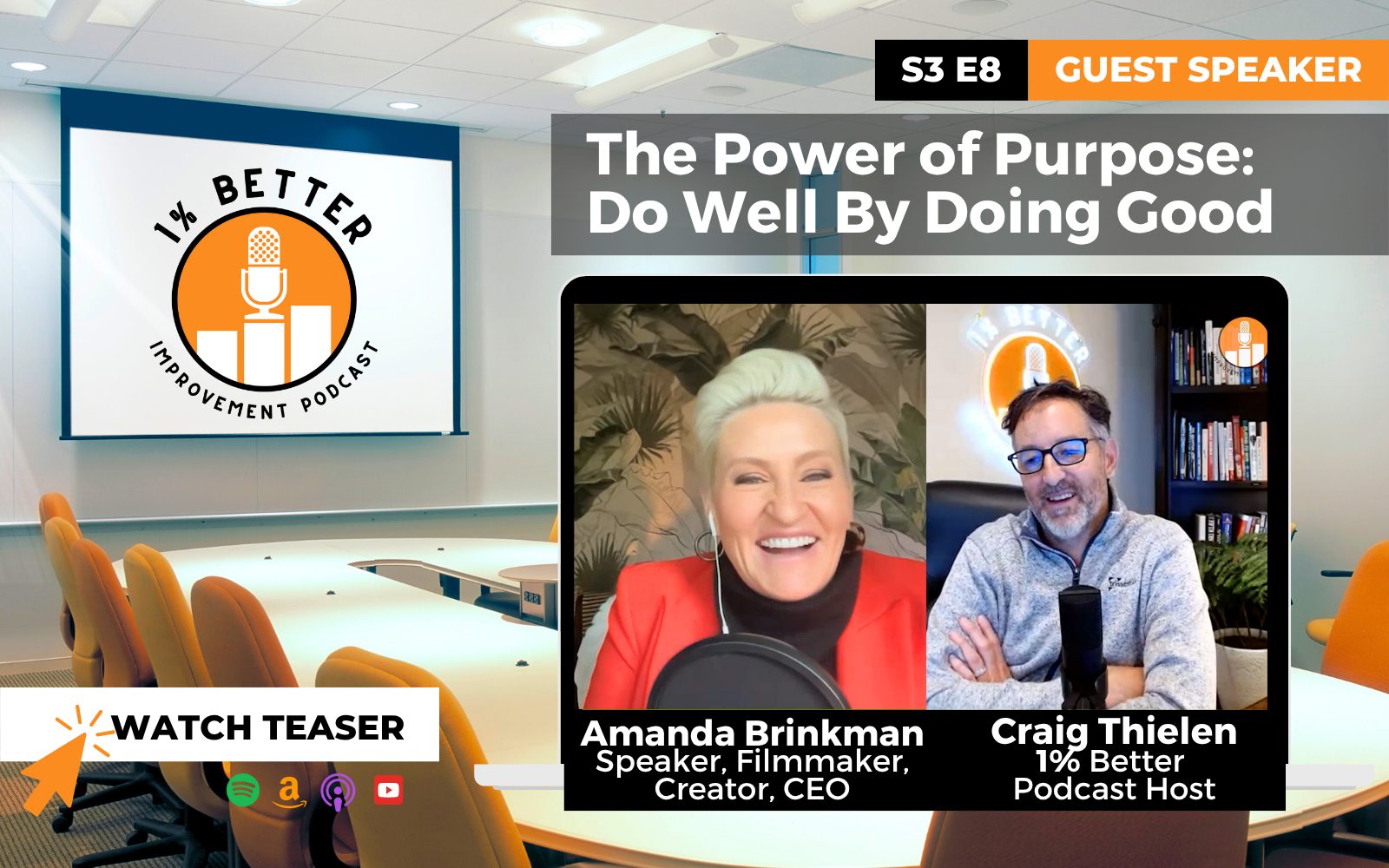
Hello, I’m Craig Thielen, and this is the 1% Better Podcast. Today, I’m speaking with Amanda Brinkman, CEO of Sunshine Studios. Amanda, welcome to the 1% Better Podcast.
[00:00:15.05] – Amanda
Thank you for having me here.
[00:00:16.14] – Craig
Yes, I’m excited for this. Usually, I’ll give a short background just to give people a lay of the land so they know who you are. Many people do know who you are. But I looked at your background and I go, I don’t think I could do justice to that. There’s It’s just too much in there. You have a very diverse and unique background and path that you’ve had, and it’s fascinating. So I’m going to let you do that for us. Maybe just go back… where did you start your education, your early career, and then how did that progress into what you’re doing now? And then we’ll dig into that.
[00:00:47.12] – Amanda
Yeah. All right. So I can start all the way at the beginning. I was raised here in Minnesota and loved my upbringing, loved my family, very happy childhood. I met my husband in college. When I was going into college, I had that classic conversation you always have with a teacher about what are you going to do after high school – Are you going to go into the trades? Are you going to start a business? Are you going to go to college? I remember I shared with them that I was really conflicted with this decision because I was becoming so attracted to branding and marketing and advertising. But growing up, service had been a big part of our life, and I had always felt like I was going to go into something that did good in the world. It’s interesting because there’s only so many jobs that really immediately read as good. Of course, nonprofit leaders, but teachers or first responders, nurses… I was conflicted by that. I want to do something that’s good in the world, but I really love branding and marketing. And those things don’t feel like they’re the same thing. And he said, without missing a beat, he’s like, But, Amanda, if people who want to do good in the world don’t go into business, how will the business world ever get better?
And how will the business world ever… I heard as, how will the business world ever truly understand its impact in the world and the ability to do good and to advocate for things? I went into my career really wanting to prove this thesis that companies could do well by doing good. So I did go into marketing. I started on the ad agency side, Campbell Mithun, Fallon for a long time. I got to work on the BMW films very early in my career, which was fantastic and very exciting. Then I moved over to the corporate side and I held a variety of roles at UnitedHealth Group, I started at an internal agency there called Carrot. I went to Allianz. I was at General Mills. Then I was the Chief Brand Officer at Deluxe. In that role, so people either don’t know the name or at the time did not know the name Deluxe or associated them with our legacy, which was checks. But we were trying to be known more for small business and small business services. That was a new growth area for us. When I joined the company, we were about to celebrate our 100th anniversary.
So came up with this idea to not only raise brand awareness with small businesses for Deluxe, but to finally prove this thesis that companies could do well by doing good. It was called the Small Business Revolution, and it became an unscripted reality show, and it made over different communities each season, and it had incredible impact, both on our business as well as in real life for these businesses. I loved that, and it was so fun. I realized how impactful that long-form storytelling can be for a brand. And so I left to start my own production company called Sunshine Studios and to pursue speaking full-time. And that gets us to where we are today. Awesome.
[00:03:41.04] – Craig
Well, that’s a lot. Thank you. I knew I wouldn’t do it justice. And I do want to dig into that work, that Small Business Revolution. I mean, that’s going to be a fascinating story for people to hear about. But I want to just go back because it defined you. When you were in the position at Deluxe, a lot of things came together. So you worked at many Fortune 500 companies. Like you said, some of the bigger ones in the Twin Cities areas, for sure, UnitedHealth Group, Allianz General Mills. These are like premier brand, premier large organizations. What would you say that you… Sort of aha moments just looking back at that career, you’re in different industries, different philosophies, different roles… Do you recall any aha moments that said, Hey, this is good, but I want to go here, or I learn this from this situation or this mentor, or any of those moments that you recall that helped define you later?
[00:04:38.11] – Amanda
Yes, absolutely. It’s a fantastic question. I actually have this gratitude practice that I do now, which does a lot of that same reflection. I really feel like as you’re meeting people and as you’re having these opportunities, there are these little stars that are illuminating. And it’s not until you get later in your life and you look back and you realize all those stars are somehow connected and have created this beautiful constellation that is your life. And so I use that as a place of gratitude. Whenever I’m driving to a meeting or standing on a stage, I always say, How did I even get here? And it’s so fascinating because you’re right, it’s all these little moments or these little ahas or ways in which people helped you that form this life that you lead. So a few for me, I had a boss early on when I was at Fallon who said, Amanda, when you say things in a they’re really impactful. You’re smart. You should speak up more. It was basically the headline of what he was saying. And he said it very gently, I’m a ‘words of affirmation’ love language communicator. And so he knew that about me.
So you have to be very careful with feedback for words of affirmation people, of course. But anyway, he was like, You need to speak up more. I remember I said to him, I said, I know, but it feels like the things I’m saying are just going to maybe be obvious or people have thought about it. He said, Well, they’re not. But even if they were, even if they were, people don’t keep inviting people back if they don’t contribute. The way you get ahead and the way you get noticed is by contributing and speaking up in a meeting and having an opinion, raising your hand to do something. Those are the ways in which you get on people’s radar and you become indispensable to a project or people. You want to be the person people just want to have in the room because you’re going to bring energy and you’re going to bring ideas. I’m so grateful that he said that to me. That was very early in my career, and that really set me on a different path around being more vocal and more assertive and sometimes I did say things that I think other people had already thought of, but he was right. I think you start to become someone that people want in those meetings. So that was very formative advice for me.
[00:06:43.09] – Craig
Gave you some confidence for sure, right? That you had something of value and you belong there. Yeah. Okay. Well, good. Well, let’s talk about a big theme of what you speak about and the work you do. And then I’m going to come back to the show is just do well by doing Good. Describe what that means to you.
[00:07:03.03] – Amanda
I believe that historically we’ve thought about it a bit too binary, that companies are either a for-profit model that make money for shareholders or you’re a nonprofit that has mission and works within the community. I think that there’s real magic when those two things come together, and it actually can be good for business to do the right thing. And so doing well means you don’t have to forfeit business success and business metrics and achievements in order to do good. So how do you bring those two things together? And when I’m advocating for it, it’s not just philanthropy. It’s not just companies giving away money, though. I think that’s an important role. It’s more about really understanding what resources do we have here? Everything from not just fiscal, but expertise, influence, access, research, data… How can we contribute to our customers’ lives in a way that makes their lives better rather than just selling them things. When I talk about companies doing well by doing good, I’m really just advocating for that. Don’t just stop it saying, We have this brand purpose. That’s just becoming a marketing catchphrase. Sounds a little sexier than mission statement. You have to actually turn it into brand action.
How are you actually demonstrating that purpose on a day-to-day basis and how you move through the world, how you treat your customers, what you’re using your platform for. Now I’ve parlayed that into talking about personal purpose, but I truly believe that that brand purpose is the key to business success, and it’s just the right way, I think, to operate as a company.
[00:08:38.00] – Craig
It sounds like it’s more than just the right corporate thing to do. I mean, everyone’s got their mission statement, their vision, and it’s on their website, it’s on their walls, but it’s a whole another thing to actually make it real. And it is real. It’s not just words on the wall. And then the real question is, why are you doing it? So are you doing it because it’s just check the box or it satisfies certain people? And we go through the motions, almost like a compliance checkbox. Yeah, we’re compliant. We did our culture thing. We did our brand. We have our committee. We have our little fund. Or is it ingrained in your belief system? Is it in your culture? To some degree, all those roads lead to a leader. If a leader doesn’t believe in something, they’re doing it for the right reason… It could be leaders, it could be the whole executive team or board… But there’s a huge commitment there if it’s more than lip service. I have had the opportunity just feel so blessed that you’ve interacted with lots of organizations, probably hundreds, right? And I’ve been able to interact with several thousand organizations.
And the more you do that, the more you can very quickly ascertain what the culture is and what’s important to them. It literally takes minutes to figure that out. By the language that they use, by how they think and how they speak and how they prioritize, it comes out very, very quickly. It’s not to say it’s wrong to say, Hey, all we care about is hitting our numbers and making our MBOs and our bonuses… That’s okay. We’re in a capitalistic society, and we have to be successful and do those things. But what’s really important to you? And so I’m just curious, when you have that conversation, it can get very personal, very quick, and you almost have to call out leaders or the leader and say, Is this really important to you? Because if you’re just going to do the lip service, then let’s just call that out and move on, right?
[00:10:54.06] – Amanda
Absolutely. Yeah. It’s like, how are we actually going to demonstrate that? We can’t just say we stand for this. It’s like, are we putting our money where our mouth is. Are we using our platform to advocate? And I think you probably see this with all the companies you work with, too. Not every company needs to be solving for the exact same things. It’s like, what’s core to what you are truly an expert on and what you can actually have influence on? We need everybody to be solving different things within the world for all the things that need to be fixed to be fixed. We can’t all be focused on the on-house population or hunger or economic empowerment. We all need to be focused on different things that are in our lane that we actually have expertise on and influence around. And what can we do to actually demonstrate that we stand for those things? I’ve also started to expand my definition of good, too. I think especially the last six or seven years. Remember joy? Remember having fun? Some of those things feel like we’ve sacrificed those things, and people want that and need that levity.
Sometimes it’s just by bringing joy to people’s lives and fun and reminding them how great life is. That is good. Sometimes we think a little too narrowly about what altruism means. It could also be just bringing people joy, just making people’s lives, lifting their days, lifting their moods. How can you train your frontline employees to have a ripple effect out in the community? I talk a lot about ripple effect as a part of how we live in our purpose in my work now. It’s amazing once you help people see that they have an ability to make people’s lives better right away, you see people feeling that impact and feeling like they have some control over that.
[00:12:40.11] – Craig
Yeah, it’s so, I think, poignant that you just pointed that out, because I think a lot of, I would call the ’90s and 2000s, there’s been lots of books written about purpose-driven organizations, and this has been going on for a long time. But I feel like in that era, It was more like, yes, we have a charity committee. Yes, we’re giving back. Yes, we have… And it was very mechanical versus a broader definition of good. And then in that 2010, 2020 era, it’s like, oh, are you supporting the green movement? Are you supporting the DEI movement? Are you supporting this movement? Because that’s the good PR that the world is looking for you to signal you’re doing good. And I think your definition goes way beyond all those things because some of those things come and they go and they’re flavors of the day. And then a broader definition is just, are you improving the lives of people? Our purpose, and this is actually how we started this podcast, is the same thing with you at Deluxe. We’re celebrating three years ago, a 20 year anniversary, and we wanted to find a way. Our purpose is to improve the lives of everyone that we come in contact with.
For us, that’s a very broad… It doesn’t just mean our executive sponsors. It doesn’t just mean our biggest and best clients. It means literally everybody. If it’s someone we’re interviewing, someone that’s an employee, helping them succeed in life and be engaged and being fulfilled, or even partners that we work with or clients that maybe we have a couple of meetings with. We still want to leave them better than we found them and give them something. So that’s where we started the podcast because we wanted to share amazing, great stories of people that we’ve worked with and that other people can learn from. But I love that broader definition because there’s so many… And just bringing the joy out of people that are working with you, that’s a great thing. We talk about people being the most important asset, but how many times do we actually act on that and say, And here’s what we’re doing about that, right?
[00:14:55.12] – Amanda
Yes. Oh, absolutely. I think you’re right. And I think our employees are looking to us, to our team members… They’re watching us. They’re watching how we behave as leaders, and if we’re actually living those values, and if we’re demonstrating them, and how we react, and in our tone, and everything from the big program that we green light to our day-to-day interactions with other people. Can we say that we are really supportive of working parents? Then in the short term, we’re making these clear moments of shaming, or these off-handed comments or these whatever… Well, then we’re not truly supportive of working parents. I think our team members are watching that to that level of detail, so you couldn’t be more right.
[00:15:38.08] – Craig
It gets to, again, a lot of books written about authentic leadership, servant leadership, et cetera. It It’s to the core of what you say, your actions follow your words. I think people are very perceptive, and they mostly follow actions. The lip service, they’ll watch. There’s the old saying, you have to say stuff seven times seven ways. Well, there’s a reason for that because they don’t believe you the first six times. They believe what they see and what they feel.
Let’s talk about the Small Business Revolution. This is a fascinating thing. You’re at Deluxe and you guys are going, Hey, we got to really shift our organization from being this traditional check company, and we can help small business, and there’s so many services that we can help with. How do we do that? I don’t know where the idea came up, but maybe just walk through how that progressed from a marketing campaign thing to an amazing show. I don’t have all the stats in front of me, but many seasons and how many towns that you went to go visit and that whole experience of how it blossomed, and maybe did you even dream it was going to become so big?
[00:16:53.02] – Amanda
Yeah, I think that’s what’s the magic sometimes of programs that become so successful is that if you start out in the right space, trying to achieve the right goals. Sometimes it will grow organically to this beautiful place that you couldn’t have quite imagined at the very beginning, especially coming from the ad agency background. We’d always have clients coming in saying, Can you create a viral moment for us? We’d always have to say, That’s just not how it works. You have to let these things breathe, and then they become things. I will say that was a huge part of why and how it grew to what it became was that when I first stood in front of the board, I had a I had very supportive CEO. I had very supportive peers in the C-suite of this work. But as I’m standing in front of the board, they really supported the fact that I said, when I first pitched the idea, which I’ll go back in time a little bit, I said, We can’t just do this. This can’t be a one and done, though. For this to actually be effective and to grow the way I’m envisioning, we have to commit to it for multiple years so that we have that momentum and that accumulation of energy behind it and notoriety. That’s how a brand grows.
And I commend them. The board saw that wisdom. And oftentimes, even if you come up with a great idea, half the time as an executive, your job is also just to keep protecting the idea, even once you’ve already sold it or executed it. And I’m really grateful for both my peers at Deluxe, both CEOs that I had during the time I was running this program and then the board, they really saw the beauty in this work. And so I’m grateful for that. The idea came because I, as a marketer, love to spend time with customers. I think we’re so data-rich as a business community now, as a world, that sometimes we get a little lost in the data, and we forget that we’re trying to sell products and services to human beings who make decisions, who have real lives. I love to just go out and spend time with the customers, whether I was in health care or CPG. In this case, I loved going out and spending time with small businesses. How am I supposed to even understand what keywords we should be focused on if I don’t understand how small businesses thinking about their marketing or their finances?
So I was just out spending time with these small businesses, trying to get these really qualitative insights. I just noticed how moved I was personally by their stories, why they started their business. Or what was hard about running this.
[00:19:16.03] – Craig
So you went to go meet with them off camera or this is part of the show?
[00:19:19.02] – Amanda
Yes, this was to come up with the idea. When I first started at Deluxe, the challenge in front of me was, we’re about to celebrate our 100th anniversary. We can’t use it to talk about our past. We really do need to use it to talk about our future. We have less than 1% brand awareness with small businesses. Could you fix that, please? Here’s just a small amount of money because we’re a conservative Saint Paul company that does not invest in big brand campaigns. That was the task at hand. I’m an optimist to the core, so I saw that as everywhere from here is up. Here we go. In order to come up with, Well, what idea is going to break through with this limited budget and this need to also celebrate this centennial? I decided if I’m going to I’m going to try and reach small businesses in this moment, I’m going to go spend time with them to gain some insights. That’s what I was doing when I realized how powerful their stories were. The idea was that we would go across the country and share the stories of 100 small businesses all during our 100th year.
The reason we felt like that would be so powerful is because we were literally making it about the small businesses and not about ourselves. It was a Small Business Revolution championed by Deluxe. We felt like that would get us reach, and that would get us in front of small businesses. But more importantly, it would do really… So that’s doing well, but it would do good for small businesses because we’re advocating for the importance of supporting them. Because when you hear a small business owner story, you want to support them.
Yeah, for sure.
We said, Let’s be the people who are owning that. All our competitors were just selling them products and services. We can own the space of just championing them. So that was the idea. It then evolved into a television show where we didn’t just share their stories, we actually went in and them with the things that Deluxe does, but in a very authentic way. It was an unscripted reality show, but it was still shot documentary style, which is unheard of in that category. We ignored all the other tropes about unscripted shows. We didn’t try to create any faux drama. There was no confession rooms. Running a small business is the antagonist. You do not need to create drama.
What year was this, Amanda?
This would have been 2016 through 2021. It ran for six seasons. It was nominated for a few Emmys, real Emmys, and it was on Hulu. It was wildly successful. It ended up reaching 14 times more people than we would have reached if we would have invested the same amount of money in paid advertising, which is where I was taking this budget from. I’m so glad that the board believe me. And we were right. We ended up reaching more people by doing something people would want to spend time with. And that’s a lot of what I’m focused on now at Sunshine Studios. It’s like, how do you create the thing that your customers want to spend time with rather than creating the ad that interrupts what they want to be doing? And I just think that’s really powerful. So we were very proud of that work. It was fantastic.
[00:22:09.03] – Craig
So when you went out to just go talk and meet with these customers, you had a certain thesis or a certain theory of like, here’s what we’re going to go here, and here’s where we can help them. What changed when you actually talked to people? Did you learn something different that you didn’t expect?
[00:22:28.14] – Amanda
Yeah. And I think all of us reassigned our understanding of small business. I think as an American culture, business culture, we’re very enamored with the 10X growth, VC funding, the exit plan, this fast growth mindset of businesses, and that’s what we started to take on to the word entrepreneur. These were small businesses. The premise of the show was that each season we would revitalize a different community’s main street through its small businesses. It was a small business makeover show. Each episode was about an individual business within that town. There’s a whole nomination and voting process and everything to determine where we were going to be filming each year. When we’re meeting with these businesses, growth to them looks like hiring two more employees from their community. That’s growth. Absolutely. They’re not using anything X. They’re using real-life metrics. It was just humbling and sobering to remind ourselves that this is what the majority of small businesses look like, though, across the country. Again, we’re just so used to the Shark Tank, Angel, startup, that stuff. It was really empowering to realize that through helping them with their marketing and their finances and doing a little renovation to their space, that that could completely change, for sure, their business, but their lives and the lives of their employees and their families, and it had a ripple effect within the communities we were in.
That was a powerful realization, that we did. We took that back to the team at Deluxe. It’s important for everyone… My team got to work on this work. It was so fun. It was exciting. It was super meaningful. But to be able to go back to our folks in the call center who are talking to small businesses on a day-to-day basis. They’re not out on the film set. They’re really doing the work that we’re representing on camera. To be able to share with them, this is the impact of these products and services, though. Yes, we’re making websites for small businesses, but this is what a great website means to them. It’s huge. I think that’s our work as leaders, too, to not just to help our employees see personal purpose in their work, to see how they individually are contributing to making someone else’s lives better. Not just the company you work for, but the role in which you have as part of this bigger team that’s advancing goodness.
[00:24:55.06] – Craig
Yeah, it makes the work real and the impact. The impact real. When you say small business, let’s just define that. Are you talking companies under 100 employees, typically? Oh, yes. These are coffee shops and service companies and retail shops. How many cities and businesses did you actually do this for?
[00:25:21.00] – Amanda
It was six seasons, so six communities. I could talk about season six was a little bit different, but the first five seasons were all in small towns. Over the course of the show, we had over 30,000 towns nominated, and that was also a marketing strategy. Absolutely. We had all these tent pulls of attention, both earned media, organic sharing, everything where people were nominating, and then we would narrow it down to the top 10 communities. My team and I would put boots on the ground and go and visit these 10 communities. In each of those towns, we would host these rallies all about how important their small businesses were. So it was really fun for them to be able to see, to be to impact not just the winning town. They all said, even though we didn’t win, we did win because you came here, we had this shared purpose to all work together to clean the streets and wash the windows and truly realize how special our town was. It’s being considered for this television show meant a lot to them. And so we wanted to… How many towns and businesses and people can we affect with the goodness of this movement, not just the winning town and those six businesses that are going to be featured.
Then so over the course of the show, it was like over almost 40 businesses were featured. But we’d also host marketing seminars and a lot of different things within all the town. Even members of the team, Julie Gordon, she’s seen quite a bit in the series and in real life. She’s as heartfelt as she appears on the show, and she would go door to door and help all the businesses with their Google listings and these different things, well beyond what we had promised the town we would do. That’s cool. Because we truly cared about helping all these businesses, but they don’t come naturally to figure out how to maximize Instagram.
[00:27:09.13] – Craig
That’s cool. I’m sure there’s so many stories, but just out of the six seasons, what town or what business comes to mind? Is it just a memorable story for you?
[00:27:23.10] – Amanda
All of them… so hard to pick! Season one, we were working with this woman, Lisa Downs, who had been in the law field, paralegal, a variety of roles, and she had always wanted to go into running a bridal shop since a little girl. Everybody told her she would make no money doing that, that she should go into the law, so she did. She spent her whole career doing that. A couple, maybe a decade before retirement, she realized, What am I? I want to run a bridal shop. The season one’s town was Wabash, Indiana, a town just shy of 10,000… 8,000 at the time, I think. The addressable market for a wedding shop is small. We helped her figure out lots of different marketing techniques and things like that. But one of the things we noticed in season one, my co-host was Robert Herjavec from Shark Tank. One of the things we noticed when we were digging into her numbers was how much she was carrying on inventory for bridal shops. It came out that she had the same purchase minimums as David’s bridal. A small bridal shop in a rural community has the same minimum from these dress manufacturers as a national conglomerate.
Yeah, that’s crazy.
It’s like for both Robert and I, we’re not in the bridal industry, so we’re asking these questions like, Why? Lisa’s like, Well, that’s just how it’s done. We said, Does it have to be? I commend her. She picked up the phone and kept calling and figuring out how to get to places to ask if that could be different. And she started to rally other bridal shops in other small towns to almost be a collective voice for changing that purchase minimum based more on sales and addressable market than just you want to carry those dresses. And she got it changed. She got it changed.
Wow good for her, that is awesome.
Which it me gives me goosebumps even telling this story years later because it’s like, that also changed the business and lives of all those bridal shop owners in all these other communities that we had nothing to do…. that had nothing to do with the show, but we just love those kinds of ripple effect moments. We’re so proud of who Lisa is as a person, but certainly as a business owner, to take that on and think of it as something bigger than herself. I think real magic happens when you do that. That’s one of my favorite stories of impact beyond the town.
[00:29:43.07] – Craig
Yeah, and just having someone coming in from the outside. I mean, obviously, Robert’s got a huge business background, just asking some of those questions because everybody has lock-ins. Everyone goes, Well, this is just how it is. Those are some of the little moments that that can really change the direction of a business. So let’s talk a little bit about, I’m curious on your doing well by doing good. How much of that was part of the show? And were you able to… I mean, were you bringing that to some of these businesses as well, or does that come after the show?
[00:30:21.14] – Amanda
Yeah, I think what’s really interesting is when I’m out talking about how companies can do well by doing good, oftentimes big companies are the ones that maybe need the reminder. These small businesses, we could learn so much from them. They don’t need to be reminded. It’s just natural to them, right? They are. They’re the ones who are.
Because if they’re not doing good in their community, people just aren’t going to use them, right?
Yeah, and they don’t even need to be told that it could be a good business idea. They are just doing it because they’re great community members. They’re already sponsoring the little league and doing the food drive and all these things. I think the doing well by doing good was more The Small Business Revolution gave us this incredibly pure case study to prove that that’s possible, that when you truly do good, you can do well, that those things come together. It was more of a thesis for bigger businesses. I don’t… I mean, we certainly emphasize that with small businesses, but they did not need to be reminded of it. And so that was… Now, I speak about how companies can do well by doing good. That was what my TED Talk was on, and I enjoy that topic. But I actually speak just as much on personal purpose. I have this talk called The Purpose Pursuit, because I think for me, coming off of such purpose-driven work, when we wrapped the show and it was all a very happy ending and it was a happy exit, and I was excited to go start my own business and everything.
I really wrestled with, though, coming off of something that was so purpose-driven and that having become part of my identity. I noticed that other people struggle with finding purpose in their work, too, I think, especially post-pandemic. I’m sure you’re seeing a lot of that in your work. But anyway, so now I speak just as much about personal purpose as I do company purpose, because I think that is the solve for this quiet quitting and lack of engagement we’re seeing right now. I think if people can see purpose in their work, I think you solve the engagement problem.
[00:32:23.08] – Craig
Yeah. Well, and I also believe that we have tried to separate in the past, this notion, even the term work-life balance. We try to separate these things, and I didn’t realize this, but do you know where the actual term work.. Because I just have grown up my whole life with this term, Oh, work-life balance, work-life balance. Do you know where this term came from?
No, tell me.
This is a very recent term that just started happening in the ’70s as the women’s liberation movement was picking up steam, and women were going into the workforce in pretty large numbers. And of course, they’re having children, and how much time do they get off? And that’s where that term came. So it’s a very new term. And of course, now it’s morphed beyond that movement into just everyone should… And then what it does is, I think, one of the side effects of that is that it separates work is work, and then my personal life is my personal life. And in reality, they’re intermixed. And the more we can intermix them and recognize is that you bring work at home and home stuff affects work. And some of your passions, why would we separate our passions and our interests from home to work? We have to put a wall in front of it.
The same thing goes with an organization, purpose-driven organization with purpose-driven people. I don’t think you can really separate those things. An organization doesn’t live without people. And whatever your purpose of a quote unquote organization is, if the leader and/or leaders don’t really believe in it and live it, it’s pretty much lip service. And if the people don’t believe it and engage with it, then it’s not going to really benefit anybody. So it’s like, I think you have to do both. You can’t just say the organization has this purpose, but we don’t care about the people, or you guys have your own purpose that’s private and work-life balance. I think, to me, it’s a magic because you don’t have those things in sync, then you’re not really true to it. It’s not really authentic.
[00:34:36.04] – Amanda
Yeah. Well, thank you for sharing that history with me. I do think it was probably started from a place of good intention, but you’re right. For sure. It’s into this place of thinking of it as… Yeah, I’ve heard people talk about work-life integration, work-life whatever. It’s just life. I think it’s just life.
It’s just life. And we’re just people.
Yeah. I think it’s more about creating… I think that’s a little bit less what it’s about. I think it’s about time blocking. It’s like, what do I want my life to look and feel like, and what is my calendar reflecting in terms of how much time I’m dedicating to those things? I can’t say I’m a nature enthusiast and look at my calendar and I haven’t seen the last time I went to a park. How are we actually living those things? You can’t say travel is a passion or a core principle of your life, and you haven’t taken a trip for a few years. I think, of course, it has to.. travel is expensive, but you know what I’m saying. I think it’s really about how are we making that true.
[00:35:36.02] – Craig
For me, I think it’s the alignment. You shouldn’t have to have a purpose at work that aligns to some company, which really, again, there is no such thing. It really is a company purpose. It’s the accumulation of people. And is there alignment with the people towards the purpose? And then say, in my personal life, I have a different purpose. If those things aren’t in alignment, you’re naturally going to have stress and anxiety, and you want to push these things apart. So it’s just how do you get in alignment with both? We have all these sayings that we say for many years. I have kids and constantly talking to them about what majors they pick and what careers they choose. And we all say things like, well, do what you love and work will be easy, right? Well, what does that actually mean? It actually means what is your purpose? What brings you happiness, joy? What do you feel like you’re uniquely gifted for or that energizes you? Well, if you don’t separate that and say, that’s my personal life, and you say, well, all of that stuff I can bring to work, then work does get pretty easy, right? But you really got to stop making boundaries and start saying, How do I do it together? Same thing you’re saying. Hey, let’s talk about what you just called this pursuit. What Did you say Pursuit?
Yes. The Purpose Pursuit.
The Purpose Pursuit. Is this your master class? Tell us about that.
[00:37:06.02] – Amanda
Yes. I just launched a new online course. It’s eight episodes. Each of them are under 20 minutes, and it really breaks down how we can see purpose in our work and in our lives. I’ve been researching the topic of purpose, both for my own… I’m in the middle of my midlife chrysalis. I’m trying to figure out how to continue to work and live with intention, just like I know so many of us are. I was just doing a lot of reading and researching around how exactly do we, quote unquote, find our purpose. Yeah, that’s a big one.
[00:37:38.09] – Craig
You’re checking a big topic. It’s been since the start of mankind, I think, that’s the biggest question. Why are we here?
[00:37:46.11] – Amanda
Totally. Oh, totally. That’s why I found fascinating. First of all, it’s like, we already know this stuff. There’s 14,000 new titles written in this category every year. That’s bananas. There’s no way there are 14,000 new ideas or ways to think about it. They’re just new frameworks, new catch phrases. I think that’s beneficial. We all learn in different ways, and you just mentioned it earlier, we need to hear things sometimes multiple times, seven plus times to really have it sink in. Or sometimes we’re not ready to hear that message. It’s the whole plant the seed, watch it grow, or when the student is ready, the master will appear. It’s all that same stuff. I love that one. So we’ve been talking about this stuff, you’re right, since the beginning of time, and I think we’ve overcomplicated it. We’ve made purpose this big thing that feels so weighty. And if we think about it as this thing we don’t yet have that’s in the future, we risk sleep walking through our actual lives. And so in this course, I just walk people through how to see that purpose. And it’s a lot of what you were just talking about.
We’re so focused on… I think we’ve added the ‘know your why’ to our lexicon, which I think It’s been very helpful. That was a great advancement in thinking about purpose at a macro level. But in this series, I’m really arguing for your purpose is just as much about your how, like how you do your work, how you treat people, how you move through the world. And you can see purpose in that as you so eloquently said earlier. Your unique gifts, your unique journey are all on purpose, and you are meant to live in service to the people around you. And as soon as you start seeing your work as service, and as soon as you start seeing that you have this ability to have an impact on other people, you’ll see that purpose come to life. So I just say, by the end of the course, you’ll just feel better. It is meant to help realign, reassess, and just change your perspective on it. I think the way I think about purpose is different than what’s out there. And then a lot of it is me just reiterating some of these things I think we need to continue to stay focused on to realize purpose. So, yeah, it’s called The Purpose Pursuit.
[00:39:59.10] – Craig
Yeah and we’ll share the links to the website and all that good stuff so people can check it out. So it’s interesting because you grew up and you’re an expert at branding and marketing and defining this from a corporate perspective. And now you’re directly into the personal, who are you as a person? These are very different spaces. And now you’re getting into psychology and you’re getting into human behaviors. And so I’m curious, as you’ve gotten into that more like, we’re not talking about the company and the branding, we’re talking about the person and who you are. One of the statements that I love is Michelangelo when someone said, Hey, how did you create such an amazing masterpiece? And he goes, Well, I didn’t actually create it. I just revealed what was already there. So it takes a big stone of marble, and he’s revealing what’s in there in terms of this beautiful sculpture, David or whatever it happened to be. And that’s fascinating… It’s just a different way to look at things. And it’s the same thing when you’re working with people and saying, Well, really, it’s not for you to guide them on their purpose, it’s to help them reveal what’s already there for them, right? So that’s a big shift. And I’m just curious how you do that. How do you help people reveal that? It’s a different skill set. It’s a different space. It gets very personal, gets back to childhood. It gets all sorts of things are wound up in our egos and what we think society wants and our parents and all that stuff. So I’m curious about that. Did you see that shift, and was it a big shift for you?
[00:41:46.06] – Amanda
Yeah, it’s interesting. Very early on, when I was back at that whole, what are you going to go into college, perspective, I also was very attracted to psychology and human behavior. And I parlayed that into I mean, as a marketer, you need to really understand human behavior very much. And so I thought to myself, I’m checking the human behavior box… It’s involved in the strategic end of my work of communication. And I left it there. And then you’re right. Now I’m starting to see this come back up again. And you mentioned the concept of our childhood. I think so much of her work in this purpose space is peeling back these layers that we have added on top of ourself. I think you completely right, that oftentimes, we were already who we were back then. Like a rock that needed to go into the tumbler, we needed to be polished up, though. We didn’t understand exactly how certain things worked, or we didn’t have the EQ to be in a boardroom, or to stand on a stage or whatever it happens to be in terms of the need to amplify and distribute our message that we are called to give to the world or to share with the world or how we’re meant to contribute.
But I think the ethos, the core of who we were was always there. It’s very interesting. I talk a lot about knowing your superpowers in my work, and there’s a whole exercise around figuring that out. One of the key things is talking to your parents about who you were because it’s just so true. So many of these core values or ways in which you were, were already there. And then we added up all these other things that we thought other people wanted of us. I think that’s the gift also of mid midlife is that I think when we talk, I think everyone’s talking about this awake. If you have approached midlife, you are feeling a little bit of this awakening…
It depends what you mean by midlife, but I think I know what you’re talking about.
Like, There is this… You just start to question things, the things that are on your calendar, the things that you’re spending time on.
[00:43:51.12] – Craig
You start to see you’re on this upward trajectory in life, and you’re growing, you’re growing, you’re growing, you’re growing. And then all of a sudden, the moment you start to see, Hey, wait a minute… At some point, I might die. At some point, I might start declining. Maybe when you start feeling aches and you can’t physically do things and stuff. But at that very moment, that’s like the midlife crisis going, Wait a minute, this might come to an end at some point. Am I on track with whatever it is I want to do? That’s the moment, right?
[00:44:20.07] – Amanda
Yes, Oh, totally. I think that’s why we question during this, and I think it’s a gift. I think oftentimes we think about the midlife. We used to call it a midlife crisis, and now there’s a different language around it. I love Chip Conley, he talks about his midlife chrysalis. It’s this time of reawakening and rebirth, and I think that is true. The gift is that we have all of this wind at our back. We have literal resources, we have experience, we have a reputation. We have built most of our life and our families in a good… All the things are there. But now we truly get and need to decide how we’re going to spend our time and how that’s going to move forward. I think that’s the gift of it, is to be able to think about it. So for me, back to your original question, why I love talking about this or how I’ve shifted into it, is because I am living this. I think it’s very hard to be a teacher or an advocate or even a speaker for anything if you don’t have a lived or shared experience in it. I struggled with this when I left Deluxe.
I have so much intention around that. I had been so planful about that exit. Financially, we had everything set up. I had my LLC. All the stuff around starting a business was in place. But the thing I did not prepare myself for is how much of your purpose and identity you put in your job the way we previously defined it, not the way you and I have now redefined it here in this time together. I struggled. I struggled with my identity in that time. I myself needed to figure out, what is my purpose? Did I just leave my purpose at that job in that work that is now done? When I think about too, part of my research was doing a listening tour with other leaders, both in nonprofit and for-profit sectors all across the spectrum. It was really interesting just to see how many people were starting to struggle with that piece of it, where some of them had exits that they were not planful about that happened to them. That’s very common, especially lately, right? That, too, can really mess with you because you feel like-
It’s more abrupt, right?
Yes. You feel like they took your mojo, like you left it there. And so now who am I without that title? And I myself didn’t think I had ego around my title or things like that. The first cocktail party I went to and people ask that classic question, What do you do? I had a good response. I just started my own business. I’m going out speaking… It was a baller answer. It could have been, but I stumbled over it. And in that moment, I’m like, I don’t know. I don’t know, what did I just do? And I just had hot tears behind my eyes. And I realized I did have a lot of ego. It was far more interesting and sexy to say, Oh, I host a television show. C-suite executive, blah, blah, blah. That was more fun to say. And I did have ego around it. And so there’s a lot of undoing around that. Anyway, so that’s why I’m focused on this space now, because I’ve lived it and I found a way through it that for me has just made me feel so much better and more intentional. And I want to share that with other people. It’s such a simple approach that I just think it help a lot of people just feel better. I just want to help people feel better.
[00:47:33.01] – Craig
Yeah, that’s awesome. And the most powerful things always come from a place of… I mean, there’s knowledge and then there’s understanding, right? A lot of people, we can read, we can say these quotes, but to understand it, you have to live it. You have to go, I understand what it’s like to lose a loved one. I understand what it’s like to get fired. I understand what it’s like to go through a divorce. You don’t understand those things unless you’ve lived it, right? To share those experiences is pretty powerful. I want to ask you a question. We’re all about 1% better, which is really a growth mindset about how can you… Whatever your goal is, wherever you want to be, whatever your purpose is, how do you incrementally work at that in a disciplined, in a focused way? And then that’s where breakthroughs come, not because you had some brilliant idea, because you made some big move, but it’s that constant… I’m going to keep working on it, keep working on it, keep working on it… that you get these breakthroughs. I’m just curious, does that resonate for you in the work that you do, the companies? Have you seen that play out in real life?
[00:48:51.03] – Amanda
Yeah, I think it’s very well said, and I think it’s a very clever name. Not just name, concept, approach, theory, all of it. I love this concept of this 1% Better because I think that is all life is, is these little moments of transition over and over and over again. Other than incredible tragedies, doesn’t have that many moments where there are just these clunk changes. A lot of it is just this progressive nature of how we grow and how we move towards goals. And oftentimes, especially as an entrepreneur, I am like, this is a lived experience for me because you often feel like, is my business growing? Am I moving forward? How is this going? But it’s only when you look back at the past year that you see it. But if you look back, even just day to day, it’s hard to see how those two Zoom calls and that one proposal and these small tasks on a day-to-day basis don’t feel very seismic, but it’s when you look at it in accumulation. I love this concept of just keep moving, just keep making the next best decision, keep working with the trust and energy that you have around the direction you’re going, but be listening because maybe there’s a turn you’re supposed to be making.
And so, yeah, so instead of thinking about these big leaps and bounds, it’s a little bit more about this very deliberate, intentional, forward momentum. In my keynote, I do this math equation. The Purpose Pursuit keynote is not math-heavy, but at the end, I do this one math equation that you would love. It’s where you see the number one and it’s times 365. Okay. And times one. If you don’t change anything, you end up with the same number at the end of the year. But if you just make it 1. 0, even to 0. 1, you end up with a whole different number. I’ll share it with you. It’s the math equivalent of your theory. But it’s all about, and my message in that part of the talk is really about, we don’t have to blow up our lives. We don’t have to change things. But these small incremental perspectives collective shifts, which is what I’m advocating for, seeing our life differently, can start to add up to this different lived experience over time. We don’t have to think of our current life as bad or it needs to be changed, but how do we keep nudging it forward?
[00:51:17.05] – Craig
Right, Yeah. Very good. Well, the last question that we ask everybody is just taking a step back from what you’re doing now and just look at your whole life and everything that you’ve learned… What life lessons would you want to pass on, maybe that you knew when you were coming out of high school or you would pass on to the next generation of just simple truth, simple life lessons that you’ve learned?
[00:51:43.13] – Amanda
Yes. I think it would be to trust the process. I had heard that phrase forever. I mean, you hear it everywhere, people are on tattoos, et cetera. For a long time, admittedly, I didn’t exactly know what that meant to trust the process. I’m a type A… I’m an achiever. I’m like, Tell me what the next task is, and I’m after it. And so trusting the process, just the word trust, what does that even mean? And over the course of this journey I’ve been on these last few years and building The Purpose Pursuit, I myself have felt this… Sometimes you’re supposed to be leaning in and hustling something into existence, and sometimes you’re supposed to be leaning back and letting it come to you. And I’ll always struggle with that posture because my muscle memory tells me that the leaning in and the hustling, good hustle, the work ethic, making the calls, making the connection, the good stuff. That that’s how I built my career, and that’s how success has been the result. But it’s not true. There are all sorts of moments in there when I talk about the life’s constellation, when I look back at all those stars that were illuminating and the things that were connected, there was a lot of divine intervention, divine timing.
There were things that came to me that I had nothing to do with. Now, I didn’t need to show up in those moments and do the work and be likable or prove expertise or whatever it happened to be. So leaning in and the hustle did matter. But that is not how I’ve built… That’s not how my life has come to be, what it is now. And so I think I just could have saved myself a lot of just angst throughout my life. So when you talk about going back, what would you tell yourself early on? It’s to just trust it, man. It’s unfolding for you. Oh, I heard this phrase when I was very early into my work on this, that your life is not happening to you, it’s happening for you. I love that. That’s good. All these things are not It’s not… Just calm down. These are all meant to be gifts, and we just need to chill out the majority of the time.
[00:53:53.13] – Craig
Yeah, but you know what? What you’re saying is pretty timeless and profound, but I think that you can only understand that. Again, you can have all these little quotes all day long, but you have to live life enough to actually trust it. No, you know what? I’m not actually driving the bus, and I don’t control everything. Where I push the hardest sometimes is where I get the least amount… pushing water uphill or what have you. Sometimes you have to just go, I totally missed this opportunity, and it came to me, and I ignored it because I was pushing so hard over here. I think you have to live that and understand that… I have a daughter right now who’s just graduated college looking for a first job, and she doesn’t trust the process. She’s like, There’s no jobs, and I’m worried, and how am I going to know? It’s like, Just trust. Just work hard, trust the process. I think you have to live that to really understand it, but it’s a good one.
[00:54:55.14] – Amanda
Yeah. It’s interesting, too. On entrepreneurship was the right move for me. I feel very called to this work, especially the speaking side of my world. I feel, not to sound too meta, but I feel like I’m living in my purpose when I’m out speaking at these conferences and companies about purpose, and then certainly through the course. But it’s like, I still have such a heart for corporate. There’s so many people there who want to see me in their work. That was a huge part of creating the course. It’s like, I want people in corporate to feel better. It’s designed to be taken either individually or as a team. But I think when people… I mean, that’s where we’re going to see the real change in the world is when people within these big companies and small companies, mediums, all the companies, when they start to see purpose in their work, I mean, think about the impact and change that’s going to be possible. I could have never designed that at the beginning. I could have never said, The way I’m going to help even the do well by doing good is by having a personal identity, coming up with this keynote, then developing it into a course at companies. I would have never… That’s just an example of trusting the process. It’s like, that was just the next best decision at every point. And that might actually be the way I’m able to truly impact this doing well by doing good and just companies seeing their ability to have impact. And I couldn’t come up with that as the answer at the beginning.
[00:56:16.11] – Craig
Right. Yeah, great point. And it’s really the basis for the whole is you’re not going to know what the fourth step is until you take the second, third step. Everything is put in front of you to learn from versus an obstacle or a failure, but it’s there to teach you if you’re listening. Well, good stuff. Well, we could go on for a long time, but thanks for sharing your story. We’ll put links to some of your work and just really fun to talk to you today.
[00:56:51.13] – Amanda
Thank you so much for having me. I loved the discussion so thank you.
Check out other podcast episodes