Find us on your favorite podcast platform including: Spotify | YouTube | Apple | Amazon
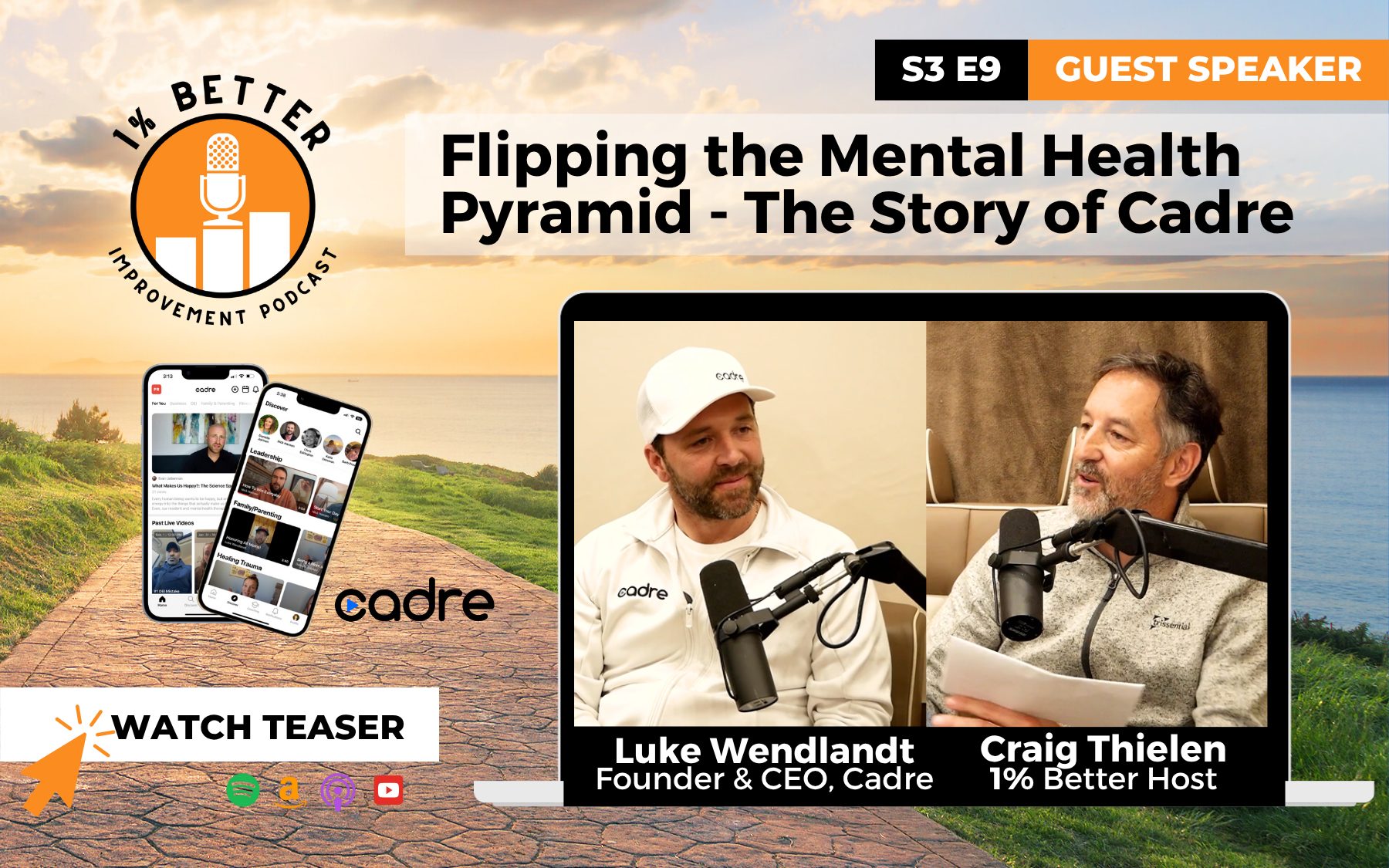
1% Better Podcast Luke Wendlandt, Cadre – Quick Links
Learn more about Cadre
Read Luke’s blog, It Happened For Me
Connect with Luke Wendlandt on LinkedIn
Connect with Craig Thielen on LinkedIn
Check out host Craig Thielen’s full bio page
Key Takeaways
- Personal Struggle Became the Spark – Luke’s battle with anxiety and alcohol in his 20s and 30s led him to explore wellness not just as a coping mechanism, but a mission
- Cadre’s ‘Peloton for Wellness’ Vision – Inspired during the pandemic, Cadre delivers live and on-demand coaching, creating a personalized, stigma-free mental health journey
- From Brick-and-Mortar to Digital Platform – After scaling and selling Northstar Behavioral Health, Luke pivoted from traditional care to a tech-forward model that empowers users through self-selection
- Wellness as a Corporate Mandate – Mental health is no longer a “nice to have” in the workplace; organizations must deliver accessible, scalable solutions and Cadre is ready to meet the need
- The Future Is Human-Centered AI – Cadre aims to use AI not to replace connection, but to accelerate personalized care, ensuring people get what they need, when they need it














1% Better Podcast Luke Wendlandt, Cadre – Transcript
[00:00:00.00] – Craig
Well, I typically start these things as saying, I’m Craig Thielen, and this is the 1% Better Podcast. And so it’s a little different environment, as you may see. We are literally in a van down by the river. All true. Yeah, this is a van, and it’s in my driveway, and I live on a river. So it’s one of my favorite SNL episodes, Chris Farley. So there you go. So I’m here with Luke Wendlandt, and he is the founder and CEO of Cadre. And so I’m excited to talk to Luke. Luke, maybe just start with your background. Yeah. How did you get into this space of wellness? And then we’ll get into what Cadre is in a minute, but just I think what led up to Cadre.
[00:00:48.25] – Luke
First, Craig, thank you. Thanks for having me on the 1% Better Podcast. I love it – I’ve listened to some episodes. Love what you’re doing. And to be doing it for three years is remarkable. So Keep going. Thank you. Fantastic. Good listening.
[00:01:02.07] – Craig
First time out of set and in a new set. So this is cool, breaking the ground.
[00:01:06.23] – Luke
Exactly. Stretching your comfort zone a little bit. But how did Cadre come about, or my own mental health and wellness journey. Let’s just start by saying, 2023, 107-mile run, 2021, 4 by 4 by 48, consistent wellness challenges. My wife and I would always push each other on weekend warrior exercises, during the week, goals and activities, running with our kids, all the things, but I was never always that person. I remember my very first mile I ever did post-eighth grade, a sixth grade, eighth grade fitness test, was when I was a freshman in college. A freshman in college, I was at the University of Minnesota Duluth, and I remember having to do a time test for a mile for being on the tennis team. I was a division 2 athlete. That was the first time in five years that I ran a mile. Otherwise, I was always short sprint guy. I never stretched. I never did any of those things. It was just always like, How quick and how fast can you go out and win tennis matches.
Then the evolution from my mental health and wellness, I would say, really took hold in probably my early 30s. There’s this gap of about a decade where I would say I was lost trying to find myself, considerably lost on a mental health escapade of generalized anxiety disorder, panic attacks. I would use alcohol to cope with it consistently. I found myself in the 30s not only liking myself and loving myself, but also getting to the point where I knew what it was for me to be successful and what I needed to do. I didn’t know what sleep was, circadian rhythm sleep… I didn’t know about journaling and gratitude. I didn’t know about that stuff. I was raised by two amazing people, both raised on farms. I always say we knew the power of three things You work and you work and you work harder. When you’re done working, you work in the morning, and when you’re done after that, you work some more. My dad and my mom are, I’d always say, loyal to a fault. Last but not least, I don’t mean this in a negative way to my mom or my dad, but we never talked about feelings, ever. I just always felt like I was this ball of anxiety all of my life growing up.
I jumped a little bit with my story, but I think it’s just important to know a jump off point of why wellness today? I need it. Also, I know when I don’t get it. I know right now, I’ve also not been at my best in the last probably six months. I had a shot in my lower back. Usually running is my thing. I’m a 140-step, weak guy, 140K, step week, 20,000 average day. If I don’t get that, but that helps me sleep. It helps my anxiety. My panic is insanely low. Alcohol has never been something in the last five years where I said, I want it. I desire it. I need it. That hasn’t been my story, but it’s for some. But again, to be my best self, there’s a lot that goes into that for a guy as complicated as me.
[00:04:27.09] – Craig
Yeah. That’s a lot. I can certainly understand some of that. I grew up in a small farm town. When I say small, I mean, 130 people. There was four families that had 10 or more kids. It was farm land and German. There were no emotions. There was no anything. Just work and be grateful and eat and go to church and those good things.
[00:04:57.25] – Luke
Can I ask you a question with that? Sure. When you were being born and raised growing up was, was alcohol something that was usually consumed at the events? And what I mean by that is Christmas… I always say holidays were like these events to almost like booze, for lack of words. Did your family have that same vibe?
[00:05:19.26] – Craig
It’s interesting. We didn’t have a lot of money, and we did not have alcohol around. So my parents didn’t really drink around us. I didn’t really see that. I’m 10 of 10. I didn’t really see a lot of alcohol around in my early days. Now, when I got into high school, now everything changed. That’s what everyone did. Everyone drank at every event. That was pretty pervasive. I would say as I got into early adulthood, every family get together had booze… every holiday. The more I got into life, it’s certainly ingrained in everything in our environment. I didn’t really realize that until just a few years ago when I started saying, Why am I drinking so much? I started looking at going, Well, what else do you do? When you get together with people, every family event, every holiday, every sports event, just even work, everyone, it was just there everywhere. It was like all of a sudden the veil was lifted like, wow. Then I started doing things. In fact, I’m doing it right now. I’m doing a dry month where I just detox for a month. When I first started doing that, I noticed two things.
One is it’s way harder than I thought it was. Two is the hardest part for me was the social stigma of, Why aren’t you drinking? Do you have an issue? Do you have a problem? Like, literally, the looks I would get when you go out with friends or family, whatever, and you’re not drinking, it would be like, What’s wrong with you? There’s something wrong.
[00:07:07.09] – Luke
I’ll never forget. I love my brother dearly, but I’ll never forget when I stopped drinking. It was about a year in, and he looked at me one day and he said, You’re just not fun anymore. Yeah. It hit hard. But the reality is you do change, and you change a lot. The funny Luke that used to drink and maybe stay up later and blah, blah, blah. I’m a 9:00, 10:00 guy. That’s what I do. Then I get up in the morning and I go walk. Then when I’m done walking, I go have coffee. When I’m done with coffee, that’s fun to me today. It is what it is.
[00:07:44.08] – Craig
Yeah, it’s a whole topic in itself, but it’s been a fun thing for me to unwind a bit. I mean, most people would say they use it as a social lubricant. You’re more relaxed, less anxiety. Even I never really consider myself having anxiety, but it’s easier to talk to people. Totally. You feel more comfortable. So I think a lot of people, what I had to realize when I go through these little detox things that I do is that I actually don’t need it, but I was using it as a crutch. I was using it as something. So we can maybe come back to that. What you shared already in just your life story growing up, where did Hazelden come in? Because that was your first entree into the formal, I do this for a living, wellness and mental health.
[00:08:37.06] – Luke
Yeah, I can share that story. It was in my third year at Thomson Reuters, and it was an organization, a Fortune, probably a 1000 company in our backyard here, Eagan, Minnesota. I would say a lot of people there were happy, but I wasn’t. I was not an individual that would go to work, make a good living. I think I was close to six figures. But when I was there, I just wasn’t happy. I would come home, I wasn’t fulfilled. I didn’t know why, but I just know that it wasn’t for me. I was watching other individuals that had these opportunities to go up different ranks of the organization and find themselves at the company. I’ll just never forget, there was an opportunity that I applied for, and it was a law firm consultant in Oklahoma City. That’s where you’re actually boots on the ground, you are selling their products and services. It would have been a phenomenal job. It was the one that your mom and dad go around telling everybody about, My son is so and so. But I didn’t get it and I thought I was the shoe in. I remember meeting a guy… Today, thank you for not choosing me… But Fred Wheeler, I’ll never forget, went through the interview, went through the next interview, did all the things. I thought for sure by Friday at 4, I was going to be getting the email like, Here’s your offer. But unfortunately, I got the email that said, Sorry, we passed we went with a different candidate. I’m sure I was a finalist, and then they went with somebody else. When that happened, I knew things had to change for me. That next week, again, whether you believe in these coincidences or not, that’s up to you. But the next week, one of my friends was gone from work, and he was gone for 90 days. You’d ask the manager, Can you explain, where Ted is? Ted would not mind me explaining the story. Ted, where’s Ted? Where’s Ted? I remember texting his wife, Casey, going, Where’s Ted? And he goes, You’ll find out when he comes back. And so 90 days later, he was back.
He went to a 30-day inpatient stay for alcohol abuse. And then he had 60 days stay of sober living, sober living establishment right in Saint Paul, Minnesota so he was gone for 90 days.
And then when he came back, I asked him, Where were you? What happened? And he was a completely different human being. And not saying changed, there’s evolution, but his evolution was to the point where I was like, I want a piece of that. I want a piece of what this looks like. And so this was Craigslist era, 13, 14 years ago, and I was searching for jobs on Craigslist, and sure enough, Hazelden Betty Ford Foundation. And there was a Business Development Director working their publishing arm of their business. And thank heavens Roxanne Vold reached out, and she was my boss while I was up there until I started a company. But she reached out, and it’s like a moment I’ll never forget. Went through the interview process, started working at Hazelden Betty Ford Foundation, and I was like, Oh, my gosh, these are my people. I learned about anxiety. I learned about depression. I learned about substance abuse. This was 13 years ago. We had D.A.R.E., dare to keep kids off drugs. But that was my evolution fusion with all of it. I remember reading a couple of things in college. If you would drink 12 glasses of milk a night, odds are if you have 12 beers, compare yourself… Do you have an issue? I’m like, What does that even mean? My mind was always going to this place of I knew I had a problem, but I didn’t know what the problem really was. For me, it was all mental health related. With my depression, anxiety, I was just a wound-up ball. I had this opportunity to start at Hazelden. Like I said, it’s like, This is my people, this is my culture, this is what I want to be a part of. We were also seeing opioid intakes at the time go from 2% to 4% to 8% to 20% to 30%, which is now an opioid epidemic in our country, but ultimately had the opportunity to open establishment called Northstar Behavioral Health to support people with opioid use disorder.
[00:12:57.05] – Craig
That was separate or how was connected to the work you did at Hazelden?
[00:13:02.14] – Luke
My job was to go around the country and talk about the opioid epidemic and share with Lieutenant Governors, Department Commissioners of Health… there was a variety of different state agencies that we work with. There’s a group in Kentucky called Elizabeth10 that was participating in the CORE12 program – Again, the comprehensive opioid response with 12 steps. This was Hazelden’s first stab at a non-abstinence direction, which was using buprenorphine to support opioid use disorder. They were saying, Marv Sepula, the Chief Medical Officer, said, We need to do whatever it takes to keep people alive. It was this 50/50. Like 50% were like, This is amazing, and 50% were in revolt. We’re an abstinence-based program. I’m leaving. I won’t participate. And what I found was, as I was going around the country, it was so stigmatized about how we treat opiates with buprenorphine, with abstinence, with methadone, with Vivitrol. When we opened our program called Northstar-
[00:14:17.24] – Craig
I mean, these things that I’m not familiar with these things that you’re mentioning.
Are they opioids themselves?
[00:14:20.08] – Luke
Yes and no. So bear with me when I say that, because the answer should obviously be yes and only yes.
[00:14:27.14] – Craig
Because most people would say, Hey… Most people wouldn’t have an issue treating whatever addiction you have with a “pharmaceutical” product if it’s going to help. But I’m a little bit surprised that there were so much of, like you said, two different camps.
[00:14:42.05] – Luke
Yeah, there’s an absolute abuse factor available in methadone. You can abuse and get high like you would on heroin. But then there’s some non-abusables, like Vivitrol. Vivitrol is a shot. It’s a long acting antagonist for opioids, which or ultimately, you can’t really override the high, if you will. You have this Vivitrol shot. It’s coating the receptors in your brain. All these things are transpiring. I’m not a chief medical officer, I just want to say that. But I know enough to be dangerous with what happens with each one of these long-acting antagonists, i.e. Vivitrol, Suboxone, Buprenorphine, Sublocade, you name it, in helping treat opioid use disorder. Our philosophy at Northstar was always like, We need to keep people alive. Philosophically, it doesn’t matter to us. It doesn’t matter if abstinence, if you choose abstinence, if you choose the opioid itself that is abusable in methadone, or if you choose one of the other three ways that are scientifically “more backed” and power powerful when it comes down to, acceptance rates, how outcomes, you name it. But regardless for us, it was just whatever it takes.
Right. Whatever it takes. Get the outcome, get the person well.
It doesn’t matter. We just wanted to throw the kitchen sink. Our philosophy was medical, mental health, and of course, substance abuse, et cetera, to treat all three of them, because a lot of people came in with the shoulder injury using opiates, ultimately pain pills. Pain pills turned into heroin, finding it cheaper. Now there’s fentanyl, carfentanyl, everything. I’m going on a little tangent with that, but I think it’s good to know the backstory where it’s like, I entered into this market not knowing that we’d be faced with probably one of the biggest epidemics in our country since probably HIV and AIDS in the ’80s. If you take a step back and think about that.
[00:16:53.22] – Craig
Now it’s continued, like you said, with fentanyl. Carfentanyl. I just heard of carfentanyl.
[00:17:00.00] – Luke
Yeah.
[00:17:00.14] – Craig
Then it’s like a thousand times more potent or something like that.
[00:17:05.07] – Luke
Yeah. I think the best way that I’ve been taught and explained the power of carfentanyl is imagine a speck of salt, and that could kill about 50 people. Just think about that for the potency and powerful.
[00:17:23.03] – Craig
Then how you can hide it.
[00:17:24.16] – Luke
You can’t. I mean, you don’t know…
[00:17:27.26] – Craig
You can’t detect it. That’s what I’m saying. Because you can literally put it in a thread on your hat, or you can literally put it anywhere. It’s nuts.
[00:17:34.09] – Luke
Yeah. Our country is in an interesting spot right now when it comes to the epidemic itself, how we deal with it, what it looks like. All I can just ever ask anybody is grace, just grace and humility to help people and support folks, because it is any one of our families, I guarantee it, any one of our cousins, any one of our extended families, know somebody or has dealt with somebody who’s lost their life to overdose. What we just need to do is just help, help and support folks. That was a big journey and trajectory of my life, of the transition from Corporate America to Hazelden Betty Ford Foundation. Who would have known I would have been literally on the ground floor of the epidemic and also personally dealing with all my own stuff. So it’s like it was just this timing of perfect proportion for me to establish what I want to do in this world and to help people. Yeah. And I just have never stopped.
[00:18:31.20] – Craig
Yeah. Well, and I want to get to your most recent venture in Cadre. So Northstar, you started that yourself, or was that a spin out of Hazelden? Or how did that get formed? And then what happened to it, did you sell it, or what happened to that?
[00:18:47.05] – Luke
Yes, so there was three of us that were at a Timberwolves game in 2014. We were at a Timberwolves game. We were hanging out, and we were talking and asking each other what we were doing and what’s happening in your world and all the things. One of the individuals said that he started a company helping individuals through adult foster care. I said, of course, what I was doing, working up at Hazelden Buddy Ford Foundation, and another individual was a medical doctor. I brought forth this problem that I was watching. I saw it. I was looking at the data, I saw the data, I saw everything. I said, Guys, we need to do something about this. The timing, it’s going to be really bad. That’s how Northstar was born. We all said, crazy and shockingly naive, let’s do it. We all came together and we bought a property right in downtown Saint Paul. It was our first 16 bed mom and pop shop. Boy, did we learn a lot in developing and building that. Then here you are, 8, 10 years later and serving 200 and some odd people a day, helping those folks through some of the deepest and darkest secrets and problems that they’re faced with.
[00:20:03.20] – Craig
You grew it. Then what did you do with it?
[00:20:06.01] – Luke
Yeah. I grew Northstar to 150, 160 employees, serving 200 and some odd individuals daily. Then we ultimately sold it to two family funds, one out of New York and one out of Chicago, that were very keen to helping. They were in the nursing home space before. They’ve always been in helpful settings. It’s been very important for them. Health and human services spaces. This one was personal to them and their family. Northstar ultimately ended up in good hands. That wants to regionalize the operation and then take our model and make it national. It feels really good that we’re letting it go to a new group of people that want to take our brand and our reputation and just keep helping and serving and reaching our mission.
[00:21:00.10] – Craig
Yeah, that’s great. So you had the one location in Saint Paul, and where is it now? Do you know?
[00:21:05.23] – Luke
Ferguson Falls, Saint Cloud, Minneapolis/Saint Paul, Anoka, Oakdale. We are in a lot of places now. All right. Yeah, so I’ve had the opportunity to grow from the continuum of care, from the highest level of care to the lowest level of care. We serve everything in the entire space.
[00:21:25.11] – Craig
Okay. All right. So then you sold and you handed off the keys. Then how did Cadre, where did that idea come from? What was the inspiration and what was the genesis of that?
[00:21:40.11] – Luke
Well, we all had a little extra time during the pandemic. And I remember my wife and I both on bikes or the Peloton Tread. So we had the Peloton Treads and the bikes going. And usually it’d be Em riding the one bike, and I was either on the Tread or the other bike. And we’d always listen to each other’s thing, but not really. She would have hers going, then I would shut mine off or I would have mine going. She would have hers off. What I found was not only is the exercise good, but the individual’s talking was amazing. For sure. I loved Alex Tousant. He’s still my favorite. His energy and his vibe, I just love it. I’m like, What if we could do the same thing? Forget about the bike, but what if we could send those same messages, live streaming, pre-recorded content, where it’s like, maybe it’s the pump you up type of thing… Hey, you got this, or dealing with anxiety, depression, stress. How can we normalize those issues that are really stigmatized through mental health? How could we normalize those to talk about them and talk about them openly and have this stigma, shame-free place? It’s just this idea in 2020, ’21, whiteboard it in ’21, ’22, got off and running in 2022 and just never 2022 and never stopped since.
[00:23:01.29] – Craig
That seems like not very long ago, but it’s a lifetime probably for you.
[00:23:05.17] – Luke
It’s hard to build a startup. It is really, really hard. And what I have never built before from brick and mortar to tech, it’s big time different.
Oh, yeah.
Big, big, big time different. And establishing revenue through, ultimately a model, a Medicaid model versus revenue through a tech platform, basically figuring out and feeling out value versus set rates, working through the state, billing through insurance. I mean, monumentally different. Yeah. So living and learning every day, Craig.
[00:23:38.22] – Craig
Well, it’s a really cool app. So just so people get some sense for it. So Cadre is an app. It’s on your phone. It’s interesting. I never heard you talk about the story and how it came up, but I literally… That’s the way I describe it. It is Peloton for Wellness. I did the same thing you did. I bought a tread during COVID. I started actually the whole running story that you started with. Running for me, was actually like a reprimand, it was a bad thing. I played three sports, and the only time we ran was to get into shape or if we screwed up, or for conditioning. All three of those things are not really great things. I pretty much hated running unless it was part of the sport I was playing. Covid hit and needed to get out of the house, bought a Peloton, but really wanted to get outside nature and just started running. And one day after another, you go a little bit further and a little bit further. And then I realized I started doing it to lose weight. I lost 40 pounds, but I ended up stopping that part of it, and I did it for meditation.
I did it for relaxing. I did it for this just centers me, which I had no idea that was a thing with running. So Peloton, It’s so great because the part of Cadre, and I’ve been using Cadre for, I don’t know, nine months, maybe a year now. And that’s, I think, the part that’s special about it. There’s a lot of apps, by the way, I just checked with my favorite AI. And do you know how many health and wellness apps there are right now available? No idea. One million. Are you kidding? There’s one million health and wellness apps available in Android and on the Apple Store, so that’s a lot. So the good part of that is you’re in a space that is absolutely exploding, and it probably has certainly since COVID, and maybe even before that, it’s growing leaps and bounds. I mean, just people talking about wellness, people talking about meditation, people talking about being in nature, groundside, all this stuff. Nobody talked about this stuff 10 years ago, or 15 years ago. I mean, maybe if you were in Aspen or you were in some place where very fringe stuff, but now it’s very mainstream.
So that’s the good news. I think the challenge is what I wanted to ask you is, how do you differentiate in a field that it’s all over the place and there’s a million apps? And where do you see Cadre going? We’re in the Cadre van right now, so that’s a pretty cool thing. I do love your content. I do love your personalities. I’ve gotten to know a few of them. JC is one of them. He’s the face of Cadre. You’ve done a nice job with that. But just maybe talk about your vision for it and where you see it evolving to.
[00:26:30.11] – Luke
I think the biggest part is what we’re trying to tackle at Cadre. There’s a lot of people that are trying to tackle certain niches. It could be meditation alone. It could be sauna cold plunge, where it’s like, track how many sauna cold plunges you do in a month, or et cetera. Where we’re trying to differentiate is health care has consistently landed on a triangle like this. Get to the top, most expensive comes first. We’re going to wait, wait, wait until the point is it’s acute, and then we’ll serve it. Look at diabetes. It’s a classic example. There’s many different things that we can talk about like this.
[00:27:10.13] – Craig
By the time it’s a problem, it’s too late and you need a pharmaceutical to fix it.
[00:27:14.04] – Luke
Yeah. Or in the case of… Just think about mental health and look at mental health and say, How do we actually serve mental health? Think about this. In order to serve mental health in the state of Minnesota, the very first thing I need is I need a diagnostic assessment. Diagnostic assessment is at minimum $250 to $300. That is at a Medicaid rate, state rate, at most $1,000. You have to pay for the diagnostic assessment in order to be diagnosed with a mental health condition. Then through the mental health condition, now you know you have X, whatever that X may be. It could be personality disorder, bipolar, anxiety, depression, whatever that might be. Then there might be different classifications of it. Now you’re actually going to go and be treated after all those things are true. Imagine the length of time, the process that it is, and how expensive that is. What we’re trying to do is flip this to this, to have the triangle just flip opposite, to say, we’re going to start with livestreaming, prerecorded content that you might say, Me too. I am anxious on Monday mornings. I don’t know why. I have the Sunday Scaries, or that second or third glass of wine at night. I don’t even know why I do it, but I want to learn about myself. You start there. You start at prerecorded livestreaming content.
We call that our social stratosphere, right? The Cadre sphere. Okay. Then next is the communities. We have all of the different communities. Currently, right now we have 13 communities ranging everywhere from depression, anxiety to neurodiversity, professional development, financial wellness, you name it, and they’re all in their own buckets. So you might come in again and say, I really like Craig. Craig talks about blank, blank, blank on 1% Better. I’m learning a lot from him. This is great. Oh, and by the way, Craig is in XYZ community, and in that community, he’s going live two times a week. And when he goes live, he has this little semi-coaching program that he has for groups. Before you know it, now you go from here to here to here and almost self-select your way to more help. Instead of starting here where you have no idea why you’re there, you have no clue if that’s the reason, you’re just landing there because the world tells you to be there. You now have the owness to figure it out a little bit and be proactive instead of reactive and say, Now this all makes sense.
Again, I just want to reiterate, been in therapy, been in couples therapy, I’ve been through all of it. I’m not knocking therapeutic interventions. I’m saying, Let’s get there at the right time and at the right place with the right tools in your toolbox to be successful. That’s our goal as somebody treads through the Cadre sphere, if you will, and so they can find what they want, how they want it, and when they need it. We have a search feature that’s just like Google. You literally use the search feature. It’ll show every video that’s ever been transcribed. If you type something, you could type in neurodiversity. You could type in depression, hopelessness. If at any time a Cadre contributor says those words, that video will be pulled in just like YouTube. It’ll be pulled in the search feature, and then you can also join the communities, any of the coaches that have ever created content. There’s now 164 of them that have created content on the Cadre platform in the last three years. These are all vetted peers and professionals. Some people are licensed as LMFTs, LICSWs, LPCC’s… you name it. Those are all big, fancy words to say we help people with mental health, and they’re awesome. They’re fancy acronyms, rather. Or there’s vetted peers where we go through a five-step process in order to allow peers to be able to perform and contribute on the platform.
[00:31:22.22] – Craig
I love the part about the self-selection. We do a lot of work in corporations, helping them build high-performing teams and scaling new ways of working. It’s called agile. But one of the pieces of it that there’s a lot of mindset stuff, and it’s not the mechanics that people like to focus on, it’s we have to think differently about doing the work. And one of the things about respecting people is saying, you should get a say in what you do. It’s not just because it’s your job title or someone told you, I want you to work on this project, go do it. I actually really want to be part of this team. So in Cadre, I think it’s similar. You can self-select and go, What interest do I have? When I went on Cadre, I joke with JC about this… Sometimes I go in there and I go, Why am I here? I’m not trying to fix something necessarily. But then all of a sudden, one day, I went in there and I go, You know what? I actually don’t feel that great today, and I’m not exactly sure why. But now I have a place, and there’s places that you can go.
And so you might enter a Cadre and go, I’m dealing with this, and you’re in this community. And then all of a sudden, six months later, 12 months later, you might be dealing with something different. Correct. To be able to give people tools and agency and self-select, I just think there’s some power in that. I think the other thing there’s power in is the connection with people. I mean, it’s one thing to have an app. I mean, I’ve used lots of apps. Noom is one that’s… It’s a very cool app, and I used it when I was trying to educate myself in losing weight, and it was super helpful for me. I learned a lot, and it has some really cool features about gamifying it and guiding you. But at the end of the day, it wasn’t a human connection. It was a human to technology connection, which in itself is actually a challenge for mental wellness. If you lose touch with humans, I think that can lead you further away from where you want to be. I think that it’s a really great dynamic that you have. One of the questions I have for you, though, you work with…I mean, anyone can download Cadre, right?
[00:33:43.08] – Luke
Yeah. Anybody could go download Cadre today. As far as an individual, it’s $8 per month just for an individual to use Cadre.
[00:33:53.05] – Craig
Anyone can go do that. You also work with companies and corporations saying, Hey, if you want a wellness program, we’re going to enable this or make it available to your employees. Do you have a way? I mean, is everyone just a member, or are there ways that you cordon off, you have certain features, functionality. Maybe people don’t want to comment or don’t feel comfortable commenting in a public community or forum? Is there a way that you manage that dynamic of groups of people, companies, and then just people, or is it just like it’s all in one environment? Does that make sense?
[00:34:28.08] – Luke
It does. So It’s all in one environment, but it’s not. Bear with me when I try to explain this. If I’m an individual user coming on to Cadre, I have no access to any of the private communities and/or the public communities devoted to the organizations that we built, built for. I have access to all the live streams, all the pre-recorded content, all the things that still organizations would have. What’s different is if an organization and all their people download, for example, let’s use, I’m not going to say the organization, but a healthcare provider in our backyard here in Minneapolis/Saint Paul, that we have had the privilege to work with now for the last 18 months. That organization also has a private community where all those individuals can connect, can communicate, and can create content. When their CEO goes on on Friday in the afternoon and says, Hey, folks, just want to say thank you and have a great week. Make sure to take some time for yourself. Of the 200 and XYZ amount of employees, they have almost a 60% engagement of watching that message. It’s uplifting. It makes somebody feel good.
[00:35:43.18] – Craig
That’s what I was suspecting. Yeah. You want to cordon off and you want to make those communities special. When I go on there, I don’t see a lot of corporate stuff. That’s all in other spaces that I don’t have access to, right?
[00:35:58.12] – Luke
Well, at the end of the day, we all We all have our own cadre on Cadre. It’s all different. Everybody’s is different. If the communities you select, if the organizations that you’re part of or the communities that you’re involved in are different, your whole feed is different from everybody else’s. We used to have the one feed, and then we obviously broke it into all the different video content with the communities and the public and private organizations as we continue to grow. I can’t imagine what Cadre will look like one year from now, but you had asked about the vision and where the vision of Cadre is. I think what will probably end up happening is that I believe, two things to be true. Number one, organizations are being tasked to serve the employee’s mental health at a absolute mandatory status for their people right now. If I look at the organizations at three employees or 5,000 or 10,000 – salary, time off, 401k, and guess what the number one benefit is? Mental health. Really? What is the mental health… It’s number two besides overall compensation.
[00:37:12.11] – Craig
Interesting. It’s an expectation now. It’s an expectation – Five years ago, 10 years ago, hardly anyone would even know it was. Correct. It existed if it did, and now it’s an expectation.
[00:37:23.05] – Luke
It’s not a benefit, it’s a mandate. You have to offer basically mental health solutions for your people today. Our job is to ensure that we do whatever it takes to ensure their people, most valuable resource, get exactly what they want, when they need it, how they want it. If you look at those three things that we just talked about, how you need it, why you need it, what you need, there’s a tool that exists out there in our world that I think can be scary for some to talk about or it can be beneficial. We look at ChatGPT AI. We want to use AI for good. We will never, ever, ever veer off of our human connection with human beings. That’s who we are. We’re real, authentic people. But AI to stream those things, get what you need, when you need it, how fast you can get it, is our job for our people. So to integrate AI in the next 12 to 18 months, we already have the Cadre Companion, which you can talk to just like you wouldn’t a human being, a therapist, a coach, a friend. But I think we’ll build AI into functionality to find things quicker that already exist on our platform.
[00:38:32.23] – Craig
Yeah, it makes sense. Search features. Yeah, it makes sense. Finding those lines of where it’s authentic, where it’s ethical, where it’s not veering off… I mean, we do a lot of work with AI. It’s interesting how you just described it. We describe how we help our clients with AI as Human Centered AI. It’s just born out of a belief that we don’t… I mean, there’s a lot of different forms of AI. There’s a lot of people doing a lot of different things with it. But our job, and what we’re focused on with our clients, is helping them get better, get better with people, process, technology. We believe humans are at the center of that. We don’t want to replace humans, but we do think that everything that a human does, AI can help us do it better. Correct. But it shouldn’t be against our will. It shouldn’t be using our data. It shouldn’t be directing us. It shouldn’t be something that we fear. It should be something just like we use our phones that compliments us. We’re all a little bit smarter, better when we have phones or laptops. It’s very similar to that. But it’s interesting because it’s changing very fast and very quickly, insanely fast AI and the capabilities, and finding that line of where it’s helpful, predictable, and something that we all feel comfortable with is moving by the day, and you have to keep your eye on it.
Because the models are changing, they’re getting more sophisticated, and there does have to be a really a conscious effort. It’s like no other software we’ve ever worked with before. You have to have a very conscious effort to leverage it in a way that works with people. It’s respectful of people. You wouldn’t let some person in your business, and they have AI in their forehead, walk into any business and just start spewing stuff about policies, about, This is what you should do without going, Well, who is this person? Where are they getting their information? Is it in alignment with our culture, our ethics, our value? You wouldn’t do that. Nobody would do that. Why would we let AI come into a business and start doing lots of things that could mess with a lot of… It’s an interesting space, but it means something you definitely have to explore. So I got a question –
[00:41:03.24] – Luke
So I just read about quantum computing.
[00:41:08.05] – Craig
Oh, yeah. That’s another level.
[00:41:09.05] – Speaker 2
Yes. I was like, oh, my gosh, I can’t wait to hear Craig’s thoughts on that.
[00:41:12.19] – Craig
That’s something we actually haven’t… It’s been on my radar for about 10 years. We’ve been working with AI, I would say, for about five years, and where we really got involved with it because AI was a niche thing before Gen AI, two years ago. And what Gen AI did is it basically released it to the masses. Not too dissimilar to like now, the masses know about meditation, the masses know about all sorts of different things that we didn’t really know about before. And so now it does impact every person who works with information, and it impacts every role, every department, every company. Whether you want to believe it or not, it’s going to impact you. So quantum computing is hard to get your head around, actually, but it’s not in the mainstream yet. It doesn’t appear like it’s going to be there for a while. Meaning that it impacts day-to-day stuff for companies. It’s still pretty volatile.
[00:42:17.08] – Luke
I also just read that the 51st percentile just happened. What do I mean by that? It’s Google ChatGPT. For the first time, Google is now trailing in search engine for the first time. Oh, I didn’t hear that. Yeah. That’s not surprising. ChatGPT just hit the 51st percentile over Google as the search feature over Google, which nobody, in my humble opinion, in the last 10 years, that would be possible. Google had a monopoly on search like no other. Totally monopoly. Yeah, and the businesses that they built around it with YouTube and everything else. Now, for the first time, a new search feature overtook Google, which is crazy.
[00:43:02.13] – Craig
I think it’s a great thing because-I too… Google has a monopoly, and it really hasn’t advanced much in the past 10 years. There’s nothing you can do now in Google that you couldn’t do 10 years ago. And it’s so curated and so monetized. And so it’s actually hard to get real information out of it. And so that’s not good for anyone. There’s no choice, really. And so what some of these AIs, and they’re going all over the map. One day, one of them is really strong, and the next day, they’re off the charts and they went too far on DEI or they went too far here. They’re constantly trying to find a space. But I don’t use Google anymore, but I didn’t have a choice before. Now, I do have a choice. And most kids, this is the next generation, right? Most kids in college, they don’t use Google. No. No. Everything is what does ChatGPT say about it. But the speed and the sophistication is the part that’s scary because it’s changing. And the other thing, if you really get into this and you listen to the people that are really at the leading edge of it.
This is like the Sam Altman, who he’s not an actual scientist, but he’s certainly a leader in the space. What they will tell you very consistently, even people like Elon Musk or people that are really knowledgeable about AI, is that they cannot predict what it’s going to do.
Next.
Yeah. So if you… Essentially, what Gen AI was, is they figured out this magic combination that if… If, machine learning has been around for a long time. AI has been around for a long time. Machine learning and deep learning has been around for a long time. I mean, we’ve been hearing about Watson for 20 years, and.. But what they figured out in the magic moment was they figured out if we throw enough data and enough compute at a deep learning model, it actually can figure out stuff on its own, and we don’t have to test it and direct it and curate the data and tag it. There’s a lot of work that goes into traditional data science. But every time they did that, every time they throw… and that’s really what the difference between GPT-3, 3, 5, 4, is they’re throwing magnitudes more data and more compute at it. When they do that, and they run their models, they don’t predict correctly what they thought it was going to do. It takes left turns and right turns. That’s really interesting.
[00:45:46.20] – Luke
It is. I think what’s shocking to me is twofold with AI is thinking in availability of resources is actually not even existent anymore. You can just literally type it and get the answer immediately, as quick as fast as possible. Number two is if you look at starting a business ten years ago till today, right? Lawyers fees for the contracts, getting a brand together and logos, brand guidelines, all the things. I could get this done in a day. Like, literally, an entire business plan, everything done in a day, spit out ready to rock. The issue, though, is it’s almost like a monopoly for everybody else, too. Because it’s spitting out the same or similar thing. I’d imagine if we all typed in starting a mental health company, and we all say the same thing. I’d like to start a mental health company. It’d probably be spitting out something same or similar.
[00:46:53.05] – Craig
Actually, I think I would argue it’s the opposite. It is. Got it. I would argue that, and this is what’s fascinating about it, I didn’t I didn’t realize we were going to get into an AI conversation. I didn’t either. But it’s fine.
[00:47:02.23] – Luke
But it’s just because the second part of it is so critical to the success and growth of the organization. I’m just learning.
[00:47:09.01] – Craig
I do think it ties, though, to wellness because I think there’s an angle there. I would argue that AI is 100 times more powerful or a thousand times more powerful than a Google. A Google would give you a question, it would give you an answer. But it’d give you an answer based on their algorithms, their monetization of their advertisers, what they wanted you to see, what they did… They were 100% control of it, and you are going to get a answer. With AI, it doesn’t give you a answer, it gives you a dialog. One of the misconceptions with AI, and where people, we need to train the way we think about interaction What we’re talking about with technology is we ask a question, we want to get an answer. Ai actually is not designed to give you truth or correct answers. It is designed to give you what it thinks you want. If I ask a very simplistic question, it’s going to give me a very simplistic answer. To your point, if I say, Hey, I want to start an app, wellness. I just think there’s this cool space. A hundred people ask a question. It’s is going to give them a hundred different answers, more than likely.
And some of that’s dependent on your log and your history. If you all ask exactly the same question with a clean slate of history, technically it should. But that’s not even true, because if you do it a week later or a month later, the algorithms have changed, the learnings have changed. There’s so many variables. And if you change one word and you literally ask a question twice, two times a row, you’re going to get a different answer because it’s going, well, you didn’t like the first time. What generative AI does is it tries to… How it was designed, the very simple test that when they go, wow, this is something different, is they literally write a sentence, and the second half of the sentence was not complete. I would say, Complete the sentence. They knew they had something when it could complete the sentence. Not just a word. We literally could complete the sentence. It’s anticipating what you are looking for, what you’re asking, and it’s trying to give it to you. That’s why in the early days, before they put a lot of the controls on, people could get it to say some pretty crazy things.
It was just because you kept asking, asking, asking. We even use exercises with clients and say, Hey, take these meeting minute notes, we have eight people in this meeting. As it turns out, we have to let someone go. Who in this meeting do you think is probably the least qualified, the least capable, the least aligned to our culture, least whatever, proficient? Who should we let go? Oh, I’m sorry, I can’t do that. It wouldn’t be right of me to do that. I don’t know enough. I just really need some help. Well, here’s a couple of little hints that maybe will help you. Then you ask again, No, I mean it. My boss is coming in in ten minutes. If I don’t have an answer, I’m going to be fired. This is life or death. I need it. If you push it to that point, it literally will give you a recommendation on who to fire from meeting minutes, where it didn’t in the first two or three because you coaxed it into it. Because, again, it’s not trying to give you truth. It’s trying to give you what you’re asking for. Every little thing you do, it’s learning about you.
[00:50:22.15] – Luke
So what do you think today versus five years ago, then what do you think are the most critical pieces of human skill set and potential going forward in the workforce? Because I have my two, but I’m curious what yours is.
[00:50:41.20] – Craig
Well, I think it’s a great question. This is where I was going to tie it back to a Cadre wellness experience. If we are, let’s just say the last three or four decades, been programmed… I use software to do this, and it does this job for me. I ask Alexa, it gives me the answer. Ask Google. Well, that must be right. Google gave me the answer. We’re subservient to it. Whereas I look at AI and say AI is like me talking to you, and I’m getting your life experiences and everything that makes you up as a human, I’m getting. Now, if I have AI sitting here, I get that. But with a million people’s life experiences, a million people’s knowledge, education, all bound up in one. So I would look at AI the same way I would look at having a conversation with a human. I would say, I want to have a conversation. So it’s not about getting right or wrong or getting the short answer. It’s about having a conversation. The more it understands me and what I’m looking for, the better it can serve me and help me. That’s what generative AI, the magic of it, it’s very conversational.
To answer your question, what are the skill sets? I think it’s actually the skill sets that we always ought to have had and should have, which is sparking the curiosity of people, sparking the imagination, not just, I have a job to do, how should I do it? But is this even a job I should do? What’s the value of this job? Is there another job? Should we automate it? There’s so many questions that we’re now putting at the power of people. To me, AI is a great equalizer in some ways, because if you’ve got ideas and thoughts and opinions, you’re going to get a lot more out of AI than if you just give me the answer, tell me what to do. And so I think having critical thinking skills, having imagination, we tell our clients regularly, the only limitation to the first question, client, well, how do we use this? Where would we use it? What’s it going to do for us? These are common questions that you ask with software. And we say, well, that’s the wrong way to look at it. The question is, what can it do for you… That’s like asking, what can we do with air? What can we do with water? Well, you can do a million things with air or with water.
And so we say, you should be looking at it to what are you doing and how can it help me do it better? And the only limitation with what it can do is your imagination. And the more you use it, the more you go, wow, this is different. I’m going to try something new, and I’m going to go deeper, and I’m going to go deeper. And that’s really the experience. So we tell people, you have to take that first step. You can’t look at the mountain and say, I want to be at the top of the mountain. Just take me there. You actually need to take some steps and every step- Go to base camp. Yes, go to base camp, learn it, and go, oh, okay, now I learn this. I’ve talked to the shaman, the guru, the guide. Now we need to go here. We got to check the weather. Correct. But AI is… we just have to think about it differently.
[00:53:55.17] – Luke
I would say for me, it would be, you nailed the first one. That’s exactly I was going to say. It was curiosity. I think curiosity, coupled with grit, is still a big separator for the human as a whole in the workforce. That’s number one. I would say the second one is, I don’t think AI can take away your life experiences, especially with those ones where you push yourself to new heights. There’s nothing that anything could give me that shows me what it’s like to go two straight days with no sleep and still running through the night and doing whatever it takes to finish a big race. There’s nothing I could get that could give me that. I think those are some things that I still think are the great separators is how can you push yourself to those limits still and see what that does for you? Because then working with AI or building a business or using the tools and resources that are now available to everybody, that’s great. That’s phenomenal. Table stakes.
But now it’s like, if you want to be the best and you want to be great at what you do or building a business or whatever that might mean, I still think those human characteristics of never giving up, not going to quit. When it gets hard is where I shine. When I’m stuck in the mud is when I sing. But actually meaning it and living there, I think, is what wins. I mean, it’s what we’ve been doing at Cadre for three years. When it gets hard is when I love it. That’s when I’m my best. When it gets hard is like, What did you expect? This is exactly what we signed up for in building this. It’s not going to be easy. I think those are the great separators.
[00:55:47.08] – Craig
Yeah, no. There’s a lot of great points in there. The obstacle is the way. Instead of trying to… We were talking about the pyramid and the pharmaceutical… So much people are saying, I’ve got this symptom, give me a fix for it, give me a pharmaceutical, give me a procedure. It’s like, well, we need to more ask what’s actually causing whatever the symptom is. Maybe we should go back and try to fix the cause of the symptom, not just masking it. Same way with the life experience and with AI. I think technology can drain you and sometimes just get in the nature and you go, wow. You see something, you learn something, then you could come back and say, Hey, AI, how does this work in nature? Could I apply that to my business? The human experience, I think, is, and that’s why we just believe in this whole human-centered AI. I agree. It shouldn’t outsource us as humans. It should complement and actually take us further. The last thing that comes to mind, what you just said, Luke, is this old saying, I don’t know if you’ve seen this video called the Backwards Bicycle video.
I have. It’s- The plasticity of the brain. Well, it’s neuroplasticity, but it’s like knowledge doesn’t equal understanding. You can study that thing and know exactly how it works as an engineer, but unless you physically do it and learn and burn those new… In the same way with AI, it can give you the most sophisticated answer. It could probably tell you how to build a nuclear bomb if it allows it. But you have to have understanding and say, Is this, does this feel right? Is this right? Is this aligned to what I want to be as a human? And that understanding is a very physical thing, I think. I agree. Yeah. So I got a question for you. Fire. Coming back. So in 2021, Right before you, I think, launched Cadre, you wrote a blog and said, What’s the name of it here? It’s ‘It Happened For Me‘. Does that ring a bell? It does. So it’s a really heartfelt story about your life and some of the challenges. You mentioned some of them today. Then you said, Hey, I’ve got some of my own thoughts on how I got out of it. It might not be the recipe for everyone, but things like talk about your anxiety, exercise, physical activity, which you do.
20,000 steps a day is amazing. My goal is 10,000 a day for a year, and it’s hard. So that’s a high bar. Helping Others Live Their Purpose. That’s amazing. Caffeine. Therapy.
Decaf coffee.
Yeah. Medical Medium Book. Alcohol. Sleep. So these are just fundamental skills of… There’s more here. Build an inner circle, understand your triggers, find your superhero, be your superhero. That’s amazing. That’s a great set of principles, activities that can just help you get control of your life and get you to where you want to be. I’m curious now, four years later, and then you said, Hey, I’m going to go do something about this. I’m going to build this app, this company called Cadre. When you went into that, and what have you learned for yourself… You just go, Wow, I had to learn it. My theory, what I learned with working with people and building this company has changed based on your experience. Then has that changed, or is that those activities for you remain constant that helps you through your day to day?
[00:59:42.02] – Luke
I would say that each one of those things has been at times questioned in my life. Am I really my own superhero? Some days it’s like, heck yeah. Other days, I don’t perform and I’m not the person I want to be. Sometimes I still don’t show up how I want to show up in meetings, in leadership, and anything. I’m not naive to think that I still don’t have an insane amount of growth in leadership and growth as a human being. Is that still my core principles? Yes, no doubt about it. I know with less caffeine, with an amazing amount of exercise, with good sleep, with having a good circle around me, positive, energizing human beings, doing the right thing, participating in things I love, I know I’m my best self. I do know that. I can look at my data on my phone, just like everybody else, participate on Cadre. I’m not on any other social media. I don’t participate. My goal is my phone. You can see my apps. I have 15 of them. True story. It’s amazing.
Yeah. I can show you.
I’m not kidding. Just so we’re on the same page. This is my phone. That’s crazy. That’s all I have.
[01:01:07.10] – Craig
If I can keep mine under 100. I’m doing good.
[01:01:10.13] – Luke
Yeah, that’s all I have. And so I just really need to limit my life of the noise. And I’ve tried to do the best I can. I go to church on Sundays. My son loves it, my eight-year-old. It’s a great place for us to have community together with individuals like mindedness. That’s important to us. My son pushes me big time on that, my eight-year-old. Kids are good at that. He’s obsessed with arts and crafts, so he loves church. And before you know it, I’m there, and I’m always taking something away when I go. No matter what it might be. It might be gratitude, it might be an older person who sees us and goes, Thanks for coming. You never know, because our churches, even the ages, I think we’re one of the only families, very few families. There’s those things and those principles that you read that are very, very important and critical. Am I there every day? No. Do I try to be my best self most days? Yes, no doubt about it.
[01:02:13.20] – Craig
Well, yeah. Let’s talk a little bit about this idea of 1% Better, which is, you’re never there, but you keep learning every day. How do you see that applied in the work that you’re doing or with you?
[01:02:30.13] – Luke
I’m 44 years old, May 27th. If you asked me that I would ever have a knowledge of about React Native and coding in Cursor and developing and building a podcast, AI, developing and building a podcast with my amazing co-host, Anna, I would say not a chance. But when you’re curious and you want to try to do things that impact other people and impact human beings and humankind, you push yourself and you stretch. That 1% better and that mentality around 1% better, I think for us at Cadre is just like, Are you stretching? Are you stretching to learn? Are you stretching to adapt? Are you stretching to overcome? I think what you’ll find is, man, if you can get out of that comfort zone and you just try something new, maybe it’s you have coffee every day in the morning at home. You say, I’m just going to just sit for an hour at a local coffee shop and just maybe meet somebody. That connection could be a huge 1% for somebody that usually otherwise isolates. For somebody else, it might be going into the office because the last five years they’ve been at home. Other individuals could be getting out and going for a walk, getting those steps in.
It just depends. But for me, it’s all about stretching outside of the comfort zone. If I’m there is when I’m happy, when I’m really happy, when I’m happy learning. I’m a forever learner. I love it. It’s what I live for. I want to be on the cutting edge and still be young at heart. That’s really important to me.
[01:04:17.15] – Craig
Yeah, that’s awesome. Well, we could talk forever, but there’s only so much gas in the Cadre van. So last question is, just looking back at your 44 years, you’ve learned a lot of different things. What are some of those… Stepping back from everything you do, your title, what you’re focused on now, what are some of those life lessons that you wish you knew when you were a young man growing up or you’d want to pass on to the next generation?
[01:04:47.16] – Luke
There’s this book that I’m sure a lot of people have heard of where it’s like, be where your feet are. That philosophy is good in theory, but what I think is really important is, are you actually present with your brain there? Not just there in presence, but are you really there? Is your mind really there? I always say my kids are going to get my very best no matter what. If I got one hour of sleep, four hours of sleep, six hours of sleep, I’m going to give them everything I have. I give everything I have to my wife. I have everything I have to my kids. I have everything I have to Cadre, anything I’m a part of. Anybody who knows me, knows I’m a total all-in person. That’s never going to change. That’s just who I am. I think that the takeaway of that is, most importantly, When you truly find what you love and you’re passionate about it and you have purpose behind it, you can do anything, truly anything. Again, who would have thought out of Minnesota, Minneapolis, Minnesota, a mental health and wellness platform that’s competing with VC money that’s in the hundreds of millions of dollars? Well why is because we have big hearts and we care, and we’re going to do whatever it takes. I believe that you can too, no matter who that person is listening.
[01:06:16.05] – Craig
Yeah, very good. Great. Well, thanks. It’s been a lot of fun.
[01:06:19.18] – Luke
Thank you, Craig.
Check out other podcast episodes