Find us on your favorite podcast platform including: Spotify | YouTube | Apple | Amazon
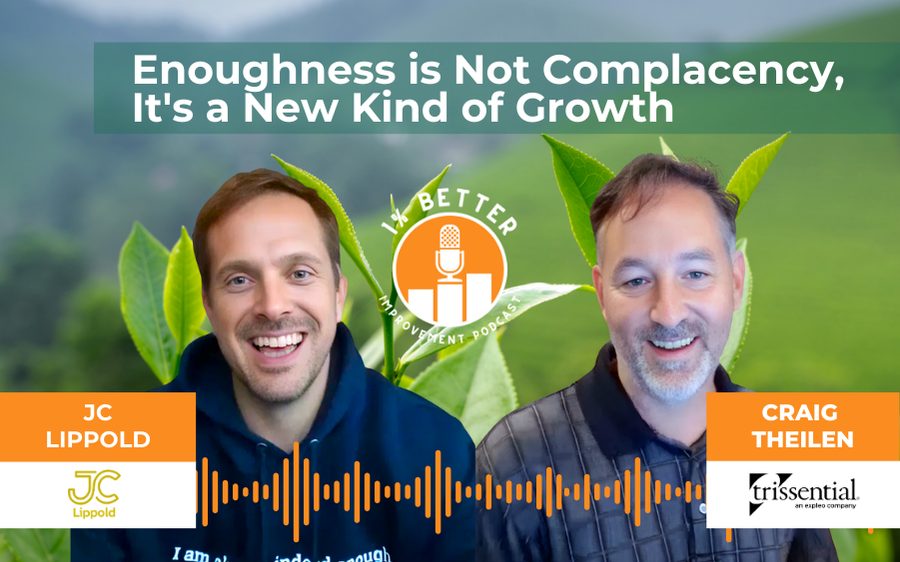
1% Better Podcast JC Lippold – Quick Links
Learn more about JC Lippold’s services
Subscribe to JC’s mailing list
Connect with JC Lippold on LinkedIn
Connect with Craig Thielen on LinkedIn
Check out host Craig Thielen’s full bio page
Key Takeaways
- Enoughness Over Hustle Culture: Enoughness is the practice of recognizing your current capabilities and worth, flipping the script on the culture that says we must become something else before we can create impact
- Redefining Success Through Presence: JC challenges the idea that success is tied to roles or productivity. Instead, he focuses on being grounded, present, and contributing authentically wherever you are
- From Shame to Sustainability in Wellness: Having worked in the wellness industry, JC highlights how shame is often a business model and why Cadre’s human-centered platform is intentionally different
- The Power of Language and Slowing Down: Minimizing words like “just” and “only” can change how we view ourselves and communicate. Slowing down is not lazy, it’s powerful
- 1% Better and Enoughness Can Coexist: Rather than competing, JC sees 1% Better and Enoughness as two sides of the same coin, one rooted in growth, the other in grounding




















1% Better Podcast JC Lippold – Transcript
Craig (00:07)
I’m Craig Thielen and this is the 1% Percent Better Podcast. Today I’m speaking with my friend JC Lippold and JC it’s finally good, we’ve had many conversations… Finally great to have you on the 1 % Better Podcast.
JC (00:20)
Yeah, there’s nothing better than being able to stir in conversations for a long time and then to have this be the synthesis. So I’m excited to be on the podcast today.
Craig (00:29)
Yeah, and I’m excited to finally hit record because every time we talk, it’s always something interesting and we go in different places, but I always learn a lot about you and about just the world, it seems. And so let’s start with that. Cause I think part of your, the mystique of JC is just who is JC and what do you do?
JC (00:49)
Yeah, so you know where everybody has their own starting points. My starting point is a first ring suburb kid, youngest of seven, six gen X siblings, boomer mother and greatest generation father. So you know I grew up looking at the world through lots of different people’s eyes. You know as as a kid who was, you know, hyper emotional nonverbal. You know, kind of kind of kind of figuring out where and how I fit, but that leads right into to kind of what, what I do. I’m 43 and I’ve never applied for a job in my life. Everything has always been a conversation, an offering, and very vocation driven. So when I attempt to talk about what I do, I start by saying that I’m a professional homemaker. I follow my mom’s attempting to offer people space where they can feel maybe for the first time what a space that offers you safety and curiosity and courage and agency and autonomy, all these things that
⁓ When people get to be, as we often talk about, in flow state or in the zone, those things happen when people have the opportunity to go, huh, I’m getting to be who I am, what becomes possible with that? So some of the hats I wear, I’m in the art space, the education space, the systems change space, the professional development, change management, org design space.
I guess all of those things kind of get brought together by saying that I’m a storyteller, right? No matter what world we’re in. My undergraduate work was in a sociologically lens theology world. So everybody believes in something, whether it be God or food or fitness or Britney Spears or the Minnesota Twins, you know, like whatever that is, if we can go from a place of this is what I really care about, then we can move people from that space. So lots of hats, but glad to wear all of them.
Craig (02:28)
All right, well, that’s a lot. And I feel like you just covered, there’s so much to you and what you do that even that was just some small little data points. I’ll call them the wave tops of all the things that you’re involved with. I think you’re involved with, and we’ll talk about this, but being a sort of a big face and contributor of a wellness app called Cadre and your, you know, a marketing director and you’re involved with coaching and you’re involved with teaching art. I mean, the list goes on and on of the things that you are involved with. and so that’s just really fascinating. By the way, when you say, uh, part of a large family where I’m from small town in Northern Minnesota, a family of seven was a nice little midsize family. So, so we had four families in our community. I’m, I’m 10 of 10. Oh wow- we weren’t the biggest family.
JC (03:21)
and we were
Craig (03:23)
So there was a family of another family of nine, another family of 11 and another family of 13. And those four families alone made up about 50 % of the size of the town. So it’s all relative, right?
JC (03:38)
Hopefully you all cheer for the same sports teams, otherwise there could be some mutiny.
Craig (03:41)
For the most part, yeah, for the most part we all do. It’s all twins and Vikings type stuff. Traditional Minnesota stuff. Let’s talk about, use this term, ⁓ professional homemaker. What does that mean?
JC (03:58)
Yeah, I mean, if growing up as the as the, you know, the the non alpha, the non competitive, the the person who you know, I related more to my mother than than I did did to my dad. I love both of them. They’re both, wonderful at doing what they did and who they are. But so often we look at, you know, homemaking. My mom, my mom stayed home and made home. My dad went out and made the bread.
And often we look at things like homemaking as a passive act. A lot of the things that I work in are taking things that are seen as passive and activating them, going, what is the power of following? What is the power of making home? What is the power of quitting? What is the power of not, as we’ll talk about later, what is the power of not thinking that progressively every single day it’s going to be something that we can be in control of? I love flipping that script and going,
So often in the spaces where we do our work, so our professional spaces, we don’t ride the assumption that we should feel at home or that we should feel seen or that we should feel that who we are innately is probably the best space to operate from. But then if we look from a physiological standpoint, like what is who are the best athletes? They’re not the strongest, hardest, fastest, deepest individuals. They’re the ones who get to ready position first.
They go, here’s what I have and here’s how I can put it to use. So when I say professional homemaker, what I’m talking about is in the space that is not your personal space, how do you feel incredibly safe and in doing so incredibly uniquely yourself and getting people to operate from that space?
Craig (05:34)
Yeah, so it’s basically a mindset of getting to a deeper level of connection with people and allowing them to be safe and feel comfortable doing that.
JC (05:44)
Yeah. Exactly.
Craig (05:45)
It’s interesting because I say this to you all the time, like you use words that I haven’t heard for a while. Like the last time I heard the word homemaker was when I used to fill out all this information when you’re in high school and filling out whatever and it says, what’s your father’s profession, what’s your mother’s profession? And I would always go, well, my mom was, I mean, 10 kids, that’s a full-time job. And so I would always put homemaker.
I don’t even know what that means really, but it’s just, that’s what I would put. So it’s, um, it’s a cool, cool term. So when did you realize, so again, we could spend this whole podcast talking about all the different things that you do, but one thing that’s really clear and you said it, you’ve never applied for a job, which that’s incredibly unique. I don’t know anyone, that’s later in life, like, like we are that hasn’t applied for a job. But it’s clear that you have many, many, many, you wear many hats and you play many roles to say the least. And so what point did you realize that I’m not going to be, you know, cause a lot of people, JC define themselves by their job, by their role, by their title. In fact, some people live it from the moment out of high school or out of college. And that’s I’m a doctor, I’m a plumber, I’m a this, I’m a that. And sometimes people change career once or twice or three times, but it’s very rare.
⁓ that people don’t define themselves by their job or their role. And for you, it’s like so much so at what point did you go, I’m not gonna, and I think to some degree, I’ve been thinking about this a lot more lately is like, there’s so much programming. We’re programmed from the moment we’re born,
you know, that we’re able to understand language and speak language, we’re programmed that, okay, you go to grade school, you go to high school, you go to college, you get a job, you work for a company, you play a role. And so at what point did you go, no, I’m not gonna follow the script or I’m not gonna go and try to pick a job or be a thing. And I’m just gonna go, I don’t know. When did you figure that out?
JC (07:51)
Yeah, so I mean, I often talk about my joyfully tormented existence, which started when I was young. You know, like if we think about kids in elementary school or kids in middle school, high school, trying to figure themselves out and where they fit. It was, you know, and probably everybody can relate to this to a certain extent. I was that highly tormented kid of going, how do I fit in when I don’t feel like I do? And I was never good at I never successfully became someone else. Here’s a great story. I was ⁓ a kid who didn’t like wearing jeans. You see you often see those kids in elementary school who want to wear sweatpants or exercise pants every day. I was that kid. But because I wanted to quote, quote, try to fit in the first day of middle school, I bought a pair of Girbaud jeans and I put them on. ⁓ yeah. I them the first day of school. And I got laughed at. I got laughed at because I was so out of my normative state.
And again, in the way that I remember this story, I picture everybody standing around me in a circle pointing and laughing and I never wore jeans again. And for the rest of middle school, from the first eight to the end, I didn’t talk to a lot of people because I was so uncomfortable with with who I attempted to be. And then I finally realized after a while, I’m never not going to be able to be myself. And some people may go, so you’re not strong enough to fit in the normative. And I go, yeah,
That’s a wonderfully true statement in the sense that I have always been able to go. I need to be who I am and listen to where I’m going. You know, I was the Polish Catholic kid who ended up becoming a Lutheran youth director for 10 years. I broke my back and then I went into the health wellness space because I saw it’s like, ⁓ actually adults need more support than young people do within their progression as human beings. And I was kind of in that health and wellness space for about 10 years and the systems change space. And then I realized the health and wellness industry is not incredibly sustainable because it’s written with a lot of things that that drive people to not be able to see this as as something that they can count on for a long haul. So that I moved more into the corporate space because that’s where the system, the money, the idea, the you know, that the grounding starts and all these things just naturally move from one to the next. But all the time, there’s this coaching thread, because I was the high school tennis coach who then became the, you know, the professional development coach. Like all these things just weave together. But at the end of the day, I have I there was no Renaissance or awakening moment where I was like, huh, I’m going to do my own thing. It was almost this submissive act of going, I’m not good at being anything other than what I am naturally. And I’ve written that for 43 years.
Craig (10:34)
And you don’t recall, because it’s a great point that you make is, and I kind of referenced the programming, know, society says we need to follow a certain, you know, protocol and programming, and you didn’t fit those from an early age. You felt that. So you feel ostracized. You feel like the odd person. You feel like I’m not following the program, but did you ever feel like, you know what? I’m actually okay with that. that, you know, clearly wasn’t in middle school or high school. I don’t think anyone has anything figured out back then, but at some point, did you feel like, you know what, this is actually who I am is not, it is to not be like everyone else or not try to follow it. And I’m going to figure it out. And that’s actually, I mean, did that, does that make sense?
JC (11:16)
Yeah, no, absolutely. Like, like, like, here’s here’s a great example. So I was I was an education major throughout throughout my undergrad journey, ⁓ undergrad journey until all of a sudden, the education system started shifting. My my friend, Governor Jesse Ventura, we used to coach together at Champion Park. funny.
Craig (11:34)
My neighbor, he was my neighbor in Maple Grove, yeah.
JC (11:37)
That’s so funny. So growing up in Brooklyn Center, he was mayor of Brooklyn Park. I went to school with his kids. And then when he became governor and the education system shifted, I’m like, I don’t think I’m going to be able to exist as a teacher for the long haul. So all of a sudden my senior year, I’m like, all right, I’m going to get a theology degree. And people started asking me, it’s like, what are you going to do with a theology degree? And I go, live my life with a theology degree. know, it’s like, like it was very.
Craig (12:03)
It has to be a job, right?
JC (12:05)
Exactly. know, like even the same point when I went back to my graduate work, you know, people are like, so what are gonna do with this degree? And I go, I don’t know. what do like when people buy a new car, what do they do with a new car? Like a new car sooner or later will depreciate. But me learning something at the end of the day in my, you know, kind of self driven, you know, world, I’m going, I’m really excited to always be in the seat of student. So I’m always going to invest my time and energy and learning stuff. And the return on investment
It feels it feels that that isn’t the question that I ask I go how do I how do I exist in a seat where I feel most grounded currently and Do that every single day? Again, that’s that’s kind of the root of this enoughness concept But at end of the day it was those moments when I started making decisions that were countercultural because again It’s like there’s not a lot of people who get a theology degree in and make a living out of it but I go every single day I use my
cultural linguistic groundings, look at my sociological belief structures, and I go every single day, I use my undergrad degree in a way that maybe wasn’t designed, but in a way that makes sense because I have this tool in my belt.
Craig (13:13)
Yeah, well, this is a great segue. You mentioned the word enoughness and it’s, I feel like your sort of life experience, of not feeling like you fit in or you need to do your own thing is kind of the genesis of enoughness, right? So maybe define what is enoughness. Cause that’s a big focus of yours today. And you talk about it, you speak about it. I believe you’re writing a book about it. So what is it?
JC (13:38)
Yeah,
yeah, so enoughness is I always try it again. I go back to my cultural linguistic groundings. Words don’t mean anything until we place something in them. You know, I always pick up my water bottle and I go. What is this? And people go it’s a water bottle and I go OK, yes, there’s currently water in it, but purely it’s a vessel. What you put in it makes it what it is. So enoughness is is is a word that I define as you know that the practice of being where you are with what you have and making the most out of that. This practice of affirming that you are
already in this moment capable of doing something that has some innate worth. It’s adjacent to mindfulness, work and presence and zone and flow. But at the end of the day, it’s highly countercultural in a world that says, once you become this, then you will be capable of. And I’m going, hey, if you put those lines on top of one another, and you’re saying, I am currently capable of, so now it becomes possible.
So it’s a set of calibration tools. The enoughness journey starts by asking two questions. The first one is, I capable, am I worthy? If the answer is no, change what you’re asking yourself. It’s like, am I currently capable of running 100 miles? No. Am I capable of going for a walk around the neighborhood? Yes. Okay. The second question then is, so what becomes possible? And all of sudden it’s recalibrating to a space of tomorrow isn’t the moment when I’m going to be worthy of.
Today is that moment if we calibrate it correctly. So we talk about four things. First of all, your honesty, that’s your words being enough. Number two, your intuition, that’s your feelings being enough. Number three, your curiosity, that’s your thoughts being enough. And lastly, you being enough and that’s your presence. So whenever I walk people through this journey, and this is the basis of the impending book, it allows people some mechanisms to go, huh, I live as you shared before,
in systems and structures that set me up to always be striving for the starting line. And it moves the starting line to where you currently are in order to go, great, now I can go ahead and do something in this moment that is going to innately change my life.
Craig (15:40)
Yeah, good stuff. So let me ask you this. We’re on the 1 % Better Podcast. What does that mean to you? And do you believe that’s convergent or divergent from enoughness?
JC (15:51)
Yeah, in a world that loves to create divergence and polarization, I come back to what I said before, and that is words are merely vessels. Craig, you and I could right now go, no, I need to be better every day. And JC’s saying, no, you’re currently everything you need to be in order to accomplish really great things. And I’m a pluralist by nature. So at the end of the day, if people see
fuel and energy within an idea, within a community, within a process, an object that’s like, this is my thing. I’m gonna go, that’s awesome. And then I’m gonna get hyper curious and go, tell me more. I wanna understand your inner workings and your connectivity to the thing or the idea or the pathway. Because at the end of the day, 1 % better and enoughness are in essence saying the same thing. I often get attacked by saying, no, telling people they’re enough is bad,
because that’s going to make them complacent. I go, actually, it’s the complete opposite. It’s like people move to complacency because they don’t think that they’re enough, so they never do anything. And people can go ahead and point the finger at 1 % better, being like, I’ve never met the person who every single day progressively gets better. Actually, I know more five-year-olds who are more optimized than I know 50-year-olds. So how do we throw them in the air? And what both of us are saying is we’re creating a
a sandbox, a playground where people can go, huh, I’m spending some time, I’m investing in the idea of myself and how I can optimize this journey that I get to be on. And I think that’s why, you know, the two of us converging right now is so powerful in a world that is highly diverging because it shows that, you know, like the enoughness journey may work for some people. And I know it doesn’t work for a lot of people. And in the same way, one percent better.
has those people going like, how do I, how do I translate this into a way that people can pick it up and hold it in their hands, high autonomy, high agency in a space they would feel home.
Craig (17:53)
Yeah, yeah, I couldn’t agree more. The first time that I really heard you talk about enoughness, it was really interesting. I think you tried to describe it and words are really interesting. Like words, they’re never, they don’t give you the full meaning. Like, I mean, you can say words and then 10 people can hear those words and hear 10 different things. And so you really have to like talk through, okay, what did we mean by it? Get, you know, sort of a.
a conversation going about to really get some understanding and ultimately probably experience it and be iterative about it. But words always seem to sort of not have a complete meaning of what was intended. So when you first said, enoughness, and you’re trying to define enough, and you said, in a world where people are trying to go harder, faster, better, 1 % better, I think you even used that term, I immediately went, whoa, so this is something different than 1 % better.
And then I of course said well, let’s listen. Let’s understand and then immediately like within 30 seconds I go well actually we’re talking about the same thing like it’s just two sides of a coin and if enoughness, know means you don’t have to prove yourself. You don’t have to do X Y & Z to be enough you already are enough, but you can this can allow you this can free you to
to accomplish whatever it is that you wanna accomplish. And 1 % better is, there’s actually some techniques and mindset and things you can do to get better. And one of those things is actually to slow down. Less is more. Understand your why, reflect. mean, all those things are enoughness things and 1 % better. It’s kind of interesting, because I call it two sides of the coin, but they’re both trying to help us be better people.
JC (19:41)
Yeah.
Craig (19:41)
Be more of our understand ourselves as you described before, like not try to be something else or try to please someone else or try to be a thing or define yourself with a thing, but just like, who am I? But it probably attracts different people. We probably are trying to bring them to the middle, which is enoughness and 1 % better together is what’s gonna really allow you to make some strides.
So it’s just interesting, but it’s just words, right? It’s like you said they’re words and we have to put the definition and the intent in the vessel to define it. So I don’t know, I think it’s fascinating. It’s such a great example of like, don’t judge a book by its cover, understand it and then you get a fuller meaning of it.
JC (20:25)
Well, you know, so if I go back to my theology roots, I at least five times a day I bring up cultural linguistic interpretation. So every every someone attempts to communicate their attempting to communicate to a specific group of people at a specific time using specific words and ideas in order to deliver a specific message. So at the end of the day, how often do people communicate thinking from their own cultural linguistic grounding?
As opposed to who they’re attempting to communicate with. You know, how often do we hear in the business world, but also everywhere, know your audience. It’s like, how do you walk into a space going? It’s not about what is naturally grounded in me. That’s half of it. It’s how do I take what is naturally grounded to me and translate it in a way to the people who are curious and hungry to listen.
I often tell the story as a non-athletic kid coming from a relatively athletic family, I was standing on the three meter diving board at the Brooklyn Center Community Center at the edge of the board going, I need to jump because if I jump, then I will be enough of a boy. I will be enough of an athlete. I’ll be enough of all the things. And all the kids who are down in the 12 foot pool are looking at me and saying, just jump, just jump. I remember this moment.
I still play it back to my head where I’m having this internal dialogue with them going, this is a just act for you. It’s not a just act for me. This is a life altering act. You know, so I always joke that sooner or later, Nike is going to sue me because I always raise the point anytime I, you know, I keynote where I go, Nike would make 10 X the impact and 10 X the dollars if their slogan was do it rather than just do it. Because the paradigm that Nike is establishing is,
Hey, just do it like Michael Jordan. Just do it like Serena Williams. Just do it like… And in reality, we’re supposed to go, ⁓ we. It was easy for them, quote, quote, or even if it wasn’t easy for them, they did it and they got to be superstars. So if we just do it, just being this highly minimizing word or highly simplistic binary word, then we will also arrive in the space where they did. But if if Nike would say do it and even better, do it if you want to.
I still have never jumped off the three meter diving board because I don’t need to. I actually don’t want to. My journey or my worth is not on the other side of that. Now again, it may be tomorrow, but it hasn’t been yet in my current state of enoughness. But at the same time, I’ve also run 40 marathons, but I don’t know what my PR is because I don’t care about me getting stronger, harder, faster, deeper in a marathon. But people go, you’ve run 40 marathons. I go, yeah. And I don’t like running.
But I like being around people who are doing things that they’ve been told maybe that they’re not supposed to do or things that they go, I’m doing this for my family member for a cause or for myself. And I go, I’ll be in that world every day. But my grounding as to why back to, you what you raised about, you know, like, Simon’s going to have a lot of, you know, a very long runway talking about the why. Yeah. And again, it’s like we a lot of our generations have lived in a world of you do things because you do them.
Well, why do you do it? Because you do it. And I go, yeah, but what if you tap into maybe what moves you, what grounds you, what fires you up? You may do it in a different way or with a different connectivity. Yeah, to the point, words are so interesting. And in a world, Beth Comstock, who kind of saved NBC Universal and General Electric in chapters of her career, in 2019, Beth Comstock said, change is happening slower now than it’s ever going to happen again. Said that in 2019.
Craig (24:09)
That’s interesting.
JC (24:11)
And to the point, it’s very true. Why? Because we honor efficiency, we honor effectiveness, we’re looking for, you know, human creation and technology to go, how do we get more and more efficient, better, stronger, harder, yada, yada. So yeah, if we ever want to experience peace, this is the most peace that we’re ever going to experience in terms of the least amount of information coming at us. So with that being said,
We need to be counter-cultural in going, we’re going to slow things down on purpose for a moment to think about what we’re saying, why we’re engaging. And then from that place, we gain our power to go, now we can move forward one step, two steps, 1%, so on and so forth.
Craig (24:50)
Yeah, that’s interesting. I mean, it’s in a certain way, it’s true. And in other ways, of course, we’re faster and faster and faster. I guess it all just depends on the context and what you’re speaking to. So let’s talk about Cadre a little bit. So I had a chance to talk with Luke, the founder of Cadre, and was in the Cadre van.
And that was fun in my driveway, as I say, in a van down by the river. So that was a lot of fun. And I know you’ve been in it and you did a podcast in it. So that’s just a fun, but tell us about, we heard from Luke on why he started it what it is, but I just love to get, cause I think it is probably something different for everyone. what is Cadre to you? And by the way, just as a context, you are, I call you the face of Cadre. You’re, you’re, um, you know, you do a daily
livestream and you’re super active with it. And so you’re and you have been for two years So but so what does Cadre mean to you and why do do it?
JC (25:50)
Yeah, so again, everything is vocation and everything is connection. You know, I met Luke because his wife Emily saw me on the ABC Syndicate doing a segment on one of their lifestyle shows and Emily said, Luke, you need to meet that guy. So he messaged me on LinkedIn. We sat down five minutes later. I’m like, yep, I get it. Let’s let’s go. I’ll raise the water bottle again. I’m like, Luke, I’ll tell you right now, Cadre to me is not interesting.
It’s not unique in the sense that I’ve been doing Cadre and I’ll kind of describe what I mean by that in a moment. You know my my whole life I’ve been walking through the wilderness finding people who for moments need space access conversation perspective. Luke, the interesting thing that you’re doing here is not in the in what’s being delivered, but in the vessel in which which is being delivered. 50 years ago, no one drank water unless they-
Craig (26:41)
plastic anyways.
JC (26:43)
out of plastic or out of anything consistent. What ended up creating this movement of people drinking water to a space of benefit and consistency was all of a sudden, the invention of the reusable water bottle was created or the disposable water bottle. You could literally go to the store and be like, I’m going to be able to very easily and with great access, find water. And now everybody is kind of born in a generation of water bottle. I’m from the Nalgene generation.
There’s people from the Hydro flask, there’s people from the Coleman, there’s people from, and I go, Luke, you’re creating the reusable accessible vessel for conversations around people’s wellbeing. And Luke, I’ll be a part of this if the idea is we are showing people that there’s many ways to being well, because the current wellness culture is always, here’s the right answer, here’s the right answer, here’s the right answer, here’s the right answer.
And what Cadre is doing is saying, no, we’re going to create a library. We’re going to create a storefront where you can walk in and find lots of things. And then we’re going to create human connectivity relationships where our contributors are not creators and they’re not experts. They may be creating something and they may be very knowledgeable about a certain topic, but
the way that we frame them is they are contributors. They are people who are giving of themselves their time, their perspective, their reality to say, hey, I’m sharing me and creating the neural pathway in you to share you. So for two years, I’ve been that highly pluralistic, highly present connectivity voice where sometimes I’m very dressed up and my hair is dapper and
I’m wearing a suit and other times I’m sitting on the floor of a hotel room or I’m sitting in my car in a gas station parking lot and people go, ⁓ this is this is a person who’s living life and we get to enter into the reality of life. So often we think we need to come up with the next unique unthought of idea in order to be successful, and there’s more and more research and thought that shows completely unique original ideas actually very rarely
change the world. The ideas that change the world are different perspectives on ideas that people already hold in their hands. So it’s not who we’re going to create a new water. We’re going to create a different access point to water. It’s not we’re going to create another app. We’re going to use use an app that’s very familiar to people in the the layout in the format to invite people to see something different. So as we think about what Cadre is doing in the world,
it’s creating an access point and a highly autonomous agency point for everybody, whether they’re getting a B2B from their workspace or whether they’re finding it in an app store to go, this is a way to use social media in a really powerful, potent way. Because the other thing I always say, it’s like, we can go ahead and slam the world. like, social media bad, social media killing the world. And I go, well, that sounds really simple.
I bet a lot of people are going to buy into that simple idea, but also it’s not true. Are there elements of social media that are bad? Of course. there elements that are good? Of course. Is it complex? Oh yeah, it’s complex. So how about we create something that acknowledges with great effort how we can use this tool that we’ve created as social media in a really positive way. And I’m glad I get to be part of it every day.
Craig (30:04)
Yeah, it’s really, ⁓ it’s really interesting because when I spoke with Luke, I asked, look, I go, do you, did a little, you know, GPT, ⁓ we don’t do Google searches. I mean, that’s so old. That’s so, you know, 2010. and said, how many, do you know how many health and wellness apps there are?
JC (30:21)
millions.
Craig (30:22)
Yeah, there’s over 2 million. For a guy who started a health and wellness app, like his, his heart skipped a beat or two, like, my God, what am I doing? But it’s a, it’s a big field and it’s exploding. As you know, you’ve been in this space for awhile, but it’s just absolutely exploding just as a general topic, not just apps in ⁓ the last, would say five years, it’s now mainstream a lot of things in the health and wellness field. I mean biohacking and meditation and
mindfulness and just, you name it, that all the modalities like those things weren’t really talked about in mainstream 10 years ago. ⁓ And so it’s exploding but the, the part that I was attracted to Cadre that liked was, the Peloton like experience where it’s yeah, it’s digital and there’s, we have too much digital, ⁓ today it’s hard to keep up with all the things in the apps, but it’s, it’s really people talking to people. It’s long form. And the thing that you just said,
I didn’t think about before, I think this is goes back to what I was talking about before. We’re all just programmed. So, okay, if you go to other health sites, they basically will say, well, what’s wrong with you? Okay, here’s the answer. Here’s the, you know, the thing to do to fix it. And it’s our opinion and it’s our science and it’s our, and this is the right way. you know, a million of them all have their own right way. And so,
it could even be a diet. Could be, oh, the Atkins diet’s better. Oh no, it’s the keto diet. Oh no, it’s the paleo diet. It’s… and it’s like, wait a minute. And the real answer is there is no one diet that’s right for everyone. That’s like ridiculous to even think about, but we kind of seek that kind of stuff out. Whereas, um, Cadre doesn’t try to jam a certain anything at you. just basically says, let’s talk about a, um, you know, a bunch of different topics.
And it’s people talking to people in long form that gives a chance for what we’re doing today, which is what does that mean? What’s your experience? What’s my experience? How do we learn from each other? But it’s not here’s what we’re trying to push. Here’s what we’re trying to sell. Here’s the answer. So that’s what’s interesting about it.
JC (32:33)
Yeah, well, mean, like in an earlier chapter of life, you know, I opened 33 core power yoga studios around the United States. I helped, culturally ground a dozen Orange Theory studios. I’ve worked for Life Time Fitness. I’ve worked for Solid Core. I’ve worked for all of the things that this led me to being able to be, on a team of three people who did the first comprehensive research ever done on food, body and fitness shaming in the Western Hemisphere. And people go, how has there not been
research like this done on shame before and I go well because shame is a mechanism used in health, wellness, food, nutrition, body to sell stuff. Like you said, it’s like exactly the model is you’re broken and we know how to help fix you in five easy steps in three months and so on and so forth and the synthesis of all this research is this simple sounding solutions to complex problems are the root of all shame because people go here’s a simple sounding answer.
If I follow it, I will get what I want. I find out that I don’t get what I want. I must be the problem. So now I’m humiliated. I’m isolated. I’m desperate. And then I start the cycle again to the point this is this is a really good model for people to create a business structure around for five to 10 years before they have to shift it again. But at the end of the day, you say it’s like mindfulness, meditation, yoga. It’s been the pop culture center again. But also yoga has been the pop culture fitness trend
15 times over the last 80 years. Running has been the thing, know, strength training has been the thing, this diet, that diet. And at the end of the day, sooner or later, we can reach our KPIs and our bottom lines and our revenue goals, but we can’t create a sustainability model around it, which hopefully what the world is looking at now is how do we actually create really successful business models in a
wonderfully capitalistic society that also is sustainable because what people are finding from us is something like water. It’s like, ⁓ people who make water bottle every, every brand. I mean, I could literally pick up, you know, a water bottle in this office that has the brand of the name of the entity that I’m sitting at. Here we go. Washburn Center for Children. It’s literally right there. Like I had to look around. I didn’t even know if there was, but I’m sure there’s something here because now people go, what is the sustainable tchotchke
that we can put our name on and it is a water bottle. It is telling ⁓ people to breathe. It is smiling to people. It’s a coffee mug. Exactly. So yeah, you’re right on. It’s this how do we create pathways that are sustainable for the people creating them, but also the people that they’re created for.
Craig (35:11)
So, JC, you work in, again, if I just take a step back and look at all the different things you’re involved with, it’s kind of a messy middle of personal development, which gets very deep into people and their beliefs and who they are and their childhood. And we’re all messy, right, to some degree on the inside. And then it’s professional development, like, hey, I need to be successful. I need to make money. I have aspirations. So how do you
help people with that tension and how do you deal with this general space? Because sometimes you get injected in the professional side and it’s like, we’ve got to drive change and we’ve got to do marketing and we’ve got to do… And then on the other hand, you work with people one on one and get very intimate and very personal. But how do you help people with that tension?
JC (35:59)
Yeah. So I will reference a wonderful connectivity point with with one of my mentors and someone who’s been on the 1 % Better podcast, you Paul Batz founder of Good Leadership. Paul often talks about healthy tension and I go, Paul, I get it. And there’s spaces where healthy tension is the additive that’s needed. But I always go, but Paul, so often positive friction is more needed. Tension is something that exists, right? Tension is almost
systematically infused within the paradigms of our operation. In other words, there’s tension here. Like I walk in my workspace and I feel tension and friction on the other side is something we create. Where, you know, I often joke that I get mistaken for being a nice person. You know, I work in a lot of nonprofit spaces. It’s like I work with with young people in art and young people in mental health. And I work with old people in system changes and music and by old people, meaning like people that culture calls old like
60 to 95 years old and they go, don’t call us 90 years young. I’m 90 years old because I’m okay with being old because I am. And also those things shift. But when I walk into those nonprofit spaces where it’s assumed to be lighter, fluffier, less about the bottom line, I go, no, if we aren’t putting our business in the business ducks in a row, we’re not going to be around. We’re not going to able to do our mission very well. And at the same time, then I walk into
the boardroom of, huge organizations. And I wear stretchy pants and backwards ball caps, because that’s my authentic space. And I go, Hey, team, it sounds like y’all need to talk to each other for a little bit before we get back to business. Because that’s that’s the hindrance in that moment before they can actually accomplish the work. And again, I walk in as the external entity to be the positive friction moment.
And because I’m coming in from a place of investment, place of, I always again, I have never applied, right? So I always say, you’re the one who’s brought me here. So with that being said, I’m risking to be present and to share what I see and to provide the pathways that I know that are worth walking down.
At the end of the day, like you said earlier, it’s about moving everybody to that enough in the middle space where they go, I’ve been looking at myself as less than I’ve been looking at myself in partiality versus I need to be human in this moment. And I need to go ahead and be incredibly part of the system that is bigger than me in this moment in order to move in the direction that we want to be moving in. Because at the end of the day, I wear a lot of hats, but I always feel like I only do one thing.
And that is Edith Wharton has a really great quote where, Edith said, light is shed in two ways from the candle and from the mirror. There’s times that I’m the candle in a room. I’m kind of the consultant. I’m the I’m walking in with some expertise in order to move you further along. But a lot of the time, most of the time on the mirror and the walking in, I’m saying, well, it seems like, well, to me, it appears.
here’s what I’m experiencing. Tell me, tell me if I’m right. And I’m not actually the one putting on a different hat. I’m walking into a space where there’s a different game, a different conversation, a different cultural linguistic context. But I’ll tell you, it’s pretty phenomenal when I will in it- My Mondays last fall, I was with Alive and Kickin, which is Minnesota’s senior premier rock ensemble, which uses ⁓ rock music to
to change the idea of aging. It’s an access organization, a creative aging organization, but I would be with them in the daytime. And then I would go to Stages Theater Company in the evening with my 10 to 18 year olds, talk about how do we tell stories? How do we build community? How do we impact people? I was working with 10 to 90 year olds in two very different worlds. And then in the middle of these two things, I would often hop onto a couple of executive coaching calls where I’m dealing with people who are…
talking to hundreds and hundreds of millions of dollars of revenue and stakeholders and private equity partners and people like, how do those things fit together? And I go, I get to work with people who care about the thing that they’re doing in helping them do the thing they’re attempting to do 1 % better or optimally in the moment enough with what they currently have capable. And it’s like, huh, yeah, okay, that’s all the same. But it’s so hard because culturally in the systems we exist, I
The one question that always sound like a bumble head on is, hey, so what do you do? Because culturally, I know what I do. Culturally, doesn’t translate. Yeah, but it’s always this moment of bringing people close enough to themselves that they can consider what it is they’re attempting to do and how they can do it.
Craig (40:39)
So I’m very curious because I believe everybody has a unique perspective and a unique set of experiences that’s illuminating. So for you, you just described it. You work with an incredibly diverse set of people, day in and day out, week after week – age, ethnicity, income, roles, interests.
very, very diverse, from young children, elderly, business professionals, et cetera, et cetera. So if you just took a step back, what have you learned about, I think you’re in a unique position, what have you learned about just people that’s multi-generational, multi-cultural, whatever, what would you say you’ve learned about people in all the different types that you’ve worked with in different roles?
JC (41:31)
Yeah, that’s great great question and one that I love answering because I do think because of purely the amount of people I get to meet in the various plot points that they exist on in the spectrums that we place people on. I remember when I was youth directing in my 20s. There was a time I was working at two different congregations, one in affluent suburb and one in inner city. The place that you’re not supposed to want to be.
And in the same day, I went from conversations of suburban kids talking about eating disorders. And then I went to inner city congregation where they’re talking about their friend being shot and killed. And I often ask people, go, which of these two groups of kids had a more stressful, tumultuous, traumatic day? And people…
don’t want to answer that question because it’s first of all, they know that there’s not really an answer. But if people will venture, they will go, well,
The the the inner city or well, no, this is right. And my response is always they were experiencing something that would actually bring them together because they were both experiencing their lives in the most loudest of ways and were then getting to come to a space where they could be seen within their specificity to go. So what do do with this? And the number one thing that I have come to know about people and I see this every single day.
Is that every single person has a nervous system that does not have an opinion. Nervous systems don’t say this is good or bad. Nervous systems simply say something’s happening. Every person has sympathetic, parasympathetic. Exactly, yep. And to the point, if we look at from a physiological standpoint, everybody has the same vessel, the same amount of data points to pull in. And if we start from that place.
Craig (43:09)
Yeah.
sympathetic right
JC (43:26)
You can work with anybody. You can see everybody. But to your point earlier, we live in a world that always is attempting to go. How are people different from one another versus how are people all the same? Now again, the things that make people different in terms of access, age, privilege, yada yada yada, those things truly do create separation. But if we’re attempting to create positive movement in the world.
It’s about going, how do you remove barriers in order to allow people to move in the direction of? And it’s the way that I can wake up every morning and not kind of lose my brain because I know it’s like, OK, I’m doing a lot of different things, but at end of the day I’m a people person. I’m a connector and I get to connect with a lot of different people and I’m grateful for that.
Craig (44:09)
Yeah, for sure. It’s interesting. Well, time has flown by. We’re at the last question here that everyone gets on 1 % Better, which is take a step back on your whole entire life and you get to convey some life lessons, maybe some 1 % Better advice to yourself. You wish you knew when you were maybe wearing those Girbaud jeans or perhaps the Next Generation or
some kids maybe that you’d be mentoring in the future, what are some of those life lessons that you’d want to pass on?
JC (44:40)
Yeah, the two that that that I’ll speak to because I think at the end of the day the invitation to slow down in a world that’s inviting you to speed up ⁓ is the gift that I can give. So I offer two things. Number one, minimize the minimizing language. So often we bubble wrap ourselves by using the just the only is the I may be the only one or this may sound stupid. And in reality, if people ask us something they want us.
And risking to here’s the second thing – Speak our truth quickly, is always the thing that is going to provide people the impact that you have. It’s going to provide you the influence that that you desire in moments. Allow yourself to be seen and the way that we’re seen is often through the evidence of the words that we use. And I will never say that those are simple things. Those are things that we continue to do.
I always joke that I ruin people’s lives by making them aware of how often just and only are used. And then they text me every day going, I can’t not hear it. And I go, yeah, and that’s a gift because it invites you to slow down and invite you to give that gift to other people. So be prudent with your words, y’all, because ⁓ we do a lot of things that dilute our clarity and our magic without even knowing it. And when we become aware of those things, life starts to get better pretty quick.
Craig (45:54)
Awesome good stuff wise words and thanks for being on 1 % Better.
JC (45:59)
Thanks
Craig, appreciate you.
Check out other podcast episodes