Find us on your favorite podcast platform including: Spotify | YouTube | Apple | Amazon
1% Better Podcast Sue McKinley – Quick Links
Connect with Sue McKinley on LinkedIn
Learn more about Sue’s Wellness System Roadmap
Check out Sue’s book suggestion Desktop Companion to Physical Pathology by Roger Morrison
Connect with Craig Thielen on LinkedIn
Check out host Craig Thielen’s full bio page
Key Takeaways
- Chronic illness is often a “load problem”: Modern life creates overwhelming physical, emotional, and environmental stress that the body can’t process fast enough
- The nervous system is central to healing: When stuck in fight-or-flight mode, the body can’t repair, digest, or rebalance effectively
- Root cause matters more than symptom relief: Treating symptoms alone is like “sitting on a tack and taking an aspirin” – it doesn’t solve the underlying issue
- Small, consistent changes outperform big overhauls: Sustainable progress comes from manageable steps – true “1% better” improvements over time
- Healing is individualized and layered: Everyone has different exposures, genetics, and experiences, requiring personalized approaches


















1% Better Podcast Sue McKinley – Transcript
Craig Thielen
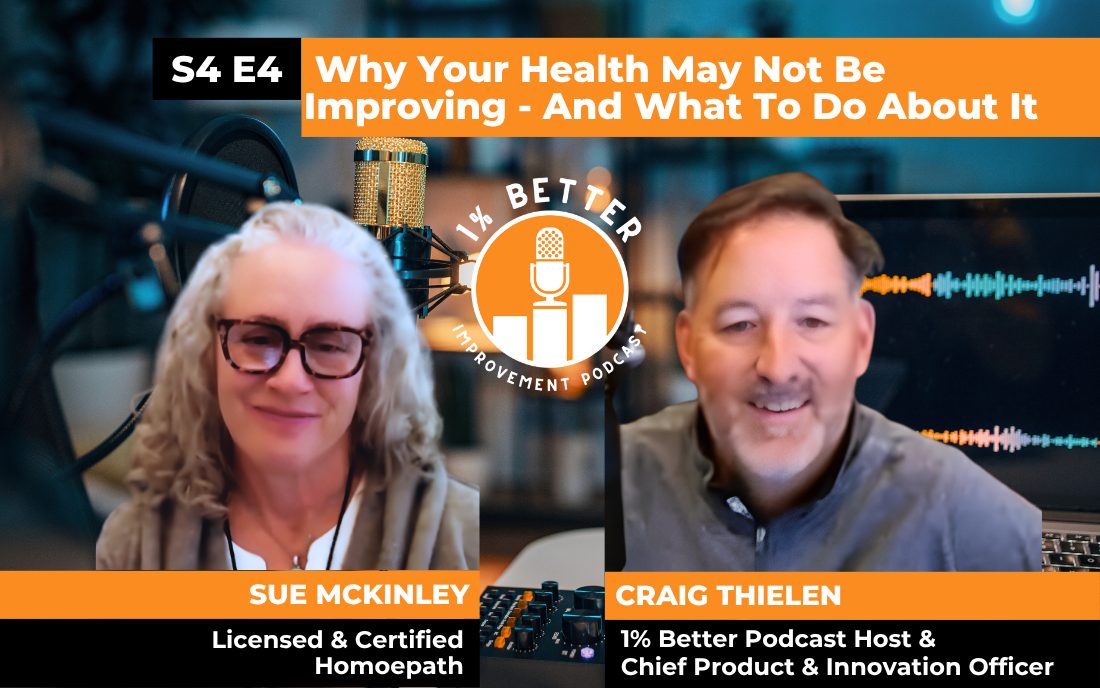
Sickness, chronic stress, exhaustion, anxiety, gut issues, brain fog. Many people suffer from it, and we’ve normalized a lot of it. They might be common, but they’re not normal. These are system failures. we’re talking about how health actually works and why getting your body right might be the most powerful upgrade you can make. And with me to talk about this, is a licensed and certified homeopath, Sue McKinley.
Sue McKinley
So happy to be here.
–lost a few minutes of recording–
Sue McKinley (00:39)
The moms are brilliant. And when I paid attention to what the moms were doing for the kids who were improving, they said, you’ve got to try homeopathy. And I’d never heard of homeopathy, but I’m not going to not do it if it’s something that is working for other families.
Craig Thielen (00:54)
Well, yeah, you’re going to try anything that’s not going to be harmful, but you’re going to try anything that help. Absolutely.
Sue McKinley (00:59)
Yep, anything, right. I tried homeopathy and it changed immediately. It’s, I saw it was a…
Craig Thielen (01:06)
Wow. Like you’re talking hours or days or what’s immediate.
Sue McKinley (01:11)
Within a day, there was a change. There was a shift. And it wasn’t total.
Craig Thielen (01:13)
Wow. So what was, can you share what the protocol, what the treatment, not that it means anything to anybody else. I’m just curious. So like, what did you do that you got some immediate response?
Sue McKinley (01:23)
Yeah, So let me back up and I’ll explain the response and then I’ll tell you what the remedy was. So we are the experts on our kids. We know what a change is. We know what’s important. We know what we’re living with on a daily basis. And he had severe anxiety and he also had these ticks that I’ve talked about. And he also had some pretty big behavioral episodes. And one thing that he did was when he hated going into his booster seat in the car.
And I would I would have to leave five minutes early, walk out of the house just for a five minute effort to get him into his booster seat. And it would involve me holding him down with my elbow while I pulled on the seatbelt. And then I would need to take a couple of deep breaths. It was very intense for everybody involved. The next day after giving this dose, he climbed up into his booster seat and he sat down and he waited for me to buckle up. And my husband looked at me and he said, what just happened? Right. We both knew that was a big shift. So the remedy that I had given him was called Belladonna. Belladonna is known for inflammation. It’s a great inflammatory remedy. And I gave him one dose. I can’t remember now if it was a 30 C or a 200 C. I’d seen a professional homeopath. She said, try this. And it shifted something for him. And I was a convert, right, you in a minute.
Craig Thielen (02:41)
So did you put it on topically? Did he ingest it? And is it a tincture? What was the form?
Sue McKinley (02:47)
Yep, little pellets. Gave him two little pellets. That is, that’s what it was. Yeah.
Craig Thielen (02:49)
Okay. Wow, that’s incredible. Well, that’s such a great, and that got you obviously into it because you needed to be in it and you were exploring every avenue and mainstream medicine wasn’t helping to the degree it needed to. at what point after that did you go, I want to do more than just help my son, but I want to help other people.
Sue McKinley (03:15)
Yeah, well, so I was so intrigued and I went back to school, started studying, saw the homeopath for my son. You know, it was an up and down journey for several years after that. I can tell you he has made a complete recovery. And by that I mean he has a job, he has friends, he does well in school, he’s going on a 50 day backpacking trip in Alaska this summer. I mean, this kid, he’s 17 years old and there just isn’t anything that…
Craig Thielen (03:38)
Awesome.
Sue McKinley (03:42)
I think he can’t do that if he wants to do it. So he has made basically a complete recovery. that’s fast forward 15 years. there was depth to what he was experiencing and we had to work through layers with him, but he has, he’s come out the other side. And so it was immediate that I wanted to learn more. And a few years went by before I went back to school and I’ve been in practice now, I’m licensed, I’m certified, and I’ve been specializing in working with kids with conditions like his since the start of my practice.
Craig Thielen (04:15)
Yeah, amazing. maybe we can take a step back now that we know how you got into it. And again, I feel like a lot of the people that I follow that are in, I’ll call it alternative medicine, not mainstream medicine, they get into it for their own personal challenges or someone they know and love, a family member, a child. So it is a very common path to it.
⁓ But maybe we should just define what is homeopathy? Like what is the definition? What does it mean? Because I know even me, the first time I heard this word was four years ago, maybe five years ago, and I’m like, what is this? And then someone explained it, I’m like, that sounds like weird hocus pocus magic vibrational stuff, and I didn’t really understand it until I learned more. So how would you just describe it to
a neighbor or someone that knows nothing about it in simple terms.
Sue McKinley (05:02)
Yeah, I would say that it’s a system of medicine and it is actually used as a system of medicine in many countries in the world. It is part of the national healthcare system in countries, many of which are healthier than the U.S. is, but it matches the pattern of a remedy, and I’ll get back to that in just a minute, to the pattern that the person is displaying.
So the idea is that these remedies are made from natural substances and they’re made, they’re prepared in a very specific way that a process of serial dilution and agitation. And by following this process, we are left with an energetic signature of that source substance. And that energetic signature is like a signal to the body. So, and it’s a mirror kind of mentality. So if the substance would produce that set of symptoms in a person, it will help regulate and rebalance, help stimulate the body to rebalance those symptoms in somebody that’s experiencing those symptoms.
Craig Thielen (06:07)
many times it comes from again, a natural oil or a natural plant or a natural substance. And then it’s very small amounts of it, but that vibrational energy or the energy that’s within it creates a signal and the body recognizes that signal, and then can sort of address the body.
Right? Is that a fair way to say it?
Sue McKinley (06:27)
That’s exactly right. That’s exactly right. And, you know, the example I can give you.
Craig Thielen (06:30)
I want to just show one one quick example that just to let people know, how does this work? And a lot of times, you go into a homeopathy shop and it does seem like Harry Potter. It does seem like there’s all these tinctures and potions. and it takes a lot of expertise to know exactly what your symptom is and why. And there could be lots of reasons for our symptoms, and we’ve talked about our food source, toxins, stress, anxiety, hundreds and hundreds of probably reasons why. But then what remedy is going to maybe address that. And just one that’s a very well known one. And I just happened to use it a week ago. It’s called Arnica. And you can buy this stuff anywhere. You can buy it at Walgreens. And I first started taking it.
My wife said, you should take Arnica because it’s great for pain. And so I have a back issue that kind of goes up and down. And of course I’m trying to get off of Advils and Tylenol and all this kind of stuff. won’t, we won’t sidetrack into that, but I just wanted to kind of stay off of pills and NSAIDs, et cetera, et cetera. And so was trying to find something that’s natural. It’s not full of chemicals, more toxins for my body.
And I didn’t realize because it is a product and it is commercialized. I just thought, well, this must have some sort of pain relief substance in it. And actually it is a homeopathy product. And I was fascinated and it works. anyone who’s tried it, it works wonderful, works for me. So that’s one example. So you can get some of these products in stores, but a lot of them are, I guess, more custom made or made outside of stores and products, is that right?
Sue McKinley (08:03)
Yeah, that’s exactly right. I put them loosely into two categories, acute versus chronic. So the acute type remedies you can get them lots of places. You can get them on Amazon or at a local food or co-op or natural food store. Whole Foods sells them, some of them specific to like influenza or colds and flus and such. Those are really easy to access and they’re pretty easy to even understand which one to use for the more complex and chronic conditions like the ones where, I call them modern chronic illnesses, these things that we’re seeing on the rise today-
Craig Thielen (08:37)
Autoimmune is a really growing, exploding area and that’s one of those, right?
Sue McKinley (08:41)
Exactly. Autoimmune, chronic fatigue, these inflammatory conditions of all kinds, depression, anxiety, these are the things that we’re just seeing so much of these days. And a person that comes to me with a full picture like that, that really is a very deep case. And that’s where there are typically layers to it. And we’re not talking about the acute remedies. It’s it is much more, complex analysis and process.
Craig Thielen (09:08)
Yeah. And when you say it’s a system, I love that because everyone knows that our body is a system and it’s in a brilliantly intelligent system. And it is incredibly adaptable even with the hundreds and thousands of toxins and stressors that we apply to it in a modern age, but every system has failure points. Okay.
And so I love how you describe that. So I guess one way that I think about it is it’s not just what we’re used to. and I’m not trying to bash mainstream medicine as I’m just trying to compare it. although I think they really can live together in a much, much more cohesive way than they have ever before. is that if you have a set of symptoms and it’s more complex, it’s not just, I got some pain and my back needs to heal and it’s inflamed and I put some artica, that’s a very cute thing, right? But you’re saying it’s autoimmune, which these things are complicated. Maybe the system part is, okay, what caused it? Likely, let’s remove the stressors, let’s remove the toxins, because no matter what you do in life, if you just try to fix something, if you don’t solve the core issue, you’re fighting against it. Is that a fair way to look at it?
Sue McKinley (09:58)
Mm-hmm. That is exactly right. And the way that I think about this, and this goes back to when my son was sick, I used to say, if you’re sitting on a tack, don’t take an aspirin. Right? We’re not here to just, right? We’re not here to just make the symptom go away. We’re here to do root cause healing. And the corollary to that was that I also use in terms of how I used to think about this is, is if you’re sitting on five tacks, removing one doesn’t make you better. It’s necessary, but it is not complete. So that’s how I think about and you are so exactly right when you say we’re living in this time with more toxins than ever. And the way that I think about that is load. And I see this. I saw this with my own son. I’ve seen this in countless clients till now. And I see this in people that are not my clients. And the idea is that we are all being exposed now to far more than we could have ever, than our bodies can handle. Let me say it that way.
Craig Thielen (10:47)
Right. Love that.
Sue McKinley (11:15)
And whether it’s the cognitive load, the emotional load, the environmental load, our bodies, our bodies are brilliant. Our bodies are beautiful. We have healing capabilities built into us, right? Our bodies know how to how to repair after illness or exposure to something. The problem is the bucket is full because we’re constantly being exposed to more than we can absorb or more than we can process in the time frame we have to process it in because it’s constant. So the bucket is full and the bucket starts to overflow and that’s the analogy. What’s happening physically is our systems are getting overwhelmed and the nervous system is a big one. So the nervous system, the autonomic nervous system decides whether we’re in sympathetic or parasympathetic. That means if we’re in survival mode or if we’re in rest, repair, digest. That’s the mode we need to be in in order to do this processing of all the load that we’re exposed to. But the constant exposure to load drives us to stay in survival mode, in that sympathetic mode. So we’re spending too much time being
Craig Thielen (12:27)
That’s the fight or flight where your body is stressed and it thinks it’s under attack. And so it creates cortisol and it creates all sorts of hormones that your, now your body can’t repair. It can’t digest. It can’t do normal functions because it’s too focused on this… I think I’m going to die type of situation. Okay.
Sue McKinley (12:29)
Exactly. Yep. Yep. Exactly. So we’re not taking out our own trash so to speak. You know, we’re not doing our repair work because our body thinks it is under attack. And it is because the chronic, load, whether it’s the always being on for work or whether it’s the glyphosate in our food products or whether it’s our cell phones or the texting or the in the traumas that can come from all different ways that are unprocessed. There’s just, I mean, the cord blood of pregnant women are showing on average 135 chemicals in them. Those are things that didn’t exist for bodies to deal with not all that long ago. So our bodies are experiencing load and our bodies know what to do with it, but it’s too much and too much over a short period of time if there’s then a repair window.
Great, our bodies can fix that. If it’s too much and it becomes a lifestyle, if it becomes sustained in that way, our bodies really can’t deal with it. And so that nervous system stays, I’m going to call it hijacked, stays activated and that’s very expensive to the body. And the body takes that energy away from the other systems, the immune system, the digestive system, right? So the endocrine system. So those systems… And again, our bodies know how to do this. This is the natural conclusion of what our bodies…
Craig Thielen (14:06)
We have to let it do its job though, right?
Sue McKinley (14:10)
Yes, so it’s, these other systems are adapting and they know how to do that. They’re meant to do that because their whole goal is to keep the body alive. So they keep adapting. Well, those adaptations, we experience those as symptoms. and so everything is interconnected and our bodies just just need a break, need more support. So the math equation in my head and how this fits in with homeopathy is reduce the load, increase the capacity that our body already has to do all of this, and then rebalance. And that’s where nervous system regulation, limbic system regulation, and holistic modalities like homeopathy are brilliant. Because when you are creating the conditions for the body to be able to heal itself, and then you’re giving it the body something to actually help it signal where it needs to rebalance, that I see the best results from my clients in the ones that are doing all of those.
Craig Thielen (15:11)
Yeah, Sue, all of that makes great sense. And I know that what you speak of works. So it just makes sense. Right. Get rid of it. It doesn’t matter if you’re a car or you’re a machine or a factory. Like we would never consider putting sugar in our gas tank or putting Coca-Cola in our antifreeze. Like we wouldn’t consider just throwing a bunch of mud on top of our car, like all of these kinds of things, it’s kind of very similar than what we do to our body. We just constantly put bad stuff in it that clearly is not designed for humans and our bodies. So that makes a ton of sense and we’ll come back to how we can systematically do it, because I do think it can be an overwhelming thing. And I’ve gone through this as a roller coaster.
Like, wow, I just learned something, I’m gonna put it into practice. And then all of a sudden, wow, there’s 500 of these things that I should be doing differently. And it can be overwhelming and you have to kind of ride through that. But I want to just take a step back a little bit. And I’d love to hear in practical terms, you talked about these client success stories, you talked about your child. But can you share one or two stories of your clients? Obviously, you don’t have to name names or anything, but just what they came in with, what the simple protocol, and it can be a combination of what we just talked about, and then what the outcome was. I’d love to just hear that in real life stories.
Sue McKinley (16:37)
yeah, absolutely. Okay, so… I started my practice five years ago in another month or two here. So one of my early clients was a woman that had COVID and she recovered from the acute COVID, but she continued to have symptoms. She had fatigue, she had brain fog, and she had pain in her lower joints and extremities. And so I gave her a remedy and within, I mean, certainly within a week, within two weeks, I mean, it was very fast. She was about 40 % better. But the time we meant for her one month follow-up, ⁓ her pain had gone from an 8 on a scale 1 to 10. I like to try to make things that are somewhat, primarily subjective, more objective by asking people to talk on a number scale. So she was, the intensity of that symptom was an 8 and it dropped to a 2 for her. And so that was for the physical pain. For her energy, she self-reported that it went from a four to an eight. So it was was very low. Yeah, that’s huge. So and within two months she was fully recovered and it had lasted several months for her at that point. So, that was a long covid story. Another example is there’s a girl that I see and she is, and by the way, these are fully anonymous stories, nobody will recognize themselves in these, I’m anonymizing these for the sake of this conversation. So a 10 year old girl with autism and she had very, very limited language, she could speak in single words, sprinkled throughout the day. And she there were potty training issues, she was in a diaper. And she would have crying spells that would last hours at bedtime. And this had been going on for years. And at her first follow-up, I gave her a remedy. At her first follow-up, her mother reported to me that the crying for hours at night was gone. She would sit in her bed for 15 minutes and talk quietly and script talk and read for 15 minutes and then she would go to bed. So that’s life-changing for these families. that would spend literally hours, two to six hours was how it was described to me. I mean, parents, we know this is beyond comprehension and there’s more. So over time, this didn’t happen in the first follow-up, this happened in the third or fourth. It was reported to me that she had started speaking in full sentences, that she was showing humor, she was showing interaction with her family in a whole new way. She was funny. She was making comments that showed a level of engagement and comprehension and connection that was previously not possible. So these are a couple of examples of the things that I see.
Craig Thielen (19:28)
Well, thanks for sharing those. What I love about those two examples is they were not acute. These are complex things. COVID is a very complex thing. lot of people have, well, everybody has different response to it that I know of. And some people have, what they call long COVID. Good luck trying to figure out what that definition of that is other than it lasts longer than a few weeks.
Unless in some cases, some people still struggle with it. And then of course, autism, very complex, there’s not just a simple remedy for it. And then you were able to get pretty immediate relief to those things. If not, not fully cured immediately, but just really great progress and relief. And what’s interesting is the homeopathic remedies you speak of for the most part, you please tell me more fairly inexpensive. Like we’re not talking hundreds and thousands of dollars per treatments, which sometimes you get into again, mainstream medicine and the procedures and the medicines are exceedingly expensive. These are relatively inexpensive, aren’t they?
Sue McKinley (20:30)
Oh yeah, a remedy will cost somewhere between 20 and $30 typically. Yeah. And you know, if I can just comment on something you just said, everybody’s starting point is different. Everybody’s ending point is different. People respond in very individualized ways. These are great stories with great progress. And I can tell you some things that I have discovered over the years that I believe contribute to that. But, the fact is I’m telling these stories because they’re great stories. every story doesn’t have a dramatic change in the first month or two months. When homeopathy works, it can be dramatic and impressive and life changing. It was for me at my house, it was for some of my clients and for many others that I’m aware of. For most, it is a slow, progression because what we’re doing is helping the body do what it already knows how to do by signaling it, by supporting it to do that. the greater the load and the lesser the capacity and the more dysregulated all those systems are that we talked about, that’s a longer path. A more recent onset that is, less involved, less complex, if you will. with typically if it has fewer interventions, that’s a faster path. That is often I should say a faster path.
Craig Thielen (21:49)
curious how you focus on your domain of homeopathy, because there’s many other types of remedies. So for example, people can have a lot of different things. People can, and when you talk about like what’s the core issue, it could be they have parasites, it could be they have worms, it could be they have heavy metals, it could be they have a root canal that is infected of bacteria and they don’t know it. It could be they’re putting poison on their skin called perfumes and they’re having a reaction. There’s so many things. to some degree, you have to find out what the root cause is and then say, Hey, we have to dial this back and remove some of those tacks as you said earlier, but where do you draw the line from what you do versus, for example, like the parasite thing, that’s a real thing that humans have in them that can cause, you know, lots of issues. where do you draw the line with medicine versus homeopathy?
Sue McKinley (22:37)
Yes, absolutely. I always start with homeopathy because it’s natural, it supports the whole person.
For example, my kids are very active and they’ve all been injured at different times doing different sports and different things. And I might give them a homeopathic remedy on the way to the ER or on the way to TRIA, but I’m taking them to the ER or to TRIA for evaluation. like a bone reset, homeopathy doesn’t touch that.
Craig Thielen (23:09)
No.
Sue McKinley (23:10)
But for for other things for acute things or for even chronic things if you have time I would always start with a natural modality. now, but to your point… there are the context matters. and this gets to what I’ve observed over the years with the clients is that it’s rarely for a complex and chronic condition, it’s rarely just homeopathy that needs to do, that’s going to signal the body. Because it’s all that contextual stuff. You have to take the tax out. have to, you know, the diet. There’s always a need, diet and cleaning up the environment. One thing that I see quite a bit in my practice, because by the time we get to the cases that I see, I see very complex cases in very young people often.
Craig Thielen (23:39)
Yeah, you have to get the text out.
Sue McKinley (23:56)
There’s always multiple things happening there. So there’s typically some exposure to mold, whether it’s in the home or whether it’s somewhere else. There’s often there’s some chronic exposure or an illness in the family could be in utero. That’s not uncommon at all. So baby was exposed, and especially during these COVID years. there are a number of things that need to be looked at.
The remedies work best if somebody is doing the things that already support their body. So clean up the diet, have a healthy lifestyle. For example, get outside time every day, move and stand more than you sit, especially if you’re a child. There’s all kinds of health factors that are just getting us back to how are our bodies meant to be conducting and operating in this world? So do as many of those as you can and then use a remedy on top of it. And that’s where I see the best results.
Craig Thielen (24:52)
So it sounds like there’s layers of this, but there’s a very base, I assume a very base foundational layer that if someone wants to work with you, you say, okay, what kind of sleep are you getting? What are you eating? What kind of water are you drinking? What kind of chemicals are in your environment? What kind of molds in your environment? do you have a wifi router, you know, one foot from your head at night, probably not gonna help you sleep but there’s the kind of a base foundation that you can sort of take anyone through. Is that part of your protocol as well?
Sue McKinley (25:21)
To an extent, yes. So it comes down to the level of overwhelm. If we’re talking about a child, then yes, it’s easy to have those conversations with a parent. If my client is an adult that is overstressed and has the poor diet themselves and is overwhelmed or burned out, that person needs a different approach. They need a different level of support. And that’s why I created the Wellness Personal Roadmap. And it’s an eight week program. And that’s where we identify hidden sources of load, where we identify places where individual capacity could be increased for them. I teach all kinds of nervous system regulation exercises, limbic system exercises, and then we use homeopathy because you know, you made this comment earlier and it was so right. It’s that this can be very overwhelming. And the problem is we have people who are already very overwhelmed. so, you know, for people- you don’t want to add to the stress- No, and it’s not possible. people cannot do more if they if it was easy, they do it. people aren’t getting sick like this because they’re unmotivated or undisciplined. They’re getting sick because the load is too great. So how do we help people shift? And by the time you get to that point, many of these people, their nervous system is living in chronic activation mode, the limbic system. So that’s the old brain. That’s the part of the brain that’s responsible for threat detection. It lives in a state of, I am not safe. These are people that have looping thoughts and hypervigilance, right? This isn’t a state. This is a state that requires additional support. And that’s…
Craig Thielen (26:49)
Yeah. So the eight week program that does some education, right? You’re educating them on how your body works and then you’re giving them some of the basic mechanisms to try to just take away some of those really bad habits or bad toxins.
Sue McKinley (27:05)
So start with it starts with. Yeah, and I want to be really supportive of of all of us, because there is so much more load than people are even aware of. I presented at a conference called the Bloomington Holistic Health Summit. And I was talking on this topic and one of the places where load comes in is in unprocessed trauma.
Craig Thielen (27:24)
For sure.
Sue McKinley (27:36)
So this is hugely researched. It’s this idea of adverse childhood experiences, creating the conditions and setting people up. There’s up to 400 % greater likelihood of a chronic illness later in life if you’ve had these adverse childhood experiences. And these are tough things, right? But what it, because what happens is from that early, early age, the body does not feel safe. That limbic system is engaged. The autonomic nervous system is activated.
And so from early on, the body isn’t doing the processing. It isn’t in that parasympathetic mode where it can do the regulation and the repair work and the processing. And that’s very well researched. a woman came up to me after I spoke and she said, she was advancing years. And she said, I didn’t know that. just the look on her face, it looked like it explained so much for her. To know that there are factors, there are things, whether it’s the chronic stress, whether it’s the lived trauma, inherited trauma is real, right? And then you go through the environment, the water, the food, the, you know, all the other things that where load comes in. It’s not necessarily as simple as… go through a checklist. It can be, but again, we’re talking about people that are very dysregulated to begin with and the- people ae complex.
Craig Thielen (28:29)
That’s great. That feels good. People are complex, right? I mean, people are just complex. we all have different ancestry, different history, different raising, different food, different environments, different traumas. Like everyone’s got some trauma. every human that’s ever walked on this earth has some trauma. But how much? And how much is a lot for one person versus another? Like, it’s super complex. But I’m really curious just to go back to your consulting days, because one of the things that I saw many, many years ago, as we go through and help clients, through transformations and changing from A to B, whatever that thing is, whether it be lean or some new ERP or now AI or whatever the change is. And one of the things that stuck with me was a study that was done, I think in the seventies, it was either by Harvard or Johns Hopkins. And it showed that people had a terminal diagnosis, right? So let’s say they were gonna die and they’re a smoker or they had some bad drug habit or they had some other thing that they needed to change in their life. They were eating terribly, not exercising, whatever. And their choice was either you gotta change your habits or you’re gonna die. Something like 70 % of people said, I can’t do it, I’m not gonna do it.
I’m just gonna just give me a happy ending. I’ll do the best I can. So what that says is the way that our brain is wired is change is hard for humans. In some ways, change is the autonomous part, I think, is the body’s always changing and reacting. But the part where we have to change our neural pathways is very difficult. So I’m curious how you live that world in org change management and in corporate world. You know how hard it is for people to change and there’s techniques to that.
Sue McKinley (30:20)
Yeah.
Craig Thielen (30:39)
Did you have it’ll bring some of those techniques and how do you just simply get someone that basically has to eat better exercise, stop eating horrible food, stop putting poisons on your body, just things that we’re used to doing. How do you get them to to change essentially?
Sue McKinley (30:52)
I start with regulating the limbic system and regulating the autonomic nervous system because we create capacity and and so I teach these exercises. So and I like to say, start small, whatever change you think you can make, back that up to 50 % and back that up to 20%. So you’re the smallest change possible that is sustainable because nothing’s -you know what that sounds like? sounds like 1% better. that’s what it is. That is what it is.
Craig Thielen (31:18)
You know what that sounds like? It sounds like 1 % better.
Sue McKinley (31:23)
You’re 100 % right. Yep. And the way I think about that is nothing succeeds like success. If people try something, so we’re working on multiple levels here. So we’re giving them moments of calm, when before they might not have had any. we’re teaching the body that it’s safe. You can go into safety mode. And if I can just pause there for one second. The body has a language.
And these things that we’re talking about, staying in the activated state, that really starts in the brain and the nervous system. But it has ways that it lives in the body. And when we talk back to the body in its own language by teaching it very specific things, it cues back to those systems that are upstream and it says, no, it’s okay. I am safe. I can be calm right now.
Craig Thielen (32:12)
Like an example of that would be a breathing exercise, right? Yeah.
Sue McKinley (32:16)
Exactly. Yep, exactly. Because when you’re being chased by a tiger, you’re breathing maybe more shallowly and, it’s it’s you’re breathing rapidly. Whereas when you give like a slow exhale and you breathe from your belly, you are telling you can’t do that if you’re being chased by a tiger. But you can do that if you’re safe. And so it’s like we’re just talking the body’s language right back to it and saying, I’m safe.
Craig Thielen (32:35)
Right?
Sue McKinley (32:40)
And I see it over and over again where it allows for something different for them. Even if it’s just moments, we’re cueing the body. And this is why it’s a process. This is why it’s an eight week course that I teach because it takes time to help the body allow that. But once it starts to allow that, then you can do things like, for example, this is a really easy one.
Just don’t touch your phone for the first hour after you wake up. Because these are micro changes. Easier said than done- it is, but these are micro changes. It’s a game changer – yeah, and even slow progress is progress if you stick with it. There’s that one.
Craig Thielen (33:08)
Yeah. Easier said than done. Easier said than done. But it’s a game changer,
Right. Yeah, it’s so true. it really is the, joked about the 1 % better, it totally is why we do this. It is the definition of the 1 % better because nobody can do big things overnight. There’s hundreds and hundreds of things to do to live healthier and whatnot. I used to listen to biohackers on podcasts and the first maybe five or 10 or 15 episodes, I was so excited. I learned something, I could just apply it. And then all of a sudden I hit a wall. like, I did everything this biohacker did, I would be 24-7 doing nothing but this stuff because there’s literally 200 protocols that they’re talking about every day and it’s impossible and it stresses me out thinking about it. But if you just go back to, and I kind of keep track of this stuff myself, in a book that I write down that literally every day, every week, every month, there’s things I’m doing that can get me better. Now I’m not trying to solve any sort of chronic disease at this point, knock on wood, thank God, but I’m trying to just give my body the best chance it can to do what it’s really good at, which is, being healthy and happy. But if I didn’t do it like one little step at a time, it would be overwhelming and I can look back and go, yeah, I got better. If I can do one thing, why can’t I do another thing next week and another thing next week and another thing? And then it becomes quite easy to get into that habit.
Sue McKinley (34:44)
Yeah, and you know, you’re touching on a really good point and that is in my model, it’s we reduce load, we increase capacity, we rebalance, and then we optimize. Part of the problem is sometimes people just do things out of sequence. And if you start taking a whole bunch of supplements, for example, anti-NAIDS or anything else, you’ve just thrown so much more burden on a body that because it’s just in fight or flight. It doesn’t want that. It doesn’t need that. It can’t even handle that and it creates load on the liver, load on the kidneys. Right? So we’ve just made it harder. So sequencing and timing are really important.
Craig Thielen (35:13)
Right. No, that makes a ton of sense. Cause again, we, think I’ll just speak for myself. We’ve been taught that whatever your problem is, there’s a remedy. mean, not a homeopath remedy, just go into a store and saying, I’m going to take a pill or prescribe. now we have weight reducing drugs and all sorts of things. but are we really, is that just a taking away the symptom. And a lot of times we do things that actually cause more harm than good. like cortisol shots. if you’re at a nine pain level, you’ll say, put that cortisone shot right in my back, put it at the knee, wherever it is. And yes, it will alleviate inflammation. However, you do that more than a few times and it actually destroys those same ligaments and muscles and tendons and everything else.
So a lot of times we actually can do more damage, especially with pharmaceuticals and other things that the body’s not used to. You can do more damage, good, but I love that because if you just start throwing stuff into the system, whatever the cool thing of the day, NAC or I’m gonna take this supplement or this or this or this, or I’m gonna go to the gym, then you’re kind of actually adding to part of the stress and part of the problem if you don’t start taking away what’s actually causing the stress, right?
Sue McKinley (36:32)
Right, 100%. I’ve seen whole cases change for people when they’ve introduced a B vitamin or calcium or something else that’s really benign. ⁓ Vitamin D- Right, zinc. saw that one time. you know, just because it’s benign for most people does not make it benign for everybody. It goes back to that individualized. What is your starting point? how much load can your body absorb? Is it load or is it actually beneficial?
Craig Thielen (36:41)
Vitamin D! Vitamin D!
Sue McKinley (36:58)
depends entirely on your body, but also the state of your body.
Craig Thielen (37:04)
Yeah, and you touched on a good point. reminded me. it’s fun to see and I wanna ask you this question. what trends you’re seeing even in the five years you’ve been doing this, because now there’s actual mainstream healthcare that’s pulling some of this in. And so for example, I switched from my old dentist to a natural dentist and they very much have incorporated homeopathy into it and other things and they test what substances my body reacts negatively to versus positively to. And the reason they do is because when you have a root canal taken out or you’re having an implant, they have all sorts of materials that they’re putting in your body and all sorts of things, procedures. And if they’re putting something in your body is negatively reacting to. And again, it’s through energetic waves that they’re measuring this stuff and your body response. Well, I’m going to react different than you do. there might be a certain type of porcelain, a certain type of ceramic or a certain type of plastic that my body goes, yep, I’m rejecting that. And your body may go, no, I’m okay with that. So it is very personalized, isn’t it?
Sue McKinley (38:08)
Yep. 100%. And, you know, with this modern world we’re living in, people are, this gets back a little bit to why some people are affected and others aren’t. Some of it just has to do with the size of their bucket, the bucket that they were born with and their genetics. Some people, you know, I do see a lot of mold in my practice and if you don’t live in the world of being exposed to mold and having mold toxicity, it might sound unattractive and it is, but the fact is mold is everywhere. It’s in the natural world. We’re all exposed to it every day and some bodies are genetically predisposed to be able to just process it and let it move on through. Others, because of genetic variants, do not. And those are the people for whom it accumulates and can become very problematic. So how frequent the exposure is, how severe, what type of mold it is, comes to matter. But to your point about it’s all individualized, it is 100 % individualized. How much any person can absorb of any one thing has to do with many, many factors.
Craig Thielen (39:13)
Yes, well, I could talk about this stuff forever, but I’m going to try to wrap this thing up here. A couple final questions. One is, again, if this is a new topic to some people, or you know a little bit about it. By the way, I’ll add a third one. you were talking about remedies, I was thinking, well, how many remedies are there? There’s got to be thousands. And then how do you stay as a practitioner knowledgeable because that’s a never-ending thing of just learning and adding those to your repertoire.
Sue McKinley (39:42)
Well, it’s true. the idea in homeopathy is we’re trying to match the pattern of the energy that is being expressed through these symptoms with the remedy that has the corresponding pattern to it. And it would be an impossible task to know these 5,000 remedies deeply enough so that we could tell. And the fact is it’s a little bit more complicated than that because oftentimes people have layers and I mean, more than one. that’s exactly the conclusion is that, there are a couple hundred that I work with, probably with, great regularity and those are often close enough. It can be a little bit like sailing. If you want to get across the lake, you go left, right, left, right, use zigzag, you know, seesaw and zigzag across the lake. And it’s a little bit like that. We’re heading in the right direction. This is a close enough remedy and then that oftentimes what happens is that layer is removed. And then we go to the next, what’s the next layer that’s being revealed. We go for the next close enough remedy for that symptom picture. And in that way we make progress. It has certainly happened where there are people who have had significant improvement with just a single remedy, but it’s a pretty daunting task to try to, to assume.
Craig Thielen (40:59)
And like you like you said, everyone starts at a certain point and ends at a certain point. big difference between a three-year-old and a teenager and someone midlife, someone who’s 80 years old, maybe just taking the acute issue away is good enough. Like everyone’s in a different place in the world for a lot of different reasons. Another thing I wanted to ask you is, again, for someone who maybe has not heard of this or is relatively new, what would be some good sources of information. I mean, obviously people can Google it, they can AI it. But what would you recommend to start their education?
Sue McKinley (41:33)
So if it’s acute things, I think Google can be fine. I don’t tend to think it’s the best or AI even I don’t think they work well enough for the chronic things, because I’ve tried it and I’ll describe what I’m seeing. And it’ll come back with 10 remedies and I’ll say, no, I know it’s not any of those because of this other thing. So I can have a bit of an intelligent conversation with it about no, not that. But a lay person wouldn’t. A lay person would say, that says Belladonna. I’ll take Belladonna. Then they try Belladonna and it isn’t actually indicated. there, you know, there are some good books, the ones that I tend to like best. There’s one by Roger Morrison. I’m looking at my bookshelf right now.
Craig Thielen (42:16)
Yeah, yeah. What’s that book called?
Sue McKinley (42:18)
and I don’t see it in front of me – Let me grab it.
Craig Thielen (42:23)
Yeah, we can put that link in. That’s great. I know I did that with essential oils, which is separate, but I mean, obviously connected because it’s also very naturalistic. But and got started with a book on essential oils, all the different things and that it can help with and how you use it and dosing and some other contraindications and whatnot. So what what book is that?
Sue McKinley (42:45)
So I like this, it’s called Desktop Companion to Physical Pathology by Roger Morrison.
Craig Thielen (42:49)
Wow, well, it’s a beautiful book. And so that teaches the concepts and gives you kind of a basic understanding of homeopathy.
Sue McKinley (42:53)
Yeah, that’s a nice. Like for example, if you’re having a cough or a headache, you could turn to the the headache section and it’s going to tell you the top 12 indicated remedies and when they’re indicated.
Craig Thielen (43:09)
Okay, it’s all homeopathic remedies. Yeah.
Sue McKinley (43:11)
Yeah, he’s an MD, He’s an MD, but he is a homeopath as well and it’s homeopathic book.
Craig Thielen (43:17)
So are you seeing more acceptance socially, medical establishment, or is it hasn’t changed much in five years?
Sue McKinley (43:25)
I could answer on both sides of that, I think. a few years back, broken arm in my household and I found myself at Tria and there was in the discharge paperwork, it said, try taking Arnica. it is. Yeah, I love that.
Craig Thielen (43:37)
That’s a start. It’s a start.
Sue McKinley (43:41)
I think people that are sick are willing to try anything and many, people come to homeopathy out of desperation. I think if you’re in the mainstream and you’re relatively healthy and you don’t have any type of illness or any type of chronic symptoms, and that’s a shrinking number of people, but for those people, it might not be time yet. That’s how I look at it. I think everybody…
Craig Thielen (43:44)
Yep. Well, got to just based on that alone. got to imagine that the homeopathic industry is booming because we have more disease, more inflammation, more diabetes, more autoimmune disease, more, more, more, more cancers, more everything than we’ve ever had before to the point where probably 80 % of the population of the United States has some major condition or challenge or issue. that alone has got to raise all boats, I would think.
Sue McKinley (44:36)
Yep. The statistic I heard is 71 % of adults in the US have at least one chronic condition and greater than 40 % have at least two. So the world is getting sicker and we have to work harder to… We’re not going to change the world, right? We’re not going back to the time of, riding riding wagons and having our own cows and so on so that we can avoid everything. That isn’t going to happen. So we need to find ways to live in peace with this world and that means we do need to be a little bit more intentional and there are things we can all do. There are things we can all do every day to help reduce our own load.
Craig Thielen (45:13)
Well, I love that. And they’re absolutely. And again, the beauty of it to me is much of it’s common sense, much of it’s very inexpensive. Yes, there may be some trial and error type stuff, but almost all of it that I’m aware of is has no negative side effects. Like every pharmaceutical has a whole list of side effects and many and most and maybe all have zero side effects.
And that alone is just a wonderful thing. So it doesn’t cost you a lot You can experiment and you can get some immediate relief that alone is pretty amazing as compared to you know other Alternatives that you’re spending lots of money doing and it may or may not work So last question on 1 % better is to you know Take a step back from this whole conversation about homeopathy and just talk about your life and what sort of life lessons would you want to share with your grandkids or with you when you were 15 years old that you just learned in life that you’d like to share 1 % better life lessons.
Sue McKinley (46:13)
wow. So I would say something somebody said to me early on in my career when I was as a consultant and they said, this is our problem to solve. And I really do think that mindset of having hope and and having a belief that things can get better. We can see improvement. I mean, I’ve lived it. I witness it daily and weekly. And it it requires some some work. But I do believe that that there is reason to be hopeful or changes for ourselves. And I’m talking probably most specifically about health, but really about anything.
Craig Thielen (46:51)
Yeah, I mean, one thing that we started this podcast with and I’ll end it on it is health is all we have. Right. And so everything, every aspiration, every challenge, every opportunity, our home life, our professional life, every aspect of it gets impacted by our health. And in some cases we get consumed by it because when your back goes out or you have digestion issues, it’s a life changer. But even day to day, just how you and make decisions and how emotional you are. it really does impact every part of your life. And so thank you. we learned a lot. We got educated on this topic of homeopathy. by the way, just really respect the fact that you were a problem solver for your child. And then you said, hey, I’m going to do whatever I can. And then how do I help other people doing that… That is amazing. think that’s what life’s all about is helping other people. And I think this is just a great space and thank you for sharing some of your wisdom with us.
Sue McKinley (47:46)
Thank you so much. I’ve so appreciated being here today and thank you for just having me and for the great conversation.
Craig Thielen (47:51)
Thank you.
Check out other podcast episodes