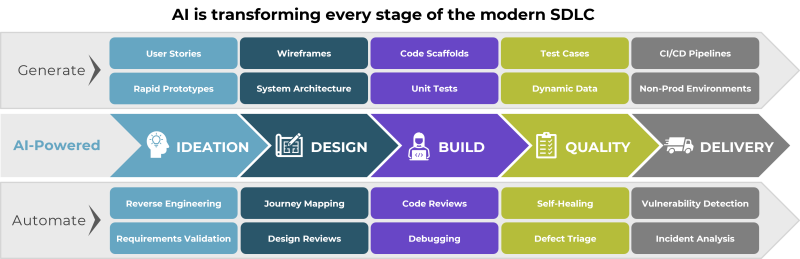
Artificial Intelligence has swiftly moved from experimental addon to indispensable productivity tool, seemingly overnight. Nowhere has AI proved itself more essential than in the realm of Digital Engineering. AI has become the connective tissue that weaves insight and automation through every stage of today’s software development lifecycle (SDLC). When AI is intentionally and thoughtfully integrated into development workflows, ideas mature faster and designs take shape sooner. Software engineering becomes more efficient and produces more robust code. Quality efforts achieve predictability and releases hit production with far fewer surprises. AI is redefining how organizations build, test, and deliver software, empowering teams to move from idea to production at a pace unimagined just a few years ago.
From Concepts to Clear Requirements
Anyone who has wrestled with translating business concepts into actionable software requirements has felt the pain of ambiguity and misalignment. The enumeration of business rules has traditionally relied on time-consuming, back-and-forth discussions often resulting in frustrating delays. But this is rapidly changing with the advent of a new wave of AI-based tools that significantly streamline the transition from ideation to execution.
Large language models now automate the discovery and refinement of acceptance criteria, turning business artifacts into coherent, testable user stories. Generative UX tools help create clickable prototypes in minutes rather than days, accelerating the iterative process of finding the solutions that customers want. With this toolset, even legacy systems become a valuable source of truth: AI-powered analysis can reverse-engineer interfaces and data models to surface hidden business rules early in the lifecycle, preventing costly late-stage scope creep.
With Artificial Intelligence underpinning the SDLC from its earliest phase, business leaders and product owners gain crucial feedback days (even weeks) earlier than was traditionally possible. This, in turn, empowers informed decision-making and helps ensure that teams are aligned on a shared vision before a single line of code is written.
Supercharging Design Decisions
Digital architecture and User Experience (UX) design have long suffered from an insidious, shared affliction: Analysis Paralysis (AP). These disciplines support a seemingly endless array of design options, inducing a unique form of inertia that must be overcome to drive the design process forward. This is where today’s AI-driven design tools are proving essential by helping teams push through the wall of AP.
Architects are using AI to translate natural language scenarios into sequence diagrams, data models, and cloud topologies that can be evaluated visually with a speed that traditional methods are unable to support. For designers, generative UX tools are now sketching wireframes and creating journeys maps in real time during workshops, allowing stakeholders and subject matter experts to react to something tangible instead of an abstract list of requirements.
Design reviews no longer require endless slide decks or manual diagramming. Automated design checkers compare proposed solutions against documented standards and best practices, closing governance and usability gaps in the process. For leaders, this means design conversations move faster, with fewer ambiguities and a clearer path to consensus. The net effect is a more efficient process with fewer revisions and outputs that are highly refined and adaptable.
Coding with a Digital Mentor
Software engineering productivity has historically been bandwidth limited by a slew of repetitive tasks such as writing boilerplate code, scaffolding UI markup, and tedious, manual debugging. As a result, software developers have been faced with an uncomfortable choice: either miss deadlines or sacrifice quality to gain speed. But there is hope – a new generation of AI coding assistants is beginning to take over responsibility for the repetitive, the routine, and the error prone.
These emerging tools can translate structured requirements into ready-to-use code, generate comprehensive unit tests, and proactively identify bugs and security vulnerabilities as code is being written. AI-driven debugging assistants can analyze stack traces and log data, correlate errors with recent code changes, and suggest targeted fixes, dramatically reducing the time engineers spend diagnosing and resolving issues. As a result of these innovations, developers now spend less time on routine tasks and more time implementing complex business logic. AI is not replacing engineers, it is augmenting their efforts and helping them to build faster and better.
Forrester research indicates that organizations leveraging AI coding assistants deliver new features up to 60% faster and improve code quality by roughly 30%. Showcasing the rapid adoption of these tools, GitHub claims that their AI assistant, Copilot, now helps author almost half of all new code committed on its platform. Any software team not using some form of AI coding assistant is putting themselves at a disadvantage vs. their competition. The investment needed to use them is minimal and the benefits are undeniable.
Quality that Predicts, Learns, and Self-Heals
In recent years, quality engineering has shifted from reactive bug hunting to proactive prevention. Leading the charge for this modern approach is a host of AI-powered quality tools revolutionizing how software quality assurance (SQA) is organized and automated. AI-powered testing platforms can generate end-to-end test suites from user stories and synthesize realistic test data on demand. Self-healing test frameworks detect UI changes and update scripts without human intervention, maintaining robust coverage even as applications evolve.
Case studies cited by Information Services Group (ISG) indicate that infusing AI into quality pipelines can cut test execution time by as much as 40%, representing a staggering return on investment. For engineering leaders, this translates to shorter feedback cycles, earlier defect detection, and the ability to release updates at higher velocity with greater confidence.
DevSecOps Enhanced for Speed and Safety
Traditional security and compliance checks involve significant manual effort which slows down release pipelines and exposes organizations to both risk and inefficiency. Artificial Intelligence is now being used to dramatically streamline and enhance this essential governance practice.
Generative AI agents can build comprehensive Continuous Integration/Continuous Delivery (CI/CD) pipelines and help dynamically provision secure environments using Infrastructure-as-Code (IaC) scripting. This allows the direct integration of automated compliance checks and security scans into the development lifecycle. Real-time, AI-driven continuous monitoring solutions can analyze logs and system events instantaneously, swiftly identifying anomalies and drafting clear incident timelines for rapid resolution.
Darktrace data indicates that organizations utilizing autonomous AI-driven investigation capabilities shorten breach lifecycles by an average of 108 days. It has never been easier – or more crucial – to implement secure, highly automated development pipelines.
Tangible Outcomes and Compounding Value
When AI accelerators converge across the SDLC, organizations witness compounding returns on their investments. Feature throughput rises by 20% to 50%, defect escape rates drop by half, and mean time to detect and remediate security events plummets. The efficiency of each phase feeds into the next: clearer requirements strengthen design, robust design yields cleaner code, dependable code reduces test churn, and resilient pipelines make deployments routine rather than risky.
Conclusion
If you’re eager to understand how AI can elevate your Digital Engineering capability, Trissential is here to assist. We can help pinpoint the highest impact use cases for applying AI, specifically suited to your organization’s goals. Connect with us today and begin your journey toward realizing AI-powered Digital Engineering success.
Learn more about Trissential’s Digital Engineering Services: Cloud Strategy | Software Engineering | QA & Testing | PLM
Talk to the Expert

Brian Zielinski – Sr. Director, Digital Engineering
brian.zielinski@trissential.com