Find us on your favorite podcast platform including: Spotify | YouTube | Apple | Amazon
1% Better Podcast John Benton – Quick Links
Connect with John Benton on LinkedIn
John Benton’s Team USA 2010 Olympics page
Connect with Craig Thielen on LinkedIn
Check out host Craig Thielen’s full bio page
Key Takeaways
- The Olympics are unlike anything else: Competing on the Olympic stage is an “inescapable month-long adrenaline high” both physically and mentally overwhelming
- Consistency separates good from great: Elite performance isn’t about one great moment, it’s about sustaining excellence over days, weeks, and years
- Team chemistry determines success: In a four-person sport like curling, trust and communication are everything on and off the ice
- Pressure magnifies everything: Wins are celebrated for 24 hours. Losses linger even longer. Learning to manage attention and expectation is critical
- Gratitude and presence outlast medals: The biggest life lessons weren’t about podiums, they were about gratitude, relationships, and being present



























1% Better Podcast John Benton – Transcript
Craig Thielen (00:15)
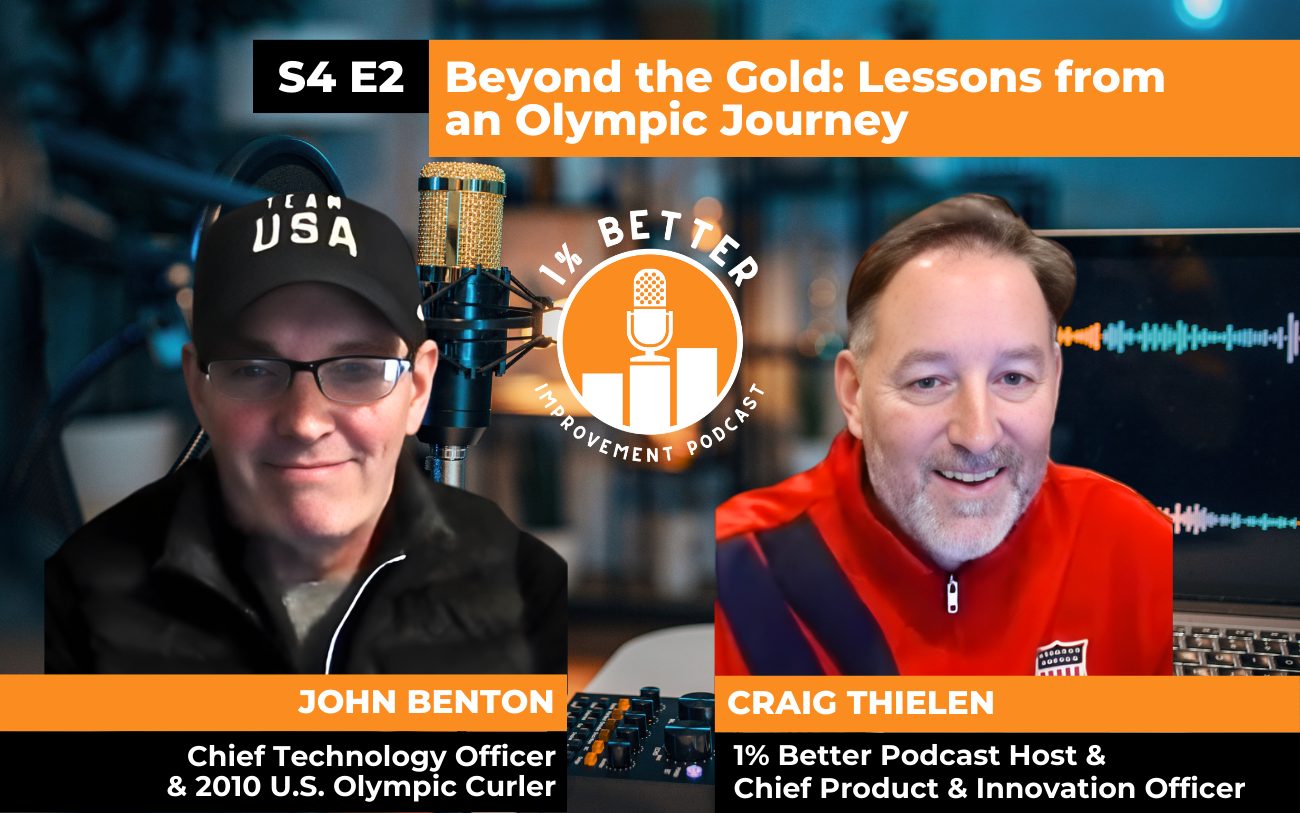
Welcome to the 1 % Better Podcast. We have a very special episode and I just can’t be more excited. What an incredible moment for Team USA as the Olympics close out. United States, of course, captured both men’s and women’s hockey gold, a historic sweep. The first time in the history of the Olympics that United States has captured both gold and men’s in women’s hockey. Just an unbelievable performances and final games, one in overtime, both were 2-1 scores. Just so much to talk about there. And it just reminds us about beyond the games itself, just what it takes to get to that point, to put yourself in a position to win the ultimate medal for your country, for your team. The early mornings, the practices, all the work and the dedication, just so much that goes into these things that we never see as observers of this. And that’s why today’s conversation is so exciting to me. I’m joined by Olympian John Benton, who represented Team USA on the world’s largest stage. John knows exactly what it feels like to be in the Olympics and the whole experience and we’re in USA across your chest.
And we’re going to go inside and learn how he got there and what he learned from it and all the mindset preparation pressure… Everything that goes into it and of course how the 1% Better mindset comes into play. So John welcome to 1% Better.
John Benton (01:41)
Thanks for having me, Craig. I really appreciate it. This should be fun.
Craig Thielen (01:44)
Yeah, I just want to let’s just start with it. It’s just such a great moment. I was in two places out and about when each of the finals took place and in both cases, the entire environment erupted and people cheered. And when you’re in a public setting and something like that happens, it’s just a wonderful moment. I think it’s a wonderful moment for our country. Of course, we’ve gone through a lot the last few years and there’s lots of stuff going on.
And sport has a way of bringing people together and sort of forget, you know, all the other stuff that could be going on in someone’s personal life or, in any part of their life. And so I just, let’s just start talking a little bit about that game. I mean, you watched it, you watched the game today with the men’s and I’m sure the women’s, but what went through your mind when you were watching this, having been there yourself and lived the experience.
John Benton (02:36)
Sure, you know it it’s really amazing to me to watch especially in the case of the men’s and women’s hockey teams… Professional athletes, you know, they’re gonna have a little different view I think of the games but in the end you’re still wearing USA on your back or your chest and it’s still it’s still like nothing else. And so especially being from Minnesota and having the connection with Faber and Hughes and Boldy and knowing what’s happening with their professional careers right now. Just having that extra little tie was something for me. And watching both games, especially today, as soon as it went to 1-1, I was like, well, this is going to overtime. Like, I think almost everyone thought that, right? It’s really going to be who got the break and I thought both teams played awesome it was a fun, tough game to watch and that elation… So I happen to be out of town right now and at a work event. And so I was busy setting up for a production. And so I wasn’t around a ton of people, but the people I were around were like, I had it up on my phone and I had it cranked as much as I could. And people would walk by and say, what’s the score now? Right. And then when the goal went in, you could hear like from various parts of the building, people screaming Yahoo, like it wasn’t, we weren’t in like a big group, but you could tell that everybody was watching it. So just that level of excitement for your country to do something special on that stage is it’s like nothing else. I remember having played in the 2010 games. I remember that game and unfortunately I wasn’t watching it, but I was walking through downtown Vancouver and I remember they had a huge foghorn on top of one of the buildings in Vancouver and every time there was a goal, that for Canada that horn would sound and I did know that it was heading into overtime and I remember hearing that horn and I just remember feeling deflated and so you know this was the opposite of that it was really kind of special.
Craig Thielen (04:40)
Yeah, there’s so many special things about this one. again, it’s the first time we’ve won men’s and women’s. Both games are incredible games. know, like you said, played at the highest level, two one, you know, it’s classic tight, tough hockey. One play is going to make or break. The last time the men’s team won was 1980, that’s the Miracle on Ice. And I believe this is the first time since then that we’ve allowed the, well, no, it’s first time since 2014, I think, that we’ve allowed pros to play. So there’s a lot of different dynamics going on, with this game and just how historic that it really is.
John Benton (05:17)
Yeah, yeah, and people are going to remember this for a really long time and it now kind of gets us closer to level with Canada in terms of the number of golds that have been won and so it kind of increases that rivalry. You know, it was it was just an amazing game, right? I could hardly take my eyes off of it as I was working today, so.
Craig Thielen (05:42)
Yeah it’s something that, yeah, like you said, we’re all going to remember. The other thing I want to just call out, for the women’s, they just had not only an incredible game. I mean, I think they were the odds on favorite, but they had an incredible season. They outscored their opponents 31 to one and they had 350 consecutive shutouts. I mean, so they were, this was a dominant team, but as we all know in sports and curling is probably, more well known for this than any sport. It doesn’t matter coming into the big game, how good you are and how many all the stats are, you can still lose the game. And so the fact that they finished it in dramatic fashion, probably the best women’s team in the history of sports or the Olympics in terms of how dominant they were.
John Benton (06:32)
Yeah, and that in and of itself being dominant in the Olympics. I mean, you’ll see it in maybe some of the individual sports like skiing, skating, where somebody’s just -Michael Phelps, right? yeah, where somebody is just way above anybody else in the field, right? And I think there was a Norwegian that won six golds in skiing this trip around, right? You just don’t see that in the team sports as much, where somebody’s as dominant as the women’s hockey team was. So it’s that much more amazing. And maybe that’s as good a lead into, kind of talking about the Olympic experience as anything, because I can tell you that for any athlete there, it’s a completely different thing than what you normally do in your sport. And I can’t overemphasize that enough. I try to share that with people. It’s a very special time. It’s a very special environment. And I’ve said, unless you get a chance to do it, it’s really even hard to explain why it’s so different and why it’s so special.
Craig Thielen (07:38)
Well, I want to get into that. But before we do, I really want to talk a little bit about your background, John, because I think you, like many, many Olympians, the story is not just what you do when you get there and the games and the finals. mean, many Olympians never get to even close to the finals or, the podium or the top five or the top ten. Many don’t even get there. But a lot of times the story is how you even got to the Olympics, because I mean, there’s obviously billions of people in the world and it’s incredibly difficult to even get there. So how’d you get into curling? Minnesota, I’m from Minnesota, so I know it’s definitely in our culture and our heritage, especially, with the Scandinavian, parts of Minnesota. But just maybe just talk about your background and what led you and how you got to the Olympics.
John Benton (08:26)
Yeah, sure. I started curling when I was six years old. So curling is a very generational sport. There’s a lot of families in curling that it just gets passed down and most curlers will tell you that, you know, once, once you start, it’s a sport that you can’t really stop. It’s, it’s very, very addictive. it’s a lot like golf in how you can go out and be the hero one day and just be awful the next day. So it has that element and surprise surprise the Scots invented both sports. I like to say they invented the two most fickle sports in the world but… so six years old –
Craig Thielen (08:59)
Never thought about that. Yeah, they both are similar in that way.
John Benton (09:03)
Right. So six years old, playing in the St. Paul Curling Club, growing up and eventually started competing as a junior. And even back then there were junior state and national championships that led to a world championships. so being such a niche sport, there’s opportunity there. It’s still this way that for kids to have a chance to go compete internationally, that the competition’s pool is very small. So you have an opportunity.
Craig Thielen (09:30)
Relative to other sports. Yeah.
John Benton (09:32)
Yeah, you have a great opportunity if you get into curling to go experience some of those things. I won a junior state championships in 1987, which kind of put me on the path to be a competitor. Yeah, exactly.
Craig Thielen (09:45)
So you were a teenager then, late teenager then. ⁓ When was and you started competing, like you said, six years old, that’s pretty young for curling. I a lot of people get, I got introduced in high school, because where I’m from, we had a curling arena rink. In high school, they drag you over there and they show you how to curl. And that was the first time I did. But you got introduced really early. But when was the first time that you thought, wow, I actually make it to the Olympics.
John Benton (10:11)
So at the time when I won that state championship, curling still wasn’t an Olympic sport. It didn’t become an Olympic sport until 1998, right? It had long been talked about and it had been a demonstration sport. So it was never really on my mind until it became a full medal sport. And by that time I was competing in men’s tour events. Curling has a tour really of highly competitive events that happens basically now it’s August through end of December, early January before championships start. And so you can travel all around Canada, you can go to Europe. Some people have gone to Asia to play. So, you kind of foray into-
Craig Thielen (10:56)
The Bonspiel tour, right?
John Benton (10:58)
Yeah, it’s a Bonspiel tour. I had been doing that and I had again some some success. in 1997, I was playing on a team out of Wisconsin. So we won the Men’s State Championship out of Wisconsin. And that was my first national championships and that was really when I thought, man, I’m in a pretty small group of people here who have an opportunity to do this. And then a year later, it became a full medal sport. And so that’s when the real quest began was in 1998.
Craig Thielen (11:32)
So you made it to the 2010, 1998, that’s only 12 years. So the, the, the preceding, so that’s three Olympics, right? So those preceding Olympics, you probably knew many of the players that went to the Olympics, right? You played with them.
John Benton (11:38)
Yeah, absolutely. I competed in every trials except the last trials. And so, you know, it’s a very small community. Oftentimes, I’ve played with a number of people, right, who’ve gone on and had success, right? Rich Ruohanen who was on the men’s team this year, was a longtime skip and a fellow player on teams that I’ve been on. So, you it’s still a very, very small community. you try and you try and you try. And I was really about two months, two months removed from saying the R word. I was going to retire. I had really kind of, worked super hard at trying to make it. And I just didn’t see that it was going to happen. And I got lucky enough to get a call from John Shuster in 2008 and we went out fishing, had a chat. He said, I really like the way you play the game. I like how you do things. I’ve got a young team and we need an older veteran who’s got some experience to help guide us through this process. And so I joined that team and, two years later we won the Olympic trials. A whirlwind from free to-
Craig Thielen (12:58)
How many teams compete How many teams compete or how does the process work when you say we won the Olympic trials? How many teams are competing for getting to represent US in curling for the Olympics?
John Benton (13:09)
Yeah, it’s usually eight or 10 is usually the field of a nationals or an Olympic trials. And the qualification process has changed over the years. Basically now it’s mostly a point system where you’re earning points for the years leading up to it by playing on tour, making it to national championships. Yeah.
Craig Thielen (13:15)
Okay trying to make it more systematic and math-based rather than just, hand-picked teams.
John Benton (13:34)
Yeah, they want teams that have had international experience. Because a team can get hot and rattle off nine wins and win a playoff. And you really don’t want to send an inexperienced team, right? So that’s how that has worked. And so the 09 national championships was also the Olympic trials. So we won that, and we went directly to the world championships where we finished fifth. And basically, the world championships in 09 was all of the teams that we’re going to be at the Olympics. So we’ve got a good gauge about our-
Craig Thielen (14:08)
How many teams represent the US? Is it just one team or is it multiple? One team. One team of how many players? How many players?
John Benton (14:11)
Just one team, just one team earns the right for the men’s women. Five players, so four players, an alternate. You’ll have team coach, team leader, national coach.
Craig Thielen (14:18)
Okay. Only one alternate, wow.
John Benton (14:23)
Yep. Mixed doubles by the way doesn’t even have an alternate because it’s men’s and women, right? So you technically need two. So if somebody gets sick or hurt there, that’s an issue. So yeah, leading up to 2010, we trained, we were on tour. We trained all summer in Green Bay, which was-
Craig Thielen (14:30)
Can I ask how does that happen? Because I think of curling, every sport’s different. Some sports are known, like you have to dedicate your entire life, like gymnastics as an example. You go off to Colorado or wherever these training camps are, and when you’re 10 years old or 12 years old, and you just dedicate literally years of your life. How does that work with curling? mean, a lot of you, you have full-time jobs. Did you have to leave your job? How intense is the training?
John Benton (15:06)
Yeah, every curler has a job, a full-time job. And one of the things about me that has happened pretty much with every job that I’ve had is I’ve told them upfront, hey, I’m a curler. And then once the Olympics came along, I would say, you know, I’m trying to get to the Olympics. Generally employers are pretty happy to hear that. They like to hear that people are motivated to do something like that. And so it’s never really been an issue. And that seems to be the case with most of the athletes, but working, you know, for a curler during the season, you’re probably practicing or throwing rocks, three to four days a week. And at the time that I started, the gym wasn’t a huge thing, but it sure is now. We’re all in the gym, again, three to four times a week at least. And then during the season, you’re often playing eight or 10 weekends generally.
And that doesn’t include week long national championships or qualifiers to get to an Olympic trials. So it’s a big time commitment.
Craig Thielen (16:12)
What was the biggest obstacle for you, John? I mean, obviously, there’s lots of technique and there’s lots of ways to measure how good you are as a curler. Maybe we’ll get into that later. But just what was the biggest obstacle for you trying to get to the Olympics?
John Benton (16:26)
Forming a team. I talk about this all the time and I had a chance to coach for quite a bit of time as well, coached juniors. And team formation, because it’s such a small unit, right? Because you’re really only playing with four players and the alternate, a lot of teams don’t even select their alternate until they’ve won a national championship, so you don’t generally carry them during the season. So it’s really just the four of you, right? And you don’t have a bench of players that you’re bringing into the game. So you really need to learn each other’s habits, both on and off the ice. And you have to be a cohesive unit. And it’s really an interesting sports psych study for a lot of people, because there’s really no other sport like it. And we rely so much on communication, again, both on and off the ice.
A couple of the examples I used as a coach with kids was, everything’s great when you come to practice and you go play on a weekend, but you head off to a world championship and you’re stuck with each other for 10 days. And what if Billy forgets his credential or forgets to bring his broom or how are you gonna handle that? Because that’s a higher stress situation and some of your not-so-good of good traits may come out. Stuff that doesn’t come out when you’re just at practice, right? So it’s a really interesting sport in that sense. Our sports site, when he first came to the sport, he looked at it he said, well, this is like speed dating because…
Really after every season teams will break up and they’ll reshuffle and they’ll get a new player, right? Because something’s not quite working out. So getting that team when you see a John Shuster or even a Danny Casper or the Peterson team, they’ve worked really hard to build those teams and sometimes it’s been about making sacrifices for those players to say hey, well I really want to be successful. So i’m going to have to change how I behave, either on or off the ice, right? And I’m going to have to make a sacrifice for the team so that we operate better. It’s a really interesting sport from that standpoint.
Craig Thielen (18:37)
So how does that play out? I played football, basketball, baseball, and so I have a pretty good sense on how those sports and how the team chemistry and how it’s important and how it plays out off the court and on the court. But I don’t have that with curling. How does that show up on the ice? Is it more of, hey, the cohesiveness needs to be off the ice because you have to trust that someone’s as dedicated as you.
They’re working as hard, they’re doing the right things because you’re putting all your time and effort into it. And the last thing you want is someone sloughing off, maybe hitting the booze, maybe not trying as hard, whatever. And it’s like, hey, that’s where we’re going to win or lose together. Is it that, or is it actually the communication on the ice that can also break down?
John Benton (19:18)
Well, it’s both, right? They overlap each other. And what I mean by that is, and you touched on a lot of it, whether it’s commitment to training or doing the right things when you’re out of town. Examples are, curling is a very social sport. There’s a lot of drinking that happens… There’s a lot of-
Craig Thielen (19:35)
A lot if it – I remember our curling club had a big refrigerator stocked full of beer and before anyone hit the ice, so it’s a very social sport.
John Benton (19:44)
And that’s no different for any of these tour events, right? When you’re heading out, you’re going to a different town. Often there’s 40 teams playing in an event. It’s a lot of people. It’s a good time. You get to socialize. But in the end, if one of your teammates isn’t coming home till two or three in the morning, that’s gonna be a problem. It’s gonna create a trust issue, right? And then when they step on the ice, if they’re not performing, the question always is are you not performing because you’re just having a bad day or are you not performing because you’re hungover or you were out too late. So it’s those things blend into each other and there’s other things… family school girlfriends boyfriends… a lot of things that can distract you from the intent and if everybody on the team has said hey, I want to go to the Olympics, there’s an expectation there of how you’re going to handle yourself to be able to do that
because it doesn’t just happen and and I say this a lot because there’s a lot of curlers who will say Yeah, I want to go to a world championships or I want to go to an Olympics and I say well That’s great. But do it with your eyes open because you have to know what that means when you say that because it is three or four days a week in the gym and on the ice and committing to your team that you’re gonna be there when you needed. Dreams are great, dreams are great, but dreams also take commitment.
Craig Thielen (21:11)
Absolutely. Well, you had, as you said, success and if I had to sort of paraphrase, you got a second chance almost when you got the call from, from Shuster saying, Hey, I like your style. I need someone that’s experienced, and you thought maybe you were sort of over the hill or you, your time had passed. So it seemed like the time was right. The fit was there.
John Benton (21:20)
Right.
Craig Thielen (21:34)
And then you guys won the men’s championship and then you went to the world championship or the US to the world. So just leading up to it.
Was your team gelling? I mean, was it performing, getting better? Were you gaining momentum? Did it meet your expectations of what it took to even get there? Before you said, you guys are in, you guys made the cut. That must have been kind of an experience as well. Like it wasn’t a given by any means, even though Shuster’s got a great reputation and built great teams before. He’s been there before, right? ⁓ But it wasn’t… by any means a guarantee. how did that, I’m just curious, the lead up, the year to two years, a lot of pressure for you guys to perform.
John Benton (22:14)
Right. So it again, it’s super interesting. What happens when you know that you’re going to the Olympics, right? Everything kind of changes, and there’s all of a sudden expectations there that maybe weren’t before because you were just a hopeful leading up to that point. And now there’s a training regimen that’s even higher than you may have been on. And there’s a bunch of coaches and you get what they call the team around the team. And you get a lot of inputs and dealing with that and media requirements and interviews and all of those things, you have to learn how to manage it, right? And so that’s kind of a big question mark for a lot of people who’ve not gone before is do you have somebody to help you manage that? Is it because you can’t do it by yourself. It’s just impossible. It’s almost immediately overwhelming. I think it was when we won the trials, I think it was three and a half hours before I got to see my family. Simply because I had to go do direct-
Craig Thielen (23:20)
Because of all the media stuff?
John Benton (23:21)
I had to go do drug testing and then I had to go sit with NBC and do interviews and green screen backgrounds and all of the photo shoots and all of that because they want to do that right away to get it out. So, it’s just there’s a lot of unknowns if you’ve never been through it before. Hopefully you’ve got somebody preparing you for that.
It’s a pretty crazy time. Now in terms of our performance, once we qualified, we were automatically then entered into a number of tournaments. There were four Grand Slam events that year that we played in, all of them, because again, it was all of the teams that were gonna be at the Olympics were in these events.
And we were performing, but we were struggling to finish games. That’s really the way that played out. And we worked really hard at it. We actually went to a ⁓ long road trip. We started in Toronto, and then we went to Norway, and then Switzerland, and then back home just to get us some time together playing some of the teams that we might see.
You know, it was hard. It might sound like a dream to a lot of people to be able to go to these great places, but it was hard. ⁓
Craig Thielen (24:28)
Oh, yeah, I’m sure. It’s not glamorous.
I mean, it’s hotels and it’s traveling and it’s working out and it’s game planning and it’s reviewing. I don’t know if you guys how much you reviewed film back then, but probably… it’s a grind. Honestly, and it’s your way from your family and your own bed. That’s tough.
John Benton (24:39)
Yeah. lots. And you really have to, this is the other thing that I tell athletes that I coach, is that you really have to be a love to win person rather than a hate to lose person, right? Because loving to win is what will keep driving you when it’s a grind.
Craig Thielen (25:00)
Yeah.
John Benton (25:05)
Right? If you hate to lose, that grind is going to be really hard to get through. And I don’t want anybody to think that any of what I just said is a complaint, right? Because I’m a love to win guys. I, it was hard.
Craig Thielen (25:12)
Yeah. I’m curious, so John, in addition to the love to win part, is it also, you have to love the process. Because you weren’t going to go undefeated between now and when the Olympics started. And so every loss, no matter how bad it was, is an opportunity to learn. And just to say, how can I learn? What can I get better tomorrow practice? I can eat better. So you have to actually love the process of the grind, or no?
John Benton (25:40)
You do, the funny thing is, I played football, I played hockey. I never got really good at either of those sports. once I had won in curling when I was a teen, I kind of went on that path. But I never really got exposed to kind of that process-based coaching. And coaching and curling is really in its infancy. It wasn’t really until I was mid-20s that coaches really started to become a thing in curling. So it’s only 25 to 30 years that we’ve been having coaches with teams and we’re just now getting to high-performance coaching where process-based coaching.
Craig Thielen (26:18)
Interesting.
John Benton (26:31)
Looking at process improvement rather than outcomes. All of those types of things that, that we all know now if we’re involved in sport are super important. And I love that piece of it, right? Because as an IT guy, I’m into processes. Processes make sense to me. I can always evaluate myself against the process. Whereas I can go out and play great and lose a game.
Or I can go out and play really bad and win, that doesn’t really tell me a lot, but if I’m measuring against processes, then I know something. And so that part of it for our team was really pretty new when we went in 2010. And it wasn’t readily accepted by everybody on the team.
You know, we were really good at just going out and playing.
Craig Thielen (27:22)
It kind of reminds me a little bit of the NFL in the seventies or, know, like these guys didn’t, they weren’t full-time football players, sixties, fifties, sixties, seventies. They didn’t have big contracts. A lot of them had jobs and they just were great athletes and they had skills and they didn’t worry about what they ate and they didn’t go to the gym and now everything is so scientific…
Frankly, it’s millimeters and inches and split seconds that all matter and curling… It’s actually hard for me to get my head around what’s the difference between a great player and just a good player. It’s really like millimeters. it’s like other sports, it’s easy to see in basketball. You can see guys that are more athletic and they’re quicker and they can jump higher in football speed and size and strength.
You name the sport and a lot of it’s very physical attributes. In hockey, I could it be five three and 110 pounds or six three and 225 pounds. It doesn’t matter. It’s what you do with the stone and you’re doing it with your fingertips and your body sliding. And so there’s so much nuance and so much just fine tune. it’s like a game of millimeters. And so I’m really curious, maybe just break that down, how do you break that stuff down into a process so that you can get good at it? I mean, we know what the outcome is. You want to bump this stone and you want to get in this circle and you want to spin it. But it’s such a different sport, like you said.
John Benton (28:52)
So think about it this way. This is another coaching thing. I had a chance to go to a youth Olympics coaching, and I had to tell that team that the difference, as you put it, the difference between a good player and a great player doesn’t have necessarily to do with how they compete in an individual match.
So look at what just happened, right? Danny Casper and his team and the Petersons and Cory Thiesse, they’re playing a nine game round robin, right? Over, you know, about 10 days. There’s a lot of really good players who could probably go out and win three or four games in the beginning of the week. But as that week goes on, mentally and physically, they’re gonna start breaking down.
Craig Thielen (29:32)
Interesting
John Benton (29:32)
And that’s to me in our sport what makes a great player great is that they’ve put in the effort to be consistent from beginning to end.
Craig Thielen (29:38)
So consistency.
John Benton (29:44)
And when you, it’s a really unique thing, especially in the tour events that we play in during the year, you might have a three game day on Friday, a three game day on Saturday, and then you gotta wake up and win a playoff game to get to the quarterfinals and then the semifinals and the finals. games are two and a half hours long. It was another thing that our sports psych said, so you’re up at 6 a.m., have your breakfast, you go play, you get done, you eat, you play again, you get done, you eat, you play again, and then you go to bed. Now take that idea and throw the Olympics at it, where again, you’ve got media, everything that comes with being an Olympian, meeting other athletes, being in the village, all of the attention that you get, right? So to be consistent, and this is why, just to go back to the women’s hockey team for a second, think about that, right? Think about what they went through in their tournament.
Craig Thielen (30:29)
Yeah, right.
John Benton (30:46)
and how they were so dominant when the spotlight is all over them the entire time, right? It’s really amazing, an amazing feat to do what they did. Not to diminish what the men did or anybody else, like to be that dominant in a team sport. I know as a coach from my sport, from what we’ve been talking about here, that there’s a high level of trust with all of those ladies on that team and their coaching staff to be able to just move through the way that they did and not have hiccups. Just really, really amazing.
Craig Thielen (31:19)
Well, that’s a perfect segue. So you made it, and then you have all the tournaments leading up to it, which is a grind and hard work and it’s preparation. But then how does it change? This is, think, the biggest question that a lot of people want to know. Now, opening ceremony, and you are in the Olympics. And in your case, I would suspect many, many, many players, they get one shot at this. They’re not Michael Phelps or they’re not the skier gal from Minnesota that’s been in seven Olympics or six Olympics. Yeah, Lindsey Vonn, that’s super rare. So you’re there, how does everything change? How is it different than what you thought? And how is that pressure, how does that show up? I think that’s a fascinating thing because it’s so unique.
John Benton (31:48)
I wrote a post about this the other day because I wanted people to understand a little bit. the phrase that I used was, it’s like being on an inescapable month-long adrenaline high. Because even when you’re sleeping, it’s not off because and you really don’t sleep very well. That’s actually a big problem because there’s just so much happening around you and you have almost no privacy because you’re probably staying with one of your teammates.
Craig Thielen (32:28)
Yeah, I bet.
John Benton (32:37)
And you know when you get up and walk out the door in the morning, there might be a camera in your face or a fan wanting an autograph or to talk to you, right? ⁓ Or you’re going to see another athlete that you’ve always wanted to meet. And especially for curlers, because we are there for an entire month.
It’s really a lot. From my vantage point, having been there, I can see whether it’s a curling athlete or another athlete, whether it’s taking a toll on them. And I believe that it does. there’s, know, Michaela Schifrin, skier, talked about this a little bit. It’s just, I wouldn’t even call it pressure.
It’s just really hard to settle your mind and to go out and perform at the level that you know you’re capable of. One thing that I know from my experience is that the place where I felt the most comfortable was on the ice.
Craig Thielen (33:29)
Mm-mm.
John Benton (33:29)
because there was just so much, just so much. And the other piece of it is that there’s a lot of expectation no matter what sport you’re in. I don’t think we were expected to do very well, and we didn’t. We lost four of our first five games on the last shot in an extra end or extra inning, which was really hard to take. And there was a lot of criticism, which we had not experienced before. And when we won a game, there was a lot of praise. And it was extended.
Craig Thielen (33:48)
Wow. Absolutely.
John Benton (34:04)
You might celebrate a win for an hour or two, you sit around and talk about the game and then you move on. At the Olympics, if you win a game, you’re talking about it for an entire 24 hours.
Craig Thielen (34:16)
Easily, yeah.
John Benton (34:16)
Right? And if you lose a game in, especially if you lose a game in dramatic fashion, that might be three or four days, depending on how it was lost and what your reaction was. There was a huge controversy this year about, some cheating, which we could talk about, but I don’t think we want to get into that, but I’m sure that the teams that were involved in that… that was four or five days worth of chatter that they knew going into every game and coming out of every game there was a good likelihood that they were going to be asked about it. And how is that going to impact your performance?
Craig Thielen (34:53)
Well, again, curling is just so darn unique in many great, great ways. But it’s out of the radar to say the least as far as a sport. And so if you could have won a big Bonspiel even in Switzerland or somewhere in the US, really, nobody’s newspaper is going to cover it. Maybe just this really tight curling community. We have a mutual friend, Brian Grabowski showed up to him, he might know about this stuff because he’s following everybody and everything. outside of a few hundred people, maybe a few thousand at the most. But now you’re in the Olympics and everything that you do or happens, it is globally known and everyone knows, the USA team is disappointing or they’re good and there’s talk about. So that’s got to be completely different that like just how visible it is.
John Benton (35:16)
Exactly. And if you’re not, if you’re not thoroughly prepared for that, whatever the sport is, we did a lot of media training leading up to the Olympics, didn’t even scratch the surface of the onslaught of, just the demand for your time and literally not really getting a second of private time. We would go back to the village and be in our room. But again, you’re not at home, right? You’re not in your comfort zone. And you’re thinking about, you know, whether it’s your next media appearance or your next game.
Thinking about the last game and what happened and was it good, was it bad? Like I said, it’s a month long adrenaline focus on nothing but your sport.
Craig Thielen (36:33)
Yeah. What was your ⁓ most memorable moment from your Olympics? Or not necessarily moment, but just what’s the most memorable part of it?
John Benton (36:40)
Yeah, I mean, I feel like it’s cliche to say the opening ceremony. At the time, smartphones weren’t quite what they are today. So I had a camera with me, which I, it’s a funny story, I ended up losing that camera and then it got mailed back to me months later.
But I have a picture because they said, it’s not a good look if you have your camera out while you’re walking out. So they wanted you to put away your cameras. So the picture that I have is actually coming out of the tunnel and you can’t really see much except the lights and the crowd. And I look at that picture all the time because that moment of I’ve arrived, you will never experience that in that way, only Olympians have that. And I won’t forget it. The other most memorable thing, and it was something that my sports psych worked on with me is, he said, I want you to pick a moment that you want to capture. And it was actually the first slide that I took on the Olympic ice. And my wife at the time took a picture of it. And actually I my hand down as I’m coming up to that Vancouver 2010 logo on the ice, just kind of soaking it in saying, you know, I’m actually here doing this. This is not a dream.
I’m actually here doing this. I will never forget that.
Craig Thielen (37:54)
Yeah, that’s pretty special moments. Anything that you took away from it, after you got back and you reflected, because you said it’s got to be surreal. Like you’re just, it’s like drinking from a fire hose and there’s so much stimuli and so many emotions. I mean, you’re wearing your country’s name too, and you’re surrounded by other countries, which many of them don’t speak English it’s kind of a very, I assume like competitive and, know, maybe there are some good relationships that are built, but it’s also a very much competitive environment. So there’s just so many emotions going on, I’m sure. But after you got back, I’m just curious, did you reflect and go, what did I take away just as a person, a human, life lessons that I take away from that experience?
John Benton (38:35)
for sure. There’s a multitude and it’s part of the reason why I wanted to get into coaching was because of those experiences and being able to share that. A lot of what we’ve talked about here in terms of, team formation and making commitments and what does that mean between four people and how is that going to change over four years time if you’re making a run for the Olympics? And then once you get there, how does that change people and how can you best position yourself as an individual and as a team to manage that, right? You know, was all of those things that came out of that experience, we didn’t get on the podium, we didn’t medal, it was disappointing from a performance perspective, but you can always say, you know, hey, I made it to the Olympics, that’s great, but I don’t want anybody to ever go and have that experience and not at least have a basic understanding of how different it is. Because it is like nothing else.
Craig Thielen (39:40)
Yeah, and as you said, your first four out of five matches were just down to a very small margin, the last stone and very small differences. And so now you have four years… I’m sure you guys are playing this in your head, like what could we have done better? What could, how could we have trained more? And just, it’s the little things. So it’s this whole 1% better, which is what can we do every day? How can we learn because it’s a little tiny improvement that can make the difference between winning four out of five frankly or losing four out of five.
John Benton (40:11)
Exactly and and we’re kind of tying all of this together… you asked what makes a good curler versus a great curler and that consistency is really kind of drilling down into that consistency bit, right? What does that actually mean? consistency on the ice consistency as a teammate consistency in your mental preparation…
Are you willing to be a more consistent person so that your teammates understand you better? So it gets very broad to be able to get that extra one or two or 3% of performance. So you’re making that last shot and you’re putting yourself on the podium.
Craig Thielen (40:50)
Well, and I’m sure you kind of alluded to this, but you said coaching is important to you. So maybe we can talk about that next here. You wanted to give back. It sounds like one of the things that you wanted to take this learning, this amazing experience, and give it to others so they could benefit from. So maybe just walk us through what you’ve been doing since the 2010 Olympics to do that.
John Benton (41:10)
Yeah, I came back, I was working at Fairview Health Services in their IT department for a long time, engineering, and a couple of things happened. So first of all, I got asked to be a national team coach for the junior program, for the women’s junior program started in 2012. Right around the same time a new facility was being built in Blaine attached to Fogarty Arena. A lot of people would know Fogarty Arena from hockey and so they hired me to manage that curling facility. So I started managing the curling facility and doing a lot of coaching and training so I started going to a of coaching conferences with the USOC you know, getting really filled up with knowledge about, how high performance coaching works and how do you make that work in your sport and so trying to apply a lot of those principles along with my experience for those junior athletes. So super proud moments for me this week, although I’m no longer her coach, Cory Thiesse of Cory and Cory the mixed doubles and she also played on the women’s team. She was on one of the teams that I coached and we spent four or five years together, working together and did a lot of technical coaching with her.
It’s great to see athletes that you’ve worked with at any point have success. if you’re a dedicated coach, you can’t have a happier day than seeing your athlete, former or current, do well. And on the Olympic stage, it’s even greater. So, very satisfying.
And in the end, I’m not doing a bunch of team coaching anymore. I do a lot of technical training with new people coming into the sport, but, the mission that I had to be able to share those experiences has played out a number of times. And, I brought a team to the Youth Olympics in ’18 and that was, or 2020 I should say, that was one of the most amazing experiences that I’ve ever had. They didn’t have great success and that was actually the success story because the lead up to it was all about how do we manage things, How do we manage somebody missing a boss? How do we manage somebody losing their credential? How do we manage losing? How do we manage winning? And it all got to play out and they all had a great, great event regardless of their results. And that was one of my greatest success stories, I think is seeing a team be able to feel good about themselves, regardless of the outcome.
Craig Thielen (43:58)
Yeah, absolutely. that’s again, a big part of coaching is, outcomes don’t define you as an athlete, especially any one given outcome or win or loss. And it’s what you do with it. As they say, it’s not a matter of whether you get knocked down. It’s what you do afterwards. And can you pick yourself up? And can you get back up and go again? So that’s a big part of coaching. And, you know, that could have really impacted helping them get there number one, but number two the fact that they didn’t win it or do as well as they all wanted to that could have been devastating and it has been for many athletes that they don’t recover from that and so to be able to deal with that because again, this is just one part of life, even though Curling’s been a big part of your life. It’s not the only part of your life… You’ve got a lot of other parts. So thank you so much for for taking the time…I’m gonna ask you one more question and then wrap this thing up. the one question we ask everybody on the 1% Better Podcast is, stepping back from the Olympic experience that you had, which is incredibly unique and timely, just what have you learned in general about life, life lessons that you’ve learned that maybe you’d wanna pass on to your kids or grandkids, or you’d wanna wish you knew when you were 14 years old before you won your first juniors and you’re getting into this competitive, global environment, just what’s some life lessons you’d want to share?
John Benton (45:14)
I think the number one thing is gratitude. Waking up every day being grateful that I’m here. because number one, there’s a lot of people who don’t live a long life, don’t have the opportunities that I’ve had. There’s so many people less fortunate, so gratitude is part of my life every day, regardless of what’s happening in my life.
I think the other thing is just being present. kind of ⁓ goes hand in hand with that. It’s so easy, especially these days with everything that’s happening, to be distracted and to be pulled away from things that are actually really important. Things like family and your work, your closest friends should be important to you and really spending time with those people. Those things are core to my being now, which is get up every day grateful and make sure that the interactions that I have with the people that I care about are real interactions and not distracted and not just teeth out. really, really take the time to make sure you’re nurturing those relationships because they’re the most important things.
Craig Thielen (46:27)
Well, that’s super wise advice and thank you for that. And I can say that I’m super grateful for you for taking the time. I know you’re traveling, you’re busy, but what an amazing moment that we’re in with wrapping up the Olympics and again, the double gold medals and just to be able to share your experience because all we see is the game, right? And that’s just maybe 1% of the big picture of what goes into athletes and performances. And just to be able to get a sense for that. So thank you so much for sharing that and doing everything you’ve done, frankly, ⁓ with what you’ve been given. You’ve given a lot back. You’ve shared your experience with a lot of others. I know impacted many other people and just really want to thank you for taking the time to do that.
John Benton (46:48)
Absolutely, Craig. This has been great. It kind of came out of the blue and it’s always fun to talk on this level with people. My favorite saying as a coach is that you’re not responsible for the outcome, you’re only responsible for the effort. So I’m glad you made the effort to reach out.
Craig Thielen (47:30)
Yeah, thank you. Go USA.
John Benton (47:33)
Go USA, thanks Craig.
Check out other podcast episodes