Artificial Intelligence has arrived at center stage, but many organizations are still stuck behind the curtain. They’ve piloted GenAI tools, drafted strategy decks, and sat through vendor demos. Yet when it comes time to scale, the reality sets in: they’re not ready.
Not because they picked the wrong tech, but because the work of modernization runs straight through the middle of their organization. Hybrid environments. Inherited complexity. Competing priorities. Unclear data ownership… the tough stuff.
Most frameworks discuss Data Mesh principles or cloud-native design, fewer discuss how to get there. What follows is a field manual for modernization’s political and organizational realities, drawn from work with clients in healthcare, education, and financial services.
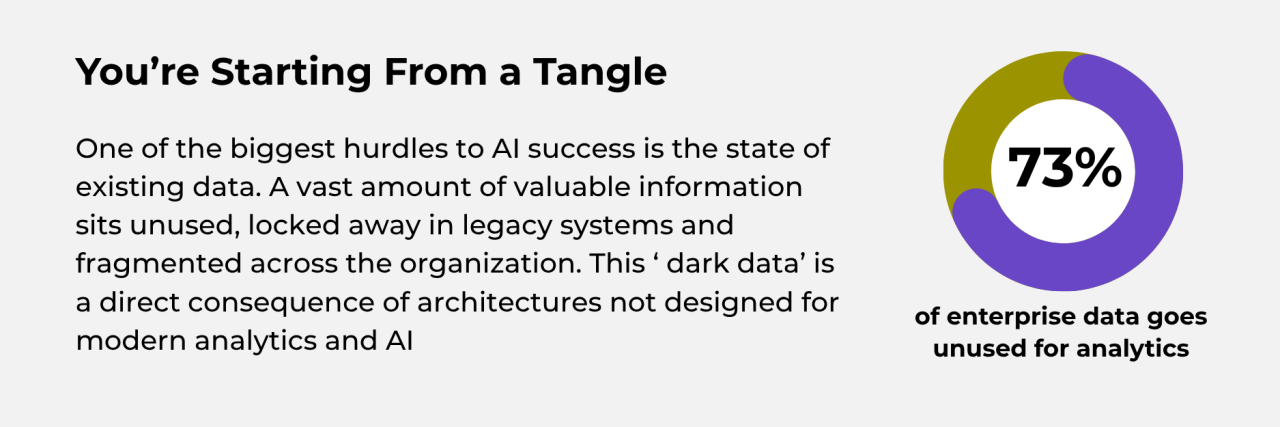
You’re Not Starting From Scratch, You’re Starting From a Tangle
One of the biggest fallacies in modernization strategy is the idea of a ‘clean start’… that doesn’t exist.
In one healthcare organization, the shift toward a data-centric strategy required rethinking not just tools, but how the organization worked. This included establishing a new data and analytics department, defining enterprise-wide roles, and launching domain-aligned DataOps teams to support self-service and advanced analytics. What looked like a technology initiative on the surface was in fact a full-scale operating model shift, with governance, agility, and business alignment at the center.
This is not unusual. Forrester suggests that on average between 60% and 73% of enterprise data goes unused for analytics, often due to legacy architecture and fragmented ownership.
In the public sector, a state agency operated with different rules and retention practices across many divisions. Shared drives were common, but shared understanding was not. The concept of a ‘single source of truth’ sounded great. The reality was multiple truths, none of them well-labeled.
If your modernization roadmap doesn’t start with confronting what you’ve already got, it’s not a roadmap… It’s a wish list.
Data Mesh Is Not a Design Pattern, It’s a Political Project
The Data Mesh principles sound clean on paper: domain ownership, data as a product, and federated governance. But in practice, getting from concept to implementation often means unwinding years of centralized decision-making and informal dependencies.
In one financial services firm, decentralizing ownership exposed deep misalignments in how teams viewed their responsibilities. The business assumed data teams would continue to cleanse and model shared assets. The platform teams assumed that domains would build their own pipelines. Everyone agreed on the idea of Mesh. No one agreed on how to pay for it.
Organizations embracing decentralized data ownership report a much higher success rate in cross-functional AI initiatives than traditional platforms. Gartner argues that traditional, centralized platforms create bottlenecks that slow down or kill AI initiatives.
The moment you introduce domain-aligned product teams or assign ‘data product owners,’ you’re not reorganizing dashboards… You’re shifting power, budget, and accountability. If you don’t manage that shift explicitly, you invite failure by default.
The CDO Role Is Being Rewritten in Real Time
In many organizations, the Chief Data Officer still carries an older job description – set governance policies, manage stewardship, publish reports. But today, that isn’t enough.
In several clients we’ve supported, the absence of empowered data leadership led to deadlock. Platform changes got delayed. Governance frameworks existed but weren’t enforced. In one case, a data strategy was fully documented but couldn’t move forward because no one had cross-functional authority to implement it.
The modern CDO has to lead across IT and business, set culture, define operating models, and enable decentralization while ensuring alignment. In some cases, we’ve helped clients frame the business case to re-scope or elevate the CDO role, because too often, the data team reports to tech, and the strategy gets stuck in translation.
Translation Is Not a Nice-to-Have, It’s the Job
Technical complexity doesn’t kill strategies, misalignment does. This is true for AI as well.
In one client environment, we had to bridge a major communication gap between enterprise architecture and executive leadership. Architects talked about ingestion pipelines, storage optimization, and streaming readiness. The C-suite wanted to know when the call center dashboard would finally update in real time. We reframed latency issues in terms of revenue recognition and customer retention, which unlocked investment.
Modernization efforts fail not because the platform isn’t robust, but because the business case isn’t understood. Translation between technical strategy and executive priorities has to happen constantly, not just at quarterly check-ins.
If no one is translating, no one is buying in.
AI Doesn’t Require Perfection, It Requires Alignment
There’s a common belief that AI won’t work unless everything is governed, labeled, and real-time. That’s not true. What AI needs is clarity – where data lives, who owns it, and whether it can be trusted.
In client after client, the pressure to deploy GenAI is real. But many are missing critical prerequisites – lineage tracking, retention clarity, and minimum data quality standards. In a recent engagement, we focused on getting teams to agree on which source systems would be used and how updates would be audited. That groundwork matters far more than a pilot in a sandbox.
In their landmark report titled ‘The Data-Driven Enterprise of 2025,’ McKinsey found that organizations with strong data foundations are 2.6 times more likely to exceed their business goals and 23 times more likely to acquire new customers.
Modernization is not a sprint to cloud migration, it’s a continuous negotiation between what’s possible and what’s necessary. The organizations that get it right slow down just enough to lay proper foundations (NOTE: ‘just enough’ is a key phrase here – don’t tap the brakes).
Final Thought: Organizational Change Is the Work
If your team is exploring Data Mesh, GenAI, or large-scale modernization, here’s what matters most – this is not only a technical project but also a cultural and political transformation.
Treating it thoughtfully and deliberately separates the leaders from the laggards. A modern data architecture won’t take root without a modern operating model. AI won’t deliver value without alignment between data and business and the CDO won’t succeed unless empowered to lead, not just manage.
If you’re in the messy middle, keep going. Just make sure you’re leading change in the organization, not just upgrading tools in the stack.
Learn more about Trissential’s Data & AI Services: Artificial Intelligence | Data & Analytics | Hyperautomation
Talk to the Expert

Larry Odebrecht – Sr. Director, Data & Analytics
larry.odebrecht@trissential.com