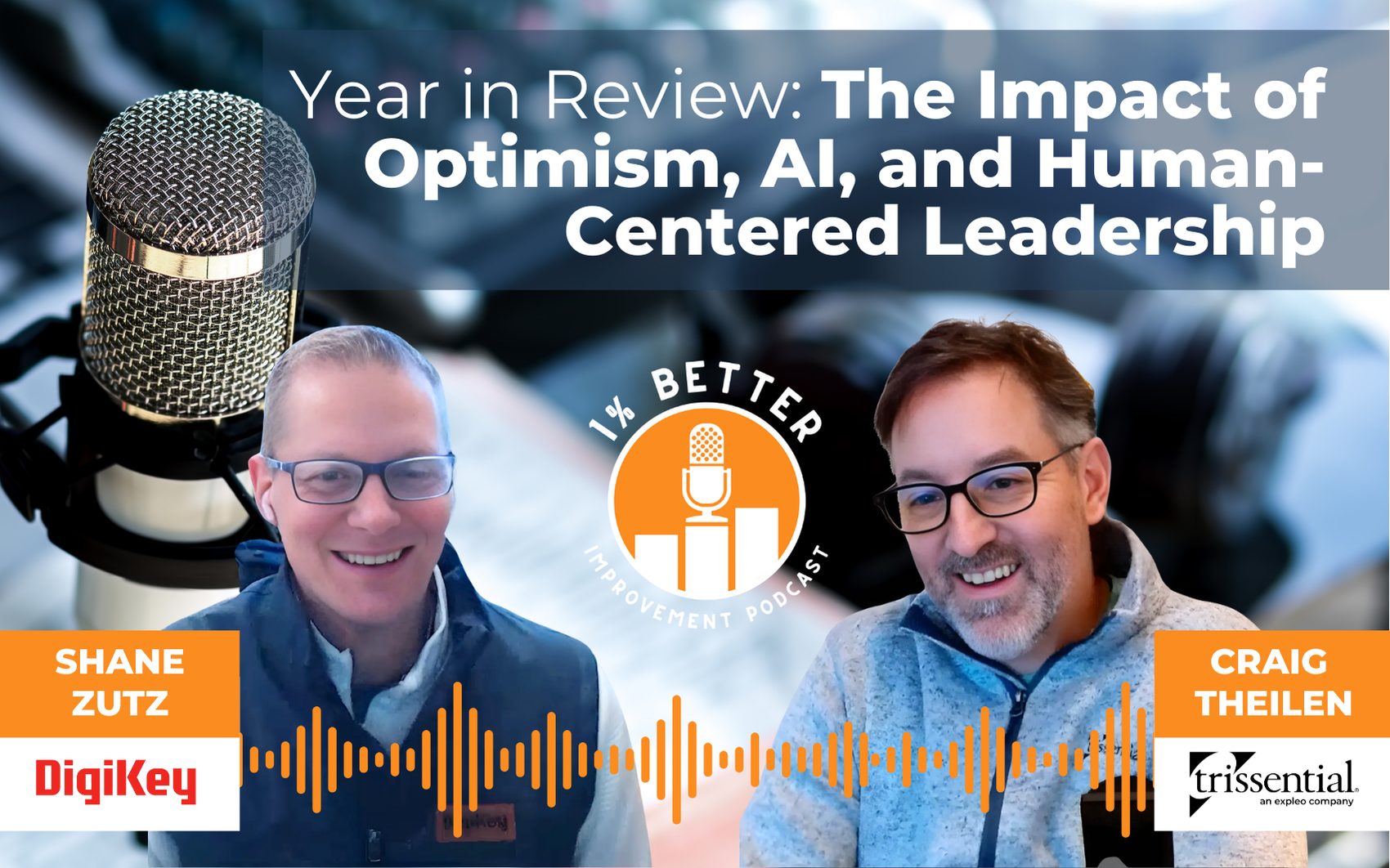
1% Better Podcast: Shane Zutz

Find 1% Better Improvement Podcasts Here





1% Better: Shane Zutz, VP of HR at DigiKey
Quick Links
Check out Shane Zutz’s Leadership Newsletter
Connect with Shane Zutz on LinkedIn
Connect with Craig Thielen on LinkedIn
Learn more about DigiKey
Key Takeaways
- Continuous Learning and Curiosity: Shane Zutz emphasizes the importance of being curious and constantly learning. This mindset not only helps in personal growth but also in professional environments where innovation and improvement are crucial. His approach to asking questions, absorbing information, and not jumping to conclusions showcases a leadership style that values growth and development.
- Effective Time Management: The conversation highlights how Shane manages to accomplish a significant amount of work both inside and outside his professional life. His ability to balance responsibilities and his commitment to productivity serve as a powerful example for others looking to improve their time management skills.
- Leadership in Unlikely Places: Shane’s story illustrates that good leadership can be found in unexpected places and situations. His journey from being an elementary education teacher to a high school principal, and eventually to the VP of HR at DigiKey, underscores the idea that leadership skills are transferable and can make a significant impact across different settings.
- Importance of Incremental Improvement: The core theme of the podcast, and Shane’s work ethic, revolves around the concept of seeking 1% improvement in various aspects of life and work. This philosophy is grounded in the belief that continuous, incremental improvements lead to significant growth over time. It’s a practical approach to personal and professional development that encourages consistent progress.
- Data-Centric Transformation and Accountability: Shane discusses the transformation of DigiKey and his previous work in education towards a more data-centric approach. This shift underscores the importance of using data to inform decisions, ensure accountability, and drive improvements. It highlights a modern approach to management and leadership that is evidence-based and results-oriented.

















1% Better Episode 1 Transcript
[00:00:00.460] – Craig
I am very excited to kick off our inaugural podcast on 1% Better, and I can’t think of a better way to do that than to have Shane Zutz here with us. I’ve had an opportunity to work with Shane, and I think he emanates improvement in everything he does. And so really excited to get into it. So with that, Shane is the VP of HR for DigiKey.
Some of you may or may not know about DigiKey, but they are in some ways a little bit under the radar. Being in Thief River Falls, Minnesota, but they have quickly become one of the global leaders in electronics distribution. In fact, their claim to fame is they are the largest electronics distributor in the world with real time part availability. They take a lot of pride in that, and that’s really one of the success factors they have. I’ve had a great chance to work with Shane. We’ve done some work together with our businesses, helping them with a transformation, moving to a more data-centric organization.
Some of the things that come to mind when I think about working with you, Shane, are three things. One is how curious you are. You ask such great questions and you absorb and you’re constantly learning, not jumping to conclusions. Second, time management. There’s certain people in the world that you go, how do they get everything done that they have? I know how much you have on your plate inside and outside of work. I think that’s always something to learn from. And then lastly, good leadership is good leadership. And sometimes we find it in unlikely places. I think your great story of that yourself in your life, but also how we got to start working with you. So we’ll dig into those things, but I thought we would start, Shane, just walk us through because I think this is a big part of your story is your background, your education, and some of your early career that led you to this role that you’re in now.
[00:01:49.780] – Shane
Well, thanks for having me, Craig. It’s exciting and I think people are going to learn more from listening to you than probably me, to be honest with you. It’s been great to connect with you. There’s a lot to leadership. Probably one of the earliest lessons I’ve learned from different mentors and things is you should look for it in unlikely places. I got a lot of stories where I think that have impacted me from working at a convenience store in high school to some of the things I do now. But people get a bigger kick out of my background than I do. I live it. So then I think it’s normal. And at the end of the day, I’m a teacher and a coach. And so what does that actually mean is I graduated from Thief River Falls. This is where I’ve lived my whole life and went off to college and got an Elementary Education degree. And my whole goal in life was to be an elementary education teacher and a head baseball coach. And that was it. So I accomplished that goal.
And very quickly as I was in the education, was approached about potentially getting my graduate degree in educational leadership that can lead to administration and things like that. So there was something I wasn’t going to pursue, but I was very much encouraged. In fact, my principal at the time came down on a Friday afternoon and said, Hey, I don’t see your name on the list to take this Masters in Educational Leadership. And I’m like, No, I’m coaching. My wife and I just had our first kid, and I don’t think I’m going to do it. And he said, Well, I’ll see you signed up in my office by 3:15. Got it? I was like, Okay, got it. That was somebody that maybe saw something in me.
I didn’t teach for very long. I taught for three years and then moved into our assistant principal role at our middle school in Thief River Falls. I loved working with middle school kids. Most people think, Well, that’s the craziest thing in the world. But, man, when you work with middle school kids, I think you can work with about anybody because they’re trying to find themselves. They have tons of energy. They’re trying to learn. Some days they’re not very fired up about life. They bring all those different emotions that we find in the workplace on a daily basis and working with colleagues and leaders and everything.
And ultimately then I ended up as our high school principal and teacher. And that was my dream job. And I will probably always call it my dream job. It was the high school that I went to when I first started as principal there. Half the staff was teachers that I had. And we did some really great things that at that time were more on the front end. I won’t say leading edge because we never led anything. But when you talk about one to one, we’re one of the first schools that went to MacBook in a one to one environment. We implemented a highly recognized College and Career readiness program and partnership with the University of Minnesota and went through almost a $30 million bond referendum where we redid our building and stuff. We did all at once. So that was a lot of fun. That was a tremendous learning time for me as a leader. We had a tremendous staff and we can get more to that later.
But Dave Doherty is our President at DigiKey. I’ve said it numerous times to people, by far he’s the best leader I’ve ever had the opportunity to work for for a multitude of reasons. And we started having breakfast and talking about leadership and, Hey, what do you see in your role? And what do you see in back and forth? And one day he says, Hey, we have breakfast. He’s like, You should come work for us. I’d like to have you join my team. And just short of calling him crazy, I called him crazy. I’m not going to do that. And in fact, I was so in my element as the principal of the high school, and we did so many things that I actually went back to my office that morning, and I didn’t give it a second thought. And in the spring as a high school principal, you’re extremely busy. There’s lots of things going on, and there can’t be anything about you as a leader. It’s got to be about kids, families, the community, and everything that comes with concerts and awards banquets and graduation and all that stuff. Anyway, it was a week or so or a couple of weeks later, he sent me a text and something along the lines of, You must have some questions by now. Then I called my wife and I said, I think Dave was serious about this, but I don’t want to do that. But she encouraged me. She said, Remember, you don’t always ask. Sometimes people see things in others and that’s how people end up where they are.
Ultimately, we had more discussions. I’ve been at DigiKey for pushing six years now, and it’s been a tremendous journey. It’s taught me a lot, and we’ll get into more in that. But at times, it’s humbled me. It’s shaken my confidence. It’s grown me tremendously. There’s just all those things that come with leadership I think have really happened for me throughout my career, but probably most specifically over the course of the last six or seven years, for sure.
[00:06:27.490] – Craig
Well, thanks for sharing that. I do love that story. I mean, it gives a lot of clues to you. And a couple of things that come to mind, one is how you got a few nudges along the way, right? And the principle that nudged you, maybe not starting gently and then, Hey, this is something you need to do. Saw something in you, your conversations with Dave, conversations with your wife. Just staying curious and being open to some of those nudges that we get in life, I think is one thing. And some people aren’t looking or don’t listen to those things.
But I think it says a lot, you took a lot of risk. I mean, you were comfortable. You were in, like you said, your dream job, and you were pretty early on still in that. You were driving a lot of change and really loving it. And then to jump into a whole another realm called business, called electronics called corporation is a lot of fear and certainty and doubt. To be able to do that and put yourself in a very uncomfortable position, a fish out of water, so to speak, we all need to aspire to. I try to constantly put myself in, and it’s a mindset with a lot of organizations that we work with, which is how do we get comfortable with change because the world is just constant change, and how do we get comfortable with being uncomfortable? I think that’s a great story.
Let’s go back to… You had a lot of success when you said a lot of things that you were driving that wasn’t just, Hey, I’m taking over the reins. It’s business as usual. Some could argue, Well, elementary education has been the same for decades, and it’s very repeatable. But you were really driving a lot of change. And you were early in your career and you said a lot of the teachers were your teachers. So these are people that are your senior by 10, 15, 20, 25 years. And who’s this young up and coming person going to tell me how to do my job? I’ve been doing it my whole life. So talk a little bit about that dynamics and how you had to say, I’m going to push out of my comfort zone, out of everyone’s comfort zone, how you rally people that are much your senior. Why did you do it? What caused you to do it? Because the easy path would have been, let’s just keep running things the way they were. And you really pushed outside that.
[00:08:33.860] – Shane
Yeah, it’s a great question. And there’s a few things there that running a high school is markedly different than being at a middle school or having an elementary background. So I wasn’t coming in with understanding about all the intricacies of credit recovery and graduation requirements and all that. There was a lot of learning there. But I think the thing that I think went pretty well, and I’ve gotten some feedback on is I really had to understand with that staff at that time at Lincoln is what mattered to them, not where did we need to go because we weren’t ready for that.
I’m telling you, when I walked in that building, the talent with regards to the staff was, I thought, super high. I always had in the back of my mind, well, if you can get these people all going in the same direction, things are going to go pretty quickly. So rather than do a typical 30 60 90 or like we say in the business world, okay, here’s the landscape, here’s what I need to change, and then start enacting change. Education doesn’t quite work at that pace anyway.
But rather than that case, I didn’t know enough to be dangerous at that point. So I really spent time getting to know and understand what was important to the staff. And one of the things that really stood out was that there’s some opportunity for accountability with our staff, crazily enough, with kids and within the building. And so my style is not to walk around with a stick and make sure everybody’s going in the same direction. But what I did then is I thought, okay, I have all the kids in the building. I actually know them all because they were all at my middle school. And as an assistant principal, your job is to know kids very intimately. So I thought, okay, I’m going to spend time understanding where the staff would like to see kids improve or do things different. And how do we take that energy and then push that into other space?
And I can remember we were two weeks into the year, and you do these very typical all school class meetings that are by grade, and hey, here’s what we expect, and all this stuff. And how I started each of those was, and Cal Lindberg is his name, and he passed away now. He’s a social studies teacher, grade teacher, I had him. But he came into my office and he pointed his finger at me and he goes, I want to tell you one thing, young man. I thought, Oh, what did I do wrong? This is Mr. Lindbergh. And he said, I even get goosebumps telling the story. He goes, I have not seen kids have respect and sit and understand and show up like that in an auditorium. For him, that was important.
And so, again, that doesn’t mean it didn’t happen. I’m just using that as an illustrative story that I talked about when we bring kids into our auditorium as an example, that this is our living room. And sometimes in our living room, just like a family, we’re going to have fun, and that’s the goal. And then there’s times we got to have serious conversations. And there’s times we might cry. I can almost get emotional talking about this because… And that’s what happened in my tenure. We had students that passed away and we had to get in our living room and we had to talk about it. And we had times where we had rallies for sports and music and different things. And I would tell parents that would attend, I want you to understand, this is our living room and our goal today is we’re going to have fun. And so if it gets loud and you think kids are crazy, yes, they are. But this is our living room. So I tried to really understand what was important to them more personally.
And then how do you take that collectively to create some inertia? And then that really gains trust with people. And then as we got around halfway through the year, I said, okay, now more typical of what you would do in a business. I said, Let’s have a conversation about where we wanted to take this place. We did a chainsaw planning process that I borrowed from a good friend of mine who’s done a ton of leadership stuff. Simple process with Post-It notes and the stickies and things like that. And what came out of that is, hey, they wanted our kids to be really prepared when they walked out of high school. So as a principal, I just got a gift. You said that you want our kids to be prepared. So now that gave me a license, really, I think, to lead at that point and not manage because it’s like, okay, so this is what we signed up to. This is what you want to do. My job is to get you the things that you need and what you want to accomplish. And from there, things just took off.
Our community supported a big referendum. We had a lot of trust. So to me, in that case, it was really about understanding what was important to them. But I think the other things that go with that in a business world, you really got to make sure that you listen. The biggest thing is it’s not about your… And so if you show up that way and humbly take time to understand and listen, I think you gain so much traction there by going slow in that case, that people would say, but it propels you to go faster as you gain traction.
[00:13:26.680] – Craig
Yeah, that’s great stuff. The take away for me, Shane, is that you have to build the trust with the people before you can go further. It reminds me of Simon Sinek and he’s got this golden circle, and basically says people don’t care about what you do as much as they care about why you do it. So for you to get to know some of the teachers and get to know you and what you’re about and you get to know them and what they’re about, that was fundamental for them to be open to a conversation about doing something differently and implementing different processes.
It also ties back to your coaching days because I’ve been involved in sports my whole life and coached dozens and dozens and dozens of teams. And the biggest thing that I learned over time with coaching was I had to build the trust with the kids and the parents. Once I did that, they would do anything for you and they would have more fun. I assume that you correlated your coaching days because that’s just a basic principle of coaching as well.
Let’s talk a little bit about how you were able to parlay. Now you had some success and you pushed the envelope and you did that in a high school. Then all of a sudden now you’re in a whole new environment and a whole new set of challenges. Again, you’re a newcomer. You’re fairly young as compared to people around you. Little, if any, industry experience, all the things that people judge others in terms of on paper, how are you able to repeat that, or how did you parlay that into a business environment where the stakes are more people, more outcome based, and the pressures of a business? Talk a little bit about parlaying that into the business environment.
[00:15:08.150] – Shane
Yeah. So let me say that early on, I think I was able to get by with some street credit because people that worked at Digi-Key were parents of kids I had. A lot of my students were working here and things like that. Because I’m going to tell you that inwardly, not outwardly to others, but inwardly, I did the exact opposite that you should do. I looked backwards. Why did I do this? I was on state boards. I was working with the University of Minnesota. I had a huge, strong network across the state. I walked in and I had none of that anymore. Now you have it, but there’s still people that you’re connected with. I became very selfish, I think, inwardly to myself. Not outwardly like, Oh, do this. I need these people reporting to me and all that. I didn’t know any of that anyway. But I really played the victim card with myself. I really underestimated the emotional journey, Craig, that I was going to undergo. I didn’t get it. I’m really super glad that I made this move because I’m not scared anymore. I don’t know that I knew that I should have been scared, but I had a hard time.
I have a vivid story that vulnerability here. I was only in my first week and I had a Dell computer or whatever and I used to Mac and I couldn’t get it to do something. I don’t know what hit me, but my chest became hot. I felt just horrible. I texted my wife and I said, Hey, let’s go out for lunch. Well, she knew something was up because as a high school principal, you don’t text your wife to go to lunch. That’s not how that works. So I stopped at Cenex here in the River and we met by the river. There’s a nice spot to park and have lunch. So I get out of my truck and get in her car and I barely sit down and I lose it. I am balling like my entire life fell apart. It was super hard. I think it took me a good 16 to 18 months, Craig. So believe me, I didn’t come in here and light the world on fire. I think I brought energy and passion to the game that I think I was able to leverage that and give people some thoughts that, hey, we’re going to have a different energy around HR. I think that that was something that I don’t know if Dave will say it or wanted that, but I think that’s what he’s looking for. So I was able to get by with that.
But I really had to make a conscious choice that quit playing the victim card, that you’re poor Shane, and now you don’t have this, and your people are back there. And even battling through where you struggle with your identity about going ahead. So at that point, it was like, you need to buckle down, Shane, and pull up your pants by the bootstraps or whatever that saying would be and start focusing forward. And once I did that, then I started to see all the possibilities that were at Digi-Key and in our industry and in the building and globally. And candidly, ever since then, I’ve been on fire. Covid wasn’t a very fun time in a big business like ours, but if you take that out, I’m more blessed than I deserve, I think, with the opportunities I’m getting.
So go back, how did you leverage that? First, I had to get over myself. Second of all, the stuff about people translates anywhere, Craig. I could move to a foreign country and not speak the language, but I would hope that some of the ways I show up as a person and leader that I know are effective would work there too. But it’s the same thing then, except it’s going to be bigger now is now I have to work with each of my business unit leaders and executive colleagues to understand what are they trying to get done in their business? What strategies are they trying to win at? And how can my area evolve to support them to win at what they need to do from customer count, revenue operations, operational excellence, supplier relationships… And so a lot of it’s the same to be very candid, which is cool in a way.
[00:18:43.680] – Craig
Yeah, absolutely. Well, there’s so much. Thank you for sharing that. So much in what you just shared, Shane. Again, my takeaways is just how you were able to reflect on it and look inwardly instead of just here’s this tough situation I’m in, but how you were able to really reflect on yourself and what you can do differently, the humility that you had, but also the, what am I going to do about it? And pick yourself back up and just that mindset. And it’s all about mindset.
From one day to the next, you’re in the same exact chair, the same situation, the same dynamics. And in one day you’re like, Oh, my gosh, what did I do? My whole world is falling apart. The next day, it’s like, Hey, I got this. Let’s go do this. It’s all about that mindset. So those are some powerful things there. What I love about this topic of improvement and change is human behavior change is actually one of the most difficult things we do in life, personally and professionally. It’s just how our brains are wired over millions of years, and we could get into all sorts of geeky science about neural pathways and how we get stuck in ruts. Literally, the neural pathways are ruts. And for us to break outside our old behaviors is very, very difficult. It’s proven study after study. Even people that have life threatening diseases have a hard time changing. What I love about what you just talked about, though, is it wasn’t easy.
We all hear these great case studies and, Oh, we could accomplish all these great things, but nobody really hears about how difficult and how much uncertainty. A lot of times I think we think, Well, people that have these big titles in companies, well, they got this. They’ve been there. It’s like, No, they’re changing, they’re evolving. They have to challenge themselves as much as anyone. It reminds me of this saying that we use a lot in change, which is change is hard. Change is also like the weather. Everyone likes to talk about it. Nobody likes to stand in it.
[00:20:39.880] – Shane
That’s a good one.
[00:20:41.000] – Craig
This stuff is not easy. I’ll shift gears a little bit. One of the things that really struck me, Shane, was you have this leadership newsletter, and it’s quite in depth. I’ve never seen anything like it, and it’s just loaded. Every week you send this out, and I think you started it in high school, which is quite amazing in itself that here you are in a high school and you’re sending out a leadership newsletter. Not education or not something that’s in your… But just pure leadership. And then now you’re doing it and you do it weekly and it sets so much depth. So this is clearly a passion of yourself. But again, what instigated you to do it? And just talk a little bit about the time commitment to do it and why you do it.
[00:21:27.010] – Shane
Everybody has habits or things that they like to do in their free time. And for me, I’ve been a reader my whole life. That is something I really enjoy. When social media came along, and I know not everybody’s a Twitter fan, but I love Twitter because there’s so much great leadership content shared. So all those things came along. It started innocently enough. I started at the high school doing a staff weekly. You’d send it out on Thursday or Friday, and then it would give you a preview for the week ahead. What’s going on in the school, the schedule, but hey, here’s a cool article, here’s a quick video link and some of those things. And then it evolved into this leadership piece. And I didn’t send it out because I could put it on social media. I’m not doing it for that. And maybe I should or shouldn’t. I don’t care. But we talked about that another day.
But I got some feedback like, thank you so much for sending that. It’s exactly what I needed today. So then I’m like, Okay, I have to keep doing it now. Because even if one person says that, I’m reading anyway, how do I pull it together? And so literally every Friday, Craig, I have people that are very transparent and vulnerable. And one lady tell me at Digi-Key, and I won’t use her name, of course, but she sat in her car before coming in the building and she was just having a heck of a week and a heck of a month or for whatever reason. She popped this up on her email in that first intro piece that I do, which is a little bit of a blog post. She goes, I sat in my car and cried. She goes, Shane, you have no idea how that impacted me today. And basically said, I’m on fire now and I’m going to go win today.
It’s a simple tool that comes from education. Smores and education driven tool and you just populate it. But one thing I think, Craig, that’s impactful is there’s lots of newsletters that are sent out by people, right? And leadership, especially now in the world of social media, things are blowing up around that. But what I think the impact is for the people that I send it to is they know who I am. So they’re more apt to open it up and they’re more apt to say, oh, that’s really good advice. Thank you, Shane. Whereas if it’s generic coming out from somebody, they still might look at it. So I really think that’s candidly the impact. It’s people you know. But it goes to leaders in our industry now. It’s people at DigiKey and tons of former school administrators that I used to work with and in or in my network. So it’s just a fun thing that I do. And again, when you’re in education, I always say you got to steal stuff because you don’t have any money to have access to it. Like I do at Digi-Key now, I can call Craig and we can work together. So it’s really stealing some thought leadership from others and then reflecting on it. And for me, I’d like to encourage how do you use this with your team? That’s the piece. So, yeah, it’s just a fun thing. And it’s been pretty impactful, to be honest. So it’s been rewarding that way.
[00:24:10.130] – Craig
It’s amazing. I’ll tell you, just personally, I’m a lot like you. I’ve always been just a student of leadership and related topics, and I feel like I’ve read every book and I’m constantly reading and consuming. And so to see your newsletter, it’s got so much richness, so much depth. It would take me a week just to get through it all. But I will tell you, every single newsletter, there’s something that I grab. You make it small enough, easy enough, clickable enough to get what you want quickly. Sometimes it’s just a saying, or sometimes it’s a short article. Sometimes it’s a video. Then I learn something every single time I read your newsletter, and then I want to share it because I don’t want to contain this knowledge. It is impactful, and it’s just amazing that you make that a priority and do that.
I’m going to wrap this up, Shane, and throw an open ended question to you. When you take a step back and you think about just improvement, personal improvement, business improvement, just driving improvement, and this whole idea of 1% better actually came, a friend of mine had this idea about, Hey, if we just did 1% better, well, this is the whole notion of continuous improvement, right? But it’s got to be incremental and it’s got to be consistent. So the idea is if you did 1% better every week for an entire year, you’d be almost 60% better at whatever you’re doing. What if you did something better? This is your newsletter. If I can just share one thing or someone can learn one thing, man, and all of a sudden you get really dramatic results. I think we all know that intuitively, but it’s getting in that discipline and practice. So if you just take a step back, I know you’re doing a lot of things in terms of leadership at a major global organization. We’re driving some transformation in multiple different places there. You’re doing some of your own personal education. You got a full family life. When you take a step back, what are you most excited about when you think about just improvement and getting better and advancing things? Is it some technology that you’re excited about? Is it some process you’re applying? Is it a mindset or culture? What do you get excited about when you think about improvement?
[00:26:19.300] – Shane
That’s a deep question. Let me just talk about this 1% thing really quickly. I love the title of the podcast, Craig, and I love the thoughts behind it. I think sometimes people get inundated by, You need to change your life, and you need to build these habits, and you need, and you need, and you need. The people that are going to be most successful at changing the ruts, as you noted earlier, or changing trajectory, I don’t care how big the organization, they’re going to have to do it incrementally. Now, there are times, of course, when the whole ship has to move no matter what. I’m not talking about that because those are exception based things. I really like the idea of this 1%. And I think it’s super simple and people can gravitate to it. So kudos to you for your thought process of bringing that alive that way.
What I’ve learned about myself is I like to build things. And one of the great parts about being at Digi-Key is we have access to a lot of different tools and people and my network is wider and I could check in. I’ve gotten tons of feedback and LVIs and different things. It really comes out that my strengths and my skills really lie in this idea of being a connector and a galvanizer. Those are my own my super powers. I’m not saying that that’s coming from others. That feels good, right? That means… I’ll get to the next part is that’s great. I want to be known as a connector and I want to be known as a galvanizer.
But what excites me right now is some of the stuff that I actually got to work with you and Trissential on is the fact you can bring energy to the room, you can get people, you can find the problem and figure out how to solve it and get people excited about it. But realistically, how do you know that you’re really making an impact and moving that problem to solution and all those things? And to do that, you have to use data. You can’t just use your gut. You can’t just use your head. You can’t just use this theoretical stuff. I always say this, Craig, when I was a principal, it’s got to show up in a classroom on a Tuesday. And when I say it at Digi-Key, it’s like, What does it look like on the floor?
So this idea of how we take information and data and really marry it up well with this people stuff, that excites me. I’m not saying I know anything about it. I’m saying I’m super excited about it. So for me right now, for us as a company, we’ve grown so quickly that right now, and I’ve actually had this conversation with people, right now, I couldn’t get more jazzed about understanding and fixing and helping and driving about how we work as a company. And this isn’t about hybrid or that’s I’m talking corporately, how do we work to get smarter and create this culture where we just have these worlds collide to be a smart and healthy company from a personal perspective, for employees and teammates and to that stuff personally outside of the business. That’s what jazzes me up right now. It gets me excited.
[00:29:10.790] – Craig
Good stuff. Well, Shane, thank you for all the time. I know you got a full schedule and we could talk for hours. Maybe we’ll be fortunate enough to get you back in a future episode. But I know one thing is I have certainly enjoyed working with you and you just bring this positive energy and this energy towards moving things forward. And that is part of your super powers about how you can guide and coach and just get another level of energy. And I know I’m going to follow you and DigiKey because I know wherever you are at, there’s going to be good things happening and pushing the envelope. And so thank you again. Appreciate all you do.
[00:29:46.540] – Shane
Thanks for the opportunity, Craig. It’s so fun to talk about leadership and improvement and helping others because there’s no way I would have any of the opportunities I’ve had without all the mentors and coaches and different things. And that’s a whole another podcast that you can talk about that impact. But yeah, thanks for your efforts as well and being a leader in this space. So we’ll definitely look forward to more podcasts that you lead.