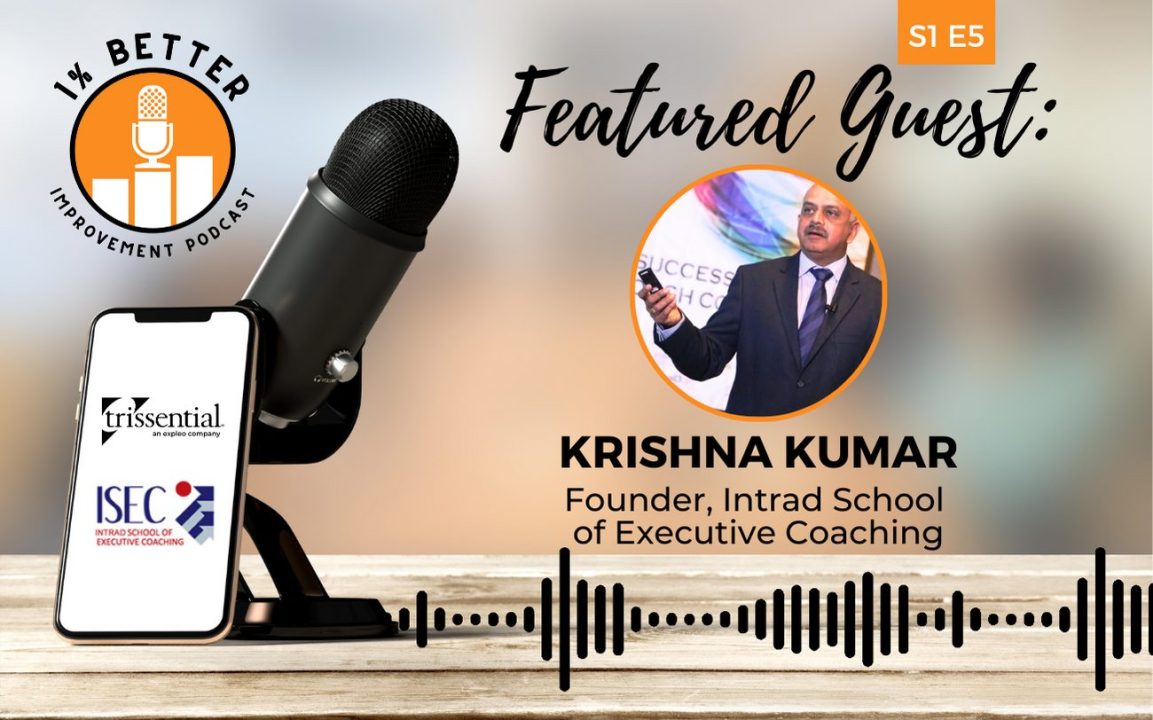
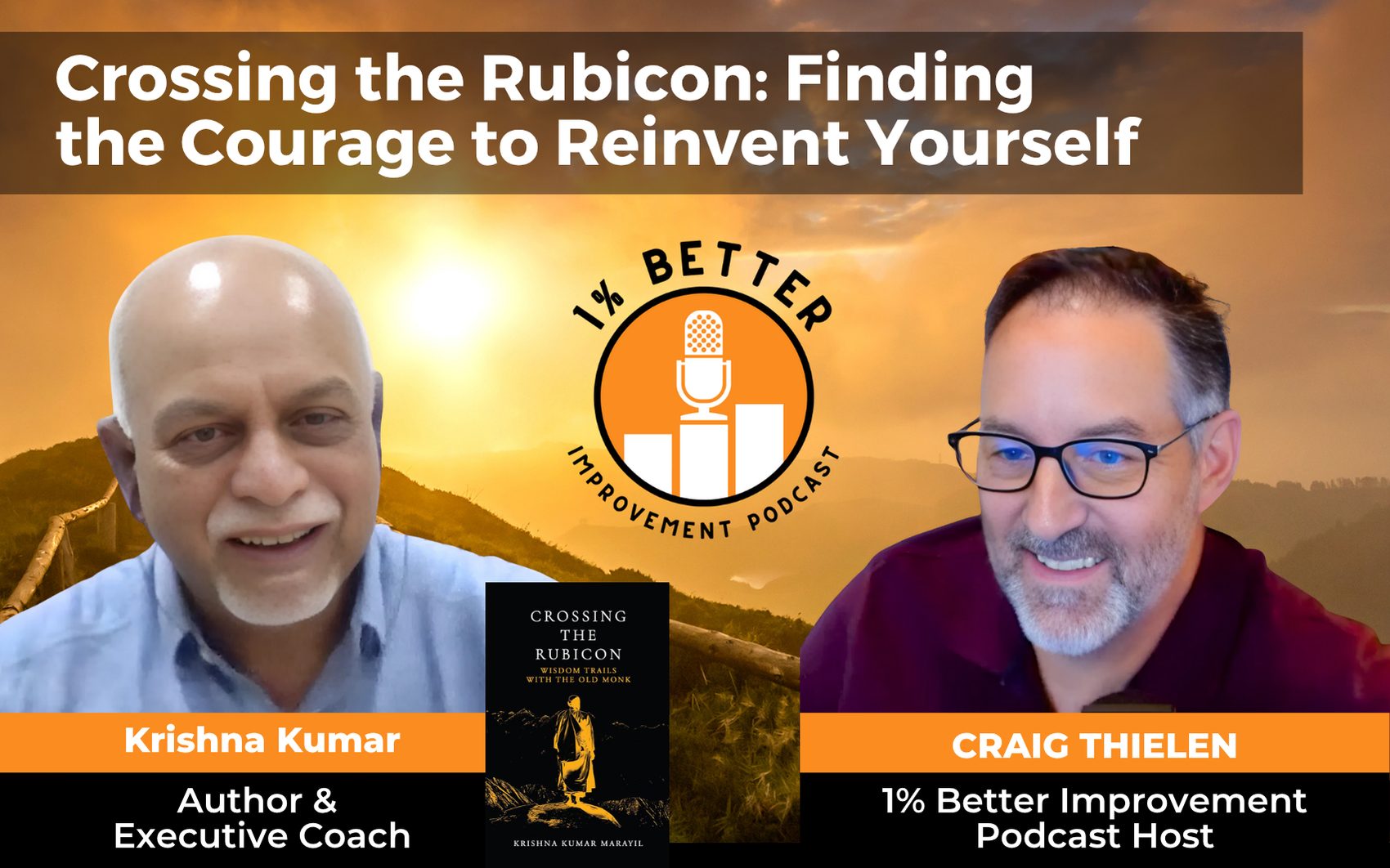
1% Better Podcast: Krishna Kumar
Find 1% Better Improvement Podcasts Here





1% Better: Krishna Kumar, Founder of ISEC
Quick Links
Learn more about Intrad School of Executive Coaching (ISEC)
Learn more about Tim Gallwey’s book The Inner Game of Tennis
Learn more about Dan Millan’s book Way of the Peaceful Warrior
Learn more about Charles Handy’s book The Second Curve
Connect with Krishna Kumar on LinkedIn
Connect with Craig Thielen on LinkedIn
Key Takeaways
- Versatility in Coaching: Krishna Kumar’s career demonstrates the versatility required in coaching, moving seamlessly across different roles— from a senior corporate executive to a sports coach, and then to an executive coach. This underscores the importance of adaptability and the wide-ranging impact a skilled coach can have across different fields and age groups.
- The Essence of Learning and Coaching: A core theme discussed is the fundamental approach to coaching and learning. Kumar emphasizes that the desire to learn is crucial, regardless of age. However, he finds teaching children especially rewarding due to their visible, rapid progress, highlighting the importance of openness and eagerness to learn in effective coaching.
- The Inner Game: Reflecting on Timothy Gallwey’s work, “The Inner Game of Tennis,” Kumar illustrates how effective coaching draws out the answers from the coachee, rather than providing them outright. This approach fosters self-discovery and personal growth, underlining the coach’s role in facilitating awareness and insight rather than dictating solutions.
- Awareness and Self-Improvement: The conversation underscores awareness as a pivotal element in personal and professional development. By becoming more self-aware, individuals can better navigate their paths toward improvement. This principle is central to Kumar’s philosophy on coaching, emphasizing the journey of inner growth and self-awareness as key to achieving one’s potential.
- Embracing Change and Overcoming Fear: Kumar and the host discuss the concept of the “Second Curve,” based on Charles Handy’s book, which metaphorically represents the need for reinvention and adaptation over time. Kumar highlights the challenge people face in initiating the second curve, primarily due to fear and resistance to change. He advocates for introspection and confronting internal obstacles as crucial steps toward embracing change and achieving sustainable growth.














1% Better Episode 5 Transcript
[00:00:00.250] – Craig
Hello. I’m Craig Thielen, and this is the 1% Better Podcast. Today I’m speaking with Krishna Kumar, calling in from Bangalore, India. Krishna is the founding director of the Intrad School of Executive Coaching, a pioneer in the sphere of leadership and executive coaching in India, and an internationally recognized Master Coach. In a career spanning four decades, Krishna has donned many hats, including Senior Corporate Executive, a sports coach, an entrepreneur, a professor at the India Institute of Management in Bangalore, Global President of the International Association of Coaching, a founding fellow of the Harvard Medical School, and a member of the Forbes Coaches Council, and many more. First of all, welcome to 1% Better, Krishna.
[00:00:44.360] – Krishna
Thank you, Craig. It’s wonderful to be here with you. I’m excited and also feel privileged about it, so thank you for having me.
[00:00:49.970] – Craig
Excellent. Well, Krishna, we met about five years ago. I was taking part in an executive leadership program, a very unique situation. It was a partnership between Cologne University out of Germany and the India Institute of Management in Bangalore, otherwise known as the IIMB, and you were one of our professors. I have to say you are easily one of the most memorable of the professors that we had, and you taught us the notion of leadership coaching through the sport of tennis, and it’s very memorable – It stuck with me. We’ll talk maybe more about that later, because I think it’s very sort of central to who you are. And we’ve been elaborating and working on a number of things ever since that time, and I certainly can say I’ve learned a lot from you over that time.
[00:01:36.640] – Krishna
Thank you, Craig. I mean, that’s encouraging to know that you’ve learned a lot from me. I think we learned both ways. My every interaction with you has been great learning too.
[00:01:44.760] – Craig
Well, super. Before we jump into the core of this, it’s been a while since I’ve been in India. It was pre COVID, and so I just wanted to ask you, how are things in India post COVID? And how would you compare and contrast things, are we back to normal or how are things over there?
[00:02:01.900] – Krishna
I think it’s amazing because it’s better than normal. The joke is that there’s a lot of revenge tourism. It’s like people are trying to make up for those almost two to three years lost years by trying to do everything all at once. So India is on overdrive, the airports are full, the travel is awesome. It’s like that.
[00:02:21.060] – Craig
Oh, super. Well, I look forward to making my next visit over there. It’s such a different culture and different society, and it’s fascinating. I learned so much. So one of the things I want to jump into here with you, Krishna, is, as we kind of talked about in the intro, you’ve worn a lot of different hats over your career, and you’ve gotten involved with a lot of different types of work – corporate world executives of all sorts. But you’ve also been on the other end of the spectrum, teaching kids tennis. And so working one on one, I’m curious how you look at personal development across that whole wide spectrum of kids all the way to the most seasoned executives.
[00:03:02.010] – Krishna
Well, that’s an interesting question. I’ve never been asked that before, Craig, so I must think a little. But off the cuff, I would say that there’s fundamentally no difference if a person wants to learn. The challenge people face normally is that, do they really want to learn or are they doing it because they have to? I think when we come to the older age groups, whether they are early level executives or seniors, the urge to learn by and large dilutes unlike that you see in kids who are hungry. And if you ask me honestly, I would say I take a lot more pleasure in teaching the little kids than I would in teaching the grown ups, simply because you can literally see and that kind of links back title of your podcast, you can literally see the 1% better almost on a day to day basis. So that’s the difference, because their minds are still evolving. There’s a lot of, I would say, hunger to fill it up, whereas when we go to the older folks, the older executives, lot of behaviors are set and it takes that much longer to bring about the change. And if there is a resistance to change, then I guess I need hardly tell you that it may not happen.
[00:04:14.270] – Craig
So that’s the that’s really interesting. That that sort of brings me back to, again, how we got introduced and you were teaching us leadership coaching and you didn’t sort of start with academia and here’s all the practices and methods. You started with an example of how you taught a young person, a child, something about tennis, and we were wondering, where are you going with this? And then we of course, figured it out at the end. And some of it is for us that are later in our careers, a lot of things are set and we tend to have a very rigid framework of how we think about things, whereas kids tend to be much more open and much more malleable. And I believe the technique that you were teaching us was based on a book called The Inner Game of Tennis by Tim Gallwey. So tell us about that book and that teaching and how you use that, both in the literal sense of teaching tennis, but also in helping executives think differently and improve and grow themselves.
[00:05:06.150] – Krishna
There are two parts to that, Craig. One is how I got introduced to The Inner Game in the first place, and two, how I apply it. And maybe I should start with the beginning by saying how I dived into this space, quite unintentionally, I must say. Because after my corporate career, I was running a consulting business and tennis coaching was a hobby, a kind of a passion for me because I was certified by one of the leading organizations and I set up my academies and I had a lot of kids. Alongside that, I ran across the work of Timothy Gallwey and Tim Gallwey’s work is kind of off the beaten track. It’s not the conventional way people teach the sport. And he came across this in the 70’s and that’s a long story in itself, which I won’t go into because it’s all available in public domain. But what I discovered there was the teaching of that sport was not teaching, it was all about learning. That was a fundamental thing, because what Tim brought into the space was directive versus nondirective. Traditionally, when you go to pick up something, people tell you what to do. They instruct you and say, you should stand like this and should hit like that, and you should do this. And Tim fundamental approach was, that’s not the way it should be. We should start by saying, you already know, it’s just that you haven’t figured it out, and I’m here to help you figure it out. And that was actually an eye opener for me because he said, if you figure it out on your own, then you’re going to be that much better, you’re going to progress that much faster simply because it’s coming from within you. It’s like you always knew the answer, and my role was only to help you find it. And that’s really what the core of coaching is all about.
[00:06:42.760] – Craig
Yeah, I was just going to say that’s really, in essence, the difference between somebody mentoring or advising and coaching, which is really bringing out what’s already there. This is a famous, I think, Michelangelo quote saying, I don’t create the sculpture, I just sort of release what’s already in the rock. I find it and I sort of expose it. And that’s really what you’re doing with kids. So how would you compare and contrast that with kids versus executives? Obviously, I would think it’s much harder to do with executives because they feel like they’re already built and they are who they are, and you’re saying, no, you have to look deeper inside, but you’re not giving them the answer. And that’s one of the things that I really appreciate. I went through a master coaching program with you after the Executive Leadership Program. You were very artful but intentional about not giving us the answers, which I think a lot of us, especially in the U.S. we’re like, here’s the problem – what’s the answer? Right? And it’s like, well, no, you have to find the answer. You have it and you give clues and maybe some breadcrumbs. But you would always challenge us to find the answer ourselves, which obviously, I think anyone’s personal experience, you learn more, it lands more. It’s not just in one ear, out the other, but it’s something that you can really practice, and it becomes part of you.
[00:07:56.660] – Krishna
Yeah, the core of that you summarized it wonderfully well. The core of this, the challenge that most people run into is to put it simplistically, the fact that there’s a lot of conditioning taking place. They are what Tim Galway tends to call conformity. We live in a zone of conformity. We tend to want to fit in and so the boundaries that we draw around ourselves are boundaries that society has drawn for us. We stop thinking for ourselves and after a while we are not really free agents. So what he says is the movement from conformity to being mobile, mobility of the mind and that’s really what coaching. The core of it is essence of that is if you can get the person to move or open himself or herself to be moved, then you will be able to take them to areas they haven’t been before. They will discover things that they haven’t really thought about. But we’re always there.
We all have ambitions and dreams and goals that we haven’t really reached out for because we buried it, saying that, well, this is not the right time for it or maybe I need to make a lot more money or I got other pressures of family and all the rest of it. So you don’t free yourself and in the process, it’s too late afterwards. And there we come again, which is why I really like the title of your podcast. I mean, there we come again to the 1% better part. Are we really doing this incrementally, which is more linear? Are we doing this exponentially? Are we making the quantum jumps that we are capable of doing but we have not been doing? Because we’ve been in this zone of conformity, of being shackled by whatever thoughts that we have.
[00:09:31.200] – Craig
Right, conformity. But also a lot of times we look for the silver bullet, we look for the easy answer. We want to go from A to Z. And it’s the journey that you have to learn that A-B-C you have to get there and it’s the learning that allows you to get to the outcome. One of the things that we already early in this podcast, we get into this intersection of personal development and professional development. And again, I think in the corporate world we’ve sort of separated those two things for many decades and I think in the past, I would say maybe five to ten years, we’ve started to really bring those two things together, at least start to talk about things like meditation or self-discovery or things of that nature. So I’m curious with you again, your wide spectrum that you’ve worked with people, how do you separate, can you separate personal development and professional development? And doesn’t all development start from within?
[00:10:26.230] – Krishna
Yeah, I think the last line you said is spot on. Firstly, of course, on a more obvious note, COVID did it. COVID actually merged the personal and the professional lives. I mean, majority of the world, the white-collar world, started working from home. So you took your office to the home and not the other way around. So that was more of a physical, practical aspect. But once that happened, the other discovery started coming about, which was that can I integrate the two and just be one holistic self? And where does that begin? As you said, it began within us. And the word for that is awareness. It’s really the key. Awareness holds the key. If a person starts moving on the journey of being self-aware, everything else follows.
[00:11:08.140] – Craig
Awareness, that word. So one of the things that I love about our relationship is you’re an avid reader and I’m an avid reader. And so we share books often. And one of the books that you introduced to me was called Way of the Peaceful Warrior. And in fact, it’s now become into a movie and Nick Nolte is the sort of the star in it. And the whole focus of this movie is this aspiring high end Olympic talent that has all the talent in the world, are on the verge of sort of making the Olympics and living his dream. And he has major obstacles. He first, he starts blaming everyone, this coach, the world, the gym, the environment, his girlfriend, like everything external. And then he meets this character, Nick Nolte, in the movie anyways. And he realizes that it’s all his perspective, it’s all inside, all his impediments are all inside him. And he has to face those before he can overcome and really realize his potential. And isn’t that really the case with anybody, right? Whether you’re an Olympic athlete or an executive or a kid trying to learn a sport, isn’t that good example of it?
[00:12:17.180] – Krishna
It’s a wonderful example. I mean, Dan Millman, who’s the author of that, perhaps lived some of that life himself as a gymnast. And a funny part of it is the boy, the gymnast, who kind of the alter ego of Dan Millman, in the book and in the movie, who runs into Nick Nolte. He kind of nicknames this character as Socrates. That’s very interesting because he picked up the name of Socrates maybe after reading Philosophy 101 or whatever, and he said, oh, you were just like Socrates because you asked me all those difficult questions. But the key to the whole thing is the difficult questions that the man was asking which forced this boy to think on dimensions and layers that he had not thought of earlier. He was very materialistic before, and suddenly that opened up a world. And he was questioning his pursuit, he was questioning his dream. The value of that, which is something that I believe the lessons for that which we can learn, particularly in the corporate world, we haven’t. People are moving in such a quest for the short-term materialistic goals that they are missing out on the deeper self-awareness. And that shift has already happened. It’s happening. I don’t know how you see that because you also have this wide experience with a large number of corporates at senior levels. And so what we are seeing is that people have started questioning, they have questioned the even nature of what it means to be a leader.
As one of my gurus who had passed away a year and a half back, he discovered the concept of flow. Amazing work, amazing man, amazing work, very evolved. And when he used to speak about that because he said the concept of the future leader, the good leader of the future who runs a good business has to focus on three things. And he was very interesting because historically business was all about profit. I mean, go back to the days of Adam Smith and the economists and this if you are in the business of business, you have to make profit. So that was the first P and then later on everybody shifted gears and it became the buzzword that business is about people. And they said well, all people is what makes the business. And so their second P came in and both of them were absolutely right, you need businesses to be healthy, you need businesses to look after their employees. So that was great. But he came up with the third P, which I think is vital in the world that we are seeing today and that was the Planet. And he said a futuristic leader, the really transformative leader has three P’s – the people, profits and the planet. And once you take that dimension in, we have to force ourselves to a level of awareness which most people don’t have. The decisions I meant taking were giving me money, were looking after my people. But how does it impact the wider world? How does it affect the planet?
[00:15:01.830] – Craig
Certainly is relevant today. Everything that happens anywhere in the world instantly impacts other parts of the world. And speaking of COVID we’ve seen that, we still see that. We still see one little blip that happens here can really have massive ramifications all over the world. That’s probably not likely to change with such an interconnected world. So speaking of books and speaking of interconnected world, I want to jump to this next topic which is another book called The Second Curve and I want you to describe it. But really what I believe it is, is helping people understand and sort of get to the next level of their awareness, next level of understanding. And I think you’ve lived this yourself, I think many people have. But how this notion can help people in a world that is changing at a speed at which we’ve never seen. And we’ll get more into next here about what’s really exploding in the world right now, which is AI and generative AI and things of that nature. But talk a little bit before that about this notion of Second Curve and how this helps people adapt to change.
[00:16:06.690] – Krishna
I need to dive a little bit into history for that one, Craig, so you have to indulge me a bit on this, maybe to give a context to those listening in. The Second Curve was actually first publicized by management guru Charles Handy. But more importantly, it’s something that has been there for quite a while. The Second Curve, the curve itself is shaped like an S, which draws from the Greek word the Sigmoid curve. And if you think about it, it’s just like a lazy S, a kind of an S half lying down. But that particular shape denotes the rise and fall of many things, the rise and fall of civilizations, of empires, of dynasties, and more recently, of organizations. And it’s interesting because most civilizations and empires and dynasties and all the rest of it start off in very small, humble ways, and then they accelerate huge period of growth where they can’t go wrong at all, and they at some point peak. And after that, there’s only a fall. We have seen it. Whether it is a Roman Empire, civilization, the same story.
But coming to more simplistic things not simplistic, perhaps, but something you and I can have a handle on, leaving aside civilizations and dynasties and empires, but the more simple thing is organizations. And we’ve seen that. I mean, whether it was Pan Am or whether it is Kodak or Polaroid or any of these companies where they were riding so high, and today they hardly exist. And there are many more. I mean, the streets are littered with organizations that were humongous at one time and nowhere now. And if you drill down further, you see that also in specific products. We can talk about Blackberry’s, and there are thousands of them, which at one time you couldn’t be seen without one, and now you’re never seen with one. So you have organizations and products.
And now we come to the most important thing that’s again relevant to the human being, to the individual, to you and me. We also go through the same thing. We have an initial starting out period where life is good and then there’s a long period of growth. At some point you peak, and then it’s only a fall because once you peak, you can’t go any further up, you have to go down. And that is really where the second curve comes in. Because the challenge of the second curve, and that’s the core of it is, it all depends on where you are on the first curve. And most of us don’t know where we are on the first curve because you know a lot of what happened behind you, but you do not know what the future can bring. So when you don’t know what the future can bring, you coast along happily depending on your past successes. It’s like navigating using your rear-view mirror, hoping for a bright destination. And that doesn’t work.
[00:18:45.540] – Craig
Intellectually, I think we all understand that there’s these cycles, whether it’s dynasties and empires or companies, and products, we all intrinsically know that. We could look at all these Harvard Business case reviews of the Blockbuster Videos and the Motorolas and the Polaroids of the world. And even Blockbuster had an opportunity to buy Netflix once for very low amount, I think it’s $40 million, and it’s now worth billions. So what is the fundamental thing about humans? Because this has been going back for thousands of years. We know that we have these cycles, but that we don’t say, hey, this is on the decline, this is an incline. We need to reinvent ourselves. Is it fear? Is it just this short term, we got to make money and profits? What is the core issue that’s preventing companies, products and even people from reinventing themselves? It seems to be fear based.
[00:19:38.180] – Krishna
Yeah, let’s just stick to people for a moment, Craig, because you have already described the organization part very well. So the people thing is a little more nebulous, a little more hazy. So we’ll come to the people part here and then where the second curve comes in. The biggest challenge on the first curve is knowing where you are, because you don’t, nobody does. When life is good, it’s good. So you think that tomorrow will always be a good day. That’s the biggest challenge. Even for us as people. We don’t see the future as not bright. The problem is we don’t know for sure. We didn’t know about COVID for example, and it’s just very recent. So we don’t know what the future will bring and when we don’t know what the future will bring, and you continue to coast along as if nothing is going wrong, that’s when you need a second curve. And what the concept of the second curve, as Charles Handy described, it was very nice because he said, and this again, something we use in coaching a lot, what he said was that you can start your second curve now… any day… right now. And if you do that, you will be running two curves. You’ll be running a curve that’s doing really well and you’re happy and you’re earning from that curve, and it’s great. But you’re also preparing yourself for the future, whenever that happens. And so you need to create a second curve.
The question is, what is the second curve? Now, the first curve is performance driven because by then you have invested in that curve. You’re getting the rewards and the returns of that curve. Perhaps learning will be a little less there. Perhaps you may not be having as much enjoyment as you did in the past. You come to the second curve. That’s where the learning is enormous, because you want to pick up something that was always exciting but you never got around to it. It could be an exciting hobby. In my case, it was doing tennis coaching, which I just did as a stress buster. But there was terrific learning in that. There was a great deal of enjoyment, much more than I got from my regular consulting business. The performance was better in consulting because I was matured there, and here I was still on the learning path, but I was running both.
You, again, hit the nail on the head when you said fear. I mean, that’s basically resistance to change, the resistance to move out of the conforming zone and experiment. The second curve is a lot about experimenting, finding what you like and what you would like to gain from learning and trying it out and run both at the same time. And that’s going to be the tricky part because you’re going to start it today. You have an existing curve. Both are running together. There’s double the work in many ways. And so what you pick up has to be something that you really, really want to do.
[00:22:11.120] – Craig
So again, it comes back to looking inward and saying, Why am I afraid? It comes back to the peaceful warrior, like, what are the obstacles? And they’re internal obstacles. And change is hard with humans, and we’ve talked about this on previous shows where we’re hardwired in our brains with these neural pathways to not change, actually. And change is hard. In fact, you described a very difficult change. You were moving up the ranks of coaching and tennis, and you thought, man, I have got this really mastered. I’m good at it. I know how to do it. I’m getting great results. And then you met another master coach who is more experienced, and he said, you’re doing it all wrong, Krishna. And you go, what? What do you mean I’m doing it all wrong? And the game had changed, and your philosophy was maybe more rigid. That wasn’t easy to hear for you the first time, but then you had to do some introspection to say, hey, maybe I do need to think about it differently, right? So it’s not easy.
[00:23:04.650] – Krishna
It wasn’t easy at all. In fact, I was running a huge academy at that time. I had about 600 odd students across multiple centers. A lot of coaches, many of them had played up to international levels. And we thought we were doing great till this person came along. He was a great friend, Captain Pavan Murthy, who had retired as a globally renowned coach. And he was retiring, settling in. And I ran into him, and we became friendly, and he came across and watched what I was doing. And then very gently, he said, I don’t think you’re doing it right. And I said, what do you mean? I am certified. I’ve got it all right, and things are happy. No one’s complaining. And he said, well, yeah, you can continue like this, but you’re not going to go very far. So you really want me to do something, I can do it for you, but you got to change. And I can say that I did agree to what he said. And we had to do an enormous amount of change because literally, I’m not getting into the techniques of it out here, but we had to change everything. We unlearned everything. 180 degrees. Everything we did, if we were used to hitting the ball in a certain way, he made us hit it differently. And it was modern tennis, which is still played today by the great players of the world, and we didn’t even know. Well, I’m not going to get into the results, because the results were amazing that happened afterwards.
But for that, it was the beginning of my second curve, actually. And it was the revelation, the awareness that came that you don’t know it all. You got to start from zero very often. That’s something that I have tried to build into my life, but more importantly, something that when I coach senior executives, I say that often, I say, step back, take the time to reflect. That’s where self-awareness comes in and do it very non judgmentally. It’s not easy to do that. And if you do it, you don’t know what the results can bring you.
[00:24:55.810] – Craig
Yeah, that’s a great lesson. Thanks for sharing that. It reminds me of the quote, when the student is ready, the teacher will appear, but you have to be ready to get that feedback. We get these pieces of feedback all the time. Sometimes maybe we’re not aware, we’re not always receptive. So that’s a great story. So that went by very fast. Last question… Looking back at your vast career that we’ve talked about, if you were sitting down with one of your grandkids or a young version of you, what piece of advice would you give them?
[00:25:25.460] – Krishna
That’s the hardest question you ever asked. But let me give it a try. To start with, let me make it a little funny by saying that I never want to have another version of myself. I want only better versions to populate the world. But you know what I mean by that, right? So I wouldn’t ever give any advice, because that’s not what coaches do. But what I would do is… I have to practice what I preach here.
But what I would really do is challenge that youngster, whoever he or she was. Challenge them to keep challenging themselves. And say that I have a game, I play with many of the executives, and I say you should start with the kids to start with. I say that. And I’ll give you this example, and it could be very much connected to the 1% that whole topic is about. I say, imagine that you were filling up your bio data and I gave you only a one page, one A4 size sheet and you got to fill in whatever you want on that. Of course, you may take up some 10% of it with some basic demographics, fair enough. But the rest of the space, you can fill it with stuff that you believe are your accomplishments up to this point of time. And then I’m going to ask you every six months, you need to add a few points there. And because you have limited space, you necessarily have to knock out a few. Now, what you knock off has to be worse, obviously, than what you put in, which means that just a simple exercise that you do or keep thinking about is going to challenge you to better yourself. It’s just a simple exercise. It’s going to take little bit of space in your mind or on a piece of paper, but it’s going to be very hard to do unless you make it a practice that I know that December is coming up, I have to see what I’m knocking off and what I am adding.
[00:27:15.860] – Craig
Right, well hey, that sounds a lot like a 1% Better kind of mindset, right? Just keep making improvements with a growth mindset and great things are going to happen, right?
[00:27:25.920] – Krishna
Absolutely. Great. Like I said, I really love the title of your podcast and this kind of fits in very well with that.
[00:27:34.290] – Craig
Well, thank you so much. I always enjoy our conversations. I always learn, as I did today, and I’m sure all of our listeners are going to learn as well. So thank you Krishna.
[00:27:43.490] – Krishna
Thank you very much for having me on the podcast, Craig. It’s always been a pleasure chatting with you, and we learn from each other.