Find us on your favorite podcast platform including: Spotify | YouTube | Apple | Amazon
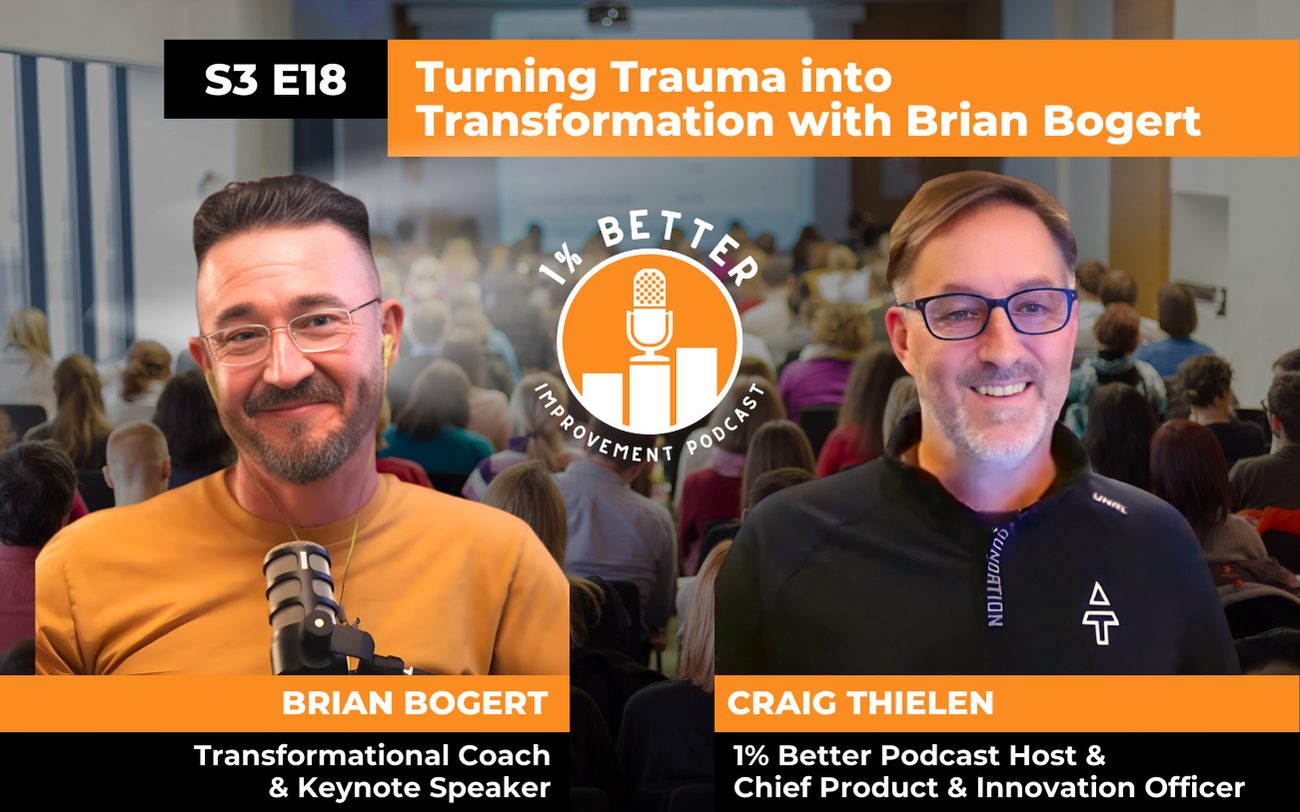
1% Better Podcast Brian Bogert – Quick Links
Learn more about Brian Bogert
Check out Brian’s Flipping the Lid podcast
Connect with Brian Bogert on LinkedIn
Check out host Craig Thielen’s full bio page
Key Takeaways
- Your story matters: Every person has a unique story with lessons that can shape growth and connection
- Pain often hides deeper truths: Emotional pain can manifest as physical pain – healing requires addressing both
- Performance ≠ worth: For years, Brian tied his value to achievements; true freedom came from self-acceptance
- Wisdom vs. knowledge: Knowledge is everywhere, but wisdom comes from surrender, application, and authenticity Choice unlocks power: No matter the situation, you always have at least two choices – asking better questions creates more


















1% Better Podcast Brian Bogert – Transcript
Craig Thielen (00:07)
Hello, I’m Craig Thielen and this is the 1% Better Podcast where small, repeatable actions and learnings can create limitless outcomes. Today I’m speaking with Brian Bogert and this is gonna be a fun one. I’m calling this the Flipping the Lid 1% Better Podcast.
Brianbogert.com (00:24)
Dude, I’m excited to be here with you. Every time you and I chat, I enjoy myself. I feel like I deepen and improve just because of who you are. And so, you know, for you to flip the script on me, I’m excited about it man.
Craig Thielen (00:35)
Well, I am too and ditto. So we’ve had a few conversations. One of them you have that’s called, I think it’s called ‘Rapid Fire 15 Minutes’ and we didn’t hardly even know each other, but man, we just, you just went so deep, so fast. And then of course we did a second session with your podcast called ‘Flipping the Lid’. And both were really, I will say, intense experiences. In fact, I shared, the podcast with my spouse and some of my family members and they learned new things about me so that says a lot about you and I’m excited to get to ‘flip your lid’ if I can.
Brianbogert.com (01:04)
Wow. Wow. Yeah, man. Dude, thank you for sharing that with me. Though I know oftentimes people have new insights or new understandings through the show in particular, not everybody reflects that back, nor does everybody share it with their family and then be able to give that. So you just gave me a gift right out of the gate. Thank you.
Craig Thielen (01:23)
Yes, thank you. Okay, so a lot of times I’ll try to attempt to introduce people, in your case, I think it’s the best route and this is how you do it as well, which is just tell me, Brian, and the audience, who you are and a little bit about your background.
Brianbogert.com (01:38)
Yeah. I always start with, I’m a husband and father first and I’ve said that for over 20 years but my words, my actions, and my behaviors were not always congruent and so today they are and they have been for a long time but it’s not only accountability for myself but it’s also a way just to start by me being vulnerable as I’m human and I screw up but I also have the opportunity to grow at least 1% better every single day. The story that I’m probably most well known for and let me answer the question a little further.
I said I’m husband father first, but I also am deeply fascinated with human behavior, human connection and general performance, and I mean that in any capacity. I love to watch people in their absolute ideal flow state doing their unique area of brilliance. I don’t care what it is, it’s fun to watch people in that creative pursuit, the way that they can connect. And I’ve been studying that for a very, very long time. Now that said, I do a lot in the world, but it’s important, I think, to start with what I was saying a second ago, which is the story that I think most people associate with me is from when I was seven. I was run over by a truck and my left arm was completely severed from my body. They reattached it, 24 surgeries, a whole lot that went with that. But it’s important for me always to start there because I have realized in all these years, yes, how unique my story absolutely is. But every time I tell my story, I also learn deeply how relevant and unique everyone else’s stories also are. And so regardless of the extremities of our stories, what I care most about is for people to be able to learn to pause long enough to extract the lessons they can from their own stories so they can become aware and about those, understand them, and then become intentional in how they apply them in their lives moving forward.
Look, I thought this was my transformation story. We’ll talk about this I’m sure through the course of the show, but what this really was was a story that created a bunch of trash from my past that I pushed through and pushed down for years and it caused me to be disconnected from myself and many others in my world despite having a huge degree of external success. Today, I like to compress time for people to clarity connection and amplified impact.
And we do that through what we call our Waste to Wealth Methodology and a whole variety of supporting tools and aspects that I’ve had to learn and develop in my craft. But my friend, I love people. I’m a highly imperfect human. I’m highly neurodiverse. I’m used to believe I wasn’t creative even as little as five years ago. And I also saved what I thought was going to be the moment that I was going to lose my wife and my kids due to anger as a result of me. And yet we found a path through it. And we’re here today happy, healthy and looking for every opportunity to be 1% better every day.
Craig Thielen (04:16)
Well, thank you. I know it’s a question that it’s hard to answer in a concise way. First of all, just think my first reaction, because I did know your story, and it’s an incredible story. We’ll start there because it defines you. But what I find really interesting having interacted with you, as we talked about earlier, is how you use your story that started at a very early age for you and how you understand people. Like for example, I have a story and as you said, everybody has a story. Now mine’s not the same as yours. It’s not even nearly as traumatic at an early age, but you brought me back to early childhood things that I hadn’t thought about for a long, long, long time and processed it real time with me.
So I just think that’s an interesting thing because of what you lived through, can now do that for other people, whether they think they need it or not. It’s just a wonderful talent you have and a skill that you’ve learned. That was something I wanted to just play back for you. So let’s go back to that. Seven years old, I’m only got, you it’s hard for anyone that’s been through any sort of traumatic event to understand and put yourself in anyone’s shoes. Of course we never can, but how did you process that when it happened? I’m sure there was lots of pain. was lots of surgery. There was lots of a lot of people. my gosh, I feel sorry for you. And a lot of… here’s all the things you can’t do and just that whole cycle. So how long did it take? How did you immediately react in the months afterwards, after sort of all the hospital work, mentally, and then at what point in your journey did you decide to go, you know what, this isn’t going to define me. I’m going to do something even better because of it or something like that. Just walk us through that.
Brianbogert.com (06:11)
Mm. Yeah, yeah, yeah. So a lot of what you just hit really did happen, even for a seven-year-old. I mean, I remember within days, and I would say the first two days were kind of in a fog. I’ve even shared with some people, it was almost like I had an out-of-body experience. I was in and out of consciousness nonstop for those first probably 24 hours. Don’t remember a lick of that.
But then I do remember waking up in that hospital bed and it was still a couple of days before I think I settled back down into fully myself and had some level of awareness. But when that happened, even at seven, I remember the why me? What’s going to happen to me? What is the rest of my life going to look like? And yes, there was a ton of pain, but there was also a lot of perspective because I was in the ICU and I was surrounded by families with kids that were in the ICU.
And those families were coming up to us, me and my parents, nonstop saying, we’re so sorry for what happened to you. We’re so sorry for what happened to you. And even still today, I highlight and address that my story only has gotten attention because of how unique it is. Right? All of the kids that have childhood cancers, leukemias, muscular dystrophy.
Right? Heart… congenital heart defects. Like, what I’m going to call the more normal things that cause children to have trauma and healthcare stuff early on. They don’t get all that attention. Why? Because you hear about them every day. You don’t hear about somebody’s arm getting ripped off and reattached every single day. But yet that same reality is true because I’m sitting there and they’re apologizing and saying, so sorry. What can we do to help you? And then we come to find out that they’re laying in the hospital bed next to me with a terminal illness and don’t know if they’re going to live for another 30 days.
Craig Thielen (07:37)
Right.
Brianbogert.com (07:56)
It hit me really quick. Again, that was one of the moments that I decided I was no longer going to get stuck by the things that had happened to me, but instead get moved by what I could do with them. Why? Because I didn’t know at that moment whether or not my arm would one, be successfully reattached, right? There was still a whole lot that had to happen before then and where it was going. And two, whether or not I’d ever regain use of it. But what did I know? My life was no longer in jeopardy.
Craig Thielen (08:11)
Right? Yep, amazing.
Brianbogert.com (08:22)
Right? I could have bled out in the parking lot. I didn’t say it in my intro, but there’s a woman who saved my life that day. Right? And she taught me a whole lot. I reconnected with her on the 30th anniversary of the accident. And we had a deep, profound conversation that I integrate into keynotes and other lessons. But, but it’s crazy how that works. And then what happened? I get out of the hospital. After I’m shifting some of this mentality, I was in there for probably two and a half weeks.
Craig Thielen (08:27)
Mmm.
Well, well.
Brianbogert.com (08:45)
And in those first few months, and I’m going to say probably year, year and a half, were something to this degree. I’ve said for a long time that I’m only as good as the quality of my questions. And it’s funny because I only recently reconnected why I care so much about questions. It’s because of the number of people who used to stare at me and never ask. Meaning they were immediately writing my story for me. They were already determining who I was, what happened, what I was going to be capable of without even giving me a chance to share my own story. They just stared. Right? And, and okay. So then there was some margin and percentage of people that got the courage to ask… well, he’s a cute little kid. I’ll go up and ask… what happened to you? Then this is the next layer, right? They’d say, what happened to you? I’d look them dead pan in the eye. I was run over by a truck and my left arm was torn off. Now I got really used to seeing adults pick their jaws up off the floor. And then the second thing they would do is they would pause and they’d turn to my parents for validation, which told me what, Craig? They didn’t believe me.
Craig Thielen (09:45)
Right.
Brianbogert.com (09:46)
They didn’t believe this crazy, audacious story that this little seven-year-old kid is telling them, even though it’s what I’m living and wearing in my own truth. They don’t believe me. Right? So then I’ve got this whole framework and mentality where it’s like, okay, well, most people are just going to write the story for me. They don’t even ask questions. The second piece is, well, then they don’t even believe me. And then the third is a layer that you even suggested, which was, then if they believed me, or when they believed me, because my parents would confirm it…
Then they view me through their lens of what they’d be capable of in my situation immediately telling me everything I was and wasn’t going to do for the rest of my life. Well, I don’t know if I can use language on this show, but I didn’t have this word then, but it was the visceral feeling that I feel today when I use this word. Then it was ‘fuck that’.
Craig Thielen (10:27)
It didn’t feel good to you right immediately every single interaction. Didn’t feel good-
Brianbogert.com (10:30)
I hated it. I hated it. But it also also took me years to understand all of the ways that actually conditioned me in areas that were hurting me, disconnecting me, because of how I started to create these protections within myself. Right? And one of the biggest protections was a mental mindset protection. It was literally, well, shit, if they’re not going to believe me, then I’m going to be somebody that the world can’t refuse.
Right? And it was like, I’m going to do anything and everything above and beyond for as long as I can. And the narrative was Brian’s good, Brian strong, Brian’s capable. Brian can do anything and he’s going to do it better than you. And they added a fifth narrative that I didn’t know about for years. I’ll come back to that. But it was a performance arc. Why? Because if they weren’t going to believe me, well, they could believe me the outcomes of what I was going to do. But it also conditioned me to receive love, validation and connection through performance, which I didn’t realize for a long time.
But that also meant it wasn’t contingent upon who I was, it was contingent upon what I did. And that shaped so much of my actions and behaviors for decades in ways that yes, I had a lot of success. Yes, I broke a lot of people’s minds and my own, but I also did a lot of damage to my body unnecessarily doing things to prove things to people that I really didn’t care about. Right? Like my favorite one to tell is I was, I would deadlift 400 pounds. I know I’m not that big of a guy.
But I have a shitload of a pain tolerance. know how to deploy my brain. I’ve learned and conditioned how to overcome it. Well, guess what I also did? I damaged a whole bunch of stuff in my body doing that. Why? Because my body and my frame, especially with the imbalance, there’s no need for me to have to pick 400 pounds up off the ground, other than just to say I could and to show someone else that it was possible. Right? But that was a part of my journey. So I don’t have those regrets. so that’s the early stage though, Craig. To answer the question, those first few years and that those first probably 12 to 18 months while I’m going through multiple surgeries, 20, 22 surgeries over the course of four to five years. But that was what that first arc looked like. It was a hundred percent performance and a hundred percent about how am I going to regain use of my arm if that’s ever a possibility. So years of therapy and years of lots of stuff just to get it to work again.
Craig Thielen (12:42)
So the first part was the pain of having to relive it, people not believing you, just bad interactions. Then it’s like, I’m gonna prove them. I’m gonna show them. I am gonna overcome and do stuff that astounds them. And they’re gonna be blown away by the story. How long did that period last? And besides the dead lifting, what are other ways that you exercise that?
Brianbogert.com (13:11)
Man the list is probably too long to go on, but whether it was learning how to water ski and slalom ski with getting out of the water with one arm because I didn’t have the grip strength to hold on with the left side. Whether it was snowboarding and doing tricks in parks, whether it was playing. became a tennis pro at 15, right? And I would toss the ball up with my left arm. And because I don’t have a tricep, it would just flop and hit me. But I learned how to do it. And it was a mindset thing. I mean I was doing mountain biking at a pretty aggressive level pretty early on.
Craig Thielen (13:25)
Wow.
Brianbogert.com (13:43)
The list truly does go on. Like there was, I say now that it took me a long time to realize this. I always had a very high rush threshold to begin with. But then you throw something like this on top of it and it’s like your whole ecosystem gets thrown off. And for years, it was almost as if I had to push the limits of death just to feel alive. And so I did a lot of things that would have been considered probably more aggressive and extreme for someone with two fully capable arms, let alone the fact that I don’t have a tricep in my left arm. I still don’t have a lot on the left side of my back, right? My shoulder is different size and strength. Like even if I look at you look at the size of my body from the side here, it’s completely different than the size of my body here. And for no other reason than it’s just developmentally what took place. So there was a lot of this now how long did that arc last? If I’m honest? Primary part of the arc before I started to become conscious to some of the ways it was hurting me was about 13 years, but it was probably closer to 25 in total. I just didn’t see all the layers of it, right? I mean, that went for me through high school that went with me through college pretty much until the age of 20. When I went down in a snowboarding injury and re broke my left arm in the same spot it came off.
I almost lost it again. I waved down the snow patrol. I had them air evac me basically to the closest hospital after they got me down the hill. They had no records. I wouldn’t let them give me any pain meds. They reset the bone two or three times, even though it was compound fracture, which would have normally been surgery. And the next 10 months opened up a big window of learning for me, which was that 13 year arc. What happened in that window, I went through seven surgeons who were afraid to touch me. And 10 months with my arm hanging by my side with the bone broken in casts and supports with any moment that risking clipping- you really relived the whole thing- I really did. And I talk about that because I relived a lot of what I experienced as a kid, as an adult, now in a place where I didn’t have the built in ecosystem of my family. Right, and it gave me a different level of appreciation, not just for them and the support that they gave all the way throughout, but, but truly how much I wouldn’t have been able to do myself, even as a 20 year old reliving this. Had they not been such a solid support system to help me learn these things. But my wife and I’ve talked even about today, one of my abilities to see people and see complex systems within businesses or complex patterns within people, because I work a lot with AI, I work with lot with scaling and doing things and identifying issues at an aggregate level. But part of the reason that I see the world so differently, I think, is because literally my entire life, I’ve had to learn how to do things differently. Right? I had seven years with conditioning in a cellular level in those in that first childhood development period with full access to my both arms. And then all of a sudden I’m having to relearn to tie shoes, button pants with one hand again. Those same things I had to relearn to do it 20 because I had forgotten again how to do it with one hand because I got used to being able to use my left arm. But I got super depressed in that period. And that that also was the time that I was getting really frustrated with other people.
Because I though I was on this performance arc, I also always had a really good intent. And I helped a lot of people with a lot of things. And I did a lot for others. Again, this is part of the shame dynamic of that performance arc, it all being tied to love, validation, connection to performance. However, what happens now is I’m in this 10 month window and nobody was there for me. And I got frustrated and I got angry. And then I realized they just bought into the power of my own narrative.
Brian’s good, Brian’s strong, Brian’s capable, Brian can do anything himself, right? And he will, and he’ll tell you. The one they added is, and he’ll ask for help if he needs it. I didn’t know how to do that. I’d benefited from a lot of help, but I never had to ask for it. It was built in with my family. And I- Came full circle then- yeah, yeah. It did come full circle, and that was when I realized how disconnected I was. That was the path of me starting to attempt to regain other elements of myself, though it was still years later before I did.
Craig Thielen (17:46)
That’s interesting. Came full circle then.
So that, I mean that 10 month, the second time around was 10 months when you went through the second part. So what did you, when you came out of that, how did you change? What was different about you? Just in terms of like what goals you had, what you were gonna focus on, what your life was gonna be like.
Brianbogert.com (18:06)
Mm. Yeah, I still had a pretty strong performance arc, but it fed a lot of that next period for sure. What I realized was how disconnected I was. And so I really started to pay attention to at the time what I believed was the glue that bound human connection, which was vulnerability and authenticity. I also realized that though I was surrounded by people, I often found myself completely alone and that wasn’t what I wanted.
Right. But I did not have a healthy model for chasing who I was or who I was doing this for, who I wanted to be surrounded with. What did I have a model of? What the world has taught us all, which was what house, what car, what amount of money? I didn’t have a who model. I had a what model. And so I went into this idea that I’m going to do all these things. So I got very good at sharing just enough about myself in a vulnerable way. Right. And then asking really good questions to get someone else to open up.
Right. And what was really happening for a long time, Craig, is I was getting very, very good at sharing just what I wanted to so that I could open them up and drive a Mack truck through and focus on their problems and not mine. I thought I was doing something that was productive, that was helpful, that was establishing better connection. And I was, it was still coming from a good place, but I still was blind to how disconnected I was with myself. Cause it wasn’t a conscious thing to do that. It wasn’t a point of manipulation. It just was how I went to that next phase. But the same thing was true. I had the what model, what house, what car, what amount of money. And by 27, I was a partner in helping build to establish a $10 million business. I had the house, I had the car, I had the money, my bank account was full, but I found myself still empty. And that was one of the moments that I really took a pause.
It was one of the first times I actually really understood that I had shame, that I had anger, that it was affecting my business, that it was starting to affect my relationships. But there still wasn’t that emotional depth and resonance. It was still very intellectual. Hired my first coach. All of those things got put into motion. But again, it was five more years before I really opened up. And I’ll pause after this to see where you want to take it. But you know, 27, I had all these things and I started to realize how empty some other people were. But it wasn’t until 32 that I realized that I wasn’t feeling emotion at all. It was a moment with my daughter that she brought me to tears and it was so profound. Everything else was pale in comparison. And that’s when I realized that when I shut off physical pain, when it exceeded my ability to cope, I shut off mental pain, emotional pain and spiritual pain for 25 years and didn’t realize it.
And so I would tell you that 32 was really the beginning of like my real healing to where I am today at 40. And that’s been the most profound growth and it’s been the most exponential impact and also simultaneously some of the most difficult times because of what surfaced in that window. But though I healed physically way long ago, I would have told you I healed mentally even up through my 20s and early 30s. I didn’t even open up the emotional and spiritual side until eight years ago.
Craig Thielen (21:19)
And you think what helped you do that? Was that specifically like therapy or self-reflection or what was that?
Brianbogert.com (21:27)
The moment with my daughter made me realize it, right? I’m a big believer that we sometimes have to feel something, experience it to even see it, right? And as I’m crying, I had conditioned tears out of myself years ago. And I want to be clear, I think men crying is a sign of strength, like I do, this is what I believe. But I also conditioned myself to not cry for so long that I’m still learning to reaccess tears. And yet I’ve cried three or four times in the last year, and I’m celebrating that because I’m like, shit, I couldn’t cry for so many years.
Craig Thielen (21:45)
For sure.
Brianbogert.com (21:55)
So when I’m crying with my daughter, it was such a profound moment because I was happy. I was like joyful, but she kissed me on the cheek and said, I love you, Dada. And I just started bawling. And so that’s when I like really started to realize, okay, wait a minute. If this is this feeling, I’ve never felt this before. I’ve never felt anything before. But that’s also when I started to be able to connect the dots to realize how much I was actively, but unconsciously suppressing every emotion I ever felt. It’s not that it wasn’t there.
Craig Thielen (22:06)
Hmm, that’s something.
Brianbogert.com (22:25)
It’s just that from the stimulus or trigger, the time between when my body would feel it, my emotions would trigger and it would go to my head was milliseconds. It was so fast because I didn’t want to feel because why pain hurt and it hurt for a long time and I learned to shut it off. Right. But, but it also manifested in different ways. And so that’s, that’s a big part of the truth is that what did I do? Yes.
Craig Thielen (22:39)
Right. Yeah. Yep. Yep.
Brianbogert.com (22:51)
By the way, the only number I’ll probably you’ll hear me flex probably ever is in the last 13 years, I’ve invested over a million dollars in myself in healing, in therapy and coaching in alternative like approaches to medicine. So the answer to your question is how did I do that? A whole variety of things, but there wasn’t a single one that got me there. It was a combo of a lot of them. And then I had to ultimately find my own path with all of it, which is what I kind of believe for everyone. We can give people frameworks, but they’ve got to find it. So I just had to slow down the feeling long enough to realize and understand what it was. And then once I could slow it down, I could feel it longer. And then it started to map in the areas that I needed to with intention. So yes.
Craig Thielen (23:16)
Yeah. There’s a million. Yeah. So one interesting part of your story is very standard part of human physiology, which is when we have something painful, we bury it in our brain. And there’s a wall there between our frontal cortex and our animal brain. that’s where we, because whatever happens, to us, no matter how bad, PTSD, however bad it is, you can’t think about it every second of every day. You can’t live that way. You have to go get milk. You have to work with your children. You have to work. have to do all this stuff. And you just can’t focus on the pain. I think for you is just more extreme, right? The physical pain that you had, you immediately buried any emotional pain and said, I’ll out work, I will toughen up, I will get through this. And so that wall was, instead of a six inch brick wall, maybe it was a two foot cement wall. I don’t know the analogy, but I think that’s true of physiology and some analogies. And then we all deal with this. Like every single person that’s ever been a human has pain. Okay, that’s a human experience. How great it is, it’s all variable and it’s contextual and it’s a lot of different degrees. But there’s been a lot of, I think, discovery in this field in the last 10, 20, 30 years. And what they say, therapy, PTSD is a great example, because we have so much of it because of war and different events, right? What used to take years and years and years of therapy to try to just tap in and hammer through that wall, little pieces at a time.
Brianbogert.com (25:06)
Mm-hmm. All around us. Yep.
Craig Thielen (25:19)
There’s some other therapies like, for example, psilocybin or other DMT, ketamine, like all these different sort of psychedelics can immediately break down that wall. Like it doesn’t exist and you access it all now, then you can deal with it. So in some cases, people have been cured of, you know, alcohol, drug addictions have been cured of PTSD in like a single session. So there’s a lot of different modalities now.
Brianbogert.com (25:23)
Mm-hmm. Yep..
Craig Thielen (25:46)
I’m not asking you to share all of yours, but does that make sense to you?
Brianbogert.com (25:48)
happy. I’m happy to – I’ve done if there’s a healing modality out there, I’ve probably done it. And I’m a big believer in plant based medicine. I’m a regular user of cannabis at this point today. What I will say is even leading to what some of the things are that you mentioned just because I’ll reference the specifics around the path that you were. I am a huge, huge, huge believer in mind altering or state altering additives, plant-based medicines or ketamine, DMT. I will give a giant caveat. I am not a giant fan of a lot of these things being done recreationally, unguided, or in repetition at such a level that like there’s no time for integration. So I highlight that as a big distinguishing factor before I make any comments. But weed, cannabis, it was that or narcotics for me. And this was about eight or nine years ago. And so what’s funny is, yes, though I had physical pain in terms of like, could shut a lot out. What also started developing very early on, I lived in nearly daily physical pain for almost 31 years through this recovery without understanding, and it would get progressively worse, right? That wall that I had created, as you described it, the first layer of it that got majorly knocked down was when I was 20. And what’s funny is I had never connected the dots on this until I was listening to you communicating that I knew the pain that I’d been in before that. But like, as you were talking about it, I’ve always joked that I’m dense enough that I like need sometimes to just get hit to see it. Like it’s got to be that big and dramatic. What’s funny is there is a definite exponential arc in my daily physical pain that went after that 10 month window that I don’t think I ever connected to that timeline in the same way. And so I think you gave me a gift today and that, but where am I going with that? Almost every single day, this is what I lived with. And before I tell you the pathways I used, it’s important to understand I’ve now lived without physical pain for nearly two and a half years. And there wasn’t a single thing I did, but however, it’s the deepest level of congruence and the deepest level of healing I’d ever reached in my life.
And I will tell you definitively that a majority of the physical pain I was experiencing, at least in the decade leading up to me being out of pain was not physical pain. was emotional pain manifesting as physical pain. So here’s what I’ll say though. I started using cannabis eight, nine, 10 years ago, somewhere in there. I’ll say it for those who care. I was in a state where it was medically available and I did go through the proper channels to take care of that. But I also am a big believer in it. My brain works off patterns so I could quickly diagnose stuff. But like to your whole point.
Craig Thielen (28:05)
Ugh.
Brianbogert.com (28:26)
Paranoia and weed is just where your insecurities lie. Why? Because weed helps lower your armor. Exactly what you just suggested. I didn’t even realize I had social anxiety until I started becoming a cannabis user. And then I went out in public, high for the first time, and I was like, ⁓ shit, why everybody’s looking at me? Like, why? And I realized how much I still cared about the outside lens because that paranoia was showing me something I could work on.
No different than anything else I’ve had in my life. I’m always looking for the flashlight to shine in the dark corners to figure out what tool, what modality can I use? Psilocybin I used and I micro dosed in multiple situations and still do occasionally. It did miraculous things for my nervous system and I’m convinced that it actually helped unblock some of the nervous system connections that despite the fact that the physical nerves were connected, there was still communication challenges in certain areas of my arm that psilocybin directly had an impact with.
Craig Thielen (29:17)
Yeah.
Brianbogert.com (29:21)
Right. I’ll also say I have only ever tried to trip on psilocybin one time. And the reason I’ve only done it one time is because I did a ridiculously high dose. I did a ridiculously high dose under advice and guidance as to what I was trying to accomplish. And I never tripped. And here was the lesson for me. The removal of expectations. What I’m a big believer on is that plant based medicines especially will always surface the lesson you need, not the lesson you think you want.
And as long as you’re paying attention and you go into these things with intention, no different than going through talk therapy, getting a reflection from me on my show, right? Using weed or other alternatives. It’s the same thing I feel for prescription based medicines, if, where and how they are applied with intention and with knowledge. And so for me, there’s always been this dynamic mix of mental, physical, spiritual, and emotional components that I can integrate to increase my overall either performance, awareness, quality of life. And it’s this iterative process that I was referencing earlier that I had to do to just learn to do basic things that I think has actually become one of my superpowers because I don’t see things in a traditional manner at all, ever. And everybody’s always like, where did that come from? I don’t know. It’s what came to me.
Craig Thielen (30:32)
I think that’s one of those, right? Yeah, no, I think that’s one of those gifts that you don’t know you have until you know you have it. That you had to, no one would wish any of the pain and agony and suffering that you had. But because nothing was quote unquote normal, there’s not a single thing past seven years old that was quote unquote normal for you.
Brianbogert.com (30:57)
Right.
Craig Thielen (30:57)
Your brain was rewired to, well, of course it’s not normal. So nothing’s normal. Everything is for me to try to figure out, which is different than maybe someone who has been taught, follow the rules, just do what you’re told, play by the rules, everything will work out. Okay, well, I trust you, because I’m just gonna keep following and following. You never had that mindset. You didn’t have a mindset.
Brianbogert.com (31:17)
Mm-hmm. However, I do need to highlight something though, because there’s a very interesting dynamic of things that just popped up when you said that. And I say this with grace and love before I say this, because I am undiably loyal to my parents, my brother, my dad, my mom, but as is the case with me as a parent, as intentional as I am, I know I’m doing something that’s going to have some residual effect in their lives or the way they think or the way they view themselves or the way they operate that would have never been my intent. Right. But somehow it happens. And I say this because I know that with my parents, they only ever had the best intent in mind. But I often say I grew up in a household, Craig, where there was one right way to do everything. I just didn’t often know what that right way was until I got in trouble for doing it the wrong way.
Right? And so what’s interesting is you’re right in terms of like capacity, creativity, like lack of bounds in terms of what can be possible. I was very wired that way, but this deep conditioning of discipline, behavior, and what I’m going to call control and perfectionism that was there designed to create safety actually also created this sense of self where I had this unhealthy relationship with authority.
Right? Like I was like, I actually made myself very small. I was afraid to step out in some ways. I had shame that developed in ways that I could not like do anything other than have a big reaction that was covered by anger. And so, yes. And I think that it’s me having to unwire that side that has actually allowed me to fully step into both the gift that I think I was given as well as the benefit of this kind of unconditional thinking that can open up possibility. I was only scratching the surface of that until I healed the need to justify, defend or protect everything I was doing because I wasn’t believed for so long. And I would often feel like I did everything wrong. And so that dynamic still hit me despite having the creativity and external success. And I’m trying to highlight that because no matter what people see on the outside, there was a lot of time on the inside I was suffering.
And that’s what I’m also wanting people to see is like I didn’t even realize it because I’d shut it all off.
Craig Thielen (33:31)
Right, you didn’t know it until you knew it. So one interesting thing is that it sounded like, and I’d like you to go a little bit deeper. You said you worked with people lot and you would give them a little bit about you so that they would open up about them and then you would just drive the bus through and you would help them. So a lot of people, I imagine, had their own trauma, their own, you know, pain, suffering, and you were able to help them address it, call it out, go deep, go where maybe they weren’t comfortable going. Is that true? And isn’t that interesting that you were able to do that, but you weren’t even applying it to yourself?
Brianbogert.com (34:09)
Well, that’s yes. Yes, it’s true. Yes, it was part of what I would say is a little bit of an intuitive gift that I was given that I had to also understand. Why? Because I do see people’s pain. I see their protection.
But I think because so often I wasn’t given the chance to have my potential be seen through those things or the outside of what people saw. I also have a very non non-judgmental and objective view and seeing people’s potential through their pain and their protection. So I’ve always had an ability to ask questions and surface things or see things and reflect them back in a way that would be empowering or would move some energy for people that would have impact. I did it in different ways. I did it in the philanthropic world. I did it in the nonprofit world. I did it in volunteering… I did it through my work with my associates. I did it in work with my clients. I just didn’t realize I was doing some of it to the extent that I was because it just became normal for me. However, it’s also one of my superpowers today is my ability to compress time for people in that exact same skill set that I did condition, but I wouldn’t have told you then that I wasn’t doing the work on myself.
What I do know though is that I’ve often said that vulnerability and authenticity are the glue that binds human connection. But human connection without emotion is not human connection. So I was doing the work and getting the conditioning, but I didn’t have the empathetic and energetic or emotional response, which is why my wife, and it used to frustrate me so much when she said it, would say, you are the most sympathetic person I’ve ever met, but you don’t have empathy.
And inside I’d be like, what do mean? see everybody’s emotions. I can label it. I can describe it. I can communicate it. But, but empathy is… I am because you are. I can be in like, I see your example because I understand it from my own. And I didn’t unlock my emotions until 32. And so that’s the point that was interesting is yes, I was doing this work and yes, it was good intent. And yes, I was working on myself. I told you, I hired my first coach at 27 and I went deep and I did a ton of work on it, but you can only go so deep… if you’re unconscious to the fact that you’re not even experiencing emotion.
Craig Thielen (36:19)
Yeah, there’s a lot to unwire, right? Let’s shift gears a little bit. What point did you decide, determine, set this goal that you wanted to really focus on helping people, and you set this big, harry, audacious, goal you wanted to impact a billion people?
Brianbogert.com (36:38)
So I would say that it was a series of events. I’ll keep it tight though. I hired my first coach at 27, like I mentioned, and within a month of working with him, and I don’t often reference his name only out of respect for him because I don’t ever want it to seem as if I don’t give the credit, but he’s somebody that I’m grateful for always. Ben Newman is his name. And one of the things that he said to me within a month of working with him was, Brian, you’ve got to be doing this. And I said, what are you talking about?
He said, you need to be speaking and you need to be coaching. I was like, yeah, fuck off, buddy. Like I’m paying a lot of money not to tell me how great I am, but to help me figure out these other things. And he just kept coming at me and he kept doing it. He’s like, Brian, you get the personal story of the professional story. You are always helping people in nonprofits. You raise money like people you’re helping individuals, you’re helping organizations like you have it all. Why would you not get paid for it? And I was like, that’s not why I’m doing it, bro. Like, stop. I’m not like that’s not even on my radar. Don’t even talk to me about it. Well, he kept doing it for nine months.
And then the universe sent me a signal that I could not ignore. And I decided I would jump in. And it was a 30 day window that which the weirdest most obscure thing I don’t even believe it honestly when I say it other than it happened. Over 30 days the universe was clearly trying to help me hear something. I got an email, a text, a phone call, ⁓ personal comment, a DM… Every day, at least one for 30 days from an organization or a person saying, thank you. Thank you for the impact you had on my life. Thank you for helping us get clear to help us raise that money. Thank you for the donor and the relationship that you helped deepen here. Thank you for helping ask the right questions so that even though we ended up buying insurance from you, what you actually helped us solve had nothing to do with insurance. Like it just went on and like the first week I was like, well, that was weird. I laughed it off. The second week I was like, okay. The third week I paused because it was just weird at that point every single day. It was weird. And I started talking to my wife about it after like the second week and I was like, I don’t know what’s going on. And it happened every day for like 30, 35 days somewhere in there. And it was about the, like the fourth week that it was like, okay, I got to listen. So then I had to decide, is this complimentary or conflicting on my current path? Cause at that time I was only on a growth path where I was at. had no visions of nothing that I was going to leave. So this was like another way to fulfill some of my passion that I was already doing in the community through philanthropic and nonprofit and volunteer work. And I was like, so this will be a great way to just, to do this in a different way. Awesome.
That was great. And that was the part of where it started, but it wasn’t until 2019. So this would have been probably two years after I started unpacking emotion, but still in this kind of performance arc. 2019, my wife and I went away on a weekend and she… as we’re headed back to pick up the kids, she’s like, Brian, what would you do if you didn’t have to go to the office on Monday morning? And she unlocked a whole bunch in me.
Immediately, was like, babe, that’s a pretty loaded question. Why don’t you tell me more? Because I’m sitting there swirling in my shame, flooded in my fear, drowning in my doubt. And she’s like, babe, you are living a life that I don’t think is totally aligned. I think you’re dying a little bit inside every day you live in insurance. She said, I don’t think you’re scratching the surface of your potential or the impact that you can and want to have in this world. And she said, and if I’m honest with you, we need and want 100% of you and we don’t have it.
So she said, I don’t care if we live in a cardboard box on the corner, but what I do know is that I would double down on the bet of Brian Bogert every single day. So why don’t we double down on this bet and let’s see what you can do if you leave and go see what you can do to create impact in the world. So that was 2019. Three months later, I announced it to my business partners, our COO-
Craig Thielen (40:21)
Was that completely separate from this, your coach giving you all the advice on the 30 days of straight- completely separate, this was 4 years later.
Brianbogert.com (40:27)
Completely separate. This was four years later. Yeah. Yeah. So she knew everything I was doing in this business. I was excited about it. I wanted to do, but it was a side project still. And that was her chance to say, like lean in. Literally three months later, I communicated it and 10 months later, I executed by selling the business and I left. And so it was May 1st. Yeah. June 1st, June 1st of 2020. That was day one of doing this full time and that was when I started to focus on that that impact goal and yet a whole lot has happened in the last five years, too.
Craig Thielen (41:01)
Yeah, well, how amazing is that to have a partner who’s that aligned, that aware, that supportive, et cetera, et cetera. You know, there’s a lot of folks that would be like, hey, what you get a great job. We got a great life. You have we have all the stuff. Don’t screw it up. Right. So that’s great.
Brianbogert.com (41:21)
It’s not lost on me how special this woman is. I mean, she’s my partner and- she’s a keeper as they say- Yep, and every single morning when I wake up and she’s still in bed next to me, I celebrate a victory right of the gate because she’s still giving me one more day, right? And that’s kind of as much as I see a 20-year horizon, I try to live as if it’s every day because every day does matter.
Craig Thielen (41:23)
Yeah, she’s a keeper as they say.
That’s awesome. It’s interesting. I’m a book fanatic. You’ve said about 32 different things. In my brain, it’s like I have a book for like every, like you said, live every day like it’s your last. Well, that’s the Last Lecture, right? The Flow by Chimileski, The Flow State. You said you were a student of that. So anyways, it’s interesting. So let me ask you this.
Brianbogert.com (41:55)
Mm hmm. Yeah.
Craig Thielen (42:09)
You and I talked about knowledge versus wisdom… So you had a lot of knowledge. You’re a smart guy. You’re well-studied you you understand the world… You could see things in other , but yet you weren’t in the early days able to just sort of apply that and see yourself necessarily or allow yourself to go deep in yourself and drive the truck back inside you. So how do you think about that knowledge versus wisdom, based on your own life experience, and then how do you help other people because a lot of people go Yeah, I know that. I know that I should be doing that I know I should be doing that… but they don’t. They don’t act upon it. They don’t reflect. They don’t take the clue… etc. etc.
Brianbogert.com (42:47)
Yeah. So that’s a really big question, and I’m really happy you asked it because nobody’s ever actually dissected that statement or thing that I’ve I’ve I’ve I’ve suggested in the past. I think knowledge is extremely important. Right. To your point, like I do believe in education. I do believe in access to resources. I do believe in being ⁓ diverse in terms of our experiences, knowledge, capacity, skill sets to the limits of whatever each and every one of us are capable of. Right. Because we all have slightly different capabilities, capacity, resources. And so I think knowledge is unbelievably important, but we also live in a world today where any information, any knowledge you need is only fingertips away from you. And so the need for you to know it is either because you need to prove it to other people on how smart you are, what you know, or how you know it, or it’s because you’re applying it to develop something that’s a passion or your business, or you just want to get better at in your life. So knowledge though is readily at our fingertips, wisdom I don’t believe is. And at least for me, I associate this example to like when I would go on stage or when even I was coaching people. If I was in a place where I felt the need to access knowledge, I’ve thought for years I have a really shitty memory.
Why? Because the second that I’m in a position of pressure to have to access a piece of knowledge that I once knew for the sake of showing how smart I am or for whatever reason I’m trying to bring it in to the mixture, there would be blocks and it could never recall. A great example, I’ve rebuilt five or six different engines from the block up.
I could not describe to you or tell you if you ask me questions, details on the exact parts and how to put it together and the workflows. But yet when I’m in front of the vehicle, I know what to do and I intuitively can follow that. And if I need to find more resources, I do. But like when I was speaking or coaching, I used to worry about what I was going to say, how I was going to say it. Am I protecting the person? Am I going to be in a good place in performance on stage?
And when accessing knowledge, that would be memorization. That would be trying to access things that I would say in the exact way I say it because I’m worried about that. Every time I did that, it would be gone. And I would have anxiety all the time before I would go on stage because it’s like, well, am I going to be good enough? Am I going to say the right thing? Am I going to do it the right way? Why? Because I’m still being judged based on what I do, not who I am.
And so it wasn’t about accessing knowledge. It was about learning to surrender and trust that I have always had a gift for gab and language has always been very accessible to me. But if I’m not worried about what I’m saying or how I’m saying it, and that doesn’t mean it’s total disregard, doesn’t mean I’m an asshole and I’m rude. It means that if I’m not worried about it from a judgment, criticism or performance standpoint, then the knowledge I need is always there, but it flows through as wisdom
Right? Wisdom is when we can take something because we have understanding and be able to discuss it, communicate about it, teach it to other people. There’s lots of things that I can do that with, that if I was asked to just teach the knowledge and the facts and I needed to perform on a test, I probably would still fail. But yet I could sit down and distill it in a 30 minute conversation with somebody if I’m not worried about how it’s going to come out.
And so the difference for me and being able to exist in wisdom was truly that surrender, meaning I’d gotten myself to a place where I knew who I am and my value isn’t rooted in what I do any longer. Which means that I also don’t care if I make a mistake in something I say, I’m the first person to throw myself on the sword. I often self-correct mid-sentence. If something comes out and it doesn’t land or it feels if it’s not congruent, I check myself real time. Why? Because it’s honest, it’s truthful, it’s vulnerable. And I’m not trying to hide anything.
And so oftentimes I believe that knowledge we acquire, wisdom is how we deploy. And we’ve got to be thoughtful about how that shows up in our lives because I’m the kind of guy with any hobby or anything. If I’m interested in it I see a business purpose, a life purpose, a skill set or a passion, I’ll buy all the equipment, I’ll invest myself and I’ll try to reach mastery as soon as I can. But the cool part is then, all that knowledge stacks on itself until now, all of a sudden you see the bigger picture.
You see how the ecosystems connect together between sales and marketing and leadership and operations. And that doesn’t mean I need to be the subject matter expert in all. But what it does mean is that if I get the tertiary knowledge that I need and I trust that it’s going to be there whenever it needs to be there and relevant when it is, so far when I’m in that state of surrender, it’s always there when I need it. Wisdom is always there when I need it.
Craig Thielen (47:27)
So you have to give into that. ⁓ I’m curious, like when did you, you had to trust yourself essentially. You had to give into, you know what? Get over the, what people are gonna say, judge, look at me if I screw up, say the wrong… get over all the superficial stuff. But then you had to trust like, hey, when I need it, it’ll be there. Or I’m gonna be authentic enough that even if it isn’t, it’s okay. They’ll understand I’m a human.
Brianbogert.com (47:39)
Mm-hmm. Yep.
Craig Thielen (47:55)
So when did that happen along this whole timeline that you were able to trust yourself?
Brianbogert.com (47:58)
In the last three to five years, and I’m, I would say that with a massive focus in the last 24 to 36 months, and it’s, it’s increasing. And what I have noticed, and this is kind of interesting as well. I mentioned earlier, I’ve been out of physical pain for nearly two and a half years now. I don’t… just like the fact that I was totally unconscious to the lack of emotion.
Though I’ve taught this work and the waste and what we carry and the weight of all of these things, when the weight and the veil of pain lifted, I don’t even know what my capacity is yet. It was like I was running with parachutes behind me for years, and yet I’m still running and in the race with parachutes, and now I just cut the parachutes off, and I’m like, whoa
It’s like training with weights or train… It’s like all of a sudden I’m and I’m I still don’t know what my capacity and what my limits are currently I did until I was out of pain. I had found the limits and I was living right at the limits of what I was capable of every day. And right now I feel like all of this is being compressed in even more time because even to that point like since being out of pain, I’m even more comfortable in my own body than I ever was. And I was already comfortable in my body. Like I don’t hide my arm. I don’t coddle it. I’ll be on stage in front of 2000 people. My arm’s four inches shorter. It’s clearly smaller and half or more of the room won’t even notice my arm until I call attention to it. Right? So like, it’s not like it, it doesn’t, I don’t even see it that way. And so I highlight that because it is super interesting, but I’m still working on this. Right? As much as I feel like I’ve gotten to today and I’m light years ahead of where I was even two years ago, I still feel like there is so much room for improvement for me in this area. And I’m every day, to your point, trying to challenge myself to catch any time I’m withholding. If I’m not existing or speaking within truth, if I’m out of congruence in my actions versus my intent, if, and not from an overly critical standpoint, but just a thoughtful level of awareness that allows me to have that stacked and congruent and, you know, ultimately exponential growth as the knowledge stacks and it starts to become wisdom.
Craig Thielen (50:18)
That last piece when you said, I don’t even know now what my limits are. That’s one of the most like beautiful things to experience, you know, for yourself personally and anyone around you. Like, isn’t it just a beautiful concept to go, I don’t even, cause there’s so many constraints put on us, so many, you can’t do this. You’re not smart enough. You’re not big enough.
Brianbogert.com (50:34)
Mm-hmm. Yeah.
Craig Thielen (50:44)
Well, you can’t play this sport. You’re never going to make it here. There’s there’s so much of that in the world that when somebody gets to a point where they go, you know, I actually have sort of let a lot of that go. We’re always working on it. It’s not like it’s but when you mentally flip the switch and go, I’m pretty sure I could do almost anything. Things that people thought. Now you are doing these things early in life, like physically just to prove a point, but-
Brianbogert.com (51:12)
But I didn’t-
Craig Thielen (51:12)
You’re not talking about that. You’re talking about mental, emotional, spiritual, impact wise. Freedom! That is one of the most beautiful things to think about, isn’t it?
Brianbogert.com (51:18)
Freedom. It really is. And you’re right, I was doing it before, but I was doing it with major constraints. I did it physically. I did it mentally. And sometimes those two would support each other. But there was not the emotion and there wasn’t the spirit that was behind it. And so I was really only operating with half of the categories of self for years.
And so I did, because why? My willpower, my mindset, my work ethic, I could push through more pain and more discomfort to do things. And that was something that I learned early. I had to. But to have all access to self and also be in a position where again, I don’t have any of the constraints of feeling the need to justify, protect or defend any part of who I am to anybody. I don’t care who you are, what you’re doing. And again, that’s not disregard for humanity and respect and communication and connection. That’s just… my value and my worth is not dependent on any singular person’s opinion of me in any way. Right. And so that also allows me to open. And I think there have been some other additional reflective periods that I’m not even sure that I’ve fully understood how others have viewed me in different ways. Your comment just a second ago made me think of something. And I give a caveat when I say this because it was a really vulnerable moment with my brother and I’m going to share it, but I think I’ve only ever shared it one other time. And this was in the last six, nine months.
My brother and I have always, he’s 14 months older and so, and he was there that day. So he witnessed it and that put him through his own level of trauma. And I highlight that just to start, because he saw things that I’ll never see. And, and immediately his best friend and his playmate was not his best friend and his playmate for a little while in the same ways and wasn’t going to be. And so I only give that context because on top of all of that, we’re both highly athletic and very competitive people to begin with. And so that led to like a great friendship, but also a lot of camaraderie and a lot of conflict over the years. And so I’m not even sure I fully understood all of this until somewhat recently. He said, Brian, you know, I haven’t always had the greatest momentum or the greatest motivation or the greatest drive or the whatever. But he said, you know, I, I’ve never viewed things in a way that something wasn’t possible. And I said, what do you mean? And he goes, well, like, I’ll be coaching people, developing people. He’s helped others, you know, stand something up with a tech standpoint or get a CRM established and built. And he’s like in the mortgage business, but he’s doing it because it helps them. And he’s like, well, if I take one or two extra steps, it can add value to them. And yet they see it as a total block. And yet it’s not. And he said, but people always have excuses for things. And he said, Brian, two things. He said, it is absolutely impossible for me to view anything as impossible with you as my brother. And he said, is absolutely impossible for me to accept any excuses with you as my brother.
I got chills when I just shared that because this was in the last this was in the last six to nine months. I never realized that my brother had that viewpoint of me and of everybody. He’s seen the worst of it.
Craig Thielen (54:41)
Yeah, that’s beautiful. as you’re talking, tell me this story, having that feeling that you have limitless powers, doesn’t mean we’re all powerful or Godlike, but to not even know the edge of your your your limits is one of probably the most special feelings that you can feel as a human. But one better than that is to give that gift to somebody else, your brother as an example, and everybody that you touch, I I’ve experienced it, I coached youth sports, and every once in a while you’d get a kid that just had zero confidence, couldn’t think he could do whatever it is, and you somehow helped him understand and gain that little bit of confidence in this. You can just see it, they just change. like, I never thought I could actually hit a baseball or I could hit a three-point shot or I could do this thing. And that is one of the best gifts. And when you say you’re going to impact a billion lives, I assume that’s what you mean. You want to have that kind of impact on people.
Brianbogert.com (55:40)
Yeah, I do. And in all honesty, I mean, that’s even my reason for existence, my stated purpose at this point in my life is to allow my truth to give others permission to live theirs. Right? If I can be the man and the example, right, the man in the work that I do, but the example in the example that I cast, and I have the ability to reflect things back to people accurately for themselves, then I can hopefully help compress time or help them step into what they can believe within themselves.
Half the time, my coach did it, right? My wife did it. What did they do? They highlighted and showed me a version of myself that I wasn’t capable of seeing in that time. And they gave me the permission to step into it. And I did. And sometimes it’s just because people can’t see that version of themselves and they don’t even know how to step into it. But you’re right, that is the most magical thing. And what I do want to clarify is that’s the level of impact I want, but that’s not the level of credit that I want.
I am very, very, very aware that 99.9 % of those billion lives will probably never know my name, nor will they ever pay me a dollar. But if I impact a thousand people to impact a thousand people to impact a thousand people, and by the way, I’ve done it more than that at this point, the compound effect of those good wills, of those good efforts, of those little moments, I believe that moved people move people. I’m just trying to move as many as I can and I hope that as many of them move whatever I give them through themselves and through the world. Because if that’s the case, we’re a lot closer to a billion already than I even probably think.
Craig Thielen (57:09)
Yeah, absolutely. All right, time has flown by. I got two more questions for you. One is one small, 1% Better idea, like a small, consistent habit that you learned somewhere that has major outsize impact for you or for other people.
Brianbogert.com (57:27)
So this is one that I learned, I can’t give credit to who it is, but it’s something in language that we’ve ultimately developed that I now try to empower others with. At the end of the day, the world will never, ever judge you based on your intent. The world will only ever judge you based on what your words, actions, and behaviors communicate, even if you’re not conscious to it. So a simple grounding question is if you can step into awareness and ownership around this, the simple question is, are my words, actions, and behaviors taking me closer to or further away from who I am and what I want? And if you can be honest enough with yourself to recognize that everything in your life is a reflection of you, your words, your behaviors, and your actions, the second you stop in the moment of shame and blame, growth and opportunity unlock. So are my words, actions and behaviors taking me closer to or further away from who I am and what I want?
Craig Thielen (58:28)
Yeah, that’s beautiful. I think you answered my second question. The second one was kind of life lessons. I’ll give you a chance to add another one or just say, hey, that was it. But if you step back from your entire life experience, which you’ve had just a boatload of learnings and experiences, and now you’re reapplying it back, and it’s a beautiful thing. But if you step back from all of it and you go back to when you were a young kid, and you could hear yourself, give yourself advice, or maybe your grandkids, what life lessons beyond all of these specific things would you say that you would wanna share?
Brianbogert.com (59:07)
I’m going to go to the greatest lesson I think my dad ever taught me. And it’s layered into a framework that we now teach that’s all I’ll just quickly hit on. But he ultimately said that no matter what never fails guaranteed in life, you will always have a minimum of two choices. Now, I tried to challenge that for years, but even in a situation if you’re being held up at gunpoint and your two shitty options are to get shot or hand over all your worldly possessions, you lose power the second you don’t realize that it’s still your choice. Right. And that becomes extremely powerful. And so how do we unlock choice? Well, I’m a big believer that it’s in the power of our questions. And the only time we get stuck in life, the only time we exist in waste is when we stop asking questions of ourselves and of each other. But when we ask questions, what do do? We create options and opportunities for us to make new choices, take new actions. And clarity exists through either confirmation or challenge, but that only happens after action or some forward movement so that you get feedback. And so the truth of the matter is when you can realize that not only is there a minimum of two choices, but if you could just pause and ask one more question. What if you could ask the person in front of you holding up at gunpoint what they really need? You meet them where they are. You don’t have your armor up because you’re under threat, but instead you respond and meet them with humanity. Maybe you can get them exactly what they need and you don’t have to hand over anything or sacrifice your life. But the second you shut down and believe you only have one choice, you lose. But you often have a minimum of two, if not more, if you can get creative enough to view it that way.
Craig Thielen (1:00:37)
That’s a, that’s a amazing perspective and a lot to think about. I think in that case of, you know, at gunpoint, there’s no one saying you can’t ask a question, right? So it applies throughout every part of life. So, well, thank you for that. Thank you for sharing your life story. It’s just, it’s an incredible story, but more important than that, it’s what you’ve done, what you’ve learned and who you’ve become and how you are carrying that forward in the world that I really respect and thank you for everything that you’re doing.
Brianbogert.com (1:01:13)
Craig, thank you, my friend. Thanks for the privilege of being on your show and for building the platform so I can pour some good into the world. And thanks for flipping my lid on 1% Better, my friend.
Craig Thielen (1:01:22)
I did my best. Alright, thanks. Thanks for being on the show. Take care.
Check out other podcast episodes