Find 1% Better Improvement Podcast Here





1% Better Richard McDonald – Quick Links
Get Richard’s book, The Vitality Imperative
Connect with Richard McDonald on LinkedIn
Connect with Craig Thielen on LinkedIn
Key Takeaways
- The Importance of Presence: Effective leadership starts with being present and self-aware. Leaders must take responsibility for how they are perceived and engage with others meaningfully.
- Navigating Chaos with Skill: Richard compares leadership to surfing, where navigating through chaos requires skill, understanding, and practice. Leaders excel when they can steer through turbulent situations with calm and clarity.
- Building Authentic Relationships: Genuine connections are built through empathy and understanding. Listening to others and caring about their concerns fosters trust and engagement, which are crucial for effective leadership.
- Accountability through Shared Purpose: True accountability comes from aligning organizational goals with individual purposes. Leaders should help team members see the value in their work and how it contributes to larger objectives.
- Living Authentically and Courageously: Richard emphasizes the importance of having an intimate relationship with oneself and living authentically. Courage in leadership involves having difficult conversations and staying true to one’s values, even in the face of challenges.
















1% Better Richard McDonald – Transcript
[00:00:11.03] – Craig
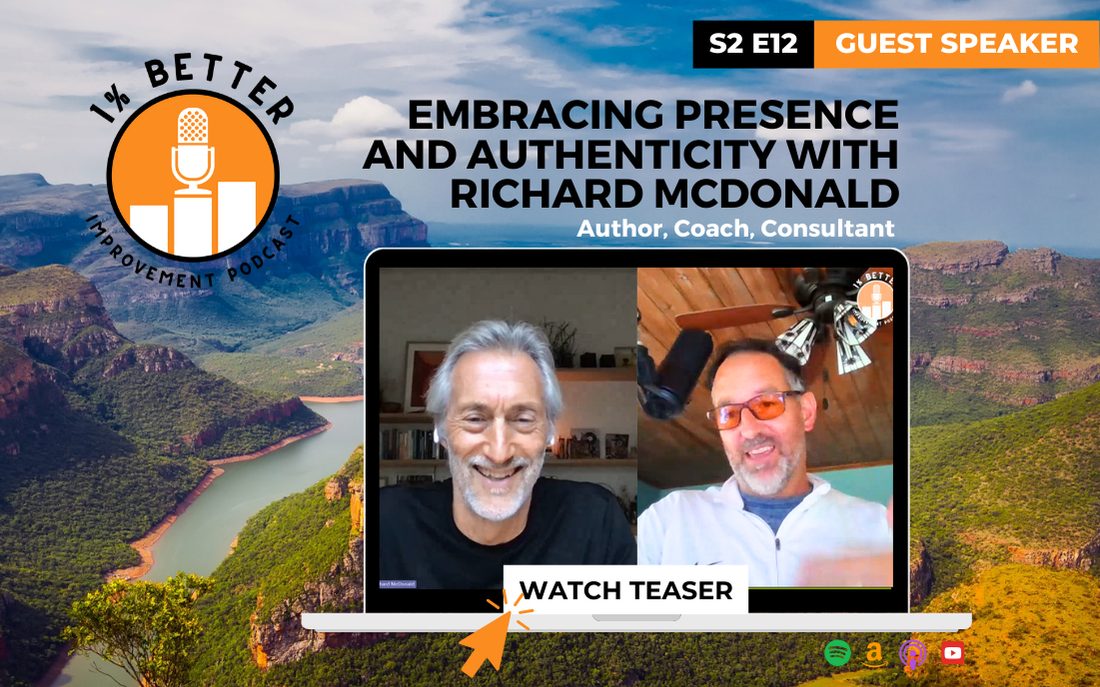
Hello, I’m Craig Thielen, and this is the 1% Better Podcast. Today, I’m speaking with Richard McDonald, who is an author, a coach, a consultant, all in the space of human development, leadership, probably a few other things. So welcome to the 1% Better Podcast, Richard.
[00:00:30.14] – Richard
Thank you Craig, good to be here. Finally, it’s taken a while, but we got this set up and ready to go.
[00:00:37.02] – Craig
Yes, and I know you’re a world traveler, so I had to try to track you down. You spent a lot of time in South Africa, which we both… You’ve certainly grew up there and spent a lot of time. I’ve spent a little bit of time. So we got you back in the States. I think you’re calling in from Austin, Texas. So that’s-
[00:00:53.03] – Richard
I am… Welcome back… I am calling. Thank you, sir. Thank you. A quick question of you, Craig. What did you love about South Africa?
[00:01:03.12] – Craig
You could wind me up. I love the natural essence of the country, the natural beauty. Of course, there’s the Big Five animals and the safari. The color of the sunset struck me is something incredibly unique. Of course, it’s got a lot of history. Every country I go visit, I try to learn, and I’ve learned so much about Apartheid and the history of South Africa. And seeing the natural beauty, I mean, being along the coastline, my first scuba dive in Durban, South Africa, which is way more challenging. Sometimes you’re naive about things. It’s one of the most challenging places to dive, I didn’t know that. And then my second dive was with sharks and no cages, of course. But I didn’t know any better. And my friends in South Africa said, Hey, what’s the problem? This is how we do things here. So I love the people. We’ve got great friends there. We’ve got a couple offices there. I could go on and on the surf culture, some of the university cities that I visited, but it’s the natural beauty and the wild animals, the rhinos and the hippos and the lions. And that is something I’ll never forget.
[00:02:18.08] – Richard
Well, thanks for sharing that, because part of what I’m going to end up referencing is my background and how that shaped me doing what I’m doing and how I do what I do and what I’ve learned so much.
[00:02:33.11] – Craig
Well, let’s start with where you grew up and you were raised. And let’s start.
[00:02:38.13] – Richard
Yeah. Well, came into the world in the natural way. Parents were in love and I was conceived. And I think at the moment, what I would share relative to the work that I do, and as you say, I’ve been fortunate to travel all over the world to do this work. But there’s something about when we grow up, what shapes us. And I was so fortunate to… My father was a great fisherman, and to get to this particular place near the city that we lived, he had a going four-wheel drive vehicles, and I’d bundle up, and we had a Willy’s Jeep from the Second World War. The only way to get there was over these roads. This place where I grew up is about the little house that we grew up in, is about half a mile from the Southeastern tip of Africa. Why significant is that the storms that go by that part of the country are just incredible. I was thinking about what I might say today. We’d had a chance to talk a little bit before. How do you condense 40 years of leadership, development, and training in a podcast. And I thought I’d start with a story.
Craig
Perfect.
Richard
So there’s two stories, and they’re both situated in this very unique place in Africa and in South Africa. In fact, all the roads are named off to ships that have sunk in the area. So it gives you an idea of the wildness and the… It’s just wildness of the ocean, the land, and this point. It’s just… The storms are just amazing. And so I was very fortunate. There was a surf movie called Endless Summer. It was traveled around the world in the ’60s looking for the perfect wave. And back then, they declared this place where we were, the perfect wave. And as a kid, I’d look at these storms in the ocean and I’d go, you got to be crazy. How would anyone ever paddle out into that ocean? And obviously, over years of practice and training, what I came to realize is the ocean, not unlike life, it’s chaotic sometimes, it’s calm sometimes. And I think leadership, sometimes your circumstances are perfect. And even if you were a bad leader, you would be successful. Yeah, right. But I think the true character of a great leader is when circumstances aren’t good, when it’s crazy and chaotic.
That leader is able to find a path and is able to communicate that path to the people that will make make work work. And I learned early on that chaos doesn’t get tamed, that you can operate in chaos when you learn the distinctions, and in this case, hydraulics, waves, ocean, water. Over the years, as your nervous system is learning and practicing, what looks chaotic and crazy to other people actually could be fabulous conditions for a surfer, somebody who is skilled at working in that environment. I was thinking that really the only difference between someone who’s great at something and someone who’s not, at least a significant difference, is the distinctions that they get to see that other people don’t get to see. And as a result, they can navigate more clearly. And I’d say that’s where I learn mostly what I know about leadership at a raw fundamental level in nature. You can’t fight it. You have to blend with it. And I think the leadership of today requires blending, not fighting.
[00:06:30.10] – Craig
Well, that’s a great way to start the show. And you’re thinking, it’s a very large, complex connection you just made to how humans operate, how we work together, how we lead to this big system we call Earth. Powerful. But I love it. And it reminds me of another podcast we had a gentleman by the name of Will Steger. You know Will?
[00:06:54.13] – Richard
Yeah, Will. Yes.
[00:06:56.02] – Craig
One of the things that he said when he was in the most challenging terrain on Earth, which is less like Earth and more like a foreign planet, which is Antarctica. And 100 degrees sub-zero temperatures, et cetera. It doesn’t know if he’s going to make it. Forty days in a storm. And you talk about storms, and nobody’s ever done it before. So there’s no reference. And I guess, how do you deal with that? Essentially, he said, I had to learn to give in, which means I’m not in control. Us little six humans can’t pretend that we’re controlling or I can’t fight it. So I had to give in to it, understand it, and then I could get clarity. Then I could get peace and focus. I think it ties to what you’re saying a little bit. But I want to come back to that story because that’s a very profound connection that you’re making. And I’m curious as… You didn’t obviously make it when you were 18 years old or something. You later like with meant, wow, I see the correlation here.
Our good friend Tom Goodell also made a similar correlation around fields. Again, there’s fields in the universe. There’s force fields, energy fields, sound fields, light fields. There’s essentially energy fields. And he made the connection from the universe and other physics and science to we have interpersonal fields, and we have personal fields, and we have team fields. And so another very broad connection. But maybe, before we dive into a little bit more, I want to get to your book. Talk about… So we know that you grew up in this very… And I got the sense… You have to be in South Africa to understand, when I was in Durban, The Indian Ocean and the Arctic Ocean come together, probably right where you were raised, right? Just downstream of that or down the road is Durban, and it’s got very fast currents for scuba diving, and it’s cold. Just the mass of the size of nature and the power of nature is just so evident when you’re there. So talk a little bit about early career. How did you get into this field? What did you study? Leadership is a field, especially people that teach it and coach it, write books about it, generally have decades and decades of experience to make some of these correlations. But how did you get into it?
[00:09:27.13] – Richard
Yeah, boy, that’s a great question. Certainly after 40 years, it’s good to reflect on how did it start. In a very, very strange way. I don’t share this often, but my father died when I was 18, and I was in a very formative stage of my life. I had many people helping me navigate that loss. As life would have it, I ended up leaving South Africa to go to school in the US, where I actually studied theology, which was an interesting beginning. I didn’t ever think of myself as someone who would be a minister as such, but the school was just a starting point for me. Then while I was at a meditation class, I met a woman and she said, I think you’d be interested to meet my boyfriend, who’s a three-time Vietnam vet, colonel, and obviously retired, and had become a spiritual warrior and was involved with a company called Sportsmind. They were a group of folks that, actually, they were all guys, and they developed this program for the Pentagon. It was a classified program. There’s a lot being written about it. There was a movie called The Men Who Stare at Goats that was based on these guys. I happened to, after a meditation class, go and have an interview with this person. And strange as it would be, talk about fields. I’m having an interview with this very intense guy, Jack Surrey. There was a shelf with books on it, and there was a practice sword for doing the keto.
[00:11:05.07] – Craig
Okay.
[00:11:06.00] – Richard
And the sword was up on the shelf. And this really was the start of my work, professionally, with this company. While we were talking, this is somebody he’s never met, I noticed that this bokken, the sword, is rolling off and it’s going to hit him on the head. For some reason, I just reached out, caught it a second before hit his ear. I’m about one inch away from his nose. He doesn’t move. I put the sword back, and for some reason, we don’t miss a beat and we continue the conversation. That was the beginning of me being invited in. To this group of fascinating people. And that’s how it started. 10,000-person AT&T program. And there we go.
[00:11:54.05] – Craig
That’s amazing. Well, clearly, you were very present in that moment and had very Jedi-like skills.
[00:12:03.01] – Richard
Yeah looking back, you might say that at the moment, it was just, I think, really being present that gave us that moment. And it’s become thematic for me in leadership present.
[00:12:13.05] – Craig
Well, that’s a good Let me just segue into the book. So you’ve worked with, as you said, that was your entry. You’ve worked with many large corporations in this field of leadership, working with thousands and thousands of people. So the book that you were co-author, The Vitality Imperative, really an interesting book. So first of all, there’s literally been thousands of books on leadership written. So clearly, it’s a topic that we have a lot of interest in and we as a human race struggle with, right? Because it’s been written about over and over and over. And so my observations from reading it is that I love the fact that it puts, what I say, all things on the table. A lot of leadership books segment to this space. This puts everything, yourself included and how you are as a person. So that’s great. I like how it forces you to ask tough questions about yourself and start with yourself. And then it breaks it down into six, I think easy to understand concepts, which a lot of books do in various forms. But then it gives you immediately, okay, now here’s how you practice it. Here’s some techniques. Here’s how you put it into action. Because it’s easy to understand the concept. It’s very hard to actually live it, breathe it, and show up that way. And so those are some of the things that I pulled from. Just for the audience, knowledge here. The sections are, and you call them promises, presence, empathy, purpose, authenticity, wonder, timing, in I think all of us can go, Yeah, those are all things that great leaders would have. We get the concept, but how do you actually live it? Those are my perspectives, but I wanted to get your perspective being an author. Now it’s 10 years later. What do you think sets this book apart from other leadership books?
[00:14:21.14] – Richard
That’s a good question. She said you’d have some good questions for me. I think, and so that book, I was a co-author with Mickey Connolly and Jim Motroni and the practice of conversion. We make a distinction between doing and being. It’s important that we learn how to do things type on a typewriter, a keyboard on a computer. So there are skills. What we really see as most impactful, especially the higher up, I think it’s true all across the board, but the higher up, it’s the presence of how we are being. That is the significant, most important, and how the people’s biology respond. So I think when you say the book is an inclusive piece because it says, it starts really with how am I being and how I am being influences the quality of all my actions. Thus, we start with the first promise of those promises, which is presence. It’s the quality with which I bring self-awareness to myself and then take responsibility for how I’m occurring in the world. We like to say that all learning starts with acknowledging what’s present. And the power of a very effective leader is a person who can bring people into reality.
So this is not Fufu, woo-woo stuff. It’s actually the power of naming what’s present. And from there, we make our choices and decisions. I think what sets the book apart in that particular practice is we didn’t go into a room and come up with a theory. We observed what explains when people move toward and engage, and what explains when people move away and disengage. There are just three basic principles. The first is the statement that all human beings, you and I and everyone listening, we have purposes, the things we care about, and of course, then we’ll have concerns, and we have our unique circumstances. If you perceive me as being aware of and maybe even caring about what matters to you, biologically, you will move toward me because I occur as safe and a resource for what matters to you. If you perceive me as being unaware and perhaps indifferent or antithetical to what matters to you, your biology is going to say, Unsafe, I’m going to move away from you. To me, if people understand this and practice it, you will see it’s like magic. You’ll do things and people will engage with you and people will say, How did that happen? But it can’t be done as a as an act of manipulation.
[00:17:33.08] – Craig
Just a simple asking someone a question. It’s really that gets to some of the other promises, like having empathy, which is really understanding other people, getting to know them, what they care about, purpose, authenticity. They have to believe what you’re saying. It has to be authentic. So it ties them all together. But it all boils down into what’s important to them. Do they feel like you’re aligned and helpful, or are you an impediment to that? Right?
[00:18:07.14] – Richard
Right. And you know, Craig, you just reminded me of a quote that I love, and it’s a little… Well, the quote is, The first act of love is to listen. You could say, The first act of respect is to listen. So wonder and curiosity is, I wonder why that’s important to you. Truly, I wonder. Before I jump in with my point of view. And you can’t manipulate that because people know if you’re doing that just as a seduction. It has to be real. You really have to care to understand.
[00:18:48.10] – Craig
Right. Yeah. I mean, you can’t argue with that. So you guys talk about promises, which, by the way, the first promise that you have is your promise to the reader, which I thought was very interesting. I haven’t seen a book like, say, Here’s what we’re going to do for you, other than we’re glad you bought it. You bought a book. So one of them is we promise that we’re not going to belabor stuff. We’re going to get through stuff pretty quickly. Another one is that it’s going to impact you pretty immediately. It isn’t just something you read about, and then maybe a year or two later, you get an aha. But immediately after practicing some of these principles, you’re going to get a benefit. And what’s the third one? There’s a third promise, I think.
[00:19:35.11] – Richard
You’ll have to remind me.
[00:19:37.06] – Craig
But I thought that was really good. It caught my eye. Okay, I’m going to read this. Yeah, here we go. And finally, the promise, the more days when your leadership feels like an energizing privilege and fewer days like a burden, because we all know leading anything, including ourselves, our family, things in our community, our work, As you said, right out of the gates, anyone can lead when the wind’s at your back or when things are going your way. But when things get tough is when real leadership gets tested. And so there’s going to be tough days. There’s going to be days that things don’t go your way. So you’re going to have more days where things are going your way, essentially. So I tried to put that to the test and after every chapter. But what it did for me is it really slowed me down. This is not a book you can just read in a few days or a week because there’s so much deep insights and then practice this, practice this. And so I felt like I really had to take it like a page or two at a time and then say, okay, I got to go practice this. Otherwise, that would have been out of sight, out of mind. So is that what you hear a lot from people who read it?
[00:20:45.07] – Richard
Well, Craig, I’m really delighted. I mean, I know you got a lot of books. You interview a lot of people. I really feel privileged that that affected you in that way, that you actually did practice it. So, yeah, that feels really good. I would just say, perhaps to the listeners, one thing you could practice after this podcast is listen to somebody that you care about and commit yourself to learning something new that you hadn’t yet known about them. If you were in a marriage or a relationship after a period of time, perhaps kids, it becomes functional. What if you slowed down, like you suggested, and maybe had a little longer eye contact and be curious? Often when we suggest this after a program or halfway through the program, people come back and say, they’re significant. I’ve busted them and said, What did you learn in class? Because you normally never listen to me like this. So really, people could do that as a pragmatic exercise. Just at work, go listen to somebody, especially the people you disagree with or where you’re getting resistance.
[00:21:56.14] – Craig
We could certainly use a lot more of that in the world, couldn’t we? Let’s listen to each other and let’s stop with what we have to say and try to understand where other people are coming from, whether we agree with it or not. Love that. That’s pretty good advice. Great advice. So one topic I wanted to ask you about that keeps reoccurring, reading lots of different leadership books, is this notion of accountability. And it comes up every day at work. And as organizations, ultimately, that’s what we want. We want people being accountable because we all have plans and goals and objectives and demands. And so when we say we’re going to do something, let’s make sure we do it. But it’s a complicated thing. And I think it’s really intertwined and enmeshed in a lot of these chapters of the book or promises in the book. So I wanted to just ask you, you’ve seen this, management leadership is trying to get accountability. And how do we do that? Because in some ways it’s a double-edged sword. It feels like we just want people to commit regardless of the circumstances and not have empathy. But on the other hand, it’s like that’s what the most successful teams and organizations have, is they have joined the accountability where they… Think about the army, the navy, the Navy Seals. They are accountable to each other. That’s what that separates the Navy Seals. They have small teams. They trust each other with their lives. They know exactly what they’re going to do, how they communicate. So how do we build that in corporate environments is my long way of getting to that question.
[00:23:43.06] – Richard
Well, it’s a great question. It’s actually a hot button for me, so I’ll do my best to moderate my enthusiasm in my response. I noticed when you were describing accountability, there was something that you were doing with your body. You were going, We need to get accountability. I think you were channeling the frustration of leaders saying, We need to get accountability. Unfortunately, this methodology of getting accountability is very short-lived and requires pressure. However, what we do know that the more sophisticated the contribution, the less people are motivated by the carrot and the stick. At a certain level of consciousness, the carrot and the stick will work wonders. The problem is you always have to have enough carrots and enough sticks. But if you want people to actually take ownership, you might want to move up that continuum and use the three axioms to get your accountability. It really upsets me when I see, and sometimes it’s just unintended, the consequence, where people say you must be accountable. You ask those Navy Seals, I bet you they won’t say they have to take care of their bodies. I bet you they’ll say, I want to. When you get people by choice seeing themselves in the responsibility you’re asking them to be accountable for, that’s when you’ll get engagement and trustworthy commitment.
And here’s That’s a challenge. If you’ve skied or you’ve climbed, the natural tendency is when you’re going fast is to lean back. It’s not going to work well when you’re skiing. The natural tendency under pressure is to demand. The problem with the demand, if that’s the way we’re leading, people don’t see themselves in the demand. They get diminished by the demand. The time to upfront it, find the intersection of what you asking them to do and how that actually serves what they care about is the sweet spot of accountability. Because we like to say you can be held responsible because of your job title and what you get paid to do. But accountability is an attitude that says, I’m going to be accountable for the success of turning this out. What pushes accountability out is when we end up blaming and shaming people for not doing what we thought they should do. That’s the antithesis to accountability. And unfortunately, in the hurry, that’s often the behavior of leaders. So accountability for me, is critical. What you could trust in accountability is if someone could see themselves in the request to commit.
[00:26:53.07] – Craig
Right. So it goes back to what you said earlier, which is understand what’s important to them. And then Is this important to them? Is this assignment? Is this responsibility? Is this goal important to them? Then they’ll start leaning into it.
[00:27:10.12] – Richard
And as a leader, I help craft that meaning for them. They might not see the value, but my job as a leader is to help them see the importance of this and their unique role in satisfying that commitment.
[00:27:27.12] – Craig
Yeah, makes sense. And sometimes there’s, I think, a big shift happening in the world with command and control style leadership, which we all grew up with. It’s a military, industrial age carry-over with how do you do, quote unquote, servant leadership, where instead of saying, Here’s the assignment I want you to carry out, I’m going to tell you when, how, how much time, say, Here’s the intent I have. Here’s the ultimate outcome I want. You are smart, capable, able person. How can we do this? How do you think we can do it? And so you’re not telling them how to do the job because they’re capable and you’re leveraging their talents, their abilities. But my intent is I want safety standards to go on. We all want that, right? Is that important to you? So is that a shift that you see as well?
[00:28:21.04] – Richard
Yeah. And I think you just answered the question you asked me more skillfully in terms of less words, because that’s exactly what it is. It is. So safety is a pretty obvious one, right? Yeah. We want our people to go home to their families. Who would argue with that one, really? So the key, I believe, is finding the shared purpose, meaning what they care about and what the organization or the company is asking for. And it’s in that intersection that we get true engagement, an authentic commitment, not an appeasement, because you can hurry that intersection to say you don’t have time, but I promise you, you’ll end up spending more time dealing with perhaps passive aggressive behavior where someone feels disrespected, told what to do.
[00:29:16.02] – Craig
Absolutely. Well, hey, you’re 10 years after the book was written. I’m just curious. Hindsight is always 2020, and we all learn every day. What have you learned since… 10 years later? Is the book still stand strong, the principles, or have you said, Hey, we need to add a chapter. Here’s what we’ve learned since we wrote it.
[00:29:38.03] – Richard
Well, first of all, it’s actually sobering to consider the book is 10 years. Time when you’re having fun. Well, that is the true thing about when you’re having fun, right? Time changes. It’s a different relationship. So to answer your question, I think for me, what I’m most interested now in the work I’m doing, and if there was a chapter or something I’d embellish, how is it that I can help people find their center of gravity or their compass? There’s chaos out there, and if we don’t have a good compass. And so when we converse and work with folks, we spend a lot of time, like when we on our big program, we spend a lot of time helping people articulate their unique purpose in life. Not the purpose as inside of a business, but the unique qualities and talents that they bring. And when people… It’s not like it gets made up, it gets revealed. You’re not making something up. You’re not trying to make somebody something they’re not. You’re actually discovering authentically what is the unique way they bring value and be unabashed by that. It gives us access to courage. It gives us access to clarity, and it gives us access to compassion. So I would say, emphasis again on the importance of finding your true north. There’s so much competing for our attention. If you don’t have a hold on yourself, you become someone else’s megaphone, so to speak. So that’s what I would say.
[00:31:31.07] – Craig
Blow around in the South African wind, right?
[00:31:35.12] – Richard
Right. That’s true. So I would say to really emphasize coming back to yourself and what you know is important. The power of contribution when I lived with integrity, we haven’t even tapped that yet.
[00:31:55.06] – Craig
Right.
[00:31:57.00] – Richard
So that’s what I’d add.
[00:31:58.05] – Craig
Well, what you said reminded me of revealing what’s already there. I think that’s a lifetime of work for all of us, right? But it reminds me of Michelangelo was allegedly asked, How do you create such beautiful statues out of a big chunk of rock? And he said, I don’t create anything. I just reveal what’s already in that rock, and I just take away and reveal what’s already in it. That’s an interesting way to think about it, because us, people that art sculptures, we look at it as a rock. How would we put that thing away and something so beautiful? And he looked at the complete opposite. It’s already in there. I’m just revealing it.
[00:32:41.10] – Richard
Yes. Beautiful. That’s so great. I love that. I mean, I’ve heard that in the past, and I really love that. Here’s the challenge for leaders. If you say you don’t have time to attend to the quality of relationships, it’s going to come back and bite you in the butt. It In the world that is so complex, there’s no one person smart enough to answer the questions and the challenges that business face. We are smarter together than by ourselves. As Mickey says, is the co-author there, The difference plus trust is wisdom.
[00:33:24.05] – Craig
The difference plus trust.
[00:33:26.01] – Richard
The difference, diversity plus trust.
[00:33:28.08] – Craig
Oh, I see.
[00:33:29.07] – Richard
Creates intelligence, wisdom, and gives us access to be able to solve these challenging problems. The question, of course, is, how do we develop trust with each other?
[00:33:42.14] – Criag
Right. Well, I think the six promises might be one answer to that, right?
[00:33:49.12] – Richard
And I’ll say the summary to that is, be direct, be straight, don’t beat about the bush. And there’s a way to learn to have those conversations. But I think we all need to risk ourselves more for the sake of, I don’t want to get grandiosia, humanity. But inside of a business, I was just talking to somebody today. They were massaging information, financial information, so that it didn’t annoy the senior person. Now, that senior person is trusting that that information is accurate, making decisions. The challenge, of course, is how do you say the difficult thing? Not being against, but being for the success. And so for me, I think we have to really, each of us, ask inside, What can we still give if we didn’t let fear dominate us? And here’s the great thing. Here’s the great thing that just is the great thing. It doesn’t matter who else signs up to do this. When I live in integrity with myself and I have the courageous conversations, I don’t lose.
[00:35:07.02] – Craig
Yeah, that’s profound. And that gives you, like you said, if you believe that, it gives you courage to do anything but do the easy thing, which is be yourself, right? Right. Which should be the easy thing, which sometimes feels like the hard thing. Well, Richard, we could go on and on, and maybe we’ll get another podcast to go deeper. But I want to close with the same question that everyone gets, which is look back at that 40-year career and everything you’ve learned working with clients in this field and training that you’ve done, and go back then to your 18 your old self, and what would you want to give yourself? What knowledge, what insights? Or let’s say you have grandchildren, you want to share some wisdom. What would you share?
[00:35:57.14] – Richard
Take the time to have an intimate relationship with yourself, and then be courageous to live your life authentically. That’s what I would have told myself when I was 18.
[00:36:12.05] – Craig
That’s beautiful.
[00:36:13.03] – Richard
Instead of appeasing and trying to please people for some false promise, if you abandon yourself, it’s a hard place to come back from. So don’t abandon yourself.
[00:36:27.01] – Craig
Well, that’s beautiful. So thank you, Richard. I appreciate the time. And thanks for being on 1% Better.
[00:36:33.14] – Richard
Thank you so much for the invitation. And I wish everyone listening to this just one step closer to being yourself and risking it. It would have been well worth it..
check out other podcast episodes