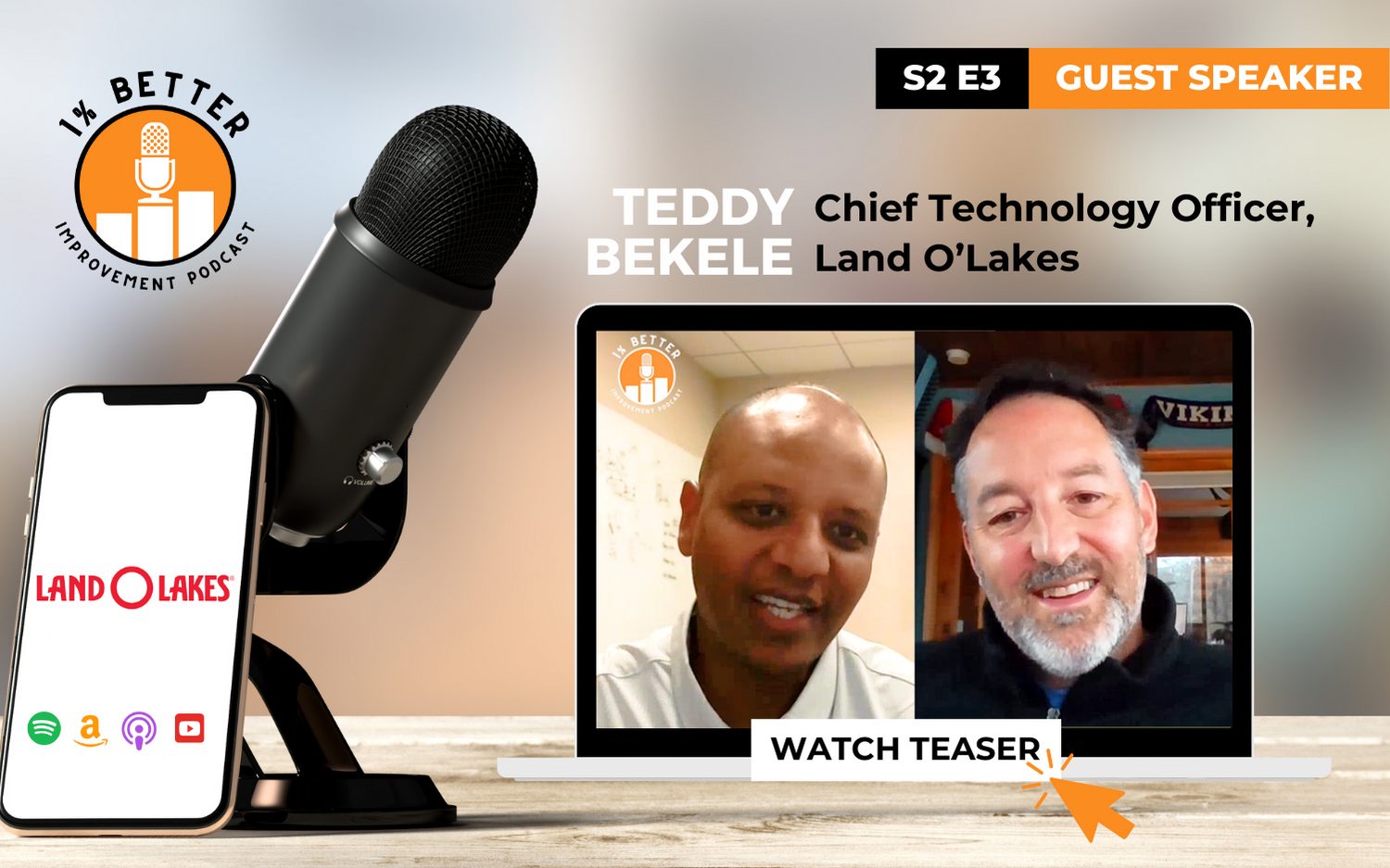
Find us on your favorite podcast platform including: Spotify | YouTube | Apple | Amazon
1% Better Teddy Bekele – Quick Links
Learn more about Land O’Lakes
Connect with Teddy Bekele on LinkedIn
Connect with Craig Thielen on LinkedIn
Key Takeaways
- Embracing Change: Teddy’s upbringing in Ethiopia and subsequent move to the United States showcased the importance of adapting to change. Despite challenges, he found opportunities in new environments, ultimately leading him to a career in technology.
- Continuous Learning: Teddy’s journey from mechanical engineering to technology leadership highlights the value of continuous learning and exploration. He emphasizes the importance of staying curious and open to new opportunities, even if they diverge from your initial path.
- Balancing Technical and Business Acumen: As a technology leader, Teddy stresses the significance of understanding both technology and business aspects. He emphasizes the need for leaders to grasp financials, market landscapes, and competitive dynamics while remaining technically proficient.
- Innovation through Experimentation: Teddy advocates for a culture of experimentation within organizations. By encouraging small-scale prototypes and cross-functional collaboration, teams can drive innovation and stay ahead of industry trends.
- Enjoying the Journey: Reflecting on his experiences, Teddy emphasizes the importance of enjoying the journey rather than solely focusing on the destination. Finding fulfillment in daily tasks and embracing challenges contributes to long-term success and satisfaction.














1% Better Teddy Bekele – Transcript
[00:00:06.570] – Craig
And this is the 1% Better Podcast. Today I’m speaking with Teddy Bekele, Chief Technology Officer at Land O’Lakes. Teddy, welcome to 1% Better.
[00:00:16.980] – Teddy
Well, thank you, Craig. I’m excited to be here and look forward to our conversation.
[00:00:21.250] – Craig
Excellent, likewise. So why don’t we start, Teddy, maybe just kind of going way, way back. Where are you from? Where are you raised? Tell us a little bit about growing up.
[00:00:32.090] – Teddy
Yeah, sounds good. I was born in Addis Ababa, Ethiopia, and I lived there for the first seven years of my life. When I was born, my dad farmed. He farmed 400 acres of corn, wheat and cotton. And then when I was about two years old, he lost his land when a dictator took over the country, nationalized it. So got out of farming, but not completely… got out of the day-to-day farming, but then sold crop protection and equipment. And that was one of the reasons why when I was seven, we moved from Ethiopia to Europe to Italy. And so he did a lot of work with Italian companies as well as German companies, and sold products from Europe into Eastern Africa, you know, depending on which country was more favorable at the time from a political standpoint. Then when I was senior year in high school, or right before starting senior year in high school, he wanted to stop dealing with the European bureaucracy at the time and the African corruption, and really wanted to work with U.S. based companies. And so we up and moved to Raleigh, North Carolina, and picked Raleigh because one of the companies he worked for, Bayer Crop Science, which we know is still in existence today, and a very strong company in the agriculture space, their headquarters at the time for their U.S. operations was in Raleigh, North Carolina, and specifically the Research Triangle Park.
So I finished my senior year of high school there. And talking to my dad, I vowed that I would never get into agriculture, would be not a discipline for me, but I would get into engineering. And if there was one thing he was aligned with me on, that one was that piece of it, like he said, agriculture is… he loved it. He loved every piece of it. But it just has been a rough time for him. And he wanted his kids to go, be lawyers, engineers, whatever you wanted to do, except for agriculture.
[00:02:31.700] – Craig
Always something better, right? You always want better for your kids.
[00:02:36.050] – Teddy
Exactly. So I followed that advice, got into engineering, went to North Carolina State University, finished my Mechanical Engineering degree there, and then joined a company called Ingersoll Rand, based out of Davidson, North Carolina, just north of Charlotte, and joined them and quickly realized that even engineering wasn’t my calling in life, at least the mechanical, electrical side of engineering. And I loved learning about how machines worked and how you put them together, et cetera, but the day to day work didn’t really appeal to me as much. And so when I joined this company, I looked for a rotational program, and so I joined in and did a little bit of manufacturing engineering, did a little bit of strategic sourcing, but quickly found myself in a group called .com at the time.
[00:03:21.770] – Craig
Sure, it was the hot segment. Everyone was trying to build their presence, right?
[00:03:24.060] – Teddy
It was. And this was like late ‘90-‘99. And so this company was trying to figure out what this whole Internet thing was all about and how we could take advantage of it. And so they were looking at websites and ecommerce platforms, and how could we… Anyway, all that seemed very exciting to me, and I joined that team as sort of a Business Analyst, predominantly more on the sort of back end side of it – How do you fulfill the order? But quickly kind of really fell in love with the technology. But as you know, in 2001, late 2001, early 2000, Bubble burst. And all of a sudden, it was like, oh, this thing is a fad. It’s going to go away. And all these companies had these high valuations, just disappeared overnight. And even this company was like, well, we see the value in the technology, but it seems like this whole thing belongs with Information Systems. It wasn’t even called it at the time. It was Information Systems. The number of mainframes and things like that that were going on.
And so I was given a choice. You can get back into engineering and sort of deal more with that, or you can stick with this technology thing. And I had a really good mentor who eventually ended up being the CIO at Ingersoll Rand. He’s like, I’ve been around this. This is going to have a major impact, but you should go deeper into it. Like, go learn how to code, go learn how to configure systems, get into the guts of things so you actually can become a technology professional. And those were wise words. So I did that for a number of years and went from package software, did a little bit of that, to custom software, where we built things ground up. I participated in a lot of outsourcing when a lot of things were moved over to India for development. And so I had a development team that was based in India and some in Europe, some in North America. I traveled all throughout, did a lot of internal consulting and internal building of systems. It was a lot of fun.
And I was at Ingersoll Rand for close to 15 years – IT roles and enjoyed my time and learned quite a bit. One of the opportunities I got there was I came back to support the engineering group from an IT standpoint, right? So they, Product Lifecycle Management (PLM) systems, CAD, go figure out what they need and how you best support them. And this was kind of a big integration to ERPs as well and had done some of that. And in that though, one interesting thing happened where some of the software products found themselves into mechanical products, right? So of the things Ingersoll Rand made at the time was these door locks, right? It’s all like the keys that you put in, like Schlage locks was a division of Rand and they started to go with, could we put a pad in? Like when you just type in number and open a door not just for commercial buildings but also like residential homes. And if we connect this, if we could put some sensors in this mechanical device and it could send a signal to a router, can’t we unlock the door remotely and things like that?
And that was exciting for me because all of a sudden we went from being a support cast here to, you guys know what to do with the data after it comes somewhere, right? And we’re like, oh, absolutely. We could put this in a database and then we can create an application layer on top of that, have a UI that sits in front and yes, we could make this magic, right? And so all of a sudden the work that I was doing sort of support became core to some of the products we were developing and really got into more project product management and really understanding how to build technologies that would really not only enable the business, but were sort of the driver’s seat of some of the newer products we’re developing.
Had a good time doing that. And then a former colleague called me up one day and said, hey, I have a really exciting opportunity for you, at Land O’Lakes. And I said, the butter company? How much technology goes into making butter? And he’s like, yes, it is a butter company, but trust me, it’s much than that. What it really is, is it’s an agriculture company.. And I’m like, oh, that’s even better.
[00:07:19.370] – Craig
And immediately, Teddy, because again, you didn’t run from the AG business, but you certainly were not intentionally going into it. Did it immediately when that came up bring you back to your childhood and your father, did you make that connection immediately?
[00:07:37.030] – Teddy
Oh yeah, it did. Because when he said, go to the website and obviously there’s the landolakes.com website that has more recipes and things like that, but go look for landolakesinc.com and you’ll find the other brands. And the business that I would love for you to work with is this division called WinField United. And they have their own story and they’re doing some exciting things. And so I click on the site, and I remember, first of all, the colors are green, right? Just like you’d expect AG to be. And reading that, I’m like, yeah, this took me back 20 some years. And I’m like, yes. And then there was one side of me that was like, this is so cool, because this is what my father did. And then the other side going, you remember how you didn’t want to go to this?
And so at the same time, it was kind of like this torn thing. But I decided, you know what? Let me learn a little bit more. And out of courtesy, out of just the phone call, I came to interview and learn more about the cooperative system and what Land O’Lakes does and who they stand for. And then what particularly we’re looking to do in agriculture, which is we want to digitize agriculture. We want to bring these innovative technologies and figure out how we get this cooperative system to be at the forefront and at the leading edge of technology in this industry that we see is going to transform here in the next few years. And so that was the value proposition they were throwing out. And I remember my wife and I coming to Minneapolis for an interview, and it was in July. They were strategically trying to get…
[00:09:07.340] – Craig
Of course, that’s very smart of them.
[00:09:09.630] – Teddy
It was, except that day, it was July 27, I forget it was 53 degrees and it was cloudy, and we were coming from Charlotte. It was 93, getting on the plane, and it was like, is this how it’s going to be all the time?
[00:09:23.600] – Craig
What’s it going to be like in January if it’s 53 in July?
[00:09:26.780] – Teddy
Exactly. We did it more as, let’s visit Minneapolis. But it ended up, I remember coming back to the hotel room that evening after all the interviews, and she’s like, don’t tell me we’re going to live here. And I’m like, oh, no, that’s not a done deal yet. But it was a lot more interesting than I thought it was going to be. And one thing after another, and a couple of months later, we’re figuring out how to move to Minnesota.
Yeah, so we moved here. And I’ve been here in this role… I’ve been at the company for ten years. First five years was working closely with Winfield United in a variety of interesting roles, which I’m sure we’ll talk about. And then the last five years as the Chief Technology Officer for the organization.
[00:10:08.230] – Craig
So that was a lot. I mean thank you though because I think it all, as we already like it all is starting to tie together. But just as I listen to you, it’s just fascinating for me how much diversity and perspective and how much you’ve been involved with. Everything from really living in Africa and Ethiopia to Europe to United States, that alone is very different cultures. And then the know getting into the engineering hardware engineering, and then software and the full spectrum of what you know really kind of the early days of where we started really thinking about technology not as sort of the back office stuff and the transactions but integrated right into the products which of course today is everything, like everything is integrated into products and service and data and we’ll talk more about GenAI. So it’s fascinating for me, I just want to go back though, when you were just for curiosity’s sake, how much do you recall about the Ethiopia days or maybe even conversations after with your father, what kind of farming practices were they using? I mean how manual, how automated, what kind of equipment? Tell us a little bit about that. I’m just curious.
[00:11:27.850] – Teddy
I mean when you think about farming mean it’s so amazing because everything was so manual back then and my father was always on the leading edge, bleeding edge type to try new things. So he was one of the few that bought a tractor, but when he bought the tractor he didn’t buy just for himself, right? So part of his this was him telling me, right, because I was still too young at the time, but part of his value proposition, he’d buy the one tractor and he’d use it for his fields, but then he would rent out the equipment to other farmers around him… Now one of the reasons he got into farming, well his father farmed but he had eleven brothers and he was number twelve and he was the last one, right? So he wasn’t going to inherit any land, so he went to work for the government agency that at the time would teach these young college students about agronomy and then they would send them out into the country and then give them ten acres and say go learn how to farm and then go teach other farmers in your area to do that.
So he was always trying new varieties of seed, new crop protection applications, but the work was very manual, right? You had to get people to come and do manual labor to do the tillage, and even after we moved to Europe I remember him trying to teach me how to till our garden and our lawn, I hated it so much but it was all by hand, right. But just kind of giving you the perspective, and most decisions were all made on intuition. Over the years to gain the experience, and it’s like, okay, I think this is what’s going to happen with the weather, just how it feels, how the spring feels. And so therefore, this is what we did three years ago. So we’re going to try that again. Maybe creation, but that was where the ones who are successful versus not is who had better intuition than who didn’t, right? And there was no data or anything else that went behind farming at the time.
[00:13:25.120] – Craig
But still within that there was a process. Some would call that trial and error, some would call that continuous improvement… empirical evidence like, hey, I tried that, didn’t work. I’m going to try something different. And you’re always learning, you’re always trying new things. You’re talking to people. In some ways that’s more agile software development than it is… I got this master plan and I was taught this, and I’m just going to follow the plan no matter what. So there’s some correlations there. The other thing I thought was interesting is when you talked about the tractor, which was leading edge, probably for that area, that he started sharing it. I mean, in some ways that was a small cooperative, right? And Land O’Lakes is one of the largest cooperatives, which is not a common model. It’s a very rare model in the business world. So I think that’s an interesting kind of correlation that you’re now part of a large cooperative. So that’s super interesting. We could talk a lot just about the different cultural differences, but personally, with all the travels I’ve done in all the countries, I always learn so much that I bring back, and you learn from other cultures and everything that you do. So I’m sure you have a lot of stories there.
But let’s get back into kind of more what you’re doing now. And one of the things you’ve said is you really started heavy tech and you thought that, well, that’s not really my thing. And you started getting more curious. And now you’re clearly not in day to day with hands on keyboards. You’re in a leadership role. So one of the things in technology that’s maybe a misconception, or maybe it’s not a misconception, is that can a great technologist be a great leader? And of course, there’s different skill sets. You need emotional intelligence, you need great communication skills, you need people skills, and coaching, mentoring. And you need to really think from a business perspective, not just from a technology perspective. So when you gravitated to that, was that just because that’s how you were wired? Was it you had to learn it the hard way? And what are your thoughts? Do people really kind of need to kind of focus one way or the other, or is it just follow your interests?
[00:15:35.370] – Teddy
That’s a great question, by the way, and there’s so much there. So I’ll try to answer in sort of the way I think about it. So, number one, I think technology is always interesting and it’s rapidly moving. So to be a great technologist and even a great leader in technology, you just have to have the passion for just the newer things coming out. You can never get settled into this one thing because by the time you learn that and you get comfortable with it, something else has come out, and all of a sudden it’s turning it upside down. Right. And then the magic there really sometimes is knowing when to apply the right technology for when the company might be ready, the customers might be ready, et cetera, et cetera. It’s kind of having that feel, right? Because I remember I literally built ecommerce platforms to actually sell things online back in 2001, right? And we were selling spare parts for air compressors online, and we stood up this beautiful site. Even to this, today’s standard, it still looked pretty decent. And it worked, right? You put the order in, and then a couple of days later, something would show up at your doorstep.
But I remember we’re launching it and going, people are like, nobody’s coming. We sold like, six parts in a month. And they’re like, this thing is a disaster. It doesn’t work. The technology team is going, it works. And what turns out is in 2001, when people didn’t have access to smartphones and it wasn’t mobile enabled, and you didn’t do all the search to be able to get the word out. And all the things that we’ve learned over time, it was just really ahead of its time. And we had a beautiful thing. It just had to sit on the shelf for a decade before it could be something. So you also have to have a feel for what’s the right technology at that time. And that leads to the next point for me, which is you have to be, as a technology leader, you have to be technically sound. There is no doubt about that, right? I mean, you don’t have to be the super expert software developer that knows all, everything about Python. But you have to understand how things are put together, how they’re built, you have to have the ability to talk to someone who actually has that expertise, right?
So the ones that really just want to go deep in the technology, there’s a path for that. And they know, they usually kind of follow their instincts and go deep in one thing, and they become sort of the guru of that. However, if you want to end up being a technology leader, you have to be able to talk to folks like that, but not to go as deep as them, but enough to understand and have enough scars over time that you can see it come together. However, you’ve mentioned the two other things which are critical. One is the EQ aspect of it, emotional intelligence, the ability to relate to people, to understand, when to give a hug, when to kick a little bit, when to learn how to influence. Right. Like, it doesn’t necessarily have to be your idea. Let your idea be somebody else’s idea and let celebrate them when they bring it forward. Right. Be empathetic at the same time. But you’re not soft. Right. So it’s kind of balancing all those things, and that’s definitely like a key ingredient to everything.
And then the business acumen side of it. I cannot unstress that, right. You can’t go in not understanding the financials of the business, the market landscape, the competitive landscape, sort of where your company is in that whole ecosystem, how you can help it progress it forward. And for me, I’ve seen many good technology leaders make the leap into becoming business leaders. Right? Leave IT and lead something else. And those leaders are phenomenal because eventually they will be a tech driven business. And they know, they understand the technology and they understand the business. What’s always been troublesome for me is to sometimes bring subject matter experts that are not in tech, to bring them into tech and try to teach them in a very rapid time frame how to be a technologist, which you sort of have to build up into that. So I always tell all the folks on my team, you don’t have to stay in IT or technology. You can go and be CEO of the company. You have the foundation to do that, especially for the future that’s coming. So make sure that you get your business acumen in place and continue working.
[00:20:02.820] – Craig
Yeah, that’s great. That leads me to a question that I think is a big question in the world, and every company is trying to figure it out, which is, what is the role of IT in the future? I think traditionally, the past several decades, two, three decades, it’s like, hey, they’re the tech guys. They’re the ones that know how to run the servers and the operating systems and computers and all the software. And when it gets technical, that’s their job. And our job is to run the business. Of course, that’s been merging. It started, I think, really back in the ERP days when technology was to run finance, and we started kind of doing some overlap, and then ecommerce, and now it’s in all of our products and services. Everything we do, every product and service that a company does, has or should have some technology integrated into it, or something very parallel to it at a minimum. And now with generative AI, so it’s really blurred. Like who are the technologists? Who needs to be knowledgeable? Who needs to be thinking about lead edge, who needs to think about strategy and architecture?
And of course now in the sort of agile world, we have product owners, which is really a business oriented role, but you really need to understand technology to build a great product. So what is the role of IT in that space? And how do you think about the blurring of the lines? Because so many people in business are like, that’s my role, and I can actually go and use GenAI myself. I don’t need IT anymore. So I’m just curious kind of how you think about that.
[00:21:39.940] – Teddy
Yeah, I love that question because, and I’ll answer with the journey that I’ve been through here at Land O’Lakes. So when I first got here, IT was definitely an enabling function, right? Keep the lights on, keep products getting shipped out the door, keep the invoices going. Yeah. We need to have a nice looking website to make sure that we have interactions, and then we have ideas for how we want to automate certain processes within our business so we can get more efficiency. And that was the focus. Right. Which is great, there’s nothing wrong with that. But it wasn’t necessarily a strategic function to the business. It was more of a, hey, we need to do this because if we’re going to be in business, we need to have it. Then all of a sudden, with sort of advancements, with compute power and mobile apps, and sort of the technology becoming more integrated into the business, I used to talk about how IT is no longer an enabler, but a driver of the business, right. As I said, know, we made a couple of bets where we said, oh, and part know the stint that I’ve been here, first three years I was the CIO for that Winfield United group,
the next three years or two and a half years was really like I had a P&L inside the Winfield United business, which was software development. And we developed software that we would then sell to our retailers that would use it with their farmers. And so it went from like, okay, if you want to drive, come in here, be a P&L leader. Here’s the software. Have your developers, here’s a small steel staff go at it. I loved it. I had a blast. However, there was this fork in the road which was, are we going to be like a technology company, like that group that I had that just sells technology, or are we going to be embedded in the business and we’re going to sell products and services, leveraging technology, right? Which are we going to go? And I remember getting to that forking going, if we’re going to be a technology company, we should just spin off and do our own thing because the rest of it is putting anchor on us, right?
I would go talk to the retail customers and they would say, and I had my, like, here’s your subscription, subscription fee and blah, blah, blah in a month. And they’re like, yeah, but I buy x amount of products from you, so I should just get that for free, right? Or I should get a heavy discount on it. And I’m like, no, we’re a separate thing. And this is going to be your secret sauce and how you go to market. That conversation got funny where I’m like, I don’t know if I’m part of the mothership. This is not going to work out. So as we had a more strategic conversation, we said, yeah, the driver doesn’t necessarily mean it’s a thing that stands by itself. It really just has to be embedded in the fabric of the business. So we went the other route, which is, okay, let’s embed it into the business. And that’s the journey we’ve been on for the last three years. And here’s where I find myself now. I’m not necessarily the front end center driver where everybody sees it, but I consider myself more of a producer of a show. Right, so where you’re behind the scenes, but you’re like powering just about everything, right? So you’re in the strategic conversations, you’re well ahead of time, not afterwards, where this is where we’re going and how we would use technology, but we’re going here because we can use this type of technology because this is available or this is coming.
And so you’re in those early on conversations. You’re thinking about how to look at the P&L leaders and them using analytics to be able to create shadow P&Ls, for example. And how would you do what if type scenarios in your PNL depending on what happens with crop prices. And so you’re just behind the scenes, and I’m letting them sort of take the credit for the results. But you’re behind the scenes making sure that technology is being used in all facets and that it’s becoming truly that idea of being in the fabric of the business. And I love the role now, and I’m getting more comfortable with it, but there is a little bit of like, well, who’s in charge here? Is it me? Is it you?
You sort of have to be okay letting them be successful and taking the technology leaders that have that business acumen and placing them as product managers, as you mentioned, inside various parts of the organization.
[00:25:38.490] – Craig
And that makes a lot of sense. I think every organization is on some spectrum of that. You don’t want to be the bottleneck. You want to be the enabler. You want to be the sort of thought partner. Right. But there has to be a role. Right. Because if everyone just goes off and does now, you get a proliferation of all sorts of technology. But there are some things that are critically important that have to be centralized, like cybersecurity and privacy, and there’s compliance, and there’s certain things that just have to be in place, and not everyone’s good at that or even understands it. So there’s a balance there.
[00:26:13.190] – Teddy
Exactly. We’ll tell you. I mean, as the business stakeholders get better and better with the technology, they’ll start to figure out, hey, we need this type of capability to make us shine or make us more efficient, et cetera. The key is behind the scenes, you have to build it in such a way that it’s not, you know, the data is important to move across different applications. You want to be able to maintain the integrity of that. You want to use platforms that are sort of very elastic, and you have microservices so you can reuse the same microservice for another need. The end users are not going to be looking at all of that. They just want this specific capability. But behind the scenes, you have to orchestrate what happens. And how do you make sure that you’re looking five steps ahead so you don’t box yourself in one corner?
[00:27:01.040] – Craig
Yeah, makes sense. I think a lot of people are really struggling with keeping up with the pace of change and the pace… You and I have been in this business for decades, and looking back, it’s hard to even comprehend how much change and how fast it’s going. And now, of course, everything’s hyper, like, hyper-connected, generative AI, and it’s changing not only by the year, but it’s changing by the month. And so how do you yourself, but your teams, your employees, but also your business partners, what guidance would you give to people to, how do you balance? Like, oh, my gosh, we got to keep up with the latest and the greatest, but it takes time to implement things, and there’s change. We can only deal with so much change. And so how do we keep up yet still make progress on things that we’ve committed to?
[00:27:55.130] – Teddy
In the right places… Yeah, I think one thing that’s worked for us is, and we put it in place for a little while now, and we’re getting better and better at it, is I have a small, let’s call it emerging tech coordination team. They’re not the ones that do the emerging tech, but it’s like they’re the ones that would kind of look for what is the next thing coming up and what is it all about? And we really focused on two areas. One is education, and the other one is experimentation. Right. So the education side of it is, I force myself to do a lot of presentations, especially to our retail customers. I mean, they’re large businesses, and a lot of times they’re coming to us going, what’s the latest and greatest? What’s happening with GenAI? What’s happening with IoT? And what should I be thinking about? And they’ll come in… I heard this thing, and what is it all about? So I’m forcing this small team to say, why don’t you try to keep up with all the latest things and create a library of what this thing is so we can talk about it, give some real life examples that you see out in the other industries or other companies that are doing it, and then the ones that we might find interesting, how about we do some experimentation, just like an experiment, not with an end, like, well, we’re going to find the next transformative application, agriculture, but more of, like, just experiment as a learning method and take different people throughout the organization, not only in IT, but even outside of it, that have an interest to build together a small prototype of something that would just be fun. We’ll celebrate it at the end. It may go on the shelf, it may never see any useful life in the future, but at least learn how to mess with this thing, right? And that’s been helpful for us. And we have those who worked on it come and talk about it at town halls and sort of regular updates to be like, here’s what’s going on? We post the different projects or experiments that are happening at any given time, and that’s helped us sort of stay up to date with what’s happening and even having a way to talk about it. Right.
Even when ChatGPT came out and I’m like, what is this ChatGPT thing? And when they went into it, they finally came back. Like, no, it’s a space called generative AI. There’s these large language models, ChatGPT is one of them. Google Bard is another one. Here’s some other ones that are kind of sprouting left and right. So I’m like, oh, I feel like I kind of a little up to date on what’s happening. So it was useful from that standpoint. Then I try to take that to the executive leadership team and kind of keep them up to date on what’s going on as well.
[00:30:19.240] – Craig
Yeah, great approach so that everyone doesn’t have to worry about it. Let people kind of focus on the bits and pieces and then communicate and learn from each other. Love it. Well, this has gone by super fast. We could go a lot deeper. But I’m going to ask you the last question here on 1%, which is just looking back at your life, really, and everything from your childhood to where you’ve lived and all the experiences that you had. Now, of course, you’re leading a large organization, technology, and sort of, I don’t know if you could have imagined that back when you were in Ethiopia or even in your early days, but what would you want to share with people like yourself when you were 18 or with your grandkids as they’re sort of entering early life, like just life lesson that you wish you would have known or something that you just feel is super important with having success and happiness in life. What’s that piece of advice… 1% Better advice you’d give?
[00:31:20.890] – Teddy
Yeah, and I’ll give you two things, but the combination of the two is, I think, is what I would tell anybody who’s at any point where I’m like, why do I feel like I got to the spot where I am today? Number one, I remember getting out of college, getting a job, and thinking that was success. And then you get in the job, and then every day it feels like, oh, my gosh, is this it? I’m just doing the same thing over and over again with some variation. I wouldn’t say I was lost, but I was like, okay. I feel like all the stuff I worked to, I don’t know where it goes and it wasn’t until, like, late 20s, early 30s where I found… And it was advice I got from someone like, why don’t you enjoy the journey? It’s not the destination that matters. It’s the journey. You enjoy what you do every day. And I’m like, what if the job is boring? And I’m like, well, go find things. Continue doing that, but use that opportunity to go find things that you find are interesting. And when you find that interesting thing, pour your heart and soul into it and have fun doing it… Have fun doing the work. And when you have fun doing the work, you will find joy in it. And it’s so true. And then the career opportunities all of a sudden just unlocked, right? Because you got involved in a variety of different things, and it was, hey, we’re doing this new thing. Would you like to participate in this? And like, oh, I think it’d be great to have you lead this group. And, I mean, in the last two decades, I don’t think I’ve applied for a job. It’s always been something, go do this, come do this, et cetera. Right. And somebody pulling at you versus trying to go find something. So finding that joy in the work, knowing there’s a lot of grunt work, then things you don’t like that go with it, is super critical.
The other piece is just people in general and relating people at a deeper level. Right. Creating meaningful relationships, whether it’s with people that are on your team, people that are in the leadership position that you report to, or whether it’s people that work on your team itself. Right. One of the things I’ve always tried to find is a way to build deeper and deeper relationships with people. And so the combination of finding fun in the job and building these really meaningful, deep relationships have always opened doors that I could have never imagined would get me to the next thing and the next thing and the thing after that.
[00:33:36.470] – Craig
Yeah great. Wow great advice, Teddy. Appreciate it. It was great talking with you.
[00:33:41.000] – Teddy
Absolutely. No, thank you, Craig, for having me and really enjoyed our time together.
[00:33:44.730] – Craig
Thank you.