Find us on your favorite podcast platform including: Spotify | YouTube | Apple | Amazon
1% Better Carissa Rollins – Quick Links
Learn more about Illumina
Connect with Carissa Rollins on LinkedIn
Connect with Craig Thielen on LinkedIn
Key Takeaways
- Embrace Career Evolution and Lifelong Learning: Carissa’s path to becoming a CIO wasn’t linear. She initially pursued law but shifted to technology after discovering her passion in college. Her willingness to learn new skills, like Visual Basic, and seek out roles that aligned with her interests propelled her career forward.
- The Importance of Resilience and Accountability: Carissa highlights the value of owning decisions – even when they don’t go as planned. She shares a story about making a tough call that didn’t pan out but underscores the importance of admitting mistakes and moving forward.
- Drive Transformation Through People, Not Just Processes: Carissa emphasizes that successful transformation must start with the people within an organization, not just executive mandates. Leaders need to ensure they have the right people in the right roles – and recognize that not everyone will stay on board, which is part of the process.
- Mentorship and Opening Doors for Others: Reflecting on her career, Carissa highlights how some women in tech closed doors behind them. She took the opposite approach, committing to creating opportunities for underrepresented individuals and mentoring others to succeed.
- Culture Can Make or Break Success: Carissa points out that toxic or non-inclusive cultures are deal-breakers for her. She shares how environments with hidden agendas or lack of transparency drive her to leave, reinforcing that a healthy, transparent, and inclusive workplace is critical to personal and organizational success.














1% Better Carissa Rollins – Transcript
[00:00:05.08] – Craig
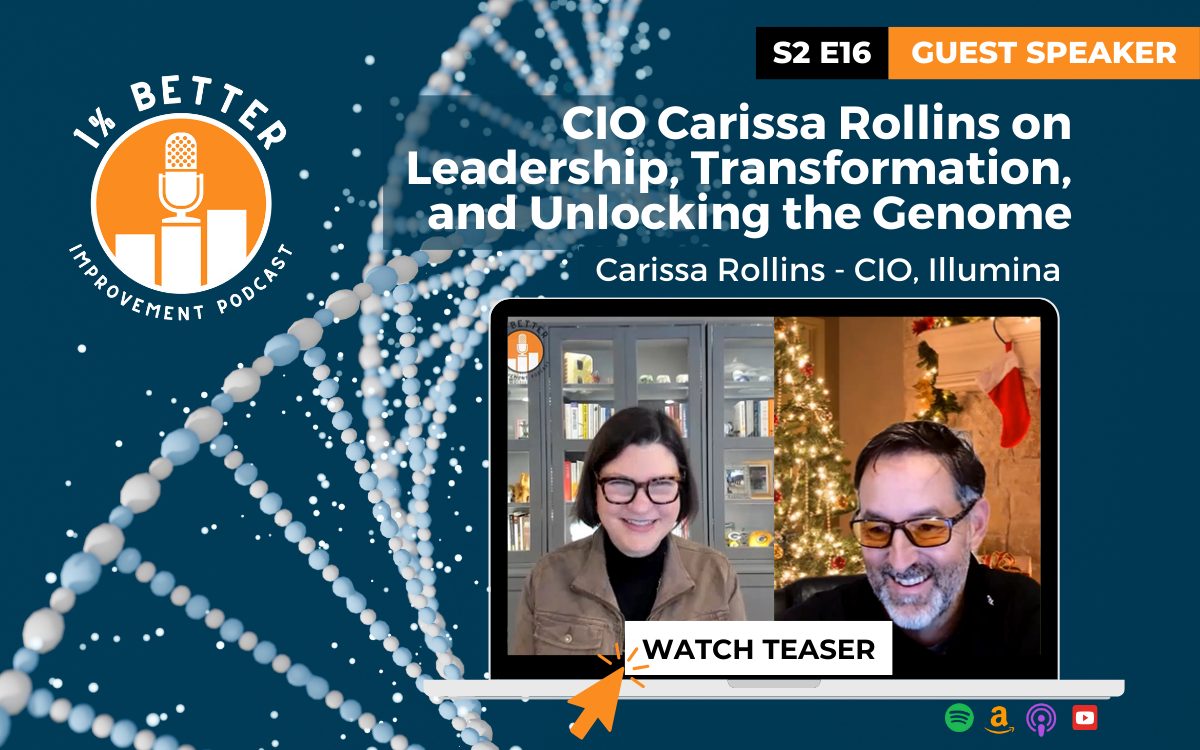
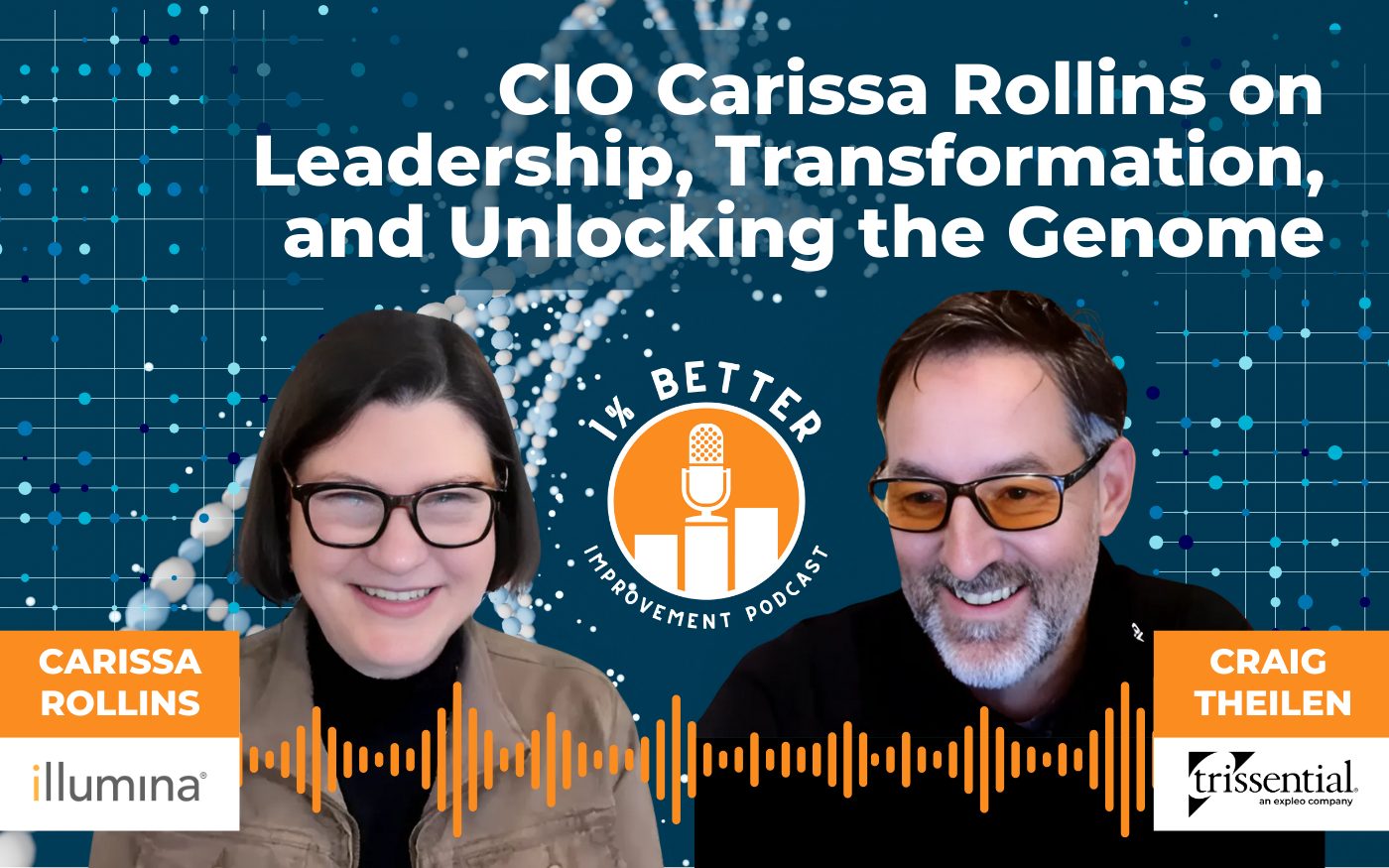
Hello, I’m Craig Thielen, and this is the 1% Better Podcast. Today, I’m speaking with Carissa Rollins, Chief Information Officer at Illumina. Carissa has also served as CIO at United Healthcare and Gander Mountain, among other things. Welcome to the Christmas edition here, Carissa, of the 1% Better.
[00:00:26.04] – Carissa
Thanks for having me.
[00:00:27.11] – Craig
Yes. Where are you calling from today? Are you in Minnesota?
Carissa
I am.
Craig
Okay, perfect.
[00:00:34.10] – Carrisa
I’m in snowy Minnesota, getting some snow for Christmas.
[00:00:39.08] – Craig
It is a winter wonderland. We do have an international audience, and so Minnesota is in the middle of winter, and we’ve got a fresh 3-4 inches here, so it’s on time for the holidays. Well, Carissa, maybe we just get started and talk a little bit about your background. You’re obviously in the CIO role today, but was that always your goal or was it something that evolved? How did you get there?
[00:01:07.14] – Carissa
Yeah, I know. Definitely wasn’t something I thought about early in my career for sure. Well, first of all, I was going to go to school to be an attorney. But I touched a computer when I was in high school. My dad had bought one for us at home, and I’m going to date myself… It did not have a hard drive… It only had two floppy drives, so you had to run the OS.
[00:01:26.10] – Craig
I’m with you.
[00:01:27.09] – Carissa
Yeah and really liked it. When I was in college, I took elective classes and computer classes. One of my professors, a woman, said, Carissa, you should really go into computers. I graduated from Marquette with a Management Information Systems degree, which back then was a big deal. My first job out of school was as a Cobalt Programmer at Baxter Healthcare.
[00:01:55.05] – Craig
I programmed in Cobalt, it’s a great language.
[00:01:59.13] – Carissa
So I will tell you that I did not really enjoy it all that much. Within the first year, I taught myself Visual Basic. I just bought a book and started learning. And I went to another group, to the leader of another group, and I said, Can I join your group? I really don’t want to be a Cobalt programmer. And so I ended up in this Client Server development group.
[00:02:21.12] – Craig
Oh, yeah, that was bleeding edge.
[00:02:23.09] – Carissa
Bleeding edge, yes. At the same time I was doing that, I went back to school to get my MBA. And oftentimes in those days, you needed to go find out what the users wanted. We didn’t have formal business requirements documents and things like that. People wrote down what they wanted. None of my peers wanted to go talk to the business, and so they sent me. My career started as being this liaison between development and technology and the business. It just took off from there. I had my own consulting firm for almost nine years, and I did really big project implementation at Abbott Labs and Johnson Controls and Miller Brewing Company and all these great places. I skipped middle management. I was at Miller Brewing Company for the third time doing a big project, and the CIO there said, Carissa, why don’t you just come on board as a director? I had to think about it for a while because I’d been on my own for a long time. But I was pregnant with my second son and didn’t want to travel much anymore, and so I did. I skipped all of the managers, senior manager, all of those layers, which was a good and bad thing, I think, but I learned quickly.
That was the start of my corporate career. I moved from Miller to Manpower, all great Milwaukee companies, to Kohl’s, also another great Milwaukee company, and made it to the VP level there, and then applied for a job here in the Twin Cities as a CIO 10 years ago. It’s been 10 years as CIO. I’m on my third gig as a CIO. The first company I was the CIO at went bankrupt.
[00:04:06.14] – Craig
Not anything to do with you. No. There’s no track record there. That’s where we met 10 years ago. And gosh, it seems like a lifetime ago, what’s changed just with you and your career, and then just what’s changed in the world and how we always say technology is always increasing the speed of change, but wow. Just think even 10 years ago, how much has changed?
[00:04:32.00] – Carissa
I know. It’s actually very crazy. Sometimes you try to stay up to date. I’m an avid reader, and I’m always listening to my team about new technology. It’s definitely something that in this role, you always have to try to stay on top of things. You don’t need to know the nuts and bolts of everything, but you need to understand how the new technology is going to fit into your business’s strategy and how it can enable the strategy, which is something I’ve been very good at over the years, which is why I think I’ve been successful in the CIO role. So, yeah, it’s been a good run.
[00:05:07.10] – Craig
Yeah, it’s been fun. I didn’t realize. I always learn about people, even though I’ve known you for 10 years… I didn’t know that you were aspired to be an attorney at one point, so that’s something new. Well, one thing that you said I want to just rewind a bit. When you first got started, you had an advisor that said you should go into technology. It was called Computer Systems and Information Management. I also got an MIS degree back in the day. But you were in the minority, like extreme minority back then. How have you seen women in technology… I mean, you must have been less than 5% back then. What was that like being the extreme minority? And then how has that changed over the years?
[00:05:56.12] – Carissa
It’s a really interesting question that I I didn’t reflect on much until probably the last 10 years when I became a CIO. I didn’t think about it a lot, to be honest with you. My dad was amazing. My parents were amazing. He never said to me, You can’t do something because you’re a girl. He pushed me hard to be whatever I wanted to be. I didn’t really think a lot about it. The other thing was, the one thing I do reflect on back when I started in IT is, sometimes the women who had made it to the top closed the door behind them. I learned a lot from that. I learned not to close the door. When I had gotten to a point where I could help open doors for minorities, not just women, for people that were overlooked, I took that to heart, and I said, You know what? If I don’t do this, who’s going to do it? We have to work on this together. The sad part about it is I actually attended a meeting a few weeks ago. McKinsey does a study every year on women in technology and women in the workforce, and we kind of peaked out about eight, nine years ago, and now it’s declining again.
[00:07:09.04] – Craig
Did not know that.
[00:07:10.07] – Carissa
Yeah, it’s unfortunate. Maybe in the next phase of my career, I’m going to do something about that. I have to figure out what to do about that. But yeah, I do feel like I don’t want to close the door behind me, and I want to make sure that everybody has the opportunity to be as successful as I have been. And I’ve had help. You asked me, did I want to be a CIO? And back at Baxter, that group that I went to as a Client Server Developer, my boss, Neil Ebert, said, You’re going to be a CIO someday, Carissa. And I’m like, wow, that’s never going to happen. I always remember that, but I never really had a path. I just did it, I guess. That’s probably not a good answer.
[00:07:59.09] – Craig
No… As I talk to people, and you’ve had really a lot of success in taking on bigger and bigger roles, I mean, probably beyond your wildest dreams to be a CIO at one of the largest companies in the US and in the world is a huge accomplishment. But I always ask people, or I’m starting to ask more and more, was it… It’s usually the chicken and the egg question. Was it always your goal to be whatever it is, whether great athlete in a sport, playing the NBA, or a certain role in a corporation, or did it’s something that just evolved and you love the work so much that you rose to the top? I think you’re probably the latter. It’s just interesting, right? Some people know exactly they want to be a doctor, a neurosurgeon, or whatever, and some people just find their passion. I think to some of you, you found your passion. We’ll get more into some of that a little bit.
But I want to ask you another question. This is maybe a hard question to answer, but just with all great triumphs, there’s always significant challenges. Many times, the challenges are what defines the triumph and help you get there.
So I’m just curious, as you look back over the years, what were some of the biggest challenges that you faced personally and how did it inform you? You mentioned one of them, just don’t close the door behind you. And It’s left an impression. But what are some of those challenges? Because I think a lot of people, it’s easy to talk about all the successes and promotions and accolades. But what were those challenges and how did it shape your approach to leading as you got into bigger roles?
[00:09:44.12] – Carissa
Yeah, I think I’ll speak to one that I had at a company in Milwaukee that I didn’t stay at very long. For me, what’s challenging for me is not the work, and it’s not the people. It’s the culture. I struggle in cultures that are not inclusive and transparent, and there’s a lot of hidden agendas. At this particular company, the CEO had promised the board that he would have this project delivered on January 1st of this year that I started at the company. I told him it was not going to happen. The woman who was the sponsor of the program was the Chief Marketing Officer, and she was actually my boss. It’s the first time in my career that I had not reported into IT. She was very abrasive and not a good leader. Did not support my team, did not support the work we were trying to do, just continued to pound on the fact that we needed to get this thing done on January 1st. And literally every week I told her it was not going to happen. What I learned from her is that I have a voice and I can be strong, and I don’t have to worry about the consequences of that.
I’ve always felt like truth is the best serum for anybody and to not hide things. And so it was very difficult to work for her, and I learned a lot, and I actually quit twice on her, and she would beg me to come back. But I did eventually leave that company because the culture was just too toxic. That’s one lesson I learned, how not to be a bad boss. The other lesson I learned, actually at that same company was telling stories is an important part of your job. If you can’t tell a story and tell the ‘why’ of what you’re doing, you’re not going to be successful. Nobody cares about the technology. They care about what you’re going to deliver for them that’s going to help them advance the company. You have to be able to tell that story. I learned that at that company. The second life lesson that I actually talk to my teams about a lot is at Kohl’s, we were turning from a brick and mortar retailer to an online retailer. We had to rip out a bunch of stuff, MDMs, like redo the website. I was in charge of the customer MDM and the product MDM.
We implemented the product MDM right after Black Friday. Wow. Yeah, just to get it going. I had made layers of technology because we didn’t have time to do a POC. We always thought we would, and we didn’t. I made a decision about one of the layers of technology with my chief architect. He’s like, What are we going to do? I’m like, Okay, we’re going to go with this technology. We had to make a decision. That technology was not working well in our environment of a lot of data and was losing data in production. My boss at the time came in my office with his forehead vein popping out, very angry and asked me in very colorful language, who made the decision to go with this technology? And I said, I did. He just calmed down after that. He said, Thank you for admitting to that. That’s really big of you. Go fix it with a bunch of F-bombs in the I’m full of that. And that was a very great lesson for me because he had my back when I had made a decision that didn’t turn out well. And so I tell my team, I’m like, You have to be okay with making tough decisions, and when it doesn’t go well, you have to admit to that, and then let’s move on. Let’s figure out what we’re going to do to fix it. I tell that story a lot to people that are admiring problems or scared to make a decision, and it seems to help them along.
[00:13:47.03] – Craig
That’s a great story. Just to tell it from your perspective, and like you said, using the story to tell it, sometimes it takes courage to make decisions versus everyone taking the safe route or having, like you said, admiring the problem or analysis, paralysis, group think… All of those things just are not helpful. Sometimes it just have the courage and know that you have people that will support you. That’s a great story. So one thing to tie back, a couple of things that you said. One of the things that is super common in your role is it seems like always driving some level of transformation. It’s the buzzword… Everything is about transformation, whether it be around ways of working or whether it be around, Hey, we’ve got to be more innovative or we’ve got to be lean or we’ve got to transform to some new platform or what have you. There’s so much talk about transformation. The reality is that most transformations fail. It’s very difficult. You’ve already alluded to a couple reasons why. One is it’s really about driving behavior change, which is cultural, and it’s sometimes it’s around how people make decisions and accountability, and there’s a whole bunch of things wrapped up into it.
I’m just curious because you’ve been through it, and I’ve been fortunate to be part of it a few times with you. How do you look at those big, complex initiatives, and not just talking about it, but how do you actually get through it? You mentioned culture. Culture is a hard thing to change. It’s not just, Hey, here’s our new culture, put it on the wall, everyone change. It takes years and you have to emulate it, and you have to talk differently and behave differently. How do you get transformation done, really, in a complex environment?
[00:15:42.09] – Carissa
Well, it definitely can’t be top-down. Definitely, it has to have executive support and be driven, but it has to start from your people. You have to have the right skills and people on the bus. Sometimes always when a transformation happens, people make choices about whether or not they want to transform. Sometimes maybe a company that used to be a startup and is moving into a much more mature phase. Sometimes people don’t like to go to that mature phase. They like that entrepreneurial move fast, they don’t have a lot of processes part of their job. When you’re in a transformation where you have to mature, sometimes you have to ask people to find something else because it’s not going to work out with their skill set, which is okay. That’s okay. But you have to start with knowing your people knowing what drives them to come to work every day and to speak to them about why the transformation is needed and get them to agree. If they agree that the transformation is needed, then you have to ask for their help to transform. You can’t do it from the top. It has to be a groundswell of the right people on the right seats, on the right bus.
[00:17:08.05] – Craig
Yeah. It’s a lot harder than it seems like on paper. I think the thing you said at the beginning, or at least you alluded to, which is it’s okay if some people don’t want to change and just acknowledging and maybe providing a path for those people, whether it be lead the organization or stay in a role or change roles or what have you, because you can try to make people do stuff, but at the end of the day, they will choose. Almost the worst situation is people that just pretend and say, I’ll just get by and I’ll just pretend I’m not really going to change, but this too will pass type of thing. But one saying that I heard a long, long time ago, and it really resonates, which is all change is loss, and all loss needs be mourned. Just to say, Hey, we are where we are. Here’s where we want to go. If you want to come with this, great. If you don’t, it’s okay, too. We’ll figure it out. But just acknowledging that is actually a big decision, a big moment for people, versus, No, we’re all going to change because we said so. Well, you know that’s not going to happen, so why even try?
[00:18:20.03] – Carissa
Yeah, exactly. It takes a long time. And I will tell you, and I appreciate Trisential’s help in this journey, because I’m not necessarily great. I’m a compassionate leader, but I also am impatient. I’m like, Okay, we’ve talked about it, we’ve talked about it. You’ve had time to make a decision about whether or not you want to change. We got to move now. We got to move. I surround myself with people that are better at helping people understand the why. I try to help people understand the why, but I get to a point where I’m like, Okay, I’m done now explaining. I surround myself with people who are really good at that. As you know, I have a few people on my team that I’ve brought with me from other companies.
[00:19:03.01] – Craig
No, you do a great job of that, inside and outside, just having alternative voices, independent voices, not just yes people, but just, Hey, am I thinking about this right? Everyone’s got strengths and weaknesses, so having a diversity of thought, you do a great job of that. We talked about transformation a little bit. I think Illumina, which I think is a fascinating company in what you guys has gone through a lot of change and is continuing to go through change and drive change. Maybe for the audience, just who is Illumina? What do you do and how are things changing at Illumina?
[00:19:42.05] – Carissa
Yeah. So I’ll start with our mission, which is to improve human health by unlocking the power of the genome. We are a global company, and we’re the leader in innovating for the future of precision health. So your DNA tells you a lot about yourself. We develop the sequencing and array-based technologies that enable that research and discovery that can add to personalized health. When I say we’re global, you have to remember, get yourself out of the United States in how our healthcare system works. In other countries, sequencing the whole population and working on population health is an important part of what other countries do, and we are very much a part of that, as well as research development here in the US and everywhere else, too. Obviously, the US is still our biggest market, but we’re in, I think, 55 countries now. The genome really has the potential to solve humanity’s biggest challenge, which is cancer, rare genetic diseases, infectious diseases like COVID-19, food insecurity. We do a lot in the agriculture business, climate change. The genome is the heart of all of that. We have a really strong passion in those spaces and in helping our customers achieve their goals in those spaces.
Our customers are universities and academic research centers and pharma companies. Pharma is really interesting because one of the things I learned when I was at United, and I’m going to get the percentages a little off, but like 50% of the time when you’re prescribed a drug for some condition you have, it doesn’t work for you. There’s this myriad of drugs that they will try until something works for you. If you had your DNA, your whole genome sequenced, you would know what drug would work for you in most cases. Right?
[00:21:45.09] – Craig
Or at least a much more informed position.
[00:21:50.12] – Carissa
Correct. Same with rare disease. When an infant is born and has several chronic conditions or conditions that can’t be diagnosed, it usually takes eight years to figure out the path. That’s the average. But with a whole genome sequence, probably a month or two.
[00:22:12.11] – Craig
So Carissa, I know there’s a project. I forget what the name of it was, and I think it maybe 10 or 15 years ago, there was a huge project to say the first company that could sequence your genome for under an amount, $5,000 or $2,000, won this big award, and it was the race because I think the theory was, and I think it was maybe government-funded, but the theory was that once you made it economical, we could apply it to the masses, and man, we could unlock so much power and potential. Talk a little bit about that, and is it accessible today to your average consumer? Can we use it as a tool? Do we go through our doctor? Just how does that work for the average person?
[00:22:59.05] – Carissa
Yeah. Yes, there was in Illumina, it was right in the middle of all of that.
[00:23:03.01] – Craig
Yeah, I figured.
[00:23:03.14] – Carissa
Yeah, all of that. It is accessible, but not necessarily paid for by insurance. The other issue we have is most of our doctors that we go to, especially in the United States, were classically trained in the ’90s. Back then, genomic sequencing was not even part of the discussion. There’s a lot of training that needs to happen. There’s a lot of insertion into care path of sequencing that needs to happen when certain conditions are met. That necessarily hasn’t happened fully yet. We do have a group within Illumina that I’m passionate about called Market Access that works with the likes of United Healthcare. It’s one of the reasons I’m at Illumina is I thought I could make a bigger difference at Illumina in making people healthier. We work closely with United and Aetna and Elevance in getting others market access for DNA testing. You’re right about the reduction in the cost of the actual just sequencing of the genome, but there’s a whole path of stuff that has to occur before and after that assay is slid into the machine. Now what’s happened is it’s gotten a lot cheaper to actually sequence the genome in the box. but everything up front, the library prep and getting it all ready, and the collection of the sample, and then after it’s done, understanding the data that comes off that genome, that’s expensive, too.
Now the transition, because you’re talking about transformation that Illumina is making is, we’re going to look at that whole workflow, and we’re going to work much more closely with our customers on what do they need in that whole workflow. It’s different. An academic research center probably doesn’t need us in certain areas of the workflow, but a hospital does. They need us to handle everything throughout the workflow. That’s the transformation we’re going through right now is how do we not just look at and create the best box, but how do we create the best workflow and reduce the cost of that workflow?
[00:25:21.07] – Craig
Yeah, makes sense. More of a solution approach versus a product off-the-shelf approach. As a consumer, I can’t just go and get my genome sequenced and pay $2,000. It’s not that simple.
[00:25:35.10] – Carissa
Well, you can. You could ask your doctor about it. He may say, Yey, let’s do that, or she may not say, Yey, let’s do that.
[00:25:42.08] – Craig
If I want to pay even out of pocket, I guess.
[00:25:45.09] – Carissa
Right. Correct. Unless you have, in some cases, we are working with, like I said, the likes of United and other payers where they will pay for it if you have a marker for some type of disease that they need to analyze further. Now, in other countries… I mean, in England, for example, they’re doing much more where many newborns are getting screened. I think in London, when a newborn is born, they’re doing a whole genome sequence, which will go with them their entire life and help inform their care.
[00:26:17.10] – Craig
Yeah, that’s interesting. So one subtopic, and I don’t know how much this ties into what you guys are doing, but I know it’s just exploding in the world, and that’s epigenetics. So we’ve been told for decades that there’s so many diseases that are hereditary, which means it’s in your DNA and it’s been passed down and it’s hereditary, whether it be your body shape and size or whether it be your predisposition to certain diseases, what have you. I still hear a lot of people talk about, Oh, it just runs in my family type of thing. But now with epigenetics, it’s a very a new exploding field, which is, yes, there’s markers in your DNA, but epigenics controls whether that marker turns into reality or not. That may be what you eat, it may be your stress levels, it may be toxin, all sorts of things can control if it triggers to, yes, you got cancer or you didn’t get cancer, regardless of what your DNA says. So that’s pretty exciting stuff that says, Hey, actually, I can control my body, and I’ve even heard some research that says your body regenerates every 60 to 90 days at a cellular level, which means that your body is constantly making decisions on what is the new form going to be, whether it’s the extra 5 pounds or the less 5 pounds or whatever those changes are.
So I’m just curious, how is that impacting you guys? And is that helping the work that you do make it even more valuable? And then what other trends are you are seeing that’s really where your industry is going? I’m just curious, what are the macro trends you guys are seeing?
[00:28:07.03] – Carissa
Yeah, I think one of the things we’re really trying to do is get deeper into the DNA and understand the genome and understand it better because we’ve gotten at a surface level now, and it’s not us, it’s our customers. But we have to provide the tools to help our customers get deeper into that genome and understand things better. Now, it’s not just about your genome, right? I actually watched this great master class on Delta last night on the way home from San Diego. I do a lot of reading on our food industry and how it’s changed and how it’s impacting our health, mental health, how the tie of your gut health to your brain health, all of that. It’s so true that the way that we’ve evolved, and then also our DNA, impacts our whole body. I think you can’t just look at one thing, your whole genome sequence or your DNA. You have to look holistically at your whole body, how you eat, where you live, your social determinants. All of those things are impacting you. In the United States, we’re the sickest country in the world, mostly because we don’t pay attention to what we put in our mouth, and then we don’t connect that to our health and our brain, and we sit in our chair all day on Zoom calls.
There’s a lot that we have to do to tie all those things together. You asked a question about what else are we working on. Definitely, cancer is a focus for us, and we released some new products this last year and really understanding cancer better and how to treat cancer better. That’s something we’re also working on, but we’re always innovating for the future and thinking about how we can get deeper into the science.
[00:29:50.14] – Craig
I know you guys have leveraged AI and machine learning for a long, long time, and it’s a big part of what you do. Has the recent GenAI and large language models, has that had an impact at all to your business model?
[00:30:05.08] – Carissa
Absolutely. I own the enterprise AI strategy. That’s data within our four walls and customer data and things like that. My counterpart, the CTO, who owns the development of our boxes and all of our products, he owns the group that does the AI on the sequencing results. They’ve done a lot of research, and yes, in fact, I just had to buy some hardware last week because we’re running a lot of space for all their data that they’re working on. But yes, they are at… Again, none of our competitors are doing this. Having this capability to analyze the data coming off of the sequencer and then having insights into what to do next is basically very new for companies that have bought the Illumina product. Research agencies or universities that are doing research, they have their own data scientists. They’ve been in the past taking that data and running their own AI language models, but now we’re trying to get something that customers can buy, which we already have, and helping them understand how it can help them.
[00:31:14.11] – Craig
Yeah, It’s really exciting… It’s got to be exciting to be in the space that you’re in. I’ve had the opportunity to participate in health care in the insurance side, United Healthcare, the provider side, Mayo Clinic, which obviously is a leader. With Illumina, the work that you’re doing can help just illuminate, not to make a pun on the company name, but really illuminate, what are we dealing with here, and just get much deeper insights, and the thing that’s been fascinating to me is there is a major shift going on, and there needs to be. We don’t have a healthcare system today. We have a sick care system. It’s like, how do we shift from solving complex diseases, which many disease states are just going up radically… How do we shift from just putting bandaids on and giving a drug and doing a procedure to how do we prevent a disease state, and we have the data now. Part of it is genome. We have your ancestry. We have health records. We have 30,000 clinical trials per disease state. We have so much data. Now we have the compute power, and we have, I guess, the intelligence given AI and large language models.
We have all the tools. Now it’s pulling it together. Then it’s going into the cultural change, which is how do we get away from how people get paid, including industries and companies and doctors and the whole system. How do we get to the best outcomes? We have all the tools, and it’s really exciting because you could dream about this maybe 10 or 20 years ago, but you didn’t really have all the tools. Now we have all the tools.
[00:33:03.13] – Carissa
Exactly. We have to get the sand out of the gears of the healthcare ecosystem. There’s a lot of people involved in the ecosystem in the United States, specifically. We have to get the sand out of the gears of the ecosystem. It’s one of the things that I try to talk about when I’m out at some of these talks that I give, and how do we get the sand out of the gears? I try to go to conferences and understand where those barriers are, which is, again, another reason I’m at Illumina is, how can I, with my inside knowledge about how a payer system works, help Illumina figure out how to get some of the tests paid for and get this as part of the care path. It’s going to take a change. A change has to occur in the industry for this to happen. It’s not just the industry, though. We, as individuals, need to pay more attention to ourselves and what we’re putting in our mouth and how long we’re sitting on the couch and all those things. We have to care and understand the connection between all of that and diseases.
The way our healthcare system works today, we don’t have the ability as an individual to make decisions because we don’t have the data that we need to make those decisions. We’re not qualified to make the decisions, but we need to be able to understand in layman’s terms what things mean when you get a test back, and what we can do without having to take a drug to impact that.
[00:34:36.12] – Craig
Yeah. Food is a medicine, and medicine is a food is an old saying. Just getting data as a consumer, I think it largely does have to be consumer-driven. Just like you said, a change in an organization has to be people-driven. There’s this really cool company called Function Health, and it’s created by a functional doctor, a guy of my name, Dr. Mark Hyman, just a brilliant doctor, Cleveland Clinic, traditionally trained, but then switched over to functional medicine. And what it does, all it does is for 500 bucks, you can get 130 tests, go Get your blood test. Well, you could never get that done in traditional medicine because it’d have to be, Okay, what’s the symptom? Okay, we’ll give you this test, and we’ll give you this test. But in basically one sitting, you can get a 130 test, and it educates you. Okay, here’s all these tests, here’s what they mean… Here’s what you can do to change them… Here’s the tolerance level.
I look at what you guys are doing is a whole another level from just 130 blood tests to, How am I wired? What is in my DNA? And what does it mean? Again, you got to be educated because now I can change my… I could possibly change my behaviors. What I eat, what I put on my body, the toxins, the stress levels, everything could possibly maybe switch one of those epigenetics because I’m predisposed to this and prevent something, that’s pretty powerful. So I’m really excited about the day that I could do a function health thing with Illumina and say, Hey, I’ll pay $2,000 if I can educate myself about my body. That’s just exciting that we have that capability. We could talk about our healthcare system, probably for a four-hour podcast. A lot of time, yes. But let’s go back. I want to talk a little bit about you. So one of your, I think, talent, super powers whatever you want to call them, is your ability to connect with people, build relationships, build trust, and then allows you to work through, because there’s lots of hard things that we do day in and day out and drive change and work through tough things. So maybe talk a little bit about that, Carissa. Is that something that was always natural for you? Have you honed it? How would you advise people on how to enhance that to be a better person and better professional?
[00:36:57.05] – Carissa
Yeah, I think I’ve always had this compassion and caring, gene’s a bad word, but aspect of my personality that I always try to put myself, not always, but I mostly try to put myself in the other person’s shoes when I’m taking an action or trying to tell a story. Why does this person care? What is it going to mean to them? I’ve honed it, I would say, over the last probably 10 years in this role to understand people’s personalities. We do things like strengths finder with my team. We just actually went through. A month ago, we looked at it together. We’re like, Oh, we got a lot of people that deliver, but we need some more people that can influence. I really like that data because it helps us as a team be better. I think the other thing about me is I’m not very hierarchical. Everybody’s got a job to do. Just because my title is a C title, it doesn’t mean my job is any more important or less important than anybody else’s job, but I have a job to do. We have to work together. I can’t do it alone, and you can’t do it alone.
We have to understand each other and be compassionate about what’s happening not only at work, but at home. Sometimes people need some space, right? For sure. They have to feel safe in saying, Look, I need to not be here today. Okay, great. Let me know when you’re ready again. I think I’ve just always had that and I’ve honed it a little bit more by trying to understand different aspects of people’s personality. I also try to understand their home life without digging too much. What do you do when you’re not working? What brings you to work every day? What makes you happy when you come to work? I’ve waned and been stronger on those depending on the situation, but it is if you’ve ever taken the Hogan test, caring is my second strength.
[00:39:03.07] – Craig
Well, they always say people follow people that care, right? You got to care first before people trust you. Good stuff there. I know one of the other things you do is you serve on a lot of different boards. I was surprised at how many that you’ve been involved with. Why is that important to you? When have you learned being part of boards?
[00:39:28.07] – Carissa
I’m a small town girl. Like you said, I had a job that I will never… I never dreamed I would be a CIO of a Fortune 5 company. It just wasn’t something in my path. I feel this great sense of responsibility to give back, to help people that need help. My board membership started with nonprofits in Milwaukee. Then when I moved here to the Twin Cities, I looked for a nonprofit that met my desire for social justice and caring about people, and that was the YWCA. Those are my nonprofits. I’m also on the board of the Grand Canyon. That, for me is like a mental break for me. It’s a forced, have to go to the Canyon four times a year for a board meeting. Darn.
[00:40:14.03] – Craig
That’s actually a really healthy thing to do is to get into nature and you’re in awe of the Grand Canyon. Yes, that’s awesome.
[00:40:21.12] – Carissa
My cell phone doesn’t work there, so that’s awesome, too. Anyway. Then I realized that I had some unique skills that I could help other companies with. I went on this path of what’s the best way to become a member of a public company board. I started with just doing advisory boards. Actually, I got asked to do a lot of those, and I’ve been asked to do several, and I pick and choose what I want to do. Then eventually, it led to being on a corporate board, which, to be honest with you, was a very difficult journey. It was not easy because people that are on corporate boards are either CEOs or CFOs, mostly. I was fortunate that I was looking for a board opportunity right at the time they wanted more technology people on the board. I will tell you that those of us who have grown up in technology are not trained to be board members. It’s not been an easy road. I’ve learned a lot in the last two years.
[00:41:26.09] – Craig
What’s the biggest learning? Because I think a lot of people think, Oh, I would love to be on a board, and it’s this great position, but they’re very difficult. What was the biggest surprise and biggest challenge? Without sharing the details.
[00:41:37.11] – Carissa
My number one strength in the Hogan is results. I’m a problem solver, right? As a board member, you don’t get to solve the problem. You have to just advise. That was really hard for me. My board chair a couple of times was like, Carissa, we’re advising. We’re not solving the problem. Like, Okay, got it. Can’t tell the CIO, This is what you should do, and here’s how you should do it. Here’s how you should call. Because that’s what I do. That was the hardest part, was just sitting back and saying, No, I’m an advisor. I have to advise. Then the second thing is I pride myself on really understanding financial statements. I read Company 10Ks, and I do all that stuff. But now you’re responsible for it. I’ve had to do digging out of old financial books and studying up on financial statements because you don’t look at that stuff every day. Not like a CFO or CEO who knows the number and what it means and what if it goes up or down. Those are things that I’ve had to really study again.
[00:42:47.09] – Craig
Yeah. Go back to the basics on that. Well, time has flown, and so we’re at the end of our time already. The last question on 1% Better is always… reflecting back on your entire life, your career, if you were talking to yourself, coming out of high school, what do you wish you knew then that you know now, or what would you tell your grandkids just about life lessons and things you’ve learned along the way?
[00:43:17.06] – Carissa
Yeah, I think I would have told my 21-year-old self in my first job to be more confident and to not be concerned about what other people are thinking about you. Just do your thing. Don’t try to change yourself into something that you’re not. And move to the places that you enjoy. You’re going to spend a lot of time at work, so make sure you like your job, and you like the people you work with, and you like the company, and you like what you’re doing. Because, again, you’re going to spend a lot of time at work, and it’s really hard to do that when you’re not happy. Yeah, that’s what I would tell myself.
[00:43:55.08] – Craig
Great stuff. Well, thank you so much, Carissa. It was great catching up, and thanks for being on 1% Better.
[00:44:02.04] – Carissa
Thanks. Thanks for having me, Craig.
check out other podcast episodes