Find us on your favorite podcast platform including: Spotify | YouTube | Apple | Amazon
1% Better Podcast Krishna Kumar – Quick Links
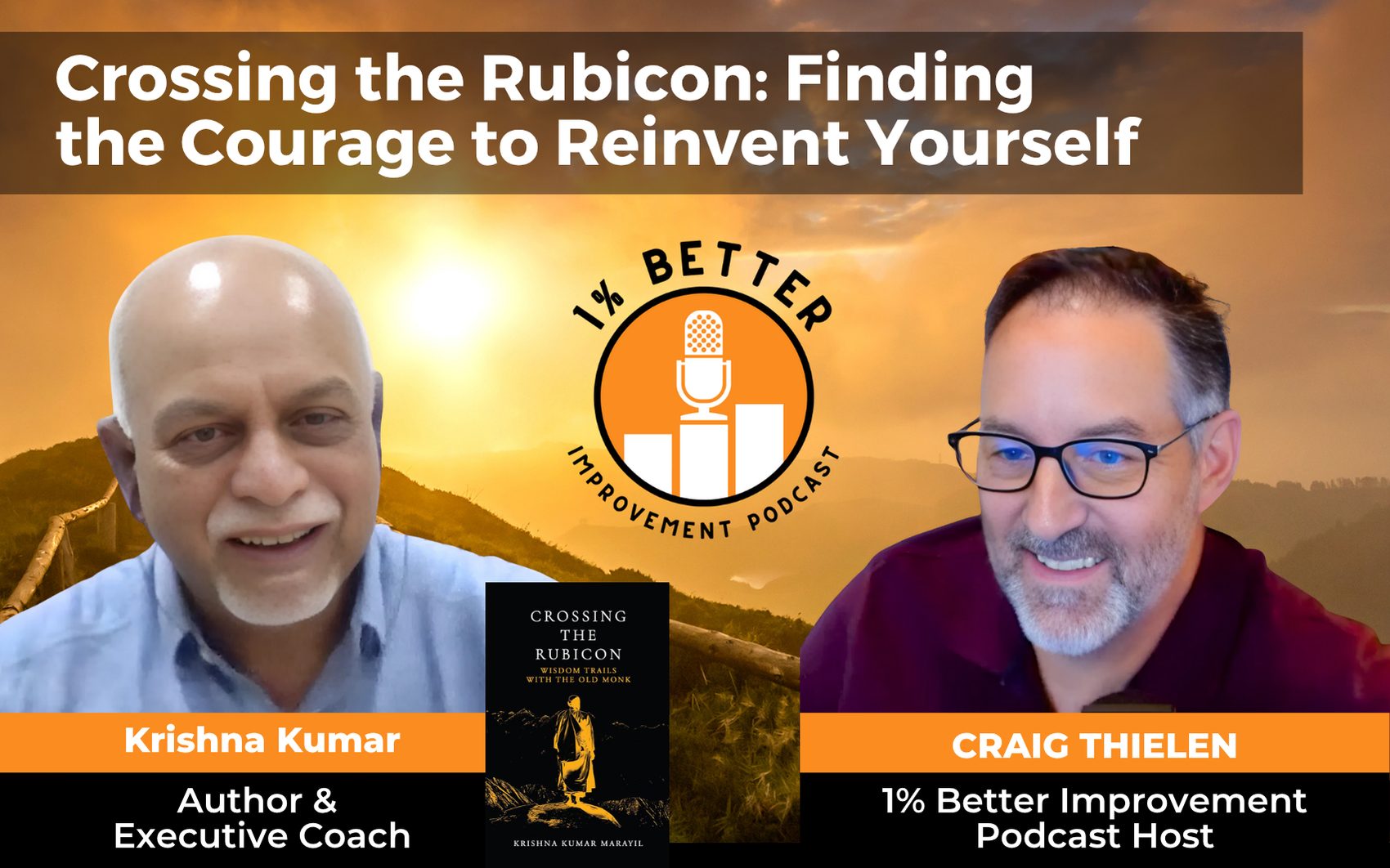
Check out Krishna’s new book, Crossing the Rubicon
Learn about the Intrad School of Executive Coaching (ISEC)
Connect with Krishna Kumar on LinkedIn
Connect with Craig Thielen on LinkedIn
Check out host Craig Thielen’s full bio page
Key Takeaways
- Crossing the Rubicon represents the moment we commit to personal transformation, even if it’s risky, uncomfortable, or uncertain
- Wisdom often begins with awareness, whether it’s recognizing the masks we wear or questioning the path we’re on
- Self-reflection is more powerful than advice, great coaching and mentorship invite questions, not just answers
- The virtues of balance and compassion are desperately needed in today’s fast-paced, hyper-connected world
- Small steps, done consistently, can lead to profound change, capture that 1% moment of insight when it shows up






















1% Better Podcast Krishna Kumar – Transcript
[00:00:00.02] – Craig
Hello, I’m Craig Thielen, and this is the 1% Better Podcast. Today I’m speaking with an old friend, Krishna Kumar, who is the Founder and Master Coach at the Intrad School of Executive Coaching (ISEC), and recently an author of the book Crossing the Rubicon. So welcome back to 1% Better, Krishna.
[00:00:26.03] – Krishna
Thank you, Craig. It’s great to be back with you and also for hosting me and speaking about my book, thank you.
[00:00:33.13] – Craig
Well, I’m excited you were a part of the podcast in the early days. In fact, you were episode five, and that was already two years ago, believe it or not. And the podcast was just an infant. It was just an idea that we had. And now we’re in season three, and we’ve had about 50 episodes, and it’s been a wonderful experience. So thank you for being part of the early days, and it’s great to have you back on.
[00:00:55.14] – Krishna
Well, it seems like yesterday, but it’s amazing that the podcast has grown so much in these past years. That’s wonderful, Craig.
[00:01:03.11] – Craig
Yeah. So just maybe get us caught up, what’s transpired in your life the last two years.
[00:01:09.03] – Krishna
Well, the book, for one. I mean, since we are on the book-
We will talk about that. For sure.
We’ll talk about that. That was a big, big… I crossed my own personal Rubicon, if I want to call it that, in writing the book, it took up a lot of time. And otherwise it was business as usual. So since we last met, this has been the significant milestone.
[00:01:29.09] – Craig
Yeah, it’s been a big. A big project. Well, before we jump into the book, I want to talk about one of the things you talked about on the last podcast was this idea of embracing change, overcoming fear, and this concept of the second curve. And I was just kind of reflecting on that. And it’s based on Charles Handy‘s book, and you reference that, and it sort of represents reinvention and adaption over time. And you’ve had many of those in your life. Just the ones that I’m familiar with… I know in your early days, you were very active in business, and you sort of rose to be a global executive. Then you sort of transition your career away from that, and you got into tennis coaching, which is completely different, which led you then into master coaching, you know, being a business coach. Master coach, starting your own business, the Intrad School of coaching, being an entrepreneurial, and then getting into education, where we met. So I lovingly call you my Professor Kumar, where we met at the India Institute of Business in Bangalore. And now you’re an author. So you’ve had many different sort of changes in your life.
So just as you reflect back on that, maybe talk a little bit about that and how did that map to this book and this idea of people reinventing themselves?
[00:02:52.12] – Krishna
No, thank you for revisiting that last podcast because that was quite a seminal time for me, too, in the sense that I was working through many things in my own life. Like you said, it’s been a journey, and I kept experimenting and you were part of it, on and off. So that was wonderful. In fact, I must mention, in addition to Charles Handy, the one who actually inspired me in that space, I haven’t mentioned him before, but I think I ought to now because he’s one of the old monks thats featured in my book. And his name is John O’Neill. And John was… And John was a dear friend, and he sadly passed on this February, you know, but he lived long and he lived well. And his last book was on gratitude, which I think was a wonderful, you know, way to end it all in terms of his writing. And John, kind of in parallel with Charles Handy, talked about the second curve, and in this amazing book that he wrote called the Paradox of Success, which, if I haven’t referred it to you before, I would encourage people to read it.
He was a great advisor, mentor to so many people, including world leaders. What John, and why I bring him up is because John took it forward from what Charles Handy… Handy spoke about the concept, and John took it one level further. He actually talked about how we could go about it. And he said we need to take frequent pauses in our life to reinvent ourselves, to take retreats, as he called it. And I tried to do some of that. In fact, writing the book for me was a form of retreat. It’s a form of second curve. Tennis coaching, which I got into, was a retreat of a kind. It was a way to cleanse yourself of certain other activities you’re doing, however far removed they were from what you were already doing. So, yes, thank you for bringing that up. And like I said, I wanted to acknowledge John here. And more importantly, the next question that you asked was, how did this whole thing evolve? Sometimes it’s accidental. A little bit is design, but I don’t… I mean, we can say it’s accidental, but I guess there’s something that is preordained in a few things. I mean. Yeah.
Right. Right.
So I. I know, I know it’s… I’ve answered you in a bit of a a roundabout way, but perhaps that’s how things work out.
[00:05:26.09] – Craig
Yeah, well, thank you for sharing that. So let’s talk about the book and what inspired you to write the book and maybe just touch on the concept of it. And the book, by the way, just… we’ll include the link of this, but it’s called Crossing the Rubicon, which even in the name itself, it has a story behind that. But yeah, what inspired you to write it?
[00:05:48.04] – Krishna
That’s a long story in itself. But let me package it. Actually, if you see the narrative in the book, it’s broken up between poetry and prose. And since you have read it and you were, you know, kind enough to review it and thank you for that, Craig. You’re aware of the flow that I’ve had and it’s kind of, people say it’s a bit different from the usual style because what I did was I interspersed chapters with little poems. And the funny part of it was that the poems came first. Somewhere along the way in one of my college groups, you know how people get to get around chatting on various things. And it so happened that one day I penned a poem on the old monk. It kind of got good traction, so I penned a lot more. And it would have ended with that, but then people said, hey, this is nice. Why don’t you do something about it? And so the idea kind of stuck and as a kind of a frivolous side to the whole thing, in India where I live, the old monk is not an old monk. Actually, in the book, he’s featured as a kind of a spiritual guide. But in India, if you tell somebody an old monk, all they think of, it’s a brand of rum.
Okay.
And a very, very popular brand of alcohol spirit. And which most youngsters, their first induction into the world of having a drink is with an old monk.
Okay.
So that was the fun part. And oftentimes I, you know, people smile when they read the book and say, ah, old monk. But the idea here was quite different. Not spirit at all. Spiritual, if anything. So that’s how it began. And the idea got… It just sparked something in me. One thing led to another. I think in the book, I try to distill a lot of my learnings from coaching people, interacting with people, the circumstances, the situations that people shared with me, some from my own life, put it all together. That’s the summary.
[00:07:50.05] – Craig
Yeah. However things happen, happenstance or divine inspiration or there’s a, there’s a plan. It was meant to be. It’s a beautiful book. I was fortunate enough to sort of pre read it and give you some, some feedback on it, and I just really enjoyed it. And as you said, it’s, it is a very unique style. I mean, I’m an avid book reader, as you are, and you’ve, you know, given me some wonderful books to read that I’ve enjoyed every single one, probably a dozen or more books that you’ve sort of pointed me towards and they’re all so good. But this one is unique, I would say. I can’t think of another one that’s constructed the same way. Like you said, it has poems interspersed in it and it’s got parables, you know, very short, easy to read chapters, but yet, you know, in parable form, a short story that makes you, on the surface seems like a very simple interaction between an old monk and a business person that maybe is at a crossroads in their life, but then there’s deep meaning to it. So I just, I love the format because it is easy to consume on one hand, but on the other hand it really causes you to think deeply about the meaning of it. So maybe I thought it’d be fun to give people a sense of the book is to have you read a poem or two. So I was wondering if you would be open to reading your opening poem to start with in the prolog. I think it gives you a wonderful sort of sense of the book.
[00:09:25.06] – Krishna
Oh, I’d be delighted to. Thank you, Craig. So let me just begin with the prolog, if I can, if I may do start with that. So again, a little bit of history here, if you don’t mind. Before I read this one, I mentioned about the fact that the old monk in India is more popular as a spirit and-
[00:09:46.07] – Craig
In the US by the way, the equivalent, I think, of that is a rum called Captain Morgan.
Oh, yeah.
So a lot of the college kids, and that’s the, if they were to, if you were to say Captain Morgan, that would be, I think, be the equivalent.
[00:10:00.09] – Krishna
I know Captain Morgan, you’re absolutely right. It’s a very similar thing. And the actual history of Old Monk, and it has nothing to do with my book, was that most youngsters, they gravitate from a soft drink like Coke to something that is a little harder. But Coke, fundamentally, we know it’s a sweet drink. I mean, it’s sugary, it’s sweet and the kids love it. And so what happens when you’re younger, in college, in university, and you have the Coke and then you want to add something to it. And so the guy who, who created Old Monk, he experimented and he came up with this rum that was sweet. And so, of course, the formula goes that you add a little Old Monk to Coke, and soon you have more of the Old Monk and less of the Coke and so on. So the ratio changes. But how did he do that? I mean, I just, you know, found out, did a bit of research and found out and then took my own take on it. So here goes. Let me just read it out. Yeah. And by the way, it was Old Monk was first created up in the Himalayan mountains, so, you know, all these bits and pieces. So here goes.
In the mountains lies a special brewery, a destination for the cognoscenti where you’ll meet man’s truest friend, an old monk, a druid, the stuff of legend. He brews an elixir to quench the driest thirst, has a recipe that overcomes life at its worst. A mix of cinnamon and vanilla, a dash of lime, all garnished with a hint of mint or thyme. One that will send warmth up any spine, beat the best of any ambrosia or wine. A sip and you scream. A man comes of age, ready for battle on the big stage. But for distilling that euphoric blend, Old Monk uses a special ingredient, one that’s tough to comprehend, hidden as your soul’s deepest intent.
[00:12:06.10] – Craig
Beautiful. Thank you for that. And again, it gives a little bit of a taste of just the writing style. So let’s talk about maybe just break down the book a bit. And what are some of the key concepts in it that you would maybe highlight as some of the themes?
[00:12:29.02] – Krishna
Yeah. The underlying theme is a journey, and which is why I call it the wisdom trails with the old monk, because the chief, the business leader who’s on vacation, wanders into the mountains and runs into this gentle old fellow, you know, on a walk. And we call it serendipity. We can call it happenstance. We can call it karma. We can call it anything. But that one meeting, which otherwise may have been just yet another encounter, this time actually goes and starts a process of transformation. And that’s really what the book is all about. It’s a journey. There’s this kind of magnetic attraction that the old monk has on the chief, who otherwise is a head honcho, a powerful man, ambitious, driven. And suddenly he finds himself in a space where he is unable to forget that meeting and wants more of it. And in each of the chapters, the conversation really takes this person into probably exploring himself a little deeper, trying to understand what his inner drive is, his inner motivation, and why he’s doing what he’s doing earlier. Much of what he did was just, you know, follow a path. Not necessarily one he set out on, but one which just took him along.
And now he questions that. And over the course of the writing, perhaps, like I said, I had the poems and I had the poems was one side of it, the story was another. And somewhere, I don’t know, I mean, it just flowed at some point. It just all came together. And the one that was probably the, the trickiest part for me was to put it together in the last chapter, which you have read and where I tried to sew it all together because that wasn’t planned, but the rest of it, yes, I had a certain flow to it. So it’s really a journey that people take. And I got asked the question, what are you? Are you the old monk or the chief? Where do you see yourself? And I said, actually I see myself not as the old monk, I see myself as the chief because I wanted to be on the journey. And you know, the old monk kind of symbolizes people I met. Most of us do. I think you would have… I would have… Others will have… People who listen to us would have met many of them. The trouble is you have to be fortunate to be able to get the best out of those people you meet and take all the wisdom they can distill into you and find your own path.
[00:15:18.12] – Craig
Yeah, that part was quite interesting for me in itself because when I read the book, I envisioned you as the old monk. And in some ways you are the old monk to me, when, when you say, well, no, I’m not the old monk, I’m actually, you know, the, the person kind of finding his way. And I think it’s all a perspective. I mean, we all are both of those things at different times in our life. And maybe at the same time, you know, to some people we are the old monk. Maybe to our children, to people that we have influenced. Of course we all are, you know, finding our own way and learning from others. And so we’re the, the person. So it… That’s kind of an interesting thing as well, that we are both of those things at different times. So you know, the one, the other thing that it reminds me of is a, is a book and a movie that you pointed me to called the Peaceful Warrior. And there’s a connection, a similar sort of connection where this boy is a world class athlete, but really struggling through life and he runs into this person who doesn’t really seem like anyone, just sort of a bum on the street, next to a gas station, I think.
And all of a sudden this person has great wisdom and he gets more and more curious and it opens up a whole new world of self-reflection and, you know, where whatever his problems were, were all within, not the external, where he was pointed… So there’s some… I thought of that, you know, several times in your book, how the interactions went. So yeah, you know, I think one of the things that the book really does for me is it challenges to reflect on ourselves and to look, you know, inside for answers and some of the challenges. So I’m just curious, there’s a lot of books on leadership out there in the world, thousands and thousands. Maybe one of the most written about topics, leadership, slash, learning, self-discovery, transformation, et cetera, et cetera. Why do you think this is important now? The concepts in the book, self-reflection, looking inside in this world that seems… We seem to have all the knowledge in the world at our fingertips. We’re in this fast-paced digital world. Why is this book important now?
[00:17:32.09] – Krishna
That’s such a hard question. Funnily enough, it’s an easy question. It’s very hard to answer because why is a book so relevant? As readers, I think every book has relevance to us. There’s lessons in everything. But why? I did three things when I wrote this book. One, I wanted it to be an easy read and a quick read in terms of number of pages, easy type phase because I knew the world had gone so fast. No one had time to read a 400-page book. It, it’s just not going to happen. The second thing was, even though it was going to be less number of pages and easy read, I also wanted it as much as I could to bring in some amount of, as you said, opportunity for introspection, reflection, questioning one’s own path. And the third thing I had tucked away at the end of the book, and if I can give that away, I… And that’s the most important part which I talked about was how to lead what I called the virtuous life. Now people have many definitions for that. They call it, you know, satisfied, fulfilled, all these words that people have.
But I just found myself the right word when I said the virtuous life. Because the way I see the world moving, that’s missing. There may be so many reasons for that. Who are we to judge what the world is about? But all I do know is that the virtuous life, as I tried to package in it, was all about having balance and compassion and you know, those things were missing. In the world today, even if we don’t get it, at least we should try for it. The two things that I just brought up, balance and compassion, is sorely missing. So even if I’m able to tickle someone’s thought process and they say, hey, that seems like something we need to work on, then we are that much ahead, and that’s what the book would all be, you know, useful for.
[00:19:33.14] – Craig
Yeah, What do you think… You’ve worked with a lot of executives, and you have a good sense… You’ve traveled and worked and lived in different places in the world. What do you think are some of the biggest challenges that people are facing today? Those pitfalls? And how do you think that some of the concepts and stories can help people with that?
[00:19:58.03] – Krishna
There’s so many stories and so many concepts. You said that in every book… The world is full of books that have concepts and stories, and there’s packaged in so many ways. But what I really think this would help people is that I’ve given instances that are as practical as one would get, as real as we can be. For instance, a young nephew comes to you and says, I’m deciding to do something with my life. And this Youngster may be 20, 30 years younger than you. And there is always the tendency to be helpful and say, hey, I’ve got the plan for you, and this is what I want you to do. And this happens to all of us at some point in our life… It may not be your nephew or your niece or your kid or your junior at the workplace, somebody will come to you for advice. That’s one illustration. How do you go about, is there a better way? Then there’s the other topic, which I think you liked a lot, which is the mask.
Yeah.
And it’s something we take for granted, isn’t it? I mean, through the course of a day, the number of masks we all wear is unbelievable. And I often joke with people saying, maybe we can’t help it. When you’re with your, you know, with elderly people, your parents, when you’re with your kids, when you’re with your peers, when you’re with buddies, when you’re with bosses, vendors, clients, we all wear masks. The question we ask ourselves is, is that the right thing to do? Most of us justify that and say, yeah, that’s fine. That’s what we need to do. That’s how it should be. And then there’s the other deeper question that is it really? That is that the definition of authenticity. Would the Dalai Lama wear masks? I mean. And this kind of deeper question that comes up, that’s what I really wanted to try and do in the book. People who read it picked up a few of these I thought was the most important and relevant to modern living. I’ve just given two instances.
[00:21:59.14] – Craig
Yeah, those are great. I would love for you to… I did that mask notion really did sort of open my eyes or, you know, it forces you to just look at yourself in a very different way. So would you. Would you be open to reading that poem, the Mask?
[00:22:18.05] – Krishna
Another one? Yeah, sure. I can. I think I already spoke about it.
[00:22:22.12] – Craig
But I think chapter six. Yeah, I think the poem, though. I’d love to hear you. You have such a poetic voice as well.
[00:22:31.01] – Krishna
Thank you so yep, here it goes. I called it the Mask.
As time marches through a single day we don identities for the parts we play. Personas that are but an effort to please, in settings where we don’t feel at ease. A lurking imposter that peeps out in fear, playing out a masquerade to appear sincere. That makes us spend many nights awake, worrying when we’ll be labeled as fake. When our concerns cause concealing, Masks adorn us in unappealing shapes. Peeled these masks leave no traces, are we old monk? A result of myriad faces. Wearing masks Chief, keeps us safe. Blocks our true self from freedom to grow, don’t live watching how the wind blows, It’s tiring to switch from pose to pose. Discarding masks can bring much relief, help turn over a new leaf, strengthen belief. Potential resides deep within the mind’s shelf, in the collective unconscious of self. Build your identity drawing on the psyche, it balances our self, free potential key. The fortunate few tap into its rich source, others unknowingly let it run its course.
So, yep, I ended with a quotation from Hermann Hesse. actually, and I think that’s very powerful. I said I only wanted to remain true to my own self. Why is it so difficult?
Yeah,
He captured, he captured it so well. So well.
[00:24:14.14] – Craig
Yeah, that’s a… I love simple truths and those kinds of statements. That’s pretty powerful. A lot of people could spend a lifetime and have spent a lifetime to try to figure out who their own self is and how to, how to become them. How to become the best version of themselves or the true version of themselves. So, yeah, a lot of deep stuff there. I love the poem. And I think one of the things. It’s just the first thing is, in a lot of these processes that we go through… The first thing is just to recognize where you are. So the first step in this case would be, what masks am I even wearing? And to just ask yourself, what mask do I wear over a course of a day, a week, a month in different settings? And it doesn’t mean it’s good or bad. Just means try to understand what masks I’m wearing and why. And then you can say, well, do I… Do I want to wear those masks? Should I wear those masks? Is that, is that really me? Or is that me trying to be someone else?
And then it leads you to other questions, like, am I defining myself? Some people, we define ourselves as a title or as a role. Like I define myself as a father, or I define myself as a friend or a title at work. And inevitably, roles and titles are temporary. We’re not, you know, a dad in every circumstance. We’re a son, sometimes we’re a friend or whatever title that we wear. We’re not… These are temporary things. And so if we define ourselves with temporary things, then what happens when that, that temporary title leaves us? Who are we, right?
So I think it’s just an example of how this book… and what I also love about it is when you talk about being authentic, this book is really authentically you. A lot of books will tell you this is what it is and how you do it. And it’s very sort of mechanical, and it’s, you know, sort of telling you, how about this concept. This book doesn’t tell you anything. It leads you to things. It causes you to ask things about yourself. And that’s, to me, you know, working with you probably now almost ten years. And, first as a student, in one of your classes where you taught us about the inner game of tennis and you taught us about coaching, and then going through your coaching program, I often found myself asking you, well, how does this work? And what’s the answer to this? And very rarely did you give me a direct, straight answer. You would somehow weave it into a story or weave it into a question back to me that caused me to try to figure it out for myself. And so that style that you have is in this book.
And so I want to ask you, is that something… Because I often try to say, well, that’s a… It’s a coaching technique, clearly. The monk does it beautifully and artfully in the book, but it’s not as easy as it seems. So is that something that you always had in you just something you developed. How did you develop? And do you continue to sort of struggle with always finding the way to help people find the way and because sometimes it’s not easy, sometimes they reject it, they ignore it, or you, you want to kind of take the shortcut. So I’m just curious in on yourself, is that… How did that transpire?
[00:27:41.03] – Krishna
Well, I think it… I’ve written in the book also at the end, in my acknowledgments that I was lucky to have trained and worked with, Tim Gallwey being one of them, and all these people, you know, Captain Pavan Murthy, many of them very senior for people, everyone injects a little bit into you and goes away – it is how you use that. And one thing I did discover, maybe post my corporate life, that very often advice, if I gave it, it was never really appreciated or used. And what people actually appreciated was what you left them with and not advice. I’ve had a person meet me many years later and say that you asked me a question. I’m still not. I’m still figuring it out. I’m still trying to figure out what… And I had no clue what I had told him. I didn’t even remember him very well. And when you consider those episodes or interesting situations you face, then you kind of strengthen your belief that probably that’s the way. And then it becomes a part of you. It really becomes a part of you. Maybe. Yeah, it’s, I think, to do a lot with like any other profession, coaching becomes you. You don’t do coaching. Those are very basic coaching people. After a while, you become a coach, maybe a mentor, whatever. It’s. It’s part of you. So-
Yes, you’re right. Great way to say it.
It comes into the book. It flows.
[00:29:18.09] – Craig
Yeah. Well. And again, I think the way you just said, it’s very beautiful. You don’t… You stop being that… You stop acting it… You stop the technique and it just, it just is you. So of course, if you write a book, it’s going to come out in that way. So, yeah, that’s a, it’s a great.. about anything in life, once you stop trying to get there, there’s a book called the Beginner’s Mind, it’s about Zen Buddhism. And the whole book is basically about stop trying so hard to get somewhere and just be. Just, Just be. Just be Zen. Just practice it. And you are. And when you’re trying to get somewhere, you’ll never get there. So this podcast, we talk a lot about this idea of 1% Better, which is small incremental changes and improvements that are done consistently over and over and over can really lead to transformational results. How do you think this book and, and the concepts of it tied to that thinking? You see, how would you describe that? Just self-improvement, self-discovery, being your better person… Do you see that correlation?
[00:30:31.00] – Krishna
I think I see more than that. I see more than that… I like your 1%, it’s great, it’s wonderful. It’s the path to move ahead. We don’t rest where we are. We continuously move on the path of self-improvement. Now as far as the book is concerned, it kind of mirrors that across the spectrum. Towards the end when the many years after the chief has met the old monk and he’s sitting on the lawn after a game and reflecting on life, all that transpired, I think it would have been a one-person journey for him. Systematically. The incremental, the baby steps that this person took, I mean he. symbolizing all of us, so to speak, in that same position, provided they actually use what they’ve learned. Most of us let it slip by – that Craig, is a tragedy. There’s so much wisdom floating around and I don’t mean on the internet and I don’t mean on social media and all that. I actually mean wisdom from the, from the minds and you know, voice and interactions one has with other people, and that, we don’t capture. We’re so caught up in all other things, we, we don’t listen enough to the wisdom that can flow from so many places.
Even now when I sometimes sit back and I have a chance to recollect conversations I’ve had with some of the people I listed in the book. For example, I will give you. I had a great coach, a great friend. I mean he’s not with us anymore again. And Captain Pawan Murthy was a legendary tennis coach. And very often after matches, you know, the Wimbledon, the French Open, the US Open, and we would pick up the phone and have a conversation. And now the French Open is happening, right?
Yeah, I was just watching it last weekend. There’s some good matches in there.
And it’s happening now tonight or tomorrow or in the morning, whatever the timeline is. And the memories flood back on the conversations that were there. I don’t mean the, the social stuff. And he would drop that one nugget of wisdom that lasted with me for such a long time. You know, he… And the same thing happened when I and I had conversations with Mihaly Csikszentmihalyi or John Whitmore or any of the others, that one little nugget will stay with you. And the point is most of us let it slip by. So all I would say from the lesson of the book for people on the 1% is… I don’t know how I think this might be relevant to the podcast is… be alert.
Yeah.
Capture that 1%, capture that one nugget of wisdom that, and be alert for that. And that will stay with you and that will make you that one person better.
[00:33:24.06] – Craig
Be aware. Again, that’s another correlation with the Peaceful Warrior book is just be aware and be alert. Because there we have so much around us, every interaction, frankly. And one thing that I pulled from the book through these wonderful little interactions between the old monk and this busy business executive is the momentum that you could feel the momentum gain. At first it was like, who is this old man? And so kind of in my way. And something he said just stayed with him. And so the next day he goes, I got, I want to talk to him again. Because something he said, it caused something to stir in him. And then every time he went back, he got 1% and he got more… And all of a sudden he was very like, almost addicted, like, I need to see the monk tomorrow. I need to see the monk tomorrow. Because he was getting so much. But if you would have ignored that first little interaction, like you’re my way on the path, he could have just lost this incredible, you know, conversation and connection that he had. So that’s, I think, a metaphor for life. Like, we can all miss these things if we’re not aware, right?
[00:34:33.12] – Krishna
Absolutely. I mean, in the… even that first poem I wrote about the second one, so to speak, of the hare’s tale, if you remember.
Yeah. Oh, yeah.
And the last bit of that is basically that, I mean, for the benefit of those who haven’t read the book, it’s basically that the age old, you know, story of the hare and the tortoise, but here we, we put a spin on it and the last bit is all about that, is what you just said.
Yeah.
It’s a journey of discovery. It’s a journey of discovery. It’s basically the entire book, I’ve tried to make it a journey, a short one, but every step of the way. I like the way you said it, that this… Initially he was very resistant and probably irritated at times, and then later on it was very different. It was like, I don’t want to lose this man. I want to be there as much as I can. Even though I’ve got to leave, I’m not going to lose that every minute I have with him. And there are so many more questions to ask.
[00:35:38.12] – Craig
Yeah. Yeah it’s like once you kind of open, open yourself up, it’s a, it’s a… It was a new world for him. And so one thing I wanted to ask you again, in the modern world that we’re in, there’s, we have information overload. You just can’t consume. If we have so, so much information at our fingertips, you can’t… And sometimes if we’re lucky, that information can turn into some knowledge and there’s a lot of knowledge floating around. But there’s this saying that, knowledge without wisdom can be very destructive or dangerous. And we, an example would be, knowledge of, nuclear fission is great, but it can be very destructive. And you could almost say that with anything. And I think that’s one of the things that I think your book can provide is maybe we need a little bit more wisdom. Maybe we need a little bit, you know, less.. We have all the answers and we have now, you know, amazing power with AI can do anything for us, but do we really have the wisdom to know how to, how to best use it?
So a lot of times my question for you is a lot of organizations be more data driven, more data centric now, where they use data to make better decisions. And they used to make decisions off gut instinct or maybe just patterns or what they’ve seen before. We said, no, we really need to use more data. But I now I’m kind of on the flip side, questioning, well, how do you get the right balance between using data and information and knowledge? You know, Deming said, if, you know, bring your data, or it’s just an opinion versus your gut instinct and your intuition, which is sometimes incredibly powerful, maybe more accurate and you don’t always know why. But how do you balance those two things? I don’t think you want to go one way too far. But how do you balance those two things?
[00:37:31.03] – Krishna
Moving away from the book, okay, on this question, this is… I gotta wear my, my professor hat, if you will allow me. Is that the concept is critical thinking, actually. I mean, the 21st century, that is one of the top skills that every kid, every leader, every executive needs to learn. And what you talked about, balancing the gut with logic and analysis, the balance. Where does wisdom actually lie? There’s knowledge on both sides. It’s the distilling of both and what arrives out of that, that helps you take the decision. Now people may say the wisdom is stored in the so-called gut. And on the other side we have reams of data analyzed through AI algorithms and all the rest of it. The question is, how would you take your decision? What makes you take that call and how fast will you do that? That’s really all about critical thinking and the learning of critical thinking. I moved away from this, but I think that if I had to provide some input to somebody, I would say that, hey, practice that. That’s the only answer.
Now what is critical thinking? You can run a 10-day workshop on it, but that’s a separate matter. The issue is the answer lies somewhere there. Ultimately it’s wisdom. But how do you get to that wisdom? And when you look into that world of critical thinking, it works on stuff like our biases, our prejudices, our expectations. Today the world is driven by that. The way we are being influenced is enormous. So to be able to detach and to see the more holistic picture, the, the right picture, and here, this is maybe the answer… As I’m speaking to you, I’m also trying to get an answer to this one. So oftentimes I ask people, what do you want to be? I mean, let’s get back to the more philosophical one. Let’s really ask ourselves. Because every time you take a decision, and I don’t really mean buying a new shoe or a shirt, right? Yeah, I’m talking about- big decisions. Yeah- yeah. I mean, even if it is like switching home or relocating or something a little more significant, oftentimes we do it and then we question why we have done it. And to be able to do that, we need to be able to have that one big, I would say, vision in front of us and ask ourselves if every step that we are taking maps to that.
And that’s what was there in the book. When I talked about the virtuous life, I said that was my vision. Now you may have another one, somebody else will have a third one. And that in coaching theory is called the ideal self, the true self, the self that you want yourself to be talked about one day, 50 years down the road or whatever, when we are not there on this planet and somebody reminds themselves there was this person. How would you like to be known? In one line, you know, what would give you the greatest fulfillment and satisfaction? I was this. Now if I’m able to capture the essence of that, then every decision I take, I map it to that one and say, yeah, is this decision getting me there? If it isn’t, I’m not on that path. The question is, how do I find that one big goal for myself? That one line,
That’s the meaning of life right there. Right? That is the biggest topic. The vision, the dream, the enlightenment, the virtuous life. Are you in full alignment with who you are and where you want to be? That’s it.
And then, and all your, all your, all the decisions you take are because, I mean, I’m talking of the big ones. Like not what toothpaste you choose or your shirt, but talk to the big ones. Because in which case, you know that this doesn’t map with my ideal self or my true self or the self I, you know, visualize for myself. And at which point in time I’m not going to take it, however interesting it looks.
[00:41:57.02] – Craig
Yeah, yeah, there you go. That’s beautiful. Well, that’s a perfect segue into… I think there’s a story behind the title of the book that relates to that, Crossing the Rubicon. Can you, can you tell us that?
[00:42:10.14] – Krishna
You want me to give away the spoiler on that story too?
Why not?
Yeah. I mean, we just gave away the meaning of life. We might as well do that.
Yeah, absolutely. No, I mean, I really like that story and I don’t know if you, I mean, it’s there.
I love it. Yeah, it’s a great one.
And for the, for benefit of those who are listening in at some point, I would basically say that it’s very easy story. Everybody can find it if you just Google it or if you have heard it before. But it’s to do with the Roman Empire and Julius Caesar. I mean, it goes back to that, but what’s the essence, without going into the whole story, but what was the essence of that is really, in many ways captures what I wanted to do in the book, which is that if every one of us, like Julius Caesar, we have that dream, that ambition to do something, but we never take that one big step. I mean, let me just take this example. You and I have spoken about it, Craig. I can assure you that between us, we know at least 20 people who want to write a book. Yeah. I mean, at least 20. Between you and me, who said that’s in my thing, how many actually cross the Rubicon? Because it’s very nice, it’s a really nice thing to do. But how many would actually take that big plunge? Because it comes at a price.
That is what the essence of the book was. Take the plunge in this, the story, the episode has the chief having to take that call, and most of us hesitate. There’s a big fear. There’s a huge fear that holds people back. That’s the single biggest obstacle to progress.
[00:43:57.07] – Craig
Yeah- And as a coach- crossing the Rubicon, and that’s the decision that Julius Caesar had to make. Was I going to take the easy path and just retire and have riches and fame, or was I going to do what I felt was why I was born, which was to- be the emperor of Rome- free the Roman Empire from tyranny, and to free the people? But it was going to be possibly death, it was going to be possibly torture. And, you know, that was him crossing the Rubicon, which was a river. And he made his decision once he crossed that river. It was very symbolic, right?
[00:44:34.12] – Krishna
Very symbolic. And it’s rumored that the one bridge across the river, he burnt it. Not that it was a very important one, but it was really like a symbol to tell the army that there’s no going back, you know, and that I have seen it so many times in my coaching practice. I have seen this a lot. And I’m sure you have, with all the experience you have and the interactions you have with numerous colleagues and clients. How many times? There’s so many people who say, I would like to set up my own business. I would like to do this. And when you ask them, when are you going to do that? They’ll say, maybe after this. After that, after this- Tomorrow- I mean, it’s simple one like that. I mean, so we do have those little crossroads in our life, and most people, the rivers most people won’t cross. So either this book, I hope, will inspire some people to come in touch with their real dreams and take the plunge.
[00:45:34.06] – Craig
Well, in some ways, you writing this book was your river, your crossing the Rubicon. So I’ll finish up with this question is, you cross the Rubicon, you wrote this book. What did you learn about yourself going through this experience?
[00:45:53.14] – Krishna
The hardest thing I have done in a long, long time. Okay, I’ll tell you a few things that I had to do, which were very tough. I wrote poems and the poems were, you know, poems are very funny things, creatures, because you kind of compress, you distill, you squeeze down all the stuff into few words, right? I mean, you have this idea and you put it together and it… You’ve got to finish it in a few stanzas and you’ve got to have everything in them. And then the other side, you write a book. And my editor, when I started writing it and I had conversations with her. All the feedback that she was giving me was… just expand it, describe it more. And my brain was lazy. I was so used to compressing that this expansion was bothering me because she’d say, describe more of the old monk. Describe a tree, describe this. I mean, and it was like a mindset shift. That was the challenging part. I learned that, you know, that I had been lazy in my writing and I had to stop being lazy. It’s a completely different thing. And that was a big learning.
The other learning was that there was a lot I wanted to share. And at one point in time we actually had a conversation. I said, okay, should I add another chapter or two? And she said, I think it’s good as it is, so you really need to be able to draw the line. And it’s interesting that then the story comes to place because this isn’t a thriller. This isn’t a kind of a detective story or a romantic story or one of those where you can neatly package it up and say, okay, the hero has killed the villain and got that, you know-
lives happily ever after, right?
And he comes yes to the reward. And I mean, this wasn’t like that. So yes, there is a circling in all stories, but it was a different one. And so that was another great learning for me. And the third thing was that, which is the fun part, now I feel good I can write another one if I wish to. So that third big one-
It allows you to take the next step, right?
Yeah, yeah, that’s true. I mean, earlier I would have perhaps hesitated. Yeah, sorry, go ahead.
[00:48:14.11] – Craig
Well, no, but I just want to thank you for sharing everything about the book and in writing it. I think it is going to impact a lot of people. I’m going to read, I was honored to write a review for you and I’m going to read it because this is what I got out of it. A beautifully written and thought-provoking story highlighting the value and beauty of living in the present moment with a gentle but clear nudge towards self-discovery. The old Monk’s tales will make an immediate and positive impact to your personal growth and stay with you long after you turn the final page. And I believe that. I think this is one of those books where people are going to hold on to and read over and over and pass on. And I think you’ve created something really special. So thank you for doing it and thank you for sharing that with us today.
[00:49:03.12] – Krishna
Thank you, Craig, for the opportunity to, to be on this podcast to talk about my book. I truly appreciate that you’ve been a great friend and I hope that we will continue this conversations going forward.
[00:49:18.03] – Craig
Thank you, Krishna.
[00:49:20.01] – Krishna
Thank you, Craig.
Check out other podcast episodes