Find us on your favorite podcast platform including: Spotify | YouTube | Apple | Amazon
1% Better Podcast Darin Lynch, Irish Titan – Quick Links
Learn more about Irish Titan
Check out Start with Why by Simon Sinek
Read The Art of the Start by Guy Kawasaki
Connect with Darin Lynch on LinkedIn
Connect with Craig Thielen on LinkedIn
Check out host Craig Thielen’s full bio page
Key Takeaways
- AI is reshaping digital commerce at breakneck speed: From AI agents to agentic commerce, the landscape is evolving rapidly – offering more opportunities for personalized, “commerce anywhere” interactions
- Omnichannel and personalization are finally real (but still aspirational): Thanks to better data hygiene and integrated tools, true personalization and consistent brand experiences across all touchpoints are now achievable
- Search is shifting from SEO to AEO (AI Engine Optimization): Traditional SEO is losing ground to AI-driven search like ChatGPT, prompting digital leaders to rethink how brands get discovered in this new world
- “Business first, online second” is more than a motto: Darin’s philosophy – rooted in understanding a client’s business strategy before jumping into tech – has guided Irish Titan for over 20 years
- In a sea of sameness, the only way to stand out is to “go rogue”: With the democratization of good-looking websites, true differentiation now comes from creative thinking, not just functional UX














1% Better Podcast Darin Lynch, Irish Titan- Transcript
Craig Thielen (00:07)
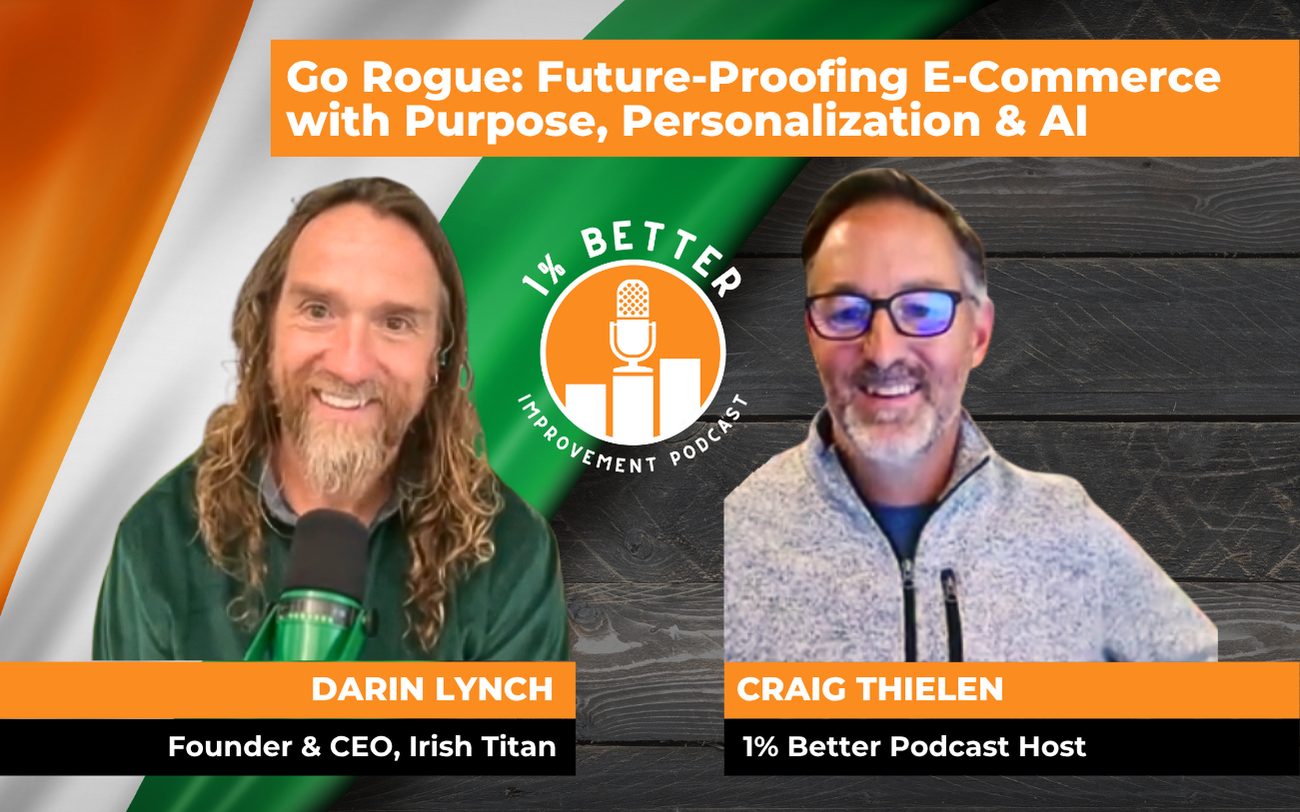
Hello, I’m Craig Thielen and this is the 1% Better Podcast. Today I have Darin Lynch, CEO and Founder of Irish Titan, a digital commerce company with me. And first of all, welcome to 1% Better. And I’m not sure if you know this, but congrats on being the 50th episode on 1% Better.
Darin Lynch (00:26)
wow. Thank you, Craig. Thanks for the conversation. I’m looking forward to it. Slantja, everybody. And I’m even more honored now to be the 50th guest. That’s a nice round number. Congrats on 50 podcasts. A lot of people don’t make it to 50 podcasts.
Craig Thielen (00:38)
It is, it is… didn’t envision it or didn’t plan on it, but sometimes one foot leads to another 1% better and here we are. So by the way, I love all the green. We’ll get to that. It’s gonna tie into Irish Titan I’m positive of, but why don’t you start with just tell us a little bit about you, your background, why you started Irish Titan and what you guys do.
Darin Lynch (00:40)
Ha Yeah. so I’m just an Iowa farm boy who likes green and can’t afford a haircut. that’s what I’ll start with. so, I’m Darin Lynch. I’m the founder and CEO of Irish Titan. We’re an e-commerce agency and we’ll get to that a little bit more. I did grow up on a farm in Iowa, grew up in Northeast Iowa on a pretty sizable, crop farm and we had feeder cattle. Then I went to university of Iowa and I’m a proud Hawkeye, worked at Principal Financial Group in Des Moines for almost five years and then moved up here to the Twin Cities 27 years ago and have been in tech since then, including starting Irish Titan 21 years ago, which is a pretty good run in our industry, in an industry that’s very fluid and changes and evolves rapidly. So that’s a quick rundown on my bio.
Craig Thielen (01:43)
Wow. All right, well, we’ll get more into that. Maybe we can start with what’s changed in the past few years. I digital commerce, e-commerce, when you started the company was, I mean, now, of course, it seems very, it was new. was relatively brand new or just coming into its own, you know, sort of post.com, right? So maybe just talk a little bit about what’s evolved over the past 20 years, but in particular, last two years, seems like everything’s speeding up and we’ve got AI and we’ve got, of course, Amazon sort of dominates the world. And there’s a few others, Alibaba, there’s a few others that do pretty well as well, but just maybe walk us through e-commerce or digital commerce 101.
Darin Lynch (02:23)
Yes. Yeah. So you’re right. The pace of change is accelerating. And that is notable given the pace of change we’ve already endured in the industry, endured or enjoyed. So, you know, when I think back to starting Irish Titan, I cast a wide net as a digital agency because quite honestly, there wasn’t enough e-commerce, particularly the Twin Cities area to go to market yet in 2004 as an e-commerce agency, right? So we went to market as a digital agency. We had a particular focus on e-commerce right from the very beginning, but we had to grow that. What prompted me to start Irish Titan is I had long known I wanted to start my own company. When I was in elementary school, like third-ish grade, like I said, I grew up on a farm and the bus half of the year would hit this T intersection on the gravel and take a left. And when it took a left that half of the year, I got off the bus like one minute later. If it took a right the other half of the year, I got off the bus like an hour and a half later. So on nice days, I would get off at that T intersection, even if it was taking a right and just walk the county or the square mile home. And there was a particular time, there was a point to this story. There was a particular time when I got home and I watched the 1960s Adam West Batman every day when I got home, right? And I popped in the kitchen and told my mom and dad, my mom was a teacher. She was home from school by this point. And dad was a farmer who happened to be inside at this point. I said, when I’m a grownup, I’m going to own my own company and I’m going to have a bat pole. So it was inevitable that I eventually started my own company. And I knew that from an early age.
When I moved up here from working at Principal Financial Group, which is a great company, I had the best boss I ever had was my first boss and I had great bosses there. My first exposure here was running a Lawson software, which I’m sure you remember Lawson software. I was running a Lawson software consulting partner. So I didn’t run Lawson, but I was running a Lawson software consulting partner. And one of our clients was OfficeMax. When OfficeMax decided to launch their very first e-commerce site in 97, we launched in 98, I raised my hand and I said, I’ll run that project.
And so that was my first taste of e-commerce. And I thought, I think there’s something in this e-commerce thing. Now, when I look back at that project in e-commerce in the late nineties, I’m like, how the hell did we even launch that? You know, then I went to Wilson’s leather, launched their e-commerce, went to second swing golf, launched their e-commerce. I got my MBA along the way and that was paving the way for me to start Irish Titan with a focus on, as a digital agency to cast a wide enough net, but with a focus on e-commerce. So big preamble that led to, you know, what’s evolved in the last 21 years. And like I said, at first we had to cast a wide enough net to do all kinds of digital work, website work, digital marketing, et cetera. We started to go to market as an e-commerce agency in 2015 and it has evolved rapidly over the entire duration of Irish Titans history because technology continues to advance.
And digital in particular is at the intersection of technology, marketing, and design, right? Because all three of those converge to create a digital experience. What I particularly love about e-commerce and what drew me to it originally is that it’s the convergence of all three of those, the technology, the design, and the marketing, but layered on top of a business focus. From an e-commerce perspective, our merchants, as we refer to our clients, are expecting us to help them drive revenue, drive sales, drive profit, right? So it’s not as much of an implied marketing ⁓ initiative as digital marketing is. It’s a true business focus. So the way that design, technology, and marketing has advanced over the last 21 years, you know, has picked up pace. And then AI, through rocket fuel on that. And in the last two years, it’s changing more by far in those two years than any previous two year, five year, 10 year kind of window.
Craig Thielen (06:57)
Sure. So give us some examples of, I mean, cause I think most people can probably imagine what websites used to look like back in the 2000 era. They were pretty basic. Some had shopping carts, some didn’t, some would just submit an email and that got better and better, more robust. People started figuring out features and functions. Of course, a lot of people maybe not now might be sort of.
We even had one client say, want to be the Amazon of our industry, et cetera, et cetera. there’s some, some copying of, all of their upsell, cross sell feature functionality. But what, and of course then you’ve got a lot of backend stuff like integration with, you know, things like Salesforce and ERPs and, and all of that stuff. And you, you connect with your, your brand, your marketing, your front end stuff, but like what’s changed practically in the last year to two years in the marketplace, in the AI world, what are practical examples of how that’s impacted your business?
Darin Lynch (07:54)
So I have a concept of commerce that I call commerce anywhere. And I’m saying commerce anywhere, not e-commerce anywhere. Because I think that the end goal that we all have in mind in our space is to help our merchants, or if I’m a merchant, I want to do business where our customers want us to, right? Which sounds sort of simple and platonic, but it’s about not just your branded site, you know, like irishtitan.com, and it’s not about just marketplace like Amazon or Walmart or Alibaba, et cetera. And it’s not just about social. Those have emerged as channels because consumers are there and they want to do, they want to interact with you in those channels. What AI is really advancing is the ability to create more interactions in more places. whether that is something like an AI agent, like ChatGPT agentic commerce is a really hot and frothy term in our space right now. I say hot because AI is enabling, know, ChatGPT and Gemini and all these different AI agents that we’re using it is allowing for the opportunity for merchants to present product there, try to capture a transaction there.
At the same time, merchants want to still protect some of their brand experience, right? With their branded site. That’s why some merchants have a very intentional strategy about what they put on marketplace, Amazon or Walmart, et cetera, versus what they put on their branded site. And so I think what AI is really advancing is this, the ability of this commerce anywhere concept that I have that maybe voice will finally become a reliable source of commerce. Maybe live shopping becomes a more reliable source of shopping. Maybe these agentic commerce visions that some of the early adopters and some of the missionaries in our space have, maybe those actually start to take shape. That’s what AI is really advancing because it can parse the data, it can present data more accurately if you have good data hygiene. And so it’s really accelerating all of those notions and those capabilities.
Craig Thielen (10:20)
Yeah, that’s good. I mean, that’s helpful. And I’d like to tell you, positioned, mean, there’s a lot of hype when it comes to all these terms, agentic, e-commerce, agentic, everything. Not always all the substance behind the hype, but that doesn’t mean that it’s not coming. It doesn’t mean that it’s not real. And so with… I’m just curious, like, you know, the old holy grail of commerce, e-commerce, digital commerce used to be this, you know, omni-channel idea that, every place that someone sees, hears, touches you is a similar type experience. And some, organizations, banks and financial institutions, you would get a completely different experience, you know, wherever you touch them. Like it’s a completely different company. And of course, there’s lots of acquisitions. There’s lots of different complexities that organizations have. So is that notion sort of gone? Because again, the idea that we now have all of these different channels is just the reality or is it, that’s still sort of foundational and all these other new channels, social media and all these things are just kind of on top of that.
Darin Lynch (11:25)
Yeah, with the way you characterize that, I would fall into the latter characterization that Omni-channel is still a concept, but it is moved from being a concept to being in practice, right? So being in the space for a long time, I’ve seen a lot of trends and buzzwords come and go, right? Some become adopted and become sort of a best practice, even if they start to go by a different name.
Craig Thielen (11:50)
Like e-marketplaces, E-marketplace was huge buzz in like 2000, 2001 and the whole world was going to be e-marketplace. it’s like, you can hardly find one now.
Darin Lynch (11:59)
Right. Exactly. Exactly. You know, so some of those, like that example float off into the ether and, never really materialize others either take shape as a best practice or sort of morph into something by a different name. Right. I think there are two in my space that we’ve heard about year after year after year after year in conferences that have finally moved from being a unicorn to either a narwhal or a more commonly seen animal that does actually exist. And that’s personalization and Omnichannel. ⁓ I think that we heard about personalization forever and it’s finally achievable if you have the right kind of data and you have the right sort of tools to personalize not just your email marketing to your customers and to your prospects, but actually you can present different product on the website. You can have a different homepage, different landing page based on people’s personalization history. so personalization is actually achievable now. Omnichannel is absolutely achievable. You know, it’s still sort of aspirational in the sense that it’s pretty damn hard to truly present a unified experience across different channels. But what is much more achievable is to present a consistent brand experience across those different channels so that your customers are still interacting with you in a way that you want them to see. ⁓ And so I think that AI is actually a big part of that. And AI itself is a frothy term, right? Like different people mean different things when they say AI. But Omnichannel is absolutely still talked about. It went from multi-channel to Omnichannel to now sort of ⁓ a new AI sort of landscape that has yet to really take a name.
Craig Thielen (13:51)
All channel, all any channel. Yeah, well, I’m sure the Gartners of the world will figure out some cool term that everyone will start adopting soon. -They’ll charge us for it – Personalization is an interesting one, ⁓ because there was this notion, when hear you say personalization, what I immediately think of is personalization of one.
Darin Lynch (14:00)
Right, and they’ll charge us for it.
Craig Thielen (14:15)
Like personalization can mean a lot of things. could mean we’re going to give it something specific for your company or this product or this, but we now have the ability to personalize every single interaction to the actual person. That’s a whole not, you know, like for example, there’s a lot of sort of voicemail automation that’s happening. There’s a video. You could get an email with a video attached that is an AI that looks like a person that is talking to you, the CEO of XYZ company, talking about your industry, your customers, your challenges that was completely built in an automated fashion. That is now possible in the world of AI, right?
Darin Lynch (14:56)
Yes. Yep. Yeah. and I love that you say personalization can mean a lot of different things, right? Because, I think that the first place in our space on the e-comm side of things, the ecosystem, as we refer to the combination of agencies and tech partners, the first place that the personalization really started to take place in the ecosystem was in email marketing. and subsequently some of the SMS marketing, but where you would reach out to a customer or a prospect based on some sort of psychographic information or buying history, right? So for me, they might send me an email highlighting green shirts that are newly released or going on in clearance, right? Something like that. Well, even that took a while for it to become not necessarily well adopted, but executed appropriately. Well, now,
It’s far beyond that what you can offer because the technologies are such that you can develop a much more holistic, comprehensive view of a consumer, whether they’re coming to your site or they’re buying or they’re buying from a collection of places that are sharing data with each other. And so now if you go to a site, depending on what sort of tools are using, what sort of data they have access to and what sort of budget they’re leveraging to try to grow their business, they might actually change the homepage or change a category page to be either laid out differently. If they have a sense of how you best interact with the site and, or sometimes both, but and, presenting different product that, is more suited for what they think your tastes are. Now the counterbalance to that is privacy, right? So Apple a few years ago did the ask app to track, ⁓ or not. And a lot of people say no, right? that through a big wrench in a lot of the personalization plans, just like it did in some of the advertising spend, et cetera. So now merchants and technologies have figured out how to work around that a little bit, but we’ll have to see where the needle lands ultimately between the personalization that people want so that their experience is better and the privacy that they want so that they’re a little distant from anything that makes them uncomfortable.
Craig Thielen (17:13)
Yeah, yeah, there’s a couple questions I have for you. So speaking of the privacy piece, and so I’ll throw this question at you. A lot of people believe that our devices are listening to us, okay, whether we are asking them or not, but you know, our phones, Alexa, ⁓ and so we’ll have a conversation. Let’s just say this is all theoretical. So I a conversation with my wife at dinner and we’re talking about, man, we’d really love to go on a cruise to Norway. Wouldn’t that be fun? Gosh, maybe someday. And then of course the next day you go online, you go to Facebook and all of a sudden there’s cruise lines to Norway. So being a digital commerce guru, tell us about how that happens.
Darin Lynch (17:54)
Well, I it’s hard to get a clear answer about that right and an admission because it’s murky ⁓ But I also believe that happens for those same reasons right like you talk about something with friends or with your wife or husband or ⁓ boyfriend, girlfriend, partner, whatever it might be, kids… and then it starts to show up. So I think that does happen I think that the social networks are the ones that most egregiously are doing that, whether it’s TikTok or Meta or Alphabet, technically Google, Google, right? So I think that the way, particularly from our, it’s driven by our phones. I don’t think it’s driven from our computers. It’s driven from our phones and the way that the apps work and share information, I think makes us prone to being exposed to that.
I think that that’s the argument, and I don’t think we need to go down a rabbit hole too deeply on this, but I think that’s the argument for TikTok’s risks to us with being Chinese owned, depending on kind of like, you know, the economic battle for the world and all that kind of stuff.
Craig Thielen (19:09)
Okay, well, that’s a good answer, good politically correct, but can’t confirm, can’t deny kind of answer, but you can, I think we all know something’s going on there. Yeah.
Darin Lynch (19:17)
And just to just to add to that I’m not trying to be murky myself because I believe it’s happening I just can’t speak to exactly how.
Craig Thielen (19:23)
Yeah.
Right. Well, yeah. And there’s, like you said, there’s some serious privacy issues that if, ⁓ if they were crystal clear on how it’s happening, maybe they’d be, you know, in some trouble. All right. Let’s talk about another very recent thing that’s happened. I mean, in your entire company’s history, Google has been the dominant search engine. Okay. I mean, for the let’s say 80, 90 % of it, maybe at one point Microsoft was trying to rival them and we had some other ones, but it’s been Google for a long time. In fact, Google has just been replaced as a number one search tool. And now of course, ChatGPT, people are doing their searches on AI ChatGPT or whatever they’re using. So the question there is this impacts directly e-commerce, digital commerce, because to get found, you would most people would do a Google search and how do you even get in the top 10? Well, you have to, of course there’s some techniques, there’s SEO, all that, but also, you know, it’s pay to play like who’s advertising, what’s really in their algorithms. Of course they don’t share that, but we all know to get ranked on certain things, you’d have to be a ⁓ contributing financial member of Google’s revenue stream. So now that it going all over, that’s being spread, lots of ChatGPT, lots of other AIs. How does that impact digital commerce and the techniques that you use to try to get eyeballs and people to the sites and making the purchases that your merchants want?
Darin Lynch (20:52)
Yeah, so it is definitely affecting us. The shape that it’s taking is still a bit amorphous because it’s all unfolding so quickly, right? Like I think that the challenge with AI in general is the pace at which it’s unfolding. You know, I think that in our lines of business, and I know that we’re not in the same line of business, but generally, you know, we’re adjacent to each other. We’ll figure out how to incorporate
AI into our internal processes, our tools, our offerings, et cetera, right? Because that’s what we do as nimble, agile entrepreneurs. I think societally, the challenge is how AI affects public policy and workforce and all that. And the challenge there, which is a little bit unrelated, but I’ll start there, is the pace at which AI is unfolding, right? Because every couple of weeks, every couple of months, it’s drastically different.
So for us, what we’ve been doing is starting by leveraging the AI that is part of the tools that we use. For example, the platforms that we build our e-commerce sites in are Magento or Adobe, because it’s owned by Adobe, BigCommerce, which is now commerce.com, Shopify, and Shopware. All four of them have very strong AI capabilities built into the tool to help us accelerate our work, to help us do better work on behalf of our merchants. The marketing tools that we use around our sites that we plug in and integrate and do all the customization with are things like Klaviyo, Gorgias, Rebuy, et cetera. All of them have strong AI capabilities built into them. So the first place we started was by leveraging what the technology partners are bringing to the table.
Darin Lynch (22:45)
So as I mentioned earlier, the agencies and the tech partners combined are called kind of the e-commerce ecosystem, right? Now what we’re starting to figure out how to put some shape around is that service offering to our clients, to our merchants, because SEO and paid search used to be the way you drove traffic to your site. Now SEO is still like, there’s still millions and millions of users on Google, right? But there’s a few million less because they’re coming through ChatGPT now, right? So how do we optimize content, not paid search, because paid search is still gonna be on ⁓ Google or Meta, their channels, their platforms, right? But on ChatGPT how do we make a merchant show up if someone’s searching for green basketball shoes? ⁓ And to what extent do you want that merchant or does that merchant want to be able to execute a transaction right there versus maybe presenting information, creating brand awareness, and then driving them to their branded site. And that’s all taking shape so quickly that there’s no definitive best answer yet.
Craig Thielen (23:59)
There’s no rules to the road. I mean it took companies, you know, five, ten years to figure out that, I mean, this is me speaking, you know, that the, the Microsoft’s and the Google’s, that their search wasn’t a pure search, that it had an algorithm. It has, you know, if you, if you’re a paid partner, you’re going to get, you know, certain, ⁓ and there’s even some sites and content that’s completely eliminated or put down. And so it took companies a long time to figure out, hey, there is this thing called SEO and how do we do it and how do we. And you’re probably probably guided a lot of clients on how to sort of master SEO. Well, now the AIs are completely different. And but what’s interesting is I’m not even finding this myself. And I know this this generation, I’ve got kids that are recently out of college and in college. They do everything on AI. And so they don’t, if they want to say, what’s the best pair of green shoes that are for this and for this and for this, they’re not going to Google. They’re going to the AI. And so, you know, again, I think we all come at AI going, well, it’s just really uber smart intelligence, but it’s, it’s non-biased. Okay. Well, nothing’s non-biased, but let’s just, from an advertising standpoint, it’s not bad, but at some point, open AI, let’s just say, or Meta or whoever, they’re going to Google, they’re going to have revenue streams that they’re trying to make money on this stuff, And so then what you’re saying is that that’s changing so fast. We’re trying to figure it out as it happens. Maybe that GPT-3, 3.5, 4.5, and maybe all of sudden 5.5 is going to have paid sponsorships. We don’t know, right? It’s all changing so fast.
Darin Lynch (25:38)
Right, Exactly. Like for example, there isn’t even a final landing spot for what we call SEO in this AI world, right? Because SEO still exists for organic search traffic on the search engines, but on the AI platforms and in the AI agents, sometimes it’s called AEO, sometimes it’s called AIO.
there is another one I heard the other day and they all make sense. But my point is that there’s so much happening so quickly and unfolding that we haven’t even landed on the common term yet for what we’re trying to do. Right. ⁓ and then something that I think is not spoken about very much is these platforms and these solutions are going to try to build moats around their offering because that’s how they make money. Right. So
Craig Thielen (26:17)
Right. Right.
Darin Lynch (26:35)
For example, Amazon, when a merchant sells on Amazon, they do not get the same level of information from Amazon about that customer and about that transaction as they do if that customer buys on their branded site. And that’s understandable, right? That’s the cost of business, right? Like if I’m building a platform and I’m bringing the people to my platform and giving them a good experience, like… I’m exposing you to these customers I’m bringing to my platform. I shouldn’t have to give you everything if I don’t want to.” Well, ChatGPT or open AI, guess, perplexity, the social networks that start to incorporate, they’re going to do the same thing because they’re in business, right? To make money. And so that’s understandable. So what I think is going to be interesting is what moats do these companies build around their solutions because that is going to impact what that commerce experience looks like and where merchants want their customers to be, where they sell whatever it is they sell.
Craig Thielen (27:41)
Yeah, it’s fascinating. we’re in early days, right? So everyone’s trying to figure it out. But it’s also, that creates opportunities. from my perspective, personally as a consumer, I go, this is a good thing. I mean Google doesn’t, no longer has a monopoly, so to speak. Now they still have a massive presence. In fact, Microsoft has been sued many times about their monopoly on their browser and what they were doing.
Darin Lynch (27:56)
Me too. Me too.
Craig Thielen (28:07)
But that’s a good thing, I think. Now, how we all take advantage of it, how we use it, that’s a whole nother thing. But I think it creates a lot of opportunities for companies. Yeah.
Darin Lynch (28:15)
I 100 % agree. I’m not a skeptic or a doomsayer around AI and I’m not ⁓ a missionary zealot around it. I think I’m kind of falling into a measured optimist kind of camp because I think it’s great how it’s advancing more natural interactions. And so I think that as the technology advances and it starts to take shape, we’ll figure out how to incorporate it. And I think that’ll be great. I think that it won’t take shape the way some people are predicting right now, but that’s true, right of all futurists, if you will.
Craig Thielen (28:48)
Right, that’s true. And AI, I mean even the AI gurus can’t predict what it’s gonna do, model to model to model. And so ⁓ that’s also a new twist. Yeah, I mean, I was just on a little vacation here, as you know, a week ago, and I just, tried to plan out one of our days, used AI, and my criteria was,
Darin Lynch (28:54)
Correct.
Craig Thielen (29:12)
Not specifically, I want to go away from the tourist spots, find me some really off the beaten path, very unique restaurants and bars, whatever. And so I got a whole itinerary, very detailed, very cool. And my impression was, well, this is very cool. I would never have gotten this on Google because Google is only going to give me their advertisers first and whatever their algorithm is.
Darin Lynch (29:33)
Mm-hmm. Right.
Craig Thielen (29:39)
and it doesn’t really care what my needs are as much. And then of course you gotta follow the money. So Google makes most of their money on advertising revenue, right? Or whatever you call paid subscriptions or that piece. And I don’t believe like OpenAI does yet now, maybe two years from now, maybe they will. They’ll have a whole program, right? And if that happens, well then you go, okay, well someone’s paying for something, they’re gonna get preferential treatment. But it’s really cool because I…
Darin Lynch (29:55)
Right? Maybe, maybe not. We don’t know.
Craig Thielen (30:04)
I got to some places that were off the beaten track that were very cool, unique, and I don’t think I would have found those in the old way of doing it. All right, well, very cool. ⁓ Let’s see, you have this, I think, philosophy of business first, online second. So what does that mean in practice and to how you guys deploy your solutions?
Darin Lynch (30:21)
Yeah.
So I’ll answer your question before raising it up to a little bit larger theme. So business first, online second means that it’s not about bits and bytes or pixels or keywords or Gantt charts or any of the sort of tangible ⁓ deliverables that any of our Titans, that’s how we refer to our employees as Titans, that any of our Titans offer. Our business is about understanding our merchants’ strategies and priorities and then working with them to figure out how to bring our talents to bear to advance those strategies and those priorities. So I think that in the tech space, tying it back to an earlier comment, technology, design and marketing are so fluid, unfold so quickly and are so full of three letter acronyms and sort of esoteric words that mean different things to different people that it’s prone frequently to a lot of snake oil salesmen that are selling a three-letter acronym and selling either the bits and bytes or the pixels or the keywords. And then as you start to use the technology or work with a company, you find out that they’re really not very business savvy, business focused, not able to really help your business grow. So I saw that before I came up with this business first online concept, I was thinking about competitors and what I’d experienced in the other side of the table. And so in 2009, ⁓
I took a few of my Titans out for beers, we’re having a tough project and we’re, let’s go get some beers and try to figure this out. And over beers, said, guys, remember it’s not about bits and bytes or pixels or keywords. It’s about business first, online second. And one of my guys said, Lynch, write that down. That’s really good. So I wrote it down ⁓ and we started to use it in our marketing materials. Well, then there are two books that have been notably more impactful to me as an entrepreneur and founder than others and lots of books are great but Start with Why by Simon Sinek and The Art of the Start by Guy Kawasaki are the two books that most influenced me. So in 2009 I mentioned business first, online second, we started to incorporate we have a trademark on it etc. Well in 2011 I was fortunate enough to be in a small group of about 20 people that met with Simon Sinek in person and so
Craig Thielen (32:44)
Interesting.
Darin Lynch (32:46)
He’s speaking about the Golden Circle and the Start with Why model. And this was right before he blew up. The book had just come out, but the TED Talk had already really started to go viral. So I was familiar with the concept. In the first five minutes, I drew our Golden Circle, which is our why is business first, online second, our how is partnerships, not transactions, because we were already referring to that was how we engage with our clients. And our what at the time, because if you’ll recall, I said we went to market as a digital agency at that time was, I think it was complex websites with a focus on user experience. I think it’s what it was. Fast forward to today, our why is still business first, online second. Our how is still partnerships, not transactions. And our what is building and growing e-commerce channels. So the business first, online second, that is our why. When I interview Titans, potential Titans I should say, I talk to them about the fact that if they’re a developer, for example,
Craig Thielen (33:20)
Okay. Okay.
Darin Lynch (33:43)
If your number one priority, if the thing that gets you up out of bed every day is to work with bleeding edge technologies, we might not be the place for you because we work with leading edge technologies, but ones that we can use to advance our merchants, our clients, businesses.
Craig Thielen (33:58)
Right. Something to get the job done. What’s practical. What’s going to solve the business problem. Not always what’s hot and sexy or cool. Right. Yeah, that’s cool. So speaking of cool, ⁓ what’s your take… I’m going to take a little sidetrack here and then I’m come back to Simon Sinek. What’s your take on vibe coding? this, you know, which for the audience sake, it’s this new idea that you can essentially have a conversation with an AI.
Darin Lynch (34:05)
Yup. Yup. Yeah.
Craig Thielen (34:27)
and just talk through, hey, I want to build this, I want to do this, and it does it. And then you come back and you interact like two humans would interact and it’s building this application as you’re interacting. What’s your, what’s your take on that?
Darin Lynch (34:41)
I think it’s great. I think it democratizes the, ⁓ the possibilities for development and coming up with, a way for a side hustle to emerge that maybe becomes, you know, your main hustle. So we have some non-technical Titans that are doing some vibe coding to come up with maybe some apps that they think, can, solve a problem in the marketplace. so.
I’m all for the concept of vibe coding. I shouldn’t say just a concept, the concept and the practice of it. think that it right now doesn’t create as code of as high a quality as, ⁓ an engineer might. but it’s a more iterative, democratized experience for someone, and that’s great. So I’m all for it. I think that it will continue to evolve, but I think it’s great.
Craig Thielen (35:24)
Sure.
Yeah, that’s cool. Yeah.
Yeah, it’s interesting because I ask a lot of people these kinds of questions and you get a lot of different kind of responses. Some say it’s never going to work, it’s nonsense. And then some like it’s the greatest thing and everything’s, 90 % of code is going to be written by AI and whatever projection. So you just get a lot of different opinions. And I think sometimes we… we look at things through the lens that we have, of course, but also through sort of old thinking lens. So one of those is, said, well, might not get it to 100 % or 90 % or it’s not as good as a developer. Well, that’s kind of not the point. The point is, if it could get you even zero to 20 faster, better ideas in a 10th of the time, that’s a pretty good improvement right there. You don’t have to get to 100%. You don’t have to code as good as a
Darin Lynch (36:21)
Right? Right.
Craig Thielen (36:25)
25 year engineer and it’s only gonna get better. But it certainly is something to keep an eye on. Okay, so back to Simon Sinek real quick. I’m a big fan of his. He’s got some really great books and great videos. Does he come across in person the same way he does on his like Ted talks? What?
Darin Lynch (36:40)
Yes. Now again, my interaction was what 20 or I mean 14 years ago now, right? And it was one interaction. But like I had a five, ten minute conversation with him just alone. And he was great… insightful, humble, very engaging. So it was it was June 15th, 2011. So if it goes to show how impactful it was. I still remember the date, right? ⁓ And I think that it was interesting because I drew Irish Titans Golden Circle in a matter of minutes. ⁓ And it’s evolved over time. One of his concepts, you know, is that your why should really never change your how probably shouldn’t either. But your what can as your business evolves. So I think we’re on our third what over time. What’s interesting, – that’s pretty good though- Yeah, yeah, yeah
Craig Thielen (37:10)
Wow, that’s cool. Great. Great.
That’s pretty good though. mean, a lot of companies that you said like, Amazon’s there, their why hasn’t changed in, you know, a long time. And so our, this is actually why we started the podcast is because we did our 20 year anniversary three years ago. And our mission was an is to positively impact everyone we come in contact with. And we said, well, how can we celebrate that after 20 years? Well, let’s celebrate all of the stories, all of the people we know, all of the client work and so it’s kind of how that evolved as well.
Darin Lynch (37:59)
Yeah, I think why is such a common topic to start with wire and what’s your why some people use that phrasing and I think they’re not even aware that it goes back to Simon Sinek and his book, which is fine, right? But I think that it gives us that emotional sort of lizard brain reason for existing. So with business first online second, one of the things that I speak to with that in our ATMs are All Titan Meetings is
Guys, let’s remember when we’re doing good work for merchants, we’re helping them create jobs because they’re actually producing product and selling it. So we’re helping them create jobs that feed families. And it’s that tangible sort of business deliverable that is one of the things that most motivates us here at Irish Titan. And I think that, you know, I know you speak a lot about leadership on the podcast, cause listen to a lot of your pods, as the kids say these days. And, ⁓ I think that when we know our personal why, it really is very centering, very kind of North starish, right? And that was an interesting experience because I came up with our Irish Titan why in a matter of minutes and first meeting Simon Sinek. And it took me a few months to come up with my personal why, and it’s to leave a legacy. And then I have my how and my what, and my how is to live life loudly. And my what is as father, family, friend, founder in that order. And so that to leave a legacy is what motivates me to grow Irish Titan the way I’m trying to grow it for us to interact with our clients and the business community, the way we try to support that, the way I try to be present for my daughters and in my relationships, all those sorts of things. So that’s also very, very impactful.
Craig Thielen (39:46)
Yeah, well thanks for sharing all that. And I know you value culture and you value leadership and how we got connected is through a mutual friend, guy by the name of Paul Batz and leads Good Leadership and you’ve been working with him and his team for a long time. So maybe talk about why you felt it was important. Ultimately you’re running a tech company and it’s all about solving the problems and the pace of change is fast and hard and it’s… you know, it’s a competitive world out there, but you felt like, you know what, I need to step back. I need to really look at leadership and culture and invest your time and effort into that. So talk about that, why you felt that was important and kind of what you’ve learned along the way working with Paul and team.
Darin Lynch (40:30)
Yeah. So what’s interesting about the conversation is you and I didn’t script any of this, right? Um, but prompting that question or asking that question prompts me to be able to tie it to Guy Kawasaki and his book Art of the Start that I said was one of the two, right? Because one of the concepts that guy talks about in his book is don’t worry about building your brand. Build a product or a service that people are paying for and then as happy customers, and then you’ll start to figure out what your brand is.
Craig Thielen (40:36)
Mm-mm.
Darin Lynch (40:59)
And that really resonated with me for some reason. And so I didn’t worry too much about Irish Titans brand and culture and all that stuff in the early years because I wanted to just build a base of happy clients that we’re delivering good work for, et cetera. Well, at a certain point, the team was big enough and by big, mean, ten-ish people, I was starting to delegate some of the everyday kind of stuff off my plate. And so that’s when I took a step back and said, okay, we’ve reached some milestones.
What is it about how we’re working internally, how we’re dealing with clients? What is it that I need to start to put a wrapper around and some labeling around to define what our guardrails are? And so that’s what started to prompt some of our cultural guardrails. And we have three lighthouses, if you will. One is our Golden Circle that I already talked about. Two is POTUS, which is not political. stands for Passion, Ownership, Teamwork, Impact and Skills. Those are our five core values. and we have supporting statements for each of those. For a long, long time, we had just those two lighthouses and those have been great, right? They’ve been in place also since 2011 POTUS came, came into place. And so we use those to help shape hiring, to help shape, performance reviews, to help shape how we interact on a daily basis at the water cooler… what we expect of ourselves with clients, et cetera. And over the course of those years, I met Paul Batz geez, forever ago now. He and I have been not just colleagues, but now I would say friends for a long time. And I think that what appealed to me about Paul is we had a shared passion for leadership and culture that we expressed differently. It’s sort of like a I’m a bit of a comic book guy still to Batman and Superman, right? Like they have this deep connection over what they’re trying to do, but they do it very different. Like Batman’s kind of dark and cynical and Superman’s kind of sunny and positive. I’m not dark and cynical, but Paul’s sunny and positive, right? -for sure even his jacket is- And I can be a little bit, right, exactly, right? And I can be a little bit more farm gritty swearing, mixing with green shenanigans, right? So we manifest these things and express them very differently, although not that differently, but in our own unique ways, but have this really deeply shared appreciation for leadership and culture and the power of people. And so we first connected over that and ⁓ have worked together over years now. And when they came up, the Good Leadership team came up with their concept of healthy accountability a few years ago, I jumped right in and embraced it. And I will say because when Irish Titans performed its best, it’s been when we have been having fun with our work and doing great work, but never, not taking our work seriously. When we’ve been challenged sometimes over our 21 years in any company is going to be challenged over a long enough period, it’s been when we’ve not taken our craft seriously enough and we’ve focused too much on some of the shenanigans. And so healthy accountability, their framework of that gave me a model to speak to and implement another framework that became our third lighthouse. So Paul has been invaluable. Paul and his entire team have been invaluable in that. Healthy accountability is now in our handbook. We have the healthy accountability infinity loop on people’s desks, and we’re figuring out how to embed it more and more. But that’s our third lighthouse, and it’s worked out really great.
Craig Thielen (44:22)
Nice. Yeah, that’s great.
Yeah. And they just published their book on it and that was pretty recent as well. So great. All right. So the world is, as you said earlier, is changing. It’s almost hard to even comprehend how fast it’s changing right now. AI driving a lot of that. So as someone who’s in the middle of a technology space, how do you stay grounded? How do you stay sane? What do you do? Because I think everyone feels it at different levels, whether we’re directly involved with technology or we’re all users of it, but just how do you deal with it?
Darin Lynch (45:18)
Um, well, first of all, I appreciate the compliment referring to me as being sane because I think a lot of people would, would question that. If you looked at my office in the, um, you know, passion for green and some of the nonsense. But I think that a big part of what helps me personally navigate that is some of those lighthouses and, and, and personal whys that I mentioned, right? I know what I’m motivated by.
I know what I want to do with Irish Titan and how I want to do it. I’m not really motivated by having the biggest house or anything like that. I’m motivated by growing Irish Titan because of the opportunity I see for us in our space. I’m also passionate about the industry that we’re in because, what I love about e-commerce is that, that convergence of the disciplines I mentioned, but I’m not threatened by AI or change.
Although right now it’s kind of difficult to navigate it because it’s happening so quickly, but I’m not threatened by it because as long as consumers exist, commerce is going to exist. As long as consumers exist, commerce is going to exist. And so our job is to continue to do what we’ve done over 21 years and that’s evolve and figure out what value we can add to merchants so that they can perform better. But now we have to do that in the wake of incorporating AI into that and navigating that new future that’s unfolding in front of us. We’ve had to do it in the past too. And so that’s why I’m a bit of a measured optimist. I’ve seen a lot of things come and go. So some of what we’re talking about will float off into the ether. Some of it will be adopted into best practices. Some of it will exist in a different name. We’ll have to figure all that out, but I like change and I’m driven to, to leave a legacy.
And so all that combines the mindset I have navigating this. Some days are a little bit easier than others, which means some days are a little harder than others, but that’s the mindset.
Craig Thielen (47:11)
Got it. Commerce, digital commerce, e-commerce, that’s a space that everyone listening to this podcast, we experienced it on a personal level and many businesses do. And it’s one of those things that you can never feel completely satisfied. There’s always improvement, there’s always change. And so you’re an expert in that field. What would be your best 1% better advice to anyone out there that wants to get better at commerce, e-commerce, digital commerce, what would that be?
Darin Lynch (47:44)
What I would suggest they adopt as a mindset is going rogue. That’s another philosophy I talk about because in a previous era in the e-comm space, it took a lot of time, talent and treasure to build a compelling e-commerce website and keep the lights on, right? Just because the technology was monolithic and it just wasn’t easy, right? Then we moved into this more recent era where there are lot of SaaS platforms that are rapidly advancing their own capabilities. And so it’s not easy now, but it’s easier than it was in that previous era, right? Well, the problem now is that it’s so much easier to build a site that really looks good, that has a compelling user experience, that if you’re not doing that, you’re automatically going to lose coming out of the gates. But if you are doing that, you’re going to be looking like a lot of your competitors who are also doing that. And so the way to win that 1 % is to go rogue. You don’t go rogue in your checkout. You want your checkout to be reliable, safe, what people expect -not in your tax, not in your shipping- Correct, right. But maybe on your homepage, maybe on your category pages, like don’t look like your competitors just because it’s easy to create a compelling professional experience. Go rogue. I think that’s the 1%.
Craig Thielen (48:38)
Not in your tax, not in your shipping.
Darin Lynch (49:00)
Exactly. Yeah, right.
Craig Thielen (49:01)
Love it. That’s awesome. Okay. Last question on 1% better is take a step back from all of this stuff, all the tech, all the leadership stuff, and just you as a person, you’ve been on this planet a while. What’s your, 1 % better advice you’d want to give yourself if you were 18 again, or you’d want to pass down to your grandchildren? What kind of life lessons would you want to pass down?
Darin Lynch (49:27)
So a few are coming to mind. I have a, I use Apple Notes for a lot of things and I have a note that is named Know Thyself, Be Thyself – That is a collection of like one or two sentence kind of sayings and principles that I either come up with on my own or read and I put them into this note and I read it every Monday. So one in there is know thyself and be thyself. I think that whether you’re a leader, or a manager, which are two different things related and adjacent, but two different things, or an IC, an individual contributor, knowing yourself and being yourself goes a long way towards being successful at work and at home. So that’s one thing that comes to mind. I think that, that I’ve always had a pretty strong sense of self. So I’m not sure that 18 year old Darin would have benefited that much from hearing that. I think that what I would have benefited from hearing is it’s not about being a big fish in a big pond. It’s about picking the right pond. And so I think that that is something, because I’m pretty driven, pretty ambitious. And I think I had big goals when I was 18 or 22, 23 when I graduated college. I still have big goals. At the time, though, I sort of thought I needed to be a big fish in a big pond. And now I’ve picked the my own pond that hopefully I’m going to populate with other fish and grow the success of that pond ecosystem.
Craig Thielen (51:01)
Well, you’ve certainly done that. You’ve done a great job of it and I hope the pond keeps growing and you keep making it your unique Irish Titan version of that pond. So thanks, love talking to you and thanks for being on 1% Better.
Darin Lynch (51:14)
This was fun, Craig, appreciate it. Thanks again for having me on as your 50th, congrats.
Check out other podcast episodes