Find us on your favorite podcast platform including: Spotify | YouTube | Apple | Amazon
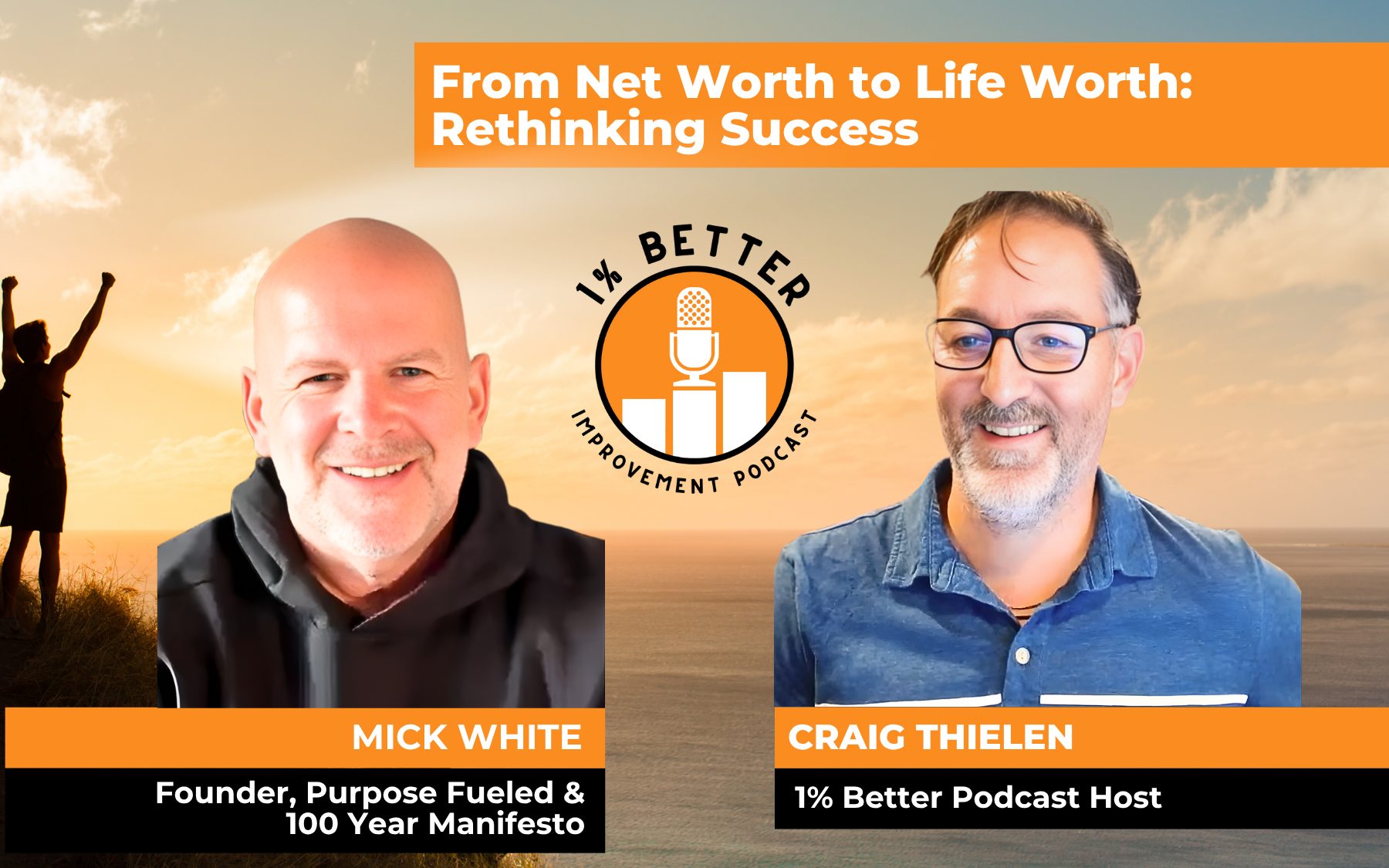
1% Better Podcast Mick White – Quick Links
Learn more about Mick’s 100 Year Manifesto
Check out Mick’s Purpose Fueled Community
Connect with Mick White on LinkedIn
Connect with Craig Thielen on LinkedIn
Check out host Craig Thielen’s full bio page
Key Takeaways
- Legacy Isn’t Later, It’s Now: The 100 Year Manifesto helps individuals live today with the kind of impact they want to be remembered for
- Purpose Starts with a Question: Asking “What hard conversation do I need to have with myself right now?” can unlock deeper self-awareness and action
- Connection Over Perfection: Purpose Fueled gatherings are not about status or performance, but about vulnerability and authenticity in community
- Action Creates Clarity: You don’t need a five year plan, just take one meaningful step today. Even a baby step matters
- Redefining Net Worth: True impact isn’t about money, it’s about relationships, kindness, and how you show up for others

















1% Better Podcast Mick White – Transcript
Craig Thielen (00:07)
Hello, I’m Craig Thielen and this is the 1% Better Podcast. Today I’m speaking with Mick White, founder of Purpose Fueled, the 100 Year Manifesto, and the Purpose Academy. Welcome to 1% Better.
Mick White (00:21)
Thank you, Craig. I am excited to be here.
Craig Thielen (00:24)
Yes, I am too. So why don’t we start with who is Mick White and a little bit about your background and what led you into all these amazing initiatives and companies that we’re going to be digging into.
Mick White (00:38)
Yeah, who is Mick White? What a question, right? I think what I know today, what I know about myself today is I’ve always been a teacher. I’ve always been a gatherer of people and I’ve always been a bit of a disruptor. Like, and that’s if I look through a common thread through my childhood and college and professional career, ⁓ that’s really it. I was supposed to be a high school history teacher. Both my sisters are elementary school teachers and yet I know that I wanted to fit in the traditional setting. It would have been a challenge ⁓ because I have ideas of we can do things differently or what if and that doesn’t necessarily fit in well in a public school setting. And so I’ve also, you know, looking back, I was always the kid in high school or college or when I bought a house of just, bringing people together, bringing my friends together, bringing my family together without necessarily a reason behind it other than community feels good. And I look back, I don’t know if I’ve ever shared this story before anywhere, but at our family functions, I grew up in Galesburg, Illinois. It’s a really small, it’s a small central hub of rural Illinois. at one of my grandma’s house, there were always extra people. There was always extra people invited to family functions. People who didn’t have a Christmas to go to or a Thanksgiving to go to or my Grammy, she just always invited people together. I think, we are frequently products of our environment and I just come from a family of teachers, a family of community builders and just people who you know try to do our best to love everybody and to see people. So yeah that’s that’s kind of the question of who I am and then I don’t know I’m just as as my son who’s now ten, every night we we ask two questions before bed. We we and it’s at this point he now asks me the questions first. He says what was your favorite part of the day? and then did you do your best? And I think that’s really pretty much sums up my life these days of like focusing on my favorite parts of the day and then all I can do is my best. All you can do is your best and offer yourself enough grace of did I do my best? Yep. Okay, that’s it. That’s pretty good… win or lose, I did my best and move on.
Craig Thielen (03:09)
Well, that’s a pretty amazing thing to teach a child to give them that kind of grounding and perspective every day at an early age. So a couple of things that you said there…
Mick White (03:40)
I’ve always thought Craig that he’s a future man. He just happens to be three or seven or ten, and I’m trying to raise him to be a healthy human and not have to figure that out in adulthood. Like just those small habits, right? That’s one of my goals in life.
Craig Thielen (03:46)
for sure. it’s a wonderful grounding. And sometimes I think, well, we’ll get into this, but you, there’s a theme here of you sort of thinking beyond, first of all, beyond yourself, beyond the moment. And not just what’s happening this week, this month, even this year, but like way out. And so this 100 Year Manifesto… but yeah, every child is gonna be potentially, a governor, a president, or that’s going to impact hundreds or thousands of people in whatever way they do. And so how do we help them find that? And just and just a neighbor…
Mick:
they’re just gonna be someone who interacts with people at the coffee shop And I want those interactions to be healthy.
Craig Thielen (04:37)
So one of the things that you said there is, and I hadn’t thought about this for, jeez, I don’t know how many decades. I’m from a big family, and so when we had holidays, it was always a lot of people, like always 20, 30. Back then, now it’s 50, 100. But My parents would always invite someone else from the community that didn’t have family. We had a neighbor, and she was a widower, and she was elderly. She just always came and was with us at the holidays, and we never even thought about it. It was just the neighbor, Anne, but what a gift.
Mick:
Anne had a family, It just ended being your family too.
Craig:
It was yeah – But anyways, I just kind of brought me back to that. So you said you were always a disruptor. Obviously that doesn’t always work well in our education system, but maybe just before we jump into what you’re doing now, what was your early career, you know, and how did that progress?
Mick White (05:45)
I was in the insurance and the investment world. It’s what my father did since I was six years old. He’s 74. He still does it, loves it. And it’s really become his mission field of he has discovered his purpose in life of being a minister of joy and it allows him to show up to work differently. Like, why would he stop working if that allows him to live it out better?
So I grew up in the industry or around the industry. My mom worked for my dad and that’s where I started for the first 15 years or so of my career. I was with the company. It’s how I got to Minnesota was for another opportunity within the company. And then a couple of things happened. But one of them specifically around this teaching was I moved to Minnesota to build a bigger firm to show that the way dad and I did business in Illinois, that it was transferable elsewhere. So I come up here and I’m You know, I think I’m doing a great job and I’ve been here for two years, you know back in this is 2008 and the state director… We have lunch and two other people were getting fired one of them that was building a firm just down the street from me and I was I’m like he’s gonna offer me one of these two positions… 32 years old. I’m like my numbers look good. Everything looks good and this was 16 years ago and he said to me, he said, Mick, you don’t have a future in management. And it blew me. I was so angry with him and I was angry with him for, you know, probably 15 years because he said that I should go back to being an agent or being a producer or going to our home office and be a trainer. Because I was always building things. was always saying like, the company stuff’s great, but here’s how really to do it. so for 15 years, I was mad at him because I knew what the trainers got paid in the home office and I knew what I got paid. And it was in my mind a demotion. And I wanted to fit in well in that home office space either. And the agent was like, I know I can do that. It’s just not exciting for me anymore. And so… But 15 years later, last year, I realized he was right.
Craig Thielen (08:11)
Mm-hmm.
Mick White (08:12)
I didn’t have a future in management. I was always creating things. What he didn’t say was, Mick, build your products and I’ll be your first customer. I was a disruptor back then. I was a teacher back then. I was just in the wrong environment to really allow me to be as independent as I wanted to be. So it took me 15 years to kind of offer some forgiveness even though
Craig Thielen (08:29)
Mm-hmm.
Mick White (08:40)
I probably didn’t need to offer any. But just that thought of sometimes we have these narratives that are in our heads about things. Maybe he was right. He just couldn’t see across that last hurdle of, Mick, we will be your client. Because he’d never worked anywhere else other than the company. The company was his solution… rather than go do your own thing and we’ll be your client, Mick. So yeah, I think it’s interesting sometimes when we look back at those stories of like, how did we get here? Man.
Craig Thielen (09:14)
Yeah.
Yeah, we get a lot of clues in life and sometimes we see them and sometimes we don’t. And sometimes the people and things and situations that provide clues, they’re sort of unaware that they’re providing feedback. Like he may have felt sort of intrinsically like this isn’t gonna work because you’re not following the structure. You’re not doing the things of a manager. You’re kind of maybe on the fringes. You’re always worried about other stuff.
Mick White (09:38)
Right. ⁓
Craig Thielen (09:44)
And so he may not even have been thinking, well, this guy can do so much more and let me help you as a sort of a coach or mentor. He’s just like, this ain’t working. Like he’s just doing his job. But we get those every day actually. And so just being present and being aware to go, what did that person mean? Why did they say it? What can I learn from it? That’s actually a pretty powerful skillset. Sometimes it takes years and decades for us to figure it out.
Mick White (09:45)
And so he may not even have been thinking, well, this guy can. Right. Yeah. Yeah, I mean it’s like what what are they really trying to say to me? Like I hear what they’re saying. People for years would say, Mick you should write a book.
Craig Thielen (10:15)
Ready.
Mick White (10:20)
And my life was a mess. I’m like, there is zero chance right now I’m writing a book. people kept saying it. And so there’s this joke that says, you if one person calls you a cowboy, it’s conspiracy. Or if one person calls you a cowboy, they’re crazy. If three people call you a cowboy, it’s a conspiracy. And if 10 people call you a cowboy, go buy your saddle. Right?
Craig Thielen (10:44)
Yeah, right. At some point, yeah.
Mick White (10:46)
But what they were saying was not necessarily what they were saying wasn’t necessarily I needed to write a book. Looking back, they were saying, I have a story and a way of framing up life that can help. Their solution was you should write a book because that’s how they take in information.
Craig Thielen (11:04)
So what changed, Mick, you were, like many people, you were busy with your career. And as you said, Hey, I was hitting my numbers and I was doing the thing and I was trying to prove that I’m, I’m good and I’m moving up, building a business. And you were doing that for a number of years. And some of it was, personal, like, Hey, I want to do well in life. I want a nice car, I want a nice home provide some of it’s, Hey, I’m working with my father. want to make sure I’m carrying on the legacy. There’s probably many reasons, and this is society. Society judges us all by how well we do professionally, et cetera, et cetera. At what point did something change in your life? They said, wait a minute. I could keep doing this and just kind of run to retirement, which is what some people do, and just go, it’ll all be better at retirement, no matter how bad and painful and hard this is. But you chose to say, something’s not working. What happened in your life that led you to that moment?
Mick White (11:59)
You know all sorts of things happen but a pivotal one was ⁓ June 13th 2011 my mom died and she died from an accidental overdose of aspirin. So at age 58, she’s there one day and not there the next and got God bless my mom, like I loved her and miss her deeply Mom never knew who the president was. You she didn’t drive on the highway. She thought banana Twinkies had real bananas in them… just this salt of the earth Human and when mom died she died on a Monday on on Thursday ⁓ Visitation was seven hours long and and mom didn’t go to college, you know, she didn’t have LinkedIn, she wasn’t on podcast. She didn’t have this platform but she had love and she loved everybody in her own way and she had a way of connecting and seeing people. And I’m like that the whole time I’m like, who are all these people? I mean, and it was from all walks of life, from CEOs of major, know, Fortune 500 companies to junior high friends and neighbors and church and people from the AA hall, like everybody showing up. And I’m like, if my mom could have that kind of impact, what kind of impact could the people that I was working with professionally have if they were intentional? My mom, that’s just who she was. But maybe if we had these conversations around, what are you really doing? And so that happened in 2011. I read a book that summer about who really has the opportunity to change the world.
The premise is its business leaders. It’s not the church. It’s not the government. It’s people out in the community and so that that had happened and that was probably that was the first major eye-opening experience of perhaps, I’m not doing the right thing and so I think about this all the time lately of… Coming from the insurance investment world, so much is talked about net worth, Net worth, net worth, net worth, how it’s how people define who their clients are, who their clients aren’t, you know, just it’s, it’s this success metric. And I think of it of if you break down the word net worth, like that means you’re only defining your worth, all of your worth, your net worth by your money, your assets, what you’ve created.
Craig Thielen (14:10)
Mm-hmm. Right. Right.
Mick White (14:40)
And mom didn’t have a net worth that was in the black. But her impact in the net worth of her life? You don’t put it on a spreadsheet. You don’t put it on a balance statement. Just and so that was probably the the biggest and first of the pivotal moments. Yeah. And then after that after that so when mom died I had been engaged for a month and which you know So I’m as happy as I’ve ever been and then as probably sad as I’ve ever been. Ended up still getting married a months later and we had a really heavy marriage, challenging season in life and ended up having our son, Macallister and when he was in his first year, we separated and it was really hard. People questioned how I showed up. People questioned how I continued to love and support my bride, now my ex through it all.
And they would question what I was doing. And it made me so angry that perhaps I was the only one who actually meant it. I don’t know. For better, for worse in sickness and in health, the for worse part includes divorce and separation. Like how do you show up then? What was, what’s unconditional love really look like? It’s when the other person chooses not to love you back in the way you want them to or the way you love them. And then in sickness and in health it includes all all sicknesses. So, I was doing that and people kept like what are you doing? Why are you doing that? And I think this perspective of my mom not being here and the realization of like we can’t take any of this stuff with us. Like who are we fooling? When we die our stuff is gone like we don’t take it. So, it was one of those like, I want, I want my ex to be healthy and happy whether or not we’re together. and so through that, I was on the call, I was on the phone one day with one of my friends and this was, this was a few months into it, four or five months into our separation. And, and my friend Bonnie was like, Mick, what are you doing?
And it made me so angry. It’s the only time I’ve ever got angry with her. I’m like, she’s a CEO of this big organization, global organization out East. And I’m like, do you not know who I am? So I felt like she was attacking me. And because I had a really clear understanding of who I was, these decisions I was making were really easy for me to make. And so that night I went home and I sketched out this 100 Year Manifesto, like
Craig Thielen (17:30)
Mm-hmm.
Mick White (17:35)
If we can have goals and visions and all of these things for our businesses. Certainly we can have a one pager for our own lives. So it included mission and life goals, but life goals that are not ones that you check off the box. Life goals like I’m raising a healthy boy. Like that is one of my goals. Who loves his neighbor, who’s generous, who’s kind, who shows up in the world doing his best. I don’t care what his future job title is. I will love him no more or no less, regardless of what he does professionally, but I want him to be a good human. So life goals that are perhaps different than how we normally think of, I want a cabin or a new car or motorcycle or whatever those things are, right? And then guiding principles and the causes that you’re passionate about. What if you could put all of this on one page? And then, so I just sketched it out and it was really for me because I was so confused why people kept questioning, did they not know me like how are my my sisters and my best friends like questioning me… this is this is clear this is what I’m supposed to do and if they’re questioning me then maybe everybody else is too… I see the, you know, the world is going, you’re not following the normal playbook. You’re kind of off doing some weird stuff according to society. And then you’re going, wait a minute, but this is actually me. So I better write this down because I got to get it straight in my head because it makes sense to me. It doesn’t make sense to other people.
Craig:
Where did, where do you think it came that instead of just, you could have done that in a lot of different ways. You could have journals, could have wrote down a few notes. But you said something very precise which is a 100 Year Manifesto… was that that night that you go I gotta go big I gotta go 100 years or did that kind of term and thinking come later like how did that happen?
Mick White (19:32)
Yeah, the 100 Year Manifesto probably I don’t know it was probably a couple weeks or a month or two before I was at ⁓ a friend’s business Ben at Woodchuck, and ⁓ So they for every I don’t know if they still do but years ago for every item they sold they planted a tree and ⁓ when I walked into their office they had on there on the wall this big 100 year manifesto, and it was the impact that their company was gonna have and so I’m just like
Craig Thielen (19:49)
Okay.
Mick White (19:59)
I take a picture of it. I’m like, this is amazing. I like I love this idea. And so when we were talking, he gives me a tour and they’re doing all sorts of cool stuff. Give me a tour and we sit down. I’m like, do you have a personal 100 year manifesto? And I just remember him saying no, but I should. And he made a little note to create one. And so that was really it was an idea from over here and an idea from over here. And then like, Man, shouldn’t we all have some sort of, coming from the insurance investment world, there’s so much of ⁓ save money, retire, and then when you die, give your stuff away to your kids and family and nonprofits or whatever it might be. And that’s it.
My life and my legacy doesn’t end there. Like a hundred years from now, what do I really want? Because it’s not about my who gets how much stuff. It’s the impact that we make along the way… at the at the coffee shop today, while we’re driving all the things with employees and staff and how am i showing up because then i’m no longer concerned about traffic being bad. No that gives you perspective right? Because it goes beyond death, which as humans, we don’t often think about death, do we?
Craig Thielen (21:13)
Right? No, that gives you perspective, right? Because it goes beyond death, which as humans, we don’t often think about beyond death, do we? It’s kind of a scary place.
Mick White (21:24)
For me, and part of like when he asked who I am, part of my normal, I just didn’t know it wasn’t normal. So with my dad in the life insurance industry in a small town, my mom read the obituaries every day in the newspaper. So I read the obituaries in the newspaper because we’d see church members or neighbors or whatever it might be. So I just remember reading the obituaries, ⁓ my dad being in the life insurance industry, and then It’s no wonder that at age 40 I was diagnosed with anxiety and when my ⁓ therapist said, you know, said, hey you have anxiety and he walked me through it. I’m like I’ve had that my whole life because I’ve been aware of ⁓ We’re not here forever and I growing up in a church there was also this eternity seems like a really long time and a Franklin daily planner doesn’t seem like a like enough like my daily planner isn’t enough and eternity just seems long.
Craig Thielen (22:25)
Yeah. Yeah.
Mick White (22:25)
100 years from now is bigger than me, not eternal. I can’t wrap my head around eternity. How long has the world been around? Eight billion years, seven billion, five billion? I don’t know. Last year seems like a long time ago. Last month seems like a long time ago.
Craig Thielen (22:32)
Well, that’s… Yeah. So it’s interesting on the, that’s makes sense on the, the 100 year manifesto, um, almost identical to that. The 1% Better Podcast. A lot of people say, that, why is it 1%? Where’d you come up with that? And same thing. It’s like, um, 25 years ago, I was working with somebody and he just said something once he goes, um, he was in sales and he was really great sales guy.
But he was so innovative and he was always doing things differently, you know, sort of out of the box, as we say. And I was just going, God, I love working with you because it’s not just, we’re just going through the motions, doing the thing, trying to win the deal. But he was just always had three ideas about how we can do it differently. And so he just dropped one time. He goes, oh yeah, I’m going to write a book about this. And I go, you should. And I go, what’s the book going to be called? And he goes, it’s going to be called 1% Better.
And I never thought it was just a conversation literally 25 years ago. And then when we were had this idea with, doing the podcast, it just came to me. It’s like, yeah, of course it’s, it’s that. Okay. So you sat down that night and you go, I’m going to do this thing. I got to get my head straight and I to put it on paper and it’s going to be big and long and it’s not going to be eternity, but it’s going to be passed when I’m on this earth physically. then at that moment, what, what changed, how did that play out the next year or two? What did you do differently in your life, because you’re doing a completely different work than you were doing then, right?
Mick:
and yeah, and so at that time I sketched that out at night and you know, just, I just went back to being in the insurance world the next day. Like had a one year old son by my side and not being from Minnesota, he came with me, he was with me a lot. And so he came with me to events and meetings and, ⁓ cause I didn’t really have a choice. Like daycare is expensive. And if you’re a single parent, I can spend $2,000 a month in daycare or I can just bring him with me and maybe make $2,000 less, but at least he’s with me. And ⁓ so yeah, I created it one night and the next day I just show up back at work ⁓ doing my thing because sometimes sometimes that big change isn’t sudden, right? Like it’s I created it. I started sharing it with people.
Craig Thielen (24:47)
Right.
Mick White (25:05)
Other people were like, well, how do I get one? And I’m like, I don’t know. Like, just created it. So then I started looking back. I started interviewing people who wanted one. So I would just if you wanted one, I’d just start asking you questions. And then I would kind of craft one. I’d fill it out and just kind of help them, which was I don’t know. It was was great. I didn’t charge them. I had no idea what I was doing. Right. they were interested. And I’m like, well, yeah, I can do that. And so we did a handful of those and I had my graphic designer ⁓ in the Philippines, Elena, she would put them together. And then I had an opportunity to create an app through a program. So some people created a free app for their app for free to create this. And because of how I was living and making choices and just framing this up, I ended up starting getting speaking opportunities. Like I never set out to be a speaker. They just presented themselves. And so next thing I know, I was in, you know, over a course of four or five months and four months I spoken of Philippines, Mexico city, Thailand, and the Philippines again. And it was, it was amazing. I see why people love doing it.
It was also really hard being away from my son. And it’s there’s no good way to get to Thailand. That’s a long ways away. I like speaking. But what I really love is sharing perhaps I could do it differently. And that’s probably this common theme of like, I want to speak, but I don’t necessarily want to fly to Thailand once a month. Like I didn’t see that with a young son.
Craig Thielen (26:28)
Mm-hmm.
Mick White (26:54)
I’m not going to fly all over the country every week.
Craig Thielen (26:56)
And you were speaking then about the 100 Year Manifesto and why it’s important and what it is and kind of that.
Mick White (26:59)
Yeah Correct.
Yeah how to how to create it how to live it and just my story. And so then what happened was because I shared this story, you know, I’m not embarrassed about having anxiety or depression and other things, a long life or for for a season, sometimes I look back I’m like, and my car got repossessed one time and we were homeless for nine months and other things that happened in life you’re like yeah I guess that happened too and so because I would share about these things people kept reaching out to me wanting to have coffee. and what what I have since kind of worked through is they felt that they could trust me they felt like I want to judge them and they they knew that I had been through some stuff And the reality is all of us, I believe, are either going through some stuff or somebody we love is going through some stuff. And so just having coffee and at that time I had really unhealthy boundaries. I was trying to help out everybody because it’s probably therapy for me too, right? It probably made me feel good helping and I have value. But just going around having free coffee …are you still in the insurance business at this time?
Craig Thielen (28:19)
Are you still in the insurance business at this time?
Mick White (28:23)
At that time, barely. Like I still had my licenses, but at this time I was doing some coaching, doing some speaking. I had a lunch at that time where I would gather people together called The Best Lunch Ever… And so there’s some sponsorships to it. was somehow keeping it all together to keep my head above water, but it wasn’t real clear.
I didn’t necessarily want to work one-on-one in coaching because part of it is I want to help people regardless of their income status. And coaching inherently doesn’t work that way. You it’s like, you have to be able to pay me X amount. So in November 2022, had this idea of
What if we get people together for coffee and these conversations and we’ll do it on the first Friday of the month and we’ll see what happens. And the first month, January, 2023, you know, 65, 70, 75 people show up in the next month. you know, more people show up and it’s just kind of builds. And, and that’s really how Purpose Fueled started was what if we bring people together in community for these conversations?
because reality is people want to share. They want real conversations and real depth, but oftentimes they don’t know. They don’t know how to do that. That’s not something most people do at the dining room table or at a family reunion or in a business meeting or a retreat to be like, so Craig, how are you doing? You’re like, yeah, living a dream. Things are great. Like, no, no, no. Like
Craig Thielen (30:13)
Right.
It’s all surface conversation. yeah, break it, break it down for us a little bit. How does one of these purpose feel? Cause you’re doing these a lot now. They’re all over the place. Just kind of break down one of these, like what is the structure? How do you pull that out of people and make, them comfortable? Because that’s not a normal societal thing is that we just kind of, share very personal items in public and go deep on things. So How are you doing? What hard conversation do you need to have? Break that down.
Mick White (30:42)
Yeah, part of it I think is this idea, Patrick Lencioni has this book out called Getting Naked and it’s really this thought about being vulnerable but it takes somebody going first. And so part of that space is that at an event, we’ll just say you’re the guest and I’m the host, we have five different locations, they’re all on the same day, same time, so I host one of them, we have hosts at the other locations. And I would welcome everybody, thanks for being here, here’s how it’s gonna work. And how it works is this, we would talk for 10 or 15 minutes, and I’d just kinda say, Craig, what’s your story, how’d you get here? And most people have some sort of story arc, that you’ve had some pivotal moments, that you’ve had some, and if I’ve created enough space over time and made people feel welcome. that person is willing to share a bit of their story. And it allows people to see each other, not as Craig with this title. You know, here’s my company, here’s my title. We have this many employees. And so here’s the hierarchy versus I’m a human too. And here’s some of the things that I’ve been through. So 10 or 15 minutes, which goes really fast, right? 10, 15 minutes. What’s and so you cover a couple of things.
And then we stop. And what’s different about Purpose Fueled is we stop and then we’ll ask a question to the people, the attendees. And so one of the questions ⁓ that I love asking is, ⁓ what hard conversation do you need to have with yourself right now? And we pause. And then I can’t keep a really intense moment like that. So I always joke.
And if you don’t like that question, there’s coffee over there. You know, it’s a good time to take a bathroom break …that’s putting a lot of pressure on people… Yeah, it’s it’s intense at the same time you don’t have to answer this question but when people do It’s such an energy in the room because it’s like this outpouring of I get to share what’s really going on in my life. And so we they will the attendees talk for 10 or 15 minutes at the tables And then we will get back together and share. So Craig, what are you doing today and where you’re going? And we’ll cover kind of some more stuff in your life. We’ll stop again. Yeah.
Craig Thielen (33:13)
So Mick, when you did that first breakout, you have small tables, right? Like six or eight people and then.
Mick White (33:18)
Yeah. three to four people in a group. Yeah. Yeah.
Craig Thielen (33:22)
Okay.
So that’s pretty, it’s pretty intimate, which I think obviously helps. do you, they talk for 10, 10 minutes or so. Do you have them do any replay or that’s just all contained at their table? Okay.
Mick White (33:35)
Just all contained at their table. So yeah, it’s contained at their table and I have some thoughts as to why not, but ⁓ I want to keep it flowing and I think it’s an hour long. You can only do so much in one hour. Would it be great to really dive deep and do some things? Yes, I see this as like this is a great first step for people pursuing themselves.
Craig Thielen (33:54)
Mm-hmm.
Mick White (34:04)
So we will get back together and we’ll do it again. You sharing your story. Then I’ll ask one more question. Another question I like to ask a lot is who’s on your team right now, personally or professionally that shouldn’t be on your team or, or who isn’t on your team. And I talk a lot about your, your personal team, the people in your life who isn’t on your team that you need to have on your team. And again, that same 10 or 15 minutes at the tables. And then we just kind of close it with like, what action are you gonna take to fuel your purpose? Is that we don’t necessarily have to have this master plan. You don’t have to have a 100 year manifesto. But action creates clarity. And so just getting people to take a step is a victory. So it’s great that people come together and there’s connection and conversations.
You can get that at other places too sometimes, but I really want people that they can point a finger on or put a finger on because of this event, I did X. And that’s really how I was at a… where that all started from was 643 days before my mom died. I was at a company event two day training.
And on the second day, you know, we’re doing goals and the workshop, the whole thing. ⁓ Second day in the afternoon, the facilitator asked a question. said, what commitment are you going to make for the next 90 days? And I wrote down that I was going to call my mom and I was in a room. I had all these other business, you know, folks. I was the youngest person there for 20 years. I when I wrote it down, I kind of like I didn’t want anybody to see it. I didn’t I didn’t want him to call on me. Like I was embarrassed. Like I’m going to call my mom.
And for 643 days, I called my mom and she picked up the phone every time I called. She might be in the shower. I called her. Yeah, so I did it for 90 days and it like I loved it. And so I just kept doing it. And so just kept calling her every day. And mom picked up the phone. She was she was at a movie theater. She hello. I’m like, where like, mom, don’t answer the phone in a movie theater. She’d be she’d be at an AA meeting and like, what is going on? She’s like.
Craig Thielen (36:03)
You’ve called her every day for two years.
Mick White (36:26)
I’m at a meeting. I’m like, Mom, she’s like, how are you? And then, yeah, sometimes she’d be in the shower. I’m like, just things you don’t like, Mom, don’t answer the phone in the shower. and then on June 13th, when I called her 2011, she didn’t pick up the phone. And that’s when I knew that she had died. She wasn’t sick, but I knew that she had died. And looking back, I really, I really initially made those phone calls because I knew how much they would mean to her.
Craig Thielen (36:29)
That’s good.
Mick White (36:56)
I was always her baby boy. I was always the the one that when I called her day lit up. She loved my sisters dearly too. She saw them all the time… Same town… When I called I’m just gonna call and so it was always the highlight of her day now today looking back It was a highlight of my day. I just didn’t know it those memories and those conversations. Like I had 643 special events with my mom from a simple commitment of I’m gonna call my mom for 90 days straight. So that’s where I think purpose fueled is really having meaningful conversations and the connection and the conversations ⁓ are all great. But taking action is really what changes lives.
Craig Thielen (37:33)
Yeah.
Yeah, no doubt about it. Yeah, that’s a big part of ⁓ what the 1% Better Mindset, what we talk about is often if you’re gonna start a journey, in your case, and you have it down to the particular number of days, you counted the days, so you know, that’s a big commitment, but the hardest step was the first one.
Mick White (37:54)
Great. Yeah.
That’s a big…
Craig Thielen (38:12)
And then it’s easier and easier and easier. And pretty soon you wouldn’t get through a day without doing it because it’s just part of who you are and what your routine is. So it’s always that first step in action. have a friend who’s an author and he’s written and ⁓ co-authored and coached hundreds and hundreds of books. And of course, writer’s block is a big thing, right? For people that are trying to write a book and
Mick White (38:17)
Right. That’s right.
Craig Thielen (38:38)
His coaching, which is along the same lines, would often be, don’t worry about it, just write for five minutes. And if it’s crap, you throw it away, don’t even worry about it. And sometimes that would happen. But often what would happen is someone would kind of force themselves through the first five minutes and all of a sudden it’s an hour later and they got a ton of content, right? But it’s that mental hurdle of, I don’t have anything, we’ll just start, just start. Action is kind of king there, so.
Mick White (38:45)
Yeah.
Right.
Craig Thielen (39:08)
Very interesting. So let me ask you this on this, these Purpose Fueled… It’s a one hour lunch setting. is your intent with this, how you set it up ⁓ is to like just help people kind of break through that surface level, get them to dig deep, get them to interact in a semi public setting, even though it’s within the table, just to kind of break that ice and have them take a first step or do you think that this is something where they can take it home and practice it or take it to work and it’s like now take this same technique out or don’t you worry about that or you think that naturally happens? Obviously people share their experiences with you often.
Mick White (39:54)
All of this is one big experiment for me at this point. what I’ve just learned in life of like, what am I trying to do? That’s a great question. Yes, people show up, be in a space where they sometimes that’s enough. And if they show up one time and they loved it, even if they never come back, perhaps we had an impact on their life and they show up differently. They take different actions. Long-term.
what’s pretty wild about it is it’s 7:30 to 8:30 in the morning on the first Friday of the month. So people are getting up early to be there so that they can also get to work and It doesn’t fit everybody. I bring my son with me because I can’t drop him off at school, you know that early so he comes with but to say people feel seen heard they have maybe connections with people that they wouldn’t normally have. I don’t know if you watch the news at all but it’s a bit of a mess out there in America right now …I try not too… and I think there’s a lot of people just don’t know each other they don’t they’ve never been exposed to people who look think or believe differently than they do and perhaps Purpose Fueled helps with that where people sit down these aren’t people i would maybe see it than the same IT networking event or it’s all business owners like it’s all sorts of different people there so at the events ⁓ we have the event for individuals what I would call the community events where anybody can show up ⁓ we’re creating a space online for activators for people who want more throughout the month you know more community and then Long-term where we’re going with it is to take Purpose Fueled to companies and to have these events where we can interview a leader however, you want to define leader, could be anywhere in their company and have their employees or team members actually sit down without the job titles and have culture building and connection. Because I think not and not just with Covid but prior to that we just really didn’t, we don’t know people the way we think we know people. And so that’s long term where we’ll go with Purpose Fueled … Have you started the corporate business yet… We have just started in the last couple months and funny a friend of mine in May was like, how come you’re not doing this at companies? I’m like, what are you talking about? And she walked me through it. that’s a brilliant idea. ⁓
Craig Thielen (42:15)
Have you started the corporate business yet or no?
Right.
Mick White (42:33)
It never once crossed my mind. And so now now I see this is a space corporately where whether it’s once a month every other month once a quarter something to say bringing people together What we probably don’t need is more inspirational speaking, so that’s the full circle for me. I don’t need to fly across the world to speak but perhaps
Craig Thielen (42:45)
Yeah.
Yeah.
Mick White (42:58)
This is my way of speaking by highlighting other people and allowing more people to share their stories together. Perhaps that’s that’s I get more joy out of that than being on stage with everybody applauding at the end.
Craig Thielen (43:14)
Yeah, well, it’s more personal. When you’re on stage — I mean, I’ve done both. I’ve done the former a lot more. For 30 years, I’ve been helping organizations change, and I’ll come back to that. The speaking thing, in most cases, is a very one-direction proposition. You get a little bit of feedback, maybe a Q&A, maybe use some technology to gather questions — but it’s still very sterile and disconnected. You don’t really get to know the audience. They might get to know a little bit about you, but it’s a hundred to one. Whereas what you’re doing is very personal, very intimate. I might have to come back and check in with you every six months because the world I live in is corporate culture — driving organizational change.
I’m curious about something. You don’t have to answer it now, but maybe when we check back in six months. I’d say 80% of companies — almost all now — have some kind of culture or core values. It’s something they feel they have to check the box on. It’s in the employee handbook, it’s on the wall, maybe even part of onboarding fanfare. But 80% of the time, it’s lip service. It’s just words on the wall. And when you look at how people, especially leaders, actually show up — they’re not following those core values or that stated purpose. That disconnect creates a counterproductive response. Can it actually be counterproductive when you say, “We stand for integrity and teamwork,” but leaders behave the opposite way? Absolutely. It makes people say, “I don’t trust them. They’re not authentic.”
So I’m curious what your experience will be as you dive into that and if you can break through it. One of the things we see in our work — we do a lot of technology and process improvement — is that the hardest part is always the people part. Everyone wants to talk about new tech and new processes, but not many want to look inward: at leaders, at culture, at themselves. That’s actually the hard part. We do a lot of organizational change work. Leaders always say, “We’re going to change the whole enterprise — go from X to Y.” It might even be at a departmental or team level. But change doesn’t really happen at an organization or team level. It happens person by person — when each individual decides: “I get it. I want it. I’m going to do it.” Or they decide not to.
Some might pretend to change, but real change is a personal decision. It’s made at the individual level. Once enough individuals make that choice, the collective starts moving in that direction. It’ll be really interesting to see your observations on how you break through that and reach people — their hearts and their minds.
Mick White (46:25)
Yeah, I think there’s so much there that is a hundred percent I’m on board with it always goes back to me that the companies who are like, We treat our employees like family or in the business world there’s a lot of financial services, the industry is like we’re really into relationships. I’m always like prove it. I don’t need I don’t need to read about it. I want to see it. I want to feel it I want to experience it and if I do that, you don’t need to paint it on your walls I know it.
That’s so much of this experience is most places we go, you know, conferences, would say college, places of worship, like somebody talks and you listen and then you’re set to process this information later on. In a Purpose Fueled it’s really about, in addition to that, you get to participate and perhaps, perhaps I can learn something from you and you can learn something from me, in addition to the host and the speaker having their conversation to that. We all have something of value to share, regardless of where we are in the hierarchy of the company that I learn more perhaps from people who aren’t like me, than I do from people who are like me.
Craig Thielen (48:08)
Yeah, no doubt. And just getting that conversation going is the first step. So let me ask you this. The 100 Year Manifesto it’s a beautiful thing for someone to go through that exercise. And by the way, I’m going to go through that exercise. And it allows you to kind of get outside of yourself, go, what’s my legacy going to be? What’s it to be like in 100 years? What’s it to be like after I’m dead? what’s really important with life because 100 years from now, as you said, it doesn’t matter what kind of car you drove. It doesn’t matter what kind of boat you have. There’s other things that are going to matter. So then my question is, once you have that, it’s one thing to write it down. And then it’s another thing to say, what changes am I going to implement? And then it’s yet a third thing to go fast forward six months or a year in your case. And I know we had a conversation not too long ago where you said, hey, Craig, life is great. I’m busy, but I am
Mick White (48:40)
Yeah. There’s other things that are going to matter. So then my question is, once you have that, it’s one thing to write it down, and then it’s another thing to say, what changes am I going to implement?
Craig Thielen (49:06)
So busy, I’m almost overwhelmed and I don’t even. So then how do you use this 100 Year Manifesto when, that’s the way life is. Life throws you curve balls and it adds six things on your plate that you weren’t planning on. That’s just the way life is. How do you use the 100 Year Manifesto to sort of re-center and go, okay, timeout. Is this all still accurate? Do I need to make adjustments or how do I help it prioritize my life? How do you re-center?
Mick White (49:35)
That’s a great question… a couple thoughts one, I think it’s it’s a living I think it’s a living document that it can, as you get more clarity into who you are, you can update it. That it’s not just, I did it one time, I think a lot of times the hardest, as in writing that book, the hardest part is putting something down on paper. Putting the first draft of like, this is something that’s better than what I had yesterday, not as good as what I’m gonna have tomorrow. And this idea of how do I live it out? is I think it serves as a really good tool this framework for what do I say yes to and more importantly what do I say no to because it’s so easy to say yes. Craig do you want to you want to go do this golf outing this event this you want to have lunch all these things you’re like yeah it sounds great. and then every time we say yes to something we’re also saying no to something else.
Craig Thielen (50:33)
100%, yep.
Mick White (50:35)
And it’s not probably just no to one thing, it’s no to 10 things. if I say yes to that, I don’t know, going to a sporting event, I’m probably saying no to my laundry and to a good night’s sleep and to some, other things that I don’t necessarily think about when I say yes. So it’s a really good tool of are these decisions I’m making does it line up with who I am and what do I really want in life? So I think there’s a lot of not just I created it as much as I created it and now I can start taking steps to live differently. When my mom died, I struggled with this question, how am I supposed to live the next 50 years? I was 36 years old. How am I supposed to live the next 50 years without my mom?
Craig Thielen (50:59)
Mm-hmm.
Mick White (51:23)
And it was the unanswerable question. just couldn’t get my head around how do I do that. And then one day I realized I don’t need to live the next 50 years without my mom. I just need to get through today. I just need to get through this next hour. I just need to get through these next five minutes. And I think with the 100 Year Manifesto, it’s similar, I don’t have to live out this all at once. I just need to focus on living it out today.
Craig Thielen (51:52)
Yeah. Yeah. So what’s your, that’s perfect segue into ⁓ what’s your 1% Better advice for people that want to get more connected with their purpose in the day to day living, whether it be work or their personal actions, one little thing that someone could do today to help them get more alignment.
Mick White (51:53)
Yeah. Yeah, so what’s your, that’s perfect segue for people that want to get more connected with their purpose in the day-to-day living, whether it be work. I think the people downplay the steps that they are taking and we say all the time or people say all the time it’s just a baby step it’s just a baby step I’m like listen, a baby step when it when a baby takes a step it is the biggest step they ever take and when they do, we have cameras and videos and people are cheering them on and like it’s a big event and they fall down and they get back up and don’t underplay the importance of taking a baby step. baby can’t walk until they take steps. A baby can’t run until they walk. We can’t drive a car, whatever those things are. It’s a series of baby steps that get us to where we wanna go. so part of it is just take action, just take a step, and you’ll figure out is it the right step or the wrong step but you won’t know that until you take it.
Craig Thielen (53:11)
Yeah, give yourself some credit. Every step’s important. In fact, sometimes the first step is the most important step. So last question.
Mick White (53:15)
I mean the hardest the Hardest step for me every day is getting out of bed, right? Like that first step out of bed is, especially if I know I’m gonna go work out that morning. You know what’s hardest step is just getting that foot on the floor and then I’m going, right?
Craig Thielen (53:23)
So true. All right, Mick, we’re at the end of an hour. Went by fast. Last question on 1% Better – If you take a step back from everything that you’re doing your entire life and you look back, what 1% Better advice would you want to give yourself if you were 18 or would you give your grandkids or somebody you want to share life lessons that you’ve learned being on this planet?
Mick White (53:57)
Enjoy all the moments. The good, the bad, the hard, the great. Tell people what they mean to you. Not after they’ve passed away, but today, even if it’s uncomfortable. And then take lots of photos of the people and the things that you love.
Craig Thielen (54:19)
Beautifully said. Well, thanks Mick for joining us. You are a great storyteller. You are authentic. You are not only impacting people with the words that you’re saying, but in the actions that you do every day and you’re impacting, hundreds, if not thousands of people. And I have no doubt that’s going to last into your 100 year timeline and beyond. So thanks for everything you’re doing.
Mick:
Thanks Craig, I appreciate you my friend.
Check out other podcast episodes