Find us on your favorite podcast platform including: Spotify | YouTube | Apple | Amazon
1% Better Podcast Season 3 Recap – Quick Links
Connect with Paul Batz on LinkedIn
Learn more about Good Leadership
Connect with Craig Thielen on LinkedIn
Check out host Craig Thielen’s full bio page
Key Takeaways
- Consistency Wins: Over 50 episodes later, the podcast thrives because of perseverance and a commitment to continuous improvement
- Three Core Themes: Purpose, mindset, and community are common threads among guests from all walks of life
- Stories Inspire Change: From NCAA basketball upsets to Ironman triumphs, real-life stories show the power of grit and growth
- Language Shapes Mindset: How we frame challenges determines how we overcome them
- The Future is Bright: Season 4 promises new formats, fresh platforms like TikTok, and even more authentic voices

















1% Better Podcast Season 3 Recap – Transcript
Craig Thielen (00:07)
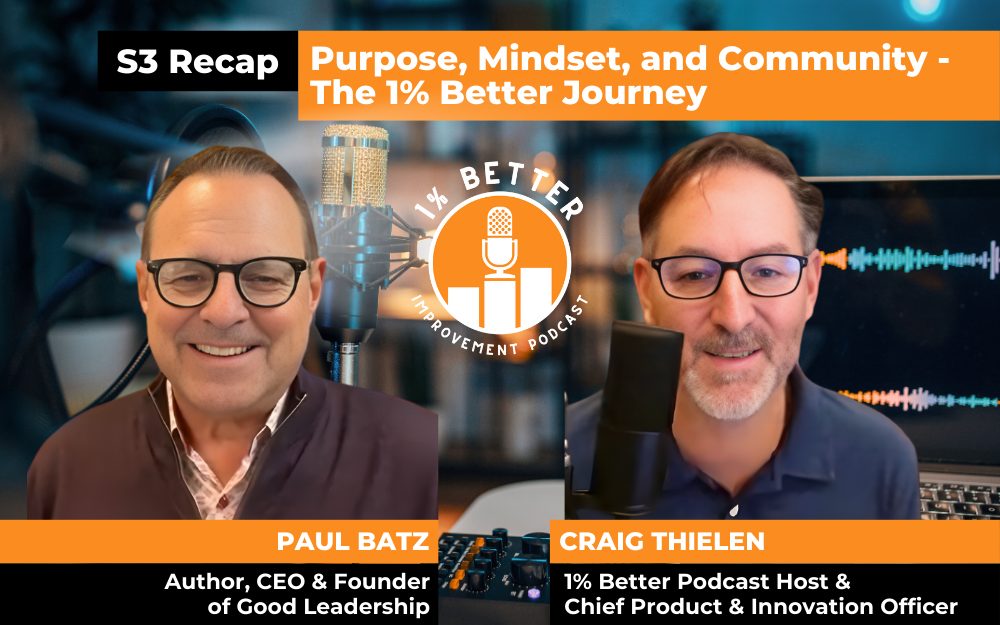
Hello, I’m Craig Thielen and this is the 1% Better Podcast. Today is a very special episode. This is our third season, the finale, the recap, and I’ve got a good friend and someone who’s been a part of this journey from really day one. Paul Batz is joining us to turn the table on me and facilitate and be the host and I get to be the guest, which I’m looking forward to every conversation with Paul, we’ve had some great ones over the years. And so we’re going to just review what we’ve been doing here in season three and really look back at the entire journey of this podcast and hopefully get some new observations. I’m looking forward to that. And Paul, I’m going to hand the ball over to you.
Paul Batz (00:53)
Thank you, I’m really happy to catch that ball. I’m honored to be on this list and if I do my math right, we’re over 50 now. It seems like this is 54, 55 podcasts and let’s just start right there. There’s no time to be humble here, Craig. People start things like this all the time and they fizzle. So you’ve done it, it’s amazing. When I look back at all the people you’ve hosted, I shook my head in amazement. So what’s been the most satisfying part of hanging on there and doing this podcast now three full years.
Craig Thielen (01:24)
Yeah, I mean, it’s fun to look back and I know you’ve, you’ve done some similar things. I think you’ve done a hundred of your own. ⁓ and so it’s just fun to really look back and, say what happened. mean, first of all, ⁓ the word that comes to mind is grateful. I’m super grateful for this is not a one man show. ⁓ it’s a team and, we’ve got an amazing person who produces this by name April Beyl, who runs marketing for Trissential. And she just does a wonderful job behind the scenes making me and the guests look good and packaging it up and getting it to the world. The next thing is just the community of – this started with us having an idea, a 20 year anniversary of our company. We wanted to give back stories and relationships and things that we thought people would love to hear and benefit from. And so it started with friends and mentors and close associates and you were on that list. And it’s just grown in a way that I would never have anticipated. How one conversation leads to the next. I mean, even just taking you, you were episode three, and I’m super grateful for the first people that signed up when this was, you know, nothing. We didn’t know what we were doing. I didn’t know where it was going. And people said, sure, I’ll be on this thing that nobody knows about. And you were one of those. were number three. And just if I even look at you and the Good Leadership message and your network and your connections are woven through the three years. I you’ve been on yourself twice, and just going to your breakfast that you do such a wonderful job of. I’ve met people there. And so it’s just fun. That’s kind of indicative of every person that comes on the show is essentially becomes a friend of the family, becomes part of it and their network does… how that leads to the next set of ⁓ shows and introductions is just super meaningful and it’s been fun to see that. So I think that’s, ⁓ I mean, I’ve got a lot of reflections on it, but just seeing it grow in ways that you didn’t anticipate and the people that I’ve been able to meet and even some of our guests, we’ve been able to connect them and it’s kind of grown into a small community.
Paul Batz (03:38)
Yeah, I’m very happy to be a part of it. And on that very first time I appeared, I talked about some of our core beliefs here. And one of that is in a framework called the Seven Fs, and I’m going to use this because the Seven Fs in alphabetical order are Faith, Family, Finances, Fitness, Friends, Fun, and Future. And in that opening, you talked about friends who have kind of become part of the family. And when you start something like this for the first time, it’s really based on a core belief that what you’re doing is important and that people are gonna think it’s valuable. That’s faith for sure. And I’m curious to find out, people who get into podcasting, it’s like any other endeavor, you must have, I’m wondering, can you remember your earliest memories of podcasting and where you heard a podcast and you’re like, ooh, that was valuable and I think maybe I could do that. Do you remember?
Craig Thielen (04:32)
I do. I’d say about five years ago, I went through in one of the podcasts that was a gentleman by name of Brian Bogert, who was just one of our recent shows. And then I was on his show and he does a lot of work. He’s got just an amazing life story. he dug, he basically within the hour podcasts that I did on his show, he did is almost like a therapy session. Like he went into my childhood and we were talking about things that I hadn’t even thought about for 30, 40 plus years. And one of the things we talked about was about five years ago, I went through a pretty big change and I got made a lot of changes in my life. And I got really into sort of health and longevity and whatnot. And when I did that, it naturally brought me to, well, who are the gurus? Who are the biohackers? Who are the experts at this thing? And it wasn’t mainstream medicine. Let’s just put it that way. It was alternative. It was lots of things, and the single best place and really the only place to get that kind of content was podcasting. So I went deep on it then of course, you know, I would say Joe Rogan is sort of the grandfather of podcasting and his story is really interesting. He didn’t ever intend to be a podcaster In fact, he was just playing around with a buddy. Like this is 10, 12 years ago. There wasn’t even a thing… podcasting wasn’t even a thing. It was just you know, now the internet had some recording abilities and you could stream and YouTube is starting to come online and, and it became a thing. It became all of a sudden, 10 people following became 500 became 5,000, 50,000. Now we know millions of people follow him. And so when we decided to start this, I was curious because I listened to many of his podcasts. He has just some of the most amazing guests, most famous people, interesting people and going back and I said, well, we’re starting this thing. Like, how do we do this? And I went back just to see what his early podcast and they were terrible. They were just absolutely like two guys in a garage with t-shirts on just talking about nothing. So yeah, it was about five years ago and it was mostly in that sort of health and wellness space. And now it’s just to me, like it’s, there’s so many of them. I mean, there’s actually, I think there’s over 4 million at any given time, podcasts, and you’re right, very few of them, I think something like 90 plus percent never make it over 10 episodes. And so it’s like a lot of people throw something out there, but it, it’s like anything else in life. I mean, it takes consistency. takes perseverance, dedication. You have to have enough focus and content and et cetera. So yeah, it was, it was about five years ago.
Paul Batz (06:59)
Yep, that’s right.
Well, what I’ve learned in doing both our breakfast series and our podcast series is that I get bored if I’m not learning something by doing them. And so just even preparing for this today, I felt myself getting 1% better by reading the resumes of all those people and being curious about some of the things that you’ve been talking about. So we’re gonna get to the Future F at the end. We’re gonna ask where is this headed. Between that faith and future, I want to ask you the most obvious question. You’ve done enough of these, you’ve seen themes. So let’s just use three. What three major themes have been present in people who participate on the 1% Better Podcast?
Craig Thielen (07:48)
Absolutely. Yeah, I love that question because again, going into it, we just said, hey, we’re just going to do this thing and, tell some great stories and introduce some great people that maybe some people can benefit from. And it just kept rolling and rolling and rolling, and I did start seeing these themes. And so the very interesting part is very in the early days, I made a very intentional decision. It was either going to be, we’re going to stick to this kind of corporate world, we’re Trissential, we’re management consultants, we work with a lot of big companies helping them drive change – People, Process, Technology, right? So we’re either gonna stick to that scope, so very, corporate like, what change, leadership, that kind of stuff, or we weren’t. And so I decided very early on, and I don’t even really know why, other than maybe it was just my personal intuition. And I said, no, there’s gonna be no limits to this. Like if it’s 1% better, it’s professional, it’s personal, it’s everything. We’re not going to put boundaries on it. And as soon as we decided that, all of a sudden, it wasn’t just CEOs and CIOs and authors and people that have accomplished big things on paper. And all of a sudden, it was Arctic explorers, was college professional basketball players, was people that have accomplished great things in life, not in the corporate world, and it was an interesting moment in itself because then I started going okay, so what’s different what’s the same? And largely it’s a lot of the same things and so if I had to boil that up into sort of big themes, I would say one is the power of purpose. If you look across – and again different age groups all the way from college kids, to people that are retired. Okay, so we had the full spectrum… And these great, great, amazing stories was the power of purpose that a lot of these folks had a life purpose… This is what I want to do with my life, very well understood and articulated. And sometimes it was through tragedy. It was through hitting rock bottom. So that’s one.
Second one is power of mindset, and that’s a big word and it’s something we’re always trying to sort of unravel. But to me, mindset is just about looking at things differently and focusing. So it’s perseverance, it’s grit… some simple examples if you could go through life and say, you know, I have bad luck and I didn’t get that promotion and someone ran into me with their car and I got this disease and all these things that happened, go, why me? Okay, that’s one mindset, that’s one perspective. The opposite perspective is, I am so grateful to even be alive. My heart is beating. And what an amazing day I have in front of me. And whatever happened, whatever failure, whatever tragedy, whatever it is, that is such an amazing opportunity for me to learn and grow from it. All this is right in between our ears, right? And so how almost in every one of these conversations that we have, there’s this mindset. What was their mindset going into whatever it was? What was their mindset afterwards? That’s where the growth takes place. They started thinking about things completely different and that’s where they get the breakthroughs, right? So that’s a theme that we could give you lot of examples almost like episode by episode. The third one I would say, Paul, is the power of community and connection. And that’s really powerful too. A lot of times people do things not just for their own purpose, their own sake, their own breakthroughs, but they do it because they’re part of a community. feel like they have, and you use the word accountability a lot, it’s a big theme for you, but you’re accountable to your family, you’re accountable to your team, you’re accountable to your company, you’re accountable to something bigger than yourself, and that connection with people, it’s incredibly powerful, so that’s sort of woven in between. Those are the three kind of big themes I would think of, the one kind of the magic in all of it is the stories and the language. I get inspired every episode by hearing people’s stories, hearing what they’ve been through, hearing how they’ve overcome it, hearing what they’ve learned. It’s just so inspiring to me, those stories, because it’s real. It’s not just a book. It’s not just an abstract theory. And then another thing is, it’s in a very powerful sort of magic, glue to all this is language and how people use language to change the narrative, to change the mindset, to change the thinking. And at the end of the day, this is all about change. We all go through change, whether it’s intentional or unintentional, but it’s how we go from point A to point B. And language is incredibly powerful.
Paul Batz (12:27)
huh. Yeah, well, I would be satisfied if we were done right now. I mean, those themes are awesome. The power of purpose, mindset, and community and connection. I think in the conversations you’ve always had, we work with executive leaders, their teams, we believe that effective leaders create a culture of healthy accountability, where people actually seek accountability instead of run from it. And in that mindset is, difficult does not mean bad.
And can you accept that life happens for you instead of to you?
And I have seen in my relationship with you, how all these things have happened and you’ve just figured out a way to make them work for you. And that’s one of the things that I think is amazing about what you’re doing, what you’re building, and the fact that – I think people are drawn to this podcast because they know you’re gonna bring that out in them. And so I’m gonna encourage you to keep that going for sure. And I wanna ask what gems that you personally got.
So I’ve listened to a lot of your podcasts while I was driving back and forth to Arizona. I lived down there in the winter time. I live in Minnesota in the summer. That’s a long time. That’s 54 hours worth of driving, by the way, to get down and back. And so.
Craig Thielen (14:00)
It’s yeah, you get a lot of times a lot of time to think, or a lot of time to listen to podcasts.
Paul Batz (14:06)
Yep, and I also spend a lot of time on airplanes. And I’ve got this orange book I carry with me that’s my “me” book. And I write things that inspire me in that book. And there several things I’ve heard on your podcast that inspired me to get 1% better. How about you?
Craig Thielen (14:22)
I’m going to talk about a few, but Paul, every episode I prep for it, then I host it, and then I listen to it after it’s all said and done. And all three of those are very different experiences, and I learn from all three of them. So when I prep, sometimes I know the people. I’ve had some relationship with them, but I learn lot more.
Some people I’ve never met before and so I’m learning about their story, their history. Sometimes they’ve written books. I usually read the books, et cetera. And then when I do it, I just try to pull out the gems. I try to pull out the learnings and what I think that frankly what interest me about them. And I hope that other people get inspired and interested. And so I try to pull that out. And then when I listen to it, I’m
absorbing it and I get a whole nother set of, wow I didn’t even remember that they said that… what a powerful statement, what a interesting observation. So, I’ll go back to we didn’t put boundaries on they have to be a certain level or certain C-level and that’s some of the gems in here like Jack Gohlke okay… his story is is incredible. So he’s the kid that a couple of years ago, the biggest stage in the world when it comes to basketball is the NCAA tournament, okay? And it’s basically a bunch of unknowns, and some of them are known because you got the big power colleges that are there every year, the Dukes of the world. And then there’s always the Cinderella teams that nobody’s ever heard of. And it’s just an amazing experience if you’re into basketball. So here’s a kid that came out of nowhere from a university that most people have never heard of. Oakland University, people would go, that in California? Like, where is this place? And they upset one of the, the all time greatest basketball teams in the history of ⁓ NCAA basketball. And he hits something like, I forget now, but 12 or 13 three-pointers. Only one other person’s hit more three-pointers than an NCAA game than… so it’s like, okay, how does that happen? And, and, and on the surface and what I love about the long form podcast, Paul, is that there’s something really special and magical. You get over the sound bites, over the headlines, over the… oh yeah that’s cool. This kid did this. What a fluke, what a lucky… And you get into the depth of it. And you can’t hide. In an hour, you have to get to the depth of things. And what you find is it wasn’t a fluke at all. That team had been building for a period of four or five, six years and…consistently getting better and better and better. And he wasn’t a fluke, even though he came from a nowhere, nobody high school in Wisconsin, he was not recruited. And he went to some D2 college and wasn’t even on the starting team for the first couple… like he barely made the starting team. And then he had a great season there and then he was done. And then he got a fifth year, and then a connection… this coach knew this coach and this coach was looking for one piece of the puzzle. And anyways, long story short, this kid has been putting in, he’s been doing nothing but basketball for six years in the gym every day for three hours, shooting a thousand shots. Nobody cares about that. Nobody that, you there’s no newspaper articles. There’s no nothing. It’s just him being, you know, having a purpose.
Paul Batz (17:32)
Mm-hmm. Mm-hmm. Mm-hmm.
Craig Thielen (17:45)
Having a mindset that says it doesn’t it doesn’t matter that I wasn’t recruited, doesn’t matter that I’m not tall enough, fast enough, regarded enough, but he had a community and he was dedicated to it. And then he was put in the place and had the opportunity. And he could have even in that moment, Paul, he could have failed because I mean, think about the stress and the pressure. Here you make the tournament, which is by all measures, the ultimate even for this team to make the tournament. And then they’re a 16 seed and they’re playing a number one seed. You know how much pressure that is? it’s hard for just the average person to even imagine. got, you know, millions of people watching you. You got all your friends and family. You got the crowd. You’ve never even been in a game this big. And he hits 13 three-pointers. Like He is so dialed in. Like The world doesn’t matter, right? All that matters is him in the basket. And so he’s in that flow state. And so that, that, that’s one story that’s just like, wow, okay.
Amazing things happen, but you gotta go back six years and say, what are all the things that I’m… so that’s one story. Another one that’s just, again, some of these things that it’s hard to get your head around, Chris Nikic – He’s a kid that has Down syndrome and he went through the system and, you know, was kind of done with the system, meaning through high school where they have programs and throughout his whole life, he was always told everything he can’t do and we’ll put you in this program, we’ll put you on the side. And then he’s done with high school and he goes, there’s nothing left in the world, there’s no programs. So he’s at home sitting at home doing nothing and him and his dad have a conversation. His dad says, well, how about we just start doing something? And they actually use, what I love about them is they actually use the same moniker…. They started saying, well, how about we just do one thing tomorrow and the next day we do one more. Pretty soon he’s out doing walks, pretty soon he’s lifting weights.
Paul Batz (19:15)
No problem.
Craig Thielen (19:35)
Pretty soon his dad said, well, geez, you’ve been running a lot. How about we do a 5K? OK, let’s do that. And every day, every week, one thing more. Well, that 5K led to a 10K led to a marathon, led to major marathons, led to ultra marathons, led to Ironman, led to being a two-time ESPY award winner talking in front of thousands of people, being the spokesman for the special. Are you kidding me? And now he’s a spokesman. He goes in front of Microsoft and huge companies. how could you even conceive of that? Again, six years ago and it was just that one thing more and he his mindset shifted. One day somehow his dad got him to say, dad, every day… his dad didn’t have to wake him up and ask him… It was like hey dad, what are we going to do one more one 1% better today? What are we going to do? And it was just like obsessed with 1% better. So if he can do that, why can’t I do that? Why can’t you do that? Why can’t we all be 1% better? So that kind of story stands out because even when I think about it now, it’s still like, it’s hard to believe how amazing it is. And then there’s just some more, you everyone’s got a story. I met this gentleman, I was on a cruise in the middle of South America, and I met this guy that just stood out and he was one of the people that was there to help you and get you drinks. and his personality and his energy and his passion. And we just built the relationship. And I don’t know why, but I just started learning about him and his life and his story. And we built this over a course of five days. And at some point I’m like, this guy’s got a great story. Would you like to be on my podcast? And he has a great story. And again, he had purpose. He wanted to provide for his family. He lived in Columbia and it was a tough life in a tough world and he had to move back for COVID and he got an opportunity that he just decided to do, never been in the travel business and got on a flight and didn’t even know if this was a real company ⁓ and it turned out to be an amazing career for him and he’s providing for his family and he’s just so happy and he’s got so much energy and so again it fits in all these themes.
Paul Batz (21:50)
Yes.
Craig Thielen (21:56)
But he’s not some CEO, he’s not someone that’s ever gonna be on TV or in an article or anything. But it just goes to show you everyone has a story and everyone has the power to change. And these stories are amazing and it’s inspiring. So those are just a couple. I I could go on and on, Paul, but every episode I feel like there’s something there that’s just so inspiring when you can sit down and get into the depth of how people go through life and there’s always learnings from it.
Paul Batz (22:13)
Yeah, so this reminds me of an exercise that we sometimes use in executive coaching to get people in a growth mindset and also in a gratitude mindset because these jobs at the top of big organizations, they’re hard. And doesn’t mean it’s bad, but you know what you’re signing up for. Complex issues, particularly how free flowing information is today. You get lots of news you don’t want to hear on a regular basis. And one of the most simplest things I like to do is an exercise asking people to identify 20 people who helped them directly or indirectly to get to where they are today. The exercise of writing down 20, most people write down 30 or 40, and then ask what’s the one thing you learned from each one of those that made you who you are today? And it’s an interpersonal exercise. Sometimes people decide to share it. I’ve had many people decide to literally write letters to all those 20.
I I did it when I started my own firm when I survived year three, which is always the hardest. And looking into year four, I wrote a letter to 24 people… and the process of just like you said, preparing, writing those letters, sending those letters, and then receiving their thanks back and engaging in conversation. It was such a marvelous growth exercise. when I was looking through your list of all the speakers that have been on this podcast so far. was thinking to myself, you’re going to have one of those moments and we’re maybe catalyzing that moment today where you’re going to think about, you know, circling back to a few people and telling them thank you. And I think that’s beautiful. I really, really do. I’m going to flip the script on you just a second because I believe that you have this deep sense of accountability about you, not only to the idea and the schedule, but to the people who listen. And that’s one of the reasons why I think you’re constantly meeting people like the guy on the ship. So I wanna ask you about, what is your earliest moment, earliest memory of accountability? Where you felt a personal need to take ownership of something because someone was depending on you. Can you think that up?
Craig Thielen (24:40)
Hey, this goes back to this Brian Bogert episode where we went back to childhood. The first job that I had, the first real job I did, I did paper boy when I was like eight or nine years old. And I felt accountable to a schedule. The papers got dropped off at like 5 a.m. and I had to wake up and, or the customers would not be happy. Some of them, you know, went out for their morning coffee at 7 a.m. and went, some went to work at 6 a.m. and they wanted their paper. So that was kind of forced accountability I would say. I did it because I had to and I knew that like people would be really upset but I wasn’t really passionate about it but I did it. The first time where I owned it and I wanted to own it was kind of a weird situation where my first summer job this was between high school and college. I shouldn’t say it’s my first job, but it was a serious job where I was on a construction crew and they were building a school. This is serious business. There’s deadlines. And I had been working in construction with my brothers because they all own their own construction businesses. And so I had been helping them out. So I kind of knew the routine. I knew hard work and long days and all that. So I show up and about a week in… and I’m just a kid, right? I’m in high school and I’m the kid that runs around and gets everything. Get me this, get me this, my hammer broke, get this tool, get these supplies. And so I was running around just, you know, doing stuff. And a week in, the foreman calls me into the trailer on the site. And I loved it I was learning new stuff. were doing cement work and we were building foundations and walls. It was just interesting, fun stuff for me, great exercise in the sun. And I get called in, and that’s never a good thing to get called into the manager’s office. And because he’s a pretty serious guy, he’s a guy cracking the whip on everybody. And he goes, I go, what’s what’s wrong? Am I not doing something right? And he goes, Well, there’s really nothing wrong. But I just I just need to tell you, you need to slow down. And, and I looked at him like, he’s speaking French. What do you mean slow down? Like how is that even a thing? What do you mean? He goes, you’re just making everyone really nervous. these guys work by the hour. And so they’re not in a hurry. And it’s just not something that people are comfortable with. Because I would literally if they said, go get that. I would run and go get it. And I would run and go back and say, okay, now what else? What else you got for me?
And so I walked out of there and I’m like, this doesn’t make sense to me. They want me to slow down? Why would you want to slow down? Our job is to get the job done. And that’s not how I was raised, okay? My brothers, you know, they had me on a job. We went fast because the faster we got the job done, the more money they made. We’re on to the next job, et cetera. So it… It made me realize not everyone is wired the same way. Not everyone has the same expectation. And that was the first time, you know, I was accountable. I actually quit a week later because I’m like, I got to find a place where I can work and feel like I’m putting in a full days work. I don’t think I can go half speed. This isn’t for me type of thing. ⁓ But that’s where the first time I learned Paul, we’re not all wired the same way. not, we don’t have the same measurement. So success to them was different than my success. So that I was accountable to myself and I was accountable to him because I’m like, I can’t do I can’t go half speed. I’m not going to just sit around and wait an hour at a time. That’s not me. So that’s probably the first time that I had to make a decision based on that.
Paul Batz (28:17)
You’re home. That’s beautiful insight. Very, very lovely answer to the story. I appreciate it. I love asking that question. Mine was I had a dad who was difficult. He had a mental illness. He was high functioning, but he was difficult. And when I was old enough to understand, I said to my mom, hey, what can I do to help you? And she said, you know, if you just take out the garbage every day, that’d be awesome. That was one less thing I’d have to think about. And you can bet your life I did it. I knew, I understood.
I understood, we didn’t even have to have a conversation. Anything that she didn’t have to worry about, because she had a lot of things to worry about. So you know what, it’s a beautiful subject, I appreciate being a part of this, and I want to ask then the last question. So if we started kind of with your belief system, which is faith, I assume is there going to be a fourth year of the podcast, and if so, what do think the future of this podcast is going to look like?
Craig Thielen (29:29)
Yeah, there absolutely is going to be a fourth year. We’ve already started to record it. You know, what’s been fun is, again, the early days of a business, early days of this podcast, we were just like, who’s going to be on next? We don’t even know. You kind of go spoon to mouth. You go paycheck to paycheck, so to speak. Now it’s like we’re recording things that are going to play in three or four months because there’s such a lineup. That’s a great thing. Like we have interest, so we’re already recording for it. We’ve started to experiment. We’ve always been experimenting. That’s just the nature of it, right? 1% better. So, early days was just straight podcast audio. Then we went to video with YouTube. Now we’re doing every other episode from long format to short format. So we call them Fast 15’s and that gets a whole other type of conversation focus, topics. That’s something that we just started and we’re going to continue with. Different platforms. TikTok is one that we’re going to start playing with that obviously is a huge platform for a lot of people. So those are things that we’re going to do. We’ve got some great guests. I won’t leak out some of the guests, but we just got great guests lined up for season four. And I think it’s, follow what got us here, right? Which is just continue to not over structure, over plan, let it be organic, meet great people of all walks of life that have a good story, that are willing to share it, that are authentic. Not I’m here to tell you how great I am and smart I am, but ⁓ we wanna know what was tough and what did you learn from it and we’ve had just great people on the show. So, just more, more of that. I’m just thrilled by the people that have been on and can we continue to attract. And again, a lot of it now is not people that directly I know, or I’ve worked with, but it’s people that have been on the show a year ago or two years ago and they say, Hey, you need to talk to this person and this would be great for your audience. I had a great experience and it’s kind of like a growing family. One of the things I’ll just add that’s been an interesting dynamic in season three that again we just stumbled across and I think I’d like to do maybe more of it is instead of just having one person on I had a couple times where the person said, well hey Craig can I have another person? Can we have two? I go sure no problem. So we did that twice where we had two guests on. And that is a whole new dynamic because now it’s just not a interpersonal reflective, you know, here’s my journey, but it’s like how people paired up. so the two examples, so Dave Clark and Doug Cornfield. So Dave Clark, just again, incredible story. Was born with polio, just had amazing limitations and not a great life experience when he was going through elementary school in his early days of just all the limitations and stigmas that the world put on him. And there was a moment of kindness that one of his classmates did for him one day. And it changed his mindset and it changed his belief system. Fast forward, so then he started thinking, it’s not all my limitations and I have to be, I can only do this and this. And I have to be on the sideline, but I can actually do things that anyone else can do, and maybe better. So he ends up playing professional baseball. He ends up being a pitcher. He ends up being a professional baseball coach and player with polio. And so he’s got crutches on the mound and he’s playing with some of the best baseball players. It’s like, how does that work? Well, it works because you have the mindset that anything’s possible. So Doug Cornfield, who I got
Paul Batz (33:04)
Mm-hmm.
Yeah, yeah, that’s right. Yep.
Craig Thielen (33:28)
introduced to, he said, Craig, this is what I do on the side. I just, I promote this story. We do all these workshops. We do all these events. We get kids to understand that anything is possible through something that’s pretty visceral, something that’s pretty real. Dave Clark’s story, there’s a book about him and his story. It’s amazing. But then Doug, like, why did Doug, who met him by happen chance, he was like a financial advisor and
Paul Batz (33:31)
Yeah.
Craig Thielen (33:55)
going along his life. And he heard this story and he was inspired and he goes, this story’s got to get out. And so he got purpose from it. He shifted his mindset and he’s been dedicating his life to getting this story out. So 1% better type of story. So that was really powerful. We did another one with Chad Greenway, the Minnesota Viking and Chad Harlander. And the story was really about Chad Harlander. And again, the amazing work he’s doing with the school system.
Paul Batz (34:13)
Yeah.
Craig Thielen (34:23)
It started within one school system, Hutchinson, Minnesota, and now it’s spread to something like 20 or 25 school systems. the impact that they’re having with children, again, all about giving them confidence, letting them know that whatever challenges they can work through it, and there’s people, there’s support systems, there’s mechanisms, there’s mindset, there’s all this stuff. And how Chad Harlander and Chad Greenway partnered, because Chad Greenway is famous, and he’s got a platform and he’s got means and how they partnered to make something that was someone’s idea to give back to something that’s become really a movement and something that’s big. That’s powerful how people can team up. I mean, even like how you and I have teamed up and how one plus one equals three. So I think that is something I’m very intrigued by and would like to pursue more of that.
Paul Batz (35:17)
Well, on behalf of all your listening audience, I’m going to fill you full of confidence as much as I can and encourage you to keep it going. We all need more positivity. Our world is seemingly really consumed by divisive dark noise. And I think people who want a mindset that this can be and should be better, look to people like you and this podcast to keep themselves in the right mindset to make the world a better place.
I’m proud to know you and I’m going throw it back to you to close your podcast.
Craig Thielen (35:48)
All right. Well, thank you, Paul. This has been fun. Again, I want to thank you. You’re a big part of how we got this thing off the ground. And I appreciate you doing the first episode with us, I think episode three, and then just following you and being part of what you’re doing and all the connections. think out of the 54, at least a dozen of them have some mutual connections, and we’re now on third generation and you always do a great job of putting things in perspective. And thank you for taking the time to do this today. I’m super excited about season four. So thank you, everyone, for continuing to follow. And more to come on season four.
Check out other podcast episodes