Find us on your favorite podcast platform including: Spotify | YouTube | Apple | Amazon
1% Better Podcast Zad Vecsey – Quick Links
Connect with Zad Vecsey on LinkedIn
Check out Late Shift – world’s first cinematic interactive movie
Check out FLIGBY – real-world business simulation
Learn more about Mikaly Csikszentmihalyi
Get your copy of Flow, By Csikszentmihalyi
Connect with Craig Thielen on LinkedIn
Check out host Craig Thielen’s full bio page
Key Takeaways
- Flow can’t be forced, only enabled: Leaders don’t “create” flow; they design environments where flow can emerge
- Peak performance looks the same across cultures: Decision-making patterns in flow are more consistent globally than most leaders expect
- Story beats theory in leadership development: Humans learn best through immersive stories, not instruction-heavy training
- True behavior emerges under pressure: High-stakes simulations and interactive films reveal authentic leadership instincts
- The future of learning blends entertainment, psychology, and data: Hollywood-quality storytelling combined with behavioral assessment is redefining development















1% Better Podcast Zad Vecsey – Transcript
Craig Thielen (00:07)
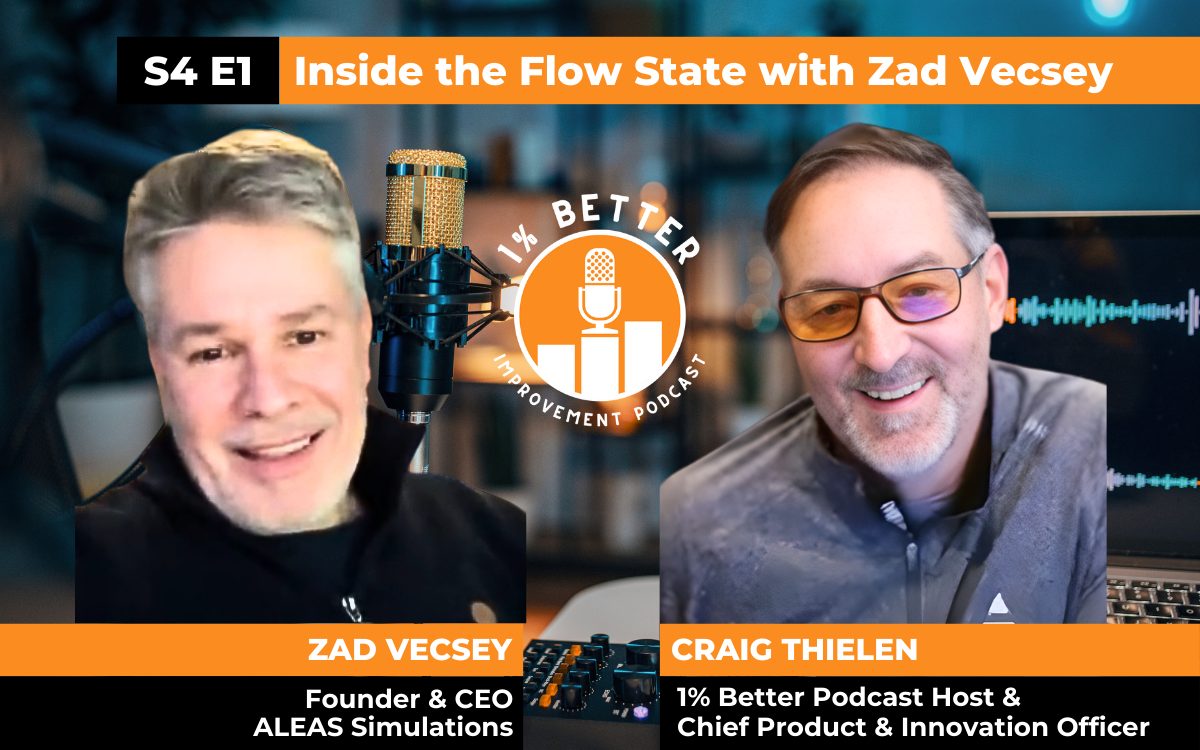
Hello, I’m Craig Thielen and this is the 1% Better Podcast. Today we are talking about the flow state. Hollywood, the FBI, and the future leadership. Hopefully by the end of this podcast, you’ll be able to connect the dots to all of those. So with me, I’ve got ⁓ Zad Vecsey, Vecsey, Vecsey… how do I say it? I know Hungarian’s like the hardest language to speak, so help me out here.
Zad (00:59)
That’s true. That’s true. Before I will tell you the secret, how to pronounce my name. Just thank you very much for being with you today in your podcast, Craig. So that’s Vecsey actually. And it’s not easy Vecsey (Vee-Shay)
Craig Thielen (01:10)
Viche. Well, thank you. I’m going to ask that a few times today here. So you are the founder and CEO of ALEAS Simulations, and you’ve been a pioneer in this idea of flow promoting leadership development. So we’re going to learn a lot more about that. And you’re coming to us from Budapest, Hungary. So welcome, Zad, to 1% Better.
Zad (01:35)
Thank you, thank you, nice to be here.
Craig Thielen (01:38)
So I gotta ask you, what side of the river, I was just in Budapest for the first time about a month ago, what side of the river are you on, the Buda side or the Pesh side?
Zad (01:47)
Yeah, actually, I’m on the Buda side currently, but for us, the citizens of Budapest, doesn’t really matter. So we are just passing the river two, three times or even four times a day if it’s necessary. The business part of Budapest is more or less on the Pest side. So if you have a meeting or you have to do a presentation or go to a client that’s mostly happening on the Pest side. Here in Buda’s side, you know, that’s a fantastic area for recreation and find your flow, by the way.
Craig Thielen (02:25)
Yeah, it is. I was curious about that because geography is very meaningful in a lot of places in the world. And I know the little bit of the history, you know, it used to be two different cities. And I think at one point, different countries, different controlled by different governments. And so now, of course, it’s come together. And I was just curious if there’s two different cultures, in the US we say, I grew up on the rough side of the tracks or the good side of the tracks. ⁓ And I live, of course, in the Minneapolis-St. Paul, which is two twin cities. We call them the twin cities in Minnesota. And it does have a different culture. St. Paul has a different culture than Minneapolis. So I’m just curious, you mentioned right away there’s really not a divide or is there a little bit of a difference between the two?
Zad (03:15)
Yeah, that’s not just the Hungarian language is difficult, but also the history, I can tell you, because if you check out this more than thousand years we lived through as Hungarians here in the Carpathian Basin, that was never easy for us. that makes, you know, the life not just to think that we are always on the sunny side, you know, but the heritage we just have is… is always explaining us a lot of messages regarding that. So Budapest is more or less one common city. I mean that’s quite united from the value point of view, from the people point of view. But Hungary was, as you probably know, definitely bigger during the history as now it is. Absolutely, it was a dominant country at one point. and then actually we lost more than 70 percent of the country after the First World War, which means that a lot of Hungarians are now living in a neighbor country. And you can already just explore the differences between these Hungarian mindsets. I mean living here in the current Hungary and living outside of the current Hungarian territory, we are speaking the same language. However, you feel that the culture and even the mindset is changing a little bit by years, but that’s okay, I think. we are quite a lucky country, even though the history was quite bold and not always in our favor. But I think having neighbors like we have, that can make us also as a country and as a as a community, stronger. And that’s even true in case of Ukraine, for example, that’s a neighborhood country which undergoes today, you know, under really severe problems. But even there we can find, I think, and I hope we will find some joy in the specs and some basis which can actually lead us toward a joint future here in the European Union.
Craig Thielen (05:37)
Yeah, well, history has got all sorts of sorted, tough paths. But I can tell you, it’s a beautiful city. I was very impressed with it, very clean. it’s one of those cities that I got to see from the river, so I got to see both sides of it. It’s a beautiful… in some cities, the rivers are almost neglected but in Budapest, it is the center. It is the place where you can see the parliament and the government buildings and the palaces. It’s just a beautiful city and I would highly recommend to anyone who hasn’t been to Budapest, it’s a great place to visit and you live in a beautiful city. So we’ll wind in the culture here as we go because it is a theme, of course, for you and for the work that you do. Maybe why don’t we just quickly, Zad, talk about your past, your early career, education, early career, and how did you get into this business of leadership and flow state, and then go from there.
Zad (06:37)
Yeah, as you then realize, Craig, Hungary is really in the middle of Europe geographically, but that was not always the case because, you know, right after the Second World War, we were occupied by the Soviet Union, which meant 40 years under communist regime. I personally was quite lucky because when I started my ⁓ university studies, that was just the year when the changes happened. 1990, which was a huge deal here in Hungary. We just got back our, you know, sovereignty. We had the opportunity to travel freely, not just on the eastern side of Europe, but also to the whole world. Also, we faced difficulties because after 40 years of a socialist communist regime, just turning the whole country toward the capitalist ideas and and and rules was not really without conflicts, I can tell you. But that was a wonderful time for me personally as well. I just started the university and and my goal was always to understand how effective organizations working. Hungary was called during the socialist regime within the Eastern Bloc as the happiest barrack, you know, in the within this communist setup. And that’s why, because we were more less more free than the other countries, especially if you combine, if you just see how the things were done in Eastern Germany or even in Czechoslovakia at that time. so we had more freedom and not just –
Craig Thielen (08:14)
Why was why was that? I’m just curious because you’re all part of the Soviet bloc, but I mean you’re right next to, as you said, it was Czechoslovakia at the time, now it’s Czech Republic, and then you had Poland and you have Romania, and you know, Austria. What allowed you to have more freedom than others?
Zad (08:18)
Yeah. As probably you heard, we had a revolution against the Soviet Union in 1956, which was really… you know, a bloody part of our history. These two, three weeks we went through really, really, under depressing situations. And actually Hungary was too weak to really go against this huge Russian empire. So we failed, but the Soviets realized that the Hungarian nation can be not just occupied as, you know, and depressed as it was. So after the revolution, they provided more freedom to Hungary, even considered the country as a kind of, you know… experiential setup, just see how far we can go actually within the Eastern Bloc toward the liberal ideas and toward the press freedom, for example, and also toward some economical realities. For example, Hungary was the only country within the Eastern Bloc who was allowed to deal with the World Bank at that time. So Hungary was also during the socialist regime, financed by some international institutions. And that set up provided a better overview for the citizens, especially who really try to understand what’s going on on the world and of the whole European set up. And also in Hungary, it was allowed, for example, just start your own small business or entrepreneurship. was already…
Craig Thielen (10:20)
And that was before… you officially became a free country in 1990, but this is pre 1990, where you had just more freedoms and that was mostly because of this Hungarian revolution that they gave you a little bit more space. But it is interesting that you grew up only nine years after, you you were completely, a sovereign country. And so that must have been an interesting time. looking back, of course, when you’re a kid, you don’t know any better. But looking back, was it sort of a blossoming, new businesses, new ideas? Was that kind of in the culture already 10 years later?
Zad (10:53)
sure. Yeah, absolutely. So it was really interesting to see. I spent a lot of time as a kid in Eastern Germany. So my language in the school was German. I learned German and, you know, every school had its own partner school in different East Bloc countries. So I had the opportunity also spent two, three weeks every year in a German school. And then we see that actually the level of the freedom and the level of free speech was very different in Eastern Germany than in Hungary, for example. So in Hungary, that’s why everybody thought that it was the happiest part of this part, because, for example.
That was the meeting point for the East German and Western German families who were just divided after the Second World War. And here at Lake Balaton, which is a wonderful place also, so we have not just Budapest, but also some other beautiful places here in Hungary. So that was the meeting point. And also some joint ventures really early moved to Hungary. For example we had, which was unbelievable at that time, but for example, Coca-Cola and Pepsi were one of the companies which were already there from the 70s. IBM had a huge basis here in Hungary during the socialist regime. So we were much more open. It doesn’t mean that it was a free country. That’s very important to make this statement that we, of course, there was only one party, that was only one party you can vote. There were no free elections. And also the whole scientific and political world was determined by the socialist idea.
But anyway, it was just more free than the other countries and we Hungarians felt it. We were really proud of that. And it meant also that the changes were much more smoother than in 1990. Actually, the whole structure turned into a capitalist setup. Then for Hungarian, it was easier.
Craig Thielen (13:16)
Right. So you grew up in that early era of freedom and being maybe even enhanced pride of Hungary being a sovereign country. So you went to university, as you said, then what was your early career and how did you get involved with Mr. Csikszentmihalyi
Zad (13:37)
yeah, pronunciation is tough. Thank you for that, because it’s a really, really difficult name. Absolutely. That’s absolutely. Yeah, so I started at the Budapest University of Economic Sciences and at that time already they had really well developed ideas about macroeconomics. So we started to learn the setup, was also known, for example, at the London Business School, which was the major partner at that time for my university. I even made my MBA later on at the London Business School. So we had this opportunity just to really get into the leading top university cohorts and also curriculas. So that was very well organized and we just got a lot of inputs from outside of Hungary during that period. And since the whole business and the whole economy has just restarted, a lot of new opportunities came to young professionals like myself. For example, I just started my career at the Coopers & Lybrand which later on, know, merged with Pricewaterhouse. So I started as a tax advisor assistant, but that was huge at that time, you know, just working for a British company, just to understand how the international business is done, how to deal with expatriates. What does it mean, the taxation? You know, that was brand new. That was the one of the not so happy, happiest, part of the changes that we just got this western-minded taxation in the socialist vision that was very, very different. Literally nobody paid huge taxes, but after the changes, of course, since the whole economical basis changed from a state-owned structure to a private-owned, the taxation, of course, as a basis for a modern…
Craig Thielen (15:45)
I’m curious about that and I don’t want to get too diverted here on this whole, communism versus democratic, capitalistic society. But just I’m curious about that. So under the Soviet rule, did you not earn income? Do they only give you enough to live on and therefore they don’t have to sort of take back taxes? Is that why you didn’t have to pay taxes under a communist government?
Zad (15:48)
Yeah. We had taxes, but the taxes was not actually a tool just to running the state or just fulfilling the state’s mission because everything was owned literally by the state.
Craig Thielen (16:26)
Right. So they had lots of revenue streams outside of trying to take it from the people, but your income level must’ve been less as a result of that, right? Right, -Sure… So it’s just different forms of taxation, whether they own the revenue to start with or whether you earn it and then they take it back. Okay.
Zad (16:30)
Exactly So that was very different at the time. And since also all aspects of the economy was controlled by the state, it meant, for example, that also the pricing was not realistic. So it was not based on what actually people would like to buy or not. It was some institutions which defined actually the prices for the goods, for the services. So that doesn’t show actually the actual needs of the people. And that was the same with the salaries of course.
Craig Thielen (17:14)
So you went to university and then you got into consulting. How did you meet Mr. Csikszentmihalyi And let’s talk about that interaction and then how did that impact you and how did that spur I mean, the rest of your life really. And just for the audience sake, this is the book [Flow] that we’re going to be talking a lot about. It’s called Flow. What’s interesting about it, is written by the author of course, Michaly Chkhikvishvili and he’s Hungarian. And this book is interesting because I don’t know how popular it was when it first came out, but it seems like it’s growing in popularity or at least it’s maintaining. So we’ve been doing Zad, this podcast for three years now and we have a lot of authors and lot of executives and lot of leaders of different sorts. And this book and this idea of the flow state has come up at least a half a dozen times. So it’s very much woven into… and it’s into sports, of course. A lot of the examples are sports figures that are in the flow state and they have amazing performances. That’s the book that we’re talking about if you haven’t read it. It’s a wonderful book. so tell us how you met him and how it inspired you.
Zad (18:32)
Sure, and by the way, the story of the book is also very exciting and interesting. I will just have some words on that later on.
Craig Thielen (18:39)
Great.
Zad (18:40)
But how we met actually… so after I spent three years at taxation side of the consultancy, I just switched to organizational development and to management consultancy. And around 2000, we realized that the internet offers brand new opportunities for leadership development. So we moved slightly toward that. At that time, it was the typical e-learning.
Craig Thielen (19:05)
Sure.
Zad (19:05)
Considering the opportunities the internet offered at that time, it’s very low bandwidth and no multimedia, but we started to explore how it could just work or support, for example, the experiential learning using some really early designed simulations, text-based. You make a decision and it will provide you a feedback text-wise, so only using text. So that was how we started. And we realized that it has its market and realized already that Hungary is too small for doing it effectively. So we had to go Europe-wide. We are now talking about 2001-2002, so back in the millennium. And that went very well, by the way. So within three or four years, we were able to build up an Eastern European network of companies, e-learning providers, mainly focusing on simulations. But we realized that we reached the kind of limit because without having the capital… like for example, or German or Austrian or UK competitors had, we had to do something more creatively. And we’ve decided just to look for a topic which was not really, worked out at that time. And Flow was already after the big hit, I will tell you immediately about that. And since Csikszentmihalyi was a Hungarian, we just had an idea why not contacting him. So we find somebody within my family actually or in my personal network who was connected to this fantastic professor at that time already worked at the Claremont Graduate University in California and he was more or less open just to have at least a conversation. I wouldn’t say that we were able to provide the full aspect of what we wanted to do at that time to him, so he was quite suspicious and he didn’t tell immediately that, okay, let’s go green light, everything’s fine. So we needed approximately a year just to understand each other and what we would like to ⁓ do with Flow on that domain we were in. But finally it became a fantastic, beautiful friendship, I can tell you. So he was not just ⁓ later on an investor to our company, providing capital and also an amazing personal network for the further growth but also a fantastic personal friend. So that’s in the nutshell. And you know, how Csikszentmihalyi started is also really, really interesting because, you know, he grew up in Italy.
Craig Thielen (21:57)
really? But he’s Hungarian. He was born in Hungary.
Zad (22:00)
Yeah, his family was Hungarian, but his father, you know, was as a diplomat working in Italy, in Rome, on in Fiume, in today’s Croatia. And they lived a fantastic life.
Craig Thielen (22:07)
interesting.
Zad (22:15)
The Csikszentmihalyi’s family was very rich, a noble family. So with all the money and opportunities you can have as a kid, he had. But after the changes, after the Second World War, when the communist regime started to build up in Hungary as well, it was really, really dangerous for the Csikszentmihalyi family. So he had to left the country, back to Italy.
and starting from nothing, literally. So you can imagine, you know, one day you owning fantastic pictures and next day you change it for bread, you know, so that’s what happened with them. So this change in Csikszentmihalyi’s life was really influential on his later ideas and how he thought about the positive psychology and the domain he explored later on. So he started to work as a late shift, night shift in different hotels. He was 16, 17 at that time in Italy. Then he moved to Switzerland, also working at hotels.
And he realized that actually his real interest is to understand the human soul. Psychology. And at that time, psychology here in Europe was very clinical one. It focused on if you are ill mentally, then how we can help you or what all the…
Craig Thielen (23:34)
Psychology. Yeah, put on a straight jacket, give them drugs.
Zad (23:48)
Yeah, and he was always somebody who wanted to understand if everything’s okay, if you feel good, if you do real what you want to do and you are happy, full with positive energy, then how to explain that. And at that time, this type of research has just started in the US. So that’s why he chose the US for his studies.
Craig Thielen (24:13)
When did he move? What year did he move to the US?
Zad (24:16)
Actually, the revolution against the Soviet Union in 1956.
Craig Thielen (24:23)
He moved to the US back then? wow, okay – not from Hungary.
Zad (24:25)
Yeah, exactly. Not from Hungary. So that was absolutely not intentional, but that’s how, you know, history looks like. So, so he just went that time, that year, exactly that year to the U.S.
Craig Thielen (24:35)
Makes sense. Okay. And how did he stumble on the concept of flow?
Zad (24:42)
Yeah, so first he tried to understand that how different states of your mind or of your psyche are changing within a day. And he just, first of all, tried to understand what’s happening if you are really immersing into an activity you are actually doing. So he explored artists, he explored scientists, he explored a lot of physical doctors, just watching how it looks like when they are really doing their job and they are satisfied by that.
Craig Thielen (25:21)
Yeah, peak performers, right?
Zad (25:23)
⁓ Yeah, but not from the point of view that it became later on, know, Flow as a part of how to create a good performing team. At that time, he was just interested in, you know, understand what’s happening if you are really immersed in the activity you are doing without any the consequences you can have later on. For example, doing a better job or performing better. That comes later on. So he started it quite early, 60s, 70s, he already managed researches at the Chicago University. And in the 80s, he just created a very special methodology, which used a special tool, this beeper, I don’t know what’s the exact name for that. So that’s prior to the mobile phone phenomena. Oh a beeper, yeah. Pager, yeah. So they bought a lot of beepers and they just beeped persons, you know, very involved in this experiment and they had to…
Craig Thielen (26:15)
Yeah, I had one. I had one back in the 90s. Everyone, doctors and lawyers and everyone who wanted to be important had a little pager.
Zad (26:33)
Exactly, that’s it. That’s the gadget they use for that, you know, working with the 600,000 persons, you know, in this experiment and this beeper just send the signal during the day twice, three times, and they had to just really write down what’s happening at the moment when they just got the signal. So what they are doing, how they felt themselves, etc. etc. So they just collected a lot of information. That was a university experiment with his students.
And one of the students said that it’s so interesting because a lot of people just described moments when they really immersed in the activity, like just being in the zone, being in the flow, like a river that flows. I’m just flowing with the activity together. So that’s how the expression came into this domain. Interesting. absolutely. And the end of the 80s, he met with the book publisher, with the book agent, and he just asked Csikszentmihalyi, why not write a book about this, because that’s so interesting. And he said, well, I don’t think so. So nobody’s really interested in that. That’s too scientific. And the guy just said, hey, if you can write a book on that, which is, you know, not too scientific. So an everyday person can also get some understanding what you mean under flow. Then, hey, I will provide you $20,000 in advance, you know, and he said, no, I’m not really interested. He went back home. His fantastic wife, Isabella, Polish lady, fantastic one said, What’s bothering you, Mihaly? You know, I just had this conversation today and the guy just offered me a lot of money just writing this. And as in the life, you know, sometimes happening. I’m sure you know what I’m talking about,
Craig Thielen (28:33)
Serendipity, yeah, there’s little clues in life, yeah.
Zad (28:37)
yeah. Isabella said, hey, now go back to this person and make the deal. We need the money. Okay, fine. So he wrote the book, actually, which was published in 1990. But it’s really interesting. And that’s where actually the story really starts, Craig, because the book was not a success. Absolutely not. Oh, ok.
Craig Thielen (28:57)
Mmm, okay.
Zad (28:59)
And Csikszentmihalyi said, hey, that’s what I told everybody, but you didn’t listen. That’s not a topic everybody would be interested in. So the book was not a success until 1992 Super Bowl final. And at that time, if I remember well, the year probably that was 1992, 1993, I don’t know. But at that time, during the live TV show and you know what horrible prices the advertisements are paying for during this period which is one of the most popular airing time in the US. So the guy who was led the Dallas Cowboys, who I do not remember, not the owner, the chief… Jimmy Johnson, probably that’s the name.
Craig Thielen (29:55)
Jimmy Johnson.
Zad (29:57)
he was asked during the halftime before the Michael Jackson show, hey, how you actually worked with your team for winning this? And the guy said, you know, I just read this book and he showed the flow into the camera, I cannot, tell how you…So this name, I cannot read it. So that’s the guy who wrote that. Mihaly was too heavy, just to pronounce for him. But that is it. And we just made the whole training sessions and everything based on that what is written in this book. And during this night, Csikszentmihalyi became literally a millionaire, by the way. So that’s interesting how that happened and how Jimmy Johnson even got a hold of that book and read it and then decided to share it. That’s a great story. So let’s go back to you. So you were already doing leadership, learning development, and you then said, hey, we need something. We need to take it to next level.
Craig Thielen (31:08)
You met Mihaly. and then you guys built a relationship. said, wow, this is powerful. Let’s anchor to that.
Zad (31:13)
imagine how difficult it was for the start. Just imagine the following situation. So we agreed via email that I will visit the old man, the fantastic Professor Csikszentmihalyi at his home in California. He just sent me the address and he told me that I should pick up you at the airport. And I just checked it out. It doesn’t make any sense, you know, because he meant an airport quite close to his home in Claremont, which were not really, you know, the best way to visit him because then first you had to arrive to LA, then back to Seattle and from Seattle to near Claremont. So that was not what I thought. It’s very effective. It took an extra day plus. So I just sent him the message, Hey, let’s meet by you. And he just messaged back. You will not find me. That’s the issue. And why not? You know, okay. So I arrived to LAX rent a car, just use the GPS, put the address in, arrived to Csikszentmihalyi’s home. His fantastic wife, Isabella opened the door. you are here. Hmm. That’s… okay. So Mike never expected that you will find us. Hmm. Okay. But he asked me, when you’re here, just phone him, you know, and he will be back from the university within 10 minutes. And he arrived and, you know, I was surprised. why they don’t think that it’s not a mission impossible getting there. And Csikszentmihalyi I asked him, how you done it? I said, well, I rented a car, there is a GPS in the car, you put the name and it will tell you where to go. It’s not a rocket science. And he said, well, okay. And that was back, Craig, in 2007. So his question was, okay, what’s the GPS? Okay. You know, that was a turning point in my whole strategy because then you had to start the conversation from a different point, you know, because I was there just convincing him doing an online product – Technology driven solution… but you know, when he seen the system and understood how is it working, so we had to test it, you know, that was my first experience with Csikszentmihalyi.
Craig Thielen (33:33)
Great technology driven solution. Yeah.
Zad (33:47)
We were driving through Claremont and he had to understand how does it work, how this gadget knows exactly where we are, how he has the ID just turning here left or right. And when he got that, and that’s so interesting, then we go back to the house and then he asked Isabella coming out and now he showed her how is it working. We went another test round, working fantastic, and that was the starting point where we could talk about, so what you are doing, – That’s interesting…
Craig Thielen (34:21)
Right, that’s interesting. It’s a great example though of how, and we do this as humans all the time, we talk about a topic and we think that the person that we’re talking to has a similar understanding and we use words and they might understand it completely. Like he was understanding what you were talking about completely different because he wasn’t in technology. And so just aligning on just basic, principles, basic values, basic, here’s what we’re talking about. I think sometimes we skip over that and we just assume everyone knows what we’re talking about, right? That’s very interesting. So did you at that point already have FLIGBY or was this pre-FLIGBY (Flow Is Good Business For You)?
Zad (34:58)
No, no, no. We have some other products already, were really a hit here in Hungary, here in Europe, Central Europe. We made great business in Germany, in Austria, but that was not the level we thought that it’s internationally ready. And I spent approximately five days together with Mihaly just talking about these technologies, how those are working and what we think about this, how should this cooperation work between us and after five days when I had to go back, came back to Hungary, I had to ask him because spending just time there and money without knowing that there will be a deal or not. So it’s important to know what we can expect. And I just asked him before I left that, okay, Mihaly, so I more or less understand what you think about what we are doing. But it’s important for me personally to know, will we work together in the future or not? What do you think? And he said, well, okay, show me again your product. And what I had on my computer, that was one of the latest simulation, that was actually a mountain climbing story, project management simulations. I showed him and he said, well, you know, I was also a mountain climber, as that’s what I’ve done in Italy a lot of time, here in the US also when I was younger. So I like it. Let’s start with this. And I was very happy, just having this already world famous personality on board for this project. And that’s how it started. And it took a year approximately just to settle it up also legally, you know, everything. It took a year from that point. But that was the…
Craig Thielen (37:09)
And that’s when you built, right then and there though, that’s when you started to build Fligby or when did Fligby come into play?
Zad (37:14)
Actually, the name was not Fligby at the time. We called it Flow is Good Business. That was the title of the project. And we started to work it out. First of all, understanding how flow can be utilized as an energy or as an asset or as a power on the leadership side. first of all, what is the added value of flow? getting high performance and how you can actually create flow. And what I learned, and that’s very important, that you cannot create flow as a decision maker. You can actually create the circumstances which will allow the flow happen. That’s what we call the flow promoting environment. So you can create a flow promoting environment, but it’s very undirect. And it really needs a lot of experience and leadership moves. And we were happy because Csikszentmihalyi wrote a wonderful book based on a research he managed already at the Claremont Graduate University about the business aspects of flow. The name of this research was Good Business, as the book. That was also a fantastic book.
Craig Thielen (38:29)
Right. Yeah, I think I got that one too up I think I got that one up there.
Zad (38:33)
Yeah, it’s an easy reading if you compare it with the original flow. it already. Yeah.
Craig Thielen (38:38)
let’s talk about Fligby, which is a learning development platform, interactive, immersive, that’s, flow is good business. And so I want to just describe it. I had the opportunity to go through it. It’s quite an intensive program. It was based on a leadership coaching program that a mutual friend of ours, Professor Krishna Kumar used in his leadership coaching program. And so what it is is, and again, you can fill in the blanks here, but I want to talk about that because that’s really, you you said, hey, let’s take this and how do we impact people? How do we bring this to more people? And so from my experience, what it was is you put in a setting and again, it’s a platform. So it’s very, at this time, I mean, I did it maybe eight or nine years ago or something like that. It’s very sort of high tech at that time anyways. Now of course with AI, it’s a whole different world, but it’s a video setting and you’re put into a place as leading a company, president of a company that’s sort of struggling. It’s a winery and you’ve got all sorts of different players involved and you’re now injected to take this company and help it become prosperous. And so you’re faced with all of these scenarios, a lot of decisions, how to put yourself, to build relationships, understand the company, understand the people, and then help guide. And sometimes people challenge you, and sometimes they have emotions, regular stuff that leaders deal with. And you’re constantly asked, what are you going to do next? And then it gives you feedback and you have a coach on the side who’s also giving you feedback and I think the whole purpose is to help you get the whole organization in sync and flow high performing etc etc. and what was really great about it is It goes way beyond theory of this is what a good leader looks like It’s actually practicing it and how often do we get to actually practice it? You know, one of the things that is striking about the difference between the arts, sports and the arts and business is in sports and the arts, you practice more than 90% of the time and you perform less than 10% of the time. And in business, it’s the opposite. You perform 99% of the time and you practice, you know, less than 1% of the time. And so this is a great immersive, interactive, immediate feedback tool that allows you to practice try out scenarios without of course doing harm and impacting real people. first of all, did I cover that right? And then I wanna talk about this platform and just what it’s done and how it’s impacted people since.
Zad (41:29)
Craig pitched amazing, really. So that’s what the thing is about, actually, that you described. Experience learning, letting people play and try out different scenarios. But it’s much more than just a curriculum. And that’s what we had to understand in the very beginning when we started to work together with Chkhikvishvili that actually this is much more about the story. So that’s a story, you know, and people are learning based on stories, with help of stories. So we need a great story. And if we have that, and that’s the problem, by the way, even today, with the most of the digital learning programs, that they would like to teach you something and not just to tell a story. It’s a very different aspect of learning. So if you let your users, your players really engage themselves or immerse themselves into situations which they will find interesting, engaging, and probably similar to their own problems. So they will find a parallel between the game and the realities, then we are there. So then we fulfilled actually the hardest challenge here. So this is a story about the winery which runs good. So, so financially that’s okay, but people don’t like to be working there. And that’s the big issue. And that’s where actually it’s starting to decline. People don’t like to be there. And how to change this? First of all, you have to understand your people, your team. You have to start to listen actively because they will tell you maybe not in a manner. that will actually be understandable for you immediately, but you have to try to get into their shoes and try to see the world with their eyes, because everybody has its own truth and try to just analyze certain situations on their ways. So that’s the major message here. And I was very lucky, I can tell you, because at the time, we just hired the lady here in Hungary, an American who worked as a C-level sales executive for IBM in the last 20, 30 years. And all of the frustration she collected at the multinational environment was implemented into the script of Fligby’s. So she was the script writer. So, and by the way, Csikszentmihalyi had the idea using the winery as a setup.
Craig Thielen (44:00)
Interesting. Yeah I thought so being in California.
Zad (44:13)
That’s just, we started with Hungarians. Few knew, but no, but actually the first really big business person in the Californian winery business was a Hungarian. And that’s why that was also, a connection to Csikszentmihalyi’s soul and to this Hungarian fellow who just –
Craig Thielen (44:33)
Interesting. Everything is connected somehow. So you created this platform. tell us a little bit about how many people have used it and yeah, let’s start with that.
Zad (44:45)
Yeah, so it became an unexpected success. So before, the most frequently used software created by us had 20, 30,000 users and now we are just nearing 10 times so big with Fligby. Mainly from the corporate and academic world. It doesn’t make Fligby the most successful product on this domain from the user numbers point of view, but that’s definitely a milestone. We are nearing 300,000. Maybe we will reach it by the end of this –
Craig Thielen (45:18)
amazing. So what, have you learned that from getting that data and that feedback that you’ve gotten from it, that maybe it was not what you expected, because you designed it for a certain purpose. You designed it for people to understand people and how to interact with people and different personalities. And of course, understand how to understand the flow state a little bit better. But it really is a lot to do with just how to work with people in the different types of personalities and sort of help guide them, but not direct them. I mean, that’s one thing that’s very clear. You’re not directing people or telling them what to do, but you’re understanding them and how to help them kind of get in their happy place or in a productive place or flow state. So what have you learned with all that data that you have?
Zad (46:22)
Yeah, so first of all, flow is very general. That’s the lesson number one. So if we see the users in India, in South Africa, in Latin America, in the US, here in Europe, they are following more or less the same behavioral patterns. If we see the decision…
Craig Thielen (46:37)
Really? Each, all the different? geographies are not acting differently, they’re acting similarly?
Zad (46:43)
Yeah, they are acting differently, but not from the decisions point of view. That’s really interesting, but how they are using the software. That’s a huge difference. So an Asian mindset, first of all, tries to explore what’s going on here. What are the expectations? So for example, the users from China, from Japan, even from India, first of all, they read through, you know, all the information we provide.
Craig Thielen (46:54)
Interesting. Yeah all the bios of all the people and the Americans just jump right to let’s get to work.
Zad (47:15)
Exactly. That’s the same with the Europeans as well. So we do not spend too much time, with understanding the game. Just go, okay, make it going on. That’s what we are doing. And that’s a huge difference, by the way, because…
Craig Thielen (47:29)
But the interesting part is that the decisions you’re saying are very similar. So are you familiar with this book, The Culture Map? So this is interesting because it highlights in eight different areas how different cultures are country by country. And so you saw some of that show up in your usage, but at the end of the day, the decision process was similar.
Zad (47:35)
Absolutely, Yeah, so how people actually understand the personal conflict is very similar. Of course, there are some differences, but those differences are much more between generations than geographical locations. So for example, and I was really happy when we got this cooperation, we worked together with Meta, they wanted to understand actually how the decision map of the Gen Z looks like and how the Gen X and that’s very different. there is real difference, craig, not the, are you living in Japan or working here in Hungary? That’s more or less the same. But if you actually, are younger and just was born together with the screen, and with how you collect information, how you understand other persons, we are video call even.
Craig Thielen (48:28)
Generation. Yeah, okay. Interesting.
Zad (48:47)
That’s where that makes the decision streams very different ⁓ of the generations.
Craig Thielen (48:56)
Interesting. Well, let’s shift into this new endeavor you have. So you created this very successful learning and development platform called Fligby. Wonderful. I loved it. I think it was a wonderful experience, especially in the context of going through a program and getting coaching and reading. it really lets you try some of the things and concepts. So you have that. Now you have this new endeavor, which involves Hollywood and it’s very high tech. Essentially it’s movies where you watch a beautifully cinematic produced, high definition movie experience – we all know and love from Hollywood, but every few minutes it’s like a choose your own adventure book for, I grew up with these little books where you’d choose your own and you’d go down all these trees of decision-makings and it’s like that and it’s really interesting I went through it, thank you for allowing me to go through it… wow, is that intense. So you have this, again, it’s a story and then you’re forced every few minutes to make decision, but really in an intense situation, life or death, where you’ve got really bad actors and you’ve got crime and murder and really tough situations that an average person. now the winery is one thing because it’s fairly docile. No one’s going to get killed. It’s about business. It’s about making wine. wouldn’t want to, I who wouldn’t want to work at a winery? It’s an amazing place to work at. And this is the opposite. This movie is intense. It’s like a Hollywood thriller and you’re making decisions and it was somewhat stressful. So I’m curious. Talk about that, how you jump to that form and why and what you’re hoping to achieve by it.
Zad (50:35)
Okay. Yeah, actually. as you just put it out, Fligby’s most important value is the assessment. So the way how we measure skills based on a decision stream, that’s very high level. And I can tell you that we are really in the forefront with that, within the industry, how to measure individual skills, people skills based on decisions you make in a simulation. And, you know, one of my friends just connected me to Contra Movie ⁓ in Los Angeles. Now they are part of the Paramount Pictures family and as the most advanced interactive movie making lab within Hollywood. And we just started a conversation. They were really interested in how we actually profile because okay, they are in a total different business, but by the end of the day, they have the same ⁓ standardized database and how we can actually read out, you know, how you use certain skills. And they were really interested in that. And we just had a fantastic conversation. And it went on almost a year when another friend of mine just told me, hey, said, you do not see actually what’s going on here. And I said, no, that’s I’m happy with this conversation, talking with Hollywood, it’s always something engaging. And he said, why not we are merging these two worlds, you know, let them collide. That’s the better expression, because we have the measurement, they have the movie. Why not using or measurement or assessment for their movies? And first of all, I thought that doesn’t make sense, you know? So they are working based on very different expectations and rules. What type of words you are using in a movie that’s not suitable for a company, for a word “f” you know what I’m talking about? So that’s a different… and as you just mentioned, Craig, people are dying in the movies, so how to, you know, but okay, finally we said, okay, let’s try and see what’s going out of that and what I learned and that’s very important, I think, and not just from my personal learning development journey, but also for everybody who wants to understand how effective learning works. So we have understand all limitations. By the way, that’s what actually Flow teaches us, with this indirect way of establishing a flow-promoting environment. So we realized actually that we, as learning professionals, cannot actually create so immersive environment, which can create by professionals whose major aspect and major goal is to provide you 90 minutes, two hours entertainment. We are not those persons. So if we are creating something like Fligby you always will feel that it has an intention. Okay, I’m playing it. It’s funny. It’s engaging, but you have an intention. You want to measure me. You want to teach me something.
And that’s what I realized, that if we can combine these two worlds, then we can create the ultimate option to analyze your behavior, because you will provide your true yourself, if emerging into an interactive movie.
Craig Thielen (54:09)
So you lose yourself in the fantasy of the movie versus using your frontal cortex to try to make… because one of the things I found going through Fligby was I was going, well, what would a good leader do? Or what this person that I might look up to, what should I do versus just being in the moment and say, what would I do? And I don’t care what anyone thinks. I’m just going to use my gut instinct.
Zad (54:12)
Absolutely. Absolutely.
Craig Thielen (54:38)
You’re constantly kind of fighting that. But in the movie, you’re just trying to create an immersive experience flow state where you just lose sight of everything in the world. And you’re just in that moment, right? But it’s also very challenging because it’s so stressful that who makes these decisions, you know, life or death decisions every day, not many people.
Zad (54:49)
Absolutely. And, you know, we just realized that actually we can measure, for example, situational awareness fantastically, which is, by the way, now the biggest business in the military and also in the preselection at corporates, just to understand the applicant situational awareness and also the intrinsic motivation, which we can measure if the environment or the product you are working with or playing with is immersive. So that opened up a brand new way and that’s where we are now. We’re really working now and started on a new project together with Contra Movie and with other corporates involved in this project to create a brand new movie which will be a Hollywood production, which will screen at cinemas. You will be able to make your decisions via your mobile phone. and those data will transformed immediately into skills profiles. So we are now in the situation to redefine a little bit this domain, how we learn, how we just got information on your behavior, how we can combine the entertainment with learning. So it seems to be that it’s a way which can be also find its way, not just on the personal development market, which is booming and growing, but also on the corporate side. For Late Shift, that’s the movie we’ve done first together with Contra Movie. I mean the assessment. So combining the assessment with Late Shift, one of the first users among that, there was the Texas Police Association, also the FBI Academy. because that’s a crime, that’s decision making under pressure. You have only three, four seconds to make decisions. but now we just finished a fantastic project with the high schoolers in Boston area, they were so happy about that. Playing a video game and getting feedback, for example, on their team role preferences, which also this product can provide. So there are brand new opportunities and we are just the edge to enter to this new world to explore.
Craig Thielen (57:13)
Okay. Well, it’s pretty exciting. yeah, I can see, makes sense where the late shift was very much geared towards the FBI Academy where people are being put in those situations to make decisions quick and have situational awareness. But it wasn’t really intended for the average person. It was like the concept of this immersive cinematic experience with real metrics, paying attention to what people are doing. But now you’re gonna branch off into different storylines that will apply to different people. I would assume, going back to more learning development for like general public type situations. Well, if somebody wanted to, Zad, I know we’re already an hour in here, so I wanna hit a couple more things here before we wrap up. But if someone wanted to experiment with or have access to Fligby learning and development for leaders or even the late shift as I would say as a experience as an entertainment experience if nothing else how would they do that or is that not possible at this point?
Zad (58:23)
Yeah, so we are available on the internet, of course, that’s the major platform. those type of services are available. So you can actually Google or ask your AI agent for FLIGBY or Late Shift. So you will find us definitely.
We have programs not for corporates and universities, by the way, the North American universities are really ahead of integrating this type of ⁓ learning methodologies into their curriculum. So they are really good in that. So you will find us because we have not just those type of institutional programs, but also offerings for individuals. I would be happy to show you around, send you some information so you can find me or open soul in it.
Craig Thielen (59:08)
Yeah we’ll be happy to share those links with people. yeah, I highly recommend both. They’re very different experiences, but highly recommend both. So we’ll definitely share that. Where do you think, I mean, is this where you think leadership learning development is going? and then how does AI play into leadership? You think that it’s shifting leadership? And what’s the impact of AI from your perspective?
Zad (59:37)
Yeah, so if we see our profession, the learning development and the professional learning, AI is definitely something we have to take into consideration. It will change a lot of basic aspects of this business. First of all, it will become a reference point, which is really hard to debate with. So, you know, ⁓ an individual coach or a consultant, I think, will become a really important competitor in form of AI agents. And that’s, interesting to think over. If you have a conversation with the AI about your own leadership development aspects or about your own skills or just explore the options for certain decisions with AI. That can be interesting how the live coaching can actually relate to that. So that will definitely have a disruption on this business or already done. I don’t know. So as we see with our clients, everybody’s using AI and it’s getting more and more personal.
That’s a triad, by the way, you know, that people are just sharing really personal, aspects of their lives with AI, even if they are using it within a corporate environment. But, but we’ve seen actually that, that that that’s getting more and more valid and important reference point. So that’s one thing. The other thing is how we keep create contents. That’s that will also, affected by that. And not just because it will be much more faster and maybe the prices can go down with the content development. But because I think we already are there, and especially the younger generations who can sense that if something too AI they don’t like that. that’s again, we have to find the balance and how use it really value added.
For example, I’m just writing a book with one of my friends about certain leadership challenges. for example, AI can be very helpful if you provide the right context, for example, to create stories which connecting to the messages you would like to share using your previous experiences, but putting in the way or finding the connections, which would be hard for you to do it within a limited time. So it’s a good thing, I think, but we should be careful. Where are the balance and where to find – yeah for sure. that’s about the AI and that’s disruptive. So it will change the whole industry, the video gaming, the movie industry, all content development businesses will be affected by that.
Craig Thielen (1:02:24)
Yeah, for sure.
Yeah. So as a person who’s spent a good part of your life ⁓ pursuing and promoting the flow state, how would you recommend for those that say, I love this concept, I wanna get in the flow state, I wanna be in there more, do you find yourself on that personal, at a personal level, not hey, I’m trying to lead a group of people, but at a personal level, do you find yourself, again, over the course of your life, trying, hey, I want to, I want to get in that state more. And is there, sort of practices that you have or things that you would suggest to people that are interested in promoting or trying to be more in the flow state.
Zad (1:03:18)
You know, it’s not easy actually just to find the general advice here. Since we are working in different industries, I see that some industries, you know, providing more happiness to people who are involved than the others. I just finished a huge program here in Europe last week at one of the major American auto car maker.
Craig Thielen (1:03:22)
Right, right.
Zad (1:03:43)
I wouldn’t tell the name, but they are here and they want to sell cars. And we work together with an administrative team. And I saw a lot of depressed persons. And that’s not because the industry is doing well or not, because currently Hollywood has also huge challenges. So for example, at Paramount, can see that there are layoffs and anything. But if you talk with people in Hollywood, you will see that actually they are not working. They are doing their hobbies. That’s what I’ve seen in their eyes when you are talking with them. Having a meeting about financial aspects, about revenue sharing, et cetera, et cetera, and right after, OK, fine. And now I will go there and we will have a slasher to do and I have to think about the artificial blood. Will I buy it from the producers who offer it or should we make ourself So these are, you know, the challenges which show that you are, and I’m not talking about the topic, but the orientation that you are doing something which is quite close or in line with your hobby. And that’s actually where the flow came into the picture. So if you can do something which makes you happy, then the performance and the engagement and the motivation, of course, will be definitely higher than just working for a multinational without knowing the real cause, without knowing the real mission of the organization. And multis are very professional in this regard. You will find all the mission statements and everything in just two clicks on the internet but everybody is sensing that it’s not the real truth. And I think that’s important. So if you like your job, if you like what you are doing, then you will find flow better. That’s for sure.
Craig Thielen (1:05:39)
Yeah, yeah, that’s great advice. find your purpose, find your passion, find what really brings joy to you. And that’s probably a place that you’re going to get a lot more flow out of. So love that. Well, let’s wrap up – on the 1% Better Podcast we usually end with one question, which is take a step back from your work, everything we’ve talked about, the stuff that you’ve built and just reflect on your whole life and say, if you had to give some 1% better advice, something you’d want to pass down to your grandkids or, give back to yourself if you were you know, 16 about to go into university, what would that advice be?
Zad (1:06:19)
I think just connecting to the thought I just shared earlier, Craig, just do what you really like to do. I just spent almost three years with taxation until I realized that it’s a dead end for me. I don’t like it, you know, just doing Excel sheets and just talking about how to optimize your tech scheme. That’s not what I wanted to do. However, for example, my daughter, she’s 21st, working at a multinational, more or less in the same environment, and she loves it. So she likes being there, doing that. So it’s not the job itself, it’s you.
Craig Thielen (1:06:38)
Right. Excellent. Well, that’s that’s super advice. So I’m gonna just finish up here with some final thoughts Zad, of what I learned from our time together. First of all, the enduring impact that we’ve talked about with this book flow from Mihaly Csikszentmihalyi is amazing. And I think it’s getting stronger and I think it’s getting more relevant, more important, even in the digital and AI age and your contribution is pretty significant to that. You you’ve been able to take it from a book and turn it into a real life experience. So that’s pretty incredible. The second thing is what you’ve done in this space, experimental immersive learning and how you continue to stretch those boundaries is amazing. And I think as humans, that’s how we’re wired. We’re, we’re wired to experience things, practice things, to get real feedback. And that’s where we learn most people anyways, the best. And so that’s been great to see you do that. The third is the power of acting, the power of doing, the power of telling stories. I think you took this idea and you acted upon it. You built a company around it. You built products around it. You’re now building movies around it. It’s one thing to have ideas. It’s another thing to take those ideas and put them into action.
And then the last is just the pursuit of 1 % better, the pursuit of improvement, the pursuit of how can we do better. And I think you’ve done a great job of trying to say, can I impact people better, help them understand better, learn themselves better and what their purpose is and how they can be happy and get in the flow state. So that’s a pretty great set of impacts that you’ve had. And I just want to thank you for sharing your story with us and making the world 1 % better, and hopefully our audience.
Check out other podcast episodes