1% Better Podcast: Paul Batz
Find 1% Better Improvement Podcasts Here





1% Better: Paul Batz, Founder of Good Leadership
Quick Links
Learn more about Good Leadership’s Seven Fs
Learn more about Good Leadership’s five learning books
Connect with Paul Batz on LinkedIn
Connect with Craig Thielen on LinkedIn
Key Takeaways
- Leadership and Personal Development: Paul’s career journey underscores the importance of continuous personal development and leadership. Starting from his early involvement in the advancement department at Gustavus and transitioning through significant roles in PR, leadership development, and eventually founding Good Leadership, Paul’s path illustrates the significance of growth and adaptability in one’s career.
- The Concept of Goodness in Leadership: Good Leadership revolves around creating a culture of encouragement, accountability, and positive teamwork. Batz defines “goodness” as the collective thriving of individuals within an organization, emphasizing that a culture nurturing these aspects leads to organizational success.
- Cornerstones of Goodness and Positive Reinforcement: The research by Good Leadership identified four cornerstones of goodness: excellence, generosity, fairness, and positivity. Batz’s approach prioritizes rewarding excellence, living generously, and promoting a positive outlook, emphasizing the impact of positive reinforcement over criticism in fostering growth and improvement.
- Integration of Personal and Professional Growth: The Seven Fs—faith, family, finances, fitness, friends, fun, and future—provide a framework for assessing and improving various aspects of one’s life. Batz advocates for a holistic approach to leadership and personal development, where individuals are encouraged to bring their whole selves to their professional roles, enhancing creativity, decision-making, and overall performance.
- Practical Tips for Improvement and Leadership: Batz emphasizes the value of starting the day with reflection and reading, aiming for continuous improvement. He shares insights on how small changes, such as focusing on process over results and practicing positive reinforcement, can lead to significant outcomes in leadership and team performance.
















1% Better Episode 3 Transcript
[00:00:00.340] – Craig
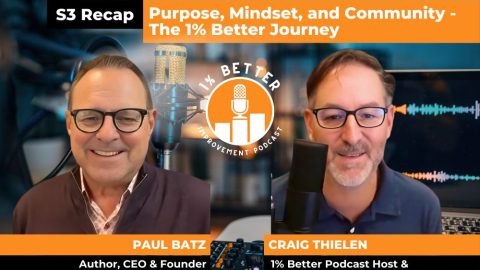
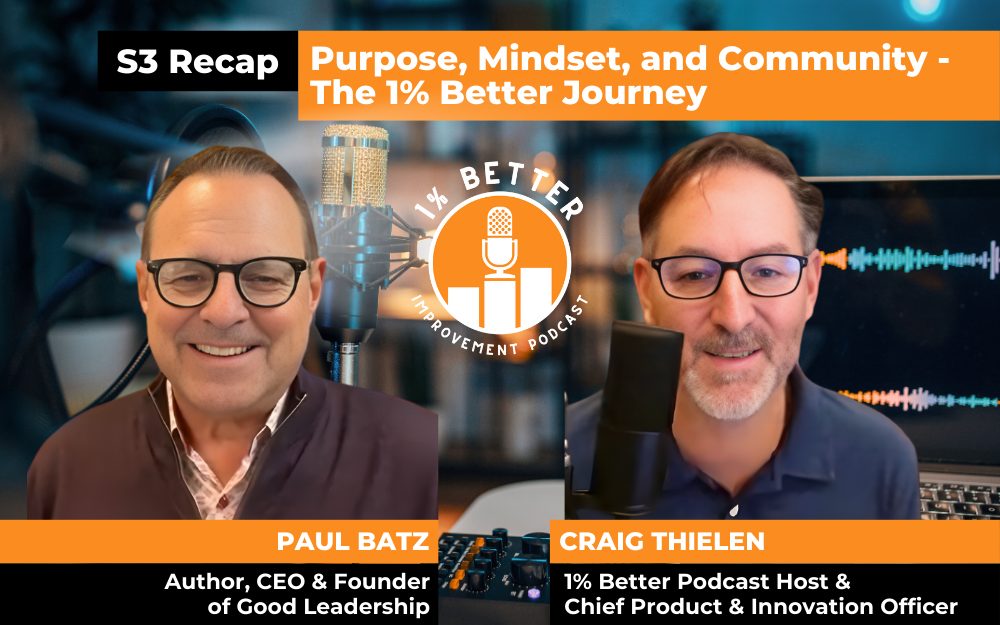
My name is Craig Thielen and welcome to the 1% Better podcast. In this episode, I have the pleasure of speaking with Paul Batz, Founder and CEO of Good Leadership, a leadership coaching and publishing firm based out of Edina, Minnesota. Paul is a speaker, best-selling author, and executive coach, creator of the Good Leadership movement, featuring the number one leadership development breakfast in the Twin Cities, the Good Leadership Breakfast, who I’m excited that I’ll get to join here in an upcoming session. More than 200 community leaders consistently attend eight times per year. Couple of fun facts about Paul – he’s recognized as one of the top 5% bloggers in America, and his LinkedIn profile is one of the top 1%. So Paul’s got the attention of a lot of people, and we got introduced a few years ago and immediately hit it off because of our mutual interests and leadership and business improvement. I’m super excited to get Paul on the show here and learn from Paul. Welcome to the show, Paul.
[00:00:55.870] – Paul
Thank you. I’m excited to be here and I really appreciate what you’re doing.
[00:00:59.450] – Craig
All right. Well, Paul, tell us a little bit about your background – my kids are recently going through what they want to do with their careers and their degrees, and the question comes up, how did you know what you wanted to do? And of course, I didn’t. I had no idea this notion of management consulting and improvement even existed. So, tell us about your background and how you got into this business that you’re in, which we’ll go into more detail around leadership and executive coaching and business improvement.
[00:01:24.920] – Paul
Well, here’s the two-minute story. Suffice it to say there was no booth at the high school job fair about executive coaching. My dad was a veterinarian. My mom was a high school and middle school music teacher. They really believed in education. I was surrounded by professional people my whole life. I grew up in Sioux Falls, South Dakota. I went to Gustavus in St. Peter, Minnesota, and I immediately got involved in the advancement department there, which was basically fundraising public relations. I just remember thinking very vividly, I want to be like these people when I grow up. I was really fascinated by why were some people so magnetic and so exciting to be around and so energetic. In those days, those people seemed so old. I just turned 63 weeks ago, so I guess they were my age now. After Gustavus, I got involved in a small public relations firm and almost instantly became involved in the business development and strategy part of the business because that’s what I was most excited about. Then my second job was the one that changed me the most. I became a partner at a PR firm called Padilla.
[00:02:32.360] – Craig
I remember the name. Padilla Spears Beardsley, right?
[00:02:36.960] – Paul
Yeah, that’s right. It was the second half of the 1990s and that was when the old IPO craze was going. That was before the Sarbanes Oxley laws really cut that down. John Beardsley, I was in charge of business development and strategy, and I became the first partner who did not have a billing goal because I was so good at engaging these people who were about to go public. Most of them didn’t have any money, so they offered us to take stock instead of fees. He said, Develop a process to make sure we know how to select the ones that were worth doing that for, and the other ones, we’re just going to charge them money. Luckily, with the help of some friends of mine, we developed a fantastic process. We helped almost 100 companies go public in three years. I got really fascinated as to why some of them were so much better aligned and competent than others. A mentor of mine pointed out that I was no longer doing PR work, that I was now doing leadership development and organizational effectiveness work.
Then I got recruited away to run a company called MDA Leadership. I was the partner in charge of Business Development and President there for 7. It was a fantastic gig right up until it wasn’t. That was during the Great Recession.
On Halloween 2009, I quit and my wife and I started our own business, Good Leadership on November 1, 2009 – we’ve been at this now for 13 and a half years. We really consider ourselves to be in the organizational effectiveness space because everyone knows you can’t have an effective organization without good leadership. We also believe that you can’t have good leadership without goodness. Our mission of our firm today is we spread goodness through good leaders because we’ve proven goodness pays, and I’m in love with what I do and I’m super happy to be here talking about it with you.
[00:04:25.460] – Craig
Well, awesome. Thanks for taking us through that. I love the idea that you’ve combined what everyone, I think, many aspire to, being good leaders and driving change in organizations with this notion of goodness. I’ve read lots of leadership books, as you have. I think one example is Bill George in the True North. He’s really bent on that you can be a great… in fact, you need to be a great ethical leader to be a great leader. But I love the way you do that. But the one thing I’ll say, it’s more than just a buzzword, or it’s more than just a philosophy or even a mindset for you. I know you have a lot of depth in terms of how you go, but almost to a science where you can measure it and you can really… And that’s what I love as well, because this isn’t just a feel-good movement, but it’s really got a lot of meat to it.
[00:05:19.600] – Paul
Yeah. Well, Bill’s one of my favorites. We had our 100th Good Leadership Breakfast in November of last year, and he was the speaker. And he and I’ve known each other for 15 or 18 years, which has been awesome. He was one of the influences, along with Richard Davis at US Bank and Greg Page at Cargill.
When I first started talking about this, they said, It’s a lovely concept. It fits in the values-based leadership space, but in order to really be taken seriously, you’re going to have to do the research because without research, you’re just a person with another opinion. We studied how Jim Collins did the Good to Great research, and we decided through funding, through several sources, it took us three and a half years. We landed on a bunch of things that we call Goodness Pays factors. But probably the most important thing was a definition that would allow us to talk about goodness in business settings without people rolling their eyes, because many people are worried that it’s soft and squishy or that it’d be perceived as weak or religious. The definition we landed on is this, it’s very easy. Goodness is when people believe they are thriving together in a culture of encouragement, accountability, and positive teamwork. It’s the Thrive Together energy that propels us to really move our clients forward into this place where if you’re really thriving together, both personally and professionally, I’ll show you an organization that’s winning. It’s pretty much that simple.
[00:06:40.170] – Craig
Yeah, and you can apply that to almost any realm like sports – the teams that win the Super Bowl is not just the one that has the best roster, it’s the ones that come together as a team and just really commit and engage at a whole another level. One other thing that just strikes me, and I didn’t even know the Bill George correlation, but it doesn’t surprise me at all that that was one of your influences, is the connection with youth sports. So youth sports, when you talk about rolling your eyes, it’s often when you talk about, well, you need to be a good coach… you need to have all these kids participate, and you need to do all these things that make it a better experience. Some coaches would roll their eyes and say, yeah, but that’s not how you win. And I’m going to teach these kids how to win.
Until I got into an organization called the Positive Coaches Alliance, and I got so hooked on it that I ended up helping launch a Minnesota branch and being on the board. And the notion was very similar what you’re talking about. But it was that not only can you do both, can you make it a great experience for all participants, all kids at all talent levels, but it actually is the environment that creates the best, most exceptional athletes, and on the bottom end of the spectrum of athletic pool, it also creates a better experience for them. So, all of the same techniques that you apply that makes it a great experience for everyone is the same techniques that allows the ‘Michael Jordans’ of the world, the ‘Michael Phelps’ of the world to achieve exceptional performance. And it’s really some basic concepts like, don’t focus on the result, focus on the process to improve; Don’t worry about the last mistake you made; Go forward and forget about that; Learn from it, forget about it, brush it off. There’s a whole bunch of techniques, five positive pieces of encouragement equals one negative. And coaches often are the opposite. They’re often just focusing on negative and how that wears kids down. So it’s interesting, the correlation, and I just feel like it’s the same story in business and sports, it’s all about leadership, right?
[00:08:41.040] – Paul
Yeah, it’s interesting. We do a lot of work in professional services because professional service organization, including medicine, people are trained to be problem hunters. And usually, your work is defined first by how well do you define the problem? And this is where it scoff at the scientific method. I mean, I understand how important it is for society and for training, critical thinkers. But no one likes to be labeled as a problem or with a problem. It’s demotivating. That came true when we were doing the research underneath what were the values that identified goodness? And we had landed on four of them, and we call them the Cornerstones of Goodness, and you’ll see why I’m bringing this up here in just a second. So the first one is excellence and specifically rewarding excellence. So rewarding is a positive concept. The next one is living generously. Generosity is a positive concept. Then you have promoting fairness. Fairness is a positive concept. Then spreading positivity. Interestingly enough, when we did the correlation, 900 leaders and countless interviews, the things that kept coming up were those four things, excellence, generosity, fairness, and positivity. From that, when we get into organizations whose culture is holding them back, what we do is we have this really simple concept that gets a chuckle. It’s called PCP, which means Positive, Critical, Positive.
[00:10:06.090] – Craig
Positive sandwich, right?
[00:10:07.460] – Paul
There you go. We know a lot about brain science and a lot about personality and things like that. And criticism is actually very important. People need to be criticized because then you know they’re paying attention, and especially if you’re sincere in it, criticism makes people better. But you can’t start and end with it. And what we’re learning is that most professional services firms will do critical, positive, and then critical. What we’ve done is flip it – positive, critical, positive. And it’s amazing when people finally buy in how much better they perform. And so we’re trying to make complicated things very simple. And we love being pragmatists over here at Good Leadership. That’s a call to market what we’re doing.
[00:10:48.930] – Craig
Yes. Well, along those lines, so in the positive coaches alliance realm, they came up with this concept of five to one ratio. And so if you have five positive pieces of input and you have one negative, now you’re at equal ground. And the one great example they have is Phil Jackson, of course, I think six or seven time NBA Champion Coach. And he really connects directly that one technique with the Bulls Run, which Dennis Rodman was a key to… yes they had Michael Jordan, yes they had Scottie Pippen… but he said Dennis Rodman was the game changer. And when he got him, he was this defeated person who just wanted to rebel. So he went the opposite in the first year he had him and he had quite mediocre performance. He was just basically calling out, Dennis, you got to show up. You got to work hard. All these negative things and poor performance. The next year, he took the opposite approach. He never did anything but praise him, encourage him, tell him how great he was. And Dennis hadn’t had that his entire life, believe it or not, in a meaningful way. And all of a sudden, his stats and everything else took off and the rest is history. And he goes, There’s one technique, and that’s because all I did was encourage him. All of a sudden, he wanted more of that, and he wanted to do that for his teammates.
[00:12:03.980] – Paul
Well, we just had a hospital executive team here in our offices last week, and it was an astounding meeting in the fact that once we… We like this concept of healthy tension, and it helps to label tension. Tension is how we all get better. Every movie, every novel, every sporting event, it’s all about tension.
[00:12:22.200] – Craig
That’s how diamonds are made, right?
[00:12:23.990] – Paul
Yeah, you got it. So pressure and tension. As long as your intention is healthy, you can do remarkable things. One of the ways we get at it, we do this speed coaching exercise where you get one minute with people and you say, Hey, Craig, what I really appreciate about you is this, and if I got more of this from you, I think everything would get easier. It’s a very positive exercise, and it’s the thing where you never forget it. When someone gives you a nugget that says, You’re really good at this, and if I could get more of it, your brain wants to hang into that. We’ve been told by so many people that they repeat what they heard in that speed coaching exercise by exercising and driving and in the shower and in meditation and stuff because it’s so powerful. You and I, we’re preaching to the choir, you and me.
[00:13:11.760] – Craig
Yeah, it’s really interesting. There’s all these sayings… If you think you can or you think you can’t, you’re right. It goes back to mindset. Let me ask you this. There’s a quote that’s quite famous, If you want to change the world, start with yourself. It’s attributed to Gandhi, of course, but who knows if that was really said or not? It doesn’t really matter. But the question for you is, how do you address this intersection of personal development versus professional and leadership outward development… And how do you bring those things together in the corporate world with leaders?
[00:13:43.150] – Paul
I have a couple of sources of influence and inspiration, one of them is Richard Leider. He’s become the world’s foremost authority on the power of purpose. And when he starts with people, he says, If you don’t know what your purpose is, let’s start with this mantra. Why don’t you accept for a short while that your purpose is to give and to grow? If you think about that every day and you become a giver and you become a person who’s growing every moment, you’ll never feel old, you’ll never get old, and that you’ll be able to create wonderful momentum. And that will probably lead you to what your purpose is. And he’s been a really powerful influence on me. He’s a mentor.
And I also had a negative influence that was really powerful. My dear father, he’s been gone now for eight or nine years. He was bipolar and schizophrenic and he was Mensa smart. He was a veterinarian. I remember the moments when he was supportive and positive and loving, so strong because I grew up on a steady diet of criticism. That’s just the only way he knew how to address himself. In taking Richard Leider’s mentality and then taking the wisdom I gained from my father, there were several periods in my life that were really difficult, and especially that time that I left the job at the old firm and I started this one. It was very traumatic in a lot of ways.
I realized that the most important thing I needed to do every single morning when I got out of bed was to sit down and start to think about how was I going to be better today than yesterday? I started working on my spiritual life. I started working on my sense of intellectual honesty about who I was and what was important to me. I started thinking about how did I need to live differently, not just lead or work… How did I need to live differently to surround myself with the most beautiful, talented people I’ve ever met in my life? I am here to say that that has all come true in beautiful ways for me. I consider that hour I spend in the morning more important than sleep. I never skip it, regardless of where I’m at. I’ve discovered all sorts of philosophy and poetry and all sorts of wonderful spiritual reading. It makes me at least 1% better every day, which is why I was so interested in this podcast.
[00:15:51.790] – Craig
Has that shifted over the past, I don’t know, decade or two? I feel like 10, 15, 20 years ago, it was taboo to talk about anything touchy, feely, interpersonal, things like meditation, things like spirituality. Have you seen a shift that that’s now on the table, and it’s an open conversation with leaders? Not only with you and them, but with them and their peers and their team.
[00:16:16.640] – Paul
Well, it’s true that the only growing category of publishing these days is spirituality. I think we’re living in a much more permissive culture to talk about that stuff. In addition to that, the baby boomers have been amazingly influential in our society. It’s a fact that as we age, we become more spiritually aware. Here we are, the most powerful generation economically, for sure, that’s gone through at least the Western world is now becoming very soulful. I was reading about it just this morning in a New York Times article, and it’s amazing how more and more people are willing to embrace that part of their world. I think that it’s not a coincidence. Yes, it is becoming more permissive, and because of that, it’s becoming more pervasive in our society. Here’s how we work on that in the business world. We have two techniques. One is a label, and the label is clear head, clean heart. If you accept a big job, it’s always going to be messy. You can’t help yourself. You always have a new idea and you’re thinking about how much better things are going to be at the next level, and those are disruptive thoughts to so many people. If you don’t have a clear head and a clean heart, these jobs could eat you alive.
Of the ways we get at that is this technique that I invented almost 25 years ago called the Seven Fs. The Seven Fs alphabetically are Faith, Family, Finances, Fitness, Friends, Fun, and Future. Faith is at the beginning, Future is at the end, fitness is in the middle. We put it out there in the form of a wheel and we ask people to assess on each spoke, 1 through 10. What it does when you’ve done that, you connect the dots, you see a shape of your life. And we encourage people to consider their spirituality as a source to make everything else on the wheel better. And I’ve decided after I started my own firm that I really needed to live my life by that Seven Fs wheel, and so I have some an improvement strategy on each one of those seven things, and it’s really helped guide me, and I’m really grateful for it.
[00:18:27.080] – Craig
I love it and I love the fact that you’re putting everything on the table. I always felt it was ironic that we want the best out of people and we use all these words, we want to empower them and we want high performing teams, but yet we’re only asking for 25% of them to show up at work and really allowing them to not realize their full potential in terms of decision making and creativity and innovation. And if they’re good at music, bring that, or you have a passion in this. All of this stuff is connected and the Seven Fs brings the whole person at least awareness and recognition that the whole person matters. I just think that’s great. Love it.
[00:19:05.770] – Paul
Not only that, but we believe you can grow as much in your Seven Fs at work as you can at home. This idea of work life balance is something that just is it’s flawed in so many levels. Yeah, agreed. We feel like if you can be satisfied on all seven of those things, you’re probably not having a work life balance issue.
[00:19:23.960] – Craig
Right. Well, like you said, it’s flawed. If you just look at work life, they’re separate. That in itself separates versus in saying that they have to fight each other, or you have to balance them when, in fact, it’s all seven. If you got all seven aware and you’re working on and you’re happy with, then every part of your life is better.
[00:19:45.220] – Paul
It’s funny. I told you, I just turned 60 not too long ago, and I’ve always been an on again, off again, exercise fitness person. In reflecting turning 60, I had lots of conflicting emotions. Some was pride and some of it was fear. It was really interesting how that flowed through me. I took a look at my Seven Fs wheel and I said, What’s the one thing that I can actually really channel myself into, to feel like I have a sense of control and that I’m taking my own destiny in my own hands. All of a sudden, my favorite of the Seven Fs became fitness. My flexibility has improved so much. I alternate between 45 and 20 minutes a day every other day. It’s amazing. I feel younger. My aches and pains are pretty much gone. I’m like, Well, dull. But it took that sense of legacy, longevity, destiny, all these big concepts. I was like, Well, gosh, I just got to do it. There’s no excuse. I think I’ve only missed one day since I turned 60, including this morning.
[00:20:47.980] – Craig
That’s awesome. Speaking of 1% better, if you look at businesses that you’ve worked with, what comes to mind? What story where just hindsight is always 20/20. When you start working out, you go, Why wasn’t I doing this five years ago or 10 years ago? It’s so obvious. In a business sense, an instance where maybe one conversation or 1% change in mindset or 1% use a technique and really provided transformative results or significant results in an organization.
[00:21:17.070] – Paul
Well, I mentioned one already, and then I’ll give you one other. The PCP change in a very large engineering firm was transformational for them. What we’re learning is that in order for work to really stick, they’ve got to put these concepts of the Seven Fs and PCP into new employee onboarding. That bottom-up accountability is what works in an empowered culture these days.
The second one is we have a very large hospital system that we work with it’s not in Minneapolis, St. Paul. One of the things that they were really struggling with was interdepartmental and multi layered communication. One of the things we did, we’ve established a quarterly leadership executive retreat cadence. Then right after they have lunch, so we meet from noon on one day to noon the next, and we give them some time off at night to sleep, of course. Okay. Go ahead. They have lunch, and during lunch they talk about what their message is going to be, and then they immediately engage the 90 directors. They eliminated the space and there’s no excuse now. You have to have your messages clear. What they do instead of giving an agenda, they tell the directors which questions they’re going to answer. They always have three. We told you we were going to meet and we’d give you answers to these three questions, so here’s the answers. The positivity, the cooperation, the collaboration, the spirit of feeling like they’re being well led has gone way, way, way, way up.
Trust and communication have so much to do with how executives behave. It’s an outcome. What we said to them, What are you willing to change in order to get trust and communication to go up as we measure? They decided they were willing to change their operating model to do it, and that’s what works. You don’t have to think about transformational things. The simple thing was here. If our directors were better informed, how would our business improve? Well, let me count the ways. It was amazing.
[00:23:13.690] – Craig
It’s unlimited.
[00:23:14.550] – Paul
Simple, small things that help make people better. That’s how I translate your 1% better concept.
[00:23:20.000] – Craig
Yeah, that’s beautiful. Okay, Paul, so someone is hearing you and going, I’m really excited and inspired and I want to be a better leader. Regardless of where they are in their career, you’ve written five books that has a wide spectrum of pieces of this. Where would you direct them to start? Which book?
[00:23:36.300] – Paul
Well, the most recent one we wrote is a summary of pretty much everything we’ve done. It’s called Good Leadership is a Team Sport. It’s written off our Good Leadership press label. These books are meant to be read in one beach chair sitting or one airplane flight. It consolidates everything we’ve learned about how to create high performing teams quickly. The second I would do is direct them to How Goodness Pays. It’s the book that features all the research we did that I talked about. That’s how we build our firm-to-firm methodology when we do organizational effectiveness work, it comes from that research. But the idea of how to be a good team member and learn how to be a good team leader, that’s in Good Leadership as a Team Sport. You can find all that stuff at www.goodleadership.com
[00:24:18.900] – Craig
Yeah, we will provide links to everything that Paul and I referenced in the show notes. Last question that all the guests get, looking back at your career, Paul, which for you has been a long and illustrious, if you’re sitting down with one of your grandkids at an age that they could comprehend this, or an 18-year-old version of Paul, what piece of advice would you give yourself or your grandchild?
[00:24:41.370] – Paul
It’s so funny that you asked this because I say this a lot. If you have big aspirations, you have to also accept the fact that some things cannot be microwaved. It amazes me how long it has taken to make some of the ideas we had in the very early stages of my wife and I in planning this business. It’s been 13 and a half years now. There are a couple of things that we dreamed of then that are just starting to come true now.
You got to be perseverant and patient and persistent because the human mind is an amazing thing. When we get in the right place, we can imagine beautiful, big things. But there’s a business truism that says sometimes it takes 17 to 18 years to build an overnight sensation. I go back to Stephen Covey – he studied his craft for 27 years before he wrote The 7 Habits. You can do remarkable things, you’ll look back on your career and be satisfied, but there are some things that just take longer than you think they should. There’s no reason to get frustrated or to put that tension onto other people. It just is.
[00:25:48.460] – Craig
Well, it’s a great way to wrap it up. Paul, that 33 minutes flew by. We could talk for hours but want to thank you. Appreciate it. I learned a lot and I’m sure the audience will as well.
[00:25:59.080] – Paul
Thank you very much. Good luck.
[00:26:00.990] – Craig
Take care. Bye. Bye.