Find us on your favorite podcast platform including: Spotify | YouTube | Apple | Amazon
1% Better Podcast Mitch Larson – Quick Links
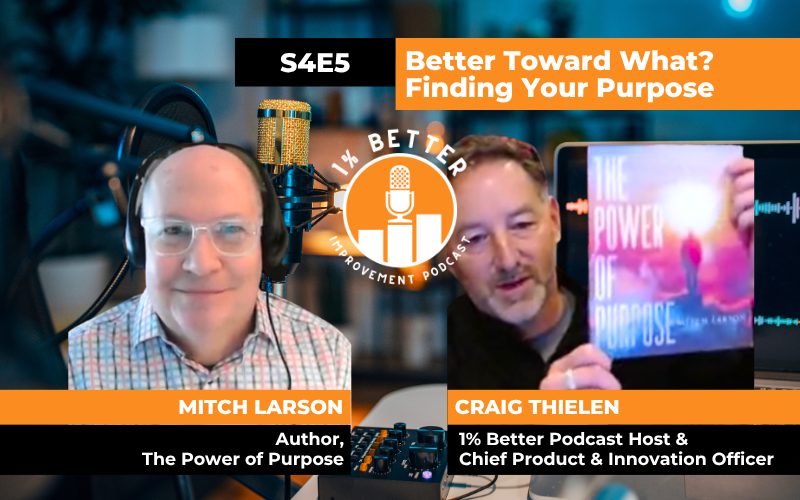
Check out Mitch Larson’s book, The Power of Purpose
Connect with Mitch Larson on LinkedIn
Connect with Craig Thielen on LinkedIn
Check out host Craig Thielen’s full bio page
Key Takeaways
- Improvement needs direction: The episode asks a powerful question: if we’re trying to get 1% better every day, better toward what? Purpose gives improvement a destination
- Purpose is often discovered through life experience: Mitch shares that his purpose became clear over decades of observing people, learning from mentors, and recognizing patterns in those living with intention
- Habits reveal whether we’re moving toward or away from purpose: Mitch emphasizes that examining your daily habit structure is one of the most practical ways to begin living more intentionally
- Fear and self-talk can become major barriers: The conversation explores how fear of what others think, negative self-talk, and limiting beliefs can keep people from moving forward
- Purpose is built one step at a time: Mitch’s core life lesson: you don’t climb a mountain in one day, but consistent steps in the right direction eventually get you to the top


















1% Better Podcast Mitch Larson – Transcript
Craig Thielen (00:15)
I’m Craig Thielen and this is the 1 % Better podcast. if you have been following this show or if this is your first time, this show is all about getting 1 % better every day on a personal and professional level. We spend a lot of time talking about how to optimize strategy, systems, performance, overcoming challenges, and we’ve heard some amazing stories over the past three years of people that have done that. But at some point, we have to ask the bigger question. And the bigger question is, better towards what? Today’s episode tackles life’s ultimate question, what is our purpose? And explores how this focus and this tool can help us really accomplish even more things and more breakthroughs. And so I’m really excited to bring on Mitch Larson, who is the author of The Power of Purpose, which we will be talking about at length. And Mitch, welcome to the 1 % Better.
Mitch Larson (01:10)
Craig, good morning. Thank you for having me. I really appreciate it.
Craig Thielen (01:14)
Yeah, this is gonna be fun. This is one of those big topics that a lot of people talk about. I got a lot of books behind me, and a lot of books talk about purpose. Strategy books, leadership books, personal development books. But not a lot of them talk about how to develop your purpose like in very practical and sometimes it’s very abstract And you look at some other people that have defined their purpose and you go. that’s amazing But I don’t have that… it didn’t just come to me in an epiphany. So I’ve had a chance to read your book and it’s really well done and I think in some ways very unique. We’ll dig more into it. Just in how you’ve constructed it and how practical it is, I guess if I had one word to describe it, which is kind of counterintuitive when you think about books about purpose. mean, you think about the meaning of life by Viktor Frankl and it’s just, wow, it’s such a deep, painful story about the Holocaust and howyou survive such a thing and it’s kind of you know the book that comes to mind for me anyways and it’s it’s even hard to get your head wrapped around it even at the end of it where your book is just so practical and common sense and what I love about it is you’ve just wrapped yourself into it and use day-to-day examples. so first of all why don’t you just get us caught up to who Mitch Larson is a little bit about your your background and sort of what led you up to the point where you said I need to write a book on one of life’s biggest questions and you got to that point.
Mitch Larson (02:46)
Great. I’m going to do exactly that, Craig. And again, thank you for having me. I’m a Wisconsin native. grew up in Eau Claire, Wisconsin and basically had what I would consider for my particular era of life, a very normal childhood. Fast forwarding through my life experiences, and I speak about this in my book, a couple of what I would call your pretty life changing moments occurred for me. Through a series of events that in my opinion were you look back now and you can kind of see the fingerprints that lead you in particular directions. Well, my plan was to go to technical college and be a motorcycle mechanic in the industry of motorsports. But I got an offer.
Craig Thielen (03:26)
Okay, which by the way, this connects to purpose. A lot of us as we guide our children, we say, follow your passion. Follow what you love into your career. If you love your job, so to speak, then you never have to work a day in your life, which is exactly what you did.
Mitch Larson (03:41)
Absolutely. So I got an offer from the University of Wisconsin-Eau Claire concert choir director. said, Mitchell, you have a very well-developed tenor voice for someone your age. If you’ll come and sing in my choir, I’ll pay for your tuition.
What happened is through just, like I say, kind of the fingerprints of the way life works, I met my wife. that experience going to college completely changed the direction of my life. And then through entrepreneurial endeavors, I was introduced to a book that for me was a seminal experience. I was given the book The Magic of Thinking Big by David Schwartz when I was 22 years old.
Craig Thielen (04:22)
Interesting. Who gave it to you?
Mitch Larson (04:24)
The particular organization I was working with, I was doing some things in the area of direct selling. It was a book that they had on their recommended reading list. I cracked the cover and started reading this thing and I was blown away. I mean it was a life-changing seminal moment because it began to examine the topic of thinking, the power of your thoughts process. Attitude is yours negative or positive all those types of things. These are concepts Craig, I had never been introduced to. ⁓
Craig Thielen (04:56)
They don’t teach this in junior high and high school or grade school or anywhere.
Mitch Larson (05:01)
No. I didn’t understand that if you begin to think about what you’re thinking about, that you can purposely guide and direct your life.
Craig Thielen (05:16)
you can’t unsee it. So how did that change you and guide you going forward after that and into your early career?
Mitch Larson (05:24)
Sure. It was nothing less than transformational because I began to be a consumer of self-development and professional development materials and resources. People say, okay, Mitch, the power of purpose… the topic of purpose draws people in, as you said in your opening comments, people are they’re looking for clues and what is my purpose.
So when I’ve talked about my book on a variety of other podcasts or talks I’ve been giving, people say, well, tell me what the difference is because it isn’t like this particular topic hasn’t been covered. And I couldn’t agree more. What I found is that many of us, because of the gifts that we’ve been given to grab another saying or anecdote, like you already said, if you love what you do, you’ll never work a day in your life. Most people, the clues of what their purpose is, is already known to them. What I found is that we are the lid on our own jars we get in our own way and I can speak to that with what I believe a fair amount of credibility because of that aha moment that I had in my early 20s. I began to understand that if I could do a better job of equipping myself. And now what does that mean when you say equipping? A tool is anything that we as individuals, we as human beings, use to help ourself and equally as important, especially if you’re leading, others grow.
So, the thinking behind the book itself, I began to realize that another gift I was given was the power of observation. And I began to quickly see that there was a noticeable difference between people that were living a life – I didn’t know that the word necessarily was purpose. At that moment, but they were doing something they were passionate about, or they were pursuing something that really got them excited. I noticed a difference in both quality and content of those people’s lives versus others that were, again, using my own vernacular, simply letting life happen to them.
Craig Thielen (07:46)
So Mitch, I wanna dig into the book, because you break it down, like I said, very uniquely and just in such a practical way. But before we do, there’s a chasm for me and I just wanna make sure that we understand how you got, because I think the book is fairly recently published in the last year or two.
Mitch Larson (08:05)
I published it in March of last year. March of 2025 it went live.
Craig Thielen (08:07)
Yep. So it’s ’25. But so what happened between, say you’re young, you got this book, you go, wow, there’s this whole thought process about basically controlling your thoughts, who you are, why you’re here, how you interact. And then just what happened over the next 25, 30 years, you started using more personal development, you started reading more books. And then you, as you said, just tell us about that career you started moving up in the good, solid, successful career, very normal trajectory or good trajectory of a person. just describe that and at what point did you use these observations collect or at what point did you go, wow, I have to share, I have to help people with this thing called purpose. I mean, writing a book is not a, it’s just talking to people. It is a major commitment and it’s intimidating. And there’s, like I said, there’s thousands of books that talk about meaning of life and purpose and this kind of stuff, personal development. get us through that 25, 30 years that you got to a point that I have something I need to share and what caused that.
Mitch Larson (09:14)
Sure. So let me go back and let’s talk about the retail experience. So I went into their management program and I lasted four and a half years, which I thought was pretty good. So at four and half years in that particular arena and I again observing a lot of things began to understand that this is a career path that probably wasn’t going to get me where I wanted to go and the number of hours required to accomplish it was not in line with my objectives. It was not a great fit.
And I said, see ya. And I got hooked up with a placement organization and I began a career in B2B selling. But all the time also keeping my foot kind of dabbling and doing some side hustles. I’m a bit of an entrepreneur, always have been, and that allowed me through access to an awful lot of people. It allowed me to begin to understand the value of association as well. And I saw some rather dramatic examples of that both good and bad in all of the different things that I’ve done. But the B2B selling that was in my late 20s. I sold enrollments to the Dale Carnegie program.
And there’s another seminal moment for me getting introduced to those programs because I had read the book, How to Win Friends and Influence People, but it allowed me really to internalize those concepts. I also was able to get my hands on the book called, to Stop Worrying and Start Living, and I could not endorse a title stronger than that particular book, especially with the challenges that an awful lot of people are facing and some rather conflicted climates that I think the world at large is dealing with. So excellent book, but I got a chance to literally live that the thinking and the principles behind many of those wonderful books. So that was a wonderful experience. And the Carnegie program ended that my tenure ended a little abruptly when the Gulf War broke out.
I found myself in transition and ultimately the door to the office furniture business was open to me through my relationship with the regional manager at Herman Miller at that time. That industry at large is filled with some very, very talented and very creative people. And I was able to surround myself and learn from those people. And that’s where I’ve spent the remainder of my career. But to go back and answer, how did I get to the point where I wanted to write this book? I had to have all those life experiences to get to that point. I just kept seeing a repeat of that one observation.
Craig Thielen (12:02)
So let me ask you a question because you are very observant, purpose is a very, it’s not talked about much in normal conversation, business or personal life. Second, it’s not something that people are always comfortable talking about. And it’s one of the most personal questions that you could possibly ask somebody.
So how did you know if somebody had purpose? What were your clues? Because I don’t think you just went up and said, hey, tell me what your purpose is. I think you observed a lot of different behaviors and clues. And how did you do that? I’m just curious because that’s a very, not a lot of people are able to do that. And that’s what you just said is kind of how you got to a point where you said, I think I can help people. So how did you do that?
Mitch Larson (12:48)
Well, I began to see a number of shared traits. Number one, they were readers. They were in some sort of self-development program. Why? Leaders are readers. I know the first time you and I met, I remember telling you that all I had to do was look around your office and go, okay, this guy’s on purpose. Why? Well, look at your library. And I’m guessing that every book in there, it’s not for show, you’ve actually consumed what’s in it, right? And people say, well, Mitch, explain to me the value of reading. Well, it’s like letting the author run around inside your head. That’s what happens. You read that experience and they run around inside your head for a while.
Craig Thielen (13:26)
Yeah, I’ve never really thoughtabout that, but you’re 100 % right. So one of my favorite sayings is you get more on what you focus on and it’s a, it’s a simple truth, meaning, yeah, okay, that’s cute. And it sounds neat, but if you really think about it, it’s really deep. And so to your point, if you focus on learning and growth and development and kind of opening up your mind, frankly, then that’s one of the ways you’re gonna do is by saying, I wanna know what other people that maybe are smarter came before me, more educated, whatever. And so to me, it’s like you have a garden, okay? And our brain is a garden and you just allowing someone to just sprinkle some seeds in that garden. Now you get to determine if you wanna water those seeds or if you’re gonna provide those seeds really fertile soil or not, because if you’re like, I know everything, I’m set, I’ve got enough information, then you’re basically putting seeds on concrete. But if you say, have every conversation, every book, every interaction I have, I can learn from now you’re talking about the most fertile soil in the world. that’s a really interesting, I never really thought about it, I just thought, some people are readers, some people are not, but I think that is a great clue. So are there others besides the book thing?
Mitch Larson (14:39)
Yes, it is a definite clue. I’ve also met people in my walk that have said to me, I am I’ve never read another book after college. And I this is this is what I think of in my mind. I go… X
Craig Thielen (14:53)
That’s quite normal. mean, for me, I don’t think from college to about mid thirties, so let’s just say 15 years, I don’t think, I didn’t pick a book and I said, why would I? I’m done with college. And it wasn’t, but it’s a mindset, right? It was a mindset like, hey, I’m busy doing my career, my family, et cetera. that’s for education and we stop education. It’s kind of almost like programmed into us. And then at some point I’m like, you know what, I started going back to school again, taking night classes and going for another degree. And I don’t really know why I did it other than I think I wanted to just continue to grow. And then like you said, when you take one piece, it’s now it’s almost addictive. Like, wow, I actually really growing.
Mitch Larson (15:20)
Right.
Craig Thielen (15:43)
In retrospect, and again, I suspect this is very common. I wasn’t really, when you talk about like your brain being fertile for growth in high school for sure, my garden was concrete. I really have no interest in learning. I have interest in getting through high school so I can get into the next step of life. But it was more social sports, all this kind of stuff. So it was concrete and in college, I was a little bit more like, want to get a good job. So it was more like, you know, a very basic garden that I got enough learning so I could gain a skillset to get a job. But by no means I wanted to go deep on the learning part. It was like do the bare bones minimum to get the degree and get the job. But it took me until mid thirties and maybe forties to go, wow, I kind of missed out on this whole learning thing. And this, that was the start of probably me kind of getting my purpose, which is my purpose is to grow. My purpose is to really try to understand. I only have so many days. Some people say 4,000 weeks, I think is the, there’s a book called 4,000 weeks. When you break down your life, it basically says you don’t have that much time. And that’s if everything goes well, like you don’t have a tragedyyou don’t die early. And when you start mapping that out, I was already halfway done with the 4,000 weeks. And I’m like, wow, what am I going to do with the rest? So I think that’s a really great analogy of just about how you’re able to sort of open that up. So anyways, keep going.
Mitch Larson (17:14)
Sure, trust me. One of the reasons that I’m so excited about being a part of this program. Number one, the 1 % concept. Okay. I say it this way. I’ve told my kids this since they were little because I had a great mentor that told me this. said, girls, you’re never going to climb a mountain in one day. But if you keep taking one step up that mountain, and I said on certain days, it’s going to feel like maybe you took a sidestep. Other days, it’s going to feel like maybe you took, one or two steps back down the hill. But I said, if you keep climbing that mountain just a little bit every day, sooner than you realize, you’re gonna be at the top. And unfortunately, a lot of people were never, they never heard anything like that. The other analogy is how do you eat an elephant one bite at a time? What does that mean in English? It means that when you approach any monumental task, project, whatever it is, don’t look at the entire thing or it doesn’t matter who you are, you’ll never start.
Craig Thielen (17:50)
Yeah. Thanks for bringing it back to the 1%. When we started this three years ago, was kind of like a celebration of our company 20 years. And our mission at Trissential is to improve the lives of everyone we come in contact with, which isn’t necessarily an obvious thing for a consultancy. And so we really believe that, you know, if we have a conversation with a client we do no business with, if we help them in some way, sometimes we even refer people to them or we help them in a personal, then we feel like we’ve accomplished our mission. We might not have made money on that, but we accomplish our mission. I won’t get into details of how I picked the title, three years later, as you hear it’s just amazing stories. And frankly, almost everybody has an amazing story. Everyone’s got a unique one for sure. they’re almost in all cases, you can go with they’ve had some privileges, but they’ve had some challenges and obstacles. And the more I’ve gotten into it, the more this concept of one percent better isn’t just a concept. It’s not just a way. It’s actually the way. And if you think about anything in life that’s been meaningful, it’s by taking one step at a time. the contradictory thing that I did sort of deprogram, because I think a lot of times you have to let go things in order to gain new things. And you have to, ⁓ so if you want to get healthy, you got to sometimes detox and get rid of all the toxins and then you can take on more nutrients. But the story of the tortoise and the hare, that’s an age old story.
Mitch Larson (19:26)
Absolutely.
Craig Thielen (19:48)
I never really believed it. You know, it’s like, yeah, the turtle wins. It’s like, yeah, really? Like, it’s a cute story. It’s a kid’s story. But when you think about it, the turtle will always win. And again, I had to allow myself to go many levels deeper to understand that it’s not just getting the degree or it’s not just taking the shortcut. Another analogy is like Mount Everest or Mount Kilimanjaro.
I think a lot of people as you know, we want life experience. I want the shortcut. So give me the, give me the map, give me the fastest way I’ll fly there, set me up in camp, give me the gear and get me up to the top. That’s actually not the point of it. I did the Inca trail, same thing. It’s like, some people just go, I’m going go right to Machu Picchu. They show up in their Gucci clothes and makeup and right from the bus, right to Machu Picchu. And I’m like,
Mitch Larson (20:23)
Mm-hmm.
Craig Thielen (20:37)
That’s a different experience than if you literally walk for four days on the same route that’s thousands of years old. Well, actually not thousands, I think it’s 500, 600 years old, but that the Incas built hand stone after stone after stone and the Spaniards and the Incas and you walk that trail and it’s really tough.
Mitch Larson (20:42)
Hmm?
Craig Thielen (21:02)
And when you get to the Machu Picchu, it is like you have entered the gates of heaven. It is so incredible. It’s not just an Instagram spot. It’s actually, it’s a spiritual experience because you’ve taken the journey and the things that you see. So, and it’s all back to this idea of 1 % better, that your journey is one step at a time. And it’s, you don’t know what step three is until you take step two, right?
Mitch Larson (21:07)
wow. All right. Absolutely. Yeah.
Craig Thielen (21:29)
And you can’t many times map it out. So keep going. This is fascinating for me because that’s a talent you had or a skill you developed is observing people that were on purpose and how they were living life and not on purpose. So then what?
Mitch Larson (21:42)
Right. Absolutely. Well, I would tell you that we can learn as much from people and the people that are in our lives and our association in terms of what not to do as well as we can what to do. So those two things kind of, I believe, meld together. But when we when we talk about what is our purpose?
Craig Thielen (21:51)
Yeah.
Mitch Larson (22:04)
Or how do I find out ultimately what my purpose is as we’re discussing? Well, as I talked before, I suspect many of us have a really strong clue on what it is because of the gifts that we were given. What are we good at? What do we enjoy doing? What makes us feel like we’re not working, but we are pursuing an endeavor that we genuinely love. people say, tell me about your journey to book. Here’s my statement. It took me 65 trips around the sun to figure out that my purpose is to help other people find their purpose. Okay, so I couldn’t have written the book until I had those life experiences.
Craig Thielen (22:47)
Did you have, okay, so last question, then let’s get into the book. Did you have a moment, an epiphany, Because you’ve been building up to this, you’ve been taking steps for 65 years, but what was the moment where you go, this is it, I have to write the book?
Mitch Larson (22:58)
Mm-hmm. Yeah, it literally welled up in me and forgive me, I’m a movie fan. Some people might even go, my God, I can’t believe he’s going there. But one of the last Rocky’s when he has that conversation with his son, and he talks to him, and he says, I don’t know what happened to you, but somewhere along the line, you started caring more about other people’s thoughts than who I know you really are. And he said, nothing’s going to hit harder than life. And he said, isn’t how hard you get hit. It’s can you get up and keep moving forward. literally, I remember hearing that and it resonated with me so much because I would say for probably the last 35 years, my internal mantra, my little, you know, just do it like Nike, my internal mantra is keep moving forward, keep moving forward.
Craig Thielen (23:49)
Yeah, I mean, it’s a great thing. A lot of people have ideas and then we just say, well, somebody else can solve this or it’s not for me or I’m not an author or there’s a million things that we tell ourselves about why we can’t do stuff. just to again, this goes back to one percent better. Just to say, you know what? I’m to take one step and then I’m going to take the next step because writing a book is overwhelming to most people. It’s like I said, it’s one of the toughest things that I talked to him on the show, maybe 15 or 20 authors, and one gentleman did it for a living, and he’s helped people write over thousand books. He’s been involved with over a thousand books. And every single person to a T has said it’s the hardest thing, one of the hardest things I’ve ever done.
Mitch Larson (24:28)
So let me describe a little bit of that process. How did it happen? All right. I literally wrote the book. I found the right publisher and that story of how I found the publisher again, talks to the fingerprints and the way connections work. Okay. When you look back on your life. I’m playing golf with one of the top sellers of my particular products And I’m telling you, you know, think I got a couple of books inside me that I want to get written on these days. It turns out that his wife runs a publishing company that was formed during the pandemic. So I get introduced to Lindsay Bednar and she runs a company called Rodney Kay Press, and Lindsay and I get connected and I find that what I’ve got in me is this treasure trove of stories that support the principles that I’ve identified. and Lindsay took that mess and helped me turn it into a message. So if there’s, if there are aspiring authors out there, one of the things you want to do is find someone that’ll come alongside you and help you get it from your head onto the page. But going back to my point, Craig, about how I’ve written some music as well, I’ve been blessed with the ability to play the guitar a little bit, etc., etc., whenever I’ve written a song, I always start with the title. Always, always, always. So for whatever reason, the Power of Purpose, a guide to help discover yours, that came into my consciousness. And as soon as that happened, I began to develop an outline around that I had that before I met with Lindsay and then she and I together worked to craft the content that would support through real life examples the various principles that were embedded in the different chapters.
Craig Thielen (26:09)
Yeah. let’s jump into that. I really want to get into the purpose. mean, beautiful background. So the first chapter, and I think language is really interesting. I’m appreciating language so much more and how powerful language is and words. And it’s kind of funny. I’ve got this thing hanging on my wall. And have you seen this before?
Mitch Larson (26:40)
Absolutely. It’s how you sew a destiny. It’s how you reap a destiny.
Craig Thielen (26:41)
Yeah. It’s words are so powerful. They’re powerful in interactions and change and communicate. And when you interact with the people of other cultures and countries and languages, it’s I was just met a gentleman who is Finnish and he started a sauna company, believe it or not. Like, what are the odds of that? But somehow we got onto this Finnish word. I think it’s called seesaw and it’s basically in simple English translation would be grit. Okay. But he gave probably a five minute dissertation on what the real meaning of this word is. And you take just a word like grit and we go, yeah, you’re tough. You work hard, you get through. And it was now, it was incredible. The depth of this one word in the Finnish language. Okay. In the Finnish language. so, and as we, progressed, I guess, over the, don’t know if we’ve progressed in many ways in some ways, maybe, but through all the different languages that we’ve had, the words and the translations are different. but words are still incredibly powerful. And so one of the things that I’ve observed is when I say a word, whatever the word is, AI is a great example.
Mitch Larson (27:49)
Mm-hmm.
Craig Thielen (27:57)
AIs in everyone’s head and it’s the topic of the probably the decade. But when I say AI and you say I can guarantee with 100 % certainty those have two different meanings and virtually for every single person. And there’s so many words that we just flip out there and we assume that people have have the same meaning as we do. So let’s take purpose. I think we could just bounce over that and just say, everyone knows what purpose is, but I don’t think so. So your first chapter is what is purpose? So describe what purpose is and then distinguish it from something that I think is tangential, but it’s somewhat confusing, which is what’s the difference between purpose and passion? Because there’s a big difference between, ⁓ I love to be a CEO or I love to play tennis or golf. Well, they’re not the same thing. But I think sometimes people have been told, you know, do what you love and that will drive you and so they could kind of equate it with purpose. So I’d love to hear your thoughts on that.
Mitch Larson (28:56)
Well, I’m literally going read from my book because I think it was said quite well and it’s a combination of myself and Lindsay, but Webster defines the noun purpose as the reason for which something is done or created or for which something exists. Such is the power of purpose. Purpose provides clarity where there is confusion, motivation where there is lack of motivation, direction if we are lost, and determination and persistence to stay the course. So then I talk about what and there’s certainly different types of purpose the immediate purpose i’ve got friends coming over and i don’t have enough ingredients for what i want to make so my immediate purpose is to get to the grocery store and and pick up those things short-term in my case i need to lose thirty pounds so i need to stand the sixty eight program if i don’t follow this program closely it won’t long-term. Now that I’ve lost the weight, need to modify my eating and exercise to avoid gaining it all back. then lifelong or overarching. There is something that I’m set to accomplish in this life. It’s up to me. And now here’s the caveat. If I don’t do it, it won’t get done. This is what the book will help you identify. And let me give you a real life example of that last lifelong overarching. Tim Tebow, in my opinion, ⁓ one of the more amazing people on the planet, in my opinion. And I know there’s a lot of different thoughts about that, but those are mine. What did Tim’s ultimate purpose end up being? He’s trying to disassemble human trafficking. That’s what his primary purpose in life is. And it took him into his, I would say what, 30s, maybe even early 40s now. And look at the work that he’s doing, the amazing work that he’s doing. Is he not a gifted athlete? Of course, the guy’s amazing, right? So he had to go through life experiences to get to that point. And he also recognized that he could utilize his platform for something different than perhaps other people would have utilized the fame and the recognizability that he developed through all the hard work and things that he did to get to that point.
So I would say observing Tim, if you would look at who he is and what he’s focused on, if you look at how that was developed, well first and foremost, he’s an athlete like your nephew. If you and I could walk, the other important part about purpose, it’s wrapped up in our daily habits. And we kind of keep coming back to this, but life is interesting. We only get one, number one. It only moves in one direction, number two, that’s forward. And I don’t know about you, but have you ever observed people that for whatever reason, Craig, they’re walking this way but facing backward? They’re walking through life looking back all the time? Now, of course, we can look back.
Craig Thielen (31:56)
Yeah, yeah, that or what I observe equally as much as they’re walking through, it’s if you’re walking down a street, they’re looking at their shoelaces or they’re looking at their, or they’re looking now in today’s world, the analogy would be as they’re downtown Manhattan with all the traffic and people and they’re just staring at their phone straight down. So they’re immersed actually in a different world, a different reality. And they literally could have you know a car run them over in or a ledge or a curb or a pothole or something and not even know it and that’s where a lot of people go through life just going well what do have to get through to get through tomorrow and next week and next month. actually I’m glad you brought that up that’s one of the things for me personally where I had an epiphany in about five years ago and I think this connects directly with purpose and my next question for you, which is I was almost 50 years old and something clicked in my brain going, well, I’m going to live to be 100. Like that just was an assumption for me because my grandpa lived to be 96, my grandma lived to be 99. Yeah. so in my brain, right or wrong, I could die tomorrow.
Mitch Larson (33:02)
That’s right. You told me about this the first time we met. I love that. Yes.
Craig Thielen (33:11)
But right or wrong, just go, well, I’m going to live to be 100 and I’m almost halfway there. And it just hit me like, well, what am I going to do with the next 50 years? A little bit of reflection on what did I do in the first 50, but I realized I wasn’t on track to even get to 100. And I certainly wasn’t on a path where I felt like I was fulfilling my purpose. So I had to make some massive changes. And I think the reason I’m sharing that is because it had to be the power of perspective. If I just kept going, well, what do I need to do this week, this month, maybe even this year, I still would have been looking down on my shoelaces and I had to look out and go, what about 50 years from now? Where do I want to be? And am I on path for that? And that changed everything. And I think that’s tied directly to having purpose or not having purpose is how far are you really looking out? And you could change that. It doesn’t have to be when you die. could be, do I want to have the next life? Do I want to live forever? You can get into religious and spiritual aspect of it, because whether you believe you’re done at the end of this life or you’re not done, you can even look beyond that. So my question for you is, you’ve interacted with lot of people before you wrote this book and certainly after you wrote this book, but what are the common patterns you see with people even identifying is purpose even important? Because, we can share all the Tim Tebow stories that we want, but then the easy knee jerk reactions, well, that’s Tim Tebow. He’s one of the greatest college athletes of all time and he’s special and he’s, he’s on a pedestal. I’m not him. I’m just a furniture salesman or I’m just a plumber or I’m just an exec IT guy doing my job, I’m just a normal person. Why is purpose, why do I need a purpose? I have a job, I have a family, I’m living life. Yeah, it feels a little bit like a hamster wheel, but what are the patterns you observe that even allows people to go, you know what, this does apply to me and this really can help me and it’s probably one of the most important things I could ever do.
Mitch Larson (35:17)
Sure, excellent question, insightful question, and I’m loving the way that our conversation is unfolding because I know we’re bouncing around a bit, but we’re really talking about some important topics and some very, very important aspects of both the purpose side of things and what I believe are the equipping side of things. So let me answer it this way. I believe that my superpower, if I may describe it as that, in writing this book is I’m the average guy. That’s why I did this. That’s why I wrote this. Did like people. I’m sorry, pardon?
Craig Thielen (35:49)
Did you have 2.5 kids by the way? Did you have 2.5 kids? Because that’s the average, you know.
Mitch Larson (35:56)
yeah, right. Well, I think people have probably, they’re going to pick up on when they watch this that I’ve got two children, then I’ve got two grandkids, and we also have two cats that have been playing behind me on the rug out in the entryway.
Craig Thielen (36:09)
I saw your cat and dog. I think that was really cool in the background, but just a funny sidetrack. I came from a small town in Northern Minnesota and people are just real and practical and no nonsense. And a guy that I played baseball with, his brother won a national award. It sounds like Christmas story. I won a national award or whatever and you get the, but he won a national award. And what it was is it was the most average
Mitch Larson (36:29)
yeah, right.
Craig Thielen (36:34)
man in America. That was the contest and you fill out all your stats and then, you your income, your education, your family, your this, your that. And he was like right on the median of every single stat. he gets this award, the most average man in America. And it’s kind of, satirical or kind of humorous, but it just made you think that’s kind of a funny thing.
Mitch Larson (36:58)
Yeah, no it is. I love it. So, let’s talk about then what I would call the five key areas that will reveal the person that’s on purpose to me. number one, attitude. Are people happier to see you coming or going?
Okay, one of the descriptors or one of the common things that one of the things that people that are on purpose have is a good attitude and a can-do attitude. And I’m not disparaging anybody that doesn’t have that. I’m just telling you when you look, most people have a can-do attitude that are living a life on purpose. secondly, they understand the power of habit.
What does habit mean? Well, habit and discipline are they are inexplicably and they’re tied together. can’t have one without the other. Discipline is on the front end of building a proper habit structure. And you gave a perfect example of your aha moment when you said, I want to live to a hundred. So what is it that I need to change in my daily life that’s going to help me be healthy enough? That’s one of the foundational bedrocks of that particular goal or purpose, what is it that I got to do on a daily basis? Well, that’s the power of habit. And one of the things that I do in this book that while it sounds so basic, I ask people to examine their habit structure. And I include myself in this. We, whenever I talk, I always use the word we. Why? If you’re not dead, you’re not done. And that means I’ve got more growing to do. I have more to learn.
Craig Thielen (38:23)
Mm-hmm.
Mitch Larson (38:35)
I have things that I still need to accomplish in alignment with my purpose. But when you begin to examine those things, number one, one of the many people I’ve talked to, Craig, they’ll tell me, Mitch, I never even thought about it. My habits are just what they are. Well, again, if I may use your nephew, if you and I spent a day with your nephew and of course everyone knows I’m referring to, why is his name escaping me? Adam Thielen, we would see almost immediately what the difference in what it takes to be a athlete at that level and not only to get there but to stay there, right? What he does or has done with his life is different than a lot of other people, right?
Craig Thielen (39:02)
And I think you would say the same thing about anyone who’s performing at a high level, whether it be a CEO or like Elon Musk in order to accomplish what they’re accomplishing, there’s such a high level of discipline, like 99.99 % of the time to be able to perform at that level. So I think that’s a common trait, yeah.
Mitch Larson (39:42)
Absolutely. And a lot of times people say, I could never do that.
In my opinion, what they’ve done when they make that statement, they’re looking at the entirety of the mountain or the entirety of the elephant. They’re not understanding that if they just begin to make some subtle changes on a daily basis, in a year they wouldn’t recognize themselves, both professionally, personally, maybe from a physical standpoint. That’s the part, if there’s any one thing that differentiates this book from anything else is it contains the basic equipping tools to help you to help us me get out of our own way so examine your habit structure then number three examine your association are the people around you helping you make no difference or hurting you and i say…
Craig Thielen (40:36)
Right. You’re the average of the five people you hang around most with.
Mitch Larson (40:42)
Absolutely. And I’m not throwing shade on any individuals, but I’m telling you that There are some people in your life that if you don’t make the decision to perhaps love them a little more from a distance, they may keep you from moving forward. And I say that with no malice. I just have observed the difference. So, and thoughts of course are a part of this, but within the thought process, the number one barrier I find is the concept of fear. And fear, I lay it out in the book. False evidence appearing real. And that’s an acronym that I picked up from one of the books I read. And I found it to be very, very true. Let me give you an example. When I was in kindergarten or first grade, I got called on by a teacher to stand up. We had to stand up back then and give the answer to a question. I opened my mouth and nothing came out. I developed… it wasn’t a terrible stutter, but it was noticeable. And I would vapor lock whenever I got nervous. I couldn’t get the words out. Obviously, I no longer deal with that issue because I can go on forever. So, what I found when I identified that as a barrier is that if I kept putting myself on the edges, another key part of ⁓ growth and development around purpose is the concept of comfort zone.
Craig Thielen (42:21)
Hmm.
Mitch Larson (42:21)
And
I literally, when I speak, I use a rubber band. I pull it out and say the changes in this rubber band are almost imperceptible when you stretch it. But if you live on the edge of your comfort zone, and that’s what I had to do to myself, that’s how I overcame my stutter. I found through those experiences that I was given the ability to communicate. I didn’t realize that at first, but that’s my happy place.
And a big part of knowing when you’re in your purpose, Craig, is that you can’t wait to get back there. It’s the reason you’re doing this.
You’re trying to help other people grow. And this is not something that, I gotta do another podcast. I’m guessing it’s probably one of the highlights of your week. ⁓ So you go back. what have we talked about so far? We talked about ⁓ attitude. We’ve talked about habits. We’ve talked about association. We’ve talked about the way that you think, managing your thoughts and fear. 4 types of them. One of the ones that I found really messes people up is fear of what other people think. I offer some some insights and one of things I tell people is guess what? I don’t think that other people think about you as much as you think they do. Why? Why can I make this thing?
Craig Thielen (43:30)
For sure. Yeah, for sure and why does it matter? Because are you ever going to believe?
Mitch Larson (43:45)
Right, and why does it matter? Number one, who do you spend most of your time thinking about? Your situation, yourself, and how you can move forward, right? Again, very commonsensical, but many times completely overlooked. Then the other thing that I’ve learned is you wanna ask yourself, where are the people that perhaps don’t hold a very good opinion of me or what I’m trying to accomplish? Are they in a place in life where I want to be? And with all due respect, if they are, who gives a flying rip what they think? I’ve heard it said many times
Craig Thielen (44:19)
Yeah, but that in itself is a big deal. you talk in this book here about the impediments, as I call them, or obstacles. And that’s one of the obstacles is that that’s a common thing that people have is they have a friend group, a family group that have a certain mindset and a certain perception. And again, I would say anyone who’s accomplished anything meaningful, and it doesn’t have to be professional athlete or CEO or anything like society think, puts people on a pedestal. could just be someone who has had a personal, breakthrough or, just accomplish something in a meaningful way to them. But every single time, the people around them were in many ways holding them back. you brought up Adam.
There wasn’t a single person on the planet, I can assure you, when he was in college, that when he said, think I’m going to try out for a pro team, not a single person that thought he had a shot. So think about that, talk about one person against the world, not his coach, not his friends, not his girlfriend, not his parents, not me, not anybody, except for him.
Mitch Larson (45:18)
Mm-hmm. Yeah.
Craig Thielen (45:30)
But that’s what it takes as far as if you want to fulfill your purpose. And to me, I’m going to bring us to a close here, not quickly, but I want to get to a couple of things.
Mitch Larson (45:38)
Sure. And you just talked about, I may interrupt, the fifth thing, and that’s belief. What I found is that people that are on purpose and passionate about what they’re doing with their life and accomplishing that purpose, they believed in themselves before anyone else did.
Craig Thielen (45:44)
Yeah, you have to first believe, and almost everyone that I’ve talked to on the podcast, again, has done something inspiring, I’ll just say. They had the belief in themselves where basically nobody else did. so you have to overcome that and go, it’s not about what my high school counselor told me. It’s not about what my parents told me. It’s not what my friends said about me. I mean, all that stuff is input, but it’s really what you have in your head about what you believe about yourself. so one thing I want to get into, first of all, I just want to say this about your book. It’s actually very different than almost all of these books behind me. It’s almost like a workbook. It’s a study guide, exactly. and I think that’s really a good idea because a lot of books have abstract ideas, but it’s hard to put it into action, go, that’s, I get it, but how do I do it? And this is all about doing. you actually, in almost every chapter, you have write it down, think about it. And so that’s great. I think that it, well, I’ve done it, of course, it was fun. It was a lot of fun. But I think one of the things that is intimidating and an obstacle about something so big as purpose is an-
Mitch Larson (46:56)
Yes. Thank you. And I see that you’ve done that already. I saw your writing in there. That’s awesome.
Craig Thielen (47:17)
And here’s where I kind of came in, is you go, wow, wow, I can’t define my purpose. Like that is such a big thing. It’s overwhelming to think about. And again, I’m not Tim Tebow. I’m just an average person. So it’s just too big of a thing. Whereas this breaks it down into little bite sized pieces. And then I think the other thing I can’t recall exactly if you’ve said this, but I think you did in some way, which is this is an iterative process. So whatever you think you’re.
your purpose is now, that may change in a month or a year, and it likely will. And so for me, when I went through this thing, I had some ideas, right, about what I wanted to do. But what I figured out is part of my purpose is to live my ultimate purpose. And frankly, I don’t know what that is yet, but I’m really excited to find out.
And I’m really excited to take every step and learn everything and talk to every person. And if I, at some point go, this is it, then I think that’s part of purposes, finding out what your purpose is. And you don’t have to have it on one day or one week or one month, but just get on the path to it. And I think it just, all of a sudden the world is your oyster and things open up for you.
Mitch Larson (48:29)
That is the essence.
You just described the essence of this book and thank you. Thank you for doing that. I tell people that there is a well of strength, a well of energy, a well of creativity and a well of belief that is there that they didn’t even know existed when they begin to tap in to that purpose. that’s why the success is the progressive realization of a worthwhile goal, dream or I would say purpose in a line with whatever it is that we were created to do. That’s my belief system, but we only get to live life on a daily basis, right? So when you understand that and you meld those two things together and you realize that it’s a journey, it’s not about what you get while that always is a wonderful benefit of achieving success in anything that you do, it’s who you become in the process. That’s the golden nugget, that’s the gold medal. people, they will find things about themselves and really begin to fall in love with themselves again when they pursue that journey.
Craig Thielen (49:41)
Yeah, that’s a great point. It’s actually the dirty secret of high performance. The dirty secret, it’s not really dirty, but it’s the hidden secret of high performance is that they actually, and it doesn’t matter if it’s Michael Jordan, Michael Phelps, Elon Musk, it doesn’t matter, people that high performance, and I’ve had, again, people on the podcast, a kid that was, you know, set the NCAA record for number three pointers in the NCAA tournament. crazy athletic performance. And these people have won many things in common. Habits, discipline is a couple of them. But one is they actually don’t obsess over outcomes. They have goals. Okay, I want to be a gold medalist. I want to do this and this. But they don’t obsess over result, result, result, result.
They obsess over the process and they love the process of getting better and obsessing over how can I get this again back to 1 % idea. And then the outcomes, because if you, every time you worry about the outcome, then it doesn’t matter how you got there. You go, it’s a fail or it’s a succeed versus I love the grind is kind of what a lot of them say. I love the process.
And you can apply that same thing to life and purpose. love the, and that’s me, if I had to define my, I love the process of growing. I love the process of learning and growing. And I think if I can share that and have other people understand that, I think it’s going to benefit every single person more. So my question for you is short of people buying the book, which I recommend, okay, I’m endorsing it. I recommend Amazon, yep, is short of them doing that. What’s one thing, practical thing, you can maybe grab one concept from the book if you want. There’s many little frameworks, by the way, that you have in the book that are just super practical. like one simple is what things you have control of, one thing you don’t have control of. And that’s again, to remove obstacles, because sometimes we worry about stuff that we have no control of, which frankly is most of what is going around in our head. What happened in the past, can’t change it. What’s going to happen in the future, don’t really know, you’re guessing. And really all you can control is this moment. and so what’s one practical thing that someone could do to say, I want to take a step in the direction of purpose that they can do short of going through the whole book.
Mitch Larson (52:04)
I would say the power of habit. I would ask them to examine their habit structure and evaluate their habit structure and say, my habits working for me or against me? And the ones that are working for you, keep the ones that are working against you, find a way to modify and have them working for you.
Okay, and then let me just, I’ll close with this one thing. The other thing about thoughts, so within the area of habit, there’s a thing called self-talk, okay? Examine your self-talk. Are you for you or against you? And you wouldn’t believe the answers I’ve got. I ask people, would you ever say to someone else what you say to yourself on a regular basis? You know what the answer is? Are you kidding me?
Craig Thielen (52:50)
There’s studies that have been done about self-talk and something like 80 to 90 % of all your self-talk is negative, which is, it’s astounding. Okay, Mitch, this has been awesome, but we gotta somehow wrap this up. We could both talk for hours and hours, but last question on 1 % Better for Every Guest. So step back from the book, step back from that, just.
Mitch Larson (52:57)
is negative. You control that. Yeah, so make it
Craig Thielen (53:12)
What life lessons would you want to share after being on the planet, as long as you have been that you would share with your grandkids or you would share with yourself if you were back in high school, that just things that you’ve learned 1 % better lessons.
Mitch Larson (53:25)
I’ve said it but I will say it again because I believe it’s the most important thing that you can teach or share with anyone that you never climb a mountain in one day but if you keep taking a step in the direction up that mountain that sooner than later, sooner than you think you are going to get to the top.
Craig Thielen (53:44)
Love it. And that’s just perfect, 1 % better advice. And again, thank you for doing this. I know it’s impacted people’s lives and it will continue to long after you are gone from this earth and I’m gone from this earth because it’s in writing forever. And I think it is incredibly practical that anyone can be a better person by just going through as it doesn’t take very long. You could get through it in a week easily if you wanted to, or you can spread it out and nip and bites and you can go back to it. But just a super practical book. So thank you for doing what you’re doing and thanks for being on the podcast.
Mitch Larson (54:17)
Thanks for having me, Craig.
Check out other podcast episodes