Find 1% Better Improvement Podcast Here





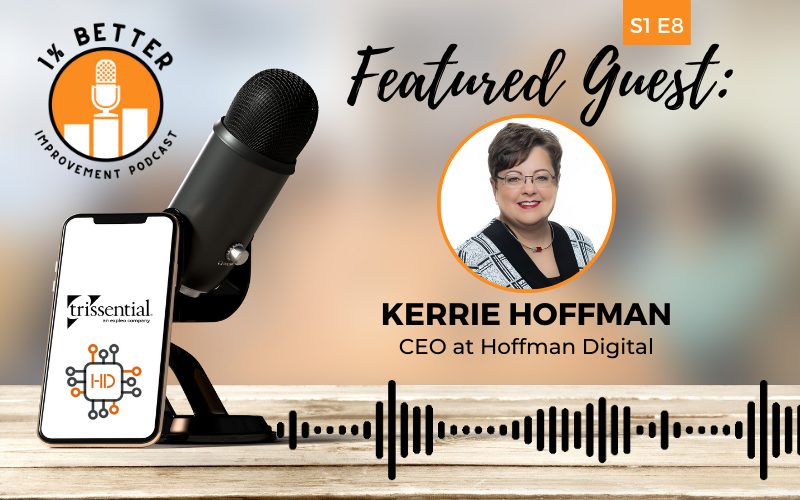
1% Better: Kerrie Hoffman, CEO at Hoffman Digital
Quick Links
Learn more about Hoffman Digital
Check out Kerrie’s chapters in the book series Brilliant Breakthroughs
Connect with Kerrie Hoffman on LinkedIn
Connect with Craig Thielen on LinkedIn
Key Takeaways
- Aim for Radical Improvement Over Incremental Change: Kerrie Hoffman emphasizes the need for organizations to not just aim for incremental improvements like 5% or 10% better, but to think in terms of 20 or even 30 times better. This bold approach is necessary for businesses, especially those lagging behind in technological adoption or operational efficiencies, to catch up and stay competitive in rapidly evolving industries.
- Embrace Agility Across the Organization: Agility is not just for software development. Kerrie discusses its application across the entire business, from the boardroom to the operational level. This holistic approach to business agility helps organizations become more efficient, eliminate waste, and adapt more quickly to changes in the market or industry trends.
- The Power of the Human Mind and Positive Thinking: Kerrie touches on the significance of mindset and positive thinking in driving change and achieving success. She suggests that tapping into the power of the human mind and maintaining a positive emotional state can lead to remarkable transformations within organizations and individuals.
- Feedback is a Gift for Growth: The podcast highlights the importance of seeking and accepting feedback, viewing it as a crucial element for personal and professional development. Kerrie shares her own experiences with feedback, noting how it can lead to significant improvements with the right mindset and openness to change.
- Cultural Sensitivity and Learning from Everyone: Kerrie’s experiences in Asia and working across different cultures underline the importance of cultural sensitivity and the belief that one can learn from every interaction. This perspective is valuable for leaders and organizations operating in a global context, where understanding and respecting cultural differences can lead to more effective collaboration and innovation.














1% Better Episode 8 Transcript
[00:00:00.360] – Craig
Hello, I’m Craig Thielen and this is the 1% Better Podcast. Today I’m speaking with Kerrie Hoffman and she’s calling in from the great state of Wisconsin. Kerrie is the CEO of Hoffman Digital, an ecosystem of companies igniting the human experience at work. I’m sure we’re going to hear more about what that means. This includes being an Executive Coach at FocalPoint Business Coaching and Co-Founder and Principal at Get Digital Velocity. In addition, she is the author of Brilliant Breakthroughs for the Small Business Owner. Prior to that, Kerrie spent 30+ years in three corporations as an entrepreneur and business transformer. She worked in a variety of leadership roles, including IT, operations, supply chain, and sales. Kerrie’s previous employers include Aurora Healthcare, Johnson & Johnson, and Johnson Controls. Kerrie and I met over 10 years ago on an engagement helping Johnson Controls transform through agility, and we’ve been working together ever since. Welcome to 1% Better, Kerrie.
[00:00:58.690] – Kerrie
Thank you, Craig. I’m happy to be here.
[00:01:00.210] – Craig
I thought we would kick this thing off. My first memory of you or one of my first interactions, you were going through and trying to drive some change in a global IT organization at Johnson Controls and trying to get this notion of agility and moving faster and going faster. You had a workshop with your leadership team, and I attended that workshop, and I think we contributed to it. One of the things that you said right out of the gates is that as a global team, and I think you guys are doing business in 60+ countries, you made this statement saying, we need to be thinking differently… No longer can we be thinking about doing things 5% better, 10% better, even 20% better… We need to do things 20 times better… We need to do things 30 times better. And that was a very, very bold statement. I will tell you, I’ve worked with hundreds and hundreds and hundreds of large corporations, and the idea of getting 5 or 10% better, they would take it every day of the week. And so you were very bold. So tell us a little bit about that. I think it’s going to give us a lot of clues to your background and why you did that. Tell us about that.
[00:02:09.870] – Kerrie
Yeah, so that was a fun workshop. The theme of the workshop actually was specifically how can we go 10 times faster than we do today? And there’s various reasons for that, and I’ll get to that in a minute. And we’re in this workshop and we’re brainstorming the first morning and everyone’s going at it and coming up with some nice ideas. But all it was, doing was the outcome of those would be two times faster. And I’m like, guys, I didn’t say two times faster. I said 10 times faster. So forget that. How do we go 20 times faster, 30 times faster, even 50 times faster? Okay, let’s brainstorm on how to go 50% faster. And there was this ‘aha’ in the room. One of my leaders says, ‘well, we would have to do something completely different.’ I’m like, yes, that’s right… We would have to do something completely different. So it was a really fun meeting because we nixed it right in the morning. We’re just coming up with these incremental ideas and we needed to move much faster. And the reason for that was as an IT organization, we were very traditional, we didn’t have a good reputation… there were just so many things about it. But the main outcome of all of the challenges that we were having as an IT organization was we were way far behind. We could not keep up with what the business wanted. In fact, we were probably decades behind in making changes. And so we couldn’t just incrementally improve, we needed to drastically improve. And that was not just true of IT, it was also true of our product organization within that company, which neither one of those products or IT had been invested in 10 years. So now you have to play catch up. And it was affecting our ability to grow. It was affecting the reputation we had with our customers, both IT’s customers and the company’s customers. We had a new president come in who really wanted to see significant change. That was the context of the whole thing.
[00:04:12.300] – Craig
If I remember right, I think you had recently before that and probably multiple times made a trip to Asia. You had seen some things over there with some of your customers, partners, etc. I think that had some significant influence to bringing that back, saying, ‘we need to think differently.’
[00:04:32.720] – Kerrie
Yeah. Oh, yes, that had a huge impact. In fact, I actually lived in Asia for three years. I lived in Singapore. It was when I worked for Johnson & Johnson, and I was responsible for leading all of IT for the Consumer Division in Asia Pacific. I had teams in 14 countries. We did business in more than 14 countries in Asia. When I was there, that was 2008 to 2010. That was during a big downturn. But in Asia, our growth just went in half. So we had been growing 20% year over year in China, and now we are only growing by 10%. What a dream, right? When the West was only growing by probably 3% prior to that downturn and then they were flat or negative. So, what I saw was this ability to change and transform. Change was a natural part of people’s lives in Asia. And so when it came to transformation at work, it was natural and we moved really fast. I remember when I first got there, someone said, ‘Oh, Kerrie, the pace here is much faster. So you’re going to have to get used to that.’ I’m like, ‘Oh, thank God’ because I was so impatient working in the US. I’ve been driving business transformation my entire career and I was very impatient. So that pace in Asia, I loved it, but I was just able to keep up with that pace, it was so much faster. So it did have a huge influence because it taught me what was possible when you remove some of the mental constraints of doing something different or moving faster.
[00:06:11.070] – Craig
Right. Yeah, I think that’s important. So a couple of questions on that, and then we’ll move on. You said they weren’t getting it, right? You’re talking about five or 10 times, and it was more incremental stuff. And then you said, Guys, we got to be thinking 50 X. And then how did that help people? What ideation or how did that help people? Did it just allow them to break all the rules? It reminds me a little bit of JFK when he said, I’m going to the moon by the end of the decade. And he didn’t go to all the scientists and say, well, lay out a plan. They always said, No, it’s impossible. In fact, I think that did happen. They said, No, it would take 20 or 30 years. And until you set a whole new target, then it allowed them to go backwards and break all the rules, norms, and policies, and procedures and say, well what would it take? So did you see that with the team?
[00:06:59.950] – Kerrie
Yeah, definitely. And it’s just like what you said. It allows people to break some of the rules and practices. And a lot of times, these rules and practices aren’t really hard, fast rules and practices. It’s just like the way we’ve been doing it for so long that it’s become the acceptable way to do it. And you do. You have to break those things. You have to think differently. It’s like one of the things I love is Lean and I love value stream mapping. I love value stream mapping because value stream mapping makes you look at not only what are all the steps in the process, but what are those circles of things you do, those circles of waste, and where in all those process steps is there waste that you can get rid of?
I was introduced to value stream mapping in my career at Johnson & Johnson. I was down in Florida with AccuVue Contact Lenses, and we were just learning value stream mapping. We were launching three products a year, and the president, again, a new president, wanted us to launch 15 products per year. We did this value stream mapping of the product process, and it was 400 days or something. In two 4 hours sessions over two weeks, we went from 400 days to 80 days for the new product process. And all we did was break down these waste loops. And the biggest thing we did was bring… It took cross-functional teams to do this. We brought teams in earlier in the process than we had traditionally done so that things got designed in upfront and you didn’t have all these rework loops in the product design and the product development, and that can be applied to anything. How do you bring people together cross-functionally to collaborate sooner in a process? That’s one normal thing that you can break. Get out of your silos, work cross-functionally, get input sooner. That has a huge impact on your ability to be able to transform.
[00:09:03.740] – Craig
Yeah, and that’s a great context I wanted to talk to you about. We’ve been working together, and I know you do a lot of work in this area called Agility… Used to be just limited to agile and software. Now it’s Business Agility and Enterprise Agility, and what you described it’s a notion of saying, hey, from the boardroom or C-Suite all the way down to all the work we do, do we have efficiency? Do we have waste? How do we go faster? How do we get faster feedback loops? So clearly that’s been a trend over the past five or ten years. But now we’ve entered a new realm. We used to call it digital, but now it’s digital on AI. And the speed at which things are going, and I don’t think people have caught up to what AI and generative AI and some of the more recent breakthroughs. Of course, we now have global high-speed internet and we have data, we have all sorts of things that are converging together. But this notion of agility at an enterprise level is more important than ever. You do a lot of work in that space and we do a lot of work – Why is it important and why is it so hard? What’s getting in an organization’s way? Because everyone knows we can’t do things the old way. I think back to your other point, another thing that’s really taught us a great lesson is COVID. We basically said something was placed on us, no one asked for it, and everyone had to break the rules to figure it out and survive. Can we learn from that in how we change and get to the speed of age or get to the speed of a startup in these big Fortune 500 corporations?
[00:10:31.020] – Kerrie
This is a great topic, Craig. You know I’m passionate about this. Let me give some context. I firmly believe that we have exited the industrial age and we have entered the next age. At first, like you said, this was the digital age. This started around the year 2000, but it really gained momentum around 2007. But it only gained momentum with digital native companies, with startup companies. And then slowly, since 2007, traditional companies have been trying to transform. The reason it is so difficult is because where you need to get to, is completely different from where you are today, completely. But you can’t jump from where you are today to that future vision. In fact, you can’t even understand what that future vision is because you don’t have context for it. So you end up having to take some incremental steps to get there. So my whole career, I’ve been pushing transformation, and I can visualize where we need to go, and I can visualize what that looks like and what that feels like. And it’s not because I’m some genius. It’s because I’m a very curious person. So I like to find areas that are already doing it completely different and then bring a traditional organization back into doing it.
There’s two power principles that I work with teams on that help with this. One is the law of incremental improvement, which speaks completely to this podcast’s name. So the law of incremental improvement, if you think of a five day work week and think of four weeks in a month, which it’s actually more than that, right? If you change one 10th of a percent per day, that’s a half a percent per week. And people can write this down and do the math. It’s 2% per month and it’s 26% per year. Imagine if you could improve 26% per year.
[00:12:29.920] – Craig
Most organizations are looking for 1%, 2%, 5% here and there, right?
[00:12:36.690] – Kerrie
Yeah, right. And you know me, I go for more than that in a year. So one of the projects other than Agile that we did was reduce our number of legacy applications. We had like 1,000 in a 15-billion-dollar business unit. Our goal was 80% in a year. And most people would be like 25% over three years would be awesome. No, not anymore because business is moving too fast with the new technology, so you have to do it faster. Most of my organization got to 60% in a year, and that was during a huge merger with another company. One part of my organization did 90%, so it’s absolutely possible. But you have to believe that it’s possible. The other principle is Gleicher’s Formula for Change. And this one’s really important because this says the formula goes D multiplied by V multiplied by F has to be greater than R (C=DxVxf>R). What that means is your dissatisfaction with the current state times your vision for the future times some easy first steps, and that’s the key, has to be greater than resistance for you to be able to make the change. It’s a multiplication equation. So if any one of those dissatisfaction vision or first step (easy first steps) is missing, you cannot make the change. And so we do a lot of work with my teams and now my clients on this because you have to actually get people to recognize their dissatisfaction with the current state, which means pull it out of them. Usually, we don’t want to listen to it, right?
[00:14:12.590] – Craig
Yeah. No, it’s so true. I love the formula because sometimes people need that guidance or they need that structure. One way that I often talk about it, but it’s simple, but sometimes it doesn’t always land, which is one of the first things I look for is what’s the pain, what’s the gain? And if there isn’t enough pain and gain, there’s not going to be enough reason. This is that even at a personal level. People talk about diets and exercise, but if they don’t have enough pain or gain to really change everything they’re doing, they’re probably not going to get through the tough days and the tough times. And of course, there are studies, this is based on scientific studies, that people that are literally on their deathbed or they have some chronic disease, and they still don’t change. Still, something like 70% of people don’t change. So you really need that pain or gain. In other ways, you really don’t have a shot at really changing behaviors. I love that. That formula helps you work through that in a systematic way versus an emotional way.
[00:15:11.190] – Kerrie
Exactly.
[00:15:12.380] – Craig
You’ve now had a chance to wear a lot of different hats. You’ve been in the corporate America. You fought your way up the food chain and politics in corporate America. You now are coached, so you coach other leaders. You also work with many small and medium-sized companies which is a whole different realm.
[00:15:32.460] – Kerrie
Very different.
[00:15:33.790] – Craig
Then you also have a consulting company, so you get hired to consult and be the expert, quote unquote. Talk a little bit about those dynamics because they’re very, in some ways, very different. In some ways, you’re still carrying, you’re still pushing and sharing insights and trying to get people to transform. But talk about those dynamics. And then should that combination, should every organization, every leader have a coach? Should they have outside thinking that really challenges them? Because sometimes you don’t get that challenging thinking on the inside.
[00:16:06.800] – Kerrie
Right. Yeah, no, that’s very true. I think coaching is extremely important. I actually have been doing coaching and mentoring my entire career. There was no way to do business transformation without coaching and mentoring people along the way because it’s very scary to make changes. It’s very easy after someone makes a huge change for them to look back and go, gosh, I don’t know why we did it that way for so long. It was so silly. When you break it down into these easy first steps, it’s just easier. But it takes a coach to help you do that because there’s always a fear of doing something differently, whether it’s the fear of failure or the fear of success. And it helps to have a coach to help you along the way for two things to help encourage you to get over that fear, but also to hold you accountable to actually make the changes, right?
[00:16:58.270] – Craig
Good point.
[00:16:59.470] – Kerrie
I think it’s getting harder and harder because of what we were talking about with now AI accelerating everything even further than all the technologies that have been accelerating things anyways. I mean, it’s so much easier to get left behind. And so you’ve got to make the changes. I think one of the big things for coaching people is when you don’t make the changes, you’re trying to do things the old way, but you’re trying to do more. You’re trying to do more with what you have and do it in the same way. And that just wears you down and wears you out. And it’s very easy, whether it’s our personal life or our business life, it’s very easy to just do what I need to do to get through the day. And that is not going to help you. That actually is going to have you fall further and further behind.
[00:17:51.890] – Craig
Which is actually how we’re wired. Genetically, neuropathways, we are wired to repeat for our own efficiency, and it goes against the notion of change. And so that’s part of the pain and the gain is we have to break those pathways. I just heard something yesterday on a podcast that said you cannot grow when you’re comfortable. I think that basically says, hey, when you’re on your pathways, you’re not changing anything. You’re just repeating and rinsing. Only when you’re uncomfortable and you’re doing something new, different, fear, uncertainty, doubt, and back to this leadership question, how you engage and you’ve been on both sides, all sides, is that what sometimes we forget as leaders have fear and certainty and doubt, they haven’t been through this digital age. They don’t know anything about AI. They don’t have agility. They haven’t had their hands on this. So they can’t teach and mentor and guide and direct, honestly, is what they’re used to doing. And now they have to apply the change. And that can be pretty scary.
[00:18:49.790] – Kerrie
Oh, yeah, it can be very scary. You’re making me think of some personal things that I’ve been through and a point I think it’s important to make. So I’ve been a high performer my whole career, but that doesn’t mean I didn’t hit some huge bumps in the road. I hit glass ceilings twice and I was a hare away from being taken out of roles twice. Okay. So people who know me and know my career would never think that that happened to me. So the important thing through all of those, and the first time I was told this isn’t working out, we’re going to give you two months to fix it, or we’re going to take you out of this world. That was a lot of pressure. Especially for someone who’s always been a high performer.
But the thing is, feedback is a gift. This is one of the points I want to make. Feedback is a gift. And even if it’s badly given, it’s still a gift. And the second part of this is that small adjustments make a huge difference. So here I am, first time. We’re going to take you out of this role. There were some root causes to the issue that were outside of my control, but I was reacting to this issue being very frustrated. And it wasn’t fitting with the culture of the business unit I was with at the time. I had a wonderful dotted line leader who gave me feedback. And this is when I was in Asia, where it’s all about saving face and they don’t like to give you feedback. That was part of my frustration. I knew something was wrong, but nobody would give me feedback. So I talked to her and then she recommended that I go to get a couple of the leaders, my peers, to work with me. So this is a small adjustment that may sound like a big deal because it’s a fearful thing to do.
So I picked two people. I picked one person who would be like, I don’t see any problem with how you’re doing. And I picked the other person who totally was on board to get rid of me. I picked those two people. I went to those two people, and all I did was say, look, I’m having some challenges and I want to make improvements with how I’m fitting in and working within, will you be willing to help me with that? That’s that is all I did. Was that hard to do? Yeah. To go and sit in front of someone and say, I’m not doing well, I need help, will you give me feedback? In one perspective, to a high-performing person who, oh, that was so hard to do. But really, let’s sit back and look at it. Was it really that hard to do?
[00:21:36.490] – Craig
No. Take your ego out of it, and it’s actually pretty easy to do.
[00:21:40.240] – Kerrie
Exactly.
[00:21:40.730] – Craig
Were these peers? Were these people underneath or were they above you, or where were they?
[00:21:48.420] – Kerrie
Technically they were peers. But in the Asian culture, age is a big thing. And whoever’s the most senior in terms of years of experience, and he happened to be a male as well, that is a big cultural thing. I needed to not necessarily think of him as a peer. The other person I picked was an Australian male who was like, We’re totally peers, right?
[00:22:14.470] – Craig
Yeah. Well, it’s so interesting because there’s a book called The Culture Map. Are you familiar with it?
[00:22:20.460] – Kerrie
Yes. It’s a great book.
[00:22:21.300] – Craig
I think it’s more relevant than ever because everyone’s working on global teams. We think in the frame of what we were raised in, and brought in, even in the United States, it’s a big difference between the Midwest and the South and the East and Silicon Valley… There’s different ways that people interact and it’s a magnitude’s different in different countries. And like you said in Asia, they don’t give direct feedback where they do it in very different ways. So you have to understand that because that’s a language, even though you might both speak English, there’s norms. Just even understanding that is an important way of connecting with people and finding and getting those breakthrough moments.
[00:23:02.720] – Kerrie
I think that’s a good point, Craig, because I always believe that I can learn from everyone. But how you apply that is different in different cultures. An older male who has many more years of experience than I do, I need to treat him differently as an Asian male than I would my peer that I want to learn from from Australia. And so it was a completely different… I understood culture, but I underestimated how important that was from a… He’s an elder in the team and I need to respect him in a different way and ask for help from him in a different way. So he wasn’t my peer, he was my elder.
[00:23:45.620] – Craig
Thanks for sharing that. We always find our way in each of these episodes of the intersection between personal improvement and professional improvement, and how we tend to separate that in the industrial age corporate America. The two don’t, they can’t exist. In fact, we even say work life balance. It’s like, wait a minute, why are we separating those two? So, I love that. Almost in every case, it’s those personal reflections, personal breakthroughs. Something as small but really big was you going, hey, maybe I need to change. Maybe I need to get feedback. Maybe I need to… Just that was a very introspective moment for you versus, no, I’m successful. I’ll fight through this. I’ll figure it out. I’m smart. I’ll work harder. That’s a big deal. I think that’s what a lot of leaders, I assume you’re coaching a lot of leaders, that’s the intersection where you get some of those breakthrough moments.
[00:24:45.450] – Kerrie
Yeah, for sure. You can apply this to Agile as an example. Agile is completely different from Waterfall, and you cannot do hybrid Agile. There’s no such thing. So it’s completely different, but yet you need to take incremental steps to get there. You need to make small adjustments. But that doesn’t mean mix Waterfall with Agile. That means doing Agile, but doing the basic pieces of it first before you try to go all in. You know we flipped a very large IT organization on a $15 billion business unit to Agile in about a year. The first four months, we weren’t really doing it. So it’s really about nine months.
[00:25:30.020] – Craig
Remember one of the first meetings I had with you and I said, What are your objectives? What do you want to get done? You go, well I want to move 30 teams in 30 days. And I go, Okay, well, we might need to talk more, but I like your aggressiveness. Good stuff.
You wrote a book as part of the Brilliant Breakthrough series for small business. Why did you write it and what are some of the takeaways from it?
[00:25:56.750] – Kerrie
Yeah. So a couple of things. The reason I wrote it, and it’s a book series with a number of authors in each one of the volumes. I wrote a chapter in volume three of that series, and I wrote a chapter in volume five. And I wrote it because I’m so passionate about getting as many companies as possible on their path to digital. Now with the AI, like you said, now we’re beyond digital. Companies that don’t transform are going to fail, and the West is moving slower than the East on this. And so I’m very passionate about getting companies moving. So the first chapter I wrote was explaining all this about digital and moving from the industrial age to the next age that we’re living in now. The thing about it is one of the things I really hit upon in there is the need to change your mindset. That is the most important thing. And it’s everything that we’ve been talking about, Craig, right? If you’re going to break through and make these huge transformations, it’s the mindset around things that is the biggest factor.
COVID is a great example. Whether you were a small company or a large company, work from home took somewhere between one day and two weeks to figure out, that’s it. If we would have done that as a project, and I’ve asked CIOs this right in the throes of COVID in April, May, June of 2020… how long would it have taken you to work from home if you would have done that as a project? People were like, 18 months, 24 months, and most people said, if I’m honest, we never would have got there because we would have thrown up all these obstacles. So mindset is so important.
When I wrote the chapter in volume 5, so two years later I wrote another chapter, I did it on mind power because our mind is so important and I could spend hours talking about this. So what it goes back to, Craig, is what you were saying about our brains being wired in a certain way and needing to change that. 90% of our decisions, if not higher, are all based on habit throughout a day. And it’s based on habit because the way our brain is wired. And if we can tap into the power of the human mind, we can make amazing changes. So I wrote the second chapter in volume five on the power of the human mind.
[00:28:12.000] – Craig
Let’s just dig into that for one second because I think that that is something that’s being talked about a lot more. We got to change our minds. Of course, in the agile world that’s talked about a lot, but I feel like it’s a flippant saying. So what would you say is a very practical way? Because sometimes you need technique and you need structure that allows people to practice things. We sometimes show videos like Backwards Bicycle, knowledge does not equal understanding. You can know something, but it doesn’t mean that you can really do it and be it. So what are some practical steps or techniques to help people get that new mindset that is required?
[00:28:55.150] – Kerrie
Well, and just for the listeners, you mentioned the backwards bicycle, so I encourage people to Google the backwards bicycle.
[00:29:01.430] – Craig
We’ll put a link in our show notes.
[00:29:02.290] – Kerrie
That’s an awesome lesson.
I think one of the key things for the power of the human mind is staying in a state of positive emotions and thinking positively. And let me give you an example. When I work with small, medium-sized, even large customers, everybody wants more customers, right? Or they want more revenue. But the way that they think about it makes a huge difference. So if you’re thinking, I don’t have enough customers, our brain is so powerful the way that it works, that our subconscious mind will go about working on how to make sure we don’t have enough customers, because it can’t reason. It can only do.
[00:29:46.050] – Craig
Like idea that you get more of what you focus on.
[00:29:50.400] – Kerrie
Yes. So your conscious mind feeds your subconscious mind. Your conscious mind only works while you’re awake. Your subconscious mind works 24 hours a day.
[00:29:59.300] – Craig
How do you break through that?
[00:29:59.810] – Kerrie
You have to flip it. You have to flip it to visualizing and saying, I will have more customers. So by this date, I’m going to have more customers. Successful people think about what they want, and unsuccessful people think about what they don’t have. It’s all based on the power of the human mind, so you flip it.
[00:30:21.120] – Craig
And you practice it.
[00:30:22.280] – Kerrie
And you practice it, every day.
[00:30:24.110] – Craig
I love it. That’s great. Well, we’re at the end of our time here. Time always flies on 1% Better because we have people that are super passionate about improvement like you are. Last question that I ask each guest is, looking back at your career, if you were sitting down with a grandchild or an 18-year-old version of you, or you’re keynoting at a graduation event, what’s one piece of a 1% Better advice that you wish you knew or that you would want to pass on?
[00:30:56.670] – Kerrie
Oh, wow. That’s a great question. I would… It’s so hard to do one. I have two in mind. I’m breaking you a rule. I’m doing two. So the first one would be to always take on side projects, extra things. Be the person who volunteers to do something extra because you end up… And it can be really simple things, but people really notice you for that. The second thing would be that feedback is a gift and small adjustments make a huge difference. It’s probably the most important one.
[00:31:31.790] – Craig
Well, you got three of them, but you want to do 20 times better, 30 times better than you’re following your own advice. Well, thank you so much, Kerrie. It’s been a real pleasure. Look forward to maybe future episodes with you.
[00:31:43.900] – Kerrie
That sounds good. Thanks for having me, Craig.