1% Better Podcast: Fin Goulding
Find 1% Better Improvement Podcasts Here





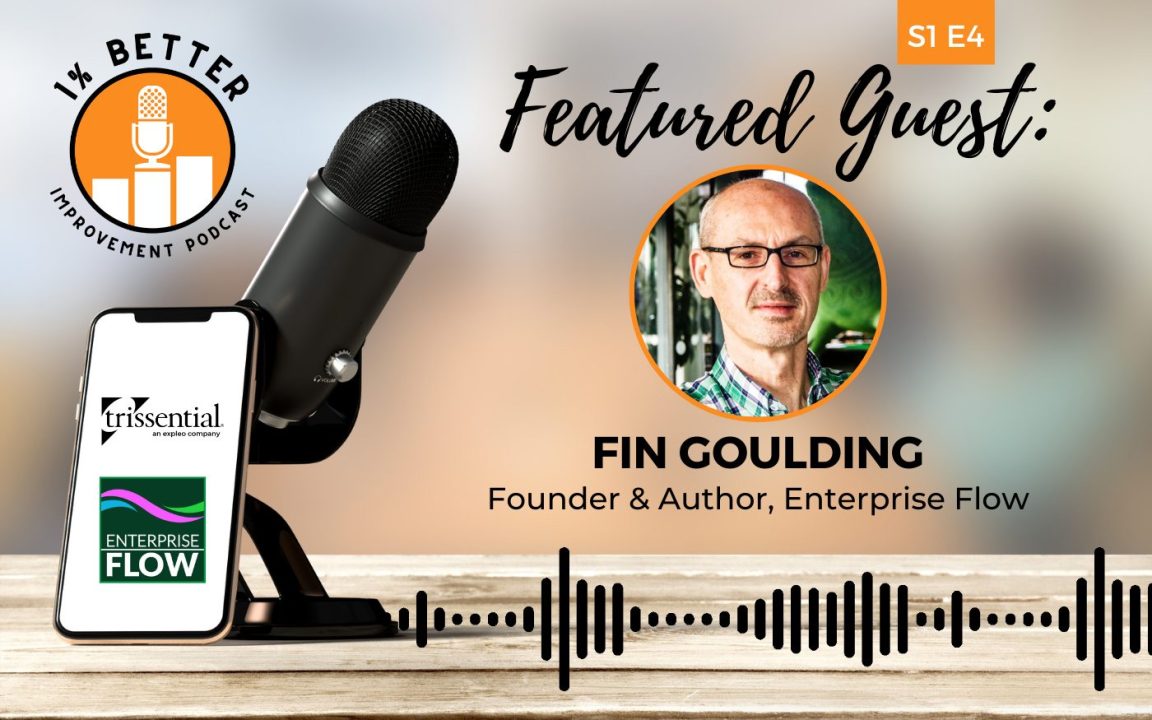
1% Better: Fin Goulding, Founder of Enterprise Flow
Quick Links
Learn more about Enterprise Flow
Learn more about Fin Goulding’s book Flow
Connect with Fin Goulding on LinkedIn
Connect with Craig Thielen on LinkedIn
Key Takeaways
- The Importance of Agility and Small Steps in Transformation: Fin Goulding emphasizes the significance of agility in business operations and the process of transformation. He advocates for a small steps approach to change, suggesting starting with a small initiative and one team to demonstrate change, rather than embarking on large, expensive projects. This method fosters a culture of continuous improvement and allows for quicker adjustments based on real-time feedback.
- Visualization as a Key Technique: A major point discussed is the power of visualization in both understanding and managing work. Goulding has implemented this with executive teams, encouraging them to visualize their strategy, backlog, and measurements on walls. This not only aids in clarity and transparency but also helps in prioritizing tasks, making it evident that not all projects carry the same value or urgency.
- Cultural Shifts and Executive Involvement: Goulding highlights the need for a cultural shift towards a more collaborative and open work environment, where even the executives are visibly involved in the transformation process. This approach challenges the traditional command-and-control mindset and encourages a more participatory and inclusive environment, which is critical for a successful transformation.
- Personal Development Parallel to Professional Growth: The conversation touches upon the interconnectedness of personal and professional development. Goulding shares his own experiences with continuous learning and adaptation, stressing the importance of being open to change and the ongoing pursuit of knowledge and improvement, both personally and professionally.
- The Role of Leadership in Transformation: Finally, a significant takeaway is the role of leadership in driving change. Leaders are encouraged to lead by example, engaging directly with the teams and work, and demonstrating a willingness to adapt and change. This involves not just delegating tasks but actively participating in the transformation efforts, showcasing commitment and fostering an environment where everyone is encouraged to contribute to the change process.














1% Better Episode 4 Transcript
[00:00:00.170] – Craig
Hello, my name is Craig Thielen and welcome to the 1% Better podcast. In this episode, I have the pleasure of speaking with Fin Goulding, who is a global Chief Technology Officer and Chief Information Officer, business agility author and expert. He’s coming to us today from Ireland, which gives him the distinct honor of being our first international guest on 1% Better. Fin’s been named one of the top global CTO CIOs. Some organizations Fin’s worked with include Visa, Royal Bank of Scotland, NatWest, HSBC, by the way, NatWest I worked at once. That was one of my clients, so we haven’t even talked about that. Aviva Insurance, Travelocity and Paddy Power. Fin is the author of three books on the topics of business agility and transformation called Flow, Twelve Steps to Flow and The Transformation Sprint. If I’m not mistaken, I believe he may be working on a fourth book.
Fin currently advises executives around the world to adopt new ways of working and remodel their business to deliver successful transformation. If that’s not enough, he’s also an avid runner and just ran a marathon last week if I’m not mistaken. Finally, on a personal note, I’ve had the pleasure of working and knowing Fin over the past five years in a number of different forums, including partnering on the implementation of Flow, working with a couple of clients and a few speaking events, one in Italy and one recently that we did together in London.
We just continue to share our experiences and learnings, and I always find great value in talking with Fin, as I’m sure you all will. And lastly, we first met in a pub in Dublin, which is Fin’s backyard. And that is the very first authentic Irish Guinness that I had. And if you ever have the choice of meeting someone for the first time, I highly recommend doing it in an Irish pub in Dublin over a Guinness. So with that, Fin, welcome to 1% Better.
[00:01:55.640] – Fin
Thank you so much. It’s a pleasure to be speaking to you again, as usual. It’s great.
[00:02:00.150] – Craig
Excellent. So, first of all, let’s get started. How’d that marathon go?
[00:02:03.540] – Fin
I went pretty good, actually. A lot of good planning and had the weather with me, so it didn’t rain too much, just a little bit of a drizzle. So, yeah, I did the Zurich Marathon. I got round in quite a decent time and that was marathon number 38. So I’m trying to get towards 50 and it’s just my way of distressing is training and keeping fit and visiting different cities around the world.
[00:02:28.510] – Craig
Yeah, maybe at some point during this conversation we can come back to that because I’m always interested in this intersection of personal development and professional development, and sometimes we separate the two and I feel like they’re way more connected than sort of the corporate world sort of allows for. And so maybe at some point you can tell us about how you use that time that you run and train and it’s very arduous and how does that help you show up differently in your professional sense? So noodle on that for a little bit, but let’s get started with just tell us a little bit about your background. How did you get into being a CIO and a CTO and then you shifted away from that. You’re very successful in that but well known in that field, and then you really started focusing on this notion of agility and sort of really spending your time there. So tell us a little bit about that.
[00:03:15.230] – Fin
I think part of the kind of traditional background of a technologist is that I was a developer, I worked on a mainframe, so I’m that old, I’m doing assembly development and there was no such thing as a kind of a career that would take you from being a technician to being a senior technician. I don’t think really architects or CTOs were really a big thing back then. So to actually move up and in a company eventually had to go into management. So that’s what I did. So I worked in large banks and financial institutions, different parts of the world in the U.S. and et cetera, and very, very corporate big teams managing big groups and climbing all the way up the ladder. Then life happens and things happen to me and I had to switch and move back to Europe. And I joined a startup because they were looking for someone that actually knew how to work with high scale, high performance, high transaction processing systems. So I joined this startup which was actually a subsidiary of Travelocity and great success in terms of making them a little bit more stable and being able to deliver and all those sort of things.
But what I learned from them was the power of agility and communication and people working together and actually having some fun and having a shared mission and rolling your sleeves up. And the CEO was doing User Acceptance Testing and it was that kind of thing. So I stayed in the startup world for a few years and then I then switched back into the corporate world. And the corporate world hadn’t changed. It was still kind of old traditional ways of working and slow delivery and monthly releases. And I’ve come from this releasing when you’re done, like every hour or something. So I kind of discovered that I could use some of the knowledge I had from the startups to bring that into the corporate world, which is what I did. Had some success there and I wrote a book about it and was talking on the speaking circuit because that’s how you hire staff, right? When you’re a CTO and you can’t get staff, you’re out there trying to impress them to come and join you. And eventually I decided to go out on my own and provide advice and guidance from having these perspectives of big corporate successful startups and then actually having the real history to share with people. This wasn’t just something that you just dreamed up, it actually happened.
[00:05:31.930] – Craig
Interesting. So you got your inspiration getting out of the corporate world into a startup about five years ago, maybe ten years ago. Time flies. There was a book called Lean Startup and very, I think sort of groundbreaking at the time when a lot of corporations were trying to figure out like, how do we compete with all these startups? Right? And it gave the mindset and it’s really a book about lean and agility… It’s really putting that startup mentality into a larger environment. So are you familiar with that? And is that kind of the same experience you had that you wanted to bring back to corporate world?
[00:06:09.350] – Fin
Yeah, I think I think everybody rushed out and bought that book and then perhaps failed in terms of implementing it within a corporate. Because some of the interesting dynamics which is first of all, there’s a resistance to change at certain executive levels that they’re not keen to learn new ways of working or risk the business, shall we say. There’s also this being scared to talk about new methodologies or because they don’t understand them or don’t understand what agile really means because there’s so much jargon in all this stuff. I think what I started to do was de-jargonize some of this stuff… get people to work together in a visual way and in a social way and actually get executives out of corner offices and actually down with the teams and being part of the production or whatever they’re doing and making. That come to life and providing the teams with the one thing that they don’t have, which is the power sometimes or the decision-making capability to pivot on the spot rather than being in executive teams working on information that’s a month old. Why don’t you work real-time? And I think that’s the power of it because you must have been into corporates that have got pool tables and foosball and free food. None of that actually works for a corporate really, in my opinion. I think it’s great for some of the employees but you now see some of the big tech giants rolling some of that back because of costs. But I think one of the key things here is that how do you create an environment that has all the elements of a startup in a corporate world? And it can be kind of hard.
[00:07:40.400] – Craig
So Fin, a lot of organizations, almost all of them really, are searching for that next thing that can help them be better. And we use the word agile, agility, but you could use continuous improvement. We have to go faster. The world’s changing, it’s more digital, speed of change… And you clearly had an experience that, hey, there’s some things that we did in a small environment that we really need to take to much larger environments. But when you got back into the corporate world and you started coaching, whether you were doing it formally as a CTO or CIO, or whether you were being that executive coach, what do you see as the most common obstacles that these sort of more traditional organizations, they have the appetite to want to be more agile, be more like that lean startup. But there’s so many obstacles in their way. What are some of those things that you see getting in the way that organizations, they try to do it and then they fail?
[00:08:32.690] – Fin
I think part of it, as I mentioned, was to try not to be too technical in the conversation in terms of the jargon that’s used. So rather than some of the lean stuff that you would know, rather than talking about cycle time and lead time, all that kind of stuff, you talk about, well, what’s our throughput? What can we produce? And use words that they would actually understand… demystify the kind of agile stuff, because it’s not that difficult, really. If I can do it, anybody can do it. So it’s a case of helping your engineering teams to go faster. They’re the ones with the skills to write the code, but it’s the environment around them and this kind of visualization making quick decisions, et cetera, and showing executives that that’s not too difficult. But you do find that there’s a certain amount of toxicity within some leadership teams, and people want to throw you off course and want to keep things the way they are because they’ve got their corner office and their fiefdom. They don’t want it to be disrupted whatsoever. So you have to take a certain amount of risk.
My first speech as a CTO in a company was always, I expect to have a life expectancy of like two to four years, and I might get fired on this journey, but I’m willing to take the risk. And I keep bringing people back. Like a bit of fun. But I’m referencing the fact that, look, I’m coming to make some change, and I’m willing to put my reputation on the line. And you often get one or two people within the team that will say, okay, let’s try this. Let’s give it a go. And you have to get some results in weeks, not months or years. I mean, really do happen quite quickly. That’s the key.
[00:10:02.190] – Craig
One of the things I love about you, and I think many people that know you do, is that you have this gift to sort of cut through the bull and get to the heart of the matter and sometimes be even provocative. And I don’t know, maybe that’s your Irish heritage. But for example, I remember you saying things like agile is dead, and the biggest impediments teams have are executives, and I’m just a plumber, and this is you being an executive. I’m just a plumber. I just try to unblock things. So tell me about how you’ve used that. We in the business use all these fancy words like, we need transparency and we need courage to report the truth, but it’s really just being really direct and saying what you know, saying what you feel. How do you think this has helped you help organizations and executives just really get to the heart of manner and get the change that’s needed. And then what can other people learn from that? Because I do think a lot of people hold back and they’re waiting to be told they don’t want to take a risk. They’re sort of playing this game, but it really just wastes time and it sort of avoids the heart of the matter versus going through the motions, which we see a lot of people do.
[00:11:06.610] – Fin
I mean, I do tend to use a little bit of humor, that’s for sure, in the way that I give the message. And I think that’s kind of important. I think in work you need to be honest and say, is this job I have my purpose? And is it my passion? And if it’s not, then you’re really just going through the motions every day. I’m not sure you really are bringing your best self to work. And I find a lot of people in that situation that are just trying to maintain the salary that’s coming in because they’ve reached quite a high level. And I guess when you get on in your career, that becomes less of an issue, so you can take more risks. And I think also you are looking to make your own life enjoyable within an environment that you’re working in. So yeah, I’ve quite often said to executives, this kind of speaking truth to power is very hard if it’s going to disrupt your own personal life. But I kind of found that risk intoxicating to a degree, and I actually like talking to executives now, and I don’t do much advisory as I used to, but I still do some. But I do this, which large consultancies they don’t do. They go in thinking about, okay, I’m going to win a small contract and another one, another one, I’m going to be there for a long time. I just go in with, if I can solve your problem in a day, I will. And we’ll have a beer and that’s it. And if I can take it, solve your problem in a month, then I will. But I quite often say to the executives, or even the CEO, you’re the problem. You need to do this, you need to do that. And I remember some executive teams taking a sharp intake of breath when I said, the CEO is the problem, I got thrown out. And then three months later that CEO was fired and they brought me back in. So it was kind of fascinating. But it is not easy. But I do think you have to have some experience and you have to realize that no two organizations are the same. Everything has a separate context. So when you see consultancies go into an organization with the playbook of they might be lucky, but probably nine times out of ten they’re going to fail because there’s a brand new context and this brand new set of players and a different atmosphere and different drivers. So you can’t make one size fit all.
[00:13:14.110] – Craig
Yeah. I love what you said. You started with going right to the team and individual level and saying, is this your passion? Are you enjoying what you’re doing? Are you doing what you want to do? And I think that’s so powerful and so overlooked when people go through these quote unquote transformations, we’re going to be agile and use all these sort of methods. We overlook that. Again, we use terms and, oh, we want empowered teams and self-directed teams, but then we continue to tell them what to do and tell them what good looks like and here’s how much money, here’s resource, and just do what we want you to do. And that’s kind of the old mindset. And so getting to what are we really trying to do? We’re trying to unleash people’s potential, their passions. Again, that usually is something that has to be led from the top. There has to be alignment in all levels of the organization on culture. Right. How are we going to show up and do the work? So how have you seen that show up and how have you addressed that when you just see that disconnect?
[00:14:11.210] – Fin
Yeah, I think you have to peel back many layers of the onion to find out what’s going on. And you often find in an organization that when they get a bit lean and mean, they cut the training budgets. And I think that’s the most ridiculous thing. You should be doubling it. You need continuous learning in your organization and you need to be learning new skills all the time. And your team needs to be learning new skills and empowering a team. Sometimes they don’t want to be empowered. They want to be given some very clear goals about what they need to do and what they need to do it when and be rewarded for it. I mean, I’ve had negative empowerment in my life and I’ve hated it. Is this a lot of pressure on you? So I often think about, with the teams I work with really as you say, about, is this your passion? But when I go into an organization, I speak to everybody, including the receptionist and the people that clean the building or whatever, everybody in the organization, because they all have a part to play and you get these nuggets of, okay, in some organizations, everything’s working well. In others, it’s like everybody out of sight is unhappy. And that percolates through the organization and it seeps into the culture and it’s one of the things that holds them back.
[00:15:15.430] – Craig
The name of this podcast is 1% better. And so the idea is around continuous improvement, it’s around small incremental. Consistent, persistent improvement can really lead to dramatic results. Sometimes it can just be one small change that’s kind of got that butterfly effect, or sometimes it’s like no, if we just improve one thing every week, boy, you look back six months or twelve months later and you don’t even look the same, right? So tell me some experiences you had on those kind of 1% moments. Either it was one thing that you did or the organization did that really sort of set the path or some consistent technique that led to dramatic results over time.
[00:15:56.290] – Fin
There are a couple of things. I think the main thing for me was always about making connections with the entire team at all levels. So I would constantly have sessions with teams or even with individuals. I’m just trying to get information about how this mass of people is operating and can I improve it. But when I talk to large companies they fear transformation, they fear change because they think it’s going to be big and expensive. And I explain my kind of small steps approach which is like let’s pick a small initiative and one small team and let’s use that to demonstrate how change can happen and within a few weeks help it to deliver. And I think one of the things you find with the feedback from that team to an executive group is that we’re actually enjoying this, we’re actually enjoying working together and we’re enjoying our job and we’re enjoying adding value to the company because we can see the results quicker. As you probably know, some companies are in the middle of a transformation that’s been going on for years, 2, 3, 4, 5 years and sometimes it becomes a vehicle to just carry people and there is no outcome at the end, there is no delivery.
I think this small steps approach coupled with social interaction with people using visual techniques, I’m not a great person that reads long reports and stuff like that. My mind can drift away quite quickly and I think that using some visual techniques to express these are all the tasks that we need to do and this is going to go on the wall and I can understand how it all fits together. That works well for me and I find that a lot of executives are in the same situation.
[00:17:30.350] – Craig
Speaking of visual techniques, that reminds me of your book Flow. I think it’s a brilliant book that takes this very jargoned, agile world that’s got all these sort of technical terms and it puts it into for me a very simple, understandable, practical language and set of techniques. And I believe one of the chapters is very focused around visualizing your work. And I know you’ve done a lot of work with even executive teams of saying hey, let’s actually put our strategy on the wall. Let’s put our C-Suite backlog on the wall. Let’s put our measurements on the wall so everyone can see it. That’s a big step for a lot of executives. A lot of times they hold things closely and they like to control them. First of all, talk a little bit about we’ll come back to that, but talk about the book flow and how it’s different than what you’re seeing when people are going through these sort of agile transformations, why you wrote it and how it’s different.
[00:18:24.480] – Fin
If you peel the book back a little bit, at its core, it’s just got a lot of things that have been stolen from the lean world. There’s lean software development techniques in there. There are agile practices, but they’re never spoken about like that. But it tries to fill in the gaps in an organization in the areas this is like five or six years ago when it was first run, there was nothing around. How do you have an agile strategy or agile risk management or agile and I don’t like those words, but I’m kind of trying to say new, shall we say new ways of working for executive teams, with a strategy, with product and marketing teams, with their portfolio of work. And how does that fit into teams that are learning all this agile, quote unquote, techniques to deliver? So it was kind of saying, how do we make the whole organization work in a new way? And part of that was visualization. The most powerful thing was to just visualize all the work that’s in play in your organization. So with one organization in New York, they were very skeptical, but we put every single project and program on the wall and the CEO couldn’t believe it. Like 350 things that were in play. I said, but your team isn’t big enough to deliver it. It didn’t take a Rocket Scientist to say, you’re having to bring in all external resources from consultancy XYZ at $3,000 a day. Maybe you should think about hanging what’s the most valuable things to deliver that would give return.
[00:19:51.610] – Craig
I’m going to stop on that for a second. The visualizations. I always comment to clients saying one of the diseases in the corporate world is that we have too much work in process and we don’t have the capacity to deliver it. So what it does, it’s like a freeway system, that’s all. I think you’ve even had a slide on this one time that showed a freeway and it’s eight lanes, but it’s just a parking lot. But sometimes it has to be physical for us to kind of understand it. If it’s just in some portfolio management system or some spreadsheet, it’s just all kind of behind the scenes. And I don’t think sometimes executives understand, like, we have 350 projects going on and some of them are enormous. So are they all equal value? Are they all equal priority? Are they all equal in the organization? Of course, the answer is no, but I think just that simple. This is a lean concept. A simple Kanban visualization of the work is incredibly powerful, isn’t it?
[00:20:41.890] – Fin
That’s kind of what I tried to set out with, kind of an executive portfolio wall of all the things that are in play. And now some people have taken that idea and run with it and they’ve come up with the visual PMO and all this kind of stuff. But anyway, it doesn’t matter who invented it first, but the idea is that you’ve got everything on the wall and you can make decisions about, okay, look, what we really need to do is pick the most valuable things here. But what I also did on that wall was leave a section for infrastructure and a section for regulatory because these things have to happen. So if something is of regulatory, it’s just as important. And infrastructure gets overlooked in terms of continually feeding this environment to make you more efficient. And that’s part of the reason, I think, why you end up with some transformations is that a lot of organizations don’t look at the care and feeding of their world, and it’s like five or six or seven or eight or even ten years later, they have to come back and do a massive upgrade of stuff, and they try to avoid that.
But you’re right, visualizing it is important. Visualizing risks in an agile, risk management way, using the term again. But it’s more about putting these risks on the wall. And you see this one risk that’s red in a report…they all get excited, the executives, they go, Bond, why is this red? But if it’s one in a sea of green and amber, it’s not quite the same. It’s important, but there’s something we can do about this one thing, but let’s get some credit for all the other stuff. That’s going quite well. But I find that visualization for me is the most fun. And then taking that and just going from portfolio to product, say, to a persistent team of set of tasks and for them to then deliver the code, which is where all the focus of new ways of working has been, has been on the engineering, it has been less upstream on the business side. And that’s kind of where I saw a gap, basically.
[00:22:38.050] – Craig
Yeah. So related to that, the visualization of the work, sometimes we say that executives can’t delegate transformation or true change, they have to lead it. They actually have to be part of it. They have to immerse themselves in it. Otherwise the rest of the organization, frankly doesn’t take it all that serious. How have you seen that transfer? One way is by doing some of the things you just were talking about. Let’s put the work on the wall. But also just have you seen change happen with executive teams by saying, hey, we’re going to actually run this executive team like a Scrum team. We’re going to use some of the same ceremonies. We’re going to use some of the same techniques that forces them to change the way they think. Now they’re putting their hands on the work versus just you guys. The rest of you change. We’re going to stay in our C-Suite and we’re going to keep doing things, command and control and keep measuring the things the same way. But how have you seen that help executives understand what this is and lead it versus just delegating it?
[00:23:35.510] – Fin
I’ll use a couple of examples, but I will just put one piece of information here which is quite interesting is that all this visualization work I was doing many years ago was going great. And then COVID really knocked us off course because we couldn’t do it. So we started using MIRO and some of those tools not quite the same. But now we’re back partially to working in the office again. Now the visualization and the interaction is coming back. One executive said to me the other day, said that all these people we hired during COVID have no clue how to socially interact. So this visualization is perfect. I mean, they can see the work, they can work with their coworkers. So I’m a big fan of remote working. I do most of my work remotely, but I love the interaction when it comes to being kind of productive and creative.
To your question about executive teams, with a few of them, I’ve created a specific visualization board for them where each row, or swim lane for those people that like that terminology, is one of the goals of the company. So let’s see, I’ve got in my team or my company or whatever it is, I’ve got six goals I need to achieve. What am I going to be doing to make those goals come to life? What’s in progress and what’s complete? It’s very simple technique because that’s what we’re here for. We’re here to increase revenue, or we’re here to hire more people, or whatever it is, and by doing that visualization but I also got them to work together out in the open where their teams could see them. Oh, I thought those executives hated each other. But they’re working really well together and leaving it there. If it’s not confidential for other people to see late in the evening, you’d see people coming along, say, what are they up to? Oh, that’s important… Oh, I didn’t know that… that kind of thing. Obviously you can’t do that for everything because you’ve got confidential stuff. But generally there’s no secret to what these people think is important. If it’s important to them, it should be important to me as person, as part of the delivery mechanism.
[00:25:26.370] – Craig
Let’s circle back to where we started the conversation. I want to come back to this idea of personal development, and everyone has things that they’re working on themselves could be getting in better shape, losing weight, could be better relationships, and then you’ve got professional development. How do you connect those things yourself, personally? And then how do you see that in organizations? When we talk to teams and we help teams be more productive, get more throughput, more flow, more velocity, all these kinds of things, how do you address those personal side of improvement versus the corporate side of improvement?
[00:26:01.230] – Fin
I think as a Technician Engineer back in the day, I had to keep learning to be productive. And then when you become manager, part of your life is protecting your world, and you actually learn less. I think you’re more obsessed with your status. And I was guilty of that, for sure. And I felt that this is not my purpose. I really need to make a transition into becoming a real leader. And part of that, I felt, was learning how to coach and how to mentor and how to counsel if needed, getting the skills to do those things. I think that broke me out of this world of being a manager into a world of being a leader because I could listen more and use my experience as well where it was needed or I would get that knowledge out of somebody themselves because they already had it by using some continuous questioning or something, some sort of techniques. But I also find that my own personal development is now more and more key because things are moving so fast, you just cannot stand still anymore. And what I learned many years ago is now changing, and you constantly need to change. And I think that’s what makes it fun in your career that puts some of the passion into your career is to continue. And you don’t have to do go on Executive MBAs and stuff like that. I mean, you can really just learn from there’s free resources out there or learn from other people, which I kind of enjoy or read books.
[00:27:23.620] – Craig
Almost too much information. Right. You could spend your whole life on Twitter.
[00:27:27.830] – Fin
Exactly. And I think I used to challenge myself by writing more and more stuff because I actually think that transformation is a continuous activity as well. It should be just done in smaller sections, and it should be the way that you run your business. But it’s a case that some people have to make these big jumps. But yeah, continuous learning, it helps. And then I think if you’re mentoring or coaching, you’re getting continuous feedback as well from the people that you’re working with. And quite often I learn a hell of a lot from people that know more than me, and I think it’s fun.
[00:27:59.900] – Craig
I think that’s very telling, Fin, that someone of your level of experience and stature and expertise in your talking about how important personal development is to you and how feedback loops are important to you. And it’s a perfect sort of segue to my last question, which I try to ask everybody, which is, if you look back, you’ve had a long career and you’ve had a lot of great experiences, but if you were sitting down with your grandkids, or like the 18 year old version of Fin, what advice would you give yourself? Or them?
[00:28:33.450] – Fin
That’s a really good question. I think from a technical perspective, I might have decided to stay technical and been an introvert boffin somewhere, coding away because I really enjoyed it.
[00:28:46.150] – Craig
That’s your passion, right?
[00:28:47.370] – Fin
That was my passion back then, yeah. I was one of those people that built my own PCs and stuck graphics cards in to make them go faster. And I got obsessed with that. But I would say that I actually think that I touched on it before, which was about if you’re a manager and you want to be a leader, I do think the coaching skills and learning how to interact with people and mentor and counsel, these are good skills to have. These really do help you to engage with a team and a wider team. And I think perhaps should have learned that earlier because you go from senior technician to manager overnight without any training. That’s the next step in terms of seniority. On the personal side, coming back to the marathon training, what I know now is a combination of all the errors I’ve made and all the races that I’ve done. So if I had that knowledge now that I’m later in life when I was much younger, I think I would be running sub three hour marathons quite easily and would have no issue whatsoever with all the knowledge I have now. And I think that it’s quite interesting because if you think about training and I learned this from a guy in the army who talked about when you do your training, it’s very waterfall… you’re planning, you’re doing all these things, you’re following the steps, but then when you’re in action, the same with when you’re in the race, then you become very agile because things are changing all the time.
[00:30:05.780] – Craig
Absolutely.
[00:30:07.810] – Fin
You’ve got a problem with your ankle. There’s too many people where are all the water stations? And it’s the same if people are in a war situation, they have to be very agile out there. But there’s a place in terms of preparation and training and learning to get you ready for that pivoting and being successful.
[00:30:26.450] – Craig
Well, Fin, thanks so much for the time. It was great. I know I got 1% better and I know the audience did as well. So thanks for being on 1% better.
[00:30:28.001] – Fin
That’s fantastic, thanks for the opportunity and I hope people enjoyed it.