Find us on your favorite podcast platform including: Spotify | YouTube | Apple | Amazon
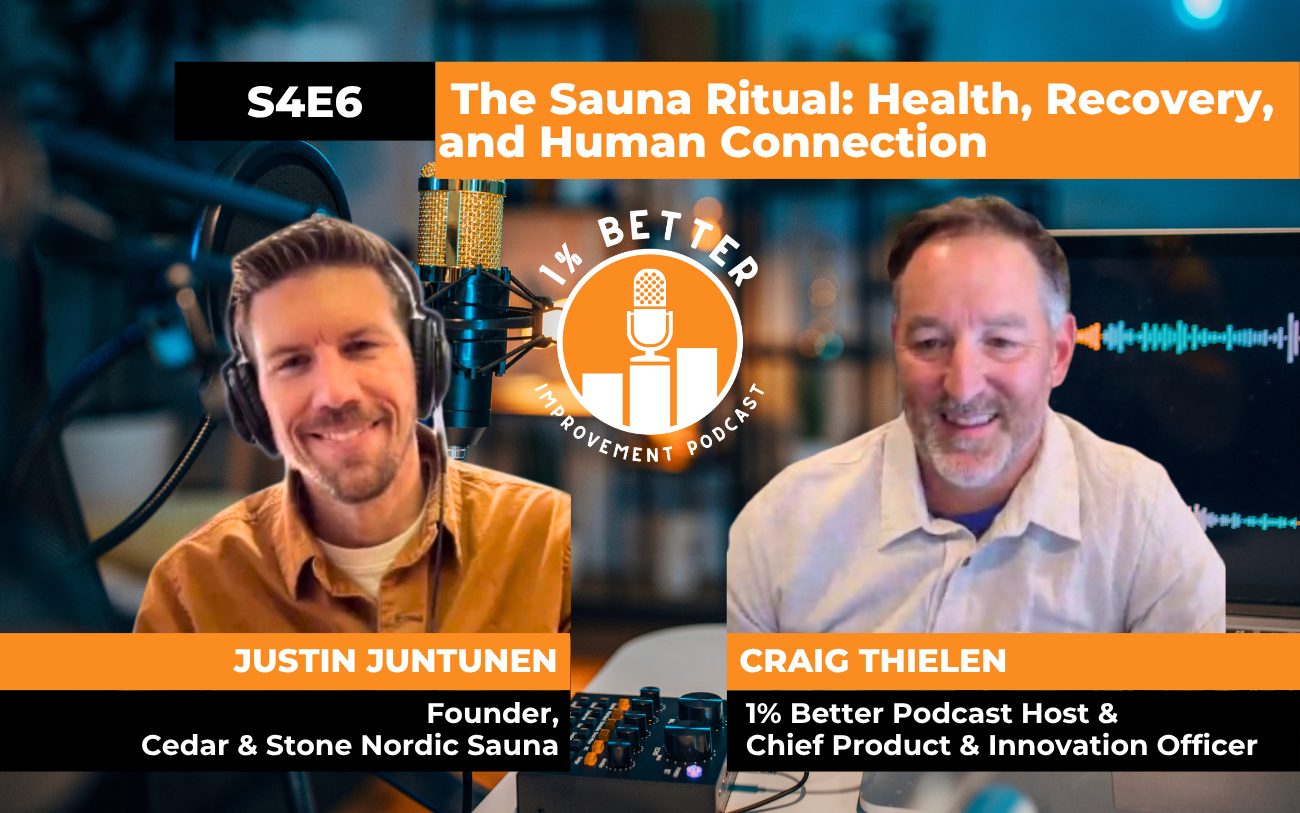
1% Better Podcast Justin Juntunen, Cedar and Stone – Quick Links
Learn more about Cedar and Stone Sauna
Check out Othership in NYC
Connect with Justin Juntunen on LinkedIn
Connect with Craig Thielen on LinkedIn
Check out host Craig Thielen’s full bio page
Key Takeaways
- Health is the foundation of improvement: Craig opens the episode by framing health – mental, physical, recovery, and how we show up every day – as the foundation for getting 1% better.
- Sauna is more than a wellness trend: Justin explains sauna as a time-tested cultural tradition rooted in ritual, consistency, and connection – not just another recovery tool.
- Traditional sauna and infrared are not the same: The conversation breaks down why definitions matter, especially when comparing Finnish sauna with infrared cabins or red light therapy.
- The ritual matters as much as the heat: Sauna creates space to disconnect from screens, slow down, talk, reflect, and connect with others in a way that is increasingly rare.
- Great businesses can be built from deep personal purpose: Justin’s story of founding Cedar & Stone Sauna shows how heritage, craft, health, design, and long-term vision can come together in a meaningful business.































1% Better Podcast Justin Juntunen, Cedar and Stone – Transcript
Craig Thielen (00:08)
I’m Craig Thielen, today on 1 % Better, we’re talking about improvement like we always do, but not just in your work or your goals, but where it actually starts, and that is health. Mental, physical, how you feel, how you recover, how you show up every day. The truth is you can chase performance all you want, but the foundation has to be there, and that’s health. One of the simplest, most overlooked tools for that foundation has been around for thousands of years, sauna, not sauna, but sauna. I think I’m going to say that right. Justin, my friend here will correct me a little bit later. This is a time tested tradition rooted in culture, ritual consistency, but now it’s colliding with modern science as a lot of things are. There’s a wave of new technology called infrared, near infrared, red light therapy. They all have great promises. Many of those are anchored back into the historic uses of sauna. Some are new.
So today we’re going to cut through all of that. We’re going to go deep. We’re going to talk about what works, what’s misunderstood, and how it fits into a real sustainable approach about getting 1 % better every day. To help us do that, I’m joined by somebody who’s not just used it or studied it, but someone that’s lived it in every sense of the Word. Built a business around it and brings both the cultural roots and the modern perspective together.
Welcome to 1 % Better, Justin Juntunen, founder of Cedar and Stone.
Justin Juntunen (01:32)
Craig, you are such a good hype man. Wow, I cannot wait to be here. I’m very excited to talk all things sauna or sauna, however your listeners are pronouncing it. I’m not gonna reprimand them, but we are gonna teach them why, the how, the benefit, all those good things. So happy to be here today.
Craig Thielen (01:48)
And that’s great. Well, honestly, I’m super excited for a lot of reasons. One of which is I’m big, huge fan of sauna. I’ve been personally doing it for 20 years and I keep learning more and I keep appreciating it more. And I kind of got out of the habit the last two years and now I’m really excited to get back in. And so I really can’t think of a better person to talk with about this topic than you. I’m sure lots of great experts all over the world, especially in the Nordic Scandinavian region. But you are a local Minnesotan group in the Duluth area, which for those, we’ve got listeners all over the world. This is Northern Minnesota, near Canada, and it is a very different geography and culture, it feels like you’re in Scandinavia. It looks like you’re in Scandinavia. It’s very different than southern Minnesota or what most people think of the United States. And so there’s a lot of history there. And of course, you with your background, with your ancestry, and then what you’ve done building a business and just a brilliant business. I can’t think of someone better to talk to this. finally, I’ll just get it out there. You and I had an opportunity to actually sauna together in your sauna.
Justin Juntunen (03:02)
We met in the sauna, We met in a sauna, right? -that’s actually where we met- I think that’s a good intro to this conversation is the fact that we met enjoying sauna together a number of months ago at Four Seasons where we have a location there, multiple sauna of ours overlooking the city and there I meet Craig and I hear about the 1 % Better podcast and here we are recording. So fun, circle moment and yeah, great. mean, sauna is the thing I’ve given my life’s work to, but it was the thing I grew up with my whole life before it was business, it was family pastime. so anything you want to dive into today, whether it’s health benefits, mental health benefits, impact on people’s families, cultural history, how to build and design them, I mean, that’s my jam. All those things are my jam.
Craig Thielen (03:47)
Well, let’s jump into, yeah, let’s jump into like the sauna itself. Okay. So a lot of people, I mean, I think everyone’s heard of them. I think everyone’s sort of been at a club. Not a lot of people, I don’t think it’s sort of built into their history or their habits. But let’s talk about, I mean, everyone I think knows that you get into a sauna and it’s hot. Whether it’s dry or whether it’s wet, it’s hot, and it just feels good. I mean, you come out of it and you feel better. I think everyone knows that. But I wanna dive into a little bit of the science behind that. Is it actually just a feel good? How does it really help you with performance, recovery, longevity, all of these things? Is this real? Is this just a feel good? Or let’s break down the science.
Justin Juntunen (04:33)
I love it. So for your listeners, you know, 1 % better, they are probably people who want to perform at their highest level or continue to progress whatever that highest level is, right? And when I think about what sauna is doing, we should be really specific here because there are different ways to look at the data that are going to get you different outcomes. So you might hear on your Instagram feed or Facebook feed or something like that, all these different health benefits.
Of which, I think there are many. And the science is now catching up. There’s both this cultural truth of what you said, it just feels good. There’s the proofs in the pudding of like, wait a minute, why do I sleep so well that night? After sauna, okay, that makes me feel good. I will talk about some of the mental health and social and emotional benefits. And on the physical side, here’s what we know. There are proven…
longevity studies around what happens to our bodies when we do this act. And to define it for your listeners, proper Finnish sauna is high heat with some humidity, medium to low humidity, not no humidity, not just dry completely. And you’re doing that act for rounds of 10 to 20 minutes at a time, cumulatively while doing that hot, cold, rest, rehydrate, repeat, you’re gonna do that two, three, four times. That act of sauna, that ritual has been studied. The seminal study was done by the University of Eastern Finland, Dr. Jari Laukkanen. This was many, many years ago, about a decade ago. They looked at all this historic health data and they found something. They said, wait a minute, the people in this study who use sauna regularly, the weekly users, one to three times a week, they dropped their all-cause mortality, dying of a cardiovascular event, by 27%. Whoa, okay. Then they looked at the people who used it daily, the four to seven times a week people, and they dropped that number by 40%. So functionally, it is adding years to people’s lives who use this regularly. Now, let’s be careful here because why is that happening? It’s happening because sauna is the laziest form of cardiovascular workout than you can do, Craig. So you can, you don’t have to go get out on the run, you don’t have to get on the Peloton bike, you can go sit down and sweat out. What happens is you’re giving yourself less cardiovascular work, your heart rate goes up, you’re in the heat, your heart rate goes up and all of your blood vessels open and widen. And so the why behind that cardio vet, the big headline that everybody references, is because they went back and they looked and they saw cardiovascular benefits, they saw good sleep, they saw lowered inflammation, they saw lower levels of stress, which impact all those other ones. And those things we just sort of know are good for our health, right? What’s happening now is as people begin to integrate this, there’s more study around it, what I think is happening is sauna is doing what sleep has done over the last 10 years.
Sleep has become a pillar for people’s health right next to eating well, exercise, sleep. Hot and cold, recovery is now the new trend that is not just trending because it’s been here for a thousand plus years, but it’s kind of being proved that, these are things that humans have figured out are really, really good for us over time. So the main initial lens to look through is that cardiovascular benefit. We still see some really amazing things when really your whole cardiovascular system, your veins, your arteries, and even your brain function, is based around, health for that is based on vasodilation and constriction. So then when we hop in the cold or we cool down or you go jump in the river behind your house, all your blood vessels close and tighten, your body’s like, ooh, survive. And what that creates is supple arteries and veins. And what helps them stay healthier for longer, and that’s true of both dementia and Alzheimer’s. We’re seeing crazy studies around that where people are lowering their risk for those things. And for heart and cardiovascular health. Because what it’s doing is it’s a great job of moving the blood. It’s moving the blood around and keeping your veins and arteries supple. Especially as later in age, that becomes harder and harder to do. Craig, does that make sense in just sort of simple terms why it’s healthy for people?
Craig Thielen (08:49)
Yeah, that’s a really, that’s a really good foundation. Yeah, I just want to kind of pull this together because I heard some different things in there and I just want to make sure that it’s all sort of fact versus fiction. So cardiovascular health, I think is pretty unquestioned. think there’s so much data around there. Sleep improvement, stress reduction, cognitive possible dementia. Detox is something that I think of often. I mean, you just think it’s pouring out of you, the water and the detox.
And there’s also some muscular, like I just feel like I typically do it after a workout. And if you work out, let’s say weightlifting, or let’s say you work out something that’s, you know, more strenuous on your joints, like running or pickleball or tennis or something, your joints are just aching and it takes all of that out. So is it, is it all those things or is it all tied around the cardiovascular and the blood flow, or is it more than that? Is it your endocrine system, your hormones, it getting into your muscles? Just how far does it go? That’s solid science.
Justin Juntunen (09:52)
Yeah, you know, the big study that we referenced right there, was the quick Google on this is Mayo Clinic sauna. You’re going to catch it right away. So if you want to go read the paper, there it is. That’s again, a cardiovascular benefit over longevity. Some of the other studies, the, the mental and cognition, those studies are done. Also worth looking at. Also go check the medical data.
The one that I would actually trouble a little bit for you is what do we mean by the word detox? Now, what we do know is sauna is really good for detoxifying, i.e. getting rid of soreness in muscles and inflammation in joints and in the body system. So that’s true. We know that. The science would prove that. That’s why after your workout, you go hit the gym, you go do the sauna, and then you’re going to be less sore the next day. It’s because you’re getting rid of all that lactic acid.
But part of that is because, again, back to our vasodilation and constriction, it’s helping move blood through that. It’s kind of help your system do that. What is also true, but I think sometimes a misnomer, is, hey, I’ve maybe had too many glasses of wine the night before. I’m gonna go sauna and detox myself in the heat. You know, that one I often coach people to be careful with because what’s happening
usually is you are dehydrating your body and getting rid of and expelling more water, salts, sodiums, and other things that your body’s trying to get rid of. Now, there is some science and some data around removing heavy metals, removing microplastics, if you use sauna a lot and regularly. But what I want to be careful is that one time moment after too many drinks, all that does is it sort of ramps up your usual systems of detoxification, your skin being one of them, your liver, you know, like it helps those things run a little bit better because it’s kind of amping up your system. So I don’t wanna claim that it is the great detoxifier as well. I think there’s some nuance in there. Now, there are some, these are areas that need to keep being studied. And there is some really interesting stuff around microplastics that I’ve even seen the last few months that I’m like, wow, if it’s true, more stuff to be had. But if that’s true, large scale, that’s a really interesting reason to be thoughtful about your regular sauna to use. I think I’ll add one little thing here is hot and cold as an act. One thing that it’s also doing is bumping up your sort of general your body’s idle, right? Your sort of initial level of like how much, what’s my normal and my calories and what am I burning usually? We see a lot of science around this from the cold therapy side. And sometimes they go really well together, but I will separate them and say, look at the science between both of them. There’s more conclusive data around heat therapy being good for your body than there is just cold therapy.
But cold therapy is good. It’s a hack sort of on your mental health. It dumps really good chemicals from your brain and people get addicted to it. People start falling in love with it. They’re like, I gotta do it. I feel so good afterwards.
Craig Thielen (13:01)
Yeah, let’s come back to the hot cold part, because I think that’s level two of this. want to jump into, just to recap what we just talked about, not only does it feel like all of those attributes, there’s tons of science and research around health benefits. And essentially what I heard you say is the more you use it, the better the health benefits are. If you use it one day a week, it’s good. If you use it two, it’s better. It’s all the way up to five to seven days a week. It’s just better and better. The data proves that. Now let’s jump fast forward into 2026. Okay. And if you follow any of the biohackers or the health movement, you are very aware of infrared, near infrared and red light therapy, blue light… It’s all you know bundle it together. Okay, and there is a lot of hype I have a red light panel that I use especially in the winter months Again, I don’t have my my sauna yet And I think there’s a ton of benefit to it. But one of the things that you and I talked about when we when we did a sauna together is You know They’re using a lot of hype and some of it is great and probably well founded, but I feel like they were sort of borrowing a lot of the, what we know as the health benefits of sauna. And you just made a very great distinction for me going, they’re not the same. They’re very different technologies. They impact your body. doesn’t mean there’s no benefit to red light or infrared or near infrared. I think there clearly is, but it’s different. It’s like comparing a fish to a dog or something. maybe go into that a little bit, because I think I kind of came into it almost like every time I heard red light therapy or an infrared near infrared sauna, I’m like, oh, it’s just the newer, more technical version of a sauna. And I kind of lumped them together. And after we talked, I’m like, no, I shouldn’t lump them together. They are very different. So talk a little bit about that.
Justin Juntunen (15:00)
Yeah, this is where definitions really matter. So, sauna, S-A-U-N-A, is the only Finnish word that got borrowed and brought into the English language. the only one, I’m one of those grandsons of Finnish immigrants. I have too many vowels in my last name. You’d be calling me Juusiyuntunen if we were in Finland together, Craig. So I love that cultural heritage. The Finns are more proud than anywhere else in the world around sauna. They have more saunas than cars in the country. It’s just so deeply in the culture there. Now, what happened when those immigrants came over, they brought sauna with them. And I’m going on a cultural trip before I come back to talking about specifics of this, but I do it because when we as Americans think about the benefits of these things,
Craig Thielen (15:31)
That’s crazy. Love it.
Justin Juntunen (15:51)
We often are borrowing cultural traditions and saying, look how good they are. This happened in yoga, right? Originated in India, got brought over. Okay, let’s like understand that for an American audience. That’s what’s happening in sauna right now. We know there’s some benefit behind it. We know other places in the world do this. We maybe don’t know exactly how to practice it, but it seems good, right? Okay, and then you get sold to and there are plenty of companies that are happy to sell you those goods. In the last 25 years, we’ve seen a huge increase in infrared sauna modalities. And I say sauna with air quotes because they’ve changed some of the key ingredients. I’ll say what those are in a minute. Traditional sauna is high heat, low humidity.
Heating ranges from about 160 Fahrenheit to 200 or 210 or 220 if you’ve really been a pro and you’ve built a tolerance to it. You also in Finnish sauna are heating that room with a lot of thermal mass. So you have wood walls, you have stones, and you’re actually trying to heat from the stones themselves. You want to heat them up and let them radiate heat to you.
That can be done with electric resistance heating. That can be done with wood fired. That could be done with gas in some instances and propane. It’s most commonly done in the states with electric heat. Unless you’re up at the cabin or in your far northern Minnesota like me. Minnesota is the sort of land of 10,000 saunas as well. So we have lots of vocabulary around this. But I bring it up because infrared is a very different technology and process that is mostly using infrared light and radiation without as much air and sort of heat that is convective heat in the room. So you’re using that heat that is only brings the air temperatures up to most of the time at max around 140. What that means for some people is it’s a great in-road to sauna. Maybe it’s their gateway drug of like they like discover it in the gym or they heard about it somewhere. They went to a wellness facility. They did infrared and they were like, that made me feel good. That’s interesting. But what they don’t know is what they are missing out on because they’ve been basically given sort of part of the meal and then they’ve removed some ingredients. They’ve removed high heat. They’ve removed thermal mass. So you’re actually just feeling it from these infrared panels and you also removed all the thermal mass of stones, which is part of the sweetness here, Craig. Most people think sauna should be this endurance challenging act. They think it should be hard and painful because that’s what we’re shown in the movies is sauna’s scary and there’s maybe wrestlers who wear like a rubber suit and they just try to make weight in the sauna. So I think to no pain, no gain. I better endure it. Sauna should be enjoy, not endure. And I bring that up because these traditional forms of it care about both the process and the quality of the heat. I’m a geek about heat like people are about wine and beer and spirits and food. And in infrared, they’ve basically just taken microwavable food and said, hey, here’s some calories. You can eat it. It’ll be good for you. And sometimes we do need microwavable food. But what the misnomer here is- when it’s quick it can be helpful if you’re hungry, but it isn’t as nourishing, right? I think we can agree on that. And the infrared companies often are taking the same studies that are done on traditional sauna and saying, look, look, look, look, look, sauna is good for you. Our version of that will do it as well. And that’s a little bit like saying microwavable food will do the same thing for you as good organic farm to table vegetables, right? And I think we all sort of know, wait a minute, that doesn’t make sense. You have different inputs, you’re not gonna get the same outputs. In other places around the world, infrared is so different that they don’t even let you say sauna. In Germany, Germany are very, they’re very regimented, they like their measurement. They won’t even allow you to market an infrared space as a sauna. They say it’s an infrared cabin. And they say that it can be used for health therapy in some ways, but let’s not confuse it and conflate it. That’s sauna and these are traditions. That’s there. I have some more to say, I mean, broadly, Craig, I think that’s the heart of it is that you want to you want the studies to be done on the thing that you’re trying to do.
Craig Thielen (20:03)
I think that’s the biggest thing is let’s separate them. I’m actually reading a book right now called Red Light Therapy and it’s by Aery Whitten and it’s a great book, okay? And there’s tremendous amount of health benefits to red light therapy. I think they call it PPV or photogenic biomodulation or something like that. because it includes a whole different bunch of different kinds of, lights, infrared, near infrared, blue lights, et cetera. But it’s, I think the biggest walkway for me when I’m talking with you and again, hearing this again, and I think we all just, we hear the word sauna and that just connects it together, we shouldn’t, we should actually get rid of the sauna on the red light part and just say that’s different technology.
They both, I think, have great health benefits. That’s my personal opinion. But they’re very different, okay? Like you said, just how they work and whatnot. And one of things I was gonna ask you is around the heat part of a sauna, and I’m not even gonna call the red light sauna anymore. That’s like out of my vocabulary, just like the Germans. That’s my heritage. So I’ll follow them on this one.
Is it better, do you think, in any way? Because I gotta imagine that historical use of sauna was wood. You know, going back hundreds and thousands of years, it was wood because that’s what we had to create heat. Do you think there’s still some benefit to wood as the heat source versus gas or versus electric?
Justin Juntunen (21:45)
So the difference in heat, and one of your questions is, is there benefit in that, right? It’s deriving sort of this like, it, do I get some added benefits from doing something more traditional in terms of a wood-fired heat? I will say two things about that. One is qualitatively, Craig, I think we should be thinking about both the feel of the room, if you are going to want to do that thing regularly.
And so I think that what gets people into these things is the initial benefit physically. What keeps them doing them for the long term is how good it feels, the impact on their body, and what it does for them socially and emotionally. And if we can make that experience more enjoyable, I think it’s more likely that we have people continue with it. And so the people who continue to run, become runners and they think it’s fun because they’ve done it and they understand it and they get used to it and their body’s used to it. So I would think about it in that way. So number one is wood-fired sauna can be beautiful and enjoyable, dare I say romantic, watching the flame, meditative, poetic, chop wood. People love, especially in the North like us, people love chopping wood, making kindling and starting a fire. That’s inherent in us. That is good in and of itself. Now, specifically, is the heat, does it create something different? I’ll say this, I’ll say that most of the data shows that one thing you’re trying to do is bring up your core body temperature. And if you can get to higher heats, not just in sort of one 10 minute sitting, but over the course of that sort of hour that you’re gonna do sauna of, those multiple rounds.
Craig Thielen (23:06)
Yeah. Yeah.
Justin Juntunen (23:26)
If you’re in those proper temps, and I’m going to say 160 to 200, you are going to get the ability to slowly bring your body temperature up. And it is easy to do that in wood fired. It’s possible to do it in electric. It’s really tough to do it in infrared. And so if we’re looking at those heating types, I would advantage ways that get you to those higher levels of heat. It’s a little like talking about going running and
basically saying, you’re gonna train for the marathon, but all you can do is walk. And if you’re gonna train for the marathon, running a marathon, but all you can do is walk, it’s a little like saying, I wanna bring my core body temperature up, but all I’m gonna do is go in the infrared sauna. It’s not as much heat in that room-
Craig Thielen (24:07)
I was talking more about is there a meaningful difference from wood heat to electric heat to gas heat? again, I’m not even including the red light part of it.
Justin Juntunen (24:18)
I think what’s common is there is more, in general, more stone and thermal mass, more rock on wood-fired heaters than most, not all, but most electric heaters. And the more you have of that, the sort of smoother and softer the heat and the steam is. And so there’s a qualitative sort of nuance there that makes it feel better. The other thing I’ll say real quick,
around this distinction too, and this is one of the things that people sort of miss, anything that has heat in it will emit some level of infrared radiation. The sun is the largest emitter of infrared rays. And so what people sort of forget when we think about infrared cabin, infrared sonic experience, is we’re just getting that one level of heat, that infrared.
Craig Thielen (24:54)
Absolutely, absolutely.
Justin Juntunen (25:07)
But if you do a wood-fired sauna or you do an electric sauna where you are heating up those stones, they are also emitting infrared heat into that room. And so it’s almost like you’re getting both at the same time. And so I would really help people to sort of double down on the science, the culture, the quality. Those are all reasons to be thinking more about these traditional methods.
Craig Thielen (25:15)
Hmm, interesting. I didn’t know that. Yeah, I didn’t know that.
Justin Juntunen (25:31)
And that’s why, that’s what we do. You know, we sort of invite people into those experiences. We teach them and train them on it. Tens of thousands of people a year come into saunas with us, as well as we design and build for people for their backyard so that they can enjoy it at the highest level. So they can be a part of this and say, Hey, I get this every day in my backyard. First thing in the morning, I set it. It warms up for me in the morning and 1 % better. I know I’m going to be in that routine first thing in the morning, five days a week.
Craig Thielen (25:36)
Yeah, let’s get, let’s shift into that a little bit. I think that’s one thing that’s very different about, as you called it, the home cooked meal from your garden versus the microwave, meal. I’m not sure that analogy plays out, but let’s just take that for a second. There’s so much ritual and there’s so much to the experience. By the way, for what it’s worth anecdotally, I personally think there’s a massive difference between a wood sauna and any other kind of sauna. And I think there’s something to the ambiance, the environment, not only the light of the fire, if you happen to be able to see that, but the smell of the wood burning. And obviously you can burn different types of wood. The crackling of it, the acoustics of it.
And I was wondering if there’s something actually different about the heat that’s generated in some sort of, you know, scientific way. But I just personally, if all things being equal, I think that is like the ultimate sauna experience. Now, the challenge is we don’t have time to go start the wood stove and it’s not very practical in your house as much as, you know, being outside of your house. And so there’s some limitations with it, you know, just from a speed, but man, it’s just, it is like, just brings you back into time. And there’s something about that, that feel that I think is like, I’ve had a sauna for, like I said, 20 years and it’s electric and it’s great. And I would do it and I could set it and turn it on and do my thing, but experience in a wood, just think is that’s like next level. And when I first thought of that was when I was in yours, at the Four Seasons in Minneapolis, and not only did you have these beautiful outdoor saunas? But you brought into it, Aromax or you brought into it, you know, smell and you brought into it. Yes. Essential oils. And that was like, wow, that’s a game changer. And it just gave you different senses. And then you had some different things to drink like electrolytes. And then I’d always done just like a session, right? So you warm it up, you do your thing, and I would do like 170 to 180 was kind of my zone, and I would do it for like 20 to 30 minutes, and then I would be done. And then when we did yours, it was like an hour long, and we went in, and it might have been a little hotter than that, but we went in for like 10 or 15 minutes, and we went out, and it was kind of chilly, which was just brilliant. And then we had a little drink of electrolytes, and then you’d bring in some smells, you’d bring in some snowballs. it was like an experience. And that was completely different level for me. And then the hot and the cold part where I wanted to get out of the sauna at the end of my 10 or 15 minutes. And I wanted to go back in and my body is just like going back and forth. But all of that, I think is really beneficial. Your body is all the things that you have going on, the organs, the endorphins, the lymphatic system, the liver, who knows what all the stuff the liver is doing.
Your skin, which is your biggest organ and just all the things that you have going on not to mention the mental part, which again the the whole experience of it so that kind of ties into I want to bring in You started talking to me about Craig this goes back in my family This wasn’t just something we did to be healthy or this wasn’t something we did after workout. This was part of life This is where we got together and talked about things. This is where we bonded so talk a little bit about that tie in with the ancestral part of it and the tradition and how we can pull some of that forward into this experience and how that enriches it.
Justin Juntunen (29:25)
Oh man, that’s… I think people get into it because of the… the heard physical benefits. I think I’m gonna get something out of it. They stick with it because it feels good. They’re changed and transformed by the depth that you’re starting to describe. The fact that they realize that most of their life is glued to a screen, distracted right now in 2026, like our attention is just being grabbed all day every day. And we don’t have these moments where we pause. We don’t have many of these moments where we have ritual. We don’t have these moments where we don’t have a screen next to us for an hour, and we have real humans sitting right next to us to have conversation. And the sauna becomes this great equalizer. One of the things that I love, this old Finnish proverb is, all people are created equal, but nowhere more so than in the sauna. It’s this idea that you can come, whoever you are, the dignitaries, the business owners, the teacher, and you come in there and you’re just humans sweating together.
Craig Thielen (30:24)
True. Hey, you can’t wear any of your Gucci or any of your stuff. You’re just a human and you’re just in there sweating it out.
Justin Juntunen (30:35)
And your iPhone battery doesn’t even work. It’s gonna give you that little temperature thing and say, it’s too hot in here to do this. And I bring that up because I think a lot of people get interested about the benefit and they wanna measure it. And I would gently urge them to say the measurement’s gonna be when you begin having memories with your family members. That was the time where I finally was able to talk to my daughter about that thing that was really important. That was the time we spent some deep, meaningful time as a family all connecting and you know what? We heard about the hard stuff that was going on. That was the time when my friend came over and he opened up about the fact that they were going through infertility issues. You know, the sauna is this safe space for conversation, for connection, to be known, to belong, and that’s what’s often missed in this health and wellness conversation around sauna is just a tool, just another piece of workout equipment. But when I would get together with my family, we would always gather and the dinner table, I’m sure we would eat, but at some point somebody be heating the sauna and we would all go use it. And it would just happen like it was automatic. I did this two weekends ago. We all went out to my dad’s.
My sister came, all the cousins, had grandmas and grandpas, and we four generations there. We had 80 year olds down to three year olds. And the sauna was warm and everybody was in it at some point. And I think that idea, right, of what are the spaces that you can create for your most deeply cared for loved ones that welcomes everybody, that actually makes space for everybody. We don’t have a lot of those in our fast paced American culture right now.
Craig Thielen (31:59)
I can’t honestly just want you described and I cannot think of anything that’s like it where you can. I mean, maybe the closest I can think of is a dinner table there’s still people on their phones, though, the kids, especially maybe, but kind of put it down and we’re all focused on eating for, you know, 20, 30 minutes. But I can’t think of another place where you literally transported into another world. There is no technology. That’s one of the things I love about it. I guess one of many because I’m I would never bring my phone there because I think the thing would melt down and malfunction and just and and you can think even if you’re in there alone. but when you’re in there with other people like you have nothing else to do but either just like meditate relax or talk and how where else can we do that in a place that has zero distractions and we’ve got all this goodness, infiltrating our body and it brings us into another state, another world. Like I can’t think of anything like it.
Justin Juntunen (33:12)
Yeah, it helps because you’re also doing a ritual together. You described the ritual really beautifully, Craig, and that ability of here’s a thing we’re going to do, it’s going to feel kind of hard at a few points. We’re going have to take the heat, right? We might have to go jump in the cold or roll in a snowbank or go outside and feel. A couple of weekends ago, I walked outside and laid in the snow with my seven-year-old nephew, and he was just like, you know.
Craig Thielen (33:17)
Right.
Justin Juntunen (33:40)
That whole weekend I’m trying to be fun uncle. Just that’s my goal whenever I’m with my nieces and nephews. I want to be the fun uncle. And out of that we had so much fun and so many memories are starting to be, you know, come out of that. I think that when I look back on that and when I hear the folks who have, you know, invested in the sauna for their home and I talked to them years later, they don’t talk to me about their heart health.
They occasionally talk to me about the pain, the stress relief and the less pain they feel, the mental clarity. But really what I get are stories. I get stories of impact of that was the spot in the yard we never used, we never went. And now it’s become the favorite thing where our family gets together and gathers. And so I think those are the kinds of things that I’m trying to sort of keep leaking into the world preaching into the world around this as a concept is the impacts are deeper than you think. And so I’m often asking people, you ready for that? What could you do to create more space in your life to both impact your own heart, but also impact the hearts and lives of your family broadly? And I think that’s the thing that’s worth committing to, to doing all the hard stuff, to working on, to developing and building.
And that’s what, you know, for our company, that’s why we have 71 employees here building beautiful saunas and sending them all over the country. And they’re going to places that are different than Northern Minnesota. mean, we’re literally California, Florida, Boston, Texas. mean, the world, North America is sort of discovering this for the first time. And it is such a joy.
Craig Thielen (34:56)
That’s awesome. Yeah. That’s so cool. Let’s hit that. Let’s dig into that. So you started founder of a company that makes saunas very high end. I’ll call them luxury saunas called Cedar and Stone. I got to experience it. Amazing. Just, the nicest built quality and everything is just amazing. But why did you start the company? So, clearly this is in your heritage and you enjoyed it.
But why’d you say I gotta go and start a company to go build these things?
Justin Juntunen (35:42)
Yeah, 15 years ago, Craig, I went to Finland with my wife. And we were living out east at the time. We were going to come back to the Midwest, move to Minnesota. We were like, all right, we’re going to do our trip to Europe for a little while. We’re going to go visit the homeland. And while we’re there, we did all these public saunas. And one of them was floating on the Baltic Sea. And I…
Craig Thielen (35:59)
Wow, so they have public So they have public saunas that anyone can just walk into?
Justin Juntunen (36:03)
Absolutely. Yep. Go buy a ticket. Go pull in. So if anybody’s listening, reach out to me. I’ll tell you which ones to go to. I’ll give you the itinerary of the sauna of Tour through Finland. Craig, we’ll go together.
Craig Thielen (36:14)
It’s already on my list. We’re going to do a Scandinavia tour here sometime soon. So I’ll be hitting you up for that list.
Justin Juntunen (36:20)
So while we’re there, I get in this little rowboat with this Finnish man and he rows my wife and I out and leaves us on this raft to sauna and swim and sauna and swim. And it was just magical. And I told my wife, Gretchen, said that day, we could do this in the States. And as any supportive partner would and should, she rolled her eyes at me and said, sure, honey, what are you talking about? We’re gonna do this in the States. I have no clue what you’re talking about.
Craig Thielen (36:26)
Cool.
Justin Juntunen (36:46)
And that was the day that sauna of flipped in my mind from family pastime, the thing that I know and love and I always talk about with friends to this could be a business someday. People would pay for this. This is valuable. Moved back to Minnesota, moved to Duluth, the city right next to my hometown, really fell in love with Duluth again. Saw this entrepreneurial culture that was burgeoning. I like, I love getting to be here on the world’s biggest beautiful lake, Lake Superior, seeing nature, and I was like, what a perfect place to start a business around sauna… the city that 100 years ago was called Little Helsinki. And so seven years later, seven years later, we opened the doors to Cedar and Stone Nordic Sauna. We’ve opened a public sauna here.
So you can come and book a session with us in Duluth or Minneapolis. You can then also work with us as a design build experience where you can buy our products and we will send you an heirloom quality sauna that’s gonna last for generations. The luxury side of it is right, Craig. Also what’s right there is you get what you pay for. And most of the sauna of world is kits and barrels that are sort of designed to last for three to five years.
And again, I’m an intergenerational guy. I think these things are valuable deeply and for a long time. And so our take on that is you should invest in something that will last you for decades because the impact is going to be there. So today we’ve grown over those last six years together. We’ve shipped them all over the country. Last Friday, we actually signed our first contract. We’re sending our first one to Mexico. That’s fun.
Craig Thielen (38:23)
Wow, that’s kind of crazy because you think Mexico, it’s the last thing they need is something that’s hot.
Justin Juntunen (38:29)
Right, yep, think you think about it as a cold weather experience, you think, yeah, it’s like ice skates and cross country skiing. But when you think in terms of the benefits for family and humans and body, well, hey, that’s good no matter the temperature outside. So, yeah, it’s been a joy and that’s kind of the undergirding, a little bit of the origin story. And now I’m just super proud because our team is really talented. We’re solving amazing problems. We’re growing and scaling right now and those are different problems than when it was me caffeine and a dream starting something getting off the ground early entrepreneurship days. Now it’s organization building and moving things.
Craig Thielen (39:04)
Very different. Yeah. lot of logistics, supply chain, employees, know, all the, challenges of a business. But I want to just go back a little bit more you could have built any kind of sauna and the price point you could have said, Hey, I want to get this to as many people. got to make it inexpensive. they have saunas now that are, like little tents and sleeping bags and as you said, they got some that are kind of like China, like components and stuff. But yours is very high end. this thing is absolutely built to last generations and it’s beautiful to be in. So did that evolve after you, did you study the market and say this is a niche that needs to be served? your customers, like what brought you to go, because it’s not easy to come out and say we’re gonna be the best or we’re gonna build the Tesla of the car or we’re gonna build the, you know, it’s a lot more expensive in fact to do that, to build that brand and the equipment and the materials and the price point and everything. So just curious how that evolved for you.
Justin Juntunen (40:05)
Well, let me tell you another story. I built my first sauna with my dad when I was three years old. And my whole life there was, again, sauna was this form of utility. It wasn’t opulence. It wasn’t luxury. was this is how we made it through. This is what we did and we do. And so every home we lived in, there would be a sauna built at some point, whether in the basement or the backyard. If was at the cabin, okay, it’s going to the cabin. –
Craig Thielen (40:10)
Okay. Just like having an attached garage, you’re going to have a sauna.
Justin Juntunen (40:30)
Exactly. So I have this background of sort of being a, you know, Finnish immigrant family building this cultural tradition wherever we were. And I heard this phrase from dad and grandpa every time we built one. And it was burned into my mind. It’s humble. It’s, it’s Nordic and Midwestern. It’s good enough for who it’s for. And that is both this like, don’t be too proud, build it simple, just enough, good enough for who it’s for. But every time I heard that, it always grated at me. And it was always this, but could it be better? Could it be more beautiful? What if the person who it was for, if we flipped it over, wanted the best? What would that mean? What would that look like? How would we build it? And I began to look at the market and do the research. there was a chapter between floating sauna on Baltic Sea and starting the business where my wife was like, honey, I can’t have you telling everybody you’re going to start a business and just quit your job. We’ve got two little ones at home. I need, I need to see some numbers. Yep. And so I, you know, I wrote a 47 page business plan and I said, I think this is how we do it. I think this is where we go. I think this is how it works. And I was always inspired by modern design, Nordic design, high end craftsmanship, things that were built well heirloom quality brand and I saw none of that in the market. I saw a lot of cheap kits. I saw a lot of barrels. I saw a lot of things that to me as somebody who knew looked like the ripoff of sauna. The sort of like let’s do it at its easiest cheapest level. You can go to Costco today and buy a barrel sauna. That’s fine and you miss a lot of things in that experience of it versus what I think we do. And so we from the get go had a desire to build beauty and longevity and craftsmanship into it. Those were core ingredients and distinctives. And now years later, we’re sort of known as one of the brands that if you want the thing done well by a company who understands it down to the quarter inch and understands it to the type of wood. Well, people feel that way about cars and they go find one that’s engineered and designed really well to drive really well. And I, we sort of committed to that level of detail around this really unique design problem that was sauna.
Craig Thielen (42:41)
Yeah, it’s awesome to see. I’m just curious when you’re in Finland, is this a thing super premium, nice high end? Is there a lot of these kinds of companies there? Clearly there wasn’t here.
Justin Juntunen (42:52)
Yeah, in Europe it’s a much more mature market, so you have some of everything. And in Finland specifically you have one of everything because there are so many saunas there. I’ve sauna’d in a sauna of the shape built into a phone booth. An old phone booth. We don’t have those anymore. Kids, before cell phones there were little booths that you had to go pay. So the experience abroad is yes, there is high, medium and low. And in the States, there’s quite a bit less and the market’s huge here. So there’s both things happening, right? Is like both the market opportunities big and the market’s very immature here. And so as I said, hey, what could we do? How could we do it? I think there’s opportunity there. think there’s an ability for us to go to it. And I just happen to be a storyteller and a marketer of these things. I know enough that I think we can build a brand that is not just shiny and opulent, but actually has something to say and inspires people towards a better way around this. I think it’s interesting to then look around the market and you see huge 150, $200 million companies and our brands sit right next to them, our social media looks just as good, our website looks just as good. It’s because we committed to telling that story at a really high level. And we aren’t the $150 million company yet, but do I believe we could get there someday? I think we could, and we’re gonna keep building towards that.
Craig Thielen (44:13)
Yeah, awesome. Well, I mean, I think the market, you hit the market at the right time in terms of just health and wellness and longevity and people are, you know, really spending a lot of money on all sorts of different modalities. So I’m curious. So on the ones you’ve built, cause you build, a standard set, people can go to cedarandstonesauna.com dot com and find you out there, but you also do a lot of custom stuff. So what’s the smallest one you’ve built? What’s the biggest one you’ve built and what’s the most unique one you’ve built?
Justin Juntunen (44:54)
Great. We have a bunch of standardized pre-designed models that are beautiful that you can customize to your own needs. You want two to three people, four to six people, six to eight people, we got you covered and they’ll be great. We’ll get them to you. Those range mid 50K to mid 80s usually for folks and that’s delivered to site. We’ll wipe the windows down. We’ll connect it to your wifi. You’re gonna love it. So that’s like investing in a car.
You know, we’ve done a lot of those over the years. That’s our bread and butter. We have also, Craig, done some super cool, super fun projects. I told you the floating sauna of story. A number of years later, we put a floating sauna in the Duluth Harbor. And then a couple of years after that, we sent one out to Seattle, Washington. And so we’ve done two 40 foot long commercial floating sauna is that are so unique and so beautiful.
There’s something about sort of being on the water while you’re in the sauna and enjoying it, watching the glint of the water around. In ours, you can look right out the lift bridge at Lake Superior from the floating sauna, super fun. And then we’ve done one, this last year we did the US’s largest public sauna. It’s in Brooklyn, New York. It’s for a wellness facility called Othership some dear friends. And it’s huge, it holds a hundred people at 700 square feet. That’s half the size of a lot of people’s homes. It is it is a multi-tiered, multi-sensory experience where you can go in and book a session with them and they’re going to guide you and walk you through it. And it’s amped up and vibey and big music and lights. And it is pageantry different than the meditative, quiet, you know. But has its place is a great experience. if any listeners are in New York City, go check out Othership in New York. Yep, yeah, totally, yep. And those experiences are popping up all over the country. So we’ve worked with a lot of both hotel, hospitality, apartment complexes looking to add sauna to it, and businesses that are sort of opening, that are looking to introduce more people to this. Whether it’s the fitness or wellness concept or almost like a Nordic spa or a thermal spa experience that’s adding sauna into it as well. So some really fun things happening and we love getting creative and bespoke around those things and our bread and butters, the backyard, you keep it, you enjoy it all day every day.
Craig Thielen (47:18)
So cool. Yeah, I think there’s something about the outdoor part of it as well. When you can interact with the outdoors. your facility at the Four Seasons in Minneapolis, it is. It was really, really good. And they have an amazing wellness center, beautiful and big, but we weren’t in there. We were out on a patio overlooking downtown Minneapolis at night in the brisk air…
I think it was February or March and to just be there in this sort of urban vibe and then you do sauna and then we come outside and you get to see that. that’s very different than doing it in the back woods or doing it, you know, by the river or whatever. But I just think there’s something about that interacting with nature that is a, extra layer of that whole thing that frankly I didn’t get, you don’t get by going to the club or just doing it in your basement.
Justin Juntunen (48:11)
I’m going to go full circle with you here. know, there are the benefits and health benefits of these things sometimes that we miss are so multifaceted as humans. There’s a thing called biophilic design, which means when you are in rooms that have more natural materials, when they have, I’m holding it right here, beautiful wood in it. When you’re in a space like that, you’re happier and you feel better. Those spaces are better for you.
So biophilic design. And there’s the experience, the Japanese have perfected it, it’s called forest bathing, where you go out in the woods and you’re, you are a healthier person, you lower your stress levels, your hormones get rebalanced, you feel better afterwards when you get out in nature.
Craig Thielen (48:52)
Their doctors actually prescribe it. So if you go to a doctor in Japan and they see that some of your indicators are off or you’re stressed or you have this, they will prescribe so many hours per week of being in nature and all your vitals get better.
Justin Juntunen (49:07)
So I say that because sauna is this unlock to enjoy the outdoors 12 months a year and to do it with this ritual to get you outside no matter the temperature. And in Minnesota like us and in the north, it can be harder to get outside in winter because it’s cold. Sauna teaches us how to conquer winter and proves to us that our bodies can handle it. We can handle the heat, we can handle the cold. Now here’s the thing that most people don’t know.
And you said it earlier, Craig, you’re like, they probably don’t need a sauna in Mexico because it’s so warm up there. Also, what’s true is we feel temperature in comparison. In the winter, it’s relative to what it has been. So in the fall, we put on our cozy sweaters when it starts getting chilly. And in the spring in Minnesota, people walk around in flip flops and sandals at 40 degrees outside because they’re like, it is not negative 10 anymore.
Craig Thielen (49:42)
Hmm, it’s relative. It’s like Einstein figured this out. You can feel the sun too.
Justin Juntunen (50:00)
And the same is true for heat. So if you are training your body once a day or a few times a week in 180, 190, 200 degrees, the heat of the summer is never sweltering. You’ve just trained your body at 100 degrees more, and you come back and the rest of your days feel nice. And so I want to make sure people sort of see it as this four seasons experience to get out into nature, to get out into their experiences of health.
Craig Thielen (50:11)
That’s true. It’s very true.
Justin Juntunen (50:27)
And that’s a thing we’re trying to do no matter where they’re at. And we’re going to talk them through, OK, here’s what it looks like to use sauna in the mountains. Here’s what it looks like to, we have our sauna is looking at both ocean coasts right now. I’m like, what a cool thing, right? Up in Maine, you can go look at the Atlantic. And over in California, you can go look at the Pacific in one of our sauna. That’s amazing.
Craig Thielen (50:38)
Yeah, I believe it. Very cool. Well, hey, an hour’s flown by. Wrap up last question here for you, Justin. Just put all this sauna business to the side and just go back to that saying, which is we’re all equal, but we’re no more equal than, more equal. What is it? We’re all born equal or created equal, but no more than when we’re in a sauna.
So just as a human, your life experience, give a little bit of what you’d wanna pass on to the next generation, again, outside of just the sauna of business that you’ve created. Life lessons, things that you’ve learned, things that you wanna pass on, 1 % better advice.
Justin Juntunen (51:22)
Yeah, the 1 % better advice to me is I’m going to come at it from a kind of that entrepreneurial angle as somebody who was the starter is it’s more common for people to create a business that is really just based on those numbers. And can we get to a certain level and can we go execute on that? And that’s fine. That’s a good enough reason to build a business.
And at the same time, I think it’s really common for people to outrun their vision. And so for me, the thing that I spent about two years discerning, how am I going to build this business? What are the steps or the process? And so I would encourage people to go deeper and dig deeper on what is their why and what are they really trying to do as they launch something.
Or as they get better at something. This is also true for your family. This is also true for your career and your profession. You know, if you were working in something like, I think most people, especially if you’re in the 1 % better habit, you’re going to achieve that goal. My question is, what’s the goal 10 years beyond that goal that you want to be shooting for? Because I think you’re going to get to the first one. And rather than get to that one and then be disappointed and say, all right, I’m going to go switch gears and do something else.
I love it when people go super deep and they say, do I, know, James Clear habits stacked my way into atomic habits that really get you far. And I think for me, that was something that I learned early on was have a big vision, go, scale, think you can, you could dream about scale. And for a number of years, I didn’t think I could, I didn’t think I had permission to think big about the business and I had an unlock. had some people in my life and I went to the universe and I said here’s my little idea for a sauna of business here in Minnesota. And Craig, what I heard back from the universe or God, however you want to speak about that, more clearly than ever I’ve heard in my life that divine sort of called it, that’s what you want to do? Well the assignment’s this. The assignment’s way bigger than that. Do you want that? I said I didn’t think I could even ask for this. Can I?
Can I ask for a little more than a handful? And I began to have a much more expansive view of what we could do and the impact we could have. And that’s given me the belief that our team can achieve that goal. We just went into a new manufacturing facility this last year and it scares the bejesus out of just about everybody who walks into it because it’s huge. And I had all this muscle memory of the same experience of our old shop that we were in for five years.
I remember walking in that room and saying, wow, this seems big. Do think we’ll ever fill it up someday? And now we’re doing the same thing with 10x the amount of square footage. And so my encouragement is like, think big, think deep, have a vision that’s bigger than you think you’ll ever get to, and you’ll still probably get to it if you keep at it. I think that’s the 1 % better kind of challenge. It’s incremental action towards that big goal. And so set the big goal.
Craig Thielen (53:53)
Yeah, you nailed it. And that’s beautiful. mean, these sayings sometimes are trite and trivial, but what I appreciate about you is, first of all, thank you for sharing that. think as humans, for some reason, we don’t think big. We tend to kind of minimize ourselves or we just think it’s too big and we can’t accomplish it. And that’s 100 % what the 1 % Better Mindset is about. It’s about getting better every day.
But you have to have something that stretches you and that you’re shooting towards. And what I love about what you’re doing is number one, you’ve just created a wonderful product. That’s just flat out. Okay. But there’s a lot of companies that have wonderful products. You have created a wonderful product that is it’s you, it’s you, and it’s, it respects every one of your customers, makes them better. It respects where you’re from and where you live because you’re making your community better. And it brings that heritage and you’re building a business. It respects your heritage and the millennia and the multiple generations of family that you’ve had that have taught you what you know and your father and your grandfather and all the family. And you’re bringing all of you and you’re not losing it as you’re having some success because I know one thing you said and I think this is really, I commend you for doing this and I think you should keep doing this, which is don’t fall into I’m the CEO and I need to make every decision, I need to manage this and run a business that deviates away from your vision and deviates away from who you are and what your purpose is, which is all of the goodness that comes with building this product and you being sort of the visionary and being the storyteller and being that person, your company needs that. Just like Steve Jobs, was that for Apple and what they would have never accomplished. I think they’ve lost their way, frankly. So keep being you, keep thinking big and keep being that because it is inspiring. Anyone can look for product and specs and all these kinds of things, but people wanna be inspired and they wanna be connected. And I just wanna commend you for what you’re doing.
Justin Juntunen (56:08)
Thank you so much Craig. It’s a it’s a it’s a the thing that I am committed to and it is joy and I think it allows me to also empower the team to say hey it doesn’t have to just revolve around me. I can be the sounding board right? I can be the bullhorn and get it out there and preach the good news of sauna all day every day and I do think it allows us to make better decisions as a team as I begin to say hey I don’t have to do everything. This doesn’t just have to be through me.
But what a joy to get to be on here. If anybody’s listening in, cedarandstonesouna.com, come visit us, come sauna with us, come hang out with us, come see the design studio and the new production facility. Let us know if you got a backyard or a cabin that we can send a sauna to, would love to. And Craig, honor to be on here with you. Always a joy and look forward to being in a sauna with you sometime soon.
Craig Thielen (56:43)
Thank you, sir. Can’t wait. Thank you.
Check out other podcast episodes