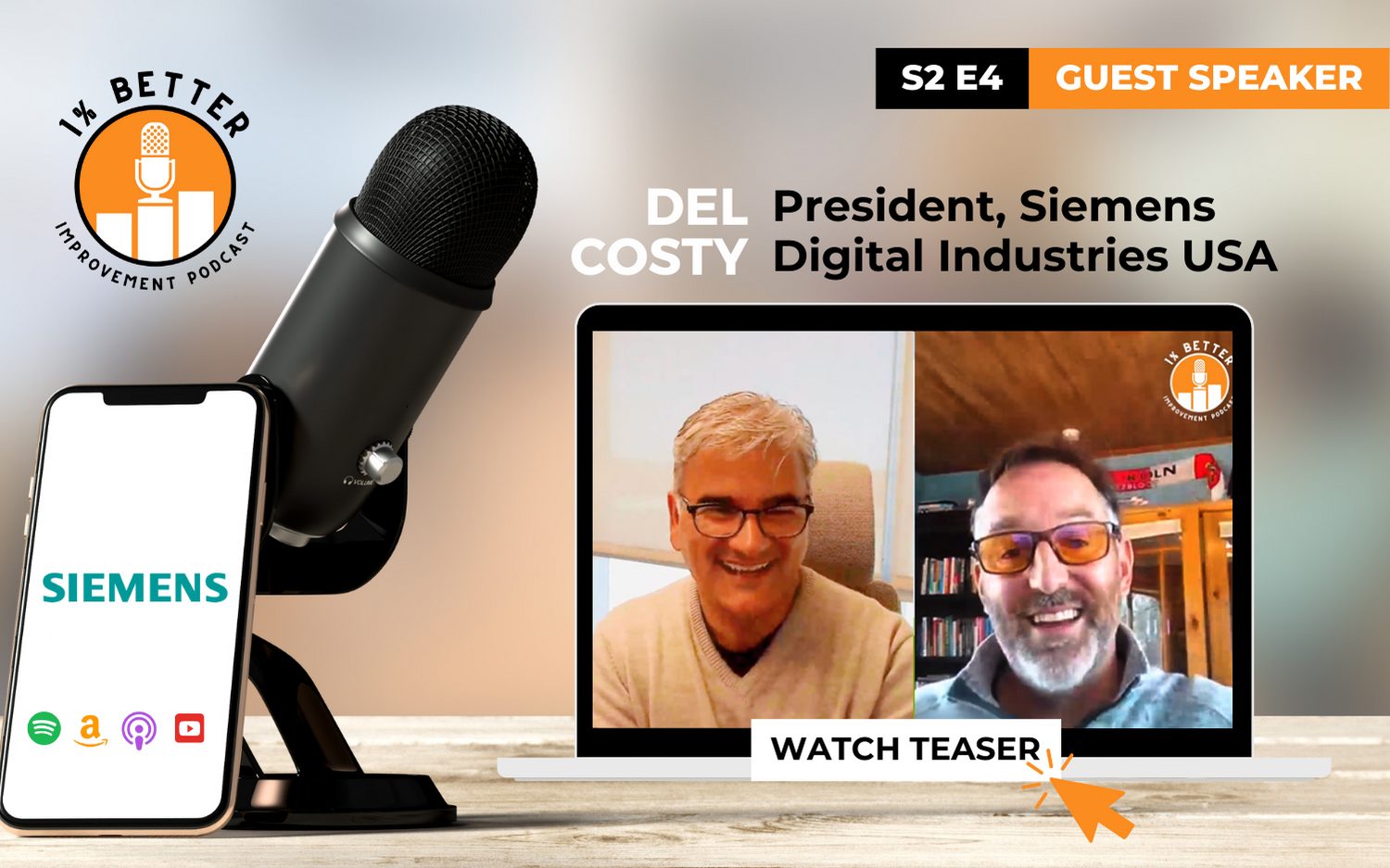
Find us on your favorite podcast platform including: Spotify | YouTube | Apple | Amazon
1% Better Del Costy – Quick Links
Check out one of Del’s favorite books Freedom’s Forge
Learn more about Siemens Digital Industries
Connect with Del Costy on LinkedIn
Connect with Craig Thielen on LinkedIn
Key Takeaways
- Digital Transformation as a Catalyst for Change: Del Costy emphasizes the transformative power of digital technologies in industries, highlighting how partnerships and business strategies have evolved to include digital transformation as a central theme.
- The Importance of Industry 4.0 and Converging Technologies: The podcast discusses the critical role of Industry 4.0 and the integration of IT and OT, which are reshaping manufacturing processes, enabling more efficient, agile, and data-driven operations.
- Overcoming Manufacturing Challenges through Innovation: Costy points out the complexities of scaling manufacturing operations and how digital tools, AI, and a well-captured knowledge base are essential for overcoming these challenges and ensuring success in production at scale.
- Breaking Down Organizational Silos with Technology: The ability of technology to dismantle traditional barriers within organizations is highlighted, suggesting a future where cross-functional collaboration is facilitated by digital solutions, leading to enhanced innovation and problem-solving.
- Leadership in Cultivating High-Performing Teams: The conversation underscores the significance of leadership in building a culture that values high performance, continuous learning, and the proactive embrace of challenges as opportunities for growth and improvement.














1% Better Del Costy – Transcript
[00:00:07.690] – Craig
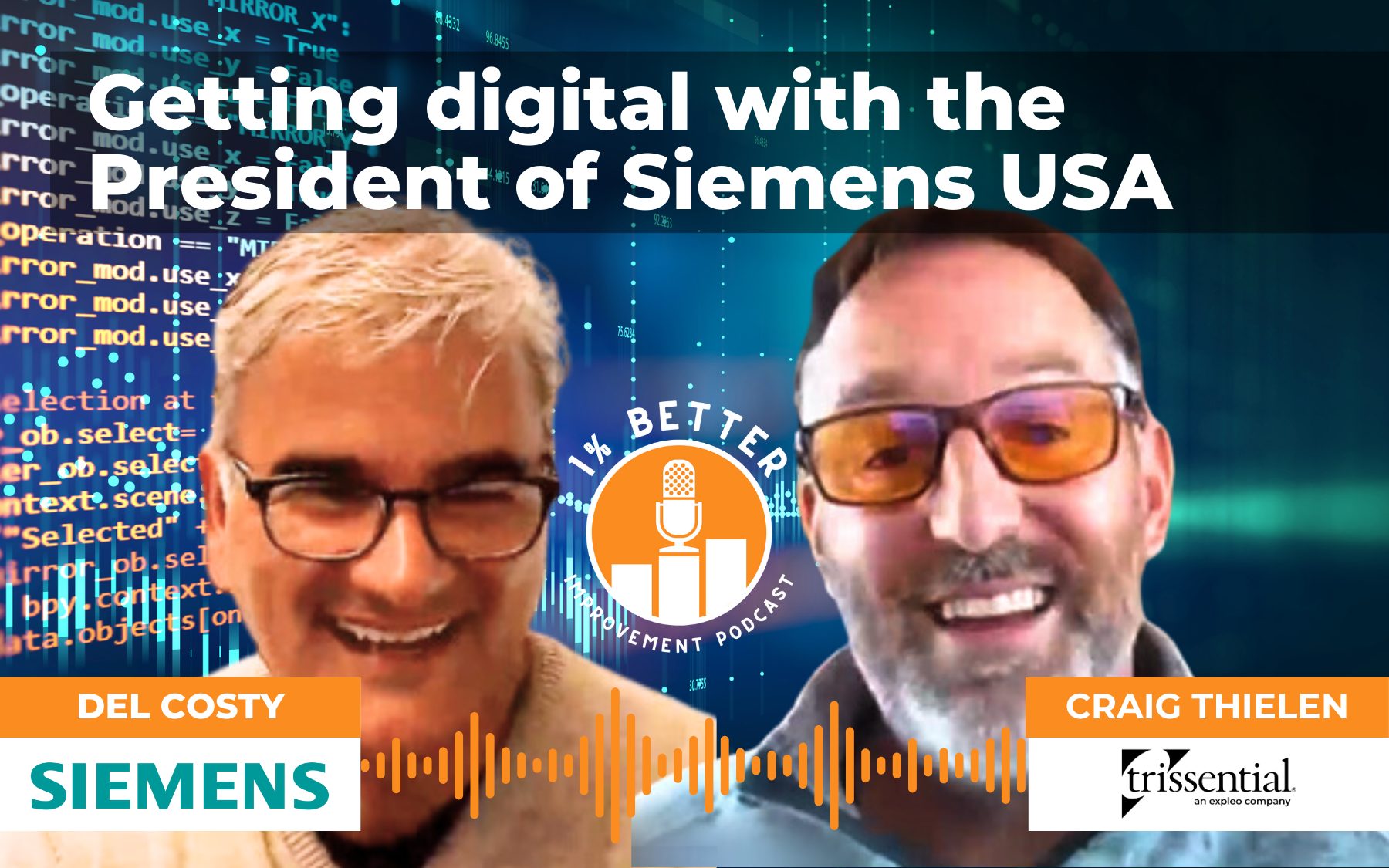
Hello, I’m Craig Thielen and this is the 1% Better Podcast. Today I’m speaking with Del Costy, President, Siemens Digital Industries USA. Welcome to the show, Del. I’m looking forward to talking to you. We’ve been partners, you know, organizations that we work for, for a long time, I think over ten or 15 years, and we’ve done a lot of work together in the PLM space and software testing, and now we’re starting to partner on broader capabilities, digital capabilities, and you’re in a role. It’s really interesting and excited to talk to you about your vision, not only for Siemens and what you guys are doing in digital, but also just manufacturing in the US and sort of what you see in your role. So excited to talk to you about that. And for those not familiar with Siemens and Siemens Digital Industries, just maybe give us a quick overview of sort of what you guys do and kind of what your target industries and clients look like.
[00:01:03.060] – Del
I would love to. Yeah so, you talked about my role in the Digital Industries Automation function that I started October 1. But on top of that, I maintained my previous role which is running the Digital Industries Software organization for the America zone, which I’m super excited about because the synergies between those two functions, when you look at the Siemens Digital Industries portfolio, it’s exactly what industries are looking for today. So it’s super exciting time. I mean, the client relationships that we have, if I think Craig, over the last 20 plus years, how that’s changed… we talk about digital transformation, the transformation in our partnerships, and you guys have seen it, you’ve been right there with us. The transformation in our partnerships is like nothing I’ve seen in my career. The topics that we address, they’re boardroom topics now. Even you look at the data right now and spend in the US this year, one of the things that just won’t get cut are digital transformation initiatives. So that’s an exciting place to be. So what do we do? We, as you indicated, PLM and the digital industry software side, we have all the product definition, our tool called Teamcenter, all part of the accelerator portfolio.
Craig
Flagship product.
[00:02:23.720] – Del
Yeah, exactly… the largest used tool out there. We do the requirements definition of the product, 1D simulation, figure out how that product needs to be designed, how you plan the process, how I go ahead and drive the execution on the shop floor, the whole thing, everything that goes in between that, the mechanical, the electrical, the electronics, the software, all modeled in this environment. And now the exciting thing about the job I started October 1 is seeing how that manifests on the shop floor – The automation equipment that decides how a product is going to be built on the shop floor and the logic of the machines and how this all comes together is super, super exciting and we hear about things like Industry 4.0 and how that’s maturing… you hear about IT OT convergence… it’s a fascinating, fascinating time.
[00:03:16.190] – Craig
Well, I can’t wait to dig into it. It’s really interesting for me. I grew up in the early 90s, mid 90s, my start in my career in manufacturing, implementing ERP systems, PLM systems, MES systems… and that was an interesting time because before then it was all these little disparate, a lot of things weren’t on computers, they were very manual and we were bringing kind of digitizing, we weren’t calling it that back in the day, but we were bringing some of those processes… a lot of lean manufacturing, a lot of Kanban, a lot of demand-driven manufacturing. I mean, you know, the whole, you’ve been through the whole lifecycle process improvement stuff and we’re bringing that to the sort of digital world. But then it was like how do we integrate all this technology and how do we now automate and we have so much data. So I’m excited because I’ve seen that over my career and kind of grew up in that environment. So it’ll be really fun to kind of talk to you about it.
So one thing I know you’re super passionate about is just not just what you guys are doing and in the software space and automation space, but just manufacturing in general. So I’d love to have you talk about what have we been through the last couple of decades with manufacturing in the US and where are we now. And of course this gets into a lot of geopolitical and policy and trade agreements and all sorts of stuff. But I think that’s important to kind of understand where we’ve come from and where are we going and where do we need to go, frankly, to really continue to be a leader and an innovator in the world?
[00:04:53.530] – Del
Yeah, it’s a great question. It’s funny, when I was going down memory lane when you were talking, because very similar… growing up in Detroit, it’s hard not to have manufacturing in your blood. It’s just surrounds you. You don’t walk down the street, you don’t go to a restaurant and not meet someone that’s working in some sort of manufacturing. It just doesn’t happen in this town. But it’s interesting. You talked about the last 20, I would say 30 years. Similar to you, I got involved in a job shortly out of college, I worked in the automotive tier space and so learned that automotive product and what it means to launch a program from a tier supplier to an OEM. And then I made a transition into, I’d say, manufacturing consulting. And I got immersed, like you said, I remember in the mid to late 90s reading The Goal and I kind of changed my thinking and then working with customers in the Detroit area and what it looked like to drive lean flow concepts through a manufacturing facility.
And how do you plan for supermarkets? Where should material come into a facility? How do you consume it at lineside? How do you plan for tac time and balance work and cells and all that great stuff that I think drove a lot of value in the industry. Fascinating time, but you think about the last 20 to 30 years. I remember being an event. Mark Fields was CEO of Ford at the time, and he was speaking and he talked about, of all the places I’ve worked, the most difficult place to get alignment between government and industry was in the US. And it was sad to hear at that time. I think we’ve seen an acknowledgement across the board in this country right now that I do think there’s an awareness of how important our US identity is. We’re a super innovative country and grabbing that manufacturing excellence back is just critically important. And I think going through what we did in 2019 on with COVID and how that changed things, the geopolitical tensions, you’re seeing companies prepare for different things, and that manufacturing prowess and understanding your manufacturing footprint and capability and driving global flexibility is more important today than ever before.
And having that digital knowledge, that digital twin. And we talk about a comprehensive digital twin, because a lot of people think digital twin and they think product. For us, it’s not just product. The digital twin is the multidiscipline, multifunction of the product, but it’s also the process definition. I have a digital twin of my product and my process and my manufacturing facility and execution. That’s what we kicked off CES, hopefully you saw Roland and Cedric.
Craig
I did. I was going to ask about that.
Del
Awesome job. I was in the front row. I thought they did a phenomenal job. But when you see what we were able to showcase, and we drink our own champagne, so we actually featured our own facility modeled in the industrial metaverse, which means real time data collection. Seeing that performance real time in a photorealistic environment right next to it, that is just the opportunity we have ahead of us. And I think about what’s going on right now in our country and this next wave… I was just speaking to one of our largest aerospace customers. The CEO had the leadership team together, and we had a panel of four companies, all pretty significant sized companies, and we got on a lot of great topics, and IToT convergence was one.
But we also talked about the crossroads of accomplishing all this and at the same time handling workforce issues that are coming up, taking what was an engineer to order type environment and making it more automated in terms of process because of workforce shortage. How do I maintain and have a digitally native facility in a world where I wasn’t accustomed to having that? And equally important, how do I hit my sustainability goals? How am I going to attack scope two sustainability goals by 2030? Technology is the heart of all that, but getting that organizational inertia to make progress is so key.
[00:09:11.970] – Craig
Talk a little bit about the challenges that you’re seeing, because, let’s face it, we’ve spent the last 20 to 30 years outsourcing manufacturing and sending it all over the globe, largely China and Asia and all over the world, and those disciplines and that expertise doesn’t exist in some cases. And companies, we’re seeing it come back, but it takes time to build that expertise back. And I’m curious, because even Elon Musk, arguably one of the smartest, innovative guys on the planet, he has said emphatically that the most difficult thing he’s ever done in his life by far, is manufacturing at scale. Like design, innovation, technology, prototypes. All this stuff is hard, nowhere near the complexity of manufacturing at scale. So I’m just curious, talk a little bit about what do you see with your sort of core traditional clients that have gone through this, you know, we got to get rid of all the manufacturing wherever it’s going, and now we got to bring it back. What are the biggest challenges that you’re seeing?
[00:10:20.230] – Del
Well, I do view this differently, and I understand where Elon Musk could come from, where he said that. But I got to tell you, again, living here in Detroit, there are some amazing, there is a depth of manufacturing knowledge that’s exceptional, and I think it spans across the country. There’s a great book for those listening. It’s a book that’s been around for a while, but if you haven’t read it, and it’s particular fondness to me, it’s called Freedom’s Forge. And it just goes through some of the key things and what really drove and left the United States forward through some major events that happened. But history tends to repeat itself. I think there’s an opportunity again. I do think the knowledge is there, but this is where digital matters. This is where AI matters. There’s a lot of enhanced capability that is going to enable AI to assist you when you’ve got your data structure to actually go in and extract some of that knowledge that you’ve been building up over 30 or 40 years and put it in a consumable way for the next generation workforce to learn from and continue to grow from.
So we’re working on that, obviously with our ecosystem partners. And one of the things we talked about on that panel, I was sitting with SAP and Nvidia and Microsoft and then us as Siemens, and that was a conversation we actually had. And we talked about as companies in a similar space that some cases compete, but really are partners. We talked about the ability to assist our customer base in doing that. And this is where technology is going to be a huge asset to us. It’s not an enemy to us. It used to be. And you remember this, I’ll use the word fondly, loosely. But especially think about the business you guys are in, but taking those legacy environments and moving them forward, upgrading systems, getting data that’s forward compatible. But now we can actually really understand the insights of the data. We can understand the decision tree that went into how we designed a product the way we did then. How do we modify the process?
The last thing I’d say on this, Craig, we can’t think about the Tesla example. We can’t do things in silos. One more conversation we did have, we were asked, ‘what do you see the future being five years out with technology?’ And my comment was, technology is finally going to allow us to deconstruct the boundaries that exist. I work for a very large company. You’re always managing through the boundaries that exist. We can actually break those down. They can become artificial boundaries now that we can deconstruct, because the technology, the ML, the AI, the generative AI that’s coming, those capabilities are going to basically see through the artificial barriers we put up between engineering and manufacturing; Manufacturing planning, the manufacturing execution, manufacturing out the door to service of the product. I mean, those boundaries now can actually start to disappear as we train these models and bring that information forward. So, of all my time in industry, I’m more excited about the prospects today than I’ve ever been. And that’s saying a lot because I’m usually a pretty positive guy.
[00:13:34.240] – Craig
Yeah. So I mean, speaking of technology and barriers, you guys just within Siemens offer a very wide range of software products and solutions. One of the sort of things that we thought we were doing in the 90s, we thought this notion of ERP was going to sort of bring an enterprise together and have everything on one platform. And we learned that it did that in some cases. I mean sort of the core of a business, but there’s so many layers of a business, there’s so much complexity that it takes a lot of different solutions and technology. So even within Siemens, there’s a lot of different solutions. So you pull that together in a way that you can simplify your customers world, not make it more complicated, because it’s hard for them. They’re running their business day to day just trying to keep up and survive. And now it’s like, well, what’s this combination of sort of technology and solutions? How do you do that?
[00:14:30.710] – Del
Well look, I think this is where the advancement in technology starts to matter. I mean, moving all these capabilities to the cloud. Think about what it took in, I’ll call it the old days to implement. You had to one, get a solution, you had to get architects, you had to work with the business, you had to work with IT; You scoped out the project, you put together… what did you tend to do? You took great technology and you married it to existing processes. That wasn’t necessarily the answer, but that was comfort, right? And then you’d spend months and months, sometimes a couple of years, building out the solution and then you would test it, you’d figure out, oh, that’s not perfect. And then you’d iterate on that testing cycle, you revise code and then you try to go pilot it out and next thing you know, you’re three or four years in, you spent a ton of money and you didn’t have the user population you expected. Then as a customer, I had to build an IT organization to support. I had all the cost of that.
Think about where we’re at now. I mean, I can have that solution on the cloud, I could have basic templates built, I could consume most of it. Maybe I have to tailor something specific to my business, but it’s hosted, I don’t have to manage it, I don’t have to do the things that I did before. I could get access to the software and how it works much faster. These things are enablers for, we call it the accelerator platform for a reason. But it’s when we revert back to doing things the legacy way that we’re missing some opportunities. Right? And so I think the technology evolution has been so favorable to consumers that are ready to take technology, because look, we often, Craig, talk about, we all talk about, everyone in the industry talks about driving business outcomes, but ultimately business outcomes, the contributor to that success is 20% tech, it’s 30% people, it’s 50% process. So when we sit down with our customers and we go through, we describe as digital thread mapping, we do it in context of the process, not just of the tools. You’re applying the tools to a process, then you’re looking at the dimension that is the people consuming the tools. But ultimately it’s what is my current process maturity and how am I going to improve that because that’s where I’m going to get the value as a company.
[00:16:44.050] – Craig
Right.
[00:16:45.330] – Del
By doing that, we manage the complexity, because when we show it to them in the context of the process, you’re right, we have thousands of products, but what you need is an outcome. So let us put that together in an outcome against your process. Sorry, I went a little long there.
[00:16:58.870] – Craig
No, that’s great. You mentioned something in there that I think is key, and it’s this whole idea of a digital thread. So just explain that to the folks that don’t know what that means.
[00:17:10.410] – Del
Yeah, I’d love to. So again, I’d go back to what I just said about the three dimensions of driving a business outcome. People will talk about digital thread and it’s really a linkage of their tool to their tool to their tool, and they stitch it together and say, look how good we can complete this thought. And that’s great. I mean, it’s really good when you’re looking at them. We chose not to do it that way. What we chose to do was, if you’re in the aerospace sector, if you are in automotive, your automotive supplier, if I’m in life sciences, pharmaceutical, whatever, pick the industry.
We said, what are those major processes that drive your business in the industry you’re in? And we describe them and then we can go into this environment called Explorer and we can show it to you. It looks like a subway map, basically. And then we pick that process and we can walk you through that. But it’s all built on something that maps out the end-to-end process definition. Why is that important? Because every time customers will look and say, ‘yeah, I need that, especially need that there. How do I get started?’ Well, now we can answer that. We can say, ‘here’s how you get started. We’re going to go and we’re going to map your process and we’re going to decide with you, where are you most broken today? Where is your biggest opportunity? What are the foundational blocks that if we don’t solve, you’re not going to get the ultimate value that you’re looking for. And by the way, how does this align to your business objectives and where you’re going? Here’s what we think they need to be based on our experience in this industry and, oh, by the way, in other industries where we’re seeing some huge advancement. So we can bring that to the table, too.’ So that’s where I’m telling you, I think the richness of the conversation now is so different than it was just five to ten years ago.
[00:18:53.790] – Craig
Yeah. What you’re able to do, I mean, what you just described, and we’ve seen what you’re talking about, but it’s pretty powerful to visualize your journey map, your customer journey map, your value stream map and actually visualize that versus getting too deep in the weeds of the technology or PowerPoint where or something. It’s pretty powerful to be able to do that.
[00:19:16.000] – Del
Well, Craig, think about how we opened. When I look at it reminds me of a lean flow, right? I mean, the old days of lean value, you know the value mapping diagrams. Every time I look at like it, I’m like wow, you know, this is just the right way to do this.
[00:19:32.280] – Craig
Well, and it’s funny because things do come back in life and repeat themselves, like this whole movement around agility and agile, because when I got involved with that was about 2005, and one of our clients back then was very innovative. They’re a very lean organization. It was actually a Berkshire Hathaway company. And you know how Warren Buffett likes to run things, lean. You probably have a few of his clients or a few of his companies, they said, we want to run an ERP program using Agile, which really, frankly, had never been done before. It’s kind of counterintuitive. And so we did it. And when I learned it myself, I was sort of leading the effort. I go, this is nothing new. This is lean. This is continuous improvement. I love this stuff. And so it just brings back Toyota production systems and all the Deming and lean. It’s kind of fun to see that come back.
Del
Absolutely.
[00:20:40.660] – Craig
So one of the things that you said that caught my ear, a lot of software and tech companies talk about, oh, we need to be partners with our clients and we need to listen to our clients and their needs. Everyone sort of talks about that, but you’ve actually said we need to go beyond that. We need to actually stretch their thinking, shift their thinking, push them, challenge them. So tell me more about how you do that.
[00:20:54.210] – Del
Well, so, first of all, we don’t try to go into an industry without competency from that industry. So every one of our teams has a collection of people that know the industries they’re working in. So we ensure we’re immersing ourselves. And that’s one of the benefits of being a large company. We’ve had relationships in our core industry that stem back 20, 30, 40 years in some cases. So we’ve been a fiber of those industries. So it’s not enough for me if my team is coming into a room and saying, well, we asked them, what do you want to achieve? Or what do you need to solve? I’m like, what kind of partner are you then? If you’re not bringing those ideas forward to say, by the way, we’ve been in three of your different divisions, and here’s what we’re observing, because I know what I see in my job. I have, I don’t know, 3,200 people, right? So oftentimes you’re not getting all that data real time. So I see what gets presented to me, and I work my tail off to get out to as many locations as I can. I want to hear, I want to talk to every level of the organization. It takes a long time. If I have a partner that’s been involved in multiple elements of my business and can come to me and saying, by the way, I’ve observed these things in your business, think of the value to me.
So it’s no different from my organization or anyone in this great company of ours. You have a wealth of knowledge, and you should have a wealth of knowledge. One, from your history in the industry you’re working in; Two, from your ability to talk to multiple divisions, multiple groups inside of our customer base; Three, to understand what’s going on across the industry; Four, work with your peers that are working in other industries. You know know, oftentimes, Craig, when we know we had Unlimited Tomorrow speak on stage at CES, we featured a company called Blendhub. These are all intent and purposes startups, right? Much smaller companies, but embracing technology because, again, not as many barriers. They don’t have these fixed revenue streams that they have to protect. And so they’re building this business and they’re leveraging tech where they can and process improvement and all this stuff. But there’s stories to be gleaned from there.
The stuff we do with race teams, it’s amazing. You watch their NPI. It’s weekly, right? When you run a race, your telemetrics tell you something, and it’s like, okay, well, this is an area we need to focus on and improve. You got a couple of day iteration, and you got to get prep billed for the next race cycle. So it’s fascinating to watch. There are gold nuggets in each of those and our teams need to be bringing those forward.
I do host an event annually for a group of executives that’s coming up here soon in Scottsdale. Fascinating. In one year we had head of manufacturing at Estee Lauder doing a presentation and then we had someone from one of the race teams. We had them sitting together at a speaker dinner and they started talking and guy from this consumer products company basically said, you mind if I come visit you? The way you guys do your pit stop planning, I see similarities. The way I need to do changeover on a cell on the manufacturing floor because I need to do it fast if I need to change. When you sit and you hear that, who would have naturally thought, let me put this customer with this one. Now, by design, we put this event together so all these different industries can exchange their stories.
[00:24:33.770] – Craig
That’s so great. It reminds me, we do a lot of work helping organizations, not IT or tech teams, but entire organizations work in a more agile way from the boardroom down to all the teams. In fact, one of our clients, oil and gas, literally has 3,000 teams. None of them are IT teams. They’re all business teams working in this small team. Very iterative. And one of the videos that I’ve shown so many times, you just described it and you’ve probably seen it’s this old 1950s race team changing tires. It takes like, I don’t know, 60 seconds or two minutes or something and they’re windshield wiping and their gas can and then it shows like 2015 or 2020 and they literally do it in 3 seconds and it’s like, hat’s innovation. That’s continuous improvement. That’s elimination of waste. That is lean to the T, right?
[00:25:28.980] – Del
Yeah, that’s a Formula one car if it’s the one I’m thinking of and it’s ridiculously fast. And those teams use our software end-to-end and they’re amazing adopters of technology, both Formula one and NASCAR. So we do a lot with the race teams and they know how to leverage that technology. It’s amazing.
[00:25:49.620] – Craig
Oh yeah, that’s awesome. So let’s shift… You mentioned that you do lead a large organization, have over 3,000 people. Let’s talk about leadership a little bit. You can’t have great outcomes, which we’re all striving for without great people, without great teams, without high performing teams. How do you think about doing that and driving that kind of environment and culture?
[00:26:14.470] – Del
It’s my favorite topic. It’s probably the hardest one to speak on, but I always speak from the heart on this, because it’s funny… I don’t fixate on things a lot of leaders fixate on. I focus on our value, our core values. I focus on when I see individual contributors leaning in heavy to help our customers or help their team. I don’t think it’s anything new to a lot of people, but there’s a lot of ways to approach running a business. You can approach it by saying, hey, it’s my job as the boss. I’m going to build a strategic plan and I’m going to roll it out and I’m going to expect everyone to execute. And that’s great. I mean, look, a lot of people have done that successfully. I challenge that thinking because I think it’s very difficult to roll out a strategic plan that your key leadership team, and I’m talking your direct leadership team and the level below had no say in building. And so what I’d much rather do is say, look, here’s the objective. Here’s what we really need to do. Here’s a stretch opportunity of what I think the art of the possible is, because I think the enemy to true success is incremental gain.
If we’re too busy patting ourself on the back for incremental. Yet the real opportunity was, we’ve seen companies grow at ridiculous percentage rates and we were accustomed, oh, if I can get single digit growth, I’m doing great. Why is that really great anymore? And so you bring the team together with, look, here’s our challenge. I’m going to frame that challenge. We’re going to come in as a leadership team with our vast experiences, and we’re a collection of multiple acquisitions. We could have brought those acquisitions and say, thou shalt do it our way.
[00:28:01.360] – Craig
Right.
[00:28:02.000] – Del
We didn’t do that. We studied what they did and we said, wow, what you’re doing there is awesome. Come on, teach us. Let’s figure out. We’re going to show you what we’re doing in these areas.
[00:28:10.610] – Craig
A great way to pull them in to be part of the team too ,right?
[00:28:13.040] – Del
Be part. Own our growth. Own our model. Execute what you were a part of building, because when you execute something you were a part of building, you execute with passion and understanding. It’s far more powerful. And I’m telling you, we’ve got a really high performance team as a result. And it’s all credit to them and it’s a privilege for me to work for them.
[00:28:36.570] – Craig
Right. But you’ve pulled them into the process so they feel authentically they are part of the team in terms of input and expertise and passion. So that’s great. When we do a lot of transformation work, we typically start it with something very simple that’s 30 plus years old. You probably are very familiar with it. It’s called a Lean A3 session, and it’s a working session. And the main purpose is you get people collaborating, sharing… where are we today? What’s our biggest problems? Getting that alignment. Everyone’s got skin in the game. Everyone’s got now accountability because they co-developed it. That is so powerful. Right? Same way you just described.
[00:29:17.190] – Del
Craig, I’ll give you, not everyone’s going to love hearing this, but I’ll tell it anyway. I was doing a town hall in South America and first question I got asked was about work life balance. Well, obviously you’re doing this and how are you going to be an example for us for work life balance? And I paused and I ended up meeting with this early career person a couple of days later. And she and I had a great discussion about how I ended up answering this question. And I said, listen, I paused intentionally because I’m not convinced you’re going to love my answer. And the reason you might not love my answer is because in your question, I already feel I failed you, because you are asking me to choose between work and life. And what I want to tell you is I don’t view those things as separate. I care about the people I work with tremendously. They are friends and they’re family to me. Do I say that they’re work? And then I need to get away from them to get to life. To me, it’s a continuum. And what I need to do is give you a rewarding environment wherever you are.
When you are here doing this job and helping a customer cross the line, that may be making a device that’s going to save someone’s lives, someone’s life, or they’re going to provide a product that’s going to improve the quality of life. Is that just a job? I would tell you that’s a mission. It’s a charter. It’s something we should be proud of and you should enjoy doing. And if lines blur and you end up working 12 hours one day, but then, hey, you need mental downtime and you’re going to work two the next, so be it. We’ll have a model to support you, but we’re here as a backstop to one another and we’re here to be a part of our customers fiber. I want that to be rewarding whatever you’re doing, whether it’s on the clock, off the clock. There is no clock. Right. Life is work. Work is life.
[00:31:14.790] – Craig
That’s beautiful. I love that, Del, because I think that’s one of the big disservices we did over the past 20 years is even this notion of work life balance. We disconnected people’s passion, their personal lives from work. And so we’re saying, don’t bring your passions, don’t bring what gets you excited into the office. And that’s exactly what you want. So I love that. That’s awesome. Hey, one thing I also love is you get this idea of an excuse board. So tell us about that.
[00:31:49.890] – Del
We need to have candid conversations. So I’m okay in every meeting, if we have a board and you need to write things, and after a while, some of them start to feel like excuses. And I’m like, look, we can have an excuse board in every meeting as long as when the meeting is over, that board is clear. But one thing we’re never going to do is walk out of any discussion with an excuse of why not? So we talk about this idea of positive energizers, some great books on the subject, but what a difference it makes when you actually learn how to actively listen versus not.
How many conversations have you been in where you haven’t even completed what you want to say and you get the yes, but we always talk about the yes. And, but more importantly, as important as those things are, the reality is, when that person’s done speaking, can you articulate what they said? Not by repeating words, but actually capturing intent. If you can’t, that means you are not actively listening. You are thinking about your point and then your point counterpoint. And what we’re not doing is being productive and we’re not being collaborative and we’re definitely not a team. So it’s a pet peeve of mine that excuses talking over one another, being not taking the opportunity to learn in every engagement, in every conversation. It’s just. Life’s too short for that.
[00:33:06.560] – Craig
Yeah, well, you’re preaching to the choir. This is a 1% Better Podcast, so it’s what we’re all about is trying to learn from every single day and getting better and better. So love that. And I know you’re a big believer in learning from failure, and failure is not a bad thing. And we’re both mountain bikers, so I’m going to give you a question here that you might not have expected, but what can you learn from mountain biking and bringing to your work life?
[00:33:31.550] – Del
I told this on a tell all in my organization, because mountain biking is not for the faint of heart, as you know. And I don’t even get to do the really tough stuff like happens in the Carolinas or out west, but I still know what it’s like at my age, and I happen to have a great bike, so equipment matters. But what I would tell you is the reason I love mountain biking is you have to leave it all behind. And if you’re not focused on what’s happening in the trail, you could ride the same trail every day, three times a day. Every time the variables change, every time they change, any condition changes that trail. And so you have to pay attention. So I’m forced to clear my head of everything else.
I had one case two years ago, I didn’t, and I was riding slow. The conditions weren’t great, and because I was riding slow, I wasn’t pushing myself. I wasn’t as keenly focused on every variable. I came around a corner, a little thin, I clipped the tree. Next thing I know, I woke up downhill, just saw blood, got up. My bike was at the base of the tree, so I clearly, when I hit that handlebar, flipped it, I just went off the bike and I clipped it. It was an eye opener to me that focus and details matter. Focus and details matter.
One, the conditioning, the preparation. But when you go to do something, do it. Do it right. Do it with focus. Multitasking is the enemy of progress. We all feel like we need to do it. I had a valuable lesson when I grew in my responsibilities at a larger organization. I’m like, when I was running a team of eight and I would be multitasking and distracted when someone was sitting in my office. I’m like, when you’re running a team of 100, 500, 1,000, 10,000, that person doesn’t get a lot of time with you. And if where they’re looking at you and you’re looking at your screen or you’re looking at your phone, Lord knows you’ve gone to enough dinners where families are having conversation and everyone’s looking at their phone or they’re not talking at all, I’m like, why did you go out to eat? And so, no different in mountain biking, distraction is danger.
[00:35:50.510] – Craig
Yeah, it’s interesting. So my very first serious mountain biking ride on a nice bike and really sort of aggressive terrain riding with a really great rider, and he let me go first, so I didn’t try to keep up with him. And I told myself maybe 50 times in my head, just go slow. Just go slow. Because I knew it’s a dangerous sport, and this is pretty dangerous conditions. I told myself that. And then all of a sudden, I got into a little bit of comfort level. Like, I got this, and I started getting in pretty good speed, and then I got distracted. I started daydreaming. I started thinking about something else, and I launched into the woods, and next thing I knew, went over a hill too fast, and there was a turn right at the bottom of the hill. And next thing I knew, I was on my back, knocked out, and I couldn’t see, I couldn’t feel my body. It could have been a lot worse if I would have hit a tree or a rock or something. But what it taught me is what you just described, which is, I got out of that moment. I got out of really paying attention to what I was doing, and that know, I got comfortable, too comfortable. And then that’s when it happened. So that can happen in work, right? Just like you described, we got to pay attention.
[00:37:08.910] – Del
Absolutely, Craig. And I’m telling you, if you and I run into each other in a year, I could recite this story to you, because when you were talking, that’s all I focused on, because it parallels my story. And I think about, that’s why when I listen to what someone says, I want to capture the essence of what they’re saying, the words, the body language. I mean, clearly, it’s a trying or deal when you have those. I’ve had three, I would say, major falls that I felt like I was lucky to get back on the bike. Many other falls, but those three will always, I’ll always remember them. I can tell you exactly what happened on each. So it’s important we learn and we evolve, but every time that stay in focus is so critically important.
[00:37:50.250] – Craig
And we learn a great deal from those three incidents, just not only about what happened, but like, okay, how do I apply this more broadly? There’s a saying I love in a video that’s ‘knowledge does not equal understanding.’ So you and I both had knowledge. We knew the dangers, we knew what we should be doing, but we didn’t understand it until we failed, or until we did it. And you’ve lived it, right?
[00:38:15.550] – Del
Yeah.
[00:38:16.670] – Craig
Well, hey, it’s been great. Time has flown by. I always ask one question here at the end of the podcast, and that is looking back at your entire life and career and everything you’ve learned, what words of wisdom, life lessons would you want to pass on? To the next generation or some grandchild or someone that’s just starting in their life. Just things that you’ve learned you’d want to pass on?
[00:38:41.510] – Del
Yeah, not many, because I think the core is the core. And it’s the core. What is your core? Identify who you want to be. And every day is a test. And did you pass or fail? It’s not complicated. We all know what the golden rule is. For me, it’s beyond that. What is your compass? I tell my son all the time, and it’s going to sound familiar to everybody. It’s not about how you acted when everyone sees you. It’s about how do you act when no one does. And to me, there’s no difference. I don’t judge myself on how I behave around people. I judge myself when I’m not around people. And I have to make a decision. So that’s one. I think the other thing is I just have an insatiable curiosity. There’s rarely a conversation I’m in that I don’t think there’s an opportunity to learn or better myself or better folks around me or better a situation. There’s wisdom in so many places, good and bad by the way. It’s easy to learn from someone or something or some situation to say, I don’t want to be that. I don’t want to do that.
I don’t want to demonstrate that. And so curiosity and everything around you, there’s just so many opportunities out there to stretch yourself and to challenge yourself.
[00:39:59.950] – Craig
Well, thank you. There’s a lot of great nuggets in there. Thank you for that and thanks for taking the time. And let’s bring manufacturing back in the US. Thanks, Del.
[00:40:08.810] – Del
I love it. Thanks, Craig.