Find us on your favorite podcast platform including: Spotify | YouTube | Apple | Amazon
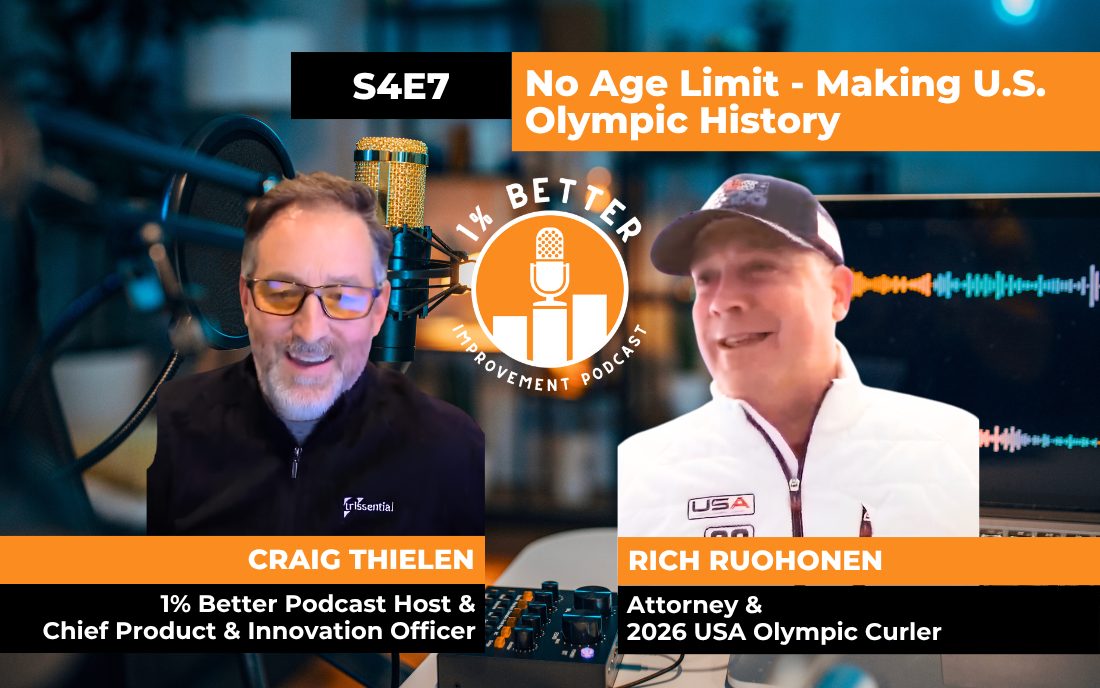
1% Better Podcast Rich Ruohonen – Quick Links
Watch 2026 Winter Olympics clip featuring Rich Ruohonen
Check out Rich Ruohonen’s Team USA Olympics profile page
Connect with Rich Ruohonen on LinkedIn
Connect with Craig Thielen on LinkedIn
Check out host Craig Thielen’s full bio page
Key Takeaways
- Making history does not have an age limit: Rich Ruohonen became the oldest U.S. Winter Olympian in history, proving that meaningful goals can still be achieved long after most people assume the window has closed
- The 1% Better mindset is built over decades: Rich’s Olympic moment was not sudden. It was the result of years of discipline, early mornings, late practices, setbacks, near-misses, and the decision to keep showing up
- Experience can become a competitive advantage: Competing alongside athletes half his age, Rich brought calm, strategy, perspective, and mentorship – showing that high performance is not only about physical ability, but also judgment, leadership, and resilience
- Preparation under pressure translates across sports and business: As both an Olympic curler and accomplished trial lawyer, Rich connects the dots between elite competition and the courtroom: practice, listening, adaptability, confidence, and learning from every win or loss
- Never giving up may require reinventing the role you play: Rich’s path to the Olympics was not linear. He retired, came back, shifted into a mentor/reserve role, supported a younger team, and still found his way onto the Olympic stage – a reminder that the dream can happen differently than expected































1% Better Podcast Rich Ruohonen – Transcript
Craig Thielen (00:08)
I’m Craig Thielen. is the 1 % Better podcast. Most people slowed down at the age of 55. Rich Ruohonen went to the Olympics at age 55. Not only did he become one of the oldest winter Olympians in team USA history, he did it at the same time building one of the top legal careers in the country. That’s just an incredible thing to think about.
While competing against athletes half his age on the world stage, Rich was also winning major trials, leading one of Minnesota’s top law firms and being recognized as attorney of the year, not once, but six times. So this isn’t a story about sports. We’re going to deep dive on sports, but it’s about perseverance, discipline, reinvention, mental toughness, you name it, at both a personal and professional level. So today on the 1 % Better podcast, we’re going to go deep into the Olympic experience and we’re going to see how these worlds collide, high performance sports and business. And I mean, this is really the epitome of the 1 % Better Podcast. I’m excited. Welcome to the 1 % Better Podcast. Rich.
Richard Ruohonen (01:07)
Thank you, happy to be here.
Craig Thielen (01:08)
So let’s jump in. gotta go right to the Olympics. It’s only, geez, what is it? A month, two months out here. Just tell us what it’s like after that. What’s the experience like just coming off of that?
Richard Ruohonen (01:21)
You know, it’s been quite a whirlwind actually. had a lot of publicity during the Olympics because of a press conference that I gave on ice activities in Minnesota and also especially because I became the oldest US Winter Olympian ever when I got into a game and I’m 55 now, but I was 54 at the time by a month. So yeah, I got in. It was super exciting. I’ve been working at this. first Olympic, I guess, event that I played to go to the Olympics was in 1988 when it was a demonstration sport. So you can almost say 40 years of trying, although I did take a little bit of a break for law school and some college didn’t play quite as competitively, but for the last 25 years
Craig Thielen (01:42)
Okay, okay.
Richard Ruohonen (02:05)
I’ve been playing really competitively trying to make the Olympics. I’ve been through eight Olympic trials, counting two in one year because I played in mixed doubles, which is a two person male female game. And then my men’s team was obviously four men. it’s been a whirlwind to finally make it, especially since I basically retired twice and then got pulled out of retirement to come. And even if it was more of a mentor and reserve role, I would say, it still was a fantastic last year and a half working with these young guys. They’re all 24 to 27 and trying to help them out because one of them got kind of sick. So it’s just been a whirlwind to get in and come back.
It’s weird when you walk around and everybody wants to take selfies with you. And I’m recognized most places where I go here in Minnesota now. So it’s been a little bit of a celebrity status. I mean, I didn’t do it for that, but it has kind of become that because Minnesota, know.
Craig Thielen (02:54)
Awesome. Right.
Richard Ruohonen (03:03)
Winter sports are huge here. And even though the hockey story was probably number one, the curling story was probably number two here in Minnesota. So big deal here, and it was fantastic.
Craig Thielen (03:12)
Yeah, for sure.
Yeah, I mean, it’s one of those things that a lot of people can, you can dream about something like that, right? But once you are actually there, it’s quite different. So I’d love to just hear, I’m sure you had all sorts of visions of what it would be like. And again, it’s one thing just to be part of the overall experience. There’s opening ceremonies, there’s, I’m sure, lot of different events and different things, but then,
you actually got on the ice and now you’re performing. just, you know, what was different than what you expected and what was it actually like?
Richard Ruohonen (03:45)
I guess for us, the difference for me right away was, we left on January 30th to go to Switzerland to train for five days and kind of get acclimated to the time change and everything like that, be up in the mountains where you have a little bit of in breathing capabilities.
Craig Thielen (04:01)
Yeah. What was the altitude? I’m just curious.
Richard Ruohonen (04:06)
Shoot, I don’t remember. I actually don’t remember what Cortina was, to be honest. Yeah, sorry.
Craig Thielen (04:09)
Okay, I can look it up while we’re talking, but that doesn’t matter. mean, even 5,000 feet.
Richard Ruohonen (04:13)
I don’t wanna say something that’s completely wrong. It wasn’t Denver, but it was, I wanna say it was 4,000 feet where we were or something. just a little, you you wanna get, you get there early so you can get acclimated to everything, you know? And then, so we had five days in Bern in Switzerland and then we came to the Olympics. You know, most people, a lot of people don’t know, but some of the sports start before even opening ceremonies and ours didn’t, but mixed doubles for curling did. So we got there on like, I think it was the fifth.
Craig Thielen (04:17)
Okay.
Richard Ruohonen (04:41)
So four days before opening, four or five days before opening ceremonies, and we had to train there in a small town. So we did a lot of stuff that just, took us, it took us forever to get anywhere in Italy. You don’t go, it’s usually two lane roads everywhere with a lot of roundabouts. And, you know, we had to, even though we had to drive only 60 miles to get to our train, the place we trained a couple of days there, it took us like two hours to get there, you know? So it was just, it was, a lot of running around early on and that kind of stuff, which you don’t necessarily expect. Like a lot of time in cars, I would say. But then, you know, getting to the Village, the Village was about, I guess, I don’t know if I had an expectation of the Village, lots of people around. know, what I did think was unusual is everybody was so friendly. I mean, not that you didn’t expect athletes to, you know, expect the U.S. athletes to be kind of, hey, we’re all this big team, you know.
Um, but people were really cool and you know, with right now and the way American politics is going, I didn’t know if it would be that way, And, and, but we were welcomed all throughout Italy. We were welcomed by all the other athletes and, it’s just kind of a community of athletes. it’s amazing how much everybody looks out for each other and just, you know, cheers on each other. I mean obviously not when you’re playing your country, but you see somebody with a medal and you go up and congratulate them, hey, way to go, even if they’re not from your country and just really good comradery. the Olympics is about that. It’s about respect. One of the tenants of the Olympics is respect and excellence and friendship. And and I think most of the athletes are that way. I mean, maybe you get a little bit more tense when you’re playing each other, but when you’re not, you know, and you’re just out there. So I thought that was kind of cool. The village was really cool.
The thing that was different is we weren’t sure if we were able to go to the, you know, there was four opening ceremonies, which most people don’t know, because we all walked through this big, yeah, we all walked through this big circular thing and everybody thought we were all in the same place, but there were four throughout Italy because it’s just so far, even though you might be two hours driving in Minnesota away, in Italy you’re five or six hours driving away.
Richard Ruohonen (06:55)
And there’s big screens showing as we were walking, like, okay, now they’re in Milan and the US team’s about to walk through. And then they go to Levino and their US team walks through. What appears maybe on TV to be the same circle thing that we’re walking under, we’re not. And then they have us go. So it took, you can imagine it took quite a while for openings. was a long time standing around waiting in this huge long line.
But you know, we got to meet some of the other USA athletes and so everybody’s like, wow, did you meet the hockey players? Did you meet, well, we were in different areas. we had, in Cortina, had women’s down hill, women’s slalom, curling, and all the luge, skeleton, bobsled sports. And so our group was actually a lot smaller than most, I think. But we got to know them all really well. What I thought was great is, you know, when we’re in the village, even while we were competing, there’s a USOPC office, United States Olympic Committee office, and they have like TVs and stuff. that’s where you get, some fuel if you need like granola bars and things like that that you need for to compete and where you get massages and all that kind of stuff and get help with whatever you need, they’re there to help. so we’d hang out in that office and watch our women’s curling team play or our mixed doubles team. So we got to meet all the other athletes.
And we would just hang out there as a lot of the US athletes and got to learn a lot about their sports and how they compete and what they have to do and how often and just.
Craig Thielen (08:15)
That’s Yeah. Most of the time you spent though with the US other Olympians or how much did you intermix with other countries?
Richard Ruohonen (08:31)
Well, you know, it’s different in curling because we play these same teams every weekend. So we know them very well. And so we’ll hang out and sit with them in the village at the lunch hall or cafeteria, whatever you want to call it. But mostly we are hanging out more with the US teams, I would say. But we know all those people. So we’re talking to them everywhere we go. I mean, these guys are friends of ours. In curling, we’ll play like a 12-week season.
Craig Thielen (08:50)
Yeah, right. True.
Richard Ruohonen (08:57)
And 10 of those weeks are going to be with those teams that were at the Olympics. So we really get to know each other a little bit. so we BS a lot. And I know, frankly, I played against most of the coaches and the parents of these kids. So I’m out there talking to the coaches all the time. And that’s why it was kind of, I felt bad because people are like, oh, are you coaching? And we have a coach, Jordan. So I kind of felt bad for her.
Craig Thielen (08:59)
Interesting. Right, that’s your age group.
Richard Ruohonen (09:20)
That was happening a lot going up to the Olympics, right? So I got this shirt, I had this shirt made that said, I’m not the dad and I’m not the coach. And I would wear, I wore that around a lot, you know? Because, know, Jordan is our coach, it’s not me, although I help with mentorship and that stuff. but there was a couple of funny memes going around, like it looks like some dad is bringing his four kids to the Olympics and curling, you know? And I think it’s hilarious. I think it’s funny. get some notoriety to the sport and I’m fine with that. So I had that shirt made. It was kind of funny, you know…
Craig Thielen (09:51)
I didn’t realize the curling team had a female coach. that the first time?
Richard Ruohonen (09:55)
I think it’s the first time for a male team, yes. there’s been women’s coaches and curling on the other side a lot, but for us, for the U.S., as far as I can, I’ve been in around a lot in the sport and I don’t remember a woman’s coach, at least not at this level, not at a real championship type level.
Craig Thielen (09:58)
Yeah, That’s interesting, pretty cool. There’s so many different storylines along the way. So when you when you finally got on the ice and that wasn’t sort of guaranteed by any means that you were going to get on the ice because you’re an alternate, right? Right. Was that any different? Was it like, did you feel tighter, more nervous, more like the stakes are bigger? Was I’m on the ice and it’s just I’m in the zone and nothing’s different?
Richard Ruohonen (10:22)
Right. Yeah, to be honest, it was something that we had planned for. It would have happened sooner or later one way or the other, but it was our second game. And unfortunately, we didn’t play very well. We were playing one of the best teams in the world, arguably the best team at the Olympics, although they only took bronze because they lost the semi. It was Switzerland. They played phenomenal. They dominated everybody, but unfortunately lost the game, the semifinal that mattered to get into the gold medal game.
Craig Thielen (10:36)
Okay.
Richard Ruohonen (10:57)
But good guys, I played against one of the guys’ dads in senior worlds the year before. I know the people that are coaching them. I played against a couple of the guys in the 2008 world. you know, it was one of these games where we weren’t playing real well and frankly, we weren’t going to win it with three ends left. And so I said, guys, let’s just get this out of the way now because the second game, let’s get the pressure off so you guys don’t have to worry about it the rest of the week.
And so we went in the eighth end where we might have normally in curling you can shake hands if you think it’s over. That’s one thing great about our sport. You don’t have to get your butt kicked and sit out there and play another three ends if you don’t want to. So I went up to each one of them because I’ve known them for years too. And I said, hey, if you don’t mind, we’re just going to play another end so we can get this out of the way.
Craig Thielen (11:32)
Interesting. Didn’t know that.
Richard Ruohonen (11:47)
I know normally we’d let it go or we’d probably just shake hands, but if you guys don’t mind and cause it’s kind of a gentle, you know, curling is a gentleman’s sport and I just wanted to make sure they weren’t going to be upset. It’s a long week for them too. And, and no, they’re like, Hey, come enjoy the moment. Let’s do this. And their coach is Glenn Howard, who’s a very famous curler who I played against for years from Canada, who’s retired, but played till he was 55, 56. And so, he, was all pumped to see it happen too. Such a great guy. And so I went in and I frankly, didn’t even stretch really. I mean, a little bit quick, you know, but I didn’t take a practice slide and I just said, tell me what I need to do. Cause we use stopwatches and curling and they’re, they’re like, throw me, throw me a 415. And that’s like timing from the back line to where we let go. And I threw a 413 perfect guard. And then I went under it, made both, swept Danny’s last one that end right to the lid and shot a hundred percent in the Olympics. So it was.
Craig Thielen (12:35)
Nice So you don’t, I mean, it didn’t feel any different when you were like on the ice. You were just casual about it or just like, hey, it is what it is. And it felt pretty comfortable.
Richard Ruohonen (12:40)
It was kinda cool.
Yeah, it definitely felt comfortable. I’m not gonna lie, it was like, kind of like the ultimate moment for me because I have trained for arguably 40 years, but definitely hard the last 25 years to have that moment. And even though it was a brief, 15, 20 minute moment, it meant everything because, my family, any curler, but especially a curler who is a full-time trial lawyer, my family’s had to make a lot of sacrifices over the years for me to do this, to do my job and to do this job, this other, this fun job I have, right? And I’ve missed some games for my kids and sports and I missed some holidays here and there and we’ve had to make a lot of sacrifices, but to have my family there, they were going crazy and I could hear them and not just them, there’s curling fans there from around the world that I know that were there from Canada, from everywhere and it was loud as could be in there. But I could hear my family, because I could tell their voices and to just have them cheering me on. And then I’m kind of a jokester out there a lot of times. And after I made both, I just said, guys, this game ain’t that hard. And so they got a kick out of that, because I was trying to use my role as an old guy. I can walk in and make both shots, guys. You can do this too, because it was early in the week, right? So I tried to use it as a-
Craig Thielen (14:02)
Hoosiers moment if you’ve seen Hoosiers…
Richard Ruohonen (14:02)
kind of a Hoosiers moment if you’ve seen Hoosiers, you know, where they go and they measure the hoop to see how high it is- Right, right. So I said, guys, this game ain’t that hard. We can do this, you know? So, but I just, to enjoy that moment was, it truly was the best moment of my life because the three, I had my family there. I had my family there too. And you could hear them cheering on and they were so proud. And I mean, they waited, because we have to go through the mix zone and get interviewed and of course when that happens and you break all these records, you break a record for a 95 year old record for the oldest US Winter Olympian ever. I had to got interviewed for almost an hour afterwards by multiple different TV stations and stuff. So it was just a great moment, really exciting and I can’t believe it happened frankly.
Craig Thielen (14:48)
Yeah, you’ll remember that moment for sure for the rest of your life. So, shifting a little bit, playing on that a little bit, can weave the Olympic experience for sure as we go here, but what do you think when you reflect on it, I’m sure it’s been a blur the last 10, 20, 30 years, but why do you think you stuck with this dream for so long? mean, I think you were from the program at 42 and most people say well you know you’re 42 you’re sort of past your prime it’s been a good run why do you think you kept going?
Richard Ruohonen (15:22)
Well, first of all, I love the game. I am more than willing to admit when there’s going to be a point where your shooting ability kind of drops off. Curling does allow you a little bit more flexibility as an older guy because strategy matters and experience matters big time. But in 42, when I got told I was going to be too old and nobody wants a 46-year-old at the next Olympics, I just said, OK, then I’m going to throw a team together.
I did, and we took second in the country that year when they said, hey, maybe it’s your past, your prime. And then that allowed me to jump on a team to kind of play the same role, like a fifth man that they needed. They were curling so much, they needed people to play though some weekends, and I was more in this role. And we made it to the final two out of three and lost to John Schuster’s team that year. So that was two years after they had cut me from the program and they didn’t cut me because I wasn’t trying hard enough or it wasn’t good enough. And I even said, let me go to the combine and I’ll show you I can beat these young punks, you know? But I’m not going to lie and say I’m as strong as I was back then, or I’m as fast, I guess, as I am back then, but I can still shoot, you know, and I can still shoot great. And so that ended up getting me back in the program for eight more years. And getting through that year and stuff and obviously it has to do with, you know, discipline, determination, a good attitude and giving a lot of effort and that passion for the sport, right? a lot of people aren’t willing to go and leave their house at 5.15 in the morning, four days a week to go work out and drive 30 miles to do it so I can get there by six, which is what I do. What I’ve been doing for 10 years, since we got the training house with the trainers, since at least 18 or whatever, right around there. And so, if you have to have that dedication, you have to hold yourself accountable and working out with your teammates, I think does that because like there are mornings you don’t want to get up and the alarm goes off at five o’clock and I’ve been out till 11 the night before because we had a practice at nine o’clock at night and I don’t feel like getting up, but it’s just that passion and that discipline and determination I think that I do have. That is one thing I do have. And I feel guilty if I don’t show up for my team, right? even these kids, if they’re gonna allow me to, they want me to be on their team, I’ve got to do what they want to do. And when they want to do it too. I can’t always just do it around my schedule. So I’ve had to make a lot of accommodations or a lot of changes in my schedule to accommodate theirs. You know, they’re young and they like Aiden will call me at, you know, seven o’clock, let’s go practice at Blaine for an hour, seven o’clock at night after I’ve been up at, or I got to get up at five in the morning the next day and been up at five in the morning this day. And I’ll go schedule ice and we’ll go throw for an hour. I get home at 10, 30 or 11 and sleep by 11, 30 and up at five. You know, that’s, that’s the kind of stuff that happens if you really want to compete at this level. The only difference is I then have to go to work for 10 hours, or eight hours and then work that night the next night.
Craig Thielen (18:24)
So I want to get into that. there had to be times where you felt like everyone were sort of betting against me. Like, hang it up? I remember, funny story. I played amateur baseball until I was 50 years old. But when I was 48, I remember I, for some silly reason, I decided to try to steal home and slid into home head first and I broke my wrist. And of course I called up my dad, my dad was like 91 at the time and I explained how I broke my hand and in a very fatherly way he goes, you know, might be time to hang up the cleats. And I just laughed so hard at that because here I am, almost 50. And my dad’s telling me to hang up the cleats. So you must have felt that so much, there must be part of you. I’m curious, have you always been someone that when someone says you can’t do something, you go, yeah, I can.
Richard Ruohonen (19:13)
yeah, makes me even work harder. So I already work harder than most people, I think, at my job and at my curling career. And when someone tells me they can’t do it, it kind of, or like if I’m in a trial and a defense attorney says, you’re not beating me or treats my client crappy or me, it makes me work even harder than I was already going to work. That’s probably the worst thing they can do if I’m going against them. And so,
Craig Thielen (19:35)
Great. Great.
Richard Ruohonen (19:37)
I did not feel like it was over in 2018. And then I played on a men’s team and a mixed doubles team. It was the whole COVID thing kind of messed with everybody, obviously. And we were off for a period of time. And I was going to play with Jamie Sinclair, who’s a very well-known curler. And we didn’t get to play the COVID year. So we just threw together our team. And we made it all the way to the Olympic trials final in 22, lost on last shot to go to the Olympics, right? And then my men’s team took third. And so I thought, you know what? It’s probably over now. I’m not gonna lie. That was four years ago. I was in 22. A couple guys on my team needed to go other ways. They were a lot younger than me and they’re 40 or whatever. Like Colin went and joined Schuster’s team, went as a fifth man to the Olympics. So obviously it was a natural fit for them. And a couple of my guys…
One of them retired and one of them moved on. And so I thought it was pretty much over then. You know, one guy quit a junior team. They needed someone to play for him at nationals. So I basically thought I was going to retire. I hadn’t announced it yet, but then I go play with this junior team at nationals. One of those kids at the time, cause they were only 20, were, was on this team that I was on. So then I came back in, then I played for a year competitively, but we were never gonna win it with Jared Allen. The former Viking played with him, and a couple of young kids for a year. We had a great time. We were probably the…
Craig Thielen (20:54)
Yeah. So what was the Jared Allen connection?
Richard Ruohonen (21:00)
Yeah, Jared loves curling and he has been involved in it for a long time. And he asked me, hey, now that you’re done with those guys, you want to come play and let’s play competitively and let’s figure it out. Yeah, for a year, for a full year. Yeah, he’s a great guy.
Craig Thielen (21:14)
bet it’s a hoot, He seems like a fun guy.
Richard Ruohonen (21:17)
yeah, he’s he’s huge. you walk with him and you just feel like, my gosh. Yeah yeah. And so, you know, so we played for a year with a couple of younger kids and a guy that was on the Olympic team with in 2000. It’s Jason Smith. I can’t remember what year it was eight or eight or 12 that he was on. And so we played pretty competitively we made nationals, but we didn’t, we didn’t fare very well. We weren’t in the top three like I usually am. And then I thought, okay, it’s time. And so the next year I was just going to play with some fun for some fun spiels with some friends. And competitively though, but not like, you know, three, four speed was big deal. And these guys, Danny Casper got Jean-Barré syndrome and was pretty sick and couldn’t play. And they needed a skip. Someone who could…
I ended up throwing lead instead of last rocks and curling the skip usually is the last rock thrower. But I can still shoot lead. Lead’s easy, I think. I still think it’s pretty easy, you know? And so I’m like, I could do that and I’ll hold the broom. And so we kind of switched around what would be a normal curling lineup. I joined them and things went great. I was playing probably 70 % of the games back then. In fact, when I first joined them, Danny couldn’t even play at all.
Then he started being able to play one game days, but a lot of times in curling when we’re out of town, we have two or three game days, right? So I was playing a lot and our goal is to get him to nationals and we play every other game till the playoffs and if he could play, he’d play and we were undefeated and we lost the last game to not go to the world championship. That was in February of 25. So then they asked me to stay on and Danny’s doing a lot better. So he’s able to play two games in a day sometimes. So this year, this past year and in the fall of 25, I probably only played maybe 15 of our hundred games. One tournament he wasn’t there and it’s one of the biggest tournaments in North America, one of the top eight, seven, we won it and he wasn’t even there. So, you know, it was, I was still playing at a pretty good level, at least with that lineup and how we were doing and the other guys all moved up a spot and we all played great. And so it at least got me some playing time. then I was there, no doubt I was, for once we got to the trials, I was gonna be there more as that fifth man if someone gets hurt, if Danny can’t play, if there’s some other issues going on, I would play, but more than likely I would be there in support role with Jordan as a fifth man and as a mentor
Craig Thielen (23:39)
you had this tenacity and I’m going to prove everyone wrong and I’m going to do this thing. There was some serendipity. mean, the game kept pulling you back a little bit and there were circumstances. And you’re like, sure. And it just evolved. So I mean, that’s cool as well that it happened in a natural way to some.
Richard Ruohonen (23:55)
Yeah, I did. I always say I got a little bit lucky to be pulled back in. I mean, thought I could still play at this level, and I still think I can, frankly. If I’m playing lead and holding the broom, I think I can. Does it get harder every day? Yes, because they require so much more of you than back in 2010. when we were playing at that high level too, now you have to be working out three, four days a week. You have to be doing sports psychology. You have to be having team meetings. And stuff that we took for granted maybe in our time, we used to think all you did was practice, right? Now we got to practice and do all that stuff I just said. And it’s hard when you have a full-time job. And that’s what I’d love to see for these kids. some of them, if they don’t work, they don’t get paid. And they’re putting their whole lives on hold for four years. And then they don’t win. But they take second. So they’ll put it on hold for another four years and they aren’t getting paid. And some of them have really great bosses. Like three of the guys on our team are able to work from the road primarily. So they’re able to at least fill in some of that time. And they don’t get quite as docked. But one of them, if you’re not there, you don’t get paid. So love to see curling kind of develop. And that’s what my hope is, that I can be an ambassador for the sport a little bit. And maybe, I mean, if you could pay these guys, you know, 50 to 100 grand a year to do this, then that could become kind of their job. Cause that’s way it is across the world. not here, we don’t have enough money, but across the world, a lot of these teams are paid. They get paid by the government to play. We don’t get paid by the government. People think that we don’t. We make, we get some money from the USOPC.
Craig Thielen (25:25)
Interesting, right? No. Yeah, it’s tough. Well, part of your role clearly, at this point is being a second coach, being that veteran, mentoring some of these kids. And it’s easy to say that, when someone’s got the level of experience that you have.
But I’m just curious, what do you think are some of those intangible things? It’s not just the, everyone knows the technique, everyone knows the strategy, everyone practices the same things and you being fit. But what do you think that you’ve learned over the decades that is sort of the X factor that you bring, above and beyond that for some of these younger guys?
Richard Ruohonen (26:02)
Well, I do think it’s that experience of having been in these situations. Like, I can give you a perfect example. I have got nine seconds in either national championships or the Olympic trials. I’ve got two golds and now three with this one. And so I’ve been in those big games where I’ve blown it and I’ve tried everything to get ready before a game. Like, do we go out and go for a walk? Do we work out? Do we have a team meeting? Do we watch Miracle? I tried that one, you know, just to get people pumped up for that speech that everybody knows. And so, I’ve tried it all. And but I’ll give you an example. Like I’ve lost that two out of three to go to the Olympics three times. And we won on Friday night and lost on Saturday night in one of the most epic curling games I’ve ever been involved in. And now your guys are down on Sunday morning. We got to play Sunday night to go to the Olympics. And, I’m kind of our rah rah.
Let’s go boys, kind of guy. Sorry, I almost swore there. But I go, I’m really like our kind of guy. OK. OK, well, I told them, let’s f-ing go, guys. I mean, get off your phones. Get off your phones. Wake the hell up. Let’s get off our butts. Let’s move around a little bit. Let’s have some good conversations and stop talking about last night. I mean, if I told you at the beginning of this week, we could play one game against Schuster for everything you would have taken in a heartbeat because we didn’t have to beat the other four teams then and win one of these other games. So if I would have told you, can jump right to Sunday night and one game for it all, you would have taken that. And I guarantee you, if we play as good as we did last night, they aren’t going to beat us again because that was one of the most epic games ever. And they made some of the most crazy, unbelievable shots. Like they were so good.
Craig Thielen (27:48)
Great.
Richard Ruohonen (27:50)
I don’t think you could ever play that good, because we were good too, and we lost. And I gave him that kind of speech, and the whole atmosphere in the house changed. Because I told him, I’ve been to this spot. I’ve sat here and sulked. I’ve been the guy who kind of said, why didn’t we win last night? And if you think that, we will not win. And you either, this is your chance. You either want to go to the Olympics or you don’t. Let’s get off our butts and get ready. And man, just the atmosphere in the whole house changed.
Craig Thielen (28:00)
Yeah.
Richard Ruohonen (28:16)
So I would say, you know, that’s something that I’m not saying that’s why we won, but I think it played a big role because I’ve been through that. I’ve taken way too many seconds. So, and we didn’t have sports psychology.
Craig Thielen (28:28)
That sounds an awful lot like lot like a coach. that in your future?
Richard Ruohonen (28:32)
Well, yeah, I think so. I thought, in fact, when I had retired, I thought that summer I told my wife, well, I guess our dream is to go to the Olympics in the summer of 24 before Danny gave me that call. I said, you know, I guess if it’s going to happen, it’s going to happen as a coach. so, I don’t think it’s luck that I got called. It’s luck that, and I hate saying this, but Danny needed help, you know, and cause it.
And I tell them that and I give them a hard time and kid them. But I think a lot of my interviews at the Olympics afterwards, they said, what do you attribute it to? And I said, a little bit of luck. But then you look back to the reason I got called is because of my discipline, my determination, my attitude, my effort, my passion for the game, and my ability to still be committed and play at this level, even at 54 years old at the time.
I think they knew I would give it my all. I think the program knew it So I do think that helped. I do think that just that experience really strategy matters. I know you can say, you know, the strategy. I run into situations every time where I’m not sure what the right shot is in curling. It’s like a chess match.
Craig Thielen (29:34)
you can have the best strategy but as soon as the first punches thrown there’s a new strategy
Richard Ruohonen (29:38)
But we do talk a lot about strategy and they changed the rule that allows, coaches didn’t use to talk except between ends and they changed the rules. We can talk between shots now. And that has been a, you gotta call a timeout if you really wanna come out and look at it. But that has been a big factor and I think I played a huge role all year long in that too.
Craig Thielen (29:46)
wow.
Okay. So shift a little bit to the career. You know, one of the things that we do a lot, we work with lot of organizations on helping them make shifts. You know, the shift could have been, putting in a new system or taking on a new approach like lean or agile or now it’s AI. And it’s largely about people change. And so a lot of the people put limitations on themselves. So there’s a lot of terms that people use like, well, we’ve got change fatigue and you can only take on so much. got my day job and I, I play this back because we hear it every day and it’s real. they’re not making it up. You know, change is hard. But then I look at the, what you were doing, you were literally working two or three jobs. it’s not, a cakewalk being a trial lawyer. There’s lots of preparation. the cases stack up and you’re probably putting in, you know, 50, 60 plus hours a week there. And then you’ve got this trying to be an Olympian and this is high performance, like you said, that’s who knows how many hours that is, 10, 20, 30 hours, and then you’ve got family and that’s a lot. And so how do you get through that? I love to hear kind of two sides of that coin. One is just like some of the techniques you use, because some of it is techniques of just how do you manage these different priorities? How do you stay sane? How do you not get stressed out? But then there’s, there has to be a fuel in you. There has to be something that motivates you beyond the challenges and then what lessons can we learn in the corporate world from what you’ve lived.
Richard Ruohonen (31:16)
Wow, that’s big. You know, first of all, I think the two careers, if you want to call them, the athlete and being a lawyer, really play well with each other. I’ve learned a lot from being an athlete that I’ve tried to put into practice, so to speak, in my firm. Like, let me give you an example. Lawyers don’t practice.
They just go to court and think they can give an opening statement in front of seven people or 11. It would depend before strikes, but let’s say seven people, they don’t know. And they haven’t practiced it. Whereas as we would never go into a curling match without throwing a million rocks, right? So we instituted this thing called Fight Club where you gotta take 20 of our 50 people, our 50 employees and go into a conference room and give them that. And so that is, and they don’t, and you don’t get good comments, this is what you did wrong. That’s why we call it Fight Club. There’s no good comments, it’s just, what could you do better? And so that’s like a really good example of what I’ve instituted here at my firm based on what I know as an athlete, what works. Also just, you know.
Craig Thielen (32:21)
In the military they call that red team analysis.
Richard Ruohonen (32:23)
Yeah, and you talked about things like changing. I will say that’s probably the part that I’m so busy. I don’t really love to put in a new system, a client database system, for instance. But we did it. And once it’s there, I’ve come to realize over the years, every time we made a change, because I’ve been doing this so long, it has been for the better, almost invariably. And one of the new things we just instituted, a year ago was an AI system here that works with our client database system. And I’ve been so busy in the last year, I haven’t really mastered it yet or used it. But with my time being even more of a time crunch, I’ve started to go, okay, I got to figure this out, even if I don’t have time right now, because you might imagine this last eight months for me has been insane. But you know, I had a bunch of depos and I wrote in, hey, what are the questions you’d ask these guys after they look, you you download all the documents and boom, my outline was right there. I had to change about 10 questions out of 100 and, or add questions. And I was just like, wow, this is phenomenal. It saved me, you know, three hours of work probably, right? And it’s sites to there. So you click on it, it’s right on the document that I would be looking for if I didn’t do it that way. So I’ve come to realize that over the years that when we make changes in our systems, it’s often super time consuming and stressful. And a lot of people don’t want to do it. And I was maybe one of those people sometimes, because just to the amount of work that I did learn something like that. But every time we have done it, it has helped our firm. now we can take 100 or let’s say 1,000 medical records and have a summary done like that with AI, whereas our paralegal might’ve spent eight hours doing that. Now she has it done, my paralegal, and she’ll just go in and change a couple things that might be wrong in it, right? But it saves her hours upon hours, and we have become so much more efficient. And then of course, I would say what is, one of the things that’s really allowed me to continue is this, since COVID, judges have finally figured out that it’s okay if we do a hearing like me and you are doing right now. So yeah, it’s huge.
Craig Thielen (34:27)
Yep, that’s huge. Same in our business. I used to travel all over and the clients always wanted to meet and now like we’ve all figured out, no, we actually don’t have to meet in person. Sometimes we still do because it’s a relationship building thing which is really important but in terms of just getting stuff done, you actually don’t need to do it.
Richard Ruohonen (34:48)
I used to drive if I had a, let’s say an appointment in South of here 25 miles in Dakota County, I’d have to leave my house if I had a nine o’clock court hearing, I’d have to leave my house at seven, make sure I didn’t get stuck in traffic to make it there. Then I’d wait in court while the judge is handling nine motions and I’m the ninth sometimes. And at 11 o’clock, I’d go up there for a four minute hearing and then drive back. And now I just, I can sit at my office and work and I’m just waiting on a screen like this, she pops on or he the judge and I get my hearing done and I’m out. And I’ve now worked for three straight hours, not been on the road, stuck in traffic. And same with me, like you said, with meeting people, even clients are like, hey, I’m fine with Zoom. Yeah, I don’t need you to drive in my house in the middle of rush hour traffic. And that has been, I would say something that has probably extended my curling career too, because I don’t know, it was getting pretty tough when, you know, in the… you know, 2018 kind of timeframe to do all of this with the more requirements that we had to do with curling and that. And that has also made it easier. It’s way easier to have team meetings. It’s way easier to have sports psychology with Zoom and stuff. you know, I would say overall, every time we’ve done some sort of change, it’s really helped. It’s helped extend probably everybody’s career. You know, it gives us more time to be at home and working from home a little bit here and there. I don’t do it that often to be honest, because I feel like I need to be here managing people and meeting people and, you know, with my staff.
Craig Thielen (36:12)
I’m sure, like you said, you’re constantly going to the gym, you’re going to work out, you’re going to play. You can do stuff on your phone now in the parking lot of the arena. So I think that gives us freedom. And it sounds like when you said you feel like the sports career and your law career played well, I assume you meant like they learn from each other. if you learn something and you gave an example of that, so that, that’s the best of all worlds, right? You get an aha on one, you go, well, why can’t I apply it to the other one? I’m just curious, do you feel like, is there ever a point where you felt like, geez, I’m getting kind of burnt out, like I’m burning the candle at both ends, and then how do you deal with that? Even though you still love what you’re doing professionally, you love it, it’s still hard, because it’s just a grind, right?
Richard Ruohonen (36:58)
I mean, it has been a grind the last six months, but it was a grind way before that. When you take second, that’s when you really feel it. Like you’re like, it’s so close, right? And it makes you also go again hard at it. But there are points in the season where it is an absolute grind. one of the things I would say that I do better than a lot of people is I use every waking moment when I’m on a plane in between games to practice my career, my law career because I have to. Otherwise I stress about being, making the most money for my firm because I want to show that I can do this curling and be successful as an-
Craig Thielen (37:34)
Right. It’s not negatively impacting your business.
Richard Ruohonen (37:38)
And frankly, I have. mean, I’m our biggest business generator since I came here in 2010, and it’s not really that close. but that means, you know what? We get done on a game. We’re on the road playing in Toronto, and we have an eight o’clock game. We’re done at 10, and we don’t play till four. I go and do work for three hours, four hours in between there. And I come home at night, and I at least answer emails and do stuff. So when I’m on the road, I’m not necessarily
early on vacation, so to speak, like people think. So because otherwise there’s no way I could do it. And so I’m on the plane. we didn’t use to have internet on planes, no Wi-Fi. So I’d be writing closing arguments out on a notepad, you know, writing direct exams on a notepad when I’m in on the airplane, whereas most people are watching movies I’m I’m working almost all the time.
Craig Thielen (38:05)
Yeah.
Richard Ruohonen (38:22)
But I do think there is a lot of overlap, even more than I said, just about big trials and that big sporting event and the highs and the lows and riding the roller coaster through the week
Craig Thielen (38:33)
I mean, one thing that’s very similar, just listening to you talk, is the competitive nature. by nature, sports is a win or lose proposition, and it’s all about competition. And being a trial lawyer, it’s all about a win or a loss, and it’s all about competition. There’s teams. So there’s a lot of similarities from that perspective. well, that’s another thing. That’s another thing.
Richard Ruohonen (38:35)
No. For sure. And we don’t get paid if we don’t win. We’re on a contingency. So you want to talk about the extra added stress? Like, I’m sitting in a courtroom where I have $100,000 of my own money into a case for my firm’s money, or $50,000. And if I don’t win, I’m out to 50 and my three years of work.
Craig Thielen (39:02)
Yeah, true.
Yeah, so you’re living competition like every in every way. So that’s that’s really interesting. So I’m curious, like you’ve not only are you a competitor and you compete every day, but you are against some of the best competitors, and all these teams that you play all the time, in curling. And then you’re going against also some of the top trial lawyers in the state and maybe out of the state. And so what in your mind just in, simple terms separates the highest performers that you’ve ever been around, do you think?
Richard Ruohonen (39:35)
well, I do think it’s wanting to learn, from your mistakes. I think I’ve learned, I’ve been pretty fortunate. think I’ve only lost 12 trials and I’m close to 90 some, which is unheard of in our business. Most people, you’re 50-50 on the plaintiff’s side, you’re pretty lucky and pretty fortunate. And I think it’s always willing to learn from the mistakes you make, even in your wins which is something I’ve instituted in curling as well, to talk about like how could, what could I have done differently to be a better lawyer? But I also think it’s taking chances. I am willing to try something that nobody else has done before. I rip off stuff from other lawyers, like great ideas about what did this person do in a closing argument that really worked. But I also am willing to try new things, even in the biggest cases of my life. And I think really understanding the details and I have a pretty good memory. I think it’s maybe not as great as it was 10 years ago, but like when I see something, I feel like I’ll remember it. And I think a lot of other people won’t. A lot of lawyers that I go against, they just forget what this record said or this important thing. And I’m willing to just, I’m willing to like, as a trial lawyer, I’m willing to tell juries that they have to do their job and tell them what it is. And I think a lot of people are worried about telling someone who I think has an obligation under our constitution to do the right thing. And I’ll tell them, this is your job. You might not like it and you might get back there and you might say, is super hard, but it’s your job. And if you don’t do it, then you’re not doing your job. And you wouldn’t be on this jury if you couldn’t do your job. So I’m not afraid to tell them, try new things, really think about what I’m saying and how I’m saying it in a courtroom, because it does matter how you say something. It can be the difference between winning and losing. But I am very, I would say much more animated than most people, and I’m not afraid to use that in a courtroom. And I’m not talking like theatrical stuff, but just the way I handle my…
Craig Thielen (41:32)
passionate people know you you believe what you’re saying right yeah
Richard Ruohonen (41:35)
And they know it. And I’ll tell you right now, that works across business everywhere. If you believe, if your team believes we’re gonna be fine here, we’re gonna get this job done and I’ll take care of you and then you follow through on your promises, it matters. And I’ve always been that kind of person too. I’ve always said, my team did a great job covering for me at the Olympics and I’ve rewarded them for it.
I feel like I owed them for that. I owe them every day for the good stuff they do for me. So I am also a person that constantly tells them when you do a good job, when you’re learning something, I thank them for when they do stuff that I didn’t expect especially and isn’t part of their job or whatever. And I think that kind of stuff can go a long way. It’s just a positive attitude. It works in curling, it works in business, you know.
Craig Thielen (42:26)
Yeah.
Richard Ruohonen (42:27)
And really just being willing to listen to my clients I think is a big deal too. And I think a lot of other attorneys, they aren’t listening in the courtroom either. They’re not listening to what these jurors are saying they’re just going through the motions, answering questions. And I have my, and maybe taking notes and they’re not even hearing what they’re saying. I have my paralegal take the notes for me and then we go back and figure it out. But I can, I just want to hear what they have to say. And then I’m, I’m feeding off those questions. And I think a lot of people just, they get too worried about making sure I write down everything or I do that, you know, like I gotta remember this and I gotta do this. And I’m not like that at all. I would say when I’m done with Voir dire most jurors, most potential jurors are thinking I’m an all right guy, you know, and they can talk to me even if they don’t agree with my side right away. And that’s all you want is an open mind. Cause I’m never gonna change. I’m never gonna change people’s minds, but if it’s open, can at least, maybe I can still win, the case.
Craig Thielen (43:13)
Yeah, interesting.
Yeah.
Richard Ruohonen (43:22)
And so that’s important to me and that’s something that I think a lot of lawyers don’t do. They don’t listen and they don’t remember what things in records and stuff that really matter. And they’re not willing to try anything new. They’re not willing to be animated. They’re not willing to tell someone what their job is because they don’t want to offend anyone. And I think I’ve won a lot of cases when I’ve maybe at the beginning or maybe during the case sometime maybe a juror hasn’t liked me but knows that I care.
And I’m passionate and I believe in my case and that is very important. You have to. Yeah.
Craig Thielen (43:54)
Right, and not only you believe in your case, you believe in the process, you believe in the Constitution, you believe in their role. It’s so much that you’re going to make sure they know their role and you’re going to hold them accountable to that. what’s interesting about that is all the things that you described about being a great trial lawyer, being a good listener, paying attention to detail, building relationships, being passionate, being confident, being a good person. All of those things not only apply to that, apply to any profession. They also apply to sports equally as well, all of the same things. Yeah, so it’s really quite interesting. Well, fascinating. I’m gonna just go back to Olympics and then I got one final question for you. So again, retrospective.
Richard Ruohonen (44:24)
Mm-hmm.
Craig Thielen (44:39)
Well, two questions. One is, what was your biggest surprise now that you sit here now? And then where were you for the big men’s Olympic hockey game? That must have been pretty fun just to be there and witness that.
Richard Ruohonen (44:51)
So what was my biggest surprise throughout the Olympics?
Craig Thielen (44:53)
Yes.
Richard Ruohonen (44:54)
Hmm, that’s a good question. I would probably say how I kind of already said it earlier, but the reception that we got from people around the world, even in Cortina, you you walk around, every athlete has their like what I’m wearing right now. And so they know who you are and everywhere you go, people want to take a picture with you. And we didn’t know what kind of a reception we’d get in Italy, but it was crazy. The people there are so great and so nice. One quick note on that I would say the biggest surprise is this is going to sound really little on the scheme in the whole scheme of things but you know, in Italy, they’re closed from like two to six every day, or, you know, the restaurants. And I’m not being from capitalistic America. We would be opened 24 seven and they didn’t change a thing. Like we’d finish a game at 2:30 and we’re hungry. And you, the only thing they had open was like a pizza slice place, you know.
Craig Thielen (45:46)
That’s actually humorous because you think that at least for the Olympics they’re going to roll out the red carpet and break the rules but no they got their tradition.
Richard Ruohonen (45:53)
Yeah, and we’d go into a restaurant, nice restaurant, and go, hey, it’s five o’clock, let’s say, and we’re trying to get a good dinner. Because you can only see your family some of the days, right? So we’d have a day where we’d have the night off, and we’d be done at 3 after the media zone and stuff. And I’d be like, hey, let’s just go get a nice dinner. And then we have to wait till 7 to eat a nice dinner. So I thought that was really surprising. And then your other question was, what again? I’m sorry, I dropped it. Yeah. Oh.
Craig Thielen (46:17)
Go to the big hockey games.
Richard Ruohonen (46:20)
So I can tell you where we were. So that was on the last day for closing ceremonies. So we were told we had to be at, on the bus by three o’clock that day, Italy time. And we had to be to closing ceremonies. So the one thing I didn’t mention is everybody was at the same closing, but in opening we had four different. We’re all driving to Levino down there. And it’s like a, should be a 100 mile drive, I think. And we get on the bus at like 2.30 and we’re driving and we are stuck in dead stop traffic. And we are three hours in and we’re still an hour away. But during that three hour dead stop, we’re with all the USA athletes leaving from Levino. So all the bobsledders, Luge, Skeleton, and some of the women’s downhill, but most of those had already left because it ended earlier. And we’re all got our phones out and like three of us and we’re all kind I wish I would have taken a picture because we are huddled in bus seats. You know what I mean? So we got like two guys holding their phones and five, six guys behind them. Then two guys holding their phones, five, six guys behind them. And when we scored, we went absolutely berserk. And probably my biggest regret is cause I would have loved to have shown, you know, shown some of the athletes and the people what was happening, but.
We didn’t have a video of it because we were just so pumped and we all were watching it on our phones, right? yeah, it was so awesome. We went absolutely nuts because the bus wasn’t even moving. And then luckily we would have missed closing ceremonies, but a cop, there was like five buses leaving, that got caught in this traffic jam on some coming from Milan and the cops like literally, got two cops in front of us and they went the wrong way down every one way and made people pull over. we got to closing ceremonies at 8.15 that were supposed to start at 8.30. I mean, we barely made it. that was kind of where I was when that’s why you’ll never forget where you were when that happened, right? And they went home. It was awesome.
Craig Thielen (48:14)
That’s funny. That’s funny. It’s memorable.
All right. That’s been a lot of fun, Rich. So last question, 1 % better. So put aside law career. Put aside all the curling stuff. And just as a person, what life lesson, 1 % better advice would you want to pass on to the next generation, grandkids or whoever?
Richard Ruohonen (48:19)
Hmm. I would say never give up on your dreams. they might not always get to that ultimate goal that I got lucky enough to have happen, but I wasn’t going to give up on them. I would have just been a coach, you know. My dream was to make it and it was the ultimate experience and it made everything that I’ve worked so hard for for the last 25 years plus, just don’t give up. Do what you can and help out where you can. I could have been a coach and still made the Olympics. It wouldn’t have been quite as great, but it would still be a dream. I think if you work hard at your dream and don’t give up, you got a good shot of making it or at least making something real close to it.
Craig Thielen (49:12)
Yeah, well, thanks for just sharing your life story. mean, it’s just it’s proof that this whole idea of a, one percent better mindset doesn’t have an age limit. so regardless of what anyone thinks or tells you, just keep showing up and all the other things that you do along the way that you’ve learned along the way, is what causes people to win and not just in a trial lawyer, not just in sports, but just winning in life at whatever you do. So thanks for sharing that. I think that’s inspiring to a lot of people, frankly.
Richard Ruohonen (49:42)
Yeah, and I think it really getting 1 % better just in like that was part of how I taught the guys and mentoring them. we’re currently at a level at that level is 1 or 2 % better shot making. Right. And so that’s what I kept telling them. Like we just got to get we got to make one more shot a game. Get 2%, 1 % better in your shooting percentage. And we are right there. And so that’s what we I preach that to them. So that’s exactly on point.
Craig Thielen (49:54)
fractions of yeah millimeters right? Love it.
Richard Ruohonen (50:11)
All right. Thank you.
Craig Thielen (50:10)
Awesome, thanks Rich.
Check out other podcast episodes